SUMMER TRAINING  AT VARDHMAN TEXTILE LTD Presented By: Deepika Singh MBA-2A
INDIAN TEXTILE INDUSTRY  Contributes: 14% to industrial production 17% to country’s export earnings Direct employment to over 35 million people around US$ 5.35 billion of foreign investment is expected to be made in India in the textile sector over the next five years. demand contraction in textiles from foreign countries  in2009 source-annual report 2009-2010 0f  ministry of textiles
HISTORY Vardhman Group  was founded in  1965 , by  Late Lala Rattan Chand Oswal Capacity of 14,000 spindles In 1982, the Group entered into the sewing thread market 1999 the Group Vardhman Acrylics Ltd joint venture with Marubeni and Exlan of Japan
CURRENT SCENARIO Turnover of $700 mn. 8,00,000 spindles 65 tons per day yarn 100,000 tons special alloy steel per annum
LISTED COMPANIES Vardhman Textiles Limited (formerly Mahavir Spinning Mills Limited) Vardhman Acrylics Limited Vardhman Holdings Limited1 (formerly Vardhman Spinning & General Mills Limited)
UNLISTED COMPANIES VMT Spinning Company Limited Vardhman Threads Limited
MISSION “ BEING WORLD CLASS SPINNERS BY PROVIDING HIGHEST QUALITY PRODUCTS WITHIN MINIMUM COST”
LOGO
QUALITY POLICY Quality should be built into the company’s products not only to meet customer’s requirements continuously but also exceed them
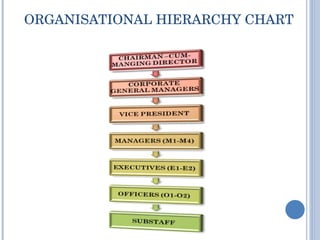
ORGANISATIONAL HIERARCHY CHART
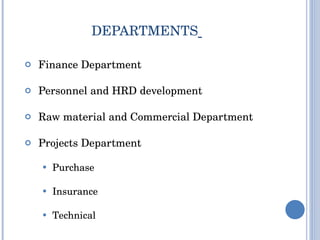
DEPARTMENTS   Finance Department Personnel and HRD development  Raw material and Commercial Department Projects Department Purchase Insurance Technical
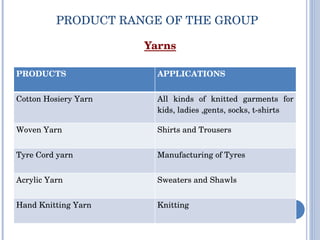
PRODUCT RANGE OF THE GROUP Yarns PRODUCTS APPLICATIONS Cotton Hosiery Yarn All kinds of knitted garments for kids, ladies ,gents, socks, t-shirts Woven Yarn Shirts and Trousers Tyre Cord yarn Manufacturing of Tyres Acrylic Yarn Sweaters and Shawls Hand Knitting Yarn Knitting
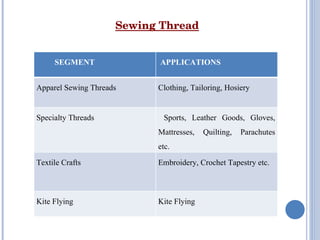
Sewing Thread SEGMENT APPLICATIONS Apparel Sewing Threads Clothing, Tailoring, Hosiery Specialty Threads Sports, Leather Goods, Gloves, Mattresses, Quilting, Parachutes etc. Textile Crafts Embroidery, Crochet Tapestry etc. Kite Flying Kite Flying
Fabrics Fibre Special steels
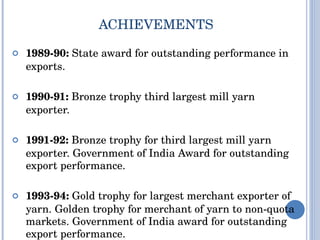
ACHIEVEMENTS 1989-90:  State award for outstanding performance in exports. 1990-91:  Bronze trophy third largest mill yarn exporter. 1991-92:  Bronze trophy for third largest mill yarn exporter. Government of India Award for outstanding export performance. 1993-94:  Gold trophy for largest merchant exporter of yarn. Golden trophy for merchant of yarn to non-quota markets. Government of India award for outstanding export performance.
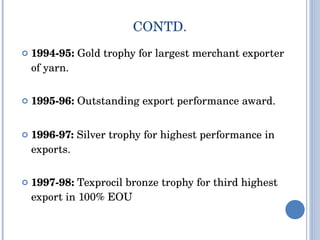
CONTD. 1994-95:  Gold trophy for largest merchant exporter of yarn. 1995-96:  Outstanding export performance award. 1996-97:  Silver trophy for highest performance in exports. 1997-98:  Texprocil bronze trophy for third highest export in 100% EOU
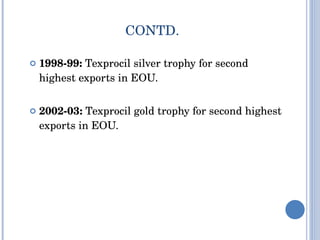
1998-99:  Texprocil silver trophy for second highest exports in EOU. 2002-03:  Texprocil gold trophy for second highest exports in EOU. CONTD.
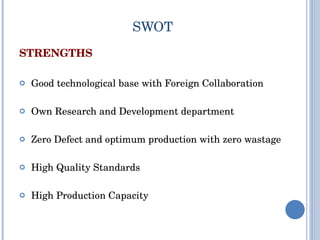
SWOT  STRENGTHS Good technological base with Foreign Collaboration Own Research and Development department Zero Defect and optimum production with zero wastage High Quality Standards High Production Capacity
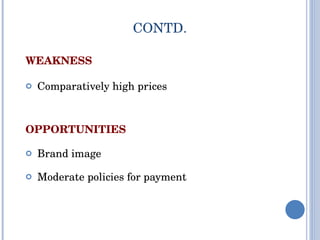
WEAKNESS Comparatively high prices OPPORTUNITIES Brand image  Moderate policies for payment CONTD.
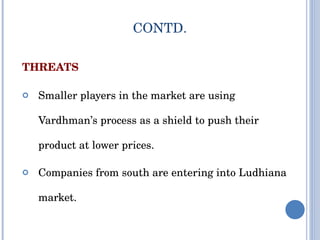
THREATS Smaller players in the market are using Vardhman’s process as a shield to push their product at lower prices. Companies from south are entering into Ludhiana market. CONTD.
FINANCIAL ANALYSIS
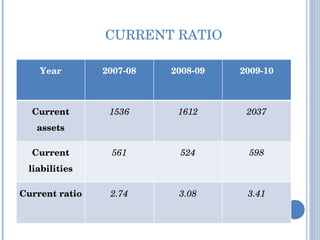
CURRENT RATIO Year 2007-08 2008-09 2009-10 Current assets 1536 1612 2037 Current liabilities 561 524 598 Current ratio 2.74 3.08 3.41
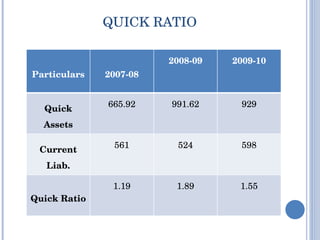
QUICK RATIO Particulars 2007-08 2008-09 2009-10 Quick Assets 665.92 991.62 929 Current Liab. 561 524 598 Quick Ratio 1.19 1.89 1.55
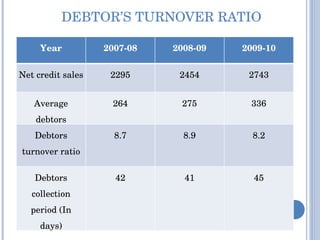
DEBTOR’S TURNOVER RATIO Year 2007-08 2008-09 2009-10 Net credit sales 2295 2454 2743 Average debtors 264 275 336 Debtors turnover ratio 8.7 8.9 8.2 Debtors collection period (In days) 42 41 45
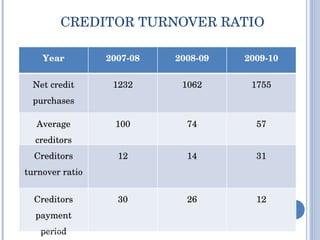
CREDITOR TURNOVER RATIO Year 2007-08 2008-09 2009-10 Net credit purchases 1232 1062 1755 Average creditors 100 74 57 Creditors turnover ratio 12 14 31 Creditors payment period 30 26 12
INTRODUCTION OF PROJECT
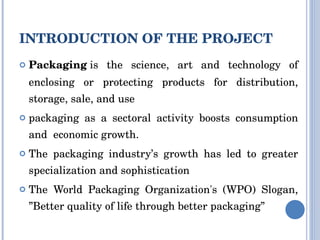
INTRODUCTION OF THE PROJECT Packaging  is the science, art and technology of enclosing or protecting products for distribution, storage, sale, and use packaging as a sectoral activity boosts consumption and  economic growth. The packaging industry’s growth has led to greater specialization and sophistication The World Packaging Organization's (WPO) Slogan, ”Better quality of life through better packaging”
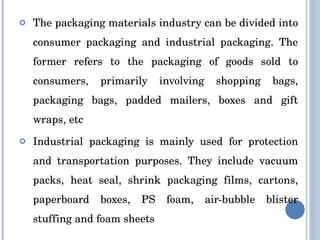
The packaging materials industry can be divided into consumer packaging and industrial packaging. The former refers to the packaging of goods sold to consumers, primarily involving shopping bags, packaging bags, padded mailers, boxes and gift wraps, etc Industrial packaging is mainly used for protection and transportation purposes. They include vacuum packs, heat seal, shrink packaging films, cartons, paperboard boxes, PS foam, air-bubble blister stuffing and foam sheets
INDIAN PACKAGING INDUSTRY MARKET The Indian  packaging  industry itself is growing at 14-15% annually. Indian  Packaging  industry is USD 14 billion and growing at more than 15% p.a.  These figures indicate towards a change in the industrial and consumer set up. However, the Indian fascination for rigid  packaging  remains intact.
More than 80% of the total  packaging  in India constitutes rigid  packaging , which is the oldest and the most conventional form of  packaging .  The remaining 20% comprises flexible  packaging . Laminated products including form-fill-seal pouches, laminated tubes and tetra packs are growing at around 30% p.a. There are about 600-700  packaging  machinery manufacturers, 95% of which are in the small and medium sector located all over India.
Germany and Italy are the latest suppliers of  packaging  machinery to India but focus is now shifting on Taiwan, Korea and China. Indian  packaging  machinery exports are rapidly growing. India's per capita  packaging  consumption is less than USD 15 against world wide average of nearly USD 100. The large growing middle class, liberalization and organized retail sector are the catalysts to growth in  packaging .
Food and Pharma  packaging  are the key driving segments. On the  packaging  machinery side, while a wide range is manufactured in India, the industry imports machinery, especially at the high end. Germany and Italy are the largest suppliers of  packaging  machinery to India but focus is now shifting on Taiwan and China. India’s imports at 20 & 25% of its total packing machinery import indicate further opportunities for Italian companies to explore.
PURPOSE OF PACKAGING Physical protection Barrier protection Containment Information transmission  Marketing  Security  Convenience 
PACKAGING DESIGN  Four basic purposes in distribution of goods from source to destination: Goods must be contained throughout the distribution process. Contents of the package must be protected from the hazards in distribution for safe arrival at destination. Packaging should assist in other ways to facilitate distribution and use of contents, including ease in handling, storage, transportation, and unpacking. The package must communicate required information, including contents, destination and any special handling warnings.
TRANSPORT PACKAGING  Designer should achieve following objectives during the design process:             Product protection from all distribution hazards Use of environmentally responsible materials and systems Minimizing shipping costs, effective use of space in transport vehicles Ease of handling and storage in distribution Efficient use of labor in packing Meeting customer needs
PACKAGING OF YARNS Yarn  is a long continuous length of interlocked  fibres , suitable for use in the production of textiles, sewing, crocheting, knitting, weaving, embroidery and  ropemaking Yarns P/C yarns Cotton yarns It mainly consists of 3 types of  packaging: Domestic packaging Export packaging Captive(Inhouse) packaging
RESEARCH METHODOLOGY
RESEARCH METHODOLOGY Systematic method consisting of: Enunciating the problem Formulating a hypothesis Collecting facts or data Analyzing facts  Reaching certain conclusion
Study on packaging of yarns TITLE
To assess the packaging of yarns of Vardhman with its competitors. Standardizing the packaging of yarns for Vardhman group OBJECTIVES
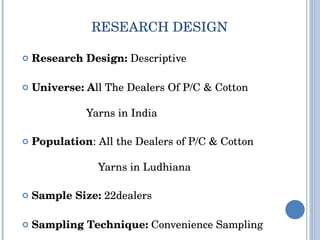
RESEARCH DESIGN Research Design:  Descriptive  Universe: A ll The Dealers Of P/C & Cotton  Yarns in India Population : All the Dealers of P/C & Cotton    Yarns in Ludhiana Sample Size:  22dealers Sampling Technique:  Convenience Sampling
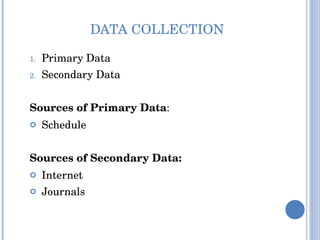
DATA COLLECTION Primary Data Secondary Data  Sources of Primary Data : Schedule Sources of Secondary Data: Internet Journals
ANALYSIS  AND INTERPRETATION
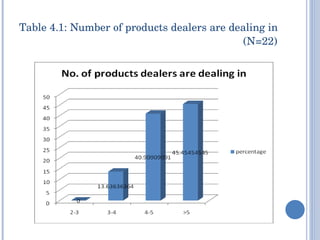
Table 4.1: Number of products dealers are dealing in  (N=22)
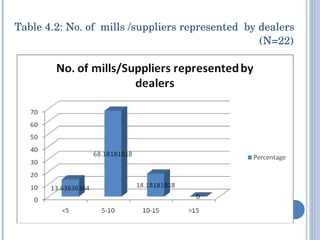
Table 4.2: No. of  mills /suppliers represented  by dealers    (N=22)
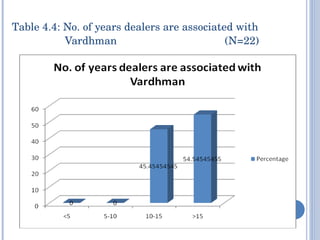
Table 4.4: No. of years dealers are associated with    Vardhman    (N=22)
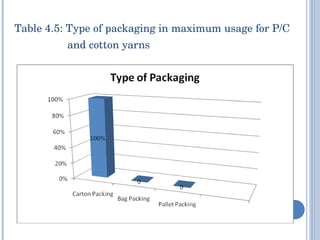
Table 4.5: Type of packaging in maximum usage for P/C    and cotton yarns
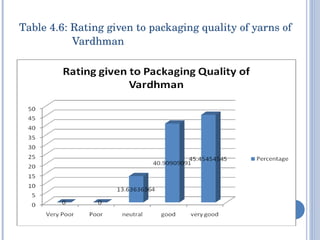
Table 4.6: Rating given to packaging quality of yarns of    Vardhman
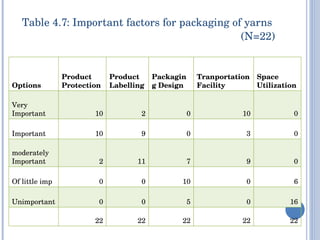
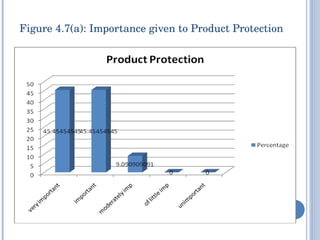
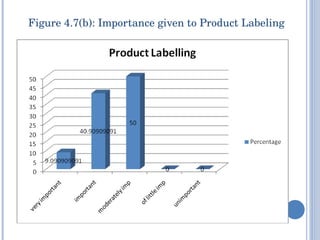
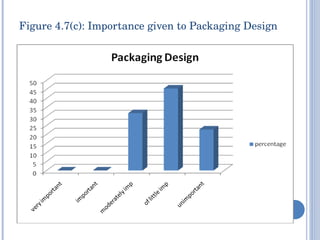
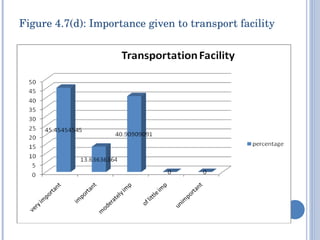
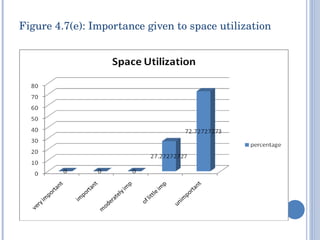
Table 4.7: Important factors for packaging of yarns    (N=22) 22 22 22 22 22 16 0 5 0 0 Unimportant 6 0 10 0 0 Of little imp 0 9 7 11 2 moderately Important 0 3 0 9 10 Important 0 10 0 2 10 Very Important Space Utilization Tranportation Facility Packaging Design Product Labelling Product Protection Options
Figure 4.7(a): Importance given to Product Protection
Figure 4.7(b): Importance given to Product Labeling
Figure 4.7(c): Importance given to Packaging Design
Figure 4.7(d): Importance given to transport facility
Figure 4.7(e): Importance given to space utilization
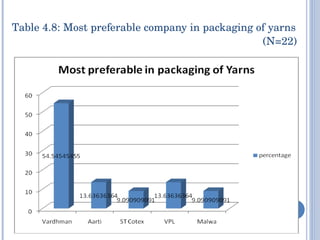
Table 4.8: Most preferable company in packaging of yarns    (N=22)
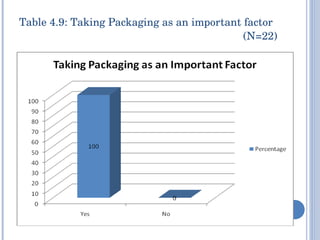
Table 4.9: Taking Packaging as an important factor  (N=22)
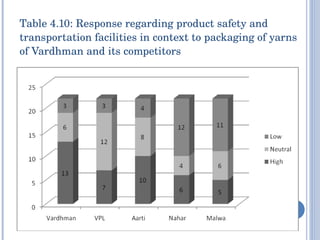
Table 4.10: Response regarding product safety and transportation facilities in context to packaging of yarns of Vardhman and its competitors
LIMITATIONS Scope of my study was limited to 22  dealers Time was a major limitation. Generally, the respondents were busy in their work so the reply given by them can be a result of hastiness. The study was conducted within the boundaries of Ludhiana only
BENEFITS OF STANDARDIZATION Strategic advantages and enhanced competitiveness Market access Brand building  and customer confidence Effective innovation Increased competitiveness Strategic tool for export oriented technologies Quality and reliability
BENEFITS FOR BUSINESS Cost Reduction through Standardization Strategic Significance of Standardization Standards and the Formation of Strategic Alliances
STANDARDISATION OF PACKAGING OF YARNS  Standards allow a company to: attract and assure customers demonstrate market leadership create competitive advantage develop and maintain best practice Standards are powerful marketing tool Standards are a respected badge of quality Standards within business


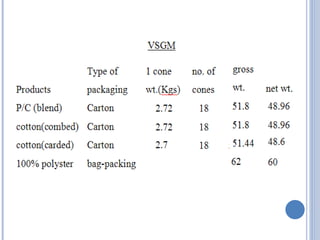
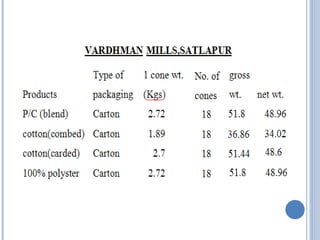
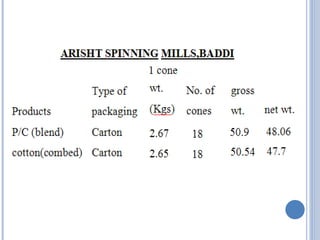
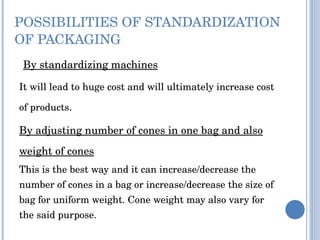
POSSIBILITIES OF STANDARDIZATION OF PACKAGING   By standardizing machines It will lead to huge cost and will ultimately increase cost of products . By adjusting number of cones in one bag and also weight of cones   This is the best way and it can increase/decrease the number of cones in a bag or increase/decrease the size of bag for uniform weight. Cone weight may also vary for the said purpose.
SUGGESTIONS & RECOMMENDATIONS To   use  Returnable packing Systems in Vardhman   General saving advantages of returnable packaging: Reduces total cost  Improves product protection Improves workers safety Improves housekeeping Improves space utilization Improves environmental impact
CONTD. Efforts on the behalf of the environment must be centered on minimizing the  impact of packaging during its use and to increases its  reusability. Aim must be to secure a place for Vardhman in a future sustainable society. Dealers  in the domestic market  must be made  aware of pallet packing due to its added advantages
SUGGESTION     On the basis of the analysis of the data collected from the project the following suggestions are given to company: Use more distribution network. Security of funds more than Brand name. Advertisement. Awareness. Scope for Private sector. Social well fare.

Deepika ppt

  • 1.
    SUMMER TRAINING AT VARDHMAN TEXTILE LTD Presented By: Deepika Singh MBA-2A
  • 2.
    INDIAN TEXTILE INDUSTRY Contributes: 14% to industrial production 17% to country’s export earnings Direct employment to over 35 million people around US$ 5.35 billion of foreign investment is expected to be made in India in the textile sector over the next five years. demand contraction in textiles from foreign countries in2009 source-annual report 2009-2010 0f ministry of textiles
  • 3.
    HISTORY Vardhman Group was founded in 1965 , by Late Lala Rattan Chand Oswal Capacity of 14,000 spindles In 1982, the Group entered into the sewing thread market 1999 the Group Vardhman Acrylics Ltd joint venture with Marubeni and Exlan of Japan
  • 4.
    CURRENT SCENARIO Turnoverof $700 mn. 8,00,000 spindles 65 tons per day yarn 100,000 tons special alloy steel per annum
  • 5.
    LISTED COMPANIES VardhmanTextiles Limited (formerly Mahavir Spinning Mills Limited) Vardhman Acrylics Limited Vardhman Holdings Limited1 (formerly Vardhman Spinning & General Mills Limited)
  • 6.
    UNLISTED COMPANIES VMTSpinning Company Limited Vardhman Threads Limited
  • 7.
    MISSION “ BEINGWORLD CLASS SPINNERS BY PROVIDING HIGHEST QUALITY PRODUCTS WITHIN MINIMUM COST”
  • 8.
  • 9.
    QUALITY POLICY Qualityshould be built into the company’s products not only to meet customer’s requirements continuously but also exceed them
  • 10.
  • 11.
    DEPARTMENTS Finance Department Personnel and HRD development  Raw material and Commercial Department Projects Department Purchase Insurance Technical
  • 12.
    PRODUCT RANGE OFTHE GROUP Yarns PRODUCTS APPLICATIONS Cotton Hosiery Yarn All kinds of knitted garments for kids, ladies ,gents, socks, t-shirts Woven Yarn Shirts and Trousers Tyre Cord yarn Manufacturing of Tyres Acrylic Yarn Sweaters and Shawls Hand Knitting Yarn Knitting
  • 13.
    Sewing Thread SEGMENTAPPLICATIONS Apparel Sewing Threads Clothing, Tailoring, Hosiery Specialty Threads Sports, Leather Goods, Gloves, Mattresses, Quilting, Parachutes etc. Textile Crafts Embroidery, Crochet Tapestry etc. Kite Flying Kite Flying
  • 14.
  • 15.
    ACHIEVEMENTS 1989-90: State award for outstanding performance in exports. 1990-91: Bronze trophy third largest mill yarn exporter. 1991-92: Bronze trophy for third largest mill yarn exporter. Government of India Award for outstanding export performance. 1993-94: Gold trophy for largest merchant exporter of yarn. Golden trophy for merchant of yarn to non-quota markets. Government of India award for outstanding export performance.
  • 16.
    CONTD. 1994-95: Gold trophy for largest merchant exporter of yarn. 1995-96: Outstanding export performance award. 1996-97: Silver trophy for highest performance in exports. 1997-98: Texprocil bronze trophy for third highest export in 100% EOU
  • 17.
    1998-99: Texprocilsilver trophy for second highest exports in EOU. 2002-03: Texprocil gold trophy for second highest exports in EOU. CONTD.
  • 18.
    SWOT STRENGTHSGood technological base with Foreign Collaboration Own Research and Development department Zero Defect and optimum production with zero wastage High Quality Standards High Production Capacity
  • 19.
    WEAKNESS Comparatively highprices OPPORTUNITIES Brand image Moderate policies for payment CONTD.
  • 20.
    THREATS Smaller playersin the market are using Vardhman’s process as a shield to push their product at lower prices. Companies from south are entering into Ludhiana market. CONTD.
  • 21.
  • 22.
    CURRENT RATIO Year2007-08 2008-09 2009-10 Current assets 1536 1612 2037 Current liabilities 561 524 598 Current ratio 2.74 3.08 3.41
  • 23.
    QUICK RATIO Particulars2007-08 2008-09 2009-10 Quick Assets 665.92 991.62 929 Current Liab. 561 524 598 Quick Ratio 1.19 1.89 1.55
  • 24.
    DEBTOR’S TURNOVER RATIOYear 2007-08 2008-09 2009-10 Net credit sales 2295 2454 2743 Average debtors 264 275 336 Debtors turnover ratio 8.7 8.9 8.2 Debtors collection period (In days) 42 41 45
  • 25.
    CREDITOR TURNOVER RATIOYear 2007-08 2008-09 2009-10 Net credit purchases 1232 1062 1755 Average creditors 100 74 57 Creditors turnover ratio 12 14 31 Creditors payment period 30 26 12
  • 26.
  • 27.
    INTRODUCTION OF THEPROJECT Packaging  is the science, art and technology of enclosing or protecting products for distribution, storage, sale, and use packaging as a sectoral activity boosts consumption and economic growth. The packaging industry’s growth has led to greater specialization and sophistication The World Packaging Organization's (WPO) Slogan, ”Better quality of life through better packaging”
  • 28.
    The packaging materialsindustry can be divided into consumer packaging and industrial packaging. The former refers to the packaging of goods sold to consumers, primarily involving shopping bags, packaging bags, padded mailers, boxes and gift wraps, etc Industrial packaging is mainly used for protection and transportation purposes. They include vacuum packs, heat seal, shrink packaging films, cartons, paperboard boxes, PS foam, air-bubble blister stuffing and foam sheets
  • 29.
    INDIAN PACKAGING INDUSTRY MARKET TheIndian  packaging  industry itself is growing at 14-15% annually. Indian  Packaging  industry is USD 14 billion and growing at more than 15% p.a. These figures indicate towards a change in the industrial and consumer set up. However, the Indian fascination for rigid  packaging  remains intact.

  • 30.
    More than 80%of the total  packaging  in India constitutes rigid  packaging , which is the oldest and the most conventional form of  packaging . The remaining 20% comprises flexible packaging . Laminated products including form-fill-seal pouches, laminated tubes and tetra packs are growing at around 30% p.a. There are about 600-700  packaging  machinery manufacturers, 95% of which are in the small and medium sector located all over India.
  • 31.
    Germany and Italyare the latest suppliers of  packaging  machinery to India but focus is now shifting on Taiwan, Korea and China. Indian  packaging  machinery exports are rapidly growing. India's per capita  packaging  consumption is less than USD 15 against world wide average of nearly USD 100. The large growing middle class, liberalization and organized retail sector are the catalysts to growth in  packaging .
  • 32.
    Food and Pharma packaging  are the key driving segments. On the  packaging  machinery side, while a wide range is manufactured in India, the industry imports machinery, especially at the high end. Germany and Italy are the largest suppliers of  packaging  machinery to India but focus is now shifting on Taiwan and China. India’s imports at 20 & 25% of its total packing machinery import indicate further opportunities for Italian companies to explore.
  • 33.
    PURPOSE OF PACKAGINGPhysical protection Barrier protection Containment Information transmission  Marketing  Security  Convenience 
  • 34.
    PACKAGING DESIGN Four basic purposes in distribution of goods from source to destination: Goods must be contained throughout the distribution process. Contents of the package must be protected from the hazards in distribution for safe arrival at destination. Packaging should assist in other ways to facilitate distribution and use of contents, including ease in handling, storage, transportation, and unpacking. The package must communicate required information, including contents, destination and any special handling warnings.
  • 35.
    TRANSPORT PACKAGING Designer should achieve following objectives during the design process:             Product protection from all distribution hazards Use of environmentally responsible materials and systems Minimizing shipping costs, effective use of space in transport vehicles Ease of handling and storage in distribution Efficient use of labor in packing Meeting customer needs
  • 36.
    PACKAGING OF YARNSYarn is a long continuous length of interlocked fibres , suitable for use in the production of textiles, sewing, crocheting, knitting, weaving, embroidery and ropemaking Yarns P/C yarns Cotton yarns It mainly consists of 3 types of packaging: Domestic packaging Export packaging Captive(Inhouse) packaging
  • 37.
  • 38.
    RESEARCH METHODOLOGY Systematicmethod consisting of: Enunciating the problem Formulating a hypothesis Collecting facts or data Analyzing facts Reaching certain conclusion
  • 39.
    Study on packagingof yarns TITLE
  • 40.
    To assess thepackaging of yarns of Vardhman with its competitors. Standardizing the packaging of yarns for Vardhman group OBJECTIVES
  • 41.
    RESEARCH DESIGN ResearchDesign: Descriptive Universe: A ll The Dealers Of P/C & Cotton Yarns in India Population : All the Dealers of P/C & Cotton Yarns in Ludhiana Sample Size: 22dealers Sampling Technique: Convenience Sampling
  • 42.
    DATA COLLECTION PrimaryData Secondary Data Sources of Primary Data : Schedule Sources of Secondary Data: Internet Journals
  • 43.
    ANALYSIS ANDINTERPRETATION
  • 44.
    Table 4.1: Numberof products dealers are dealing in (N=22)
  • 45.
    Table 4.2: No.of mills /suppliers represented by dealers (N=22)
  • 46.
    Table 4.4: No.of years dealers are associated with Vardhman (N=22)
  • 47.
    Table 4.5: Typeof packaging in maximum usage for P/C and cotton yarns
  • 48.
    Table 4.6: Ratinggiven to packaging quality of yarns of Vardhman
  • 49.
    Table 4.7: Importantfactors for packaging of yarns (N=22) 22 22 22 22 22 16 0 5 0 0 Unimportant 6 0 10 0 0 Of little imp 0 9 7 11 2 moderately Important 0 3 0 9 10 Important 0 10 0 2 10 Very Important Space Utilization Tranportation Facility Packaging Design Product Labelling Product Protection Options
  • 50.
    Figure 4.7(a): Importancegiven to Product Protection
  • 51.
    Figure 4.7(b): Importancegiven to Product Labeling
  • 52.
    Figure 4.7(c): Importancegiven to Packaging Design
  • 53.
    Figure 4.7(d): Importancegiven to transport facility
  • 54.
    Figure 4.7(e): Importancegiven to space utilization
  • 55.
    Table 4.8: Mostpreferable company in packaging of yarns (N=22)
  • 56.
    Table 4.9: TakingPackaging as an important factor (N=22)
  • 57.
    Table 4.10: Responseregarding product safety and transportation facilities in context to packaging of yarns of Vardhman and its competitors
  • 58.
    LIMITATIONS Scope ofmy study was limited to 22 dealers Time was a major limitation. Generally, the respondents were busy in their work so the reply given by them can be a result of hastiness. The study was conducted within the boundaries of Ludhiana only
  • 59.
    BENEFITS OF STANDARDIZATIONStrategic advantages and enhanced competitiveness Market access Brand building and customer confidence Effective innovation Increased competitiveness Strategic tool for export oriented technologies Quality and reliability
  • 60.
    BENEFITS FOR BUSINESSCost Reduction through Standardization Strategic Significance of Standardization Standards and the Formation of Strategic Alliances
  • 61.
    STANDARDISATION OF PACKAGINGOF YARNS Standards allow a company to: attract and assure customers demonstrate market leadership create competitive advantage develop and maintain best practice Standards are powerful marketing tool Standards are a respected badge of quality Standards within business
  • 62.
  • 63.
  • 64.
  • 65.
    POSSIBILITIES OF STANDARDIZATIONOF PACKAGING By standardizing machines It will lead to huge cost and will ultimately increase cost of products . By adjusting number of cones in one bag and also weight of cones This is the best way and it can increase/decrease the number of cones in a bag or increase/decrease the size of bag for uniform weight. Cone weight may also vary for the said purpose.
  • 66.
    SUGGESTIONS & RECOMMENDATIONSTo use  Returnable packing Systems in Vardhman   General saving advantages of returnable packaging: Reduces total cost  Improves product protection Improves workers safety Improves housekeeping Improves space utilization Improves environmental impact
  • 67.
    CONTD. Efforts onthe behalf of the environment must be centered on minimizing the impact of packaging during its use and to increases its reusability. Aim must be to secure a place for Vardhman in a future sustainable society. Dealers in the domestic market must be made aware of pallet packing due to its added advantages
  • 68.
    SUGGESTION   On the basis of the analysis of the data collected from the project the following suggestions are given to company: Use more distribution network. Security of funds more than Brand name. Advertisement. Awareness. Scope for Private sector. Social well fare.