© 2021 Deep Netts
Modern Machine Vision from
Basics to Advanced Deep
Learning
Zoran Sevarac
University Of Belgrade /
Deep Netts
© 2021 Deep Netts
What are you going to learn
• Machine learning basic ideas
• Deep learning, and what’s so special about it
• How to use deep learning for image classification
• Advanced deep learning models for object detection
2
Machine Learning Basics
© 2021 Deep Netts
What is Machine Learning?
• Type of computer algorithm that is capable
to automatically configure its internal parameters (learn)
by looking at a set of examples given as a data set,
in order to perform specific task on similar data with usable accuracy.
• Examples of what it can do :
• Learn to assign items to category - classification
• Learn relationship between variables,
in order to estimate a numeric value - regression
4
© 2021 Deep Netts
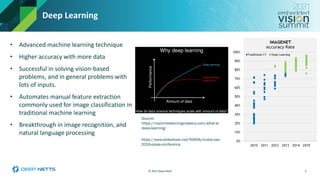
Deep Learning
• Advanced machine learning technique
• Higher accuracy with more data
• Successful in solving vision-based
problems, and in general problems with
lots of inputs.
• Automates manual feature extraction
commonly used for image classification in
traditional machine learning
• Breakthrough in image recognition, and
natural language processing
5
Source:
https://machinelearningmastery.com/what-is-
deep-learning/
https://www.slideshare.net/NVIDIA/nvidia-ces-
2016-press-conference
© 2021 Deep Netts
Shallow vs Deep Learning
https://www.frontiersin.org/articles/10.3389/fninf.2019.00053/full
6
https://www.linkedin.com/pulse/introduction-shallow-machine-learning-ayman-mahmoud/
Deep Learning / Neural Networks
© 2021 Deep Netts
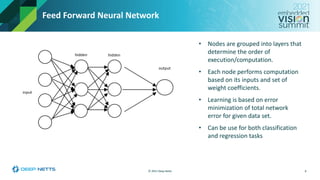
Feed Forward Neural Network
• Nodes are grouped into layers that
determine the order of
execution/computation.
• Each node performs computation
based on its inputs and set of
weight coefficients.
• Learning is based on error
minimization of total network
error for given data set.
• Can be use for both classification
and regression tasks
8
© 2021 Deep Netts
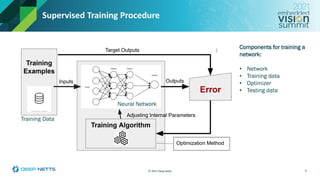
Supervised Training Procedure
9
Neural Network
Training Data
Components for training a
network:
• Network
• Training data
• Optimizer
• Testing data
© 2021 Deep Netts
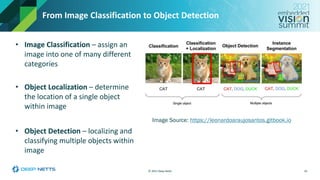
From Image Classification to Object Detection
• Image Classification – assign an
image into one of many different
categories
• Object Localization – determine
the location of a single object
within image
• Object Detection – localizing and
classifying multiple objects within
image
10
Image Source: https://leonardoaraujosantos.gitbook.io
© 2021 Deep Netts
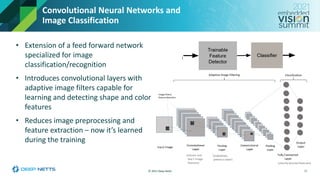
Convolutional Neural Networks and
Image Classification
• Extension of a feed forward network
specialized for image
classification/recognition
• Introduces convolutional layers with
adaptive image filters capable for
learning and detecting shape and color
features
• Reduces image preprocessing and
feature extraction – now it’s learned
during the training
11
© 2021 Deep Netts
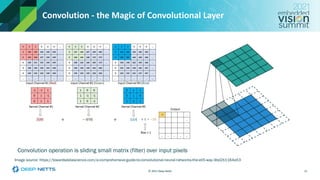
Convolution - the Magic of Convolutional Layer
12
Image source: https://towardsdatascience.com/a-comprehensive-guide-to-convolutional-neural-networks-the-eli5-way-3bd2b1164a53
Convolution operation is sliding small matrix (filter) over input pixels
© 2021 Deep Netts
Types of Layers in CNN
• Convolutional Layer – performs feature detection
• Max Pooling Layer – scales down input images
• Fully Connected Layer – performs classification
• Softmax Layer – estimates probability for categories
• Linear Layer – performs regression, estimates object position
• Dropout Layer – reduces overfitting
13
© 2021 Deep Netts
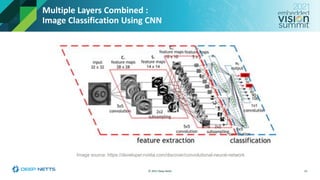
Multiple Layers Combined :
Image Classification Using CNN
14
Image source: https://developer.nvidia.com/discover/convolutional-neural-network
© 2021 Deep Netts
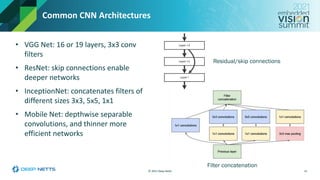
Common CNN Architectures
• VGG Net: 16 or 19 layers, 3x3 conv
filters
• ResNet: skip connections enable
deeper networks
• InceptionNet: concatenates filters of
different sizes 3x3, 5x5, 1x1
• Mobile Net: depthwise separable
convolutions, and thinner more
efficient networks
15
Residual/skip connections
Filter concatenation
© 2021 Deep Netts
Quick Overview of the
Evolution of Object Detection
• Convolutional Network for Object Detection
• Region-based Convolutional Neural Network (RCNN)
• Fast RCNN
• Faster RCNN
• You Look Only Once - YOLO
• Single Shot Detector – SSD
• Convolutional network for image classification +
Regression for determining the position
16
© 2021 Deep Netts
Region-based Convolutional Neural Network
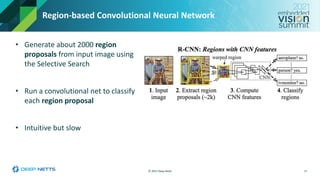
• Generate about 2000 region
proposals from input image using
the Selective Search
• Run a convolutional net to classify
each region proposal
• Intuitive but slow
17
© 2021 Deep Netts
Fast R-CNN
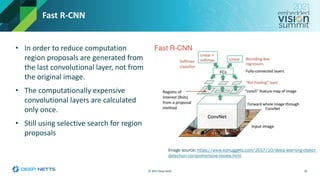
• In order to reduce computation
region proposals are generated from
the last convolutional layer, not from
the original image.
• The computationally expensive
convolutional layers are calculated
only once.
• Still using selective search for region
proposals
18
Image source: https://www.kdnuggets.com/2017/10/deep-learning-object-
detection-comprehensive-review.html
© 2021 Deep Netts
Faster RCNN
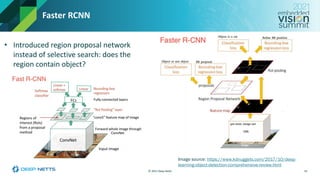
• Introduced region proposal network
instead of selective search: does the
region contain object?
19
Image source: https://www.kdnuggets.com/2017/10/deep-
learning-object-detection-comprehensive-review.html
© 2021 Deep Netts
YOLO – You Look Only Once
20
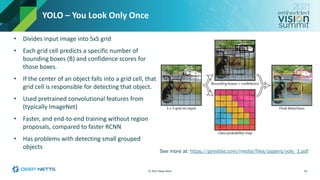
• Divides input image into SxS grid
• Each grid cell predicts a specific number of
bounding boxes (B) and confidence scores for
those boxes.
• If the center of an object falls into a grid cell, that
grid cell is responsible for detecting that object.
• Used pretrained convolutional features from
(typically ImageNet)
• Faster, and end-to-end training without region
proposals, compared to faster RCNN
• Has problems with detecting small grouped
objects
See more at: https://pjreddie.com/media/files/papers/yolo_1.pdf
© 2021 Deep Netts
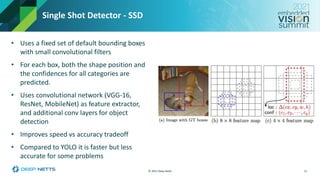
Single Shot Detector - SSD
21
• Uses a fixed set of default bounding boxes
with small convolutional filters
• For each box, both the shape position and
the confidences for all categories are
predicted.
• Uses convolutional network (VGG-16,
ResNet, MobileNet) as feature extractor,
and additional conv layers for object
detection
• Improves speed vs accuracy tradeoff
• Compared to YOLO it is faster but less
accurate for some problems
© 2021 Deep Netts
Summary
• Deep learning is enabling modern computer vision
• The fundamental models to do this are convolutional neural networks
• Image classification is basic computer vision
• Image classification can be extended to object detection
• Tensorflow provides various implementations and pretrained convolutional networks
that can be used for computer vision problems
22
© 2021 Deep Netts
About Deep Netts
• Deep Learning Made Easy for Non-Experts
• Deep Learning IDE and Java Library
• Free For Development
https://www.deepnetts.com/download
• Easy to use, integrate and maintain (lower cost)
• Good accuracy with less data
• No requirements for specialized hardware (GPU)
• Highly portable
23
© 2021 Deep Netts
Resources to get started
24
Deep Learning and image recognition book
https://leonardoaraujosantos.gitbook.io/artificial-
inteligence/machine_learning/deep_learning/object_localization_and_detection
Deep Learning for Object Detection: A Comprehensive Review https://www.kdnuggets.com/2017/10/deep-
learning-object-detection-comprehensive-review.html
Image classification with Convolutional Neural Network in Tensorflow
https://www.tensorflow.org/tutorials/images/cnn
Tensorflow Object Detection API
https://github.com/tensorflow/models/tree/master/research/object_detection

“Modern Machine Vision from Basics to Advanced Deep Learning,” a Presentation from Deep Netts

  • 1.
    © 2021 DeepNetts Modern Machine Vision from Basics to Advanced Deep Learning Zoran Sevarac University Of Belgrade / Deep Netts
  • 2.
    © 2021 DeepNetts What are you going to learn • Machine learning basic ideas • Deep learning, and what’s so special about it • How to use deep learning for image classification • Advanced deep learning models for object detection 2
  • 3.
  • 4.
    © 2021 DeepNetts What is Machine Learning? • Type of computer algorithm that is capable to automatically configure its internal parameters (learn) by looking at a set of examples given as a data set, in order to perform specific task on similar data with usable accuracy. • Examples of what it can do : • Learn to assign items to category - classification • Learn relationship between variables, in order to estimate a numeric value - regression 4
  • 5.
    © 2021 DeepNetts Deep Learning • Advanced machine learning technique • Higher accuracy with more data • Successful in solving vision-based problems, and in general problems with lots of inputs. • Automates manual feature extraction commonly used for image classification in traditional machine learning • Breakthrough in image recognition, and natural language processing 5 Source: https://machinelearningmastery.com/what-is- deep-learning/ https://www.slideshare.net/NVIDIA/nvidia-ces- 2016-press-conference
  • 6.
    © 2021 DeepNetts Shallow vs Deep Learning https://www.frontiersin.org/articles/10.3389/fninf.2019.00053/full 6 https://www.linkedin.com/pulse/introduction-shallow-machine-learning-ayman-mahmoud/
  • 7.
    Deep Learning /Neural Networks
  • 8.
    © 2021 DeepNetts Feed Forward Neural Network • Nodes are grouped into layers that determine the order of execution/computation. • Each node performs computation based on its inputs and set of weight coefficients. • Learning is based on error minimization of total network error for given data set. • Can be use for both classification and regression tasks 8
  • 9.
    © 2021 DeepNetts Supervised Training Procedure 9 Neural Network Training Data Components for training a network: • Network • Training data • Optimizer • Testing data
  • 10.
    © 2021 DeepNetts From Image Classification to Object Detection • Image Classification – assign an image into one of many different categories • Object Localization – determine the location of a single object within image • Object Detection – localizing and classifying multiple objects within image 10 Image Source: https://leonardoaraujosantos.gitbook.io
  • 11.
    © 2021 DeepNetts Convolutional Neural Networks and Image Classification • Extension of a feed forward network specialized for image classification/recognition • Introduces convolutional layers with adaptive image filters capable for learning and detecting shape and color features • Reduces image preprocessing and feature extraction – now it’s learned during the training 11
  • 12.
    © 2021 DeepNetts Convolution - the Magic of Convolutional Layer 12 Image source: https://towardsdatascience.com/a-comprehensive-guide-to-convolutional-neural-networks-the-eli5-way-3bd2b1164a53 Convolution operation is sliding small matrix (filter) over input pixels
  • 13.
    © 2021 DeepNetts Types of Layers in CNN • Convolutional Layer – performs feature detection • Max Pooling Layer – scales down input images • Fully Connected Layer – performs classification • Softmax Layer – estimates probability for categories • Linear Layer – performs regression, estimates object position • Dropout Layer – reduces overfitting 13
  • 14.
    © 2021 DeepNetts Multiple Layers Combined : Image Classification Using CNN 14 Image source: https://developer.nvidia.com/discover/convolutional-neural-network
  • 15.
    © 2021 DeepNetts Common CNN Architectures • VGG Net: 16 or 19 layers, 3x3 conv filters • ResNet: skip connections enable deeper networks • InceptionNet: concatenates filters of different sizes 3x3, 5x5, 1x1 • Mobile Net: depthwise separable convolutions, and thinner more efficient networks 15 Residual/skip connections Filter concatenation
  • 16.
    © 2021 DeepNetts Quick Overview of the Evolution of Object Detection • Convolutional Network for Object Detection • Region-based Convolutional Neural Network (RCNN) • Fast RCNN • Faster RCNN • You Look Only Once - YOLO • Single Shot Detector – SSD • Convolutional network for image classification + Regression for determining the position 16
  • 17.
    © 2021 DeepNetts Region-based Convolutional Neural Network • Generate about 2000 region proposals from input image using the Selective Search • Run a convolutional net to classify each region proposal • Intuitive but slow 17
  • 18.
    © 2021 DeepNetts Fast R-CNN • In order to reduce computation region proposals are generated from the last convolutional layer, not from the original image. • The computationally expensive convolutional layers are calculated only once. • Still using selective search for region proposals 18 Image source: https://www.kdnuggets.com/2017/10/deep-learning-object- detection-comprehensive-review.html
  • 19.
    © 2021 DeepNetts Faster RCNN • Introduced region proposal network instead of selective search: does the region contain object? 19 Image source: https://www.kdnuggets.com/2017/10/deep- learning-object-detection-comprehensive-review.html
  • 20.
    © 2021 DeepNetts YOLO – You Look Only Once 20 • Divides input image into SxS grid • Each grid cell predicts a specific number of bounding boxes (B) and confidence scores for those boxes. • If the center of an object falls into a grid cell, that grid cell is responsible for detecting that object. • Used pretrained convolutional features from (typically ImageNet) • Faster, and end-to-end training without region proposals, compared to faster RCNN • Has problems with detecting small grouped objects See more at: https://pjreddie.com/media/files/papers/yolo_1.pdf
  • 21.
    © 2021 DeepNetts Single Shot Detector - SSD 21 • Uses a fixed set of default bounding boxes with small convolutional filters • For each box, both the shape position and the confidences for all categories are predicted. • Uses convolutional network (VGG-16, ResNet, MobileNet) as feature extractor, and additional conv layers for object detection • Improves speed vs accuracy tradeoff • Compared to YOLO it is faster but less accurate for some problems
  • 22.
    © 2021 DeepNetts Summary • Deep learning is enabling modern computer vision • The fundamental models to do this are convolutional neural networks • Image classification is basic computer vision • Image classification can be extended to object detection • Tensorflow provides various implementations and pretrained convolutional networks that can be used for computer vision problems 22
  • 23.
    © 2021 DeepNetts About Deep Netts • Deep Learning Made Easy for Non-Experts • Deep Learning IDE and Java Library • Free For Development https://www.deepnetts.com/download • Easy to use, integrate and maintain (lower cost) • Good accuracy with less data • No requirements for specialized hardware (GPU) • Highly portable 23
  • 24.
    © 2021 DeepNetts Resources to get started 24 Deep Learning and image recognition book https://leonardoaraujosantos.gitbook.io/artificial- inteligence/machine_learning/deep_learning/object_localization_and_detection Deep Learning for Object Detection: A Comprehensive Review https://www.kdnuggets.com/2017/10/deep- learning-object-detection-comprehensive-review.html Image classification with Convolutional Neural Network in Tensorflow https://www.tensorflow.org/tutorials/images/cnn Tensorflow Object Detection API https://github.com/tensorflow/models/tree/master/research/object_detection