by
Bernard E. Richardson
Master Teacher|Art Educator|2022
©Bernard E. Richardson|2022
DECOUPAGE
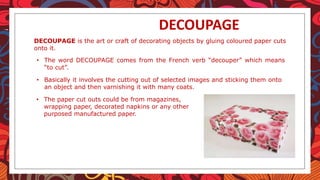
DECOUPAGE is the art or craft of decorating objects by gluing coloured paper cuts
onto it.
• The paper cut outs could be from magazines,
wrapping paper, decorated napkins or any other
purposed manufactured paper.
• The word DECOUPAGE comes from the French verb “decouper” which means
“to cut”.
• Basically it involves the cutting out of selected images and sticking them onto
an object and then varnishing it with many coats.
Decorating with DECOUPAGE
What items can be decorated using Découpage technique?
Almost anything can be decorated using Découpage. The most popular items include:
• Boxes – hat boxes, jewelry boxes, stationery boxes, storage boxes
• Vases and Pots
• Lamps – bases and shades
• Frames – picture, mirrors
• Furniture – tables, chest of drawers, cabinets
• Household items – trays, plates, bowls, etc
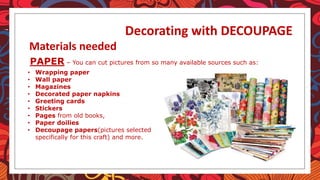
PAPER – You can cut pictures from so many available sources such as:
Materials needed
Decorating with DECOUPAGE
• Wrapping paper
• Wall paper
• Magazines
• Decorated paper napkins
• Greeting cards
• Stickers
• Pages from old books,
• Paper doilies
• Decoupage papers(pictures selected
specifically for this craft) and more.
Materials needed
SURFACE – Almost any surface can be used to create a
decoupage project. Suitable surfaces include
• wood,
• cardboard,
• papier mâché,
• terra cotta,
• tin
• and glass.
Decorating with DECOUPAGE
Materials needed
ACRYLIC PAINT - (Assorted colours) –
(optional) – Used as a base coat for the surface
being decorated.
GLUE - The best types to use are:
• Decoupage medium such as Mod Podge.
• PVA glue – regular glue which dries clear
and can be used to stick paper, fabric and
wood.
• Spray glue – easy to use and dries clear.
• Varnish – gloss varnish is best to prevent
cloudiness; matt varnish can be used for the
final coat.
Decorating with DECOUPAGE
• The surface to be worked on must be very smooth
Tools needed
Decorating with DECOUPAGE
• SCISSORS – for cutting out images.
• CRAFT KNIFE – to cut out detail and
intricate areas.
• BRUSHES – to apply the glue.
• SOFT SPONGE/CLOTH – to remove
excess glue.
Basic Decoupaging
• The surface to be worked on must be
very smooth, clean and dry.
• Use acrylic or flat emulsion paint to coat
the surface (this is optional).
STEP 1: SURFACE DECORATION
Decorating with DECOUPAGE
Basic Decoupaging
STEP 2: SURFACE DECORATION
• The surface can made into a decorative background
by using several finishes such as:
- Sponging - Dragging
SPONGING
• A simple technique done using paint in a sponge.
• Dip the sponge in the paint and dab all over the
surface to achieve a textured effect.
• More than one colour can be used. A darker colour
can be sponged onto a lighter background and vice
versa
Decorating with DECOUPAGE
Basic Decoupaging
SURFACE DECORATION
DRAGGING
• This technique uses an emulsion glaze.
• Dip the brush in the emulsion glaze and
‘drag’ it over the surface with the base
coat so that the base coat shows
through.
• Drag the glaze on in parallel lines to
created the texture.
• Depending on the effect desired, repeat
the process of dragging after the first
coat is dried
• The glaze dries fairly quickly.
Decorating with DECOUPAGE
How to make Emulsion glaze
• Mix an emulsion glaze using equal parts
of water based emulsion paint and white
(PVA) glue OR water-based varnish.
• Add about 2 to 4 parts of water and stir
well.
STEP 3: CUTTING OUT
Decorating with DECOUPAGE
• Take your picture source (magazine, napkins, wrapping
paper etc.) and cut out the pictures that will be used for
decorating the surface.
• Use a pair of scissors to cut out the pictures. Where
there is intricate details in the picture use an X-Acto or
utility cutting knife to cut out the pieces.
Before you add glue, arrange the pictures onto the surface you will be decoupaging
until you like the way they look. The pictures can be in any placement you like and
can also overlap.
Basic Decoupaging
STEP 4: GLUING CUT OUTS
Decorating with DECOUPAGE
• Choose the decoupage medium to use. Mod Podge is the most common one used.
If there is not Mod Podge, a mixture of slightly diluted White
glue may be created and used.
 Use a Foam brush or regular brush to spread the decoupage
medium or glue onto the object you will decoupage.
• Continue with the last two steps until all of your pictures are glued on.
 To stick the picture on, use your fingers to gently press down the picture
onto the decoupage medium. (For a large picture, start from the center
and work your way out) and gently press out any wrinkles and or excess
medium.
Basic Decoupaging
STEP 5: VARNISHING
Decorating with DECOUPAGE
Basic Decoupaging
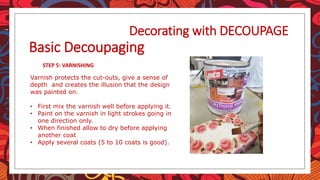
Varnish protects the cut-outs, give a sense of
depth and creates the illusion that the design
was painted on.
• First mix the varnish well before applying it.
• Paint on the varnish in light strokes going in
one direction only.
• When finished allow to dry before applying
another coat
• Apply several coats (5 to 10 coats is good).
Decorating with
DECOUPAGE
1. Tools & Materials
2. Applying base coat
paint
3. Cutting out 4. Applying Mod podge
5. Sticking cut outs in place
6. Applying a second coat of
Mod podge
RESOURCES
BOOKS
• Pryce, Maggie. (2000). New Crafts Decoupage. New York: Lorenz Books
INTERNET SOURCES
• Prima. 2022. Beginner’s guide to decoupage: get involved in the prettiest papercraft.
Available [Online]: https://www.prima.co.uk/craft/easy-craft-ideas/news/a21431/get-
started-decoupage/
THE END
©Bernard E. Richardson|2022

Decoupage

  • 1.
    by Bernard E. Richardson MasterTeacher|Art Educator|2022 ©Bernard E. Richardson|2022
  • 2.
    DECOUPAGE DECOUPAGE is theart or craft of decorating objects by gluing coloured paper cuts onto it. • The paper cut outs could be from magazines, wrapping paper, decorated napkins or any other purposed manufactured paper. • The word DECOUPAGE comes from the French verb “decouper” which means “to cut”. • Basically it involves the cutting out of selected images and sticking them onto an object and then varnishing it with many coats.
  • 3.
    Decorating with DECOUPAGE Whatitems can be decorated using Découpage technique? Almost anything can be decorated using Découpage. The most popular items include: • Boxes – hat boxes, jewelry boxes, stationery boxes, storage boxes • Vases and Pots • Lamps – bases and shades • Frames – picture, mirrors • Furniture – tables, chest of drawers, cabinets • Household items – trays, plates, bowls, etc
  • 4.
    PAPER – Youcan cut pictures from so many available sources such as: Materials needed Decorating with DECOUPAGE • Wrapping paper • Wall paper • Magazines • Decorated paper napkins • Greeting cards • Stickers • Pages from old books, • Paper doilies • Decoupage papers(pictures selected specifically for this craft) and more.
  • 5.
    Materials needed SURFACE –Almost any surface can be used to create a decoupage project. Suitable surfaces include • wood, • cardboard, • papier mâché, • terra cotta, • tin • and glass. Decorating with DECOUPAGE
  • 6.
    Materials needed ACRYLIC PAINT- (Assorted colours) – (optional) – Used as a base coat for the surface being decorated. GLUE - The best types to use are: • Decoupage medium such as Mod Podge. • PVA glue – regular glue which dries clear and can be used to stick paper, fabric and wood. • Spray glue – easy to use and dries clear. • Varnish – gloss varnish is best to prevent cloudiness; matt varnish can be used for the final coat. Decorating with DECOUPAGE
  • 7.
    • The surfaceto be worked on must be very smooth Tools needed Decorating with DECOUPAGE • SCISSORS – for cutting out images. • CRAFT KNIFE – to cut out detail and intricate areas. • BRUSHES – to apply the glue. • SOFT SPONGE/CLOTH – to remove excess glue.
  • 8.
    Basic Decoupaging • Thesurface to be worked on must be very smooth, clean and dry. • Use acrylic or flat emulsion paint to coat the surface (this is optional). STEP 1: SURFACE DECORATION Decorating with DECOUPAGE
  • 9.
    Basic Decoupaging STEP 2:SURFACE DECORATION • The surface can made into a decorative background by using several finishes such as: - Sponging - Dragging SPONGING • A simple technique done using paint in a sponge. • Dip the sponge in the paint and dab all over the surface to achieve a textured effect. • More than one colour can be used. A darker colour can be sponged onto a lighter background and vice versa Decorating with DECOUPAGE
  • 10.
    Basic Decoupaging SURFACE DECORATION DRAGGING •This technique uses an emulsion glaze. • Dip the brush in the emulsion glaze and ‘drag’ it over the surface with the base coat so that the base coat shows through. • Drag the glaze on in parallel lines to created the texture. • Depending on the effect desired, repeat the process of dragging after the first coat is dried • The glaze dries fairly quickly. Decorating with DECOUPAGE How to make Emulsion glaze • Mix an emulsion glaze using equal parts of water based emulsion paint and white (PVA) glue OR water-based varnish. • Add about 2 to 4 parts of water and stir well.
  • 11.
    STEP 3: CUTTINGOUT Decorating with DECOUPAGE • Take your picture source (magazine, napkins, wrapping paper etc.) and cut out the pictures that will be used for decorating the surface. • Use a pair of scissors to cut out the pictures. Where there is intricate details in the picture use an X-Acto or utility cutting knife to cut out the pieces. Before you add glue, arrange the pictures onto the surface you will be decoupaging until you like the way they look. The pictures can be in any placement you like and can also overlap. Basic Decoupaging
  • 12.
    STEP 4: GLUINGCUT OUTS Decorating with DECOUPAGE • Choose the decoupage medium to use. Mod Podge is the most common one used. If there is not Mod Podge, a mixture of slightly diluted White glue may be created and used.  Use a Foam brush or regular brush to spread the decoupage medium or glue onto the object you will decoupage. • Continue with the last two steps until all of your pictures are glued on.  To stick the picture on, use your fingers to gently press down the picture onto the decoupage medium. (For a large picture, start from the center and work your way out) and gently press out any wrinkles and or excess medium. Basic Decoupaging
  • 13.
    STEP 5: VARNISHING Decoratingwith DECOUPAGE Basic Decoupaging Varnish protects the cut-outs, give a sense of depth and creates the illusion that the design was painted on. • First mix the varnish well before applying it. • Paint on the varnish in light strokes going in one direction only. • When finished allow to dry before applying another coat • Apply several coats (5 to 10 coats is good).
  • 14.
    Decorating with DECOUPAGE 1. Tools& Materials 2. Applying base coat paint 3. Cutting out 4. Applying Mod podge 5. Sticking cut outs in place 6. Applying a second coat of Mod podge
  • 16.
    RESOURCES BOOKS • Pryce, Maggie.(2000). New Crafts Decoupage. New York: Lorenz Books INTERNET SOURCES • Prima. 2022. Beginner’s guide to decoupage: get involved in the prettiest papercraft. Available [Online]: https://www.prima.co.uk/craft/easy-craft-ideas/news/a21431/get- started-decoupage/
  • 17.
    THE END ©Bernard E.Richardson|2022