Decolonization And World Peace Brian Urquhart
download
https://ebookbell.com/product/decolonization-and-world-peace-
brian-urquhart-51925870
Explore and download more ebooks at ebookbell.com
Here are some recommended products that we believe you will be
interested in. You can click the link to download.
The Discovery Of The Third World Decolonization And The Rise Of The
New Left In France C19501976 Illustrated Christoph Kalter
https://ebookbell.com/product/the-discovery-of-the-third-world-
decolonization-and-the-rise-of-the-new-left-in-
france-c19501976-illustrated-christoph-kalter-33122272
The World Refugees Made Decolonization And The Foundation Of Postwar
Italy Pamela Ballinger
https://ebookbell.com/product/the-world-refugees-made-decolonization-
and-the-foundation-of-postwar-italy-pamela-ballinger-51940364
The World Refugees Made Decolonization And The Foundation Of Postwar
Italy Pamela Ballinger
https://ebookbell.com/product/the-world-refugees-made-decolonization-
and-the-foundation-of-postwar-italy-pamela-ballinger-19050752
Students Of The World Global 1968 And Decolonization In The Congo
Pedro Monaville
https://ebookbell.com/product/students-of-the-world-global-1968-and-
decolonization-in-the-congo-pedro-monaville-51887434
War Veterans And The World After 1945 Cold War Politics Decolonization
Memory Ngel Alcalde
https://ebookbell.com/product/war-veterans-and-the-world-
after-1945-cold-war-politics-decolonization-memory-ngel-
alcalde-52857842
The End Of Empires And A World Remade A Global History Of
Decolonization 1st Edition Martin Thomas
https://ebookbell.com/product/the-end-of-empires-and-a-world-remade-a-
global-history-of-decolonization-1st-edition-martin-thomas-54885964
Portuguese Decolonization In The Indian Ocean World History And
Ethnography Pamila Gupta
https://ebookbell.com/product/portuguese-decolonization-in-the-indian-
ocean-world-history-and-ethnography-pamila-gupta-50225658
Argument And Change In World Politics Ethics Decolonization And
Humanitarian Intervention Neta C Crawford
https://ebookbell.com/product/argument-and-change-in-world-politics-
ethics-decolonization-and-humanitarian-intervention-neta-c-
crawford-1739524
Mecca Of Revolution Algeria Decolonization And The Third World Order
1st Edition Jeffrey James Byrne
https://ebookbell.com/product/mecca-of-revolution-algeria-
decolonization-and-the-third-world-order-1st-edition-jeffrey-james-
byrne-5422644
Decolonization and World Peace
A volume in the
Tom Slick World Peace Series
Lyndon B. Johnson School of Public Affairs
DECOLONIZATION
AND WORLD PEACE
by Brian Urquhart
UNIVERSITY OF TEXAS PRESS, AUSTIN
Copyright © 1989
by the University of Texas System Board of Regents
All rights reserved
Printed in the United States of America
First edition, 1989
Requests for permission to reproduce material from this
work should be sent to:
Permissions
University of Texas Press
Box 7819
Austin, Texas 78713-7819
Library of Congress Cataloging-in-Publication Data
Urquhart, Brian.
Decolonization and world peace/by Brian Urquhart.—
1st ed.
p. cm.—(Tom Slick world peace series)
ISBN 0-292-73853-6 (alk. paper).—ISBN 0-292-71559-5
(pbk.: alk. paper)
1. World politics—1945- 2. Decolonization. I. Title.
II. Series.
D843.U77 1989
909.82—dc20 89-4865
CIP
® The paper used in this publication meets the minimum
requirements of American National Standard for Informa-
tion Sciences—Permanence of Paper for Printed Library
Materials, ANSI Z39.48-1984.
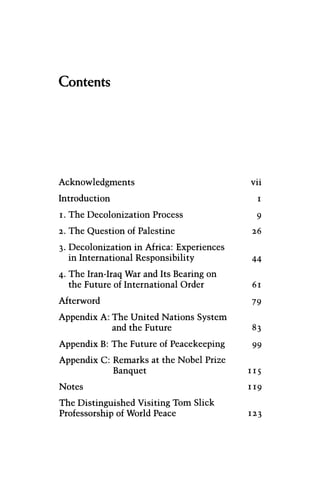
Contents
Acknowledgments vii
Introduction 1
1. The Decolonization Process 9
2. The Question of Palestine 26
3. Decolonization in Africa: Experiences
in International Responsibility 44
4. The Iran-Iraq War and Its Bearing on
the Future of International Order 61
Afterword 79
Appendix A: The United Nations System
and the Future 83
Appendix B: The Future of Peacekeeping 99
Appendix C: Remarks at the Nobel Prize
Banquet 115
Notes 119
The Distinguished Visiting Tom Slick
Professorship of World Peace 123
THIS PAGE INTENTIONALLY LEFT BLANK
Acknowledgments
I am deeply grateful to the Tom Slick Memorial
Fund for making it possible for me to give this se-
ries of lectures at the University of Texas. In par-
ticular I wish to thank Dean Max Sherman of the
LBJ School for making the arrangements and the
schedule. I greatly appreciate the encouragement
and advice I received from him and from former
Associate Dean Dagmar Hamilton.
I had the great good fortune, in parallel with my
lectures, to share a seminar in the LBJ School with
Professor Roger Louis. This was, for me at any
rate, a memorable experience which allowed me
to enjoy at first hand the superb quality and char-
acter both of faculty and of students at the Univer-
sity of Texas. I am also grateful to my friend Pro-
fessor Standish Meacham for his help and support.
Susan Roush was an invaluable guide and helper.
Her capacity for cheerfully solving all problems
and answering all questions added greatly to the
pleasure of my all-too-brief time at the University
of Texas.
viii Acknowledgments
Finally, I wish to express my appreciation to
President Franklin A. Thomas of the Ford Founda-
tion, at which I am a scholar-in-residence, for pro-
viding me with the base and the facilities for my
present activities.
Decolonization and World Peace
THIS PAGE INTENTIONALLY LEFT BLANK
Introduction
At its beginning in 1945, the United Nations had
50 member states. It was an organization that still
reflected a world of empires and colonial systems
and the interests of that world. Its concerns were
peace in Europe and Asia, clearing up the debris of
World War II, and the collective management, un-
der the leadership of the great powers of the day, of
threats to the peace or acts of aggression such
as those which had given rise to that war. There
was little anticipation of the fact that the nature
and composition of the international community
was about to undergo a radical change. Now, at
the end of 1988, the United Nations has 159 mem-
ber states.
The United States, the twentieth century's lead-
ing pioneer in the development of international
institutions, was, in 1945, unique among the great
powers that were the permanent members of the
United Nations Security Council. It was not only
by far the richest and most powerful nation in the
world. It had itself broken away from colonial
domination less than two hundred years before.
The United States had a view of the world very
2 Introduction
different from that of the other great powers in the
Security Council.
This American view of the world was to domi-
nate the postwar international scene and to have a
radical effect both on reconstruction and on the
development of the United Nations—with results
not all clearly foreseen by the government of the
United States itself. Over forty years later the leg-
acy of this world view—an international com-
munity of more than 160 sovereign, independent
states, of which a large majority are in the non-
aligned or so-called Third World—has hitherto
often been a matter more for concern and anxiety
than for rejoicing in Washington.
Of the basic concepts underlying both the League
of Nations and the United Nations, none was so
highly valued by the United States, or indeed was
so particularly American, as the principle of self-
determination. Only partially applied in 1919 as a
criterion for the disposal of the territories of van-
quished empires, in 1945 the principle of self-
determination was considered to be applicable to
all colonial possessions. The hope that the pro-
cess of decolonization would be gradual, system-
atic and orderly, was soon swept away by a "wind
of change" which quickly developed an irresist-
ible force of its own. The process of decoloniza-
tion was virtually completed within thirty years
under an initial impetus from the United States'
conviction that decolonization was a logical ex-
tension of allied war aims.
The old order—the hegemony of a few great
empires—was thus dissolved. According to the
United Nations Charter, the new order that was
Introduction 3
to replace it was a world of sovereign, independent
states working together in a system of collective
security and responsibility centered in the United
Nations. This order was to be supervised, and if
necessary enforced, by the leading victors of World
War II, the five permanent members of the United
Nations Security Council. The Charter, however,
having been written well before rapid decoloniza-
tion began, took little account of the effect of a
vastly expanded membership both on the stately
procedures outlined in the Charter and on the au-
tomatic Western voting majority, which was taken
for granted as the natural order in the United Na-
tions in its early years.
The 1945 vision of peace through the United Na-
tions was soon rudely shaken. The onset of East-
West ideological conflict, or Cold War, quickly
paralyzed the capacity of the new world organiza-
tion to maintain the peace and to provide the com-
prehensive security system that might also have
made progressive disarmament possible. The revo-
lution of decolonization therefore took place in a
near-vacuum of international authority. Newly
independent nations, looking to the Security Coun-
cil in vain for security, increasingly tended to arm
themselves and, if necessary, to go it alone in mili-
tary ventures that usually ended in disaster. There
was also a growing temptation to play one super-
power off against the other.
Since 1945 the majority of wars, claiming an es-
timated eighteen million, mostly civilian, casu-
alties, have been fought in the developing world
with weapons provided by the industrialized capi-
talist and socialist worlds. The chaos of war and
4 Introduction
the burden of arms buying have had a disastrous
impact on the capacity of many newly indepen-
dent countries to come to grips with the tasks of
development and growth which their new inde-
pendent status urgently demanded.
Decolonization and its repercussions have had a
major impact on the effort to evolve a system of
international order. In the early years, for example,
the United States and its Western allies were con-
fronted with frequent Soviet vetoes in the Secu-
rity Council. They therefore devised the so-called
Acheson Plan or "Uniting for Peace" Resolution,
which set up a Collective Measures Committee
and Peace Observation Commission independent
of the Security Council. This plan also sidestepped
the Charter by permitting questions blocked by
a veto in the Security Council to be transferred
by majority vote to the General Assembly, where
there was no veto and where the United States
controlled an unquestioned automatic majority.
As decolonization picked up speed in the late
1950s, that majority became less reliable. The vote
in 1971 to seat the People's Republic of China, a
decision which the United States had successfully
blocked for twenty-one years, marked dramati-
cally the end of the automatic US majority. The
newly independent countries, their sights fixed on
economic development and on the completion of
decolonization, could not be relied on or manipu-
lated on a number of important issues. The United
States and the West thus became disillusioned
with the once-favored General Assembly, reverted
to the Security Council, and began in their turn to
use the veto as a defense against the majority.
Random documents with unrelated
content Scribd suggests to you:
applause of a crowd. Rosselin was so used to being all alone himself
so many a year, that he could not measure the loneliness of a girl
who has no mother to weep with her, no sister to laugh with her, no
lover to kiss the dewy roses of her lips. He forgot that when he
spoke to her of fame and of art, all her young life called out in her,
'Ah—where is love?'
He stayed until late in the evening, bringing to bear on her all the
arguments and all the persuasions of which his fertile memory and
eloquent tongue could arm him; but he failed to pierce the secret of
the change in her, and he abandoned in despair the effort to form
her steps to Amyôt. He left her in anger and in reproach in the soft
vapours of a sweet night of early spring, fragrant with the scent of
opening fruit blossoms and of violets growing under the low dark
clouds of rain. He was alarmed, afraid, and full of impotent anger
and of unsatisfied wonder.
'Who has been with her? What has she heard?' he asked himself in
vain, as he walked through the cold shadowy sweet-scented fields.
His own heart was heavy with anxiety and disappointment. She was
the last ambition of his life. For her his own youth, his own genius
had seemed to live afresh, and ally themselves with the awaking
forces of a coming time.
What some men feel in their children's promise he felt in hers.
He recognised in her the existence of great gifts, of uncommon
powers, which would move the minds and the hearts of nations.
That such things should be wrecked because the mere common
useless sorrow of a human love held her soul captive and made her
mouth dumb, seemed to the great artist the cruellest irony of fate,
the crowning anomaly of all gods' grim jests.
Was Love ever, he thought bitterly, any better thing than the satire
of success, the curse of genius, the ruin of imagination and of art?
CHAPTER L.
Damaris remained unmoved by the departure of her old friend—
almost unconscious of it. His words had drifted by her ear, bringing
little meaning, and no conviction. He spoke as an artist, as a man, as
experience and the world suggested to him; but his arguments could
avail nothing against the instincts of her own heart and the horror
which the charges and the offer of Blanche de Laon had left upon
the ignorance and innocence of her mind. What would have been as
nothing to one who had dwelt in the world, to which evil is familiar
and disgrace immaterial if of profit, was of an overwhelming disgust
and terror to a child whose brain was nurtured on the high unworldly
chivalries of the great poets, and who had dwelt in a solitude of
imaginative meditation amongst the solitudes of nature, amongst the
simple and noble lessons of 'the world as it is God's.'
She passed the whole day in a kind of trance. She ate nothing; she
drank water thirstily. She scarcely replied to the questions of the
woman of the house. The night went by, bringing her no sleep, no
dreams; she was in that kind of agony which nothing except youth,
in all its exaggeration, its magnificent follies, and its pathetic
ignorance, can suffer. At daybreak she went out with her
companions, the dogs, and roamed half unconsciously and quite
aimlessly over the pastures which in the days of Port Royal had been
trodden by so many restless feet, along the margin of the little
stream which had heard the sigh of so many a world-wearied heart.
The morning was clear and cold and very still. Far away where Paris
lay there was a dusky, heavy cloud. By noon her mind was made up.
A great and heroic impulse came upon her, born out of the
innocence of her soul and the infinitude of her gratitude.
With its instinct of self-negation and noble efforts moving
impetuously in her as the warm sap moves in the young vines, she
took no time to reflect, sought no word of counsel. She covered
herself in her great red-lined cloak, and took her well-known way
once more across the pastures, bidding the woman of the house
keep the dogs within.
The movement of walking, the coolness of the wind, the scent of air
full of all the promise of the spring, renewed the health and youth in
her, gave her courage and exaltation and force. Her dual nature,
with its homely rustic strength and its patrician pride, its peasant's
stubbornness and its poet's illusions, moved her by dual motives,
dual instincts, on the path she took. To do something for him,
however slight, to try and move for him that only soul which had the
power to please his own, to prove that she was not vile or mean or
basely counting on personal gains or personal glories—this seemed
the only thing that life had left her to do.
All her innocent ambitions were dead; the career of which she had
dreamed with delight now seemed to her only loathsome. Rosselin
had said aright: she was half a child and half a poet, and with the
rude primitive faiths of a peasant she had the unworldly and unreal
imaginations of a student of imaginative things. All the stubbornness
and the simplicity of rustic life, and all the idealisation and unwisdom
of a romantic mind were blended in her; and to both of these the
accusations and the invitations of Blanche de Laon seemed as
hideous as crime. The world could hold no laurels and no treasures
she would ever care for now. Were she to reach fame what would
the world think? Only that, as that woman had said, she had loved
him and had used him to make of him a ladder of gold to a throne of
power.
He himself, even, would think so.
He himself might come one day to believe her sorrows and her
hunger, her sickness and her loneliness, all parts of some mere
drama studied and played to touch his pity and to win his aid.
The thought was sickening to her: sooner than let such suspicion lie
on her, she felt that she would seek death as Yseulte de Valogne had
sought it. They would believe then, she thought.
She walked on over the fields, past the grazing sheep, and along the
stream where Pascal had mused and Racine dreamed; and with the
rapid resolute movements of a mind strung up to some great action
and committed to some course accepted past recall, she reached the
station of Trappes and took her way to Paris.
She had gone on that road so many a time with Rosselin that it
seemed to her she could have gone blindfolded along it.
She sat motionless and unconscious of anything around her as the
train went on to Paris; her clothes were dark, her face was covered.
She reached the Boulevard Montparnasse and mingled unnoticed
with the crowd, though twice or thrice men looked after her,
attracted by the supple elastic freedom of her walk, which had in it
all the ease and vigour of movement which had come to her in those
happy days of childhood when she had raced over the sands with
the goats, and leaped from rock to rock, and sprung into the waves
with headlong joyous greeting of the sea as her best comrade.
She remained an open-air creature, a daughter of the winds and the
waters, of the sun and the dew; and all the exigencies of life in the
streets and the constraint of movement in a city could not take from
her that liberty of movement, as of the circling sea-gull, as of the
cloud-born swallow.
She took her way straight to the house of Othmar, to the house
which had sheltered her in her sickness and need. Many times as
she had been in Paris she had never seen its portals since she had
been carried through them to go to Les Hameaux. It stood before
her now in the sunshine; the vast pile behind its gates and rails of
gilded bronze, which Stefan Othmar had purchased in the days of
Louis Philippe from a great noble, compromised and exiled for the
Duchesse de Berri. The Suisse in his gorgeous uniform was standing
in the grand entrance; liveried servants were going to and fro,
through the archways of the courtyard there was a glimpse of the
green gardens and the shining fountains. The sight of it all gave her
a strange sense of her own utter distance from him.
She remembered how she had said to him, 'Is this house hers?' and
how he had answered, 'Surely, my dear, what is mine is hers,' and of
how then she had longed to rise and go out, homeless and
friendless as she was, and die in the streets rather than stay under
that roof. Standing there now, a lonely, dusty, obscure figure before
that lordly palace, she suddenly realised how utterly apart she was
from him, how eternally she would be nothing in his life. She had
been sheltered there for a few weeks in charity, that was all. He was
the whole world to her, but she was no more than a passing
compassion to him. All the pomp and pageantry and power of his
material existence oppressed her, symbolised as it was in this great
palace, with its hurrying servants, its liveried guards, its waiting
equipages, its stately gardens: whilst the knowledge she had of the
thwarted affections, and emptiness of heart, and vain desires, which
haunted him, master of so much though he was, filled her with an
agony of longing to be able to give him that simple herb of sweet
content which will so rarely blossom in the gardens of the great, in
the orchid houses of the rich man.
She stood in the sunlight which shone and glittered on the gilded
gates, a dark and lonely figure so motionless and still that the
concierge spoke to her roughly, bidding her not stand so near. At
that moment through the gateways there came the Russian
equipage of the mistress of the house; the three black horses were
rearing and plunging, their silver chains glistening, their bells
chiming; amongst the cushions of the carriage Nadine reclined. Her
face was very pale, her expression very cold; she was about to pay
her ceremonious visit of welcome to the Princess Lobow
Gregorievna.
Full of the purpose which had driven her thither, and not wholly
conscious of what she did, Damaris stretched her hands out and
caught at the sable skins of the carriage rug as the wheels passed
her.
'Wait—wait!' she cried stupidly. The horses dashed onward. Nadine
threw her a silver piece, seeing only a supplicant figure between her
and the light.
One of the men in the gateways picked up the coin and tendered it
to her. She repulsed it with a gesture.
'When can one see her?' she asked in a low tone.
The servant stared. 'See her? Why never, unless you know her and
she sends for you;' then, being good-natured, he added, 'what is it
for?—all petitions go to the secretaries.'
'I want nothing of her,' said Damaris. 'I want to speak to her.'
'Then you will wait for a century,' said the young man, and looking
at her he thought, 'I think it is the girl who was here last summer. I
heard that they had made an actress of her, and that Othmar kept
her somewhere out Versailles way. What can she be doing on the
streets?'
Then, being of a mischievous humour, and deeming that it would be
good sport to bring about any scene which would be disagreeable or
embarrassing to the master whose bread he ate and whose livery he
wore, the fellow added, as if in simple good nature, 'you could get
speech with either of them more readily at Amyôt: they go down
there in a day or two for Easter; they have some royal people.'
Damaris did not answer him; she turned away with one long look at
the house which had sheltered her in her homelessness and misery.
Was the master of it there, she wondered? She did not ask. She did
not dare. After what Blanche de Laon had said to her, she shrank
from the thought of meeting his eyes.
She went wearily from the gates as she had come to them; her
purpose was baffled, but not beaten. The vague impulse which had
taken her there, had been only strengthened by momentary defeat;
the momentary vision of his wife's face had made her the more
passionately long to clear herself from disgrace in those cold eyes.
She remembered a garden-door in the garden wall opening out into
a bye-street: when she had been carried out under the trees in her
convalescence, she had seen gardeners go to and fro through it, and
dogs run in and out when it stood ajar; she turned away into the
quietude of this little side street, and walked beneath the garden
wall until she came to the little entrance which had been a postern-
gate in older Paris days. It was standing open as she had so often
seen it, the gay branches of budding lilac and laburnum showing
through it. She passed in unseen, and waited under the shadow of
the boughs.
The gardens were as still as though they were the gardens of
Amyôt; the peacocks swept with stately measured tread across the
lawns, the fountains were rising and falling under the deep green
shade of groves of yew and alleys of cedar. It was three in the
afternoon, the shadows were long, the silence was complete. She
sat down on a rustic bench, and waited; for what she scarcely knew.
But the purpose in her was too deeply rooted in her heart to let her
go thence with its errand undone.
She could see the marble terrace, and the rose-coloured awnings of
the western front of the great hotel, she could see the banks of
flowers which glowed against its steps, the white statues which rose
out of the evergreen foliage around them; the massive pile of the
building itself was, from the garden-side, almost hidden in trees.
She saw two young children come out gaily, and laughing, their
shining hair floating behind them in the light, they mounted two
small ponies and rode away with their attendants beside them, out
of the great garden gates. She watched them with a strange
suffering at her heart.
They were the children of the woman whom he had loved so much.
She remained hidden in the little ivy-grown hut, watching the house.
No one came near her; only some birds flew near and pecked at the
ivy-berries. When several hours had gone by, she heard the carriage
roll into the courtyard; she imagined that the mistress of the house
had returned. Long suspense, long fasting, for she had taken
scarcely any food since very early in the previous day, the exaltation
of a purpose romantic to folly, but unselfish to sublimity, all these
had made her nerves strung to high tension, her mind little capable
of separating the wise from the unwise, the possible from the
impossible, in the strange act which she meditated.
But oftentimes, in moments of irresponsible excitement, the will can
accomplish what in calm moments of reflection would seem utterly
beyond its powers.
She waited yet awhile longer, till the gardens grew dark, then
without hesitation she crossed the lawn, and ascended the terrace
steps. To the servants waiting there she said simply:
'I come to see the Countess Othmar. Say that I am here—Damaris
Bérarde.'
The men hesitated; but some amongst them recognised her, and
were moved by the instinct to do mischief with impunity, which is so
characteristic of their class.
'It is the girl from Chevreuse, the girl who was here last summer,'
said one idle lounger to another, then they laughed a little together
in low tones; and she heard one say, 'It is a pity Othmar is still at
Ferrières!'
Then one of them indolently showed her a staircase.
'Go up there,' he said to her. 'My lady's apartments are to the right.
You will find her women.'
The man added in a whisper to one of his fellows: 'She came in
through the gardens, we can swear that we never saw her enter if
any mischief come of it;' and they watched her with languid curiosity
as her dark figure passed up the lighted staircase, with its blue
velvet carpets, its bronze caryatides, its great Japanese vases filled
with azaleas, its arched recesses filled with palms and statues.
Presently she came to a wide landing place, where corridors
branched off from side to side; it was lighted also, and here also its
masses of blossom, its green fronds of ferns and palms were
beautiful against the white marble and the blue hangings of the
walls.
A servant was walking up and down awaiting orders. To him she said
the same words: 'I come to see the Countess Othmar. Tell her I am
here. I am Damaris Bérarde.'
CHAPTER LI.
She whom she sought was alone in her apartments within.
She was resting, after her drive, in her bed-chamber, which was
lighted by silver lamps, and of which the furniture was all of ivory
and silver, with hangings of white plush embroidered with spring
flowers in silks of their natural colours. The bed in its alcove was
watched over by the angel of sleep; a statue in silver, modelled by
modern artists from a design of Canova's. White lilac and white
jessamine filled large silver bowls of Indian artificers' work. The
portrait of her children in the rose gardens of Amyôt, painted by
Caband, stood on an easel draped with some cloth of silver of the
fifteenth century. The floor was covered with white bearskins. It was
a temple dedicated to rest and dreams; but it had given her neither
of late. She was restless, disquieted, ill at ease, and dissatisfied with
herself.
She had the same pale rose satin gown on her; in another hour she
would dress again for a dinner at the Duchesse d'Uzès'; her hair was
a little loosened, her face was weary, she had a knot of hothouse
roses at her bosom; her women were asking instructions as to what
jewels she would wear. Her old sense of the dulness of life was
strong upon her; was it worth while to go on with it, all these days
so alike, all these dressings and undressings, all these amusements
which so seldom were amusements—tant de frais pour si peu de
chose?
In ten years'—twelve years'—time she would bring out her daughter
and marry her, probably to some prince or another—and afterwards?
—well, afterwards it would be the same thing, always the same
thing; what else could it be? She would not be able, like Lubow
Gregorievna, to solace herself for lost loves with church images.
She was tired, the day had dragged, she had been unable to put off
from her the sense of loss and of bitterness which had come to her
for the first time in all her life. She had not seen her husband since
the hour, three days before, when he had left her, insulted beyond
words, outraged, and stung to the quick by the dishonour of her
contemptuous disbelief.
In a day or two more there would be the fêtes for Easter at Amyôt;
royal guests were bidden to them; he would of necessity appear and
play his part in his own house; he and she would meet with the
world around them. Was not this the supreme use of the world?—to
cover discord, to compel dissimulation, to efface the traces of feud,
to bring in its train those obligations of surface-courtesies and
outward amities which restrain all violent expression of emotion?
One of her women with hesitation approached her, and with apology
ventured to say that some one was waiting who entreated to see
her; a young girl, Damaris Bérarde. Was she to be permitted to
come in? or should she be dismissed?
'Damaris Bérarde!' she repeated with amazement.
The women were astonished to see that this plebeian name,
unknown to them, had an effect on their mistress for which they
were wholly unprepared.
'To see me!' she echoed, 'to see me!'
She half rose from her reclining attitude, and a look of extreme
surprise was on her face, which so seldom showed any strong
expression of any kind.
'To see me!' she echoed aloud.
So might Cleopatra have said the words if the Nubian slave from the
market-place had approached the purple of her bed and Anthony's.
Her first impulse was to give the instant refusal for which her women
looked; but her next was to wait, to hesitate: perhaps to consent;
the strangeness of such a visit outweighed with her its insolence and
intrusion. She disliked all things which were sensational, emotional,
romantic, ridiculous; and yet the more uncommon circumstances,
the more singular situations of life, had always an attraction for her.
Curiosity to penetrate the motive of it, and to see with her own eyes
this creature whom she despised, was stronger with her than her
haughty amaze at such a request, whilst the morbid love of analysis
and of penetrating to the depths of all emotions, and of playing on
them, which is common to the century, and in her reached its
extreme indulgence and development, impelled her to allow the
entrance of Damaris into her presence, that she might see the issue
of a situation of which the peculiarity allured her.
'If she come to assassinate me, it will at least be a new sensation,'
she thought, with her habitual irony.
The women felt afraid: they never dared to name any visitants to
her whom they had not previously been directed to receive; they
awaited her commands in apprehension.
'Can he have sent her?' she wondered; then she rejected the
supposition. He was too well-bred for that. What, then, could bring
this girl to her?
Her first impulse was to have her thrust out shamefully by her
household, the next was that intellectual inquisitiveness which was
the strongest characteristic of her mind. Despised, contemned,
abhorred as this girl was by her, she yet felt a strange desire to see
and to examine what she believed possessed the power to reign, if
only for a passing season, over the thoughts and the feelings of
Othmar. She herself had no more doubt that Damaris was her
husband's mistress than she had that the roses she wore in her
breast were her own. But the disgust, the offence, the aversion
which she felt, in common with all other women, before such a
rivalry were overborne in her by the psychological interest of the
moment which it offered.
Always mindful to preserve her dignity before her inferiors, she said
to her chief woman-in-waiting:
'It is a young girl whom I knew at St. Pharamond; yes, say that she
may come to me for ten minutes.'
The woman obeyed, and in a moment more Damaris stood between
the satin curtains of the doorway: a dark, tall, slender figure, with
the light shining on the dusky gold of her hair, the changing painful
colour of her cheeks.
The women, at a sign from their mistress, withdrew and closed the
door behind her. Othmar's wife made no gesture, said no syllable
which could help her. She remained seated afar off, the intense light
of the room reflected from the many mirrors in their silver frames
showing her delicate cold features, the pale rose satin of her
sweeping gown, her reclining attitude, languid, haughty, motionless.
The girl trembled from head to foot.
But she advanced.
'It is I, Damaris Bérarde,' she said, in a low voice.
She paused in the centre of the room, bewildered by the beauty of
decoration which was around her, the intensity of light, the hot-
house-like warmth and fragrance, the merciless gaze of the great
lady who gazed at her from a distance unmoved and chill as death.
The heart of the child beat thickly with terror and emotion:
'Madame—Madame,' she stammered.
In her ignorance she had fancied that because she was received she
would be welcomed, that because those doors had unclosed to
admit her, that behind them she might hope to find a friend.
This silence, this coldness, this unspoken but all-eloquent disdain
made her feel herself the intruder and alien which she was, there in
the house of Othmar, in the presence of his wife. Her very soul sank
within her.
The cold contemptuous eyes of the woman whom she dreaded
swept over her with withering scorn.
'You have mistaken the apartments,' said Nadège, with her cruellest
intonation. 'Those of Count Othmar are on the other side of the
house.'
The intensity of emotion which possessed Damaris, the intensity of
resolve which was in her, the high-strung and overwrought feeling
which had nerved her to her present act made her deaf and callous
to all that was implied in the words and to the look with which her
great rival repulsed her. She crossed the room, and caught the
shining satin folds of the gown in her hands and hung on them.
'Let me speak to you once, only this once,' she cried. 'I only came to
Paris for that——'
'What can you seek from me? Surely my husband gives you all you
want!'
All the icy disdain, the cruel irony, the scorn of her as of a creature
beneath contempt, passed over Damaris almost unfelt. She had the
intense self-absorption which a strong purpose and a passionate
generosity inspire.
'I came to Paris to see you,' she said boldly. 'I tried to stop your
carriage; you thought I was a beggar, you threw me a coin; I have
come here because I hoped that I might speak to you. Listen to me
once, this once; then I will go away for ever.'
Her hearer looked at her with less bitterness of scorn, with a slowly
awakening wonder. What was strange, unusual, startling, had always
a fascination for her; a position which was intricate and
unintelligible, a character which was mysterious and for the hour
unfathomable, always possessed for her an attraction which nothing
else could have. Had an assassin been at her throat she would have
stayed his hand only to ask his motives. The supreme interest of the
enigma of human life with her surpassed all other more personal
considerations. Psychological analysis far outweighed with her all
personal emotions. What the young mistress of her husband could
seek her for, or want of her, seemed to her so odd that for the
moment the strangeness of the supplication outweighed her pitiless
scorn of the suppliant.
Her dignity would never have allowed her to cross the width of a
street to see this girl who had caused such division between herself
and Othmar; but the wish to see her had been strong in her for
some time. Her philosophic inquisitiveness before all mysteries of
human character, and her artistic appreciation of all human beauty
combined to make Damaris interesting to her as a study, though
hateful as a living creature.
'I will hear you,' she said, and drew her skirts from the touch of
Damaris, and seated herself with the coldness of a sovereign who
listens but does not forgive, of a judge who examines but does not
pardon.
'Great heaven, how handsome she is!' she thought with involuntary
admiration; and beneath her haughty calm and scorn there burned
the fires of a jealousy which scorned itself. Was this the child whom
she had brought over the sea? The peasant in blue serge and
leather shoes whom she had seen hidden from others in her
drawing-rooms like a startled stray sheep under a hedge?
Damaris stood before her pale, infinitely troubled, passionately
pained, but so nerved with the force of her purpose that she had
lost all sense of fear and of hesitation. Her voice came from her lips
quick and low, and her hands were clasped together in earnestness
as she spoke at length to this woman who had been the terror of
her dreams so long.
'I do not know what they have told you of me,' she said, 'but I am
come here to tell you the truth. I think there are those who believe
that I am coarse, and selfish, and base, that there are those who
believe that he who saved me out of the streets, and from death,
only seems to me the mere means to an end, and that end my own
renown, my own riches, my own gain. But that is not true. So little is
it true that now that I know they say it, the world shall never see me
whilst I live. You know, it was you yourself who first told me that I
could make the world care for me. You put that thought in my head
and my heart, and it worked and worked there, and left me no
peace. He tried to dissuade me, because he said that an obscure life
was best, but I would not believe. I wished to be great, I wished to
come before you some day, and to make you say, "After all she has
done well; after all she has genius——"'
She paused, overcome by the rush of her own memories, by the
flood of thoughts she was longing to utter.
Nadège looked at her with her cruellest irony.
'Why do you come to tell me this? Be great if you like—if you can!
You say quite truly: my husband can easily build you a golden bridge
to the temple of fame. But you can scarcely expect me, I think, to
come and crown you upon it!'
The chill, sarcastic scorn cut the soul of Damaris to the quick.
'Oh, my God, can you believe it too!' she cried, in an agony of
despair. 'Only because he took me in when I was half-dead with
hunger, as he would have taken home a starved dog! He has been
good to me with the goodness of angels. There is a tale of a beggar
whom a king befriended, and the beggar cut the gold fringe from
the king's robes in return; do you think me as vile as that beggar? I
know that my debt is great to him, so great that I cannot pay it with
my life; but if you can believe that I dream of taking of his gold—
that I would use him, or rob him, or ask his help for my own
ambition——'
Nadège looked at her with cold, impenetrable, unmerciful eyes of
unrelenting contempt and pitiless examination.
'I am still at a loss to know why you come to me. I am not
interested in the terms that you may have made with him. Whether
he give you a cottage at Chevreuse or an hotel in the Champs
Elysées, what does it matter to me? Do you wish for my advice upon
the architecture of either?'
She spoke with her usual languor and irony unaltered, she sat erect
with the roses at her breast, and the pale rose of the satin gown
flowing to her feet: her eyes were cold and hard as jewels, the only
trace of any anger, or of any feeling repressed was in her lips, from
which all colour had gone.
Why did she let an interview so hateful be prolonged? Why did she
not summon her people, and have this stranger thrust in ignominy
from her chamber? Why did she not send for her husband and
confront him with the truth he had denied? She did not know why
she did none of these things, unless it were that all exposure and
publicity were hateful to her, and also because the psychological
interest of the instant was strong enough to hold in suspense both
her offended dignity and her aroused passions. What brought this
girl to her? Until she knew that, she would not send her from her
presence.
The simplicity and strength of the nature of Damaris, in which single
motives and undivided instincts reigned, meanwhile made the
complexity and the variety of sentiments in this cultured and satirical
intelligence wholly incomprehensible to her. That any woman could
see matter for jest, for derision, for amusement, in passions which
bitterly offended and mortally alienated her, was a contradiction
which was utterly beyond her comprehension. That the wife of
Othmar, believing what she evidently believed, might have struck her
some mortal blow, or bidden her servants scourge her from the
house, she could have understood; but this complex mind, which
could play with its own pain, and dally with its own injuries, she
could not follow. She only felt that such a mind scorned her herself
as something too low to be believed, too poor to be quarrelled with,
too far beneath contempt to be even accepted as a foe.
'You think—you think—I do not know what it is you think,' she said in
a voice broken by great emotion. 'I have done whatever he told me,
he has told me nothing but good; he does not care for me—in—in in
that way which you believe. I am nothing to him. He loves you——'
'I thank you for your assurance of it!'
The poor child in her ignorance had spoken the very words which
could most fatally offend and arouse the dignity and the passion of
her hearer. To be assured of her husband's love by the subject of her
husband's illicit amours! Even the ironical patience and the
contemptuous tolerance of her habitual temper could not remain in
silence under such an outrage to her position and her dignity as this.
With a gesture as though sweeping away some unclean things, she
motioned Damaris away.
'Leave my presence; leave my house,' she said with an intense rage,
only controlled by pride still greater than itself. 'How dare you come
where I and my children dwell? Go—go at once, or I will disgrace
you before my people.'
But Damaris, whose dread of her had been so great, did not shrink
or quail before her.
'You cannot disgrace me for I have done no wrong,' she said in
desperation. 'I am nothing to him—nothing, nothing, except a thing
he pities. Why should you think that I am? Are not you far above
me? have not men loved you always and died for you? do not you
know that he himself is sick of heart because you care so little? You
will not believe. Oh, God, what shall I say to you! Madame, it is for
this only that I came. I wanted to tell you that my heart will break if,
through me, any pain comes to him; you think things which are not
true, and which would offend him bitterly if he knew them; and he
has spoken to me of you as the only woman whom he could ever
care for. Why are you angered that I say so? He thinks that you do
not care, he thinks that you are weary of him, he thinks that he has
no power to please you any more. And I said to myself that perhaps
you did not know this, that perhaps you would care if you did know,
that perhaps you would put some warmth in his heart, give him
some kinder words. I say it ill, but this is what I want to say. He
thinks you do not care.'
Her hearer listened with the scornful rage of her soul held in check
for an instant by her own knowledge of the likeness in the words
thus spoken to the reproach, which Othmar himself had cast against
her. In her innermost soul she acknowledged, that if Othmar loved
this creature, he was not the mere sensualist she had thought; she
recognised the spirituality and the nobility in the beauty and the
youth of her disdained visitant; she acknowledged that a man might
well lose his wisdom and break his faith for such a face as this; and
would have for his madness some excuse of higher kind than would
lie in the mere temptation of the senses. The highest quality in her
own temperament had always been her candour in her acceptance
of truths which were unwelcome to her. This truth was loathsome to
her; but it was a truth, and she confessed it as such to her own
mind. Yet, even whilst she did so, it pierced the very centre of her
soul, and filled her with a new and intolerable pain.
Her insight into the minds of others also told her that this child's
mind was honest, innocent, and candid, and though she would not
believe what her own penetration said, she could not wholly resist its
influence, she could not wholly continue to doubt the good faith of
the speaker, even whilst her anger remained unabated at the daring
and familiarity of such a scene as this.
Damaris took the brief instant of silence for consent, and sustained
and nerved by the pure unselfishness of her romantic purpose, she
persevered in her supplication.
'Listen to me for one moment more. You are an aristocrat and I am
nothing; I had only some little talent and that is dead in me; you will
live beside him all the days of your life, and I shall never, perhaps,
see his face again. Believe what I say as though I were dying. You
are all that he thinks of on earth, and he is tired, and chilled, and
empty of heart because you have never cared for him as he cared. I
shall go where I shall never trouble you, and if ever he think of me it
will be only with pity just for one passing moment. Will you
remember only this, that I have come to beg of you to make him
happier, to make his dreams true—it is only you who can do it. You
have his heart in your hands; do not throw it against a stone wall,
cold and hard, as they throw a bird to kill it. You are a great lady,
and the world is with you, and you have many lovers and courtiers,
they say, but what will it profit you, all of it, if one day he looks at
you and you know that he thinks of you no more because you,
yourself, have killed his soul in him?'
'I am flattered that Count Othmar has made me the subject of his
discourse with you!'
Damaris perceived the fault she had committed, the offence she had
excited. Resolute to follow out the purpose which had brought her
there, she drained the cup of bitterness which she had voluntarily
taken up to the last drop.
'He hardly ever spoke of you,' she said. 'But I think he wished me to
know that all his thoughts and memories were yours, so that I
should not ever—ever—be misled to dream that they were mine. I
have seen him seldom; very seldom; only once this year; but that
once he did speak of you, and I knew that all his life was in your
hands, and that he thinks you do not care——'
The words were simple, and not wisely chosen, and spoken out of
the fulness of her heart, but they carried a sense of their sincerity to
the sceptical ear of their auditor. Almost for the moment she
believed that they were truth. A sense of compassion touched her.
This girl, so young, so ignorant, so hopelessly devoted to a man who
could be nothing to her, seemed to her childish, melodramatic,
plebeian, absurd; and yet had a certain nobility and force, and
pathos, and mystery in her which stirred to pity this heart which had
never known pity. She had been only a peasant, born and reared
amongst the rude toilers of the sea and of the soil; what fault was it
of hers if she had given away her life to the first man who had been
kind to her, and in whom she saw the charm of gentleness, the
grace of culture? The infinite comprehension which she herself
possessed of all the frailties and all the errors of human nature,
almost supplied in her the place of sympathy. She did not pity
because she disdained so much; but she understood, and that
power of understanding made her in a manner indulgent, though
indulgent with contempt.
But the memory of things which seemed to her damning witnesses
of fact rose to her thoughts, and checked as it arose the softer and
more intelligent impulse which for awhile had held her passive.
She repulsed Damaris coldly, drawing once more her skirts from her
touch.
'You are a good actress. Do not neglect your calling. Rise and go.
You have been too long maintained by Count Othmar to be able to
play the rôle of disinterested innocence with any chance of duping
me. Why you come to me I cannot tell. Perhaps he sent you,
teaching you your part.'
Damaris rose to her feet, and her face grew scarlet with honest
shame and with indignant wonder.
'I have never had anything of his except his kindness,' she said
passionately. 'I have never taken a coin from him any more than I
took yours in the street to-day. What he did for me in my illness I
know was charity—a debt I could never pay—I said so. But what I
have lived on has been my own, always my own, what my
grandfather left to me when he died.'
For the moment even her listener believed her; her candid luminous
eyes flashing fire through their tears, her flushed indignant face, her
truthful voice, all bore their witness to her innocence and ignorance,
all told even the prejudice and arrogance of her judge, that
whatever the facts might be she herself believed the truth to be that
which she said.
Mercy and generosity for a moment held the lips of Nadine silent;
she was a child, she was a peasant, if she were the dupe of her
lover, was hers the fault? But that jealous scorn which has no pity
and no justice in it, swept over her soul afresh, and extinguished in
her all the finer charities and nobler comprehension of her mind.
'It is useless to tell me this,' she said with cold contempt. 'Whether
you know it or not, your grandfather left you nothing; you are living,
and you have lived, only on what my husband has given you. Leave
me, and try my patience no more. Count Othmar's amours are
nothing to me, but I do not care to have a comedy made out of
them to be played for some unknown purpose on my credulity.'
Then she rang for her women.
Damaris said no other word, all the light and warmth had gone out
of her face, there had come on it a pallid horror of incredulous and
stupefied doubt.
Silently and quite feebly, as if all strength were gone out from her,
she passed across the chamber, and felt her way through the
curtains of the door. On the entrance she turned her head and
looked back: her great eyes had the look in them of a forest doe's
when it is wounded unto death. She looked back once, then went.
Nadine smiled bitterly.
'When she found that I knew all, she could say nothing!' she
thought. 'She will be an acquisition to the French stage. Her
melodrama was so well acted that almost it deceived me. Why was it
played?'
She could not see the motive. For the first time in her life the
reasons for the actions which she watched escaped her.
And think as she would that the scene had been a melodrama, an
invention, yet there were certain tones, certain words in it which
haunted her with a persistent sense of their truth.
These had not been common entreaties, common reproaches, which
Damaris had addressed to her; there had been an impersonal
generosity, a noble simplicity, in them which lifted them out of the
charge of sensational and dramatic affectation. There was an
enigma in them which she could not solve. They were unselfish and
founded on accurate knowledge; they were out of keeping in the
mouth of a paid companion of a man's passing amourettes. It
seemed wholly impossible to her that they could have been spoken
truthfully, and yet if they were not true there was no sense in them.
Some pang of self-consciousness moved her own heart as she
pondered on these passionate supplications to her to make the life
which was spent beside hers happier—'happier!'—that one simple
word which was so ill-fitted to the complex feelings, the capricious
demands, and the hypercritical exigencies of such characters as
theirs.
She had no doubt that her husband was the lover of this girl; the
denial of the one had moved her no more than the denial of the
other; all her knowledge of human nature told her that it must be
so; but as she sat in solitude a certain remorse came to her, a
certain sense that from her own unassailable height and dignity and
rank she had stooped to strike a creature not only unworthy of her
wrath, but unprotected by youth, by ignorance, and by the quixotic
temerity which had made her thus bold.
She honoured courage. She could not refuse her respect to the
courage of this child.
She could not class her with the common souls of earth.
'Why did I not let her alone at the first? She was so content and so
safe on her island,' she thought, with that pang of conscience which
others had tried in vain to arouse in her.
It had been a caprice light as the freak which makes a butterfly
pause on one flower instead of another. But the fruits of it were
bitter to her.
When her women came she began her toilette for the dinner at the
Duchesse d'Uzès'. It was long, and nothing contented her.
From that dinner she went to various other houses; she returned to
her own house late; she heard that Othmar had come back from
Ferrières and gone to his own apartments. The following day they
would be obliged to go to Amyôt. The great party there could by no
possibility be postponed; royal people were bidden to it. If such a
gathering were broken up at the last moment, for any less cause
than death or illness, the whole world would know that there was
subject for separation and dissension between her husband and
herself. She would have given ten years of her life to prevent the
world ever knowing that.
For the first time in her life, as her woman unrobed her and took off
her jewels, she was conscious that she had been unwise in the
management of fate. She had been desirous that the world should
see that her influence could even withstand and outlast all those
adversaries of time and custom and disillusion which saw stealthily
at the roots of every human happiness and sympathy; yet she had
been so careless and so indifferent, that she had allowed the very
changes which she wished the world never to see, to creep in upon
her unawares.
It had never occurred to her that she had been as inconsistent as
one who wishing to preserve untouched a fragile vase of crystal,
should set it and leave it in a crowded street for anyone to use or
break who chose. She had not cared to keep her crystal vase herself,
and yet she was enraged that it was broken.
CHAPTER LII.
Damaris went out blindly, down the staircase and across the
vestibule and halls into the open air.
She had no knowledge of what she did; the serving-men looked at
her and then at each other, and laughed, and whispered some
coarse things, but no one attempted to arrest her steps; on the
contrary, they put her right when she mistook her way in the
corridor, and almost shoved her into the street, where the light of
day was fading.
She was strongly made in body and in mind, and in all the tumult of
her thoughts, the sickness of her shame, she did not grow faint, or
forget her road, or fall upon the stones, over which her feet were
dragged so wearily.
She found the streets which led to the station of the West, and sat
down in the waiting-chamber, and heard the roar of Paris go on
round her like the roaring of wild beasts calling for food: that those
beasts had not devoured her was due to him; she did not reproach
him or forget her debt to him, only she wished that he had let her
die that night upon the bridge.
The doors flew open, the bells rang, the crowds hastened; without
any conscious action on her part she was pushed with the others to
the wicket, paid the coins they asked her for, and found her way to a
seat in the crowded waggons.
The train moved. Soon the cold country air of evening blowing
through an open window revived her, and brought her a clearer
sense of where she was, of what had happened. She saw always
that cold, still, regal figure looking down on her with such ineffable
disdain; she heard always that chill, languid, contemptuous voice,
sweet as music, cruel as the knife which severs the cord of life.
'She does not believe,' she muttered again and again. 'She will never
believe.'
Those who were in the carriage with her heard the broken stupid
words said over and over again, while her great eyes looked out,
wide opened and startled, into the shadows of the descending night.
One or two of them spoke roughly to her, being afraid of her; then
she was silent, vaguely understanding that they thought her strange
and odd.
She leaned in a corner and shrank from their comments and their
gaze.
It was now quite dark; the flickering lamplight seemed to wane and
oscillate before her eyes; she had not touched food or water for
many hours; her throat was dry, her hands were hot, her head felt
light; she had done all she could and had failed. The only thing she
had gained was a knowledge which seemed to eat her very soul
away with its shame and misery.
She was so young that she did not know that if she had patience to
live through this agony it would cease in time, and grow less terrible
to her with every year which should pass over her head. She did not
know the solace that comes with the mere passage of the seasons;
to her the shame, the torture she endured were eternal.
She had taken his money innocently, ignorantly indeed, honestly
believing it to be her own; but she understood now why to his wife
she seemed only a wretched paid creature of hazard; she
understood now why the Princess de Laon had spoken to her as to
one of whose avarice and whose vileness there was no doubt.
To the haughty, frank innocent soul of the child it was such
unspeakable degradation that it seemed to stop the very pulses of
life in her.
She could have torn the clothes off her body because they had been
bought with this money she had ignorantly accepted as her own.
Not for one moment did she do him the wrong that his wife had
done him; she never doubted his motives, or thought that any
intention save that of the kindest and most chivalrous compassion
had been at the root of his generosity to her. Her mind was too
intrinsically noble, her instincts were too pure and untainted by
suspicion, for any baser supposition to attach itself to him in her
thoughts, even in the moment of her greatest suffering.
Only she wished—ah, God! how she wished—that he had left her to
die on the bridge in that summer night.
Intense pride had always been existent beneath her ardent and
careless temperament; the stubborn self-will of the peasant united
to the finer, more impersonal, pride derived from a great race. She
had been always taught to suffice for herself, to repel assistance as
indignity, to hold herself the equal of all living creatures; and now
what was she?—only what Jean Bérarde, had he been living, would
have driven out of his presence as a beggar, only what all the
labourers in the fields of the vale of Chevreuse would have the right
to hoot after as she passed them. Her imagination distorted and her
sensitiveness exaggerated all the debt she owed to Othmar; to
herself she seemed nothing better than any one of those wretched
paupers who stretched their hands out to him as he passed. The
shame of it made all the devotion she bore to him seem a horror, a
disgrace, a thing cankered and corrupt, which he must despise
utterly if he knew aught of it. And what should he know? What
should he care? What could she be in his sight except a friendless,
lonely thing, whom he had saved from want, as he might save any
ragged, homeless, child who asked for a sou from him in the streets.
She loved him with the passion of Juliet, of Francesca, of Mignon,
and she found herself so disgraced in her own sight that nothing she
could ever do, it seemed to her, would make any utterance from her,
even of gratitude, worth the breath spent in speaking it. To him and
to his wife she would be for ever, all their lives long, only a peasant
who had not had strength or courage to earn her own daily bread.
The cold scorn which had gazed at her from the eyes of his wife
seemed to pierce through and through the very core and centre of
her life. She had dreamed of being great in this woman's sight, of
compelling her admiration, her applause, even her envy!—and all the
while she had been nothing more than any dog which lived on the
food thrown from their table.
The train went on through the descending darkness of the night,
and the scent of the wind blowing over grass-lands and wheat-fields
came to her in her trance, and filled her with a strange dumb
longing to be put away for ever in silence under the cool and kindly
earth, the budding leaves, the sprouting corn. The aged hate the
thought of death, and fear and shun it; but for the young it has no
terrors, and in their pain it always beckons, with a smile, to them to
rest in the arms of the great Madre Natura. Death seemed to her the
only stream which could wash her soul white again from the
indignity it had, all unconsciously, accepted. A passion which was
hopeless and cruel, and ashamed of its own force, burned up her
young heart like fire. Dead, only, it seemed to him that she might
keep some place in his compassion and his remembrance without
indignity.
She descended at the familiar road-side of Trappes, and passed
through the wicket, and took her way through the country paths she
knew so well. It was not yet a year since they had first brought her
there, and she had laughed with joy to see the country sights and
hear the country sounds once more. Now they only hurt her with an
intolerable pain.
The night was dark, and a fine slight rain was falling, but she was
not conscious of it. She found her way by instinct, as a blind dog
finds his; it was long, and went over fields and pastures, but she
kept straight on unerringly, going home, why she knew not, for she
felt that she would never dwell there another day: now that she
knew.
Now that she knew, she could not have touched a coin of that silver
and gold which lay in her drawer in her room at Les Hameaux; she
would not have eaten a crust of the bread which had been
purchased with it. She had no idea what she would do; she was
alone once more, as utterly alone as she had been when her solitary
boat had been launched on the world of waters, to reach a haven or
to founder as it might. Her only instinct was to go anywhere on the
earth, or under the earth, where the eyes of Othmar's wife could
never find her in their merciless scorn.
Everything had gone from her, all her dreams of a future, all her love
for art and for the poets, all her bright and buoyant courage, all her
innocent and idealised ambitions: they were all gone for evermore;
she was alone without that companionship of a fearless hope which
had sustained her strength upon the lonely seas, and in the hell of
Paris. She had no hope now of any kind; and youth can no more live
without it, than flowers can live without the air of heaven. She was
weakened from fasting, and her brain was giddy; as she walked on
over the rough ground through the chill rain, she thought she was
on the island; she thought her grandfather was calling to her not to
loiter, she thought dead Catherine was stretching out her arms to
her, and crying, 'Hasten! hasten!' She smelt the odour of the orange
flowers, she heard the sound of the sea washing up amongst the
pebbles and the sand—'if I could only die there, if I could only die
there,' she thought dully, as she stumbled through the wet grass and
the fields of colza.
Death would be so easy and so sweet, amongst the blue bright
rolling water, in the scented southerly air, under the broad white
moon of her own skies.
She came with a shock to a knowledge that she was entering the
village of Les Hameaux as a peasant driving furiously shrieked to her
to move out of his road, and in the cabins around the lights twinkled
as the people of the house sat at their suppers of soup and bread.
Burning tears rushed to her eyes and fell down her cheeks. She
knew that she would never see the shores of Bonaventure again in
life.
She went through the village with weary steps, she was very tired,
her wet clothes clung to her, her face was white and drawn, her
hands and her throat were hot. Some people leaning against the
doorposts of their houses looked at her, and wondered to see her
out so late, so wet, so jaded, and all alone. She went through the
hamlet without pausing and without hearing any of the words called
out to her.
Outside the village and on the road to the farm of the Croix Blanche,
there stood a lonely cottage, half hidden in elder trees and built two
centuries before with the stones and rubble of the ruins of Port
Royal. A woman whom she knew dwelt there with four young
children: a widow, very poor, making what living she could from
poultry and from fruit; a laborious, patient, honest, and good soul,
always at work in all weathers, and happy because the four fair-
haired laughing children tumbled after her in the grass or in the
dust.
As she passed down the road in the grey film of rain, this woman
ran out of the house to her, weeping piteously, and catching at her
clothes to make her stop.
'My Pierrot is dying!' she cried to her. 'He has the ball in his throat—
he will be dead by dawn—for the love of God send some one to me.
I am all alone.'
Damaris pausing, looked at her stupidly. Indistinctly roused from her
own stupor, she was unconscious for the moment where she was or
who spoke to her. The light through the open doorway streamed out
into the road; she saw the wild eyes, the tearful cheeks, the
dishevelled hair of the wretched mother; she understood by instinct
what woe had come upon the house. Pierrot was the youngest and
the prettiest of the four little children who lived huddled together,
and happy under these elder trees like small unfledged birds in a
nest.
'Do not come in, do not come near him,' cried the woman, 'oh, my
dear, it would be death; but send some one who is old and will not
mind; the old never take this sickness—and I have been all alone till
I am mad. My pretty baby—the prettiest, the youngest!'
Damaris looked at her with dull, blind eyes. A strange sense of
fatality came on her; here was death—not death in the clear blue
water which would never more smite her limbs with its joyous blows,
and rock her in the cradle of its waves; but death which would end
all things, which would put her away to rest under the green earth,
which would purify her from greed and from baseness in his sight.
She turned and entered through the doorway of the house.
'I am not afraid,' she said to the woman. 'I will stay with Pierrot.'
The woman strove to draw her back, but she would not be
dissuaded from her choice.
'If God will it, I shall die,' she thought; 'and if I die, then perhaps
she will believe, and he remember me.'
CHAPTER LIII.
The great Easter fêtes at Amyôt were successful with all that
brilliancy of decoration and novelty of wit for which their mistress
was famous to all Europe. The weather was mild, the guests were
harmonious, the princes and their consorts were well amused;
nothing more agreeable or more original had been known in the
entertainments of the time; and the choicest and rarest forms of art
were brought there to lend the dignity of scholarship to the graces
and frivolities of pleasure.
No one noticed that the host and hostess of Amyôt never once
spoke a word to each other throughout this week of ceremony and
festivity, except such phrases as their reception of and courtesy to
others compelled them to exchange. No one observed or suspected
the bitter estrangement between them, so well did each play their
parts in this pageantry and comedy of society. No one except
Blanche de Laon, who thought with contentment: 'ça marche!'
Othmar had not seen his wife for one moment alone since the day
when he had left her with the bitterness of her incredulity and her
insult like ashes in his soul.
The world with its demands, its subjugations, and its perpetual
audience, was always there.
Que de fois fermente et gronde,
Sous un air de froid nonchaloir,
Un souriant désespoir
Sous la mascarade du monde!
He knew not whether he most loathed, or was most grateful to, this
constant crowd and pressure of society which spared him thought,
postponed decision, gave him no leisure to look into his own soul,
and sent him to his joyless couch more tired out with the fatigue of
so-called pleasure than the labourer in the vineyards or the forests
by his day of toil.
The six days passed without any cloud upon their splendour or their
gaiety, so far as the three hundred guests gathered there could see,
or even dreamed. The sunshine of the early spring was poured on
the glittering roofs, the stately terraces, the towers and fanes, the
gardens and the waters, of this gracious place where the old French
life of other days seemed to revive with all its wit, its elegance, and
its good manners, as they had been before the shadow of the
guillotine fell over a darkened land. With the eighth day the royal
guests and most of the others took their leave. Some score of
friends more intimate alone remained there.
A certain dread came upon him of the first hour on which he should
find himself alone before his wife. He felt that it was the supreme
crisis of his life with her; the frail cup of existence in which their
happiness, such as it was, was placed, was set in the furnace of
doubt to be graven and proved, or to be wrecked and burst into a
thousand pieces.
'If only she would say to me that she believed me,' he thought, 'I
would, I think, forgive the rest.'
But this she never said.
Man-like, the very indignity he had suffered, the very sense he had
of her cruelty, her insolence, her injustice, seemed only to re-awaken
in him that passion for her which had so deeply coloured and
absorbed his nature. The very knowledge that legally and in name
he was her master, her possessor, whilst in fact he could not touch a
hair of her head or move a chord of her heart, sufficed to re-arouse
in him all those desires which die of facility and familiarity, and
acquire the strength of giants on denial.
He had almost forgotten Damaris. The gentle and compassionate
tenderness he felt for her could have no place beside the bitter-
sweet passion which filled his memory and his soul for his wife.
In these days, when he was constantly in her presence, constantly
within the sound of her voice, and compelled by the
conventionalities of society to address conventional phrases to her,
whilst yet severed by the world from her as much as if a river of fire
were between them, something of that delirious love which he had
felt for her in the lifetime of Napraxine returned to him, united to a
passion of regret and a poignancy of wrath which was almost
hatred. He was her husband—her lord by all the fictions of men's
laws—and he would not be permitted to touch one of the pearls
about her throat or obtain five minutes' audience of her! She was
the mother of his children, and yet she was as far aloof from him as
though she were some Phidian statue with jewelled eyes and breasts
of ivory!
Whilst he went amongst his guests outwardly calm and coldly
courteous, fulfilling all the duties of a host, his heart was in a tumult
of indignation and despair. The failure of his whole life was before
him. Without her the whole of the world was valueless to him.
Yet of one thing he was resolved. He would not live under the same
roof with a woman who believed him guilty of a lie to her, who
insulted him as he would not have insulted the commonest of his
servants. He would sever his existence from hers, let it cost him
what it would. The cost would be great: to bring the world as a
witness of their disunion; to admit to society that his marriage had
been a failure, like so many others; to let his children, as they grew
older, know that their parents were strangers and enemies: all this
would be more bitter than death itself to him. All the reserve and the
delicacy of his temper made the idea of the world's comments on his
quarrel with his wife intolerable to him, and the rupture of his ties to
her unendurably painful in its inevitable publicity. He was lover
enough still to shrink from the thought of any future in which he
would cease to hear her voice, to see her face. True, of late their
union had been but nominal. She had passed her life in separate
interests and separate pleasures. She had allowed him to see no
more of her than her merest acquaintances saw, and to meet her
only in the crowds of that great world which separates what it
unites. Yet absolute severance from her—such severance as would
be inevitable if once their existences were led apart—was a thing
without hope, would make him more powerless to touch her hand,
to approach her presence, than any stranger who had access to her
house. Once separated, her pride and his would keep them asunder
till the grave. He knew that, and all the remembered passion which
had been at once the strongest and the weakest thing in him shrank
from the vision of his lonely future.
Yet all the manhood in him told him that to continue to live under
the same roof with a woman whose every word was insult to him,
would degrade him utterly and for ever in his eyes and in her own.
And he had loved her too passionately for it to be possible for him to
continue to dwell in that passive enmity, that alienation covered with
ostensible cordiality and external courtesy, with which so many men
and women deceive society to the end of their lives, and sustain a
hollow truce, of which the hatefulness and the untruth are only
visible to themselves and to their children. Such insincerity, such
hypocrisy, as this, were to him altogether impossible. Sooner than
lead such a life, he felt that he would end his days with his own
hand, and leave mankind to blame him as they would: they would
not blame her.
On her part, unknown to him, she watched him with a new interest,
bitter, painful, and more absorbing than any which had ever had
power upon her; a feeling of disdain, of scorn, of impatience, of
regret, of forgiveness, of tenderness, all inextricably mingled in an
emotion stronger than any she had known. When she thought of
him as in any way with however much indifference as the lover of
Damaris, she was conscious of an intense disgust, of a wondering
scorn, which were not wise or cold, or temperate with the judicial
severity of her usual judgments, but were merely and strongly
human, and born of human emotions. They humiliated her with the
consciousness of their own humanity, and the uncontrollable
bitterness of the sentiments which they aroused in her. Jealousy it
could have scarce been called. For jealousy implies a recognition of
equality, a fear of usurpation, and these to her haughty soul were
Welcome to our website – the perfect destination for book lovers and
knowledge seekers. We believe that every book holds a new world,
offering opportunities for learning, discovery, and personal growth.
That’s why we are dedicated to bringing you a diverse collection of
books, ranging from classic literature and specialized publications to
self-development guides and children's books.
More than just a book-buying platform, we strive to be a bridge
connecting you with timeless cultural and intellectual values. With an
elegant, user-friendly interface and a smart search system, you can
quickly find the books that best suit your interests. Additionally,
our special promotions and home delivery services help you save time
and fully enjoy the joy of reading.
Join us on a journey of knowledge exploration, passion nurturing, and
personal growth every day!
ebookbell.com


Decolonization And World Peace Brian Urquhart

  • 1.
    Decolonization And WorldPeace Brian Urquhart download https://ebookbell.com/product/decolonization-and-world-peace- brian-urquhart-51925870 Explore and download more ebooks at ebookbell.com
  • 2.
    Here are somerecommended products that we believe you will be interested in. You can click the link to download. The Discovery Of The Third World Decolonization And The Rise Of The New Left In France C19501976 Illustrated Christoph Kalter https://ebookbell.com/product/the-discovery-of-the-third-world- decolonization-and-the-rise-of-the-new-left-in- france-c19501976-illustrated-christoph-kalter-33122272 The World Refugees Made Decolonization And The Foundation Of Postwar Italy Pamela Ballinger https://ebookbell.com/product/the-world-refugees-made-decolonization- and-the-foundation-of-postwar-italy-pamela-ballinger-51940364 The World Refugees Made Decolonization And The Foundation Of Postwar Italy Pamela Ballinger https://ebookbell.com/product/the-world-refugees-made-decolonization- and-the-foundation-of-postwar-italy-pamela-ballinger-19050752 Students Of The World Global 1968 And Decolonization In The Congo Pedro Monaville https://ebookbell.com/product/students-of-the-world-global-1968-and- decolonization-in-the-congo-pedro-monaville-51887434
  • 3.
    War Veterans AndThe World After 1945 Cold War Politics Decolonization Memory Ngel Alcalde https://ebookbell.com/product/war-veterans-and-the-world- after-1945-cold-war-politics-decolonization-memory-ngel- alcalde-52857842 The End Of Empires And A World Remade A Global History Of Decolonization 1st Edition Martin Thomas https://ebookbell.com/product/the-end-of-empires-and-a-world-remade-a- global-history-of-decolonization-1st-edition-martin-thomas-54885964 Portuguese Decolonization In The Indian Ocean World History And Ethnography Pamila Gupta https://ebookbell.com/product/portuguese-decolonization-in-the-indian- ocean-world-history-and-ethnography-pamila-gupta-50225658 Argument And Change In World Politics Ethics Decolonization And Humanitarian Intervention Neta C Crawford https://ebookbell.com/product/argument-and-change-in-world-politics- ethics-decolonization-and-humanitarian-intervention-neta-c- crawford-1739524 Mecca Of Revolution Algeria Decolonization And The Third World Order 1st Edition Jeffrey James Byrne https://ebookbell.com/product/mecca-of-revolution-algeria- decolonization-and-the-third-world-order-1st-edition-jeffrey-james- byrne-5422644
  • 5.
  • 6.
    A volume inthe Tom Slick World Peace Series Lyndon B. Johnson School of Public Affairs
  • 7.
    DECOLONIZATION AND WORLD PEACE byBrian Urquhart UNIVERSITY OF TEXAS PRESS, AUSTIN
  • 8.
    Copyright © 1989 bythe University of Texas System Board of Regents All rights reserved Printed in the United States of America First edition, 1989 Requests for permission to reproduce material from this work should be sent to: Permissions University of Texas Press Box 7819 Austin, Texas 78713-7819 Library of Congress Cataloging-in-Publication Data Urquhart, Brian. Decolonization and world peace/by Brian Urquhart.— 1st ed. p. cm.—(Tom Slick world peace series) ISBN 0-292-73853-6 (alk. paper).—ISBN 0-292-71559-5 (pbk.: alk. paper) 1. World politics—1945- 2. Decolonization. I. Title. II. Series. D843.U77 1989 909.82—dc20 89-4865 CIP ® The paper used in this publication meets the minimum requirements of American National Standard for Informa- tion Sciences—Permanence of Paper for Printed Library Materials, ANSI Z39.48-1984.
  • 9.
    Contents Acknowledgments vii Introduction 1 1.The Decolonization Process 9 2. The Question of Palestine 26 3. Decolonization in Africa: Experiences in International Responsibility 44 4. The Iran-Iraq War and Its Bearing on the Future of International Order 61 Afterword 79 Appendix A: The United Nations System and the Future 83 Appendix B: The Future of Peacekeeping 99 Appendix C: Remarks at the Nobel Prize Banquet 115 Notes 119 The Distinguished Visiting Tom Slick Professorship of World Peace 123
  • 10.
  • 11.
    Acknowledgments I am deeplygrateful to the Tom Slick Memorial Fund for making it possible for me to give this se- ries of lectures at the University of Texas. In par- ticular I wish to thank Dean Max Sherman of the LBJ School for making the arrangements and the schedule. I greatly appreciate the encouragement and advice I received from him and from former Associate Dean Dagmar Hamilton. I had the great good fortune, in parallel with my lectures, to share a seminar in the LBJ School with Professor Roger Louis. This was, for me at any rate, a memorable experience which allowed me to enjoy at first hand the superb quality and char- acter both of faculty and of students at the Univer- sity of Texas. I am also grateful to my friend Pro- fessor Standish Meacham for his help and support. Susan Roush was an invaluable guide and helper. Her capacity for cheerfully solving all problems and answering all questions added greatly to the pleasure of my all-too-brief time at the University of Texas.
  • 12.
    viii Acknowledgments Finally, Iwish to express my appreciation to President Franklin A. Thomas of the Ford Founda- tion, at which I am a scholar-in-residence, for pro- viding me with the base and the facilities for my present activities.
  • 13.
  • 14.
  • 15.
    Introduction At its beginningin 1945, the United Nations had 50 member states. It was an organization that still reflected a world of empires and colonial systems and the interests of that world. Its concerns were peace in Europe and Asia, clearing up the debris of World War II, and the collective management, un- der the leadership of the great powers of the day, of threats to the peace or acts of aggression such as those which had given rise to that war. There was little anticipation of the fact that the nature and composition of the international community was about to undergo a radical change. Now, at the end of 1988, the United Nations has 159 mem- ber states. The United States, the twentieth century's lead- ing pioneer in the development of international institutions, was, in 1945, unique among the great powers that were the permanent members of the United Nations Security Council. It was not only by far the richest and most powerful nation in the world. It had itself broken away from colonial domination less than two hundred years before. The United States had a view of the world very
  • 16.
    2 Introduction different fromthat of the other great powers in the Security Council. This American view of the world was to domi- nate the postwar international scene and to have a radical effect both on reconstruction and on the development of the United Nations—with results not all clearly foreseen by the government of the United States itself. Over forty years later the leg- acy of this world view—an international com- munity of more than 160 sovereign, independent states, of which a large majority are in the non- aligned or so-called Third World—has hitherto often been a matter more for concern and anxiety than for rejoicing in Washington. Of the basic concepts underlying both the League of Nations and the United Nations, none was so highly valued by the United States, or indeed was so particularly American, as the principle of self- determination. Only partially applied in 1919 as a criterion for the disposal of the territories of van- quished empires, in 1945 the principle of self- determination was considered to be applicable to all colonial possessions. The hope that the pro- cess of decolonization would be gradual, system- atic and orderly, was soon swept away by a "wind of change" which quickly developed an irresist- ible force of its own. The process of decoloniza- tion was virtually completed within thirty years under an initial impetus from the United States' conviction that decolonization was a logical ex- tension of allied war aims. The old order—the hegemony of a few great empires—was thus dissolved. According to the United Nations Charter, the new order that was
  • 17.
    Introduction 3 to replaceit was a world of sovereign, independent states working together in a system of collective security and responsibility centered in the United Nations. This order was to be supervised, and if necessary enforced, by the leading victors of World War II, the five permanent members of the United Nations Security Council. The Charter, however, having been written well before rapid decoloniza- tion began, took little account of the effect of a vastly expanded membership both on the stately procedures outlined in the Charter and on the au- tomatic Western voting majority, which was taken for granted as the natural order in the United Na- tions in its early years. The 1945 vision of peace through the United Na- tions was soon rudely shaken. The onset of East- West ideological conflict, or Cold War, quickly paralyzed the capacity of the new world organiza- tion to maintain the peace and to provide the com- prehensive security system that might also have made progressive disarmament possible. The revo- lution of decolonization therefore took place in a near-vacuum of international authority. Newly independent nations, looking to the Security Coun- cil in vain for security, increasingly tended to arm themselves and, if necessary, to go it alone in mili- tary ventures that usually ended in disaster. There was also a growing temptation to play one super- power off against the other. Since 1945 the majority of wars, claiming an es- timated eighteen million, mostly civilian, casu- alties, have been fought in the developing world with weapons provided by the industrialized capi- talist and socialist worlds. The chaos of war and
  • 18.
    4 Introduction the burdenof arms buying have had a disastrous impact on the capacity of many newly indepen- dent countries to come to grips with the tasks of development and growth which their new inde- pendent status urgently demanded. Decolonization and its repercussions have had a major impact on the effort to evolve a system of international order. In the early years, for example, the United States and its Western allies were con- fronted with frequent Soviet vetoes in the Secu- rity Council. They therefore devised the so-called Acheson Plan or "Uniting for Peace" Resolution, which set up a Collective Measures Committee and Peace Observation Commission independent of the Security Council. This plan also sidestepped the Charter by permitting questions blocked by a veto in the Security Council to be transferred by majority vote to the General Assembly, where there was no veto and where the United States controlled an unquestioned automatic majority. As decolonization picked up speed in the late 1950s, that majority became less reliable. The vote in 1971 to seat the People's Republic of China, a decision which the United States had successfully blocked for twenty-one years, marked dramati- cally the end of the automatic US majority. The newly independent countries, their sights fixed on economic development and on the completion of decolonization, could not be relied on or manipu- lated on a number of important issues. The United States and the West thus became disillusioned with the once-favored General Assembly, reverted to the Security Council, and began in their turn to use the veto as a defense against the majority.
  • 19.
    Random documents withunrelated content Scribd suggests to you:
  • 20.
    applause of acrowd. Rosselin was so used to being all alone himself so many a year, that he could not measure the loneliness of a girl who has no mother to weep with her, no sister to laugh with her, no lover to kiss the dewy roses of her lips. He forgot that when he spoke to her of fame and of art, all her young life called out in her, 'Ah—where is love?' He stayed until late in the evening, bringing to bear on her all the arguments and all the persuasions of which his fertile memory and eloquent tongue could arm him; but he failed to pierce the secret of the change in her, and he abandoned in despair the effort to form her steps to Amyôt. He left her in anger and in reproach in the soft vapours of a sweet night of early spring, fragrant with the scent of opening fruit blossoms and of violets growing under the low dark clouds of rain. He was alarmed, afraid, and full of impotent anger and of unsatisfied wonder. 'Who has been with her? What has she heard?' he asked himself in vain, as he walked through the cold shadowy sweet-scented fields. His own heart was heavy with anxiety and disappointment. She was the last ambition of his life. For her his own youth, his own genius had seemed to live afresh, and ally themselves with the awaking forces of a coming time. What some men feel in their children's promise he felt in hers. He recognised in her the existence of great gifts, of uncommon powers, which would move the minds and the hearts of nations. That such things should be wrecked because the mere common useless sorrow of a human love held her soul captive and made her mouth dumb, seemed to the great artist the cruellest irony of fate, the crowning anomaly of all gods' grim jests. Was Love ever, he thought bitterly, any better thing than the satire of success, the curse of genius, the ruin of imagination and of art?
  • 21.
    CHAPTER L. Damaris remainedunmoved by the departure of her old friend— almost unconscious of it. His words had drifted by her ear, bringing little meaning, and no conviction. He spoke as an artist, as a man, as experience and the world suggested to him; but his arguments could avail nothing against the instincts of her own heart and the horror which the charges and the offer of Blanche de Laon had left upon the ignorance and innocence of her mind. What would have been as nothing to one who had dwelt in the world, to which evil is familiar and disgrace immaterial if of profit, was of an overwhelming disgust and terror to a child whose brain was nurtured on the high unworldly chivalries of the great poets, and who had dwelt in a solitude of imaginative meditation amongst the solitudes of nature, amongst the simple and noble lessons of 'the world as it is God's.' She passed the whole day in a kind of trance. She ate nothing; she drank water thirstily. She scarcely replied to the questions of the woman of the house. The night went by, bringing her no sleep, no dreams; she was in that kind of agony which nothing except youth, in all its exaggeration, its magnificent follies, and its pathetic ignorance, can suffer. At daybreak she went out with her companions, the dogs, and roamed half unconsciously and quite aimlessly over the pastures which in the days of Port Royal had been trodden by so many restless feet, along the margin of the little stream which had heard the sigh of so many a world-wearied heart. The morning was clear and cold and very still. Far away where Paris lay there was a dusky, heavy cloud. By noon her mind was made up. A great and heroic impulse came upon her, born out of the innocence of her soul and the infinitude of her gratitude.
  • 22.
    With its instinctof self-negation and noble efforts moving impetuously in her as the warm sap moves in the young vines, she took no time to reflect, sought no word of counsel. She covered herself in her great red-lined cloak, and took her well-known way once more across the pastures, bidding the woman of the house keep the dogs within. The movement of walking, the coolness of the wind, the scent of air full of all the promise of the spring, renewed the health and youth in her, gave her courage and exaltation and force. Her dual nature, with its homely rustic strength and its patrician pride, its peasant's stubbornness and its poet's illusions, moved her by dual motives, dual instincts, on the path she took. To do something for him, however slight, to try and move for him that only soul which had the power to please his own, to prove that she was not vile or mean or basely counting on personal gains or personal glories—this seemed the only thing that life had left her to do. All her innocent ambitions were dead; the career of which she had dreamed with delight now seemed to her only loathsome. Rosselin had said aright: she was half a child and half a poet, and with the rude primitive faiths of a peasant she had the unworldly and unreal imaginations of a student of imaginative things. All the stubbornness and the simplicity of rustic life, and all the idealisation and unwisdom of a romantic mind were blended in her; and to both of these the accusations and the invitations of Blanche de Laon seemed as hideous as crime. The world could hold no laurels and no treasures she would ever care for now. Were she to reach fame what would the world think? Only that, as that woman had said, she had loved him and had used him to make of him a ladder of gold to a throne of power. He himself, even, would think so. He himself might come one day to believe her sorrows and her hunger, her sickness and her loneliness, all parts of some mere drama studied and played to touch his pity and to win his aid.
  • 23.
    The thought wassickening to her: sooner than let such suspicion lie on her, she felt that she would seek death as Yseulte de Valogne had sought it. They would believe then, she thought. She walked on over the fields, past the grazing sheep, and along the stream where Pascal had mused and Racine dreamed; and with the rapid resolute movements of a mind strung up to some great action and committed to some course accepted past recall, she reached the station of Trappes and took her way to Paris. She had gone on that road so many a time with Rosselin that it seemed to her she could have gone blindfolded along it. She sat motionless and unconscious of anything around her as the train went on to Paris; her clothes were dark, her face was covered. She reached the Boulevard Montparnasse and mingled unnoticed with the crowd, though twice or thrice men looked after her, attracted by the supple elastic freedom of her walk, which had in it all the ease and vigour of movement which had come to her in those happy days of childhood when she had raced over the sands with the goats, and leaped from rock to rock, and sprung into the waves with headlong joyous greeting of the sea as her best comrade. She remained an open-air creature, a daughter of the winds and the waters, of the sun and the dew; and all the exigencies of life in the streets and the constraint of movement in a city could not take from her that liberty of movement, as of the circling sea-gull, as of the cloud-born swallow. She took her way straight to the house of Othmar, to the house which had sheltered her in her sickness and need. Many times as she had been in Paris she had never seen its portals since she had been carried through them to go to Les Hameaux. It stood before her now in the sunshine; the vast pile behind its gates and rails of gilded bronze, which Stefan Othmar had purchased in the days of Louis Philippe from a great noble, compromised and exiled for the Duchesse de Berri. The Suisse in his gorgeous uniform was standing in the grand entrance; liveried servants were going to and fro,
  • 24.
    through the archwaysof the courtyard there was a glimpse of the green gardens and the shining fountains. The sight of it all gave her a strange sense of her own utter distance from him. She remembered how she had said to him, 'Is this house hers?' and how he had answered, 'Surely, my dear, what is mine is hers,' and of how then she had longed to rise and go out, homeless and friendless as she was, and die in the streets rather than stay under that roof. Standing there now, a lonely, dusty, obscure figure before that lordly palace, she suddenly realised how utterly apart she was from him, how eternally she would be nothing in his life. She had been sheltered there for a few weeks in charity, that was all. He was the whole world to her, but she was no more than a passing compassion to him. All the pomp and pageantry and power of his material existence oppressed her, symbolised as it was in this great palace, with its hurrying servants, its liveried guards, its waiting equipages, its stately gardens: whilst the knowledge she had of the thwarted affections, and emptiness of heart, and vain desires, which haunted him, master of so much though he was, filled her with an agony of longing to be able to give him that simple herb of sweet content which will so rarely blossom in the gardens of the great, in the orchid houses of the rich man. She stood in the sunlight which shone and glittered on the gilded gates, a dark and lonely figure so motionless and still that the concierge spoke to her roughly, bidding her not stand so near. At that moment through the gateways there came the Russian equipage of the mistress of the house; the three black horses were rearing and plunging, their silver chains glistening, their bells chiming; amongst the cushions of the carriage Nadine reclined. Her face was very pale, her expression very cold; she was about to pay her ceremonious visit of welcome to the Princess Lobow Gregorievna. Full of the purpose which had driven her thither, and not wholly conscious of what she did, Damaris stretched her hands out and
  • 25.
    caught at thesable skins of the carriage rug as the wheels passed her. 'Wait—wait!' she cried stupidly. The horses dashed onward. Nadine threw her a silver piece, seeing only a supplicant figure between her and the light. One of the men in the gateways picked up the coin and tendered it to her. She repulsed it with a gesture. 'When can one see her?' she asked in a low tone. The servant stared. 'See her? Why never, unless you know her and she sends for you;' then, being good-natured, he added, 'what is it for?—all petitions go to the secretaries.' 'I want nothing of her,' said Damaris. 'I want to speak to her.' 'Then you will wait for a century,' said the young man, and looking at her he thought, 'I think it is the girl who was here last summer. I heard that they had made an actress of her, and that Othmar kept her somewhere out Versailles way. What can she be doing on the streets?' Then, being of a mischievous humour, and deeming that it would be good sport to bring about any scene which would be disagreeable or embarrassing to the master whose bread he ate and whose livery he wore, the fellow added, as if in simple good nature, 'you could get speech with either of them more readily at Amyôt: they go down there in a day or two for Easter; they have some royal people.' Damaris did not answer him; she turned away with one long look at the house which had sheltered her in her homelessness and misery. Was the master of it there, she wondered? She did not ask. She did not dare. After what Blanche de Laon had said to her, she shrank from the thought of meeting his eyes. She went wearily from the gates as she had come to them; her purpose was baffled, but not beaten. The vague impulse which had taken her there, had been only strengthened by momentary defeat; the momentary vision of his wife's face had made her the more
  • 26.
    passionately long toclear herself from disgrace in those cold eyes. She remembered a garden-door in the garden wall opening out into a bye-street: when she had been carried out under the trees in her convalescence, she had seen gardeners go to and fro through it, and dogs run in and out when it stood ajar; she turned away into the quietude of this little side street, and walked beneath the garden wall until she came to the little entrance which had been a postern- gate in older Paris days. It was standing open as she had so often seen it, the gay branches of budding lilac and laburnum showing through it. She passed in unseen, and waited under the shadow of the boughs. The gardens were as still as though they were the gardens of Amyôt; the peacocks swept with stately measured tread across the lawns, the fountains were rising and falling under the deep green shade of groves of yew and alleys of cedar. It was three in the afternoon, the shadows were long, the silence was complete. She sat down on a rustic bench, and waited; for what she scarcely knew. But the purpose in her was too deeply rooted in her heart to let her go thence with its errand undone. She could see the marble terrace, and the rose-coloured awnings of the western front of the great hotel, she could see the banks of flowers which glowed against its steps, the white statues which rose out of the evergreen foliage around them; the massive pile of the building itself was, from the garden-side, almost hidden in trees. She saw two young children come out gaily, and laughing, their shining hair floating behind them in the light, they mounted two small ponies and rode away with their attendants beside them, out of the great garden gates. She watched them with a strange suffering at her heart. They were the children of the woman whom he had loved so much. She remained hidden in the little ivy-grown hut, watching the house. No one came near her; only some birds flew near and pecked at the ivy-berries. When several hours had gone by, she heard the carriage
  • 27.
    roll into thecourtyard; she imagined that the mistress of the house had returned. Long suspense, long fasting, for she had taken scarcely any food since very early in the previous day, the exaltation of a purpose romantic to folly, but unselfish to sublimity, all these had made her nerves strung to high tension, her mind little capable of separating the wise from the unwise, the possible from the impossible, in the strange act which she meditated. But oftentimes, in moments of irresponsible excitement, the will can accomplish what in calm moments of reflection would seem utterly beyond its powers. She waited yet awhile longer, till the gardens grew dark, then without hesitation she crossed the lawn, and ascended the terrace steps. To the servants waiting there she said simply: 'I come to see the Countess Othmar. Say that I am here—Damaris Bérarde.' The men hesitated; but some amongst them recognised her, and were moved by the instinct to do mischief with impunity, which is so characteristic of their class. 'It is the girl from Chevreuse, the girl who was here last summer,' said one idle lounger to another, then they laughed a little together in low tones; and she heard one say, 'It is a pity Othmar is still at Ferrières!' Then one of them indolently showed her a staircase. 'Go up there,' he said to her. 'My lady's apartments are to the right. You will find her women.' The man added in a whisper to one of his fellows: 'She came in through the gardens, we can swear that we never saw her enter if any mischief come of it;' and they watched her with languid curiosity as her dark figure passed up the lighted staircase, with its blue velvet carpets, its bronze caryatides, its great Japanese vases filled with azaleas, its arched recesses filled with palms and statues.
  • 28.
    Presently she cameto a wide landing place, where corridors branched off from side to side; it was lighted also, and here also its masses of blossom, its green fronds of ferns and palms were beautiful against the white marble and the blue hangings of the walls. A servant was walking up and down awaiting orders. To him she said the same words: 'I come to see the Countess Othmar. Tell her I am here. I am Damaris Bérarde.'
  • 29.
    CHAPTER LI. She whomshe sought was alone in her apartments within. She was resting, after her drive, in her bed-chamber, which was lighted by silver lamps, and of which the furniture was all of ivory and silver, with hangings of white plush embroidered with spring flowers in silks of their natural colours. The bed in its alcove was watched over by the angel of sleep; a statue in silver, modelled by modern artists from a design of Canova's. White lilac and white jessamine filled large silver bowls of Indian artificers' work. The portrait of her children in the rose gardens of Amyôt, painted by Caband, stood on an easel draped with some cloth of silver of the fifteenth century. The floor was covered with white bearskins. It was a temple dedicated to rest and dreams; but it had given her neither of late. She was restless, disquieted, ill at ease, and dissatisfied with herself. She had the same pale rose satin gown on her; in another hour she would dress again for a dinner at the Duchesse d'Uzès'; her hair was a little loosened, her face was weary, she had a knot of hothouse roses at her bosom; her women were asking instructions as to what jewels she would wear. Her old sense of the dulness of life was strong upon her; was it worth while to go on with it, all these days so alike, all these dressings and undressings, all these amusements which so seldom were amusements—tant de frais pour si peu de chose? In ten years'—twelve years'—time she would bring out her daughter and marry her, probably to some prince or another—and afterwards? —well, afterwards it would be the same thing, always the same thing; what else could it be? She would not be able, like Lubow Gregorievna, to solace herself for lost loves with church images.
  • 30.
    She was tired,the day had dragged, she had been unable to put off from her the sense of loss and of bitterness which had come to her for the first time in all her life. She had not seen her husband since the hour, three days before, when he had left her, insulted beyond words, outraged, and stung to the quick by the dishonour of her contemptuous disbelief. In a day or two more there would be the fêtes for Easter at Amyôt; royal guests were bidden to them; he would of necessity appear and play his part in his own house; he and she would meet with the world around them. Was not this the supreme use of the world?—to cover discord, to compel dissimulation, to efface the traces of feud, to bring in its train those obligations of surface-courtesies and outward amities which restrain all violent expression of emotion? One of her women with hesitation approached her, and with apology ventured to say that some one was waiting who entreated to see her; a young girl, Damaris Bérarde. Was she to be permitted to come in? or should she be dismissed? 'Damaris Bérarde!' she repeated with amazement. The women were astonished to see that this plebeian name, unknown to them, had an effect on their mistress for which they were wholly unprepared. 'To see me!' she echoed, 'to see me!' She half rose from her reclining attitude, and a look of extreme surprise was on her face, which so seldom showed any strong expression of any kind. 'To see me!' she echoed aloud. So might Cleopatra have said the words if the Nubian slave from the market-place had approached the purple of her bed and Anthony's. Her first impulse was to give the instant refusal for which her women looked; but her next was to wait, to hesitate: perhaps to consent; the strangeness of such a visit outweighed with her its insolence and intrusion. She disliked all things which were sensational, emotional,
  • 31.
    romantic, ridiculous; andyet the more uncommon circumstances, the more singular situations of life, had always an attraction for her. Curiosity to penetrate the motive of it, and to see with her own eyes this creature whom she despised, was stronger with her than her haughty amaze at such a request, whilst the morbid love of analysis and of penetrating to the depths of all emotions, and of playing on them, which is common to the century, and in her reached its extreme indulgence and development, impelled her to allow the entrance of Damaris into her presence, that she might see the issue of a situation of which the peculiarity allured her. 'If she come to assassinate me, it will at least be a new sensation,' she thought, with her habitual irony. The women felt afraid: they never dared to name any visitants to her whom they had not previously been directed to receive; they awaited her commands in apprehension. 'Can he have sent her?' she wondered; then she rejected the supposition. He was too well-bred for that. What, then, could bring this girl to her? Her first impulse was to have her thrust out shamefully by her household, the next was that intellectual inquisitiveness which was the strongest characteristic of her mind. Despised, contemned, abhorred as this girl was by her, she yet felt a strange desire to see and to examine what she believed possessed the power to reign, if only for a passing season, over the thoughts and the feelings of Othmar. She herself had no more doubt that Damaris was her husband's mistress than she had that the roses she wore in her breast were her own. But the disgust, the offence, the aversion which she felt, in common with all other women, before such a rivalry were overborne in her by the psychological interest of the moment which it offered. Always mindful to preserve her dignity before her inferiors, she said to her chief woman-in-waiting:
  • 32.
    'It is ayoung girl whom I knew at St. Pharamond; yes, say that she may come to me for ten minutes.' The woman obeyed, and in a moment more Damaris stood between the satin curtains of the doorway: a dark, tall, slender figure, with the light shining on the dusky gold of her hair, the changing painful colour of her cheeks. The women, at a sign from their mistress, withdrew and closed the door behind her. Othmar's wife made no gesture, said no syllable which could help her. She remained seated afar off, the intense light of the room reflected from the many mirrors in their silver frames showing her delicate cold features, the pale rose satin of her sweeping gown, her reclining attitude, languid, haughty, motionless. The girl trembled from head to foot. But she advanced. 'It is I, Damaris Bérarde,' she said, in a low voice. She paused in the centre of the room, bewildered by the beauty of decoration which was around her, the intensity of light, the hot- house-like warmth and fragrance, the merciless gaze of the great lady who gazed at her from a distance unmoved and chill as death. The heart of the child beat thickly with terror and emotion: 'Madame—Madame,' she stammered. In her ignorance she had fancied that because she was received she would be welcomed, that because those doors had unclosed to admit her, that behind them she might hope to find a friend. This silence, this coldness, this unspoken but all-eloquent disdain made her feel herself the intruder and alien which she was, there in the house of Othmar, in the presence of his wife. Her very soul sank within her. The cold contemptuous eyes of the woman whom she dreaded swept over her with withering scorn.
  • 33.
    'You have mistakenthe apartments,' said Nadège, with her cruellest intonation. 'Those of Count Othmar are on the other side of the house.' The intensity of emotion which possessed Damaris, the intensity of resolve which was in her, the high-strung and overwrought feeling which had nerved her to her present act made her deaf and callous to all that was implied in the words and to the look with which her great rival repulsed her. She crossed the room, and caught the shining satin folds of the gown in her hands and hung on them. 'Let me speak to you once, only this once,' she cried. 'I only came to Paris for that——' 'What can you seek from me? Surely my husband gives you all you want!' All the icy disdain, the cruel irony, the scorn of her as of a creature beneath contempt, passed over Damaris almost unfelt. She had the intense self-absorption which a strong purpose and a passionate generosity inspire. 'I came to Paris to see you,' she said boldly. 'I tried to stop your carriage; you thought I was a beggar, you threw me a coin; I have come here because I hoped that I might speak to you. Listen to me once, this once; then I will go away for ever.' Her hearer looked at her with less bitterness of scorn, with a slowly awakening wonder. What was strange, unusual, startling, had always a fascination for her; a position which was intricate and unintelligible, a character which was mysterious and for the hour unfathomable, always possessed for her an attraction which nothing else could have. Had an assassin been at her throat she would have stayed his hand only to ask his motives. The supreme interest of the enigma of human life with her surpassed all other more personal considerations. Psychological analysis far outweighed with her all personal emotions. What the young mistress of her husband could seek her for, or want of her, seemed to her so odd that for the
  • 34.
    moment the strangenessof the supplication outweighed her pitiless scorn of the suppliant. Her dignity would never have allowed her to cross the width of a street to see this girl who had caused such division between herself and Othmar; but the wish to see her had been strong in her for some time. Her philosophic inquisitiveness before all mysteries of human character, and her artistic appreciation of all human beauty combined to make Damaris interesting to her as a study, though hateful as a living creature. 'I will hear you,' she said, and drew her skirts from the touch of Damaris, and seated herself with the coldness of a sovereign who listens but does not forgive, of a judge who examines but does not pardon. 'Great heaven, how handsome she is!' she thought with involuntary admiration; and beneath her haughty calm and scorn there burned the fires of a jealousy which scorned itself. Was this the child whom she had brought over the sea? The peasant in blue serge and leather shoes whom she had seen hidden from others in her drawing-rooms like a startled stray sheep under a hedge? Damaris stood before her pale, infinitely troubled, passionately pained, but so nerved with the force of her purpose that she had lost all sense of fear and of hesitation. Her voice came from her lips quick and low, and her hands were clasped together in earnestness as she spoke at length to this woman who had been the terror of her dreams so long. 'I do not know what they have told you of me,' she said, 'but I am come here to tell you the truth. I think there are those who believe that I am coarse, and selfish, and base, that there are those who believe that he who saved me out of the streets, and from death, only seems to me the mere means to an end, and that end my own renown, my own riches, my own gain. But that is not true. So little is it true that now that I know they say it, the world shall never see me whilst I live. You know, it was you yourself who first told me that I
  • 35.
    could make theworld care for me. You put that thought in my head and my heart, and it worked and worked there, and left me no peace. He tried to dissuade me, because he said that an obscure life was best, but I would not believe. I wished to be great, I wished to come before you some day, and to make you say, "After all she has done well; after all she has genius——"' She paused, overcome by the rush of her own memories, by the flood of thoughts she was longing to utter. Nadège looked at her with her cruellest irony. 'Why do you come to tell me this? Be great if you like—if you can! You say quite truly: my husband can easily build you a golden bridge to the temple of fame. But you can scarcely expect me, I think, to come and crown you upon it!' The chill, sarcastic scorn cut the soul of Damaris to the quick. 'Oh, my God, can you believe it too!' she cried, in an agony of despair. 'Only because he took me in when I was half-dead with hunger, as he would have taken home a starved dog! He has been good to me with the goodness of angels. There is a tale of a beggar whom a king befriended, and the beggar cut the gold fringe from the king's robes in return; do you think me as vile as that beggar? I know that my debt is great to him, so great that I cannot pay it with my life; but if you can believe that I dream of taking of his gold— that I would use him, or rob him, or ask his help for my own ambition——' Nadège looked at her with cold, impenetrable, unmerciful eyes of unrelenting contempt and pitiless examination. 'I am still at a loss to know why you come to me. I am not interested in the terms that you may have made with him. Whether he give you a cottage at Chevreuse or an hotel in the Champs Elysées, what does it matter to me? Do you wish for my advice upon the architecture of either?'
  • 36.
    She spoke withher usual languor and irony unaltered, she sat erect with the roses at her breast, and the pale rose of the satin gown flowing to her feet: her eyes were cold and hard as jewels, the only trace of any anger, or of any feeling repressed was in her lips, from which all colour had gone. Why did she let an interview so hateful be prolonged? Why did she not summon her people, and have this stranger thrust in ignominy from her chamber? Why did she not send for her husband and confront him with the truth he had denied? She did not know why she did none of these things, unless it were that all exposure and publicity were hateful to her, and also because the psychological interest of the instant was strong enough to hold in suspense both her offended dignity and her aroused passions. What brought this girl to her? Until she knew that, she would not send her from her presence. The simplicity and strength of the nature of Damaris, in which single motives and undivided instincts reigned, meanwhile made the complexity and the variety of sentiments in this cultured and satirical intelligence wholly incomprehensible to her. That any woman could see matter for jest, for derision, for amusement, in passions which bitterly offended and mortally alienated her, was a contradiction which was utterly beyond her comprehension. That the wife of Othmar, believing what she evidently believed, might have struck her some mortal blow, or bidden her servants scourge her from the house, she could have understood; but this complex mind, which could play with its own pain, and dally with its own injuries, she could not follow. She only felt that such a mind scorned her herself as something too low to be believed, too poor to be quarrelled with, too far beneath contempt to be even accepted as a foe. 'You think—you think—I do not know what it is you think,' she said in a voice broken by great emotion. 'I have done whatever he told me, he has told me nothing but good; he does not care for me—in—in in that way which you believe. I am nothing to him. He loves you——' 'I thank you for your assurance of it!'
  • 37.
    The poor childin her ignorance had spoken the very words which could most fatally offend and arouse the dignity and the passion of her hearer. To be assured of her husband's love by the subject of her husband's illicit amours! Even the ironical patience and the contemptuous tolerance of her habitual temper could not remain in silence under such an outrage to her position and her dignity as this. With a gesture as though sweeping away some unclean things, she motioned Damaris away. 'Leave my presence; leave my house,' she said with an intense rage, only controlled by pride still greater than itself. 'How dare you come where I and my children dwell? Go—go at once, or I will disgrace you before my people.' But Damaris, whose dread of her had been so great, did not shrink or quail before her. 'You cannot disgrace me for I have done no wrong,' she said in desperation. 'I am nothing to him—nothing, nothing, except a thing he pities. Why should you think that I am? Are not you far above me? have not men loved you always and died for you? do not you know that he himself is sick of heart because you care so little? You will not believe. Oh, God, what shall I say to you! Madame, it is for this only that I came. I wanted to tell you that my heart will break if, through me, any pain comes to him; you think things which are not true, and which would offend him bitterly if he knew them; and he has spoken to me of you as the only woman whom he could ever care for. Why are you angered that I say so? He thinks that you do not care, he thinks that you are weary of him, he thinks that he has no power to please you any more. And I said to myself that perhaps you did not know this, that perhaps you would care if you did know, that perhaps you would put some warmth in his heart, give him some kinder words. I say it ill, but this is what I want to say. He thinks you do not care.' Her hearer listened with the scornful rage of her soul held in check for an instant by her own knowledge of the likeness in the words
  • 38.
    thus spoken tothe reproach, which Othmar himself had cast against her. In her innermost soul she acknowledged, that if Othmar loved this creature, he was not the mere sensualist she had thought; she recognised the spirituality and the nobility in the beauty and the youth of her disdained visitant; she acknowledged that a man might well lose his wisdom and break his faith for such a face as this; and would have for his madness some excuse of higher kind than would lie in the mere temptation of the senses. The highest quality in her own temperament had always been her candour in her acceptance of truths which were unwelcome to her. This truth was loathsome to her; but it was a truth, and she confessed it as such to her own mind. Yet, even whilst she did so, it pierced the very centre of her soul, and filled her with a new and intolerable pain. Her insight into the minds of others also told her that this child's mind was honest, innocent, and candid, and though she would not believe what her own penetration said, she could not wholly resist its influence, she could not wholly continue to doubt the good faith of the speaker, even whilst her anger remained unabated at the daring and familiarity of such a scene as this. Damaris took the brief instant of silence for consent, and sustained and nerved by the pure unselfishness of her romantic purpose, she persevered in her supplication. 'Listen to me for one moment more. You are an aristocrat and I am nothing; I had only some little talent and that is dead in me; you will live beside him all the days of your life, and I shall never, perhaps, see his face again. Believe what I say as though I were dying. You are all that he thinks of on earth, and he is tired, and chilled, and empty of heart because you have never cared for him as he cared. I shall go where I shall never trouble you, and if ever he think of me it will be only with pity just for one passing moment. Will you remember only this, that I have come to beg of you to make him happier, to make his dreams true—it is only you who can do it. You have his heart in your hands; do not throw it against a stone wall, cold and hard, as they throw a bird to kill it. You are a great lady,
  • 39.
    and the worldis with you, and you have many lovers and courtiers, they say, but what will it profit you, all of it, if one day he looks at you and you know that he thinks of you no more because you, yourself, have killed his soul in him?' 'I am flattered that Count Othmar has made me the subject of his discourse with you!' Damaris perceived the fault she had committed, the offence she had excited. Resolute to follow out the purpose which had brought her there, she drained the cup of bitterness which she had voluntarily taken up to the last drop. 'He hardly ever spoke of you,' she said. 'But I think he wished me to know that all his thoughts and memories were yours, so that I should not ever—ever—be misled to dream that they were mine. I have seen him seldom; very seldom; only once this year; but that once he did speak of you, and I knew that all his life was in your hands, and that he thinks you do not care——' The words were simple, and not wisely chosen, and spoken out of the fulness of her heart, but they carried a sense of their sincerity to the sceptical ear of their auditor. Almost for the moment she believed that they were truth. A sense of compassion touched her. This girl, so young, so ignorant, so hopelessly devoted to a man who could be nothing to her, seemed to her childish, melodramatic, plebeian, absurd; and yet had a certain nobility and force, and pathos, and mystery in her which stirred to pity this heart which had never known pity. She had been only a peasant, born and reared amongst the rude toilers of the sea and of the soil; what fault was it of hers if she had given away her life to the first man who had been kind to her, and in whom she saw the charm of gentleness, the grace of culture? The infinite comprehension which she herself possessed of all the frailties and all the errors of human nature, almost supplied in her the place of sympathy. She did not pity because she disdained so much; but she understood, and that
  • 40.
    power of understandingmade her in a manner indulgent, though indulgent with contempt. But the memory of things which seemed to her damning witnesses of fact rose to her thoughts, and checked as it arose the softer and more intelligent impulse which for awhile had held her passive. She repulsed Damaris coldly, drawing once more her skirts from her touch. 'You are a good actress. Do not neglect your calling. Rise and go. You have been too long maintained by Count Othmar to be able to play the rôle of disinterested innocence with any chance of duping me. Why you come to me I cannot tell. Perhaps he sent you, teaching you your part.' Damaris rose to her feet, and her face grew scarlet with honest shame and with indignant wonder. 'I have never had anything of his except his kindness,' she said passionately. 'I have never taken a coin from him any more than I took yours in the street to-day. What he did for me in my illness I know was charity—a debt I could never pay—I said so. But what I have lived on has been my own, always my own, what my grandfather left to me when he died.' For the moment even her listener believed her; her candid luminous eyes flashing fire through their tears, her flushed indignant face, her truthful voice, all bore their witness to her innocence and ignorance, all told even the prejudice and arrogance of her judge, that whatever the facts might be she herself believed the truth to be that which she said. Mercy and generosity for a moment held the lips of Nadine silent; she was a child, she was a peasant, if she were the dupe of her lover, was hers the fault? But that jealous scorn which has no pity and no justice in it, swept over her soul afresh, and extinguished in her all the finer charities and nobler comprehension of her mind.
  • 41.
    'It is uselessto tell me this,' she said with cold contempt. 'Whether you know it or not, your grandfather left you nothing; you are living, and you have lived, only on what my husband has given you. Leave me, and try my patience no more. Count Othmar's amours are nothing to me, but I do not care to have a comedy made out of them to be played for some unknown purpose on my credulity.' Then she rang for her women. Damaris said no other word, all the light and warmth had gone out of her face, there had come on it a pallid horror of incredulous and stupefied doubt. Silently and quite feebly, as if all strength were gone out from her, she passed across the chamber, and felt her way through the curtains of the door. On the entrance she turned her head and looked back: her great eyes had the look in them of a forest doe's when it is wounded unto death. She looked back once, then went. Nadine smiled bitterly. 'When she found that I knew all, she could say nothing!' she thought. 'She will be an acquisition to the French stage. Her melodrama was so well acted that almost it deceived me. Why was it played?' She could not see the motive. For the first time in her life the reasons for the actions which she watched escaped her. And think as she would that the scene had been a melodrama, an invention, yet there were certain tones, certain words in it which haunted her with a persistent sense of their truth. These had not been common entreaties, common reproaches, which Damaris had addressed to her; there had been an impersonal generosity, a noble simplicity, in them which lifted them out of the charge of sensational and dramatic affectation. There was an enigma in them which she could not solve. They were unselfish and founded on accurate knowledge; they were out of keeping in the mouth of a paid companion of a man's passing amourettes. It
  • 42.
    seemed wholly impossibleto her that they could have been spoken truthfully, and yet if they were not true there was no sense in them. Some pang of self-consciousness moved her own heart as she pondered on these passionate supplications to her to make the life which was spent beside hers happier—'happier!'—that one simple word which was so ill-fitted to the complex feelings, the capricious demands, and the hypercritical exigencies of such characters as theirs. She had no doubt that her husband was the lover of this girl; the denial of the one had moved her no more than the denial of the other; all her knowledge of human nature told her that it must be so; but as she sat in solitude a certain remorse came to her, a certain sense that from her own unassailable height and dignity and rank she had stooped to strike a creature not only unworthy of her wrath, but unprotected by youth, by ignorance, and by the quixotic temerity which had made her thus bold. She honoured courage. She could not refuse her respect to the courage of this child. She could not class her with the common souls of earth. 'Why did I not let her alone at the first? She was so content and so safe on her island,' she thought, with that pang of conscience which others had tried in vain to arouse in her. It had been a caprice light as the freak which makes a butterfly pause on one flower instead of another. But the fruits of it were bitter to her. When her women came she began her toilette for the dinner at the Duchesse d'Uzès'. It was long, and nothing contented her. From that dinner she went to various other houses; she returned to her own house late; she heard that Othmar had come back from Ferrières and gone to his own apartments. The following day they would be obliged to go to Amyôt. The great party there could by no possibility be postponed; royal people were bidden to it. If such a
  • 43.
    gathering were brokenup at the last moment, for any less cause than death or illness, the whole world would know that there was subject for separation and dissension between her husband and herself. She would have given ten years of her life to prevent the world ever knowing that. For the first time in her life, as her woman unrobed her and took off her jewels, she was conscious that she had been unwise in the management of fate. She had been desirous that the world should see that her influence could even withstand and outlast all those adversaries of time and custom and disillusion which saw stealthily at the roots of every human happiness and sympathy; yet she had been so careless and so indifferent, that she had allowed the very changes which she wished the world never to see, to creep in upon her unawares. It had never occurred to her that she had been as inconsistent as one who wishing to preserve untouched a fragile vase of crystal, should set it and leave it in a crowded street for anyone to use or break who chose. She had not cared to keep her crystal vase herself, and yet she was enraged that it was broken.
  • 44.
    CHAPTER LII. Damaris wentout blindly, down the staircase and across the vestibule and halls into the open air. She had no knowledge of what she did; the serving-men looked at her and then at each other, and laughed, and whispered some coarse things, but no one attempted to arrest her steps; on the contrary, they put her right when she mistook her way in the corridor, and almost shoved her into the street, where the light of day was fading. She was strongly made in body and in mind, and in all the tumult of her thoughts, the sickness of her shame, she did not grow faint, or forget her road, or fall upon the stones, over which her feet were dragged so wearily. She found the streets which led to the station of the West, and sat down in the waiting-chamber, and heard the roar of Paris go on round her like the roaring of wild beasts calling for food: that those beasts had not devoured her was due to him; she did not reproach him or forget her debt to him, only she wished that he had let her die that night upon the bridge. The doors flew open, the bells rang, the crowds hastened; without any conscious action on her part she was pushed with the others to the wicket, paid the coins they asked her for, and found her way to a seat in the crowded waggons. The train moved. Soon the cold country air of evening blowing through an open window revived her, and brought her a clearer sense of where she was, of what had happened. She saw always that cold, still, regal figure looking down on her with such ineffable disdain; she heard always that chill, languid, contemptuous voice, sweet as music, cruel as the knife which severs the cord of life.
  • 45.
    'She does notbelieve,' she muttered again and again. 'She will never believe.' Those who were in the carriage with her heard the broken stupid words said over and over again, while her great eyes looked out, wide opened and startled, into the shadows of the descending night. One or two of them spoke roughly to her, being afraid of her; then she was silent, vaguely understanding that they thought her strange and odd. She leaned in a corner and shrank from their comments and their gaze. It was now quite dark; the flickering lamplight seemed to wane and oscillate before her eyes; she had not touched food or water for many hours; her throat was dry, her hands were hot, her head felt light; she had done all she could and had failed. The only thing she had gained was a knowledge which seemed to eat her very soul away with its shame and misery. She was so young that she did not know that if she had patience to live through this agony it would cease in time, and grow less terrible to her with every year which should pass over her head. She did not know the solace that comes with the mere passage of the seasons; to her the shame, the torture she endured were eternal. She had taken his money innocently, ignorantly indeed, honestly believing it to be her own; but she understood now why to his wife she seemed only a wretched paid creature of hazard; she understood now why the Princess de Laon had spoken to her as to one of whose avarice and whose vileness there was no doubt. To the haughty, frank innocent soul of the child it was such unspeakable degradation that it seemed to stop the very pulses of life in her. She could have torn the clothes off her body because they had been bought with this money she had ignorantly accepted as her own.
  • 46.
    Not for onemoment did she do him the wrong that his wife had done him; she never doubted his motives, or thought that any intention save that of the kindest and most chivalrous compassion had been at the root of his generosity to her. Her mind was too intrinsically noble, her instincts were too pure and untainted by suspicion, for any baser supposition to attach itself to him in her thoughts, even in the moment of her greatest suffering. Only she wished—ah, God! how she wished—that he had left her to die on the bridge in that summer night. Intense pride had always been existent beneath her ardent and careless temperament; the stubborn self-will of the peasant united to the finer, more impersonal, pride derived from a great race. She had been always taught to suffice for herself, to repel assistance as indignity, to hold herself the equal of all living creatures; and now what was she?—only what Jean Bérarde, had he been living, would have driven out of his presence as a beggar, only what all the labourers in the fields of the vale of Chevreuse would have the right to hoot after as she passed them. Her imagination distorted and her sensitiveness exaggerated all the debt she owed to Othmar; to herself she seemed nothing better than any one of those wretched paupers who stretched their hands out to him as he passed. The shame of it made all the devotion she bore to him seem a horror, a disgrace, a thing cankered and corrupt, which he must despise utterly if he knew aught of it. And what should he know? What should he care? What could she be in his sight except a friendless, lonely thing, whom he had saved from want, as he might save any ragged, homeless, child who asked for a sou from him in the streets. She loved him with the passion of Juliet, of Francesca, of Mignon, and she found herself so disgraced in her own sight that nothing she could ever do, it seemed to her, would make any utterance from her, even of gratitude, worth the breath spent in speaking it. To him and to his wife she would be for ever, all their lives long, only a peasant who had not had strength or courage to earn her own daily bread.
  • 47.
    The cold scornwhich had gazed at her from the eyes of his wife seemed to pierce through and through the very core and centre of her life. She had dreamed of being great in this woman's sight, of compelling her admiration, her applause, even her envy!—and all the while she had been nothing more than any dog which lived on the food thrown from their table. The train went on through the descending darkness of the night, and the scent of the wind blowing over grass-lands and wheat-fields came to her in her trance, and filled her with a strange dumb longing to be put away for ever in silence under the cool and kindly earth, the budding leaves, the sprouting corn. The aged hate the thought of death, and fear and shun it; but for the young it has no terrors, and in their pain it always beckons, with a smile, to them to rest in the arms of the great Madre Natura. Death seemed to her the only stream which could wash her soul white again from the indignity it had, all unconsciously, accepted. A passion which was hopeless and cruel, and ashamed of its own force, burned up her young heart like fire. Dead, only, it seemed to him that she might keep some place in his compassion and his remembrance without indignity. She descended at the familiar road-side of Trappes, and passed through the wicket, and took her way through the country paths she knew so well. It was not yet a year since they had first brought her there, and she had laughed with joy to see the country sights and hear the country sounds once more. Now they only hurt her with an intolerable pain. The night was dark, and a fine slight rain was falling, but she was not conscious of it. She found her way by instinct, as a blind dog finds his; it was long, and went over fields and pastures, but she kept straight on unerringly, going home, why she knew not, for she felt that she would never dwell there another day: now that she knew. Now that she knew, she could not have touched a coin of that silver and gold which lay in her drawer in her room at Les Hameaux; she
  • 48.
    would not haveeaten a crust of the bread which had been purchased with it. She had no idea what she would do; she was alone once more, as utterly alone as she had been when her solitary boat had been launched on the world of waters, to reach a haven or to founder as it might. Her only instinct was to go anywhere on the earth, or under the earth, where the eyes of Othmar's wife could never find her in their merciless scorn. Everything had gone from her, all her dreams of a future, all her love for art and for the poets, all her bright and buoyant courage, all her innocent and idealised ambitions: they were all gone for evermore; she was alone without that companionship of a fearless hope which had sustained her strength upon the lonely seas, and in the hell of Paris. She had no hope now of any kind; and youth can no more live without it, than flowers can live without the air of heaven. She was weakened from fasting, and her brain was giddy; as she walked on over the rough ground through the chill rain, she thought she was on the island; she thought her grandfather was calling to her not to loiter, she thought dead Catherine was stretching out her arms to her, and crying, 'Hasten! hasten!' She smelt the odour of the orange flowers, she heard the sound of the sea washing up amongst the pebbles and the sand—'if I could only die there, if I could only die there,' she thought dully, as she stumbled through the wet grass and the fields of colza. Death would be so easy and so sweet, amongst the blue bright rolling water, in the scented southerly air, under the broad white moon of her own skies. She came with a shock to a knowledge that she was entering the village of Les Hameaux as a peasant driving furiously shrieked to her to move out of his road, and in the cabins around the lights twinkled as the people of the house sat at their suppers of soup and bread. Burning tears rushed to her eyes and fell down her cheeks. She knew that she would never see the shores of Bonaventure again in life.
  • 49.
    She went throughthe village with weary steps, she was very tired, her wet clothes clung to her, her face was white and drawn, her hands and her throat were hot. Some people leaning against the doorposts of their houses looked at her, and wondered to see her out so late, so wet, so jaded, and all alone. She went through the hamlet without pausing and without hearing any of the words called out to her. Outside the village and on the road to the farm of the Croix Blanche, there stood a lonely cottage, half hidden in elder trees and built two centuries before with the stones and rubble of the ruins of Port Royal. A woman whom she knew dwelt there with four young children: a widow, very poor, making what living she could from poultry and from fruit; a laborious, patient, honest, and good soul, always at work in all weathers, and happy because the four fair- haired laughing children tumbled after her in the grass or in the dust. As she passed down the road in the grey film of rain, this woman ran out of the house to her, weeping piteously, and catching at her clothes to make her stop. 'My Pierrot is dying!' she cried to her. 'He has the ball in his throat— he will be dead by dawn—for the love of God send some one to me. I am all alone.' Damaris pausing, looked at her stupidly. Indistinctly roused from her own stupor, she was unconscious for the moment where she was or who spoke to her. The light through the open doorway streamed out into the road; she saw the wild eyes, the tearful cheeks, the dishevelled hair of the wretched mother; she understood by instinct what woe had come upon the house. Pierrot was the youngest and the prettiest of the four little children who lived huddled together, and happy under these elder trees like small unfledged birds in a nest. 'Do not come in, do not come near him,' cried the woman, 'oh, my dear, it would be death; but send some one who is old and will not
  • 50.
    mind; the oldnever take this sickness—and I have been all alone till I am mad. My pretty baby—the prettiest, the youngest!' Damaris looked at her with dull, blind eyes. A strange sense of fatality came on her; here was death—not death in the clear blue water which would never more smite her limbs with its joyous blows, and rock her in the cradle of its waves; but death which would end all things, which would put her away to rest under the green earth, which would purify her from greed and from baseness in his sight. She turned and entered through the doorway of the house. 'I am not afraid,' she said to the woman. 'I will stay with Pierrot.' The woman strove to draw her back, but she would not be dissuaded from her choice. 'If God will it, I shall die,' she thought; 'and if I die, then perhaps she will believe, and he remember me.'
  • 51.
    CHAPTER LIII. The greatEaster fêtes at Amyôt were successful with all that brilliancy of decoration and novelty of wit for which their mistress was famous to all Europe. The weather was mild, the guests were harmonious, the princes and their consorts were well amused; nothing more agreeable or more original had been known in the entertainments of the time; and the choicest and rarest forms of art were brought there to lend the dignity of scholarship to the graces and frivolities of pleasure. No one noticed that the host and hostess of Amyôt never once spoke a word to each other throughout this week of ceremony and festivity, except such phrases as their reception of and courtesy to others compelled them to exchange. No one observed or suspected the bitter estrangement between them, so well did each play their parts in this pageantry and comedy of society. No one except Blanche de Laon, who thought with contentment: 'ça marche!' Othmar had not seen his wife for one moment alone since the day when he had left her with the bitterness of her incredulity and her insult like ashes in his soul. The world with its demands, its subjugations, and its perpetual audience, was always there. Que de fois fermente et gronde, Sous un air de froid nonchaloir, Un souriant désespoir Sous la mascarade du monde! He knew not whether he most loathed, or was most grateful to, this constant crowd and pressure of society which spared him thought, postponed decision, gave him no leisure to look into his own soul, and sent him to his joyless couch more tired out with the fatigue of
  • 52.
    so-called pleasure thanthe labourer in the vineyards or the forests by his day of toil. The six days passed without any cloud upon their splendour or their gaiety, so far as the three hundred guests gathered there could see, or even dreamed. The sunshine of the early spring was poured on the glittering roofs, the stately terraces, the towers and fanes, the gardens and the waters, of this gracious place where the old French life of other days seemed to revive with all its wit, its elegance, and its good manners, as they had been before the shadow of the guillotine fell over a darkened land. With the eighth day the royal guests and most of the others took their leave. Some score of friends more intimate alone remained there. A certain dread came upon him of the first hour on which he should find himself alone before his wife. He felt that it was the supreme crisis of his life with her; the frail cup of existence in which their happiness, such as it was, was placed, was set in the furnace of doubt to be graven and proved, or to be wrecked and burst into a thousand pieces. 'If only she would say to me that she believed me,' he thought, 'I would, I think, forgive the rest.' But this she never said. Man-like, the very indignity he had suffered, the very sense he had of her cruelty, her insolence, her injustice, seemed only to re-awaken in him that passion for her which had so deeply coloured and absorbed his nature. The very knowledge that legally and in name he was her master, her possessor, whilst in fact he could not touch a hair of her head or move a chord of her heart, sufficed to re-arouse in him all those desires which die of facility and familiarity, and acquire the strength of giants on denial. He had almost forgotten Damaris. The gentle and compassionate tenderness he felt for her could have no place beside the bitter- sweet passion which filled his memory and his soul for his wife.
  • 53.
    In these days,when he was constantly in her presence, constantly within the sound of her voice, and compelled by the conventionalities of society to address conventional phrases to her, whilst yet severed by the world from her as much as if a river of fire were between them, something of that delirious love which he had felt for her in the lifetime of Napraxine returned to him, united to a passion of regret and a poignancy of wrath which was almost hatred. He was her husband—her lord by all the fictions of men's laws—and he would not be permitted to touch one of the pearls about her throat or obtain five minutes' audience of her! She was the mother of his children, and yet she was as far aloof from him as though she were some Phidian statue with jewelled eyes and breasts of ivory! Whilst he went amongst his guests outwardly calm and coldly courteous, fulfilling all the duties of a host, his heart was in a tumult of indignation and despair. The failure of his whole life was before him. Without her the whole of the world was valueless to him. Yet of one thing he was resolved. He would not live under the same roof with a woman who believed him guilty of a lie to her, who insulted him as he would not have insulted the commonest of his servants. He would sever his existence from hers, let it cost him what it would. The cost would be great: to bring the world as a witness of their disunion; to admit to society that his marriage had been a failure, like so many others; to let his children, as they grew older, know that their parents were strangers and enemies: all this would be more bitter than death itself to him. All the reserve and the delicacy of his temper made the idea of the world's comments on his quarrel with his wife intolerable to him, and the rupture of his ties to her unendurably painful in its inevitable publicity. He was lover enough still to shrink from the thought of any future in which he would cease to hear her voice, to see her face. True, of late their union had been but nominal. She had passed her life in separate interests and separate pleasures. She had allowed him to see no more of her than her merest acquaintances saw, and to meet her only in the crowds of that great world which separates what it
  • 54.
    unites. Yet absoluteseverance from her—such severance as would be inevitable if once their existences were led apart—was a thing without hope, would make him more powerless to touch her hand, to approach her presence, than any stranger who had access to her house. Once separated, her pride and his would keep them asunder till the grave. He knew that, and all the remembered passion which had been at once the strongest and the weakest thing in him shrank from the vision of his lonely future. Yet all the manhood in him told him that to continue to live under the same roof with a woman whose every word was insult to him, would degrade him utterly and for ever in his eyes and in her own. And he had loved her too passionately for it to be possible for him to continue to dwell in that passive enmity, that alienation covered with ostensible cordiality and external courtesy, with which so many men and women deceive society to the end of their lives, and sustain a hollow truce, of which the hatefulness and the untruth are only visible to themselves and to their children. Such insincerity, such hypocrisy, as this, were to him altogether impossible. Sooner than lead such a life, he felt that he would end his days with his own hand, and leave mankind to blame him as they would: they would not blame her. On her part, unknown to him, she watched him with a new interest, bitter, painful, and more absorbing than any which had ever had power upon her; a feeling of disdain, of scorn, of impatience, of regret, of forgiveness, of tenderness, all inextricably mingled in an emotion stronger than any she had known. When she thought of him as in any way with however much indifference as the lover of Damaris, she was conscious of an intense disgust, of a wondering scorn, which were not wise or cold, or temperate with the judicial severity of her usual judgments, but were merely and strongly human, and born of human emotions. They humiliated her with the consciousness of their own humanity, and the uncontrollable bitterness of the sentiments which they aroused in her. Jealousy it could have scarce been called. For jealousy implies a recognition of equality, a fear of usurpation, and these to her haughty soul were
  • 55.
    Welcome to ourwebsite – the perfect destination for book lovers and knowledge seekers. We believe that every book holds a new world, offering opportunities for learning, discovery, and personal growth. That’s why we are dedicated to bringing you a diverse collection of books, ranging from classic literature and specialized publications to self-development guides and children's books. More than just a book-buying platform, we strive to be a bridge connecting you with timeless cultural and intellectual values. With an elegant, user-friendly interface and a smart search system, you can quickly find the books that best suit your interests. Additionally, our special promotions and home delivery services help you save time and fully enjoy the joy of reading. Join us on a journey of knowledge exploration, passion nurturing, and personal growth every day! ebookbell.com