Measuring the Sufficient
Debt Sustainability Condition
in Pakistan
M. Ali Kemal and Beenash Afzal Malik
Introduction
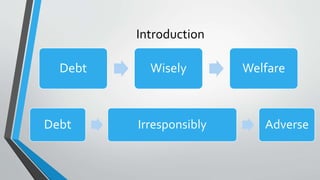
Debt Wisely Welfare
Debt Irresponsibly Adverse
Introduction
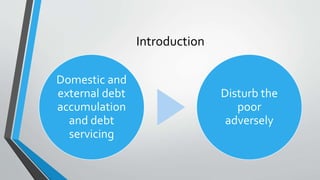
Domestic and
external debt
accumulation
and debt
servicing
Disturb the
poor
adversely
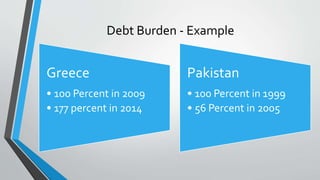
Debt Burden - Example
Greece
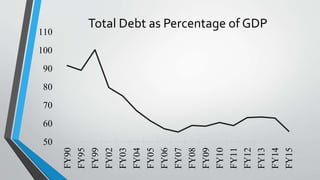
• 100 Percent in 2009
• 177 percent in 2014
Pakistan
• 100 Percent in 1999
• 56 Percent in 2005
Debt Sustainability
Ability of a country to meet its current and
future debt servicing obligations without
recourse to debt rescheduling or accumulation
of arrears and without compromising growth
Methodology
Both approaches involve Budget Constraint
• Derive necessary condition
[Mahmood and Rauf] r > g or r < g
• Derive Sufficient Condition
Accounting
Approach
• Econometric Estimation (Hamilton
and Flavin)
• Non-Ponzi Game Condition
PresentValue
Approach
SustainableDebtThresholds
Institutions PV Debt/
Exports
PV Debt/
Revenue
Additional Criteria
HIPC (2004) 150 250 Debt servicing / Exports ratio is 15-20%
DRI 140 151 Debt Servicing / Exports ratio is 12%
and Debt Servicing / Revenue ratio is
13 %
IMF 180 201 PV/GDP is 42% and Debt
Servicing/Revenue is 30%
World Bank
(2004)
190 189 [PV/Exports is 220% and PV/GNI is 80
%]* [Also Debt stock/GDP is 50%, Debt
stock/ Exports is 275%, Debt
Servicing/Exports is 30%]**
CIPA Index
Poor/mediu
m/
strong
Poor/medium/
Strong
Debt servicing as 15, 20 and 25 % of
exports for poor, medium and strong
institutions
100/150/200 200/250/300 Debt servicing as 25, 30 and 35 % of
revenue for poor, medium and strong
institutions
Total Debt as Percentage of GDP
50
60
70
80
90
100
110
FY90
FY95
FY99
FY02
FY03
FY04
FY05
FY06
FY07
FY08
FY09
FY10
FY11
FY12
FY13
FY14
FY15
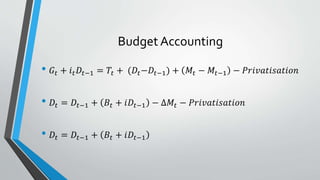
Budget Accounting
• 𝐺𝑡 + 𝑖 𝑡 𝐷𝑡−1 = 𝑇𝑡 + (𝐷𝑡−𝐷𝑡−1) + 𝑀𝑡 − 𝑀𝑡−1 − 𝑃𝑟𝑖𝑣𝑎𝑡𝑖𝑠𝑎𝑡𝑖𝑜𝑛
• 𝐷𝑡 = 𝐷𝑡−1 + 𝐵𝑡 + 𝑖𝐷𝑡−1 − ∆𝑀𝑡 − 𝑃𝑟𝑖𝑣𝑎𝑡𝑖𝑠𝑎𝑡𝑖𝑜𝑛
• 𝐷𝑡 = 𝐷𝑡−1 + 𝐵𝑡 + 𝑖𝐷𝑡−1
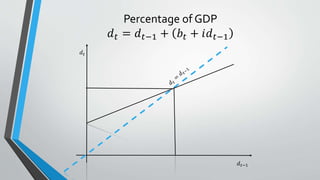
Percentage of GDP
𝑑 𝑡 = 𝑑 𝑡−1 + 𝑏𝑡 + 𝑖𝑑 𝑡−1
𝑑 𝑡
𝑑 𝑡−1
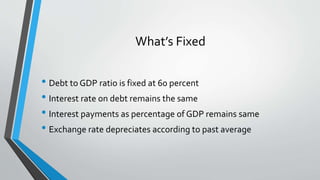
What’s Fixed
• Debt to GDP ratio is fixed at 60 percent
• Interest rate on debt remains the same
• Interest payments as percentage of GDP remains same
• Exchange rate depreciates according to past average
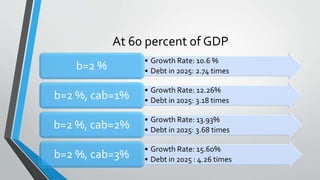
At 60 percent of GDP
• Growth Rate: 10.6 %
• Debt in 2025: 2.74 timesb=2 %
• Growth Rate: 12.26%
• Debt in 2025: 3.18 timesb=2 %, cab=1%
• Growth Rate: 13.93%
• Debt in 2025: 3.68 timesb=2 %, cab=2%
• Growth Rate: 15.60%
• Debt in 2025 : 4.26 timesb=2 %, cab=3%
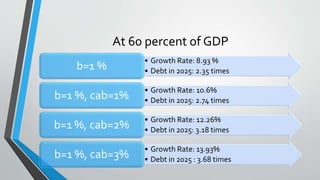
At 60 percent of GDP
• Growth Rate: 8.93 %
• Debt in 2025: 2.35 timesb=1 %
• Growth Rate: 10.6%
• Debt in 2025: 2.74 timesb=1 %, cab=1%
• Growth Rate: 12.26%
• Debt in 2025: 3.18 timesb=1 %, cab=2%
• Growth Rate: 13.93%
• Debt in 2025 : 3.68 timesb=1 %, cab=3%
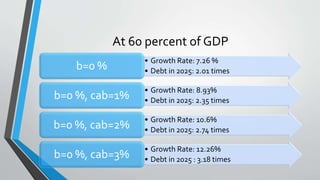
At 60 percent of GDP
• Growth Rate: 7.26 %
• Debt in 2025: 2.01 timesb=0 %
• Growth Rate: 8.93%
• Debt in 2025: 2.35 timesb=0 %, cab=1%
• Growth Rate: 10.6%
• Debt in 2025: 2.74 timesb=0 %, cab=2%
• Growth Rate: 12.26%
• Debt in 2025 : 3.18 timesb=0 %, cab=3%
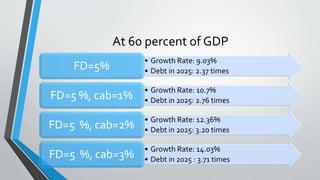
At 60 percent of GDP
• Growth Rate: 9.03%
• Debt in 2025: 2.37 timesFD=5%
• Growth Rate: 10.7%
• Debt in 2025: 2.76 timesFD=5 %, cab=1%
• Growth Rate: 12.36%
• Debt in 2025: 3.20 timesFD=5 %, cab=2%
• Growth Rate: 14.03%
• Debt in 2025 : 3.71 timesFD=5 %, cab=3%
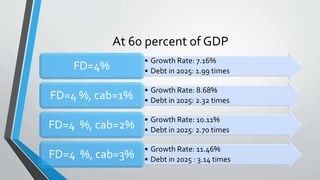
At 60 percent of GDP
• Growth Rate: 7.16%
• Debt in 2025: 1.99 timesFD=4%
• Growth Rate: 8.68%
• Debt in 2025: 2.32 timesFD=4 %, cab=1%
• Growth Rate: 10.11%
• Debt in 2025: 2.70 timesFD=4 %, cab=2%
• Growth Rate: 11.46%
• Debt in 2025 : 3.14 timesFD=4 %, cab=3%
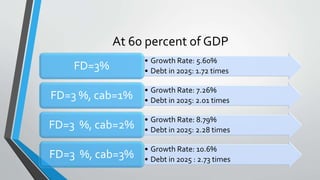
At 60 percent of GDP
• Growth Rate: 5.60%
• Debt in 2025: 1.72 timesFD=3%
• Growth Rate: 7.26%
• Debt in 2025: 2.01 timesFD=3 %, cab=1%
• Growth Rate: 8.79%
• Debt in 2025: 2.28 timesFD=3 %, cab=2%
• Growth Rate: 10.6%
• Debt in 2025 : 2.73 timesFD=3 %, cab=3%
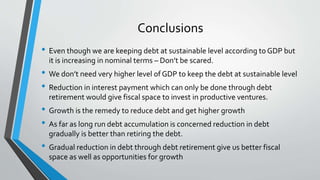
Conclusions
• Even though we are keeping debt at sustainable level according to GDP but
it is increasing in nominal terms – Don’t be scared.
• We don’t need very higher level of GDP to keep the debt at sustainable level
• Reduction in interest payment which can only be done through debt
retirement would give fiscal space to invest in productive ventures.
• Growth is the remedy to reduce debt and get higher growth
• As far as long run debt accumulation is concerned reduction in debt
gradually is better than retiring the debt.
• Gradual reduction in debt through debt retirement give us better fiscal
space as well as opportunities for growth

Debt sustainability

  • 1.
    Measuring the Sufficient DebtSustainability Condition in Pakistan M. Ali Kemal and Beenash Afzal Malik
  • 2.
  • 3.
    Introduction Domestic and external debt accumulation anddebt servicing Disturb the poor adversely
  • 4.
    Debt Burden -Example Greece • 100 Percent in 2009 • 177 percent in 2014 Pakistan • 100 Percent in 1999 • 56 Percent in 2005
  • 5.
    Debt Sustainability Ability ofa country to meet its current and future debt servicing obligations without recourse to debt rescheduling or accumulation of arrears and without compromising growth
  • 6.
    Methodology Both approaches involveBudget Constraint • Derive necessary condition [Mahmood and Rauf] r > g or r < g • Derive Sufficient Condition Accounting Approach • Econometric Estimation (Hamilton and Flavin) • Non-Ponzi Game Condition PresentValue Approach
  • 7.
    SustainableDebtThresholds Institutions PV Debt/ Exports PVDebt/ Revenue Additional Criteria HIPC (2004) 150 250 Debt servicing / Exports ratio is 15-20% DRI 140 151 Debt Servicing / Exports ratio is 12% and Debt Servicing / Revenue ratio is 13 % IMF 180 201 PV/GDP is 42% and Debt Servicing/Revenue is 30% World Bank (2004) 190 189 [PV/Exports is 220% and PV/GNI is 80 %]* [Also Debt stock/GDP is 50%, Debt stock/ Exports is 275%, Debt Servicing/Exports is 30%]** CIPA Index Poor/mediu m/ strong Poor/medium/ Strong Debt servicing as 15, 20 and 25 % of exports for poor, medium and strong institutions 100/150/200 200/250/300 Debt servicing as 25, 30 and 35 % of revenue for poor, medium and strong institutions
  • 8.
    Total Debt asPercentage of GDP 50 60 70 80 90 100 110 FY90 FY95 FY99 FY02 FY03 FY04 FY05 FY06 FY07 FY08 FY09 FY10 FY11 FY12 FY13 FY14 FY15
  • 9.
    Budget Accounting • 𝐺𝑡+ 𝑖 𝑡 𝐷𝑡−1 = 𝑇𝑡 + (𝐷𝑡−𝐷𝑡−1) + 𝑀𝑡 − 𝑀𝑡−1 − 𝑃𝑟𝑖𝑣𝑎𝑡𝑖𝑠𝑎𝑡𝑖𝑜𝑛 • 𝐷𝑡 = 𝐷𝑡−1 + 𝐵𝑡 + 𝑖𝐷𝑡−1 − ∆𝑀𝑡 − 𝑃𝑟𝑖𝑣𝑎𝑡𝑖𝑠𝑎𝑡𝑖𝑜𝑛 • 𝐷𝑡 = 𝐷𝑡−1 + 𝐵𝑡 + 𝑖𝐷𝑡−1
  • 10.
    Percentage of GDP 𝑑𝑡 = 𝑑 𝑡−1 + 𝑏𝑡 + 𝑖𝑑 𝑡−1 𝑑 𝑡 𝑑 𝑡−1
  • 11.
    What’s Fixed • Debtto GDP ratio is fixed at 60 percent • Interest rate on debt remains the same • Interest payments as percentage of GDP remains same • Exchange rate depreciates according to past average
  • 12.
    At 60 percentof GDP • Growth Rate: 10.6 % • Debt in 2025: 2.74 timesb=2 % • Growth Rate: 12.26% • Debt in 2025: 3.18 timesb=2 %, cab=1% • Growth Rate: 13.93% • Debt in 2025: 3.68 timesb=2 %, cab=2% • Growth Rate: 15.60% • Debt in 2025 : 4.26 timesb=2 %, cab=3%
  • 13.
    At 60 percentof GDP • Growth Rate: 8.93 % • Debt in 2025: 2.35 timesb=1 % • Growth Rate: 10.6% • Debt in 2025: 2.74 timesb=1 %, cab=1% • Growth Rate: 12.26% • Debt in 2025: 3.18 timesb=1 %, cab=2% • Growth Rate: 13.93% • Debt in 2025 : 3.68 timesb=1 %, cab=3%
  • 14.
    At 60 percentof GDP • Growth Rate: 7.26 % • Debt in 2025: 2.01 timesb=0 % • Growth Rate: 8.93% • Debt in 2025: 2.35 timesb=0 %, cab=1% • Growth Rate: 10.6% • Debt in 2025: 2.74 timesb=0 %, cab=2% • Growth Rate: 12.26% • Debt in 2025 : 3.18 timesb=0 %, cab=3%
  • 15.
    At 60 percentof GDP • Growth Rate: 9.03% • Debt in 2025: 2.37 timesFD=5% • Growth Rate: 10.7% • Debt in 2025: 2.76 timesFD=5 %, cab=1% • Growth Rate: 12.36% • Debt in 2025: 3.20 timesFD=5 %, cab=2% • Growth Rate: 14.03% • Debt in 2025 : 3.71 timesFD=5 %, cab=3%
  • 16.
    At 60 percentof GDP • Growth Rate: 7.16% • Debt in 2025: 1.99 timesFD=4% • Growth Rate: 8.68% • Debt in 2025: 2.32 timesFD=4 %, cab=1% • Growth Rate: 10.11% • Debt in 2025: 2.70 timesFD=4 %, cab=2% • Growth Rate: 11.46% • Debt in 2025 : 3.14 timesFD=4 %, cab=3%
  • 17.
    At 60 percentof GDP • Growth Rate: 5.60% • Debt in 2025: 1.72 timesFD=3% • Growth Rate: 7.26% • Debt in 2025: 2.01 timesFD=3 %, cab=1% • Growth Rate: 8.79% • Debt in 2025: 2.28 timesFD=3 %, cab=2% • Growth Rate: 10.6% • Debt in 2025 : 2.73 timesFD=3 %, cab=3%
  • 18.
    Conclusions • Even thoughwe are keeping debt at sustainable level according to GDP but it is increasing in nominal terms – Don’t be scared. • We don’t need very higher level of GDP to keep the debt at sustainable level • Reduction in interest payment which can only be done through debt retirement would give fiscal space to invest in productive ventures. • Growth is the remedy to reduce debt and get higher growth • As far as long run debt accumulation is concerned reduction in debt gradually is better than retiring the debt. • Gradual reduction in debt through debt retirement give us better fiscal space as well as opportunities for growth