M. Ali Kemal
Deconstructing Poverty: Unveiling
Multidimensional Challenges and
Crafting Equitable Solutions
M. Ali Kemal
M. Ali Kemal
Unpacking the term “poverty”
• Absolute Poverty
• Independent of the person's permanent location or area
• Relative Poverty
• Varies from one country to another, or from one society to another
• Income Poverty [$(PPP)2.15/ day Global Definition & Globally Comparable]
• Cost of Basic Needs Method [National/Official Measure of Poverty]
• Multidimensional Poverty Index [Complementary Measure of Poverty /OPHI]
• PMT [Used by BISP to target eligible households]
M. Ali Kemal
SDGs Indicators of poverty
• Target 1.1: By 2030, eradicate extreme poverty for all people everywhere, currently
measured as people living on less than $1.90 (PPP) a day
• Indicator 1.1.1: Proportion of the population living below the international poverty line
• Target 1.2: By 2030, reduce at least by half the proportion of men, women and
children of all ages living in poverty in all its dimensions according to national
definitions
• Indicator 1.2.1: Proportion of population living below the national poverty line
• Indicator 1.2.2: Proportion of men, women and children of all ages living in poverty in all its
dimensions
M. Ali Kemal
How poverty is estimated and reported in
Pakistan
Extreme
Poverty
[$ 1.9/ day Global
Definition &
Globally
Comparable]
Cost of Basic
Needs Method
[National/Official
Measure of Poverty
/ World Bank
Methodology]
Multidimensional
Poverty Index
[Complementary
Measure of Poverty
/OPHI & UNDP]
M. Ali Kemal
Poverty Estimates – National/Urban & Rural
2018-19
Poverty Line
Rs. 3757.85
National
21.9
Urban
11.0
Rural
28.2
M. Ali Kemal
National & Provincial Poverty Headcount
6
(Poverty Line base 2013-14, CPI base 2015-16)
21.9
11
28.2
16.5
24.5
28.7
41.8
21.3
10.9
27.5
26
NATIONAL URBAN RURAL PUNJAB SIND KPK BALUCHISTAN
POVERTY - 2018-19
Inc Fata Exc Fata
M. Ali Kemal
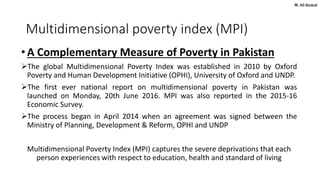
Multidimensional poverty index (MPI)
• A Complementary Measure of Poverty in Pakistan
The global Multidimensional Poverty Index was established in 2010 by Oxford
Poverty and Human Development Initiative (OPHI), University of Oxford and UNDP.
The first ever national report on multidimensional poverty in Pakistan was
launched on Monday, 20th June 2016. MPI was also reported in the 2015-16
Economic Survey.
The process began in April 2014 when an agreement was signed between the
Ministry of Planning, Development & Reform, OPHI and UNDP
Multidimensional Poverty Index (MPI) captures the severe deprivations that each
person experiences with respect to education, health and standard of living
M. Ali Kemal
Measurement
• The concept of multidimensional poverty goes beyond CBN as it, instead of relying on
consumption, recognizes poverty as being a multi-dimensional deprivation problem.
• Methodologically, the multidimensional poverty index is a product of two sub-components:
headcount (or Incidence) and intensity.
• Data Source: Pakistan Social and Living Standards Measurement Survey (PSLM)
• The MPI comprises three dimensions: health, education and standard of living.
• Further indicators under each of these dimensions are selected and weighted to arrive at a
composite index.
• A person is identified as poor if the household is deprived in 33% of all weighted indicators.
• This is the deprivation on one-third of the dimensions, education, health or living standards.
• Headcount gives the percentage of people who are multidimensionally poor. The intensity
measures the number of indicators on which an individual or household is simultaneously
deprived.
• Incidence of poverty: The percentage of people
who are identified as multidimensionally poor
(Headcount - H)
• Intensity: The share of indicators in which poor
people are deprived on average (A)
𝑀𝑃𝐼 = 𝐻 × 𝐴
Methodologically, the multidimensional poverty index is a product of two sub-
components: headcount (or Incidence) and intensity.
Headcount gives the percentage of people who are multidimensionally poor. The
intensity measures the number of indicators on which an individual or household is
simultaneously deprived.
HOW MPI IS MEASURED……CONTD
Education
Health
Standard of Living
Data Source: PSLM Survey – 2004/05, 2006/07, 2008/09,
2010/11, 2012/13, 2014/15 and 2019-20
WHAT DOES MPI INCLUDE?
M. Ali Kemal
New Incidence
Poverty Cut-off (k) Index Value
Confidence Interval
(95%)
k value=33%
MPI 0.146 0.141 0.151
Incidence (H) 30.5% 29.6% 31.4%
Intensity (A) 48.0% 47.7% 48.3%
Number of poor
(million) 68.68
M. Ali Kemal
MPI by Region
Area
MPI Incidence (H, %) Intensity (A, %)
Population
Share (%)
Number of
poor
(thousand)
Value
Confidence
Interval
(95%)
Value
Confidence
Interval
(95%)
Value
Confidence
Interval
(95%)
National 0.146 0.141 0.151 30.5 29.6 31.4 48.0 47.7 48.3 100.0 68,679
Rural 0.204 0.198 0.210 41.9 40.7 43.0 48.7 48.4 49.1 63.7 60,088
Urban 0.045 0.041 0.049 10.5 9.7 11.3 42.9 42.3 43.5 36.3 8,591
M. Ali Kemal
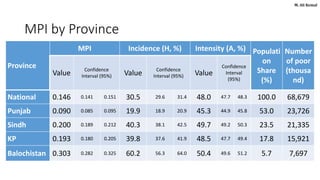
MPI by Province
Province
MPI Incidence (H, %) Intensity (A, %) Populati
on
Share
(%)
Number
of poor
(thousa
nd)
Value
Confidence
Interval (95%) Value
Confidence
Interval (95%) Value
Confidence
Interval
(95%)
National 0.146 0.141 0.151 30.5 29.6 31.4 48.0 47.7 48.3 100.0 68,679
Punjab 0.090 0.085 0.095 19.9 18.9 20.9 45.3 44.9 45.8 53.0 23,726
Sindh 0.200 0.189 0.212 40.3 38.1 42.5 49.7 49.2 50.3 23.5 21,335
KP 0.193 0.180 0.205 39.8 37.6 41.9 48.5 47.7 49.4 17.8 15,921
Balochistan 0.303 0.282 0.325 60.2 56.3 64.0 50.4 49.6 51.2 5.7 7,697
Development of 20 Least
Developed Districts
Balochistan 11
KP 3
Punjab 1
Sindh 5
Selected on Lowest MPI Scorecard
Physical Connectivity
Power & Digital connectivity
Social Sectors
Productive sectors & livelihoods
Social protection to the poorest
Interventions
• NHA connectivity roads
• Urban-Urban Roads
• Border point connectivity road
Physical Connectivity
• Access to broad-band services & internet
• Solarization of off-grid areas
• Establishment of LPG terminals
Power & Digital
connectivity
• Development of agri-livestock & mineral value-chain
• Tunnel framing, dairy farming, fish farming etc
• Development of masterplans (bus/truck terminal; fruit market)
• SEZs/EPZs
Productive sectors &
livelihoods
• Investments in skill development
• Education scholarships in boarding schools
• Strengthening of primary care (BHUs)
• Land market reforms
Social sectors
• Provide BISP coverage to all poor HHs in these districts
• Extend other components of BISP to all 20 districts
• Waseela taleem
• Waseela sehat
Provide social protection
to the poorest
M. Ali Kemal
Multidimensional Challenges
• Measurement and Data Collection
• Complexity: Unlike income poverty, multidimensional poverty involves several indicators, making it harder
to measure and track.
• Data Availability: Comprehensive and reliable data on various dimensions like health, education, and living
standards are often lacking, especially in developing countries.
• Health
• Access to Healthcare: Many people in poverty lack access to essential healthcare services, leading to high
mortality and morbidity rates.
• Nutrition: Malnutrition remains a significant issue, particularly among children, affecting their
development and future prospects.
• Education
• Quality and Access: Limited access to quality education perpetuates the cycle of poverty, as education is a
key factor in improving one’s socio-economic status.
• Dropout Rates: High dropout rates, especially among girls, hinder long-term development and economic
growth.
M. Ali Kemal
Multidimensional Challenges
• Living Standards
• Housing: Poor housing conditions, including overcrowding and lack of basic amenities, significantly
impact the quality of life.
• Sanitation and Water: Inadequate access to clean water and sanitation facilities poses severe
health risks and affects daily living.
• Economic Opportunities
• Employment: Lack of decent work opportunities and fair wages keeps people trapped in poverty.
• Financial Inclusion: Limited access to financial services and credit prevents individuals from
investing in education, health, and business opportunities.
• Social and Cultural Barriers
• Discrimination: Marginalized groups often face discrimination that limits their access to resources
and opportunities.
• Social Norms: Cultural and social norms can restrict access to education and employment,
particularly for women and minorities.
• Environmental Vulnerability
• Climate Change: Environmental degradation and climate change disproportionately affect the
poor, who often rely on natural resources for their livelihoods.
• Disasters: Natural disasters can destroy homes, livelihoods, and infrastructure, pushing people
deeper into poverty.
M. Ali Kemal
Multidimensional Challenges
• Connectivity
• Physical
• E-Connectivity
• Policy and Governance
• Ineffective Policies: Poorly designed or implemented policies can fail to address the root
causes of poverty.
• Corruption: Corruption and lack of transparency in governance can divert resources away
from those who need them most.
• Strategies to Address Multidimensional Poverty
• Integrated Approaches: Addressing multiple dimensions of poverty simultaneously through
integrated policies and programs.
• Data-Driven Policies: Utilizing accurate and comprehensive data to inform policy decisions
and measure progress.
• Inclusive Growth: Promoting economic growth that is inclusive and benefits all sections of
society, particularly the most vulnerable.
• Social Protection: Expanding social protection systems to provide safety nets for the poor
and vulnerable.
• Community Empowerment: Engaging communities in decision-making processes and
empowering them to take control of their development.
M. Ali Kemal
Equitable Solutions
• Integrated Policies: Develop policies that address health, education, employment, and
living standards together rather than in isolation.
• Data-Driven Decision Making: Use accurate and comprehensive data to inform policy
decisions and track progress
• Job Creation: Focus on sectors that generate employment, particularly for marginalized
groups.
• Fair Wages: Ensure that all workers receive living wages and fair working conditions.
• Financial Inclusion: Expand access to financial services, including banking, credit, and
insurance.
• Universal Access: Ensure all children have access to quality primary and secondary
education.
• Adult Education: Provide opportunities for vocational training and lifelong learning.
• Gender Equality: Promote equal access to education for girls and women.
M. Ali Kemal
Equitable Solutions
• Universal Health Coverage: Ensure everyone has access to essential healthcare services.
• Preventive Care: Emphasize preventive healthcare to reduce disease burden.
• Nutrition Programs: Implement programs to address malnutrition, especially in children.
• Affordable Housing: Develop policies to provide safe and affordable housing.
• Water and Sanitation: Ensure access to clean water and sanitation facilities.
• Infrastructure Development: Invest in infrastructure to improve living conditions and
economic opportunities.
• Safety Nets: Implement social protection programs such as unemployment benefits,
child support, and pensions.
• Targeted Assistance: Provide support to the most vulnerable populations.
• Disaster Resilience: Develop systems to support people affected by natural disasters and
economic shocks.
M. Ali Kemal
Equitable Solutions
• Community Involvement: Engage communities in designing and implementing development projects.
• Capacity Building: Strengthen local institutions and empower individuals with the skills and
knowledge to improve their own lives.
• Social Capital: Foster networks and social cohesion to support collective action and mutual aid.
• Sustainable Practices: Promote sustainable agricultural, industrial, and urban practices.
• Climate Adaptation: Support measures to protect vulnerable communities from climate change
impacts.
• Natural Resource Management: Ensure equitable and sustainable management of natural resources.
• Anti-Discrimination Laws: Enforce laws against discrimination based on race, gender, ethnicity, and
other factors.
• Inclusive Governance: Ensure all groups are represented in decision-making processes.
• Rights-Based Approach: Uphold the rights of all individuals to a decent standard of living.
M. Ali Kemal
Examples of Equitable Solutions – Lessons Learnt
• Conditional Cash Transfers: Programs like Brazil's Bolsa Família
provide financial support to low-income families, conditional on
school attendance and regular health check-ups for children.
• Universal Healthcare: Rwanda's community-based health insurance
scheme has significantly improved healthcare access and outcomes
for its population.
• Education for All: Kenya's free primary education initiative has
dramatically increased school enrollment and completion rates.
M. Ali Kemal
Implementation Strategies
• Multistakeholder Collaboration: Foster partnerships between
governments, NGOs, the private sector, and communities.
• Monitoring and Evaluation: Establish robust systems to monitor
progress and evaluate the effectiveness of interventions.
• Scalability and Sustainability: Design programs that can be scaled up
and sustained over the long term.
Deconstructing Poverty: Unveiling Multidimensional Challenges and Crafting Equitable Solutions

Deconstructing Poverty: Unveiling Multidimensional Challenges and Crafting Equitable Solutions

  • 1.
    M. Ali Kemal DeconstructingPoverty: Unveiling Multidimensional Challenges and Crafting Equitable Solutions M. Ali Kemal
  • 2.
    M. Ali Kemal Unpackingthe term “poverty” • Absolute Poverty • Independent of the person's permanent location or area • Relative Poverty • Varies from one country to another, or from one society to another • Income Poverty [$(PPP)2.15/ day Global Definition & Globally Comparable] • Cost of Basic Needs Method [National/Official Measure of Poverty] • Multidimensional Poverty Index [Complementary Measure of Poverty /OPHI] • PMT [Used by BISP to target eligible households]
  • 3.
    M. Ali Kemal SDGsIndicators of poverty • Target 1.1: By 2030, eradicate extreme poverty for all people everywhere, currently measured as people living on less than $1.90 (PPP) a day • Indicator 1.1.1: Proportion of the population living below the international poverty line • Target 1.2: By 2030, reduce at least by half the proportion of men, women and children of all ages living in poverty in all its dimensions according to national definitions • Indicator 1.2.1: Proportion of population living below the national poverty line • Indicator 1.2.2: Proportion of men, women and children of all ages living in poverty in all its dimensions
  • 4.
    M. Ali Kemal Howpoverty is estimated and reported in Pakistan Extreme Poverty [$ 1.9/ day Global Definition & Globally Comparable] Cost of Basic Needs Method [National/Official Measure of Poverty / World Bank Methodology] Multidimensional Poverty Index [Complementary Measure of Poverty /OPHI & UNDP]
  • 5.
    M. Ali Kemal PovertyEstimates – National/Urban & Rural 2018-19 Poverty Line Rs. 3757.85 National 21.9 Urban 11.0 Rural 28.2
  • 6.
    M. Ali Kemal National& Provincial Poverty Headcount 6 (Poverty Line base 2013-14, CPI base 2015-16) 21.9 11 28.2 16.5 24.5 28.7 41.8 21.3 10.9 27.5 26 NATIONAL URBAN RURAL PUNJAB SIND KPK BALUCHISTAN POVERTY - 2018-19 Inc Fata Exc Fata
  • 7.
    M. Ali Kemal Multidimensionalpoverty index (MPI) • A Complementary Measure of Poverty in Pakistan The global Multidimensional Poverty Index was established in 2010 by Oxford Poverty and Human Development Initiative (OPHI), University of Oxford and UNDP. The first ever national report on multidimensional poverty in Pakistan was launched on Monday, 20th June 2016. MPI was also reported in the 2015-16 Economic Survey. The process began in April 2014 when an agreement was signed between the Ministry of Planning, Development & Reform, OPHI and UNDP Multidimensional Poverty Index (MPI) captures the severe deprivations that each person experiences with respect to education, health and standard of living
  • 8.
    M. Ali Kemal Measurement •The concept of multidimensional poverty goes beyond CBN as it, instead of relying on consumption, recognizes poverty as being a multi-dimensional deprivation problem. • Methodologically, the multidimensional poverty index is a product of two sub-components: headcount (or Incidence) and intensity. • Data Source: Pakistan Social and Living Standards Measurement Survey (PSLM) • The MPI comprises three dimensions: health, education and standard of living. • Further indicators under each of these dimensions are selected and weighted to arrive at a composite index. • A person is identified as poor if the household is deprived in 33% of all weighted indicators. • This is the deprivation on one-third of the dimensions, education, health or living standards. • Headcount gives the percentage of people who are multidimensionally poor. The intensity measures the number of indicators on which an individual or household is simultaneously deprived.
  • 9.
    • Incidence ofpoverty: The percentage of people who are identified as multidimensionally poor (Headcount - H) • Intensity: The share of indicators in which poor people are deprived on average (A) 𝑀𝑃𝐼 = 𝐻 × 𝐴 Methodologically, the multidimensional poverty index is a product of two sub- components: headcount (or Incidence) and intensity. Headcount gives the percentage of people who are multidimensionally poor. The intensity measures the number of indicators on which an individual or household is simultaneously deprived. HOW MPI IS MEASURED……CONTD
  • 10.
    Education Health Standard of Living DataSource: PSLM Survey – 2004/05, 2006/07, 2008/09, 2010/11, 2012/13, 2014/15 and 2019-20 WHAT DOES MPI INCLUDE?
  • 11.
    M. Ali Kemal NewIncidence Poverty Cut-off (k) Index Value Confidence Interval (95%) k value=33% MPI 0.146 0.141 0.151 Incidence (H) 30.5% 29.6% 31.4% Intensity (A) 48.0% 47.7% 48.3% Number of poor (million) 68.68
  • 12.
    M. Ali Kemal MPIby Region Area MPI Incidence (H, %) Intensity (A, %) Population Share (%) Number of poor (thousand) Value Confidence Interval (95%) Value Confidence Interval (95%) Value Confidence Interval (95%) National 0.146 0.141 0.151 30.5 29.6 31.4 48.0 47.7 48.3 100.0 68,679 Rural 0.204 0.198 0.210 41.9 40.7 43.0 48.7 48.4 49.1 63.7 60,088 Urban 0.045 0.041 0.049 10.5 9.7 11.3 42.9 42.3 43.5 36.3 8,591
  • 13.
    M. Ali Kemal MPIby Province Province MPI Incidence (H, %) Intensity (A, %) Populati on Share (%) Number of poor (thousa nd) Value Confidence Interval (95%) Value Confidence Interval (95%) Value Confidence Interval (95%) National 0.146 0.141 0.151 30.5 29.6 31.4 48.0 47.7 48.3 100.0 68,679 Punjab 0.090 0.085 0.095 19.9 18.9 20.9 45.3 44.9 45.8 53.0 23,726 Sindh 0.200 0.189 0.212 40.3 38.1 42.5 49.7 49.2 50.3 23.5 21,335 KP 0.193 0.180 0.205 39.8 37.6 41.9 48.5 47.7 49.4 17.8 15,921 Balochistan 0.303 0.282 0.325 60.2 56.3 64.0 50.4 49.6 51.2 5.7 7,697
  • 14.
    Development of 20Least Developed Districts Balochistan 11 KP 3 Punjab 1 Sindh 5 Selected on Lowest MPI Scorecard Physical Connectivity Power & Digital connectivity Social Sectors Productive sectors & livelihoods Social protection to the poorest
  • 15.
    Interventions • NHA connectivityroads • Urban-Urban Roads • Border point connectivity road Physical Connectivity • Access to broad-band services & internet • Solarization of off-grid areas • Establishment of LPG terminals Power & Digital connectivity • Development of agri-livestock & mineral value-chain • Tunnel framing, dairy farming, fish farming etc • Development of masterplans (bus/truck terminal; fruit market) • SEZs/EPZs Productive sectors & livelihoods • Investments in skill development • Education scholarships in boarding schools • Strengthening of primary care (BHUs) • Land market reforms Social sectors • Provide BISP coverage to all poor HHs in these districts • Extend other components of BISP to all 20 districts • Waseela taleem • Waseela sehat Provide social protection to the poorest
  • 16.
    M. Ali Kemal MultidimensionalChallenges • Measurement and Data Collection • Complexity: Unlike income poverty, multidimensional poverty involves several indicators, making it harder to measure and track. • Data Availability: Comprehensive and reliable data on various dimensions like health, education, and living standards are often lacking, especially in developing countries. • Health • Access to Healthcare: Many people in poverty lack access to essential healthcare services, leading to high mortality and morbidity rates. • Nutrition: Malnutrition remains a significant issue, particularly among children, affecting their development and future prospects. • Education • Quality and Access: Limited access to quality education perpetuates the cycle of poverty, as education is a key factor in improving one’s socio-economic status. • Dropout Rates: High dropout rates, especially among girls, hinder long-term development and economic growth.
  • 17.
    M. Ali Kemal MultidimensionalChallenges • Living Standards • Housing: Poor housing conditions, including overcrowding and lack of basic amenities, significantly impact the quality of life. • Sanitation and Water: Inadequate access to clean water and sanitation facilities poses severe health risks and affects daily living. • Economic Opportunities • Employment: Lack of decent work opportunities and fair wages keeps people trapped in poverty. • Financial Inclusion: Limited access to financial services and credit prevents individuals from investing in education, health, and business opportunities. • Social and Cultural Barriers • Discrimination: Marginalized groups often face discrimination that limits their access to resources and opportunities. • Social Norms: Cultural and social norms can restrict access to education and employment, particularly for women and minorities. • Environmental Vulnerability • Climate Change: Environmental degradation and climate change disproportionately affect the poor, who often rely on natural resources for their livelihoods. • Disasters: Natural disasters can destroy homes, livelihoods, and infrastructure, pushing people deeper into poverty.
  • 18.
    M. Ali Kemal MultidimensionalChallenges • Connectivity • Physical • E-Connectivity • Policy and Governance • Ineffective Policies: Poorly designed or implemented policies can fail to address the root causes of poverty. • Corruption: Corruption and lack of transparency in governance can divert resources away from those who need them most. • Strategies to Address Multidimensional Poverty • Integrated Approaches: Addressing multiple dimensions of poverty simultaneously through integrated policies and programs. • Data-Driven Policies: Utilizing accurate and comprehensive data to inform policy decisions and measure progress. • Inclusive Growth: Promoting economic growth that is inclusive and benefits all sections of society, particularly the most vulnerable. • Social Protection: Expanding social protection systems to provide safety nets for the poor and vulnerable. • Community Empowerment: Engaging communities in decision-making processes and empowering them to take control of their development.
  • 19.
    M. Ali Kemal EquitableSolutions • Integrated Policies: Develop policies that address health, education, employment, and living standards together rather than in isolation. • Data-Driven Decision Making: Use accurate and comprehensive data to inform policy decisions and track progress • Job Creation: Focus on sectors that generate employment, particularly for marginalized groups. • Fair Wages: Ensure that all workers receive living wages and fair working conditions. • Financial Inclusion: Expand access to financial services, including banking, credit, and insurance. • Universal Access: Ensure all children have access to quality primary and secondary education. • Adult Education: Provide opportunities for vocational training and lifelong learning. • Gender Equality: Promote equal access to education for girls and women.
  • 20.
    M. Ali Kemal EquitableSolutions • Universal Health Coverage: Ensure everyone has access to essential healthcare services. • Preventive Care: Emphasize preventive healthcare to reduce disease burden. • Nutrition Programs: Implement programs to address malnutrition, especially in children. • Affordable Housing: Develop policies to provide safe and affordable housing. • Water and Sanitation: Ensure access to clean water and sanitation facilities. • Infrastructure Development: Invest in infrastructure to improve living conditions and economic opportunities. • Safety Nets: Implement social protection programs such as unemployment benefits, child support, and pensions. • Targeted Assistance: Provide support to the most vulnerable populations. • Disaster Resilience: Develop systems to support people affected by natural disasters and economic shocks.
  • 21.
    M. Ali Kemal EquitableSolutions • Community Involvement: Engage communities in designing and implementing development projects. • Capacity Building: Strengthen local institutions and empower individuals with the skills and knowledge to improve their own lives. • Social Capital: Foster networks and social cohesion to support collective action and mutual aid. • Sustainable Practices: Promote sustainable agricultural, industrial, and urban practices. • Climate Adaptation: Support measures to protect vulnerable communities from climate change impacts. • Natural Resource Management: Ensure equitable and sustainable management of natural resources. • Anti-Discrimination Laws: Enforce laws against discrimination based on race, gender, ethnicity, and other factors. • Inclusive Governance: Ensure all groups are represented in decision-making processes. • Rights-Based Approach: Uphold the rights of all individuals to a decent standard of living.
  • 22.
    M. Ali Kemal Examplesof Equitable Solutions – Lessons Learnt • Conditional Cash Transfers: Programs like Brazil's Bolsa Família provide financial support to low-income families, conditional on school attendance and regular health check-ups for children. • Universal Healthcare: Rwanda's community-based health insurance scheme has significantly improved healthcare access and outcomes for its population. • Education for All: Kenya's free primary education initiative has dramatically increased school enrollment and completion rates.
  • 23.
    M. Ali Kemal ImplementationStrategies • Multistakeholder Collaboration: Foster partnerships between governments, NGOs, the private sector, and communities. • Monitoring and Evaluation: Establish robust systems to monitor progress and evaluate the effectiveness of interventions. • Scalability and Sustainability: Design programs that can be scaled up and sustained over the long term.