FRIT 7765 Collaborative Lesson Plan
Lesson Title:
Teachers:
Monsters of Society:
Beowulf, Critical Thinking, and You
Mrs. Cheek and Mrs. Colquitt (Media
Specialist Intern)
Dates: January 27, 2017 with the option of January
28, 2017
One/Two 90 minute block(s)
Georgia ELA Performance
Standards:
ELAGSE11-12SL1: Initiate and participate
effectively in a range of collaborative
discussions (one-on-one, in groups, and
teacher-led) with diverse partners on grades
11-12 topics, texts, and issues, building on
others’ ideas and expressing their own clearly
and persuasively.
a. Come to discussions prepared, having
read and researched material under study;
explicitly draw on that preparation by referring
to evidence from texts and other research on
the topic or issue to stimulate a thoughtful,
well-reasoned exchange of ideas.
b. Work with peers to set rules for collegial
discussions and decision-making, set clear
goals and deadlines, and establish individual
roles as needed.
c. Propel conversations by posing and
responding to questions that probe reasoning
and evidence; ensure a hearing for a full
range of positions on a topic or issue; clarify,
verify, or challenge ideas and conclusions;
and promote divergent and creative
perspectives.
d. Respond thoughtfully to diverse
perspectives; synthesize comments, claims,
and evidence made on all sides of an issue;
resolve contradictions when possible; and
determine what additional information or
research is required to deepen the
investigation or complete the task.
ELAGSE11-12SL2: Integrate multiple
sources of information presented in diverse
formats and media (e.g., visually,
quantitatively, orally) in order to make
informed decisions and solve problems,
evaluating the credibility and accuracy of
each source and noting any discrepancies
among the data.
ELAGSE11-12SL3: Evaluate a speaker’s
point of view, reasoning, and use of evidence
and rhetoric, assessing the stance, premises,
links among ideas, word choice, points of
emphasis, and tone used.
ELAGSE11-12SL4: Present information,
findings, and supporting evidence, conveying
a clear and distinct perspective, such that
listeners can follow the line of reasoning,
alternative or opposing perspectives are
addressed, and the organization,
development, substance, and style are
appropriate to purpose, audience, and a
range of formal and informal tasks.
ELAGSE11-12SL5: Make strategic use of
digital media (e.g., textual, graphical, audio,
visual, and interactive elements) in
presentations to enhance understanding of
findings, reasoning, and evidence and to add
interest.
ELAGSE11-12W1: Write arguments to
support claims in an analysis of substantive
topics or texts, using valid reasoning and
relevant and sufficient evidence.
a. Introduce precise, knowledgeable claim(s),
distinguish the claim(s) from alternate or
opposing claims, and create an organization
that logically sequences claim(s),
counterclaims, reasons, and evidence.
b. Develop claim(s) and counterclaims fairly
and thoroughly, supplying the most relevant
evidence for each while pointing out the
strengths and limitations of both in a manner
that anticipates the audience’s knowledge
level, concerns, values, and possible biases.
ELAGSE11-12W2: Write
informative/explanatory texts to examine and
convey complex ideas, concepts, and
information clearly and accurately through the
effective selection, organization, and analysis
of content.
ELAGSE11-12W3: Write narratives to
develop real or imagined experiences or
events using effective techniques, well-
chosen details, and well-structured event
sequences.
ELAGSE11-12W7: Conduct short as well as
more sustained research projects to answer a
question (including a self-generated question)
or solve a problem; narrow or broaden the
inquiry when appropriate; synthesize multiple
sources on the subject, demonstrating
understanding of the subject under
investigation.
ELAGSE11-12W8: Gather relevant
information from multiple authoritative print
and digital sources, using advanced searches
effectively; assess the strengths and
limitations of each source in terms of the task,
purpose, and audience; integrate information
into the text selectively to maintain the flow of
ideas, avoiding plagiarism and overreliance
on any one source and following a standard
format for citation.
ELAGSE11-12W9: Draw evidence from
literary or informational texts to support
analysis, reflection, and research.
ELAGSE11-12RI7: Integrate and evaluate
multiple sources of information presented
indifferent media or formats (e.g., visually,
quantitatively) as well as in words in order to
address a question or solve a problem.
ELAGSE11-12RL10: By the end of grade 11,
read and comprehend literature, including
stories, dramas, and poems, in the grades
11-CCR text complexity band proficiently,
with scaffolding as needed at the high end of
the range.
By the end of grade 12, read and
comprehend literature, including stories,
dramas, and poems, in the grades 11-CCR
text complexity band independently and
proficiently with scaffolding as needed at the
high end of the range.
AASL Standards for the 21st Century
Learner
1. Inquire, Think Critically, and Gain
Knowledge
1.1 Skills
1.1.1 Follow an inquiry-based process in
seeking knowledge in curricular subject, and
make real-world connection for using this
process in own life.
1.1.2 Use prior and background knowledge
as context for new learning.
1.1.3 Develop and refine a range of questions
to frame the search for new understanding.
1.1.4 Find, evaluate, and select appropriate
sources to answer questions.
1.1.5 Evaluate information found in selected
sources on the basis of accuracy, validity,
appropriateness for needs, importance, and
social and cultural context.
1.1.6 Read, view, and listen for information
presented in any format (e.g., textual, visual,
media, digital) in order to make inferences
and gather meaning.
1.1.7 Make sense of information gathered
from diverse sources by identifying
misconceptions, main and supporting ideas,
conflicting information, and point of view or
bias.
1.1.8 Demonstrate mastery of technology
tools for accessing information and pursuing
inquiry.
1.2 Dispositions in Action
1.2.1 Display initiative and engagement by
posing questions and investigating the
answers beyond the collection of superficial
facts.
1.2.3 Demonstrate confidence and self-
direction by making independent choices in
the selection of resources and information.
1.2.4 Maintain a critical stance by questioning
the validity and accuracy of all information.
1.2.5 Demonstrate adaptability by changing
the inquiry focus, questions, resources, or
strategies when necessary to achieve
success.
1.2.6 Display emotional resilience by
persisting in information searching despite
challenges.
1.2.7 Display persistence by continuing to
pursue information to gain a broad
perspective.
1.3 Responsibilities
1.3.1 Respect copyright/intellectual property
rights of creators and producers.
1.3.2 Seek divergent perspectives during
information gathering and assessment.
1.3.3 Follow ethical and legal guidelines in
gathering and using information.
1.3.4 Contribute to the exchange of ideas
within the learning community.
1.3.5 Use information technology responsibly.
1.4 Self-Assessment Strategies
1.4.1 Monitor own information-seeking
processes for effectiveness and progress,
and adapt as necessary.
1.4.2 Use interaction with and feedback from
teachers and peers to guide own inquiry
process.
1.4.3 Monitor gathered information, and
assess for gaps or weaknesses.
1.4.4 Seek appropriate help when it is
needed.
2. Draw Conclusions, Make Informed
Decisions, Apply Knowledge to New
Situations, and Create New Knowledge
2.1 Skills
2.1.1 Continue an inquiry-based research
process by applying critical-thinking skills
(analysis, synthesis, evaluation, organization)
to information and knowledge in order to
construct new understandings, draw
conclusions, and create new knowledge.
2.1.2 Organize knowledge so that it is useful.
2.1.3 Use strategies to draw conclusions from
information and apply knowledge to curricular
areas, real-world situations, and further
investigations.
2.1.4 Use technology and other information
tools to analyze and organize information.
2.1.5 Collaborate with others to exchange
ideas, develop new understandings, make
decisions, and solve problems.
2.1.6 Use the writing process, media and
visual literacy, and technology skills to create
products that express new understandings.
2.2 Dispositions In Action
2.2.1 Demonstrate flexibility in the use of
resources by adapting information strategies
to each specific resources and by seeking
additional resources when clear conclusions
cannot be drawn.
2.2.2 Use both divergent and convergent
thinking to formulate alternative conclusions
and test them against evidence.
2.2.3 Employ a critical stance in drawing
conclusions by demonstrating that the pattern
of evidence leads to a decision or conclusion.
2.2.4 Demonstrate personal productivity by
completing products to express learning.
2.3. Responsibilities
2.3.1 Connect understanding to the real
world.
2.3.2 Consider diverse and global
perspectives in drawing conclusions.
2.3.3 Use valid information and reasoned
conclusions to make ethical decisions.
2.4 Self-Assessment Strategies
2.4.1 Determine how to act on information
(accept, reject, modify).
2.4.2 Reflect on systematic process, and
assess for completeness of investigation.
2.4.3 Recognize new knowledge and
understanding.
3. Share Knowledge and Participate
Ethically and Productively as Members of
Our Democratic Society
3.1 Skills
3.1.1 Conclude an inquiry-based research
process by sharing new understandings and
reflecting on the learning.
3.1.2 Participate and collaborate as members
of a social and intellectual network of
learners.
3.1.3 Use writing and speaking skills to
communicate new understandings effectively.
3.1.4 Use technology and other information
tools to organize and display knowledge and
understanding in ways that others can view,
use, and assess.
3.1.5 Connect learning to community issues.
3.1.6 Use information and technology
ethically and responsibly.
3.2 Dispositions in Action
3.2.1 Demonstrate leadership and confidence
by presenting ideas to others in both formal
and informal situations.
3.3. Responsibilities
3.3.1 Solicit and respect diverse perspectives
while searching for information, collaborating
with others, and participating as a member of
the community.
3.3.2 Respect the differing interests and
experiences of others, and seek a variety of
viewpoints.
3.3.3 Use knowledge and information skills
and dispositions to engage in public
conversation and debate around issues of
common concern.
3.3.4 Create products that apply to authentic,
real-world contexts.
3.3.5 Contribute to the exchange of ideas
within and beyond the learning community.
3.3.6 Use information and knowledge in the
serve of democratic values.
3.3.7 Respect the principles of intellectual
freedom.
3.4 Self-Assessment Strategies
3.4.1 Assess the processes by which learning
was achieved in order to revise strategies
and learn more effectively in the future.
3.4.2 Assess the quality and effectiveness of
the learning product.
4. Pursue Personal and Aesthetic Growth
4.1 Skills
4.1.1 Read, view, and listen for pleasure and
personal growth.
4.1.2 Read widely and fluently to make
connections with self, the world, and previous
reading.
4.1.3 Respond to literature and creative
expressions of ideas in various formats and
genres.
4.1.4 Seek information for personal learning
in a variety of formats and genres.
4.1.5 Connect ideas to own interests and
previous knowledge and experience.
4.16 Organize personal knowledge in a way
that can be called upon easily.
4.1.7 Use social networks and information
tools to gather and share information.
4.2 Dispositions in Action
4.2.1 Display curiosity by pursuing interests
through multiple resources.
4.2.3 Maintain openness to new ideas by
considering divergent opinions when
evidence supports the change, and seeking
information about new ideas encountered
through academic or personal growth.
4.3 Responsibilities
4.3.1 Participate in the social exchange of
ideas, both electronically and in person.
4.3.2 Recognize that resources are created
for a variety of purposes.
4.3.3 Seek opportunities for pursuing
personal and aesthetic growth.
4.3.4 Practice safe and ethical behaviors in
personal electronic communication and
interaction.
4.4 Self-Assessment Strategies
4.4.1 Identify own areas of interest.
4.4.2 Recognize the limits of own personal
knowledge
4.4.5 Develop personal criteria for gauging
how effectively own ideas are expressed.
4.4.6 Evaluate own ability to select resources
that are engaging and appropriate for
personal interests and needs.
Lesson Opener: Discussion of Beowulf to include information
about the monster Grendel. Transition to the
driving learning question of: What do you
think is the current Monster of Society?
Procedures/Strategies: Students will:
 Obtain a chromebook or laptop from
one of the Media Center carts
 Turn their device on
 Log in to their school Google Drive
account
 Start their Google Chrome browser
 Arrive at the JHS Media Center
Webpage
 Hover over the “Research Tab”
 Click on the General References and
Websites Tab
 Click on Gale Opposing ViewPoints
 Explore the Gale Opposing ViewPoints
site to find out more information about
their topics
 Understand how to transfer information
from Opposing ViewPoints to their
School Google Drive account
 Establish an account with Coggle
 Create a Mind Map with Coggle
Media Specialist will:
 Explain the Opposing ViewPoints
database to students
 Explain how students can save
information from Opposing ViewPoints
to their Google Drive
 Explain the Coggle website to students
(How to set up an ccount and how to
create a Mind Map)
Lesson Summary: Students finished reading and discussing
Beowulf yesterday. Mrs. Cheek has assigned
an essay about what each student perceives
to be the “Monster of Society,” or main
problem that is causing the destruction of
society, in the student’s opinion.
Students arrive at the Media Center at the
beginning of either 1st or 3rd block ready to
research their chosen topic. Each student will
obtain a chromebook or laptop from one of
the library’s carts. Students will open their
device, turn it on, and access the JHS Library
website and their school Google Drive
accounts. Media Specialist Mrs. Colquitt will
spend roughly 20 minutes teaching students
about how to access information through
Opposing ViewPoints to include information
on how to save articles to the student’s
Google Drive account.
Students will spend ten minutes finding an
article directly relating to their topics. Mrs.
Colquitt will call the class back to order and
will spend roughly 20 minutes teaching
students how to use Coggle to create a mind
map/non-linear outline for their papers.
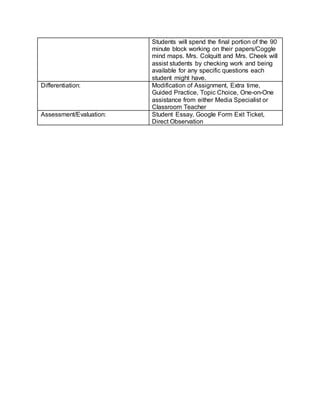
Students will spend the final portion of the 90
minute block working on their papers/Coggle
mind maps. Mrs. Colquitt and Mrs. Cheek will
assist students by checking work and being
available for any specific questions each
student might have.
Differentiation: Modification of Assignment, Extra time,
Guided Practice, Topic Choice, One-on-One
assistance from either Media Specialist or
Classroom Teacher
Assessment/Evaluation: Student Essay, Google Form Exit Ticket,
Direct Observation

Michelle Colquitt Collaborative Lesson Plan

  • 1.
    FRIT 7765 CollaborativeLesson Plan Lesson Title: Teachers: Monsters of Society: Beowulf, Critical Thinking, and You Mrs. Cheek and Mrs. Colquitt (Media Specialist Intern) Dates: January 27, 2017 with the option of January 28, 2017 One/Two 90 minute block(s) Georgia ELA Performance Standards: ELAGSE11-12SL1: Initiate and participate effectively in a range of collaborative discussions (one-on-one, in groups, and teacher-led) with diverse partners on grades 11-12 topics, texts, and issues, building on others’ ideas and expressing their own clearly and persuasively. a. Come to discussions prepared, having read and researched material under study; explicitly draw on that preparation by referring to evidence from texts and other research on the topic or issue to stimulate a thoughtful, well-reasoned exchange of ideas. b. Work with peers to set rules for collegial discussions and decision-making, set clear goals and deadlines, and establish individual roles as needed. c. Propel conversations by posing and responding to questions that probe reasoning and evidence; ensure a hearing for a full range of positions on a topic or issue; clarify, verify, or challenge ideas and conclusions; and promote divergent and creative perspectives. d. Respond thoughtfully to diverse perspectives; synthesize comments, claims, and evidence made on all sides of an issue; resolve contradictions when possible; and determine what additional information or research is required to deepen the investigation or complete the task. ELAGSE11-12SL2: Integrate multiple sources of information presented in diverse formats and media (e.g., visually, quantitatively, orally) in order to make informed decisions and solve problems, evaluating the credibility and accuracy of
  • 2.
    each source andnoting any discrepancies among the data. ELAGSE11-12SL3: Evaluate a speaker’s point of view, reasoning, and use of evidence and rhetoric, assessing the stance, premises, links among ideas, word choice, points of emphasis, and tone used. ELAGSE11-12SL4: Present information, findings, and supporting evidence, conveying a clear and distinct perspective, such that listeners can follow the line of reasoning, alternative or opposing perspectives are addressed, and the organization, development, substance, and style are appropriate to purpose, audience, and a range of formal and informal tasks. ELAGSE11-12SL5: Make strategic use of digital media (e.g., textual, graphical, audio, visual, and interactive elements) in presentations to enhance understanding of findings, reasoning, and evidence and to add interest. ELAGSE11-12W1: Write arguments to support claims in an analysis of substantive topics or texts, using valid reasoning and relevant and sufficient evidence. a. Introduce precise, knowledgeable claim(s), distinguish the claim(s) from alternate or opposing claims, and create an organization that logically sequences claim(s), counterclaims, reasons, and evidence. b. Develop claim(s) and counterclaims fairly and thoroughly, supplying the most relevant evidence for each while pointing out the strengths and limitations of both in a manner that anticipates the audience’s knowledge level, concerns, values, and possible biases. ELAGSE11-12W2: Write informative/explanatory texts to examine and convey complex ideas, concepts, and information clearly and accurately through the effective selection, organization, and analysis of content. ELAGSE11-12W3: Write narratives to develop real or imagined experiences or events using effective techniques, well-
  • 3.
    chosen details, andwell-structured event sequences. ELAGSE11-12W7: Conduct short as well as more sustained research projects to answer a question (including a self-generated question) or solve a problem; narrow or broaden the inquiry when appropriate; synthesize multiple sources on the subject, demonstrating understanding of the subject under investigation. ELAGSE11-12W8: Gather relevant information from multiple authoritative print and digital sources, using advanced searches effectively; assess the strengths and limitations of each source in terms of the task, purpose, and audience; integrate information into the text selectively to maintain the flow of ideas, avoiding plagiarism and overreliance on any one source and following a standard format for citation. ELAGSE11-12W9: Draw evidence from literary or informational texts to support analysis, reflection, and research. ELAGSE11-12RI7: Integrate and evaluate multiple sources of information presented indifferent media or formats (e.g., visually, quantitatively) as well as in words in order to address a question or solve a problem. ELAGSE11-12RL10: By the end of grade 11, read and comprehend literature, including stories, dramas, and poems, in the grades 11-CCR text complexity band proficiently, with scaffolding as needed at the high end of the range. By the end of grade 12, read and comprehend literature, including stories, dramas, and poems, in the grades 11-CCR text complexity band independently and proficiently with scaffolding as needed at the high end of the range. AASL Standards for the 21st Century Learner 1. Inquire, Think Critically, and Gain Knowledge 1.1 Skills 1.1.1 Follow an inquiry-based process in seeking knowledge in curricular subject, and
  • 4.
    make real-world connectionfor using this process in own life. 1.1.2 Use prior and background knowledge as context for new learning. 1.1.3 Develop and refine a range of questions to frame the search for new understanding. 1.1.4 Find, evaluate, and select appropriate sources to answer questions. 1.1.5 Evaluate information found in selected sources on the basis of accuracy, validity, appropriateness for needs, importance, and social and cultural context. 1.1.6 Read, view, and listen for information presented in any format (e.g., textual, visual, media, digital) in order to make inferences and gather meaning. 1.1.7 Make sense of information gathered from diverse sources by identifying misconceptions, main and supporting ideas, conflicting information, and point of view or bias. 1.1.8 Demonstrate mastery of technology tools for accessing information and pursuing inquiry. 1.2 Dispositions in Action 1.2.1 Display initiative and engagement by posing questions and investigating the answers beyond the collection of superficial facts. 1.2.3 Demonstrate confidence and self- direction by making independent choices in the selection of resources and information. 1.2.4 Maintain a critical stance by questioning the validity and accuracy of all information. 1.2.5 Demonstrate adaptability by changing the inquiry focus, questions, resources, or strategies when necessary to achieve success. 1.2.6 Display emotional resilience by persisting in information searching despite challenges. 1.2.7 Display persistence by continuing to pursue information to gain a broad perspective. 1.3 Responsibilities
  • 5.
    1.3.1 Respect copyright/intellectualproperty rights of creators and producers. 1.3.2 Seek divergent perspectives during information gathering and assessment. 1.3.3 Follow ethical and legal guidelines in gathering and using information. 1.3.4 Contribute to the exchange of ideas within the learning community. 1.3.5 Use information technology responsibly. 1.4 Self-Assessment Strategies 1.4.1 Monitor own information-seeking processes for effectiveness and progress, and adapt as necessary. 1.4.2 Use interaction with and feedback from teachers and peers to guide own inquiry process. 1.4.3 Monitor gathered information, and assess for gaps or weaknesses. 1.4.4 Seek appropriate help when it is needed. 2. Draw Conclusions, Make Informed Decisions, Apply Knowledge to New Situations, and Create New Knowledge 2.1 Skills 2.1.1 Continue an inquiry-based research process by applying critical-thinking skills (analysis, synthesis, evaluation, organization) to information and knowledge in order to construct new understandings, draw conclusions, and create new knowledge. 2.1.2 Organize knowledge so that it is useful. 2.1.3 Use strategies to draw conclusions from information and apply knowledge to curricular areas, real-world situations, and further investigations. 2.1.4 Use technology and other information tools to analyze and organize information. 2.1.5 Collaborate with others to exchange ideas, develop new understandings, make decisions, and solve problems. 2.1.6 Use the writing process, media and visual literacy, and technology skills to create products that express new understandings. 2.2 Dispositions In Action 2.2.1 Demonstrate flexibility in the use of resources by adapting information strategies
  • 6.
    to each specificresources and by seeking additional resources when clear conclusions cannot be drawn. 2.2.2 Use both divergent and convergent thinking to formulate alternative conclusions and test them against evidence. 2.2.3 Employ a critical stance in drawing conclusions by demonstrating that the pattern of evidence leads to a decision or conclusion. 2.2.4 Demonstrate personal productivity by completing products to express learning. 2.3. Responsibilities 2.3.1 Connect understanding to the real world. 2.3.2 Consider diverse and global perspectives in drawing conclusions. 2.3.3 Use valid information and reasoned conclusions to make ethical decisions. 2.4 Self-Assessment Strategies 2.4.1 Determine how to act on information (accept, reject, modify). 2.4.2 Reflect on systematic process, and assess for completeness of investigation. 2.4.3 Recognize new knowledge and understanding. 3. Share Knowledge and Participate Ethically and Productively as Members of Our Democratic Society 3.1 Skills 3.1.1 Conclude an inquiry-based research process by sharing new understandings and reflecting on the learning. 3.1.2 Participate and collaborate as members of a social and intellectual network of learners. 3.1.3 Use writing and speaking skills to communicate new understandings effectively. 3.1.4 Use technology and other information tools to organize and display knowledge and understanding in ways that others can view, use, and assess. 3.1.5 Connect learning to community issues. 3.1.6 Use information and technology ethically and responsibly. 3.2 Dispositions in Action
  • 7.
    3.2.1 Demonstrate leadershipand confidence by presenting ideas to others in both formal and informal situations. 3.3. Responsibilities 3.3.1 Solicit and respect diverse perspectives while searching for information, collaborating with others, and participating as a member of the community. 3.3.2 Respect the differing interests and experiences of others, and seek a variety of viewpoints. 3.3.3 Use knowledge and information skills and dispositions to engage in public conversation and debate around issues of common concern. 3.3.4 Create products that apply to authentic, real-world contexts. 3.3.5 Contribute to the exchange of ideas within and beyond the learning community. 3.3.6 Use information and knowledge in the serve of democratic values. 3.3.7 Respect the principles of intellectual freedom. 3.4 Self-Assessment Strategies 3.4.1 Assess the processes by which learning was achieved in order to revise strategies and learn more effectively in the future. 3.4.2 Assess the quality and effectiveness of the learning product. 4. Pursue Personal and Aesthetic Growth 4.1 Skills 4.1.1 Read, view, and listen for pleasure and personal growth. 4.1.2 Read widely and fluently to make connections with self, the world, and previous reading. 4.1.3 Respond to literature and creative expressions of ideas in various formats and genres. 4.1.4 Seek information for personal learning in a variety of formats and genres. 4.1.5 Connect ideas to own interests and previous knowledge and experience. 4.16 Organize personal knowledge in a way that can be called upon easily.
  • 8.
    4.1.7 Use socialnetworks and information tools to gather and share information. 4.2 Dispositions in Action 4.2.1 Display curiosity by pursuing interests through multiple resources. 4.2.3 Maintain openness to new ideas by considering divergent opinions when evidence supports the change, and seeking information about new ideas encountered through academic or personal growth. 4.3 Responsibilities 4.3.1 Participate in the social exchange of ideas, both electronically and in person. 4.3.2 Recognize that resources are created for a variety of purposes. 4.3.3 Seek opportunities for pursuing personal and aesthetic growth. 4.3.4 Practice safe and ethical behaviors in personal electronic communication and interaction. 4.4 Self-Assessment Strategies 4.4.1 Identify own areas of interest. 4.4.2 Recognize the limits of own personal knowledge 4.4.5 Develop personal criteria for gauging how effectively own ideas are expressed. 4.4.6 Evaluate own ability to select resources that are engaging and appropriate for personal interests and needs. Lesson Opener: Discussion of Beowulf to include information about the monster Grendel. Transition to the driving learning question of: What do you think is the current Monster of Society? Procedures/Strategies: Students will:  Obtain a chromebook or laptop from one of the Media Center carts  Turn their device on  Log in to their school Google Drive account  Start their Google Chrome browser  Arrive at the JHS Media Center Webpage  Hover over the “Research Tab”  Click on the General References and Websites Tab  Click on Gale Opposing ViewPoints
  • 9.
     Explore theGale Opposing ViewPoints site to find out more information about their topics  Understand how to transfer information from Opposing ViewPoints to their School Google Drive account  Establish an account with Coggle  Create a Mind Map with Coggle Media Specialist will:  Explain the Opposing ViewPoints database to students  Explain how students can save information from Opposing ViewPoints to their Google Drive  Explain the Coggle website to students (How to set up an ccount and how to create a Mind Map) Lesson Summary: Students finished reading and discussing Beowulf yesterday. Mrs. Cheek has assigned an essay about what each student perceives to be the “Monster of Society,” or main problem that is causing the destruction of society, in the student’s opinion. Students arrive at the Media Center at the beginning of either 1st or 3rd block ready to research their chosen topic. Each student will obtain a chromebook or laptop from one of the library’s carts. Students will open their device, turn it on, and access the JHS Library website and their school Google Drive accounts. Media Specialist Mrs. Colquitt will spend roughly 20 minutes teaching students about how to access information through Opposing ViewPoints to include information on how to save articles to the student’s Google Drive account. Students will spend ten minutes finding an article directly relating to their topics. Mrs. Colquitt will call the class back to order and will spend roughly 20 minutes teaching students how to use Coggle to create a mind map/non-linear outline for their papers.
  • 10.
    Students will spendthe final portion of the 90 minute block working on their papers/Coggle mind maps. Mrs. Colquitt and Mrs. Cheek will assist students by checking work and being available for any specific questions each student might have. Differentiation: Modification of Assignment, Extra time, Guided Practice, Topic Choice, One-on-One assistance from either Media Specialist or Classroom Teacher Assessment/Evaluation: Student Essay, Google Form Exit Ticket, Direct Observation