Deaf History Certificate Program January 21, 2010 Brian H. Greenwald, Ph.D. Director, Deaf History Certificate Program
Back then… Kendall Mansion, 1850s Stable and Carriage House, 1860
Deaf history certificate program Graduate level course work covering American Deaf history, mass media, and topics in European Deaf history Research methods and content Develop skills and awareness regarding the present state of knowledge and research in Deaf history. Gain new insight and scholarship -- history, interpreting, teaching, counseling, social work, research, Deaf studies
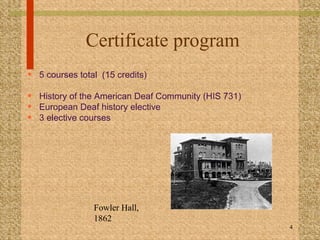
Certificate program 5 courses total  (15 credits) History of the American Deaf Community (HIS 731) European Deaf history elective 3 elective courses Fowler Hall, 1862
Courses offered His 731: History of the American Deaf community  HIS 732 History of Mass Media and the Deaf Community HIS 733: Topics in European Deaf History  HIS 734: Deaf People in Hitler's Europe HIS 735: History of Disability in the United States HIS 755: Deaf Women's History  HIS 787: Introduction to Historical Methods and Research  HIS 793: History Research Project I  HIS 794: History Research Project II  HIS 795: Special Topics in History  HIS 799: Independent Study
Mission Statement  The Deaf History Certificate program, established in 2000, provides post-baccalaureate graduate-level training in Deaf history for students and professionals. Graduates are taught and encouraged to utilize new insights and scholarship in their work and for their professional advancement. Our courses promote history research methods and content, emphasizing how the approaches and methods of social and cultural history can be applied to the history of deaf people and communities around the world. A key component of our programs is to protect and preserve Deaf history and heritage via signed and written media, as well as by the use of a variety of electronic media.   
Current careers and benefits: program graduates VL2: Community Engagement Coordinator Director, Deaf AIDS project at Family Service Foundation Elementary & High school teachers (history/social studies) Smithsonian Institute  Independent scholars
Have that academic itch? Intellectual growth Opportunities for research/scholarship Deaf History Lecture series Expanded contacts in the field
Questions? Contact: [email_address] All photos courtesy of  Gallaudet University Archives

Deaf History Certificate Program

  • 1.
    Deaf History CertificateProgram January 21, 2010 Brian H. Greenwald, Ph.D. Director, Deaf History Certificate Program
  • 2.
    Back then… KendallMansion, 1850s Stable and Carriage House, 1860
  • 3.
    Deaf history certificateprogram Graduate level course work covering American Deaf history, mass media, and topics in European Deaf history Research methods and content Develop skills and awareness regarding the present state of knowledge and research in Deaf history. Gain new insight and scholarship -- history, interpreting, teaching, counseling, social work, research, Deaf studies
  • 4.
    Certificate program 5courses total (15 credits) History of the American Deaf Community (HIS 731) European Deaf history elective 3 elective courses Fowler Hall, 1862
  • 5.
    Courses offered His731: History of the American Deaf community HIS 732 History of Mass Media and the Deaf Community HIS 733: Topics in European Deaf History HIS 734: Deaf People in Hitler's Europe HIS 735: History of Disability in the United States HIS 755: Deaf Women's History HIS 787: Introduction to Historical Methods and Research HIS 793: History Research Project I HIS 794: History Research Project II HIS 795: Special Topics in History HIS 799: Independent Study
  • 6.
    Mission Statement The Deaf History Certificate program, established in 2000, provides post-baccalaureate graduate-level training in Deaf history for students and professionals. Graduates are taught and encouraged to utilize new insights and scholarship in their work and for their professional advancement. Our courses promote history research methods and content, emphasizing how the approaches and methods of social and cultural history can be applied to the history of deaf people and communities around the world. A key component of our programs is to protect and preserve Deaf history and heritage via signed and written media, as well as by the use of a variety of electronic media.   
  • 7.
    Current careers andbenefits: program graduates VL2: Community Engagement Coordinator Director, Deaf AIDS project at Family Service Foundation Elementary & High school teachers (history/social studies) Smithsonian Institute Independent scholars
  • 8.
    Have that academicitch? Intellectual growth Opportunities for research/scholarship Deaf History Lecture series Expanded contacts in the field
  • 9.
    Questions? Contact: [email_address]All photos courtesy of Gallaudet University Archives