Panagunahing mga
  Pangangailangan
    ng mga Bingi
   Basic Needs of the Deaf


Ms. Joy L. Cristal, M.A. Psychology, RGC
Pangunahing mga Pangangailangan
              ng mga Deaf
   1. MAUNAWAAN
   2. ITURING BILANG INDIBIDWAL
   3. PAHALAGAHAN ANG NAGAGAWA SA PAMANTAYAN NA
    KATULAD NG MGA SA NAKAKARINIG
   4. MAPAGLINGKURAN NG MGA TUNAY NA PROPESYONAL
    SA LAHAT NG LARANGAN.
   5.BIGYAN NG SAPAT NA PANAHON
   6.ITURING BILANG KAPANTAY AT KAISA
   7. MATUTONG MAKISALAMUHA
   8.MAGKAROON NG MGA PAGKAKATAONG NAAANGKOP SA
    MGA KAKAYAHAN
   9. TANGGAPIN BILANG KATUWANG SA MGA PROGRAM AT
    PROYEKTO
   10. BIGYAN NG PANTAY NG SERBISYO AT PAGKAKATAON
Basic Needs of the Deaf
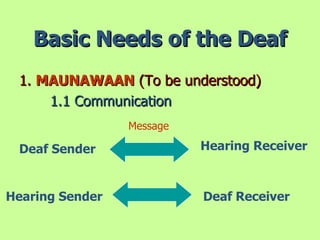
 1. MAUNAWAAN (To be understood)
     1.1 Communication
                 Message

 Deaf Sender               Hearing Receiver


Hearing Sender             Deaf Receiver
MAHALAGA SA MGA BINGI
           (Important for Deaf people)


1.   Clear communication/no barrier
2.   Eye contact
3.   Clear facial expression
4.   Simple sentence
5.   Better to use English than Tagalog
6.   Provide explanation not just yes or no
7.   Listen to the feeling of the Deaf
     (be sensitive)
Basic Needs of the Deaf
    1.2. Understanding the impact of deafness on
  the physical, social, vocational, emotional &
  spiritual growth & functioning of the person.

   Ex. Low Reading & Writing Skills (due to late
  language development)
PLEASE DO NOT LAUGH AT THE DEAF WHEN THEY
  WRITE WRONG ENGLISH.
 Poor reading and writing skills make it difficult for
  the Deaf to get employed. PLEASE LOOK AT
  THEIR OTHER IMPORTANT SKILLS NOT THEIR
  READING AND WRITING.
Basic Needs of the Deaf
2. ITURINGBILANG MGA
  INDIBIDWAL
(To be treated as individuals)
      2.1. Deaf as humans with rights & dignity.
     2.2. Deaf people are only different. They are not
  abnormal.
     2.3. Deaf people are not all the same. They have
  different personalities, moods, backgrounds,
  opinions, etc.
Basic Needs of the Deaf
3. PAHALAGAHAN ANG
  NAGAGAWA SA PAMANTAYAN NA
  KATULAD NG MGA SA
  NAKAKARINIG To be held to the
  same standards of performance as
  their hearing peers.)

    3.1. Deaf people have the same
 range of potentials as hearing people
 but they don’t get enough
 opportunities.
Basic Needs of the Deaf

  3.2. Teachers and parents must
challenge the Deaf to develop
themselves but teachers must
give them enough support.
  3.3. It is not fair to lower the
expectations for the Deaf.
Basic Needs of the Deaf
4. MAPAGSILBIHAN NG MGA
 TUNAY NA PROPESYONAL SA
 LAHAT NG LARANGAN.
(To be served by real professionals in all
  areas.)
      4.1. Teachers, counselors, psychologist,
  interpreters, social workers etc. must be
  real & competent professionals.
     4.2. Hopefully, professionals serving the
  Deaf know about Deaf Culture.
Basic Needs of the Deaf

4.3. People who provide
 services for the Deaf must
 not view them as “cheap” or
 “lower class”.
Basic Needs of the Deaf
5. BIGYAN
       NG SAPAT NA
 PANAHON. (To be allowed time.)
  5.1. Due to the uniqueness of deafness, Deaf
 people need time.

     Ex. Interpreting from spoken to sign language
 needs time. As a consequence, the Deaf might
 respond late. The Hearing person should speak at
 moderate speed when communicating through an
 interpreter.
Basic Needs of the Deaf
                   Interpreter
        VOICE INTERPRET
                            SIGN for the Deaf
        for the Hearing


Nagsasalita
                                      NAGSESENYAS
    Hearing person               Deaf person
Basic Needs of the Deaf

5.2. Many Deaf people lack skills
 due to their previous educational
 experience. They may need more
 time to acquire new skills.
Basic Needs of the Deaf

   6. ITURING BILANG KAPANTAY AT
    KAISA (To be held equal, to be
    integrated.)
        6.1. Deaf people are also children of
    God like hearing people.
        6.2. Deaf people and hearing people
    are equal to each other. Deaf people are
    not inferior to the hearing people.
Basic Needs of the Deaf
6.3. Deaf people must not be marginalized
  (pushed out of the center). They should be
  given roles and place in the society.

                  Hearing world

    Hearing person
                                    Deaf person
Basic Needs of the Deaf

7. MATUTONG MAKISALAMUHA (To
  achieve social maturity)
     7.1. Deaf people must be allowed to
  interact with people. Hearing families
  should not HIDE their deaf children.
     7.2. Deaf people need to find their
  DEAF identity by interacting with other
  Deaf people and belonging to Deaf
  Community.
Basic Needs of the Deaf
  7.3. Deaf people share a
language and a culture. They have
unique ways. Every Deaf child has
a right to use sign language and
belong to Deaf culture.
  7.4. Deaf people must be
allowed to become independent.
Basic Needs of the Deaf
8.MAGKAROON NG MGA
 PAGKAKATAONG NAAANGKOP SA
 MGA KAKAYAHAN (To attain
 opportunities commensurate with capacities)
    8.1. Deaf people can acquire work skills if
 they are trained.
    8.2. Deaf people must be hired for a job if
 they are qualified. Being Deaf must not be a
 reason why employers will reject them.
Basic Needs of the Deaf
9. TANGGAPINBILANG KATUWANG
  SA MGA PROGRAM AT
  PROYEKTO ( To be accepted as partners in
  programs & projects)
    9.1. Deaf people must not only be receivers of
  programs & projects.
    9.2. Deaf & hearing people should work
  together in programs & projects.
     9.3. Deaf people are not useless helpless
  disabled!
Basic Needs of the Deaf
10. BIGYAN NG PANTAY NG
 SERBISYO AT PAGKAKATAON ( To
 be given equal service opportunities)

    10.1 Deaf people (like hearing people)
 need services such as
Basic Needs of the Deaf
    Legal services (service of lawyers
      INTERPRETERS in courts)
    Educational services
    Medical services
    Rehabilitation centers
    House or shelter for the abused

Many of these services are available only
 for hearing people.
Reference:
   Excerpt from the article of William R.
    Boyce, Consultant Deaf & HH, Office of
    Vocational Rehabilitation, Department of
    Health Education & Welfare.
Thank You!

Basic Needs Of The Deaf

  • 1.
    Panagunahing mga Pangangailangan ng mga Bingi Basic Needs of the Deaf Ms. Joy L. Cristal, M.A. Psychology, RGC
  • 2.
    Pangunahing mga Pangangailangan ng mga Deaf  1. MAUNAWAAN  2. ITURING BILANG INDIBIDWAL  3. PAHALAGAHAN ANG NAGAGAWA SA PAMANTAYAN NA KATULAD NG MGA SA NAKAKARINIG  4. MAPAGLINGKURAN NG MGA TUNAY NA PROPESYONAL SA LAHAT NG LARANGAN.  5.BIGYAN NG SAPAT NA PANAHON  6.ITURING BILANG KAPANTAY AT KAISA  7. MATUTONG MAKISALAMUHA  8.MAGKAROON NG MGA PAGKAKATAONG NAAANGKOP SA MGA KAKAYAHAN  9. TANGGAPIN BILANG KATUWANG SA MGA PROGRAM AT PROYEKTO  10. BIGYAN NG PANTAY NG SERBISYO AT PAGKAKATAON
  • 3.
    Basic Needs ofthe Deaf 1. MAUNAWAAN (To be understood) 1.1 Communication Message Deaf Sender Hearing Receiver Hearing Sender Deaf Receiver
  • 4.
    MAHALAGA SA MGABINGI (Important for Deaf people) 1. Clear communication/no barrier 2. Eye contact 3. Clear facial expression 4. Simple sentence 5. Better to use English than Tagalog 6. Provide explanation not just yes or no 7. Listen to the feeling of the Deaf (be sensitive)
  • 5.
    Basic Needs ofthe Deaf 1.2. Understanding the impact of deafness on the physical, social, vocational, emotional & spiritual growth & functioning of the person. Ex. Low Reading & Writing Skills (due to late language development) PLEASE DO NOT LAUGH AT THE DEAF WHEN THEY WRITE WRONG ENGLISH. Poor reading and writing skills make it difficult for the Deaf to get employed. PLEASE LOOK AT THEIR OTHER IMPORTANT SKILLS NOT THEIR READING AND WRITING.
  • 6.
    Basic Needs ofthe Deaf 2. ITURINGBILANG MGA INDIBIDWAL (To be treated as individuals) 2.1. Deaf as humans with rights & dignity. 2.2. Deaf people are only different. They are not abnormal. 2.3. Deaf people are not all the same. They have different personalities, moods, backgrounds, opinions, etc.
  • 7.
    Basic Needs ofthe Deaf 3. PAHALAGAHAN ANG NAGAGAWA SA PAMANTAYAN NA KATULAD NG MGA SA NAKAKARINIG To be held to the same standards of performance as their hearing peers.) 3.1. Deaf people have the same range of potentials as hearing people but they don’t get enough opportunities.
  • 8.
    Basic Needs ofthe Deaf 3.2. Teachers and parents must challenge the Deaf to develop themselves but teachers must give them enough support. 3.3. It is not fair to lower the expectations for the Deaf.
  • 9.
    Basic Needs ofthe Deaf 4. MAPAGSILBIHAN NG MGA TUNAY NA PROPESYONAL SA LAHAT NG LARANGAN. (To be served by real professionals in all areas.) 4.1. Teachers, counselors, psychologist, interpreters, social workers etc. must be real & competent professionals. 4.2. Hopefully, professionals serving the Deaf know about Deaf Culture.
  • 10.
    Basic Needs ofthe Deaf 4.3. People who provide services for the Deaf must not view them as “cheap” or “lower class”.
  • 11.
    Basic Needs ofthe Deaf 5. BIGYAN NG SAPAT NA PANAHON. (To be allowed time.) 5.1. Due to the uniqueness of deafness, Deaf people need time. Ex. Interpreting from spoken to sign language needs time. As a consequence, the Deaf might respond late. The Hearing person should speak at moderate speed when communicating through an interpreter.
  • 12.
    Basic Needs ofthe Deaf Interpreter VOICE INTERPRET SIGN for the Deaf for the Hearing Nagsasalita NAGSESENYAS Hearing person Deaf person
  • 13.
    Basic Needs ofthe Deaf 5.2. Many Deaf people lack skills due to their previous educational experience. They may need more time to acquire new skills.
  • 14.
    Basic Needs ofthe Deaf  6. ITURING BILANG KAPANTAY AT KAISA (To be held equal, to be integrated.) 6.1. Deaf people are also children of God like hearing people. 6.2. Deaf people and hearing people are equal to each other. Deaf people are not inferior to the hearing people.
  • 15.
    Basic Needs ofthe Deaf 6.3. Deaf people must not be marginalized (pushed out of the center). They should be given roles and place in the society. Hearing world Hearing person Deaf person
  • 16.
    Basic Needs ofthe Deaf 7. MATUTONG MAKISALAMUHA (To achieve social maturity) 7.1. Deaf people must be allowed to interact with people. Hearing families should not HIDE their deaf children. 7.2. Deaf people need to find their DEAF identity by interacting with other Deaf people and belonging to Deaf Community.
  • 17.
    Basic Needs ofthe Deaf 7.3. Deaf people share a language and a culture. They have unique ways. Every Deaf child has a right to use sign language and belong to Deaf culture. 7.4. Deaf people must be allowed to become independent.
  • 18.
    Basic Needs ofthe Deaf 8.MAGKAROON NG MGA PAGKAKATAONG NAAANGKOP SA MGA KAKAYAHAN (To attain opportunities commensurate with capacities) 8.1. Deaf people can acquire work skills if they are trained. 8.2. Deaf people must be hired for a job if they are qualified. Being Deaf must not be a reason why employers will reject them.
  • 19.
    Basic Needs ofthe Deaf 9. TANGGAPINBILANG KATUWANG SA MGA PROGRAM AT PROYEKTO ( To be accepted as partners in programs & projects) 9.1. Deaf people must not only be receivers of programs & projects. 9.2. Deaf & hearing people should work together in programs & projects. 9.3. Deaf people are not useless helpless disabled!
  • 20.
    Basic Needs ofthe Deaf 10. BIGYAN NG PANTAY NG SERBISYO AT PAGKAKATAON ( To be given equal service opportunities) 10.1 Deaf people (like hearing people) need services such as
  • 21.
    Basic Needs ofthe Deaf  Legal services (service of lawyers INTERPRETERS in courts)  Educational services  Medical services  Rehabilitation centers  House or shelter for the abused Many of these services are available only for hearing people.
  • 22.
    Reference:  Excerpt from the article of William R. Boyce, Consultant Deaf & HH, Office of Vocational Rehabilitation, Department of Health Education & Welfare.
  • 23.