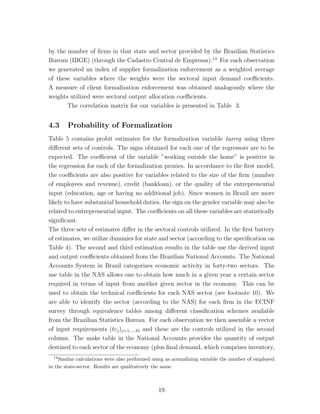
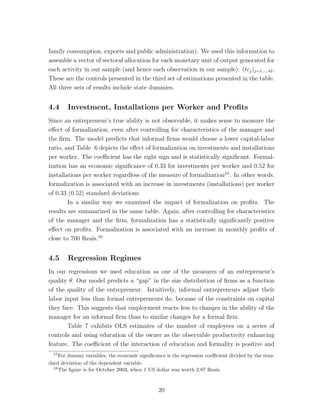
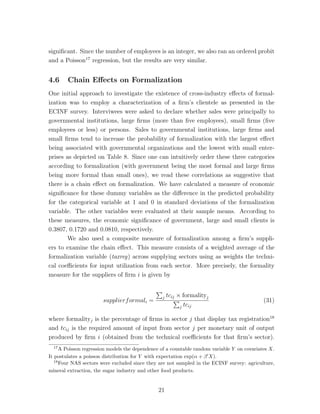
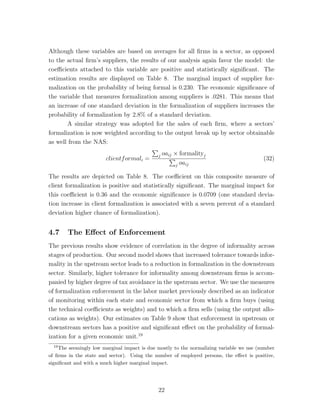
The Informal Sector  
´Aureo de Paula † 
University of Pennsylvania 
Jos´e A. Scheinkman ‡ 
Princeton University and NBER 
First version: January 11, 2006 
This Version: July 12, 2006 
We thank Rita Almeida and Sandra Brand˜ao for their help with the enforcement data, Joana 
Monteiro and Juliano Assun¸c˜ao for providing the ECINF dataset and for clarifying its content and 
methodology, and Julio Cacho for research assistance. We also benefited from comments by seminar 
participants at the 2006 NASMES. Scheinkman’s research was supported by the National Science 
Foundation through grant 0350770. 
†Department of Economics, University of Pennsylvania, Philadelphia, PA 19104. E-mail: 
aureo@sas.upenn.edu 
‡Department of Economics, Princeton University, Princeton, NJ 08544. E-mail: 
joses@princeton.edu 
1
Abstract 
This paper investigates the determinants of informal economic activity. We present two equilibrium 
models of the determinants of informality and test their implications using a survey of 50,000+ 
small firms in Brazil. We define informality as tax avoidance; firms in the informal sector avoid 
tax payments but suffer other limitations. In the first model there is a single industry and informal 
firms face a higher cost of capital and a limitation on size. As a result informal firms are smaller 
and have a lower capital-labor ratio. These implications are supported by our empirical analysis. 
A novel theoretical contribution in this paper is a model that highlights the role of value added 
taxes in transmitting informality. It predicts that the informality of a firm is correlated to the 
informality of firms from which it buys or sells. The model also implies that higher tolerance for 
informal firms in one production stage increases tax avoidance in downstream and upstream sectors. 
Empirical analysis shows that, in fact, various measures of formality of suppliers and purchasers 
(and its enforcement) are correlated with the formality of a firm. Even more interestingly, when we 
look at sectors where Brazilian firms are not subject to the credit system of value added tax, but 
instead the value added tax is applied at some stage of production at a rate that is estimated by 
the State, this chain effect vanishes. 
JEL Codes: 
2
1 Introduction 
In this paper we investigate the determinants of informality. It is difficult to unam-biguously 
define informal activities but estimates indicate that in 1990-1993 around 
10% of GDP in the United States was produced by individuals or firms that evaded 
taxes or engaged in illegal pursuits. It is also estimated that these activities produce 
25 to 35% of output in Latin America, between 13 to 70% in Asian countries, and 
around 15% in O.E.C.D. countries. (see Table 2 in Schneider and Enste [17]). 
Informality creates a fiscal problem, but there is also growing evidence that 
informal firms are less efficient,1 perhaps because of their necessarily small scale, 
perhaps because of their lack of access to credit or access to the infrastructure of legal 
protection provided by the State. For less developed countries, creating incentives for 
formalization is viewed as an important step to increase aggregate productivity. 
We present two equilibrium models of the determinants of informality and 
test their implications using a survey of 50,000+ small firms in Brazil. In both 
models informality is defined as tax avoidance. Firms in the informal sector avoid 
tax payments but suffer other limitations. 
The first model can be seen as a variant of Rausch [14], who relied on the 
modeling strategy of Lucas [11] in which managerial ability differs across agents in 
the economy, and assumed a limitation on the size of informal firms. We make a key 
modification that generates testable implications. The firms in our model use capital 
in addition to labor and informal firms face a higher cost of funds. This higher cost 
of capital for informal activities has been emphasized by DeSoto [4] who wrote that 
“Even in the poorest countries, the poor save. The value of savings among the poor 
is, in fact, immense − forty times all the foreign aid received throughout the world 
since 1945. (. . . ) But they hold these resources in defective forms: houses built on 
land whose ownership rights are not adequately recorded, unincorporated businesses 
with undefined liability, industries located where financiers and investors cannot see 
them. Because the rights of these possessions are not adequately documented, these 
assets cannot readily be turned into capital, cannot be traded outside of narrow local 
circles where people know and trust each other, cannot be used as collateral for a loan, 
and cannot be used as a share against investment.”2 This difference in interest rates 
1McKinsey [12] provides case study evidence on the impact of informality on firms’ productivity. 
They estimate that the ratio of labor productivity between informal and formal firms is 39% in 
Turkey and 46% in Brazil. 
2DeSoto [4], p.5-6. DeSoto [3] estimates that in June/85, informal firms in Lima (Peru) faced a 
nominal interest rate of 22% per-month, while formal firms paid only 4.9% per month. Straub [18] 
3
induces a higher capital-labor ratio in formal firms.3 As in Rausch [14], agents with 
lowest managerial ability become workers and the ones with highest ability become 
formal managers, with the intermediate group running informal firms. This is because 
managers with more ability would naturally run larger firms and employ more capital; 
for this reason they choose to join the formal sector, where they do not face limits on 
capital deployment and face a lower cost of capital. The marginal firm trades off the 
cost of paying taxes versus the higher cost of capital and scale limitations of informal 
firms. As a result, the marginal firm would employ in the informal sector less capital 
and labor than it would employ if it joined the formal sector. Thus, as in Rausch [14] 
or Fortin et al. [6], a size gap develops. Managers that are slightly more efficient than 
the manager of the marginal firm employ discretely larger amounts of capital and 
labor. 
Several implications of this model are supported by our empirical analysis. 
Formalization is positively correlated with the size of firms and measures of the qual-ity 
of the entrepreneurial input. Even after controlling for our measures of the quality 
of an entrepreneur, formalization is correlated with a firm’s capital-labor ratio or in-vestment 
per worker. In addition, after controlling for the quality of the entrepreneur, 
formalization is correlated with higher profits. 
The main focus of our theoretical analysis is a model that highlights the role 
of value added taxes in transmitting informality. The value added tax is a prevalent 
form of indirect taxation: more than 120 nations had adopted it by 2000.4 It exploits 
the idea that collecting value added taxes according to a credit scheme sets in motion 
a mechanism for the transmission of informality. In the credit or invoice method the 
value added tax applies to each sale and each establishment receives a credit for the 
amount of tax paid in the previous stages of the production chain. This credit is then 
used by the taxpayer against future liabilities with the tax authorities. The credit 
method is often used in practice because it offers advantages over other collection 
methods: (1) the tax liability is attached to the transaction and the invoice provides 
an important documentary evidence; (2) an audit trail is established and there is an 
important self-monitoring dimension across firms in different stages of the production 
chain; (3) multiple rates can be used and certain activities may be exempt for social 
or economic purposes (see [19]). Since purchases from informal suppliers are ineligible 
for tax credits, an incentive exists for the propagation of informality downstream in 
develops a model in which a dual credit system arises in equilibrium. 
3It is also probable that informal firms face lower labor costs, because their workers avoid some 
labor taxes. This would induce even larger differences in capital-labor ratio. 
4See Appendix 4 in Schenk and Oldman [16]. 
4
the production chain. A similar mechanism also influences firms upstream in the 
chain: selling to informal firms increases the likelihood for a firm to be informal. Our 
empirical analysis shows that, in fact, various measures of formality of suppliers and 
(and its enforcement) purchasers are correlated with the formality of a firm. Even 
more interestingly, when we look at sectors where Brazilian firms are not subject 
to the credit system of value added tax, but instead the value added tax is applied 
after some stage of production at a rate that is estimated by the State, this chain 
effect vanishes. To our knowledge, the only study to investigate the informal sector 
in conjunction with a VAT structure is Emran and Stiglitz [5]. Their focus is on the 
consequences of informality for a revenue neutral tax reform involving value added 
and trade taxes. 
Our models ignore some possible alternative reasons for informality, such as the 
fixed cost of complying with regulations or the existence of a minimum-wage. While 
we could accommodate the existence of a minimum wage, some empirical evidence 
actually points out that minimum wages may be as binding (if not more) in the 
informal sector than in the formal segment of the economy in Latin America (see 
Maloney and Mendez [13]). 
Other papers that investigate causes and determinants of informality include 
Loayza [10], Friedman et al. [7], and Junqueira and Monteiro [9] who used the same 
dataset as we do. These authors have provided evidence of an association between 
the size of the underground economy and higher taxes, more labor market restric-tions, 
and poorer institutions (bureaucracy, corruption and legal environment). The 
combination of the models we develop and the Brazilian microdata allows us to add 
novel insights to this literature. 
The remainder of this paper is organized as follows. In the next section we 
develop a model of a single industry, while in Section 3 we treat the model with two 
stages of production. Section 4 contains the empirical results obtained using data on 
informal firms in Brazil and Section 5 concludes. 
2 A Model with One Production Stage 
We consider a continuum of agents; each characterized by a parameter   0 which 
indicates his quality as an entrepreneur and is distributed according to a probability 
density function g(·). An entrepreneur chooses between becoming a worker, operating 
a firm in the formal sector or in the informal sector. If an entrepreneur employs l 
workers and k units of capital, output equals y = kl
, with ,
0 and +
1. 
5
A formal entrepreneur pays an ad valorem tax rate of  and faces a capital 
cost of rf  0 per unit. An informal entrepreneur pays no taxes, but faces a capital 
cost of ri  rf . All workers are paid the same wage w. 
An informal entrepreneur, if detected by the authorities, loses all his profits. 
The probability of being detected depends monotonically on the size of the firm. 
Though there are several possibilities for measuring the size of the firm - output, 
capital stock or labor force - we choose here the size of the capital stock (which we 
identify in the empirical work as the value of installations), because we imagine the 
probability of detection as a function of the “visibility” of the firm. We write p(k) for 
the probability of detection. While in the appendix we discuss a more general form 
for the function p we will assume here that: 
p(k) = 0, if k  k (1) 
= 1, if k  k, (2) 
that is an informal firm cannot employ more than k units of capital, but will not 
suffer any penalty when k  k. 
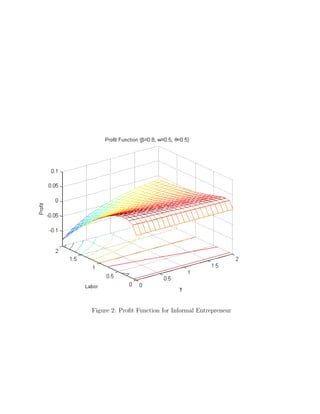
Hence the profit for an entrepreneur of quality  that chooses to be informal 
is given by 
i(, ri) = max 
l,kk 
{l
k − wl − rik}, (3) 
whereas if he chooses to enter the formal sector profits will be: 
f (, rf ) = max 
l,k 
{(1 −  )l
k − wl − rfk} (4) 
The capital-labor ratios of formal firms or informal firms that are uncon-strained 
are proportional to the relative prices between labor and capital and inde-pendent 
of the entrepreneur’s ability. Since ri  rf , the unconstrained informal firms 
have a lower capital-labor ratio than the formal firms. In addition, the constrained 
informal firms have a lower capital-labor ratio than the unconstrained informal firms. 
Hence the capital-labor ratios of informal firms are lower than that of the formal 
firms, the difference being bigger the larger the difference in capital costs between 
informal and formal firms (ri − rf ) is. In Section 4 we provide evidence in favor of 
the predicted difference in capital-labor ratios between formal and informal firms. 
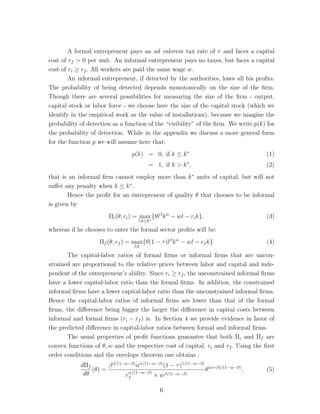
The usual properties of profit functions guarantee that both i and f are 
convex functions of ,w and the respective cost of capital, ri and rf . Using the first 
order conditions and the envelope theorem one obtains : 
df 
d 
() =
/(1−−
)/(1−−
)(1 −  )1/(1−−
) 
r/(1−−
) 
f × w
/(1−−
) 
(+
)/(1−−
), (5) 
6
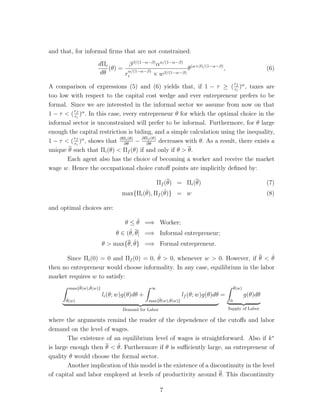
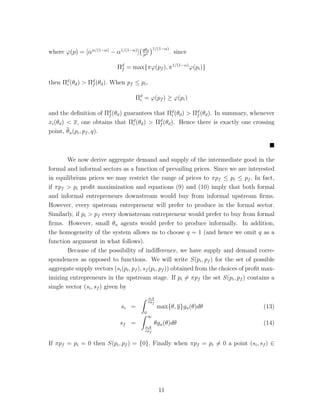
and that, for informal firms that are not constrained: 
di 
d 
() =
/(1−−
)/(1−−
) 
r/(1−−
) 
i × w
/(1−−
) 
(+
)/(1−−
), (6) 
A comparison of expressions (5) and (6) yields that, if 1 −   ( rf 
ri 
), taxes are 
too low with respect to the capital cost wedge and ever entrepreneur prefers to be 
formal. Since we are interested in the informal sector we assume from now on that 
1 −   ( rf 
ri 
). In this case, every entrepreneur  for which the optimal choice in the 
informal sector is unconstrained will prefer to be informal. Furthermore, for  large 
enough the capital restriction is biding, and a simple calculation using the inequality, 
1 −   ( rf 
ri 
@ − @f () 
@ decreases with . As a result, there exists a 
), shows that @i() 
unique  such that i()  f () if and only if   . 
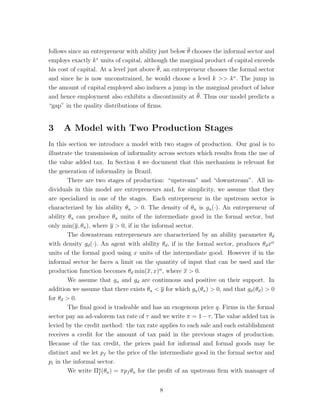
Each agent also has the choice of becoming a worker and receive the market 
wage w. Hence the occupational choice cutoff points are implicitly defined by: 
f () = i() (7) 
max{i(ˆ),f (ˆ)} = w (8) 
and optimal choices are: 
  ˆ =) Worker; 
 2 (ˆ, ] =) Informal entrepreneur; 
  max{, ˆ} =) Formal entrepreneur. 
Since i(0) = 0 and f (0) = 0, ˆ  0, whenever w  0. However, if   ˆ 
then no entrepreneur would choose informality. In any case, equilibrium in the labor 
market requires w to satisfy: 
Z max{(w),ˆ(w)} 
ˆ(w) 
li(;w)g()d + 
Z 1 
max{(w),ˆ(w)} 
lf (;w)g()d 
| {z } 
Demand for Labor 
= 
Z ˆ(w) 
0 
g()d 
| {z } 
Supply of Labor 
where the arguments remind the reader of the dependence of the cutoffs and labor 
demand on the level of wages. 
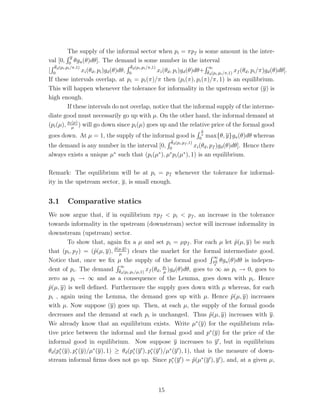
The existence of an equilibrium level of wages is straightforward. Also if k 
is large enough then   ˆ. Furthermore if  is sufficiently large, an entrepreneur of 
quality  would choose the formal sector. 
Another implication of this model is the existence of a discontinuity in the level 
of capital and labor employed at levels of productivity around . This discontinuity 
7
follows since an entrepreneur with ability just below  chooses the informal sector and 
employs exactly k units of capital, although the marginal product of capital exceeds 
his cost of capital. At a level just above , an entrepreneur chooses the formal sector 
and since he is now unconstrained, he would choose a level k  k. The jump in 
the amount of capital employed also induces a jump in the marginal product of labor 
and hence employment also exhibits a discontinuity at . Thus our model predicts a 
“gap” in the quality distributions of firms. 
3 A Model with Two Production Stages 
In this section we introduce a model with two stages of production. Our goal is to 
illustrate the transmission of informality across sectors which results from the use of 
the value added tax. In Section 4 we document that this mechanism is relevant for 
the generation of informality in Brazil. 
There are two stages of production: “upstream” and “downstream”. All in-dividuals 
in this model are entrepreneurs and, for simplicity, we assume that they 
are specialized in one of the stages. Each entrepreneur in the upstream sector is 
characterized by his ability u  0. The density of u is gu(·). An entrepreneur of 
ability u can produce u units of the intermediate good in the formal sector, but 
only min(y, u), where y  0, if in the informal sector. 
The downstream entrepreneurs are characterized by an ability parameter d 
with density gd(·). An agent with ability d, if in the formal sector, produces dx 
units of the formal good using x units of the intermediate good. However if in the 
informal sector he faces a limit on the quantity of input that can be used and the 
production function becomes d min(x, x), where x  0. 
We assume that gu and gd are continuous and positive on their support. In 
addition we assume that there exists u  y for which gu(u)  0, and that gd(d)  0 
for d  0. 
The final good is tradeable and has an exogenous price q. Firms in the formal 
sector pay an ad-valorem tax rate of  and we write  = 1−. The value added tax is 
levied by the credit method: the tax rate applies to each sale and each establishment 
receives a credit for the amount of tax paid in the previous stages of production. 
Because of the tax credit, the prices paid for informal and formal goods may be 
distinct and we let pf be the price of the intermediate good in the formal sector and 
pi in the informal sector. 
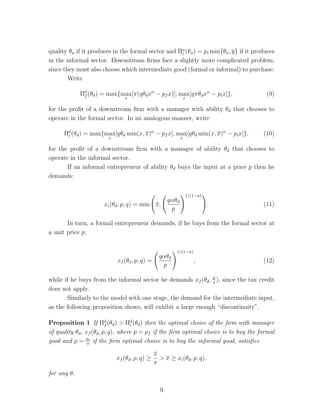
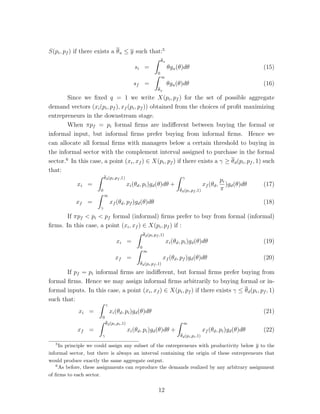
We write uf 
(u) = pf u for the profit of an upstream firm with manager of 
8
quality u if it produces in the formal sector and ui 
(u) = pi min{u, y} if it produces 
in the informal sector. Downstream firms face a slightly more complicated problem, 
since they must also choose which intermediate good (formal or informal) to purchase. 
Write 
df 
(d) = max{max 
x 
[(qdx − pfx)], max 
x 
[qdx − pix]}, (9) 
for the profit of a downstream firm with a manager with ability d that chooses to 
operate in the formal sector. In an analogous manner, write 
di 
(d) = max{max 
x 
[qd min(x, x) − pfx], max 
x 
[qd min(x, x) − pix]}, (10) 
for the profit of a downstream firm with a manager of ability d that chooses to 
operate in the informal sector. 
If an informal entrepreneur of ability d buys the input at a price p then he 
demands: 
xi(d, p, q) = min 
  
x, 
  
qd 
p 
!1/(1−)! 
. (11) 
In turn, a formal entrepreneur demands, if he buys from the formal sector at 
a unit price p: 
xf (d, p, q) = 
  
qd 
p 
!1/(1−) 
, (12) 
while if he buys from the informal sector he demands xf (d, p 
 ), since the tax credit 
does not apply. 
Similarly to the model with one stage, the demand for the intermediate input, 
as the following proposition shows, will exhibit a large enough “discontinuity”. 
Proposition 1 If df 
(d)  di 
(d) then the optimal choice of the firm with manager 
of quality d, xf (d, p, q), where p = pf if the firm optimal choice is to buy the formal 
good and p = pi 
 if the firm optimal choice is to buy the informal good, satisfies 
xf (d, p, q)  
x 
 
 x  xi(d, p, q), 
for any . 
9
Proof: Suppose first that it is optimal for the firm with manager of quality d to buy 
the formal good. If xf (d, pf , q)  x, since 
qd(xf (d, pf , q)) − pfxf (d, pf , q)  (qdxf 
(d, pf , q) − pfxf (d, pf , q)), 
the firm would prefer to be in the informal sector and buy xf (d, pf , q) of formal 
inputs. If the firm bought the informal good and xf (d, pi 
 , q)  x, since 
qd(xf (d, 
pi 
 
, q)) − pixf (d, 
pi 
 
, q)  qdxf 
(d, 
pi 
 
, q) − pixf (d, 
pi 
 
, q), 
the firm would prefer to be in the informal sector and buy xf (d, pi 
 , q) of informal 
inputs. 
 
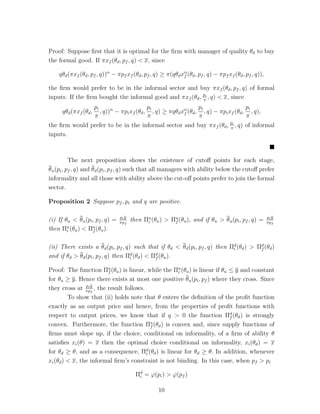
The next proposition shows the existence of cutoff points for each stage, 
u(pi, pf , q) and d(pi, pf , q) such that all managers with ability below the cutoff prefer 
informality and all those with ability above the cut-off points prefer to join the formal 
sector. 
Proposition 2 Suppose pf , pi and q are positive. 
(i) If u  u(pi, pf , q) = piy 
pf 
then ui 
(u)  uf 
(u), and if u  u(pi, pf , q) = piy 
pf 
then ui 
(u)  uf 
(u). 
(ii) There exists a d(pi, pf , q) such that if d  d(pi, pf , q) then di 
(d)  df 
(d) 
and if d  d(pi, pf , q) then di 
(d)  df(u). 
Proof: The function uf 
(u) is linear, while the ui 
(u) is linear if u  y and constant 
for u  y. Hence there exists at most one positive u(pi, pf ) where they cross. Since 
they cross at piy 
pf 
, the result follows. 
To show that (ii) holds note that  enters the definition of the profit function 
df 
exactly as an output price and hence, from the properties of profit functions with 
respect to output prices, we know that if q  0 the function (d) is strongly 
convex. Furthermore, the function uf 
(d) is convex and, since supply functions of 
firms must slope up, if the choice, conditional on informality, of a firm of ability  
satisfies xi() = x then the optimal choice conditional on informality, xi(d) = x 
for d  , and as a consequence, di 
(d) is linear for d  . In addition, whenever 
xi(d)  x, the informal firm’s constraint is not binding. In this case, when pf  pi 
di 
= '(pi)  '(pf ) 
10
where '(p) = [/(1−) − 1/(1−)] 
qd 
p 
1/(1−) 
. since 
df 
= max{'(pf ), 1/(1−)'(pi)} 
then di 
(d)  df 
(d). When pf  pi, 
di 
= '(pf )  '(pi) 
and the definition of df 
(d) guarantees that di 
(d)  df 
(d). In summary, whenever 
xi(d)  x, one obtains that di 
(d)  df 
(d). Hence there is exactly one crossing 
point, u(pi, pf , q). 
 
We now derive aggregate demand and supply of the intermediate good in the 
formal and informal sectors as a function of prevailing prices. Since we are interested 
in equilibrium prices we may restrict the range of prices to pf  pi  pf . In fact, 
if pf  pi profit maximization and equations (9) and (10) imply that both formal 
and informal entrepreneurs downstream would buy from informal upstream firms. 
However, every upstream entrepreneur will prefer to produce in the formal sector. 
Similarly, if pi  pf every downstream entrepreneur would prefer to buy from formal 
firms. However, small u agents would prefer to produce informally. In addition, 
the homogeneity of the system allows us to choose q = 1 (and hence we omit q as a 
function argument in what follows). 
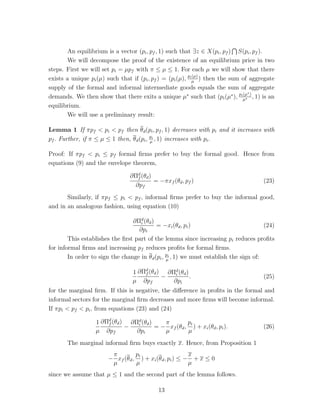
Because of the possibility of indifference, we have supply and demand corre-spondences 
as opposed to functions. We will write S(pi, pf ) for the set of possible 
aggregate supply vectors (si(pi, pf ), sf (pi, pf )) obtained from the choices of profit max-imizing 
entrepreneurs in the upstream stage. If pi6= pf the set S(pi, pf ) contains a 
single vector (si, sf ) given by 
si = 
Z piy 
pf 
0 
max{, y}gu()d (13) 
sf = 
Z 1 
piy 
pf 
gu()d (14) 
If pf = pi = 0 then S(pi, pf ) = {0}. Finally when pf = pi6= 0 a point (si, sf ) 2 
11
S(pi, pf ) if there exists a u  y such that:5 
si = 
Z u 
0 
gu()d (15) 
sf = 
Z 1 
u 
gu()d (16) 
Since we fixed q = 1 we write X(pi, pf ) for the set of possible aggregate 
demand vectors (xi(pi, pf ), xf (pi, pf )) obtained from the choices of profit maximizing 
entrepreneurs in the downstream stage. 
When pf = pi formal firms are indifferent between buying the formal or 
informal input, but informal firms prefer buying from informal firms. Hence we 
can allocate all formal firms with managers below a certain threshold to buying in 
the informal sector with the complement interval assigned to purchase in the formal 
sector.6 In this case, a point (xi, xf ) 2 X(pi, pf ) if there exists a 
  d(pi, pf , 1) such 
that: 
xi = 
Z d(pi,pf ,1) 
0 
xi(d, pi)gd()d + 
Z 
 
d(pi,pf ,1) 
xf (d, 
pi 
 
)gd()d (17) 
xf = 
Z 1 

 
xf (d, pf )gd()d (18) 
If pf  pi  pf formal (informal) firms prefer to buy from formal (informal) 
firms. In this case, a point (xi, xf ) 2 X(pi, pf ) if : 
xi = 
Z d(pi,pf ,1) 
0 
xi(d, pi)gd()d (19) 
xf = 
Z 1 
d(pi,pf ,1) 
xf (d, pf )gd()d (20) 
If pf = pi informal firms are indifferent, but formal firms prefer buying from 
formal firms. Hence we may assign informal firms arbitrarily to buying formal or in-formal 
inputs. In this case, a point (xi, xf ) 2 X(pi, pf ) if there exists 
  d(pi, pf , 1) 
such that: 
xi = 
Z 
 
0 
xi(d, pi)gd()d (21) 
xf = 
Z d(pi,pi,1) 

 
xi(d, pi)gd()d + 
Z 1 
d(pi,pi,1) 
xf (d, pi)gd()d (22) 
5In principle we could assign any subset of the entrepreneurs with productivity below y to the 
informal sector, but there is always an interval containing the origin of these entrepreneurs that 
would produce exactly the same aggregate output. 
6As before, these assignments can reproduce the demands realized by any arbitrary assignment 
of firms to each sector. 
12
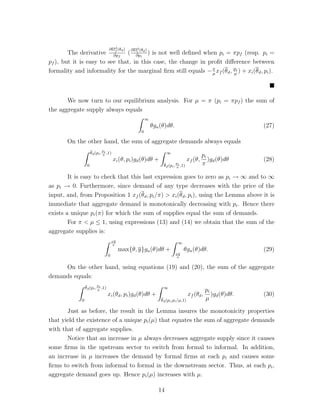
An equilibrium is a vector (pi, pf , 1) such that 9z 2 X(pi, pf ) 
T 
S(pi, pf ). 
We will decompose the proof of the existence of an equilibrium price in two 
steps. First we will set pi = μpf with   μ  1. For each μ we will show that there 
exists a unique pi(μ) such that if (pi, pf ) = (pi(μ), pi(μ) 
μ ) then the sum of aggregate 
supply of the formal and informal intermediate goods equals the sum of aggregate 
demands. We then show that there exits a unique μ such that (pi(μ), pi(μ) 
μ , 1) is an 
equilibrium. 
We will use a preliminary result: 
Lemma 1 If pf  pi  pf then d(pi, pf , 1) decreases with pi and it increases with 
pf . Further, if   μ  1 then, d(pi, pi 
μ , 1) increases with pi. 
Proof: If pf  pi  pf formal firms prefer to buy the formal good. Hence from 
equations (9) and the envelope theorem, 
@df 
(d) 
@pf 
= −xf (d, pf ) (23) 
Similarly, if pf  pi  pf , informal firms prefer to buy the informal good, 
and in an analogous fashion, using equation (10) 
@di 
(d) 
@pi 
= −xi(d, pi) (24) 
This establishes the first part of the lemma since increasing pi reduces profits 
for informal firms and increasing pf reduces profits for formal firms. 
In order to sign the change in d(pi, pi 
μ , 1) we must establish the sign of: 
1 
μ 
@df 
(d) 
@pf 
− 
@di 
(d) 
@pi 
. (25) 
for the marginal firm. If this is negative, the difference in profits in the formal and 
informal sectors for the marginal firm decreases and more firms will become informal. 
If pi  pf  pi, from equations (23) and (24) 
1 
μ 
@df 
(d) 
@pf 
− 
@di 
(d) 
@pi 
= − 
 
μ 
xf (d, 
pi 
μ 
) + xi(d, pi). (26) 
The marginal informal firm buys exactly x. Hence, from Proposition 1 
− 
 
μ 
xf (d, 
pi 
μ 
) + xi(d, pi)  − 
x 
μ 
+ x  0 
since we assume that μ  1 and the second part of the lemma follows. 
13
The derivative 
@df 
(d) 
@pf 
( @di 
(d) 
@pi 
) is not well defined when pi = pf (resp. pi = 
pf ), but it is easy to see that, in this case, the change in profit difference between 
formality and informality for the marginal firm still equals − 
μxf (d, pi 
μ ) + xi(d, pi). 
 
We now turn to our equilibrium analysis. For μ =  (pi = pf ) the sum of 
the aggregate supply always equals 
Z 1 
0 
gu()d. (27) 
On the other hand, the sum of aggregate demands always equals 
Z d(pi, pi 
 ,1) 
0 
xi(, pi)gd()d + 
Z 1 
d(pi, pi 
 ,1) 
xf (, 
pi 
 
)gd()d (28) 
It is easy to check that this last expression goes to zero as pi ! 1 and to 1 
as pi ! 0. Furthermore, since demand of any type decreases with the price of the 
input, and, from Proposition 1 xf (d, pi/)  xi(d, pi), using the Lemma above it is 
immediate that aggregate demand is monotonically decreasing with pi. Hence there 
exists a unique pi() for which the sum of supplies equal the sum of demands. 
For   μ  1, using expressions (13) and (14) we obtain that the sum of the 
aggregate supplies is: 
Z μy 
 
0 
max{, y}gu()d + 
Z 1 
μy 
 
gu()d. (29) 
On the other hand, using equations (19) and (20), the sum of the aggregate 
demands equals: 
Z d(pi, pi 
μ ,1) 
0 
xi(d, pi)gd()d + 
Z 1 
d(pi,pi/μ,1) 
xf (d, 
pi 
μ 
)gd()d. (30) 
Just as before, the result in the Lemma insures the monotonicity properties 
that yield the existence of a unique pi(μ) that equates the sum of aggregate demands 
with that of aggregate supplies. 
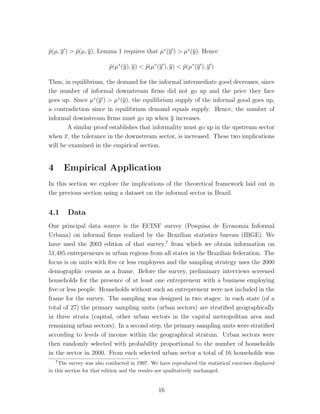
Notice that an increase in μ always decreases aggregate supply since it causes 
some firms in the upstream sector to switch from formal to informal. In addition, 
an increase in μ increases the demand by formal firms at each pi and causes some 
firms to switch from informal to formal in the downstream sector. Thus, at each pi, 
aggregate demand goes up. Hence pi(μ) increases with μ. 
14

De paula

  • 1.
    The Informal Sector ´Aureo de Paula † University of Pennsylvania Jos´e A. Scheinkman ‡ Princeton University and NBER First version: January 11, 2006 This Version: July 12, 2006 We thank Rita Almeida and Sandra Brand˜ao for their help with the enforcement data, Joana Monteiro and Juliano Assun¸c˜ao for providing the ECINF dataset and for clarifying its content and methodology, and Julio Cacho for research assistance. We also benefited from comments by seminar participants at the 2006 NASMES. Scheinkman’s research was supported by the National Science Foundation through grant 0350770. †Department of Economics, University of Pennsylvania, Philadelphia, PA 19104. E-mail: aureo@sas.upenn.edu ‡Department of Economics, Princeton University, Princeton, NJ 08544. E-mail: joses@princeton.edu 1
  • 2.
    Abstract This paperinvestigates the determinants of informal economic activity. We present two equilibrium models of the determinants of informality and test their implications using a survey of 50,000+ small firms in Brazil. We define informality as tax avoidance; firms in the informal sector avoid tax payments but suffer other limitations. In the first model there is a single industry and informal firms face a higher cost of capital and a limitation on size. As a result informal firms are smaller and have a lower capital-labor ratio. These implications are supported by our empirical analysis. A novel theoretical contribution in this paper is a model that highlights the role of value added taxes in transmitting informality. It predicts that the informality of a firm is correlated to the informality of firms from which it buys or sells. The model also implies that higher tolerance for informal firms in one production stage increases tax avoidance in downstream and upstream sectors. Empirical analysis shows that, in fact, various measures of formality of suppliers and purchasers (and its enforcement) are correlated with the formality of a firm. Even more interestingly, when we look at sectors where Brazilian firms are not subject to the credit system of value added tax, but instead the value added tax is applied at some stage of production at a rate that is estimated by the State, this chain effect vanishes. JEL Codes: 2
  • 3.
    1 Introduction Inthis paper we investigate the determinants of informality. It is difficult to unam-biguously define informal activities but estimates indicate that in 1990-1993 around 10% of GDP in the United States was produced by individuals or firms that evaded taxes or engaged in illegal pursuits. It is also estimated that these activities produce 25 to 35% of output in Latin America, between 13 to 70% in Asian countries, and around 15% in O.E.C.D. countries. (see Table 2 in Schneider and Enste [17]). Informality creates a fiscal problem, but there is also growing evidence that informal firms are less efficient,1 perhaps because of their necessarily small scale, perhaps because of their lack of access to credit or access to the infrastructure of legal protection provided by the State. For less developed countries, creating incentives for formalization is viewed as an important step to increase aggregate productivity. We present two equilibrium models of the determinants of informality and test their implications using a survey of 50,000+ small firms in Brazil. In both models informality is defined as tax avoidance. Firms in the informal sector avoid tax payments but suffer other limitations. The first model can be seen as a variant of Rausch [14], who relied on the modeling strategy of Lucas [11] in which managerial ability differs across agents in the economy, and assumed a limitation on the size of informal firms. We make a key modification that generates testable implications. The firms in our model use capital in addition to labor and informal firms face a higher cost of funds. This higher cost of capital for informal activities has been emphasized by DeSoto [4] who wrote that “Even in the poorest countries, the poor save. The value of savings among the poor is, in fact, immense − forty times all the foreign aid received throughout the world since 1945. (. . . ) But they hold these resources in defective forms: houses built on land whose ownership rights are not adequately recorded, unincorporated businesses with undefined liability, industries located where financiers and investors cannot see them. Because the rights of these possessions are not adequately documented, these assets cannot readily be turned into capital, cannot be traded outside of narrow local circles where people know and trust each other, cannot be used as collateral for a loan, and cannot be used as a share against investment.”2 This difference in interest rates 1McKinsey [12] provides case study evidence on the impact of informality on firms’ productivity. They estimate that the ratio of labor productivity between informal and formal firms is 39% in Turkey and 46% in Brazil. 2DeSoto [4], p.5-6. DeSoto [3] estimates that in June/85, informal firms in Lima (Peru) faced a nominal interest rate of 22% per-month, while formal firms paid only 4.9% per month. Straub [18] 3
  • 4.
    induces a highercapital-labor ratio in formal firms.3 As in Rausch [14], agents with lowest managerial ability become workers and the ones with highest ability become formal managers, with the intermediate group running informal firms. This is because managers with more ability would naturally run larger firms and employ more capital; for this reason they choose to join the formal sector, where they do not face limits on capital deployment and face a lower cost of capital. The marginal firm trades off the cost of paying taxes versus the higher cost of capital and scale limitations of informal firms. As a result, the marginal firm would employ in the informal sector less capital and labor than it would employ if it joined the formal sector. Thus, as in Rausch [14] or Fortin et al. [6], a size gap develops. Managers that are slightly more efficient than the manager of the marginal firm employ discretely larger amounts of capital and labor. Several implications of this model are supported by our empirical analysis. Formalization is positively correlated with the size of firms and measures of the qual-ity of the entrepreneurial input. Even after controlling for our measures of the quality of an entrepreneur, formalization is correlated with a firm’s capital-labor ratio or in-vestment per worker. In addition, after controlling for the quality of the entrepreneur, formalization is correlated with higher profits. The main focus of our theoretical analysis is a model that highlights the role of value added taxes in transmitting informality. The value added tax is a prevalent form of indirect taxation: more than 120 nations had adopted it by 2000.4 It exploits the idea that collecting value added taxes according to a credit scheme sets in motion a mechanism for the transmission of informality. In the credit or invoice method the value added tax applies to each sale and each establishment receives a credit for the amount of tax paid in the previous stages of the production chain. This credit is then used by the taxpayer against future liabilities with the tax authorities. The credit method is often used in practice because it offers advantages over other collection methods: (1) the tax liability is attached to the transaction and the invoice provides an important documentary evidence; (2) an audit trail is established and there is an important self-monitoring dimension across firms in different stages of the production chain; (3) multiple rates can be used and certain activities may be exempt for social or economic purposes (see [19]). Since purchases from informal suppliers are ineligible for tax credits, an incentive exists for the propagation of informality downstream in develops a model in which a dual credit system arises in equilibrium. 3It is also probable that informal firms face lower labor costs, because their workers avoid some labor taxes. This would induce even larger differences in capital-labor ratio. 4See Appendix 4 in Schenk and Oldman [16]. 4
  • 5.
    the production chain.A similar mechanism also influences firms upstream in the chain: selling to informal firms increases the likelihood for a firm to be informal. Our empirical analysis shows that, in fact, various measures of formality of suppliers and (and its enforcement) purchasers are correlated with the formality of a firm. Even more interestingly, when we look at sectors where Brazilian firms are not subject to the credit system of value added tax, but instead the value added tax is applied after some stage of production at a rate that is estimated by the State, this chain effect vanishes. To our knowledge, the only study to investigate the informal sector in conjunction with a VAT structure is Emran and Stiglitz [5]. Their focus is on the consequences of informality for a revenue neutral tax reform involving value added and trade taxes. Our models ignore some possible alternative reasons for informality, such as the fixed cost of complying with regulations or the existence of a minimum-wage. While we could accommodate the existence of a minimum wage, some empirical evidence actually points out that minimum wages may be as binding (if not more) in the informal sector than in the formal segment of the economy in Latin America (see Maloney and Mendez [13]). Other papers that investigate causes and determinants of informality include Loayza [10], Friedman et al. [7], and Junqueira and Monteiro [9] who used the same dataset as we do. These authors have provided evidence of an association between the size of the underground economy and higher taxes, more labor market restric-tions, and poorer institutions (bureaucracy, corruption and legal environment). The combination of the models we develop and the Brazilian microdata allows us to add novel insights to this literature. The remainder of this paper is organized as follows. In the next section we develop a model of a single industry, while in Section 3 we treat the model with two stages of production. Section 4 contains the empirical results obtained using data on informal firms in Brazil and Section 5 concludes. 2 A Model with One Production Stage We consider a continuum of agents; each characterized by a parameter 0 which indicates his quality as an entrepreneur and is distributed according to a probability density function g(·). An entrepreneur chooses between becoming a worker, operating a firm in the formal sector or in the informal sector. If an entrepreneur employs l workers and k units of capital, output equals y = kl
  • 6.
  • 7.
  • 8.
  • 9.
    A formal entrepreneurpays an ad valorem tax rate of and faces a capital cost of rf 0 per unit. An informal entrepreneur pays no taxes, but faces a capital cost of ri rf . All workers are paid the same wage w. An informal entrepreneur, if detected by the authorities, loses all his profits. The probability of being detected depends monotonically on the size of the firm. Though there are several possibilities for measuring the size of the firm - output, capital stock or labor force - we choose here the size of the capital stock (which we identify in the empirical work as the value of installations), because we imagine the probability of detection as a function of the “visibility” of the firm. We write p(k) for the probability of detection. While in the appendix we discuss a more general form for the function p we will assume here that: p(k) = 0, if k k (1) = 1, if k k, (2) that is an informal firm cannot employ more than k units of capital, but will not suffer any penalty when k k. Hence the profit for an entrepreneur of quality that chooses to be informal is given by i(, ri) = max l,kk {l
  • 10.
    k − wl− rik}, (3) whereas if he chooses to enter the formal sector profits will be: f (, rf ) = max l,k {(1 − )l
  • 11.
    k − wl− rfk} (4) The capital-labor ratios of formal firms or informal firms that are uncon-strained are proportional to the relative prices between labor and capital and inde-pendent of the entrepreneur’s ability. Since ri rf , the unconstrained informal firms have a lower capital-labor ratio than the formal firms. In addition, the constrained informal firms have a lower capital-labor ratio than the unconstrained informal firms. Hence the capital-labor ratios of informal firms are lower than that of the formal firms, the difference being bigger the larger the difference in capital costs between informal and formal firms (ri − rf ) is. In Section 4 we provide evidence in favor of the predicted difference in capital-labor ratios between formal and informal firms. The usual properties of profit functions guarantee that both i and f are convex functions of ,w and the respective cost of capital, ri and rf . Using the first order conditions and the envelope theorem one obtains : df d () =
  • 13.
  • 14.
  • 15.
    )(1 − )1/(1−−
  • 16.
  • 17.
  • 18.
  • 19.
  • 20.
  • 21.
  • 22.
    and that, forinformal firms that are not constrained: di d () =
  • 24.
  • 25.
  • 26.
  • 27.
  • 28.
  • 29.
  • 30.
  • 31.
    ), (6) Acomparison of expressions (5) and (6) yields that, if 1 − ( rf ri ), taxes are too low with respect to the capital cost wedge and ever entrepreneur prefers to be formal. Since we are interested in the informal sector we assume from now on that 1 − ( rf ri ). In this case, every entrepreneur for which the optimal choice in the informal sector is unconstrained will prefer to be informal. Furthermore, for large enough the capital restriction is biding, and a simple calculation using the inequality, 1 − ( rf ri @ − @f () @ decreases with . As a result, there exists a ), shows that @i() unique such that i() f () if and only if . Each agent also has the choice of becoming a worker and receive the market wage w. Hence the occupational choice cutoff points are implicitly defined by: f () = i() (7) max{i(ˆ),f (ˆ)} = w (8) and optimal choices are: ˆ =) Worker; 2 (ˆ, ] =) Informal entrepreneur; max{, ˆ} =) Formal entrepreneur. Since i(0) = 0 and f (0) = 0, ˆ 0, whenever w 0. However, if ˆ then no entrepreneur would choose informality. In any case, equilibrium in the labor market requires w to satisfy: Z max{(w),ˆ(w)} ˆ(w) li(;w)g()d + Z 1 max{(w),ˆ(w)} lf (;w)g()d | {z } Demand for Labor = Z ˆ(w) 0 g()d | {z } Supply of Labor where the arguments remind the reader of the dependence of the cutoffs and labor demand on the level of wages. The existence of an equilibrium level of wages is straightforward. Also if k is large enough then ˆ. Furthermore if is sufficiently large, an entrepreneur of quality would choose the formal sector. Another implication of this model is the existence of a discontinuity in the level of capital and labor employed at levels of productivity around . This discontinuity 7
  • 32.
    follows since anentrepreneur with ability just below chooses the informal sector and employs exactly k units of capital, although the marginal product of capital exceeds his cost of capital. At a level just above , an entrepreneur chooses the formal sector and since he is now unconstrained, he would choose a level k k. The jump in the amount of capital employed also induces a jump in the marginal product of labor and hence employment also exhibits a discontinuity at . Thus our model predicts a “gap” in the quality distributions of firms. 3 A Model with Two Production Stages In this section we introduce a model with two stages of production. Our goal is to illustrate the transmission of informality across sectors which results from the use of the value added tax. In Section 4 we document that this mechanism is relevant for the generation of informality in Brazil. There are two stages of production: “upstream” and “downstream”. All in-dividuals in this model are entrepreneurs and, for simplicity, we assume that they are specialized in one of the stages. Each entrepreneur in the upstream sector is characterized by his ability u 0. The density of u is gu(·). An entrepreneur of ability u can produce u units of the intermediate good in the formal sector, but only min(y, u), where y 0, if in the informal sector. The downstream entrepreneurs are characterized by an ability parameter d with density gd(·). An agent with ability d, if in the formal sector, produces dx units of the formal good using x units of the intermediate good. However if in the informal sector he faces a limit on the quantity of input that can be used and the production function becomes d min(x, x), where x 0. We assume that gu and gd are continuous and positive on their support. In addition we assume that there exists u y for which gu(u) 0, and that gd(d) 0 for d 0. The final good is tradeable and has an exogenous price q. Firms in the formal sector pay an ad-valorem tax rate of and we write = 1−. The value added tax is levied by the credit method: the tax rate applies to each sale and each establishment receives a credit for the amount of tax paid in the previous stages of production. Because of the tax credit, the prices paid for informal and formal goods may be distinct and we let pf be the price of the intermediate good in the formal sector and pi in the informal sector. We write uf (u) = pf u for the profit of an upstream firm with manager of 8
  • 33.
    quality u ifit produces in the formal sector and ui (u) = pi min{u, y} if it produces in the informal sector. Downstream firms face a slightly more complicated problem, since they must also choose which intermediate good (formal or informal) to purchase. Write df (d) = max{max x [(qdx − pfx)], max x [qdx − pix]}, (9) for the profit of a downstream firm with a manager with ability d that chooses to operate in the formal sector. In an analogous manner, write di (d) = max{max x [qd min(x, x) − pfx], max x [qd min(x, x) − pix]}, (10) for the profit of a downstream firm with a manager of ability d that chooses to operate in the informal sector. If an informal entrepreneur of ability d buys the input at a price p then he demands: xi(d, p, q) = min x, qd p !1/(1−)! . (11) In turn, a formal entrepreneur demands, if he buys from the formal sector at a unit price p: xf (d, p, q) = qd p !1/(1−) , (12) while if he buys from the informal sector he demands xf (d, p ), since the tax credit does not apply. Similarly to the model with one stage, the demand for the intermediate input, as the following proposition shows, will exhibit a large enough “discontinuity”. Proposition 1 If df (d) di (d) then the optimal choice of the firm with manager of quality d, xf (d, p, q), where p = pf if the firm optimal choice is to buy the formal good and p = pi if the firm optimal choice is to buy the informal good, satisfies xf (d, p, q) x x xi(d, p, q), for any . 9
  • 34.
    Proof: Suppose firstthat it is optimal for the firm with manager of quality d to buy the formal good. If xf (d, pf , q) x, since qd(xf (d, pf , q)) − pfxf (d, pf , q) (qdxf (d, pf , q) − pfxf (d, pf , q)), the firm would prefer to be in the informal sector and buy xf (d, pf , q) of formal inputs. If the firm bought the informal good and xf (d, pi , q) x, since qd(xf (d, pi , q)) − pixf (d, pi , q) qdxf (d, pi , q) − pixf (d, pi , q), the firm would prefer to be in the informal sector and buy xf (d, pi , q) of informal inputs. The next proposition shows the existence of cutoff points for each stage, u(pi, pf , q) and d(pi, pf , q) such that all managers with ability below the cutoff prefer informality and all those with ability above the cut-off points prefer to join the formal sector. Proposition 2 Suppose pf , pi and q are positive. (i) If u u(pi, pf , q) = piy pf then ui (u) uf (u), and if u u(pi, pf , q) = piy pf then ui (u) uf (u). (ii) There exists a d(pi, pf , q) such that if d d(pi, pf , q) then di (d) df (d) and if d d(pi, pf , q) then di (d) df(u). Proof: The function uf (u) is linear, while the ui (u) is linear if u y and constant for u y. Hence there exists at most one positive u(pi, pf ) where they cross. Since they cross at piy pf , the result follows. To show that (ii) holds note that enters the definition of the profit function df exactly as an output price and hence, from the properties of profit functions with respect to output prices, we know that if q 0 the function (d) is strongly convex. Furthermore, the function uf (d) is convex and, since supply functions of firms must slope up, if the choice, conditional on informality, of a firm of ability satisfies xi() = x then the optimal choice conditional on informality, xi(d) = x for d , and as a consequence, di (d) is linear for d . In addition, whenever xi(d) x, the informal firm’s constraint is not binding. In this case, when pf pi di = '(pi) '(pf ) 10
  • 35.
    where '(p) =[/(1−) − 1/(1−)] qd p 1/(1−) . since df = max{'(pf ), 1/(1−)'(pi)} then di (d) df (d). When pf pi, di = '(pf ) '(pi) and the definition of df (d) guarantees that di (d) df (d). In summary, whenever xi(d) x, one obtains that di (d) df (d). Hence there is exactly one crossing point, u(pi, pf , q). We now derive aggregate demand and supply of the intermediate good in the formal and informal sectors as a function of prevailing prices. Since we are interested in equilibrium prices we may restrict the range of prices to pf pi pf . In fact, if pf pi profit maximization and equations (9) and (10) imply that both formal and informal entrepreneurs downstream would buy from informal upstream firms. However, every upstream entrepreneur will prefer to produce in the formal sector. Similarly, if pi pf every downstream entrepreneur would prefer to buy from formal firms. However, small u agents would prefer to produce informally. In addition, the homogeneity of the system allows us to choose q = 1 (and hence we omit q as a function argument in what follows). Because of the possibility of indifference, we have supply and demand corre-spondences as opposed to functions. We will write S(pi, pf ) for the set of possible aggregate supply vectors (si(pi, pf ), sf (pi, pf )) obtained from the choices of profit max-imizing entrepreneurs in the upstream stage. If pi6= pf the set S(pi, pf ) contains a single vector (si, sf ) given by si = Z piy pf 0 max{, y}gu()d (13) sf = Z 1 piy pf gu()d (14) If pf = pi = 0 then S(pi, pf ) = {0}. Finally when pf = pi6= 0 a point (si, sf ) 2 11
  • 36.
    S(pi, pf )if there exists a u y such that:5 si = Z u 0 gu()d (15) sf = Z 1 u gu()d (16) Since we fixed q = 1 we write X(pi, pf ) for the set of possible aggregate demand vectors (xi(pi, pf ), xf (pi, pf )) obtained from the choices of profit maximizing entrepreneurs in the downstream stage. When pf = pi formal firms are indifferent between buying the formal or informal input, but informal firms prefer buying from informal firms. Hence we can allocate all formal firms with managers below a certain threshold to buying in the informal sector with the complement interval assigned to purchase in the formal sector.6 In this case, a point (xi, xf ) 2 X(pi, pf ) if there exists a d(pi, pf , 1) such that: xi = Z d(pi,pf ,1) 0 xi(d, pi)gd()d + Z d(pi,pf ,1) xf (d, pi )gd()d (17) xf = Z 1 xf (d, pf )gd()d (18) If pf pi pf formal (informal) firms prefer to buy from formal (informal) firms. In this case, a point (xi, xf ) 2 X(pi, pf ) if : xi = Z d(pi,pf ,1) 0 xi(d, pi)gd()d (19) xf = Z 1 d(pi,pf ,1) xf (d, pf )gd()d (20) If pf = pi informal firms are indifferent, but formal firms prefer buying from formal firms. Hence we may assign informal firms arbitrarily to buying formal or in-formal inputs. In this case, a point (xi, xf ) 2 X(pi, pf ) if there exists d(pi, pf , 1) such that: xi = Z 0 xi(d, pi)gd()d (21) xf = Z d(pi,pi,1) xi(d, pi)gd()d + Z 1 d(pi,pi,1) xf (d, pi)gd()d (22) 5In principle we could assign any subset of the entrepreneurs with productivity below y to the informal sector, but there is always an interval containing the origin of these entrepreneurs that would produce exactly the same aggregate output. 6As before, these assignments can reproduce the demands realized by any arbitrary assignment of firms to each sector. 12
  • 37.
    An equilibrium isa vector (pi, pf , 1) such that 9z 2 X(pi, pf ) T S(pi, pf ). We will decompose the proof of the existence of an equilibrium price in two steps. First we will set pi = μpf with μ 1. For each μ we will show that there exists a unique pi(μ) such that if (pi, pf ) = (pi(μ), pi(μ) μ ) then the sum of aggregate supply of the formal and informal intermediate goods equals the sum of aggregate demands. We then show that there exits a unique μ such that (pi(μ), pi(μ) μ , 1) is an equilibrium. We will use a preliminary result: Lemma 1 If pf pi pf then d(pi, pf , 1) decreases with pi and it increases with pf . Further, if μ 1 then, d(pi, pi μ , 1) increases with pi. Proof: If pf pi pf formal firms prefer to buy the formal good. Hence from equations (9) and the envelope theorem, @df (d) @pf = −xf (d, pf ) (23) Similarly, if pf pi pf , informal firms prefer to buy the informal good, and in an analogous fashion, using equation (10) @di (d) @pi = −xi(d, pi) (24) This establishes the first part of the lemma since increasing pi reduces profits for informal firms and increasing pf reduces profits for formal firms. In order to sign the change in d(pi, pi μ , 1) we must establish the sign of: 1 μ @df (d) @pf − @di (d) @pi . (25) for the marginal firm. If this is negative, the difference in profits in the formal and informal sectors for the marginal firm decreases and more firms will become informal. If pi pf pi, from equations (23) and (24) 1 μ @df (d) @pf − @di (d) @pi = − μ xf (d, pi μ ) + xi(d, pi). (26) The marginal informal firm buys exactly x. Hence, from Proposition 1 − μ xf (d, pi μ ) + xi(d, pi) − x μ + x 0 since we assume that μ 1 and the second part of the lemma follows. 13
  • 38.
    The derivative @df (d) @pf ( @di (d) @pi ) is not well defined when pi = pf (resp. pi = pf ), but it is easy to see that, in this case, the change in profit difference between formality and informality for the marginal firm still equals − μxf (d, pi μ ) + xi(d, pi). We now turn to our equilibrium analysis. For μ = (pi = pf ) the sum of the aggregate supply always equals Z 1 0 gu()d. (27) On the other hand, the sum of aggregate demands always equals Z d(pi, pi ,1) 0 xi(, pi)gd()d + Z 1 d(pi, pi ,1) xf (, pi )gd()d (28) It is easy to check that this last expression goes to zero as pi ! 1 and to 1 as pi ! 0. Furthermore, since demand of any type decreases with the price of the input, and, from Proposition 1 xf (d, pi/) xi(d, pi), using the Lemma above it is immediate that aggregate demand is monotonically decreasing with pi. Hence there exists a unique pi() for which the sum of supplies equal the sum of demands. For μ 1, using expressions (13) and (14) we obtain that the sum of the aggregate supplies is: Z μy 0 max{, y}gu()d + Z 1 μy gu()d. (29) On the other hand, using equations (19) and (20), the sum of the aggregate demands equals: Z d(pi, pi μ ,1) 0 xi(d, pi)gd()d + Z 1 d(pi,pi/μ,1) xf (d, pi μ )gd()d. (30) Just as before, the result in the Lemma insures the monotonicity properties that yield the existence of a unique pi(μ) that equates the sum of aggregate demands with that of aggregate supplies. Notice that an increase in μ always decreases aggregate supply since it causes some firms in the upstream sector to switch from formal to informal. In addition, an increase in μ increases the demand by formal firms at each pi and causes some firms to switch from informal to formal in the downstream sector. Thus, at each pi, aggregate demand goes up. Hence pi(μ) increases with μ. 14