Lurking in the Shadows: The informal sector and 
government policy  
Jane Ihrig 
Board of Governors 
Karine S. Moe 
Macalester College 
June 2001 
Abstract 
This paper develops a dynamic model that sheds light on the evolution of the 
informal sector. We show how tax rates and enforcement policies in
uence the size 
of this sector, as well as how the sector naturally shrinks as an economy transitions 
towards steady state. We
nd that a reduction in the tax rate is the best policy 
for decreasing the size of the informal sector. This policy not only reduces informal 
employment, but also increases the standard of living. The distortion resulting from 
the existence of an informal sector, in terms of the reduction in steady state capital, 
however, is small, and steady state utility actually rises when an informal sector is 
introducted to an economy with taxes. Given this result, policymakers may want to 
view the informal sector as an integral part of the economy. 
JEL:O17,O53,H26 Keywords: enforcement, informal employment, taxation 
Ihrig: Division of International Finance, 20th and C Streets NW, Washington DC 20551, ph:(202)452- 
3372, fax: (202)736-5638, email: ihrig@frb.gov, Moe: Department of Economics, 1600 Grand Avenue, Saint 
Paul, MN 55105, ph:(651)696-6793, fax:(651)696-6746, email: moe@macalester.edu. We would like to thank 
Gerhard Glomm, Ed Green, Ellen McGrattan, Marcelo Veracierto, and Kei-Mu Yi for comments on an 
earlier draft. All errors are our own. The views in this paper are solely the responsibilities of the authors 
and should not be interpreted as re
ecting the views of the Board of Governors of the Federal Reserve System 
or of other members of its sta.
1 Introduction 
The informal sector, which produces legal goods but does not comply with government 
regulations, is a functioning part of all economies. It is estimated that in developing countries 
the informal sector employs up to 60 percent of the workforce and produces nearly 40 percent 
of GDP, while in the OECD countries the informal sector employs approximately 17 percent 
of the workforce and produces 14 percent of GDP.1 These numbers provide anecdotal evidence 
that the informal sector makes a sizeable contribution to national income, even as an economy 
becomes developed. 
Throughout time, governments and international organizations have taken actions that 
aect the size of this sector. Burkina Faso recently created a tax bracket geared towards 
those who have never paid taxes before, hoping to collect a minimal two percent of income 
from these individuals and shift them from the informal to formal sector. The World Bank 
supports the goal of taxing laborers and sends mobile tax units to countries for the collection 
of tax revenue. These actions lead us to question whether governments should try to control 
the size of this sector. Those who want to reduce informal employment point out that agents 
in the informal sector undermine tax collection and drive a wedge between the returns 
to factors across sectors. This aects the government's ability to provide public goods 
and creates an ineÆciency or welfare cost. Those supporting informal employment say the 
informal sector provides a relatively easy way to create and expand employment, and provides 
a source of subsistence income during recessions. 
To shed light on some of the issues in this debate, one must understand the dynamics of 
the informal sector and how government tax policy aects the size of this sector. We develop 
a simple dynamic model where an agent has the option to work in the informal sector. In 
the informal sector, an agent avoids taxes unless caught, but works with less capital intense 
1A comprehensive overview of estimates of the informal sector can be found in Schneider and Enste 
(2000). 
1
production methods.2 In the formal sector, an agent pays taxes and has access to the capital 
market. The tradeo for the agent is between higher productivity per unit of labor input 
in the formal sector and lower productivity but possible avoidance of taxes in the informal 
sector. 
Recent theoretical research has modeled the connections between the informal sector 
and macroeconomy using AK growth models (Loayza, 1996 and Sarte, 2000).3 The AK 
framework, however, does not generate the transitional dynamics of the informal sector 
observed in actual economies. Speci
cally, the proportional change in the size of the informal 
sector and output as restricted by an AK model is not borne out in the data. Instead, our 
dynamic model captures the empirical observation that as an economy grows from a low 
level of real GDP per capita, changes in informal employment are large. As economies near 
steady state, changes in informal employment are small. 
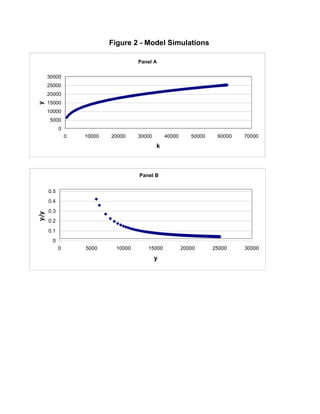
Model simulations yield movement in output (both total and informal) and capital con- 
sistent with data from both developed and less-developed countries. The informal sector 
naturally declines as the economy grows (even with no change in tax policies) and the infor- 
mal sector is a functioning part of an economy's steady state. Calibrating to Sri Lanka in 
1990, we
nd a steady state where approximately two percent of time is devoted to informal 
production and where the informal sector produces less than one percent of total output. 
This, of course, is far from Sri Lanka's current situation where it is estimated that nearly 
45 percent of time is devoted to informal employment and 40 percent of total output is 
produced by the informal sector. 
Given that our model replicates the stylized facts of informal data, we proceed to analyze 
the eect of alternative tax policies on the informal sector and the remaining economy. 
Empirical work by Johnson et al. (1998) and Schneider and Enste (2000)
nd, for both 
2The informal sector should not be confused with the criminal sector, which produces illegal goods and 
services such as drugs and prostitution. The informal sector produces the same goods as the formal sector, 
but tries to avoid government regulations. 
3An AK model is a constant saving rate version of the simplest endogenous growth model. 
2
transitional and developed economies, that higher burdens of tax policy are correlated with 
larger informal sectors. Their measures of tax burden, however, combine the administration 
of the tax policies and the tax rates themselves, and the analysis focuses on cross-sectional 
data. Here we consider the eects of these policies, either individually or jointly, on the 
transition of an economy. 
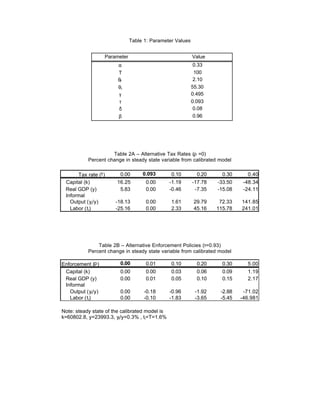
Either a reduction in the tax rate or an increase in enforcement increases the level of total 
output and decreases the size of the informal sector in the steady state. We
nd, however, 
that the eect of these two policies on the informal sector do dier. While small changes in 
the tax rate cause measurable changes in the size of the informal sector, modest changes in 
the enforcement variable (i.e., increases in the probability of detection without substantial 
penalties) have negligible eects. In order for enforcement to have a measurable eect on the 
size of the informal sector, the government must impose quantitatively large penalties along 
with increased policing. This suggests that governments interested in reducing the size of the 
informal sector should reduce the tax rate and/or increase the tax penalty of informal agents 
who are caught. If the economy wants to maintain tax revenues as a percent of GDP (for, 
possibly, public good provisions), the model suggests lowering the tax rate and increasing 
enforcement simultaneously. Therefore, when the World Bank sends mobile tax units to 
countries for tax collection, this increase in enforcement has minimal eects on the standard 
of living. Alternatively, if the objective is to increase the country's standard of living, the 
World Bank should encourage governments to lower tax rates along with increasing tax 
collection eorts. 
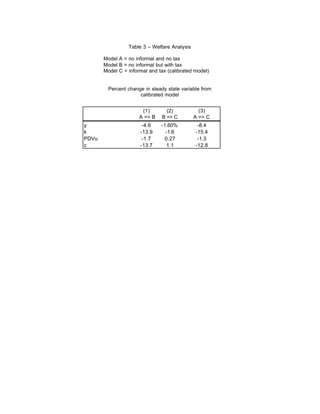
We conclude the analysis by measuring the welfare loss associated with the existence of 
an informal sector. Speci
cally, we compare steady state capital stocks and utility in three 
cases: (a) with no taxes and no informal sector, (b) with taxes but no informal sector, and (c) 
with taxes and an informal sector. Moving from an economy with no taxes and no informal 
sector to one with taxes (a to b), we
nd a large loss in the steady state capital stock. While 
the introduction of an informal sector to an economy with output taxes (moving from b to 
3
c) further depresses capital and output in steady state, utility actually rises. Since informal 
workers can produce output without capital, the depressed steady state savings rate allows 
for higher consumption. These
ndings provide support for those who believe the informal 
sector should remain a functioning part of the economy. 
We now turn to Section 2 where we describe some stylized facts associated with informal 
employment. The theoretical economy is presented in Section 3. In Section 4 we discuss 
the selection of parameter values. Model simulations and policy experiments are reported in 
Section 5. Concluding remarks are found in Section 6. 
2 Stylized Facts 
In this section, we describe two stylized facts associated with the informal sector. These 
statistics are the ones most frequently noted in other empirical work on informal employment. 
1. There is a negative and convex relationship between real GDP per worker and the 
percent of output produced in the informal sector, where informal workers produce a 
legal product but avoid taxation and other government regulations. 
2. Higher tax burdens (combining the tax rate with enforcement) signi
cantly increase 
the size of the informal sector. 
Before discussing these stylized facts in more detail, we de
ne our measure of informal 
output. We use a physical input measure of the informal economy as reported by Schneider 
and Enste (2000). The physical input method estimates the size of the informal sector based 
on electricity usage, wherein the dierence between growth of the oÆcial GDP and the growth 
of electricity usage is attributed to the growth of the informal economy. Other methods 
for estimating the informal economy include direct estimation methods, such as surveys 
conducted by the International Labour Organization, as well as other indirect methods, 
such as currency demand estimation. While the nominal value of the size of the informal 
4
sector varies across measures, the stylized facts highlighted in this section remain invariant 
to the measure of informal labor. 
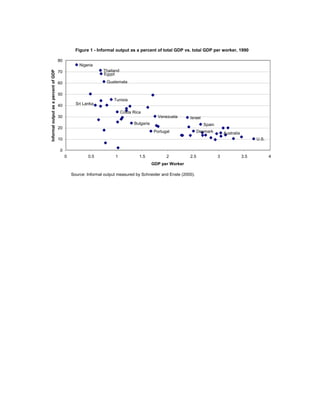
Figure 1 plots the relationship between real GDP per worker and informal output as a 
fraction of total output for a cross-section of countries in 1990. There exists a negative and 
convex relationship between the series. This relationship holds if one alternatively looks at 
manufacturing sector data or time devoted to the informal sector as a fraction of total labor 
hours. The direction of causality in this relationship, however, is unclear. It may be that a 
decrease in the size of the informal sector increases GDP per worker as workers shift from 
informal employment to formal employment. Alternatively, as GDP per worker rises, capital 
rises and this shifts workers from the informal to the formal, more productive, sector. We 
believe there is two-way causality and capture this in the model below. 
The second stylized fact is the empirical link between tax policy and the size of the 
informal sector. Many studies suggest an increase in the tax rate is one of the main causes 
of increases in the size of the informal economy. We know, however, that the level of the tax 
rate cannot be a true indicator of the tax burden since many countries have high levels of 
corruption. As mentioned above, Johnson et al. (1998) provide empirical evidence, from a 
cross-section of countries in Latin America, the OECD, and the former Soviet bloc, that the 
informal economy is large when the burden of tax policy is large. Speci
cally, this burden is 
measured by both the administration of the tax policies and the tax rates themselves. Ihrig 
and Moe (2000) estimate the eect of changes in the tax rate and enforcement on the size of 
the informal sector in Asian countries. They
nd each policy signi
cantly in
uences Asian 
countries' informal sectors. 
We now develop a theoretical model that allows us to examine the relationships among 
informal employment, real GDP per worker, and taxation policies. The model, with appro- 
priate parameter values, matches these stylized facts. 
5
3 A Simple Model 
This section develops a dynamic model of an agent's decision to accumulate capital and to 
work in the formal and informal sectors. The economy is characterized by a representative 
agent, who is endowed with an initial capital stock and a
xed amount of productive time 
per period. The agent chooses to allocate time between the formal and informal sectors. One 
key dierence between these sectors is that formal production is taxed by the government, 
while informal production is only taxed when caught by the authorities.4 We assume the 
tax revenues are used by the government to produce nonproductive services. 
Informal and formal output are modeled as producing a homogenous good, which sug- 
gests the model may more accurately depict a developing country whose production focuses 
on low-end manufacturing and agricultural output. A distinguishing feature of the two sec- 
tors is their production methods. Formal
rms employ labor and capital, while informal

Lurking in the Shadows: The informal sector and government policy

  • 1.
    Lurking in theShadows: The informal sector and government policy Jane Ihrig Board of Governors Karine S. Moe Macalester College June 2001 Abstract This paper develops a dynamic model that sheds light on the evolution of the informal sector. We show how tax rates and enforcement policies in uence the size of this sector, as well as how the sector naturally shrinks as an economy transitions towards steady state. We
  • 2.
    nd that areduction in the tax rate is the best policy for decreasing the size of the informal sector. This policy not only reduces informal employment, but also increases the standard of living. The distortion resulting from the existence of an informal sector, in terms of the reduction in steady state capital, however, is small, and steady state utility actually rises when an informal sector is introducted to an economy with taxes. Given this result, policymakers may want to view the informal sector as an integral part of the economy. JEL:O17,O53,H26 Keywords: enforcement, informal employment, taxation Ihrig: Division of International Finance, 20th and C Streets NW, Washington DC 20551, ph:(202)452- 3372, fax: (202)736-5638, email: ihrig@frb.gov, Moe: Department of Economics, 1600 Grand Avenue, Saint Paul, MN 55105, ph:(651)696-6793, fax:(651)696-6746, email: moe@macalester.edu. We would like to thank Gerhard Glomm, Ed Green, Ellen McGrattan, Marcelo Veracierto, and Kei-Mu Yi for comments on an earlier draft. All errors are our own. The views in this paper are solely the responsibilities of the authors and should not be interpreted as re ecting the views of the Board of Governors of the Federal Reserve System or of other members of its sta.
  • 3.
    1 Introduction Theinformal sector, which produces legal goods but does not comply with government regulations, is a functioning part of all economies. It is estimated that in developing countries the informal sector employs up to 60 percent of the workforce and produces nearly 40 percent of GDP, while in the OECD countries the informal sector employs approximately 17 percent of the workforce and produces 14 percent of GDP.1 These numbers provide anecdotal evidence that the informal sector makes a sizeable contribution to national income, even as an economy becomes developed. Throughout time, governments and international organizations have taken actions that aect the size of this sector. Burkina Faso recently created a tax bracket geared towards those who have never paid taxes before, hoping to collect a minimal two percent of income from these individuals and shift them from the informal to formal sector. The World Bank supports the goal of taxing laborers and sends mobile tax units to countries for the collection of tax revenue. These actions lead us to question whether governments should try to control the size of this sector. Those who want to reduce informal employment point out that agents in the informal sector undermine tax collection and drive a wedge between the returns to factors across sectors. This aects the government's ability to provide public goods and creates an ineÆciency or welfare cost. Those supporting informal employment say the informal sector provides a relatively easy way to create and expand employment, and provides a source of subsistence income during recessions. To shed light on some of the issues in this debate, one must understand the dynamics of the informal sector and how government tax policy aects the size of this sector. We develop a simple dynamic model where an agent has the option to work in the informal sector. In the informal sector, an agent avoids taxes unless caught, but works with less capital intense 1A comprehensive overview of estimates of the informal sector can be found in Schneider and Enste (2000). 1
  • 4.
    production methods.2 Inthe formal sector, an agent pays taxes and has access to the capital market. The tradeo for the agent is between higher productivity per unit of labor input in the formal sector and lower productivity but possible avoidance of taxes in the informal sector. Recent theoretical research has modeled the connections between the informal sector and macroeconomy using AK growth models (Loayza, 1996 and Sarte, 2000).3 The AK framework, however, does not generate the transitional dynamics of the informal sector observed in actual economies. Speci
  • 5.
    cally, the proportionalchange in the size of the informal sector and output as restricted by an AK model is not borne out in the data. Instead, our dynamic model captures the empirical observation that as an economy grows from a low level of real GDP per capita, changes in informal employment are large. As economies near steady state, changes in informal employment are small. Model simulations yield movement in output (both total and informal) and capital con- sistent with data from both developed and less-developed countries. The informal sector naturally declines as the economy grows (even with no change in tax policies) and the infor- mal sector is a functioning part of an economy's steady state. Calibrating to Sri Lanka in 1990, we
  • 6.
    nd a steadystate where approximately two percent of time is devoted to informal production and where the informal sector produces less than one percent of total output. This, of course, is far from Sri Lanka's current situation where it is estimated that nearly 45 percent of time is devoted to informal employment and 40 percent of total output is produced by the informal sector. Given that our model replicates the stylized facts of informal data, we proceed to analyze the eect of alternative tax policies on the informal sector and the remaining economy. Empirical work by Johnson et al. (1998) and Schneider and Enste (2000)
  • 7.
    nd, for both 2The informal sector should not be confused with the criminal sector, which produces illegal goods and services such as drugs and prostitution. The informal sector produces the same goods as the formal sector, but tries to avoid government regulations. 3An AK model is a constant saving rate version of the simplest endogenous growth model. 2
  • 8.
    transitional and developedeconomies, that higher burdens of tax policy are correlated with larger informal sectors. Their measures of tax burden, however, combine the administration of the tax policies and the tax rates themselves, and the analysis focuses on cross-sectional data. Here we consider the eects of these policies, either individually or jointly, on the transition of an economy. Either a reduction in the tax rate or an increase in enforcement increases the level of total output and decreases the size of the informal sector in the steady state. We
  • 9.
    nd, however, thatthe eect of these two policies on the informal sector do dier. While small changes in the tax rate cause measurable changes in the size of the informal sector, modest changes in the enforcement variable (i.e., increases in the probability of detection without substantial penalties) have negligible eects. In order for enforcement to have a measurable eect on the size of the informal sector, the government must impose quantitatively large penalties along with increased policing. This suggests that governments interested in reducing the size of the informal sector should reduce the tax rate and/or increase the tax penalty of informal agents who are caught. If the economy wants to maintain tax revenues as a percent of GDP (for, possibly, public good provisions), the model suggests lowering the tax rate and increasing enforcement simultaneously. Therefore, when the World Bank sends mobile tax units to countries for tax collection, this increase in enforcement has minimal eects on the standard of living. Alternatively, if the objective is to increase the country's standard of living, the World Bank should encourage governments to lower tax rates along with increasing tax collection eorts. We conclude the analysis by measuring the welfare loss associated with the existence of an informal sector. Speci
  • 10.
    cally, we comparesteady state capital stocks and utility in three cases: (a) with no taxes and no informal sector, (b) with taxes but no informal sector, and (c) with taxes and an informal sector. Moving from an economy with no taxes and no informal sector to one with taxes (a to b), we
  • 11.
    nd a largeloss in the steady state capital stock. While the introduction of an informal sector to an economy with output taxes (moving from b to 3
  • 12.
    c) further depressescapital and output in steady state, utility actually rises. Since informal workers can produce output without capital, the depressed steady state savings rate allows for higher consumption. These
  • 13.
    ndings provide supportfor those who believe the informal sector should remain a functioning part of the economy. We now turn to Section 2 where we describe some stylized facts associated with informal employment. The theoretical economy is presented in Section 3. In Section 4 we discuss the selection of parameter values. Model simulations and policy experiments are reported in Section 5. Concluding remarks are found in Section 6. 2 Stylized Facts In this section, we describe two stylized facts associated with the informal sector. These statistics are the ones most frequently noted in other empirical work on informal employment. 1. There is a negative and convex relationship between real GDP per worker and the percent of output produced in the informal sector, where informal workers produce a legal product but avoid taxation and other government regulations. 2. Higher tax burdens (combining the tax rate with enforcement) signi
  • 14.
    cantly increase thesize of the informal sector. Before discussing these stylized facts in more detail, we de
  • 15.
    ne our measureof informal output. We use a physical input measure of the informal economy as reported by Schneider and Enste (2000). The physical input method estimates the size of the informal sector based on electricity usage, wherein the dierence between growth of the oÆcial GDP and the growth of electricity usage is attributed to the growth of the informal economy. Other methods for estimating the informal economy include direct estimation methods, such as surveys conducted by the International Labour Organization, as well as other indirect methods, such as currency demand estimation. While the nominal value of the size of the informal 4
  • 16.
    sector varies acrossmeasures, the stylized facts highlighted in this section remain invariant to the measure of informal labor. Figure 1 plots the relationship between real GDP per worker and informal output as a fraction of total output for a cross-section of countries in 1990. There exists a negative and convex relationship between the series. This relationship holds if one alternatively looks at manufacturing sector data or time devoted to the informal sector as a fraction of total labor hours. The direction of causality in this relationship, however, is unclear. It may be that a decrease in the size of the informal sector increases GDP per worker as workers shift from informal employment to formal employment. Alternatively, as GDP per worker rises, capital rises and this shifts workers from the informal to the formal, more productive, sector. We believe there is two-way causality and capture this in the model below. The second stylized fact is the empirical link between tax policy and the size of the informal sector. Many studies suggest an increase in the tax rate is one of the main causes of increases in the size of the informal economy. We know, however, that the level of the tax rate cannot be a true indicator of the tax burden since many countries have high levels of corruption. As mentioned above, Johnson et al. (1998) provide empirical evidence, from a cross-section of countries in Latin America, the OECD, and the former Soviet bloc, that the informal economy is large when the burden of tax policy is large. Speci
  • 17.
    cally, this burdenis measured by both the administration of the tax policies and the tax rates themselves. Ihrig and Moe (2000) estimate the eect of changes in the tax rate and enforcement on the size of the informal sector in Asian countries. They
  • 18.
  • 19.
    cantly in uences Asian countries' informal sectors. We now develop a theoretical model that allows us to examine the relationships among informal employment, real GDP per worker, and taxation policies. The model, with appro- priate parameter values, matches these stylized facts. 5
  • 20.
    3 A SimpleModel This section develops a dynamic model of an agent's decision to accumulate capital and to work in the formal and informal sectors. The economy is characterized by a representative agent, who is endowed with an initial capital stock and a
  • 21.
    xed amount ofproductive time per period. The agent chooses to allocate time between the formal and informal sectors. One key dierence between these sectors is that formal production is taxed by the government, while informal production is only taxed when caught by the authorities.4 We assume the tax revenues are used by the government to produce nonproductive services. Informal and formal output are modeled as producing a homogenous good, which sug- gests the model may more accurately depict a developing country whose production focuses on low-end manufacturing and agricultural output. A distinguishing feature of the two sec- tors is their production methods. Formal
  • 22.
    rms employ laborand capital, while informal