Northwestern University School of Law 
Law and Economics Papers 
Year 2006 Paper 1 
Informal economy: is it a problem, a 
solution or both? The perspective of the 
informal business 
Omar E. Garcia-Bolivar 
BG Consulting 
This working paper is hosted by The Berkeley Electronic Press (bepress) and may not be 
commercially reproduced without the permission of the copyright holder. 
http://law.bepress.com/nwwps/lep/1 
Copyright 
c 2006 by the author.
Informal economy: is it a problem, a 
solution or both? The perspective of the 
informal business 
Abstract 
There are two ways to conduct operations in the economy: formally and 
informally. The activities that occur outside the legal framework are considered 
informal. It can be that activities conducted informally are of legal nature, 
that is they are not of criminal nature, but yet they are conducted without 
following the formalities established by the official legal framework and thus are 
considered informal.In this sense, usually the informal sector is characterized 
by ease to entry, low-resource base, family ownership, labor intensive, adapted 
technology, and informal processes for acquiring skills. This paper deals with 
these issues: is infomality bad, why it happens, is it good, how can it be solved?
1 
Informal economy: is it a problem, a solution or both? The 
perspective of the informal business 
by 
Omar E. García-Bolívar1 
1 Founding partner of BG Consulting, an economic development consulting firm, and its President. He 
was part of the US Agency for International Development team that assisted the United Nations High 
Commission on Legal Empowerment of the Poor for its 2006 report. He is a lawyer admitted to practice 
law in Venezuela, New York, Washington, D.C. and the U.S. Court of International Trade. He has 
completed graduate studies in political science, a Masters in Law from Southern Methodist University, 
Dallas, Texas and Masters in Philosophy and Ph.D studies in Law and Foreign Investment from 
University of Edinburgh, United Kingdom in 1997. Mr. García-Bolívar is an arbitrator before the 
International Center for Settlement of Investment Disputes (ICSID) and the World Intellectual Property 
Organization (WIPO), a member of the American Arbitration Association International Panel, and listed 
in the ICC Arbitrator Database. He is Chair of the Inter-American Legal Affairs Committee of the 
International Law Section of the Washington, D.C Bar. He is also a professional fellow of the Law 
Institute of the Americas at Southern Methodist University, Dallas Texas and member of the board of 
editors of Law and Business Review of the Americas. He is associate editor of Transnational Dispute 
Management. Mr. García-Bolívar was listed in the 2005 edition of Marquis Who’s Who in American 
Law. Email: omargarcia@bg-consulting.com. 
Hosted by The Berkeley Electronic Press
2
3 
Table of content 
I. Introduction 
II. Concept 
III. Magnitude 
IV. Context 
V. Impact 
VI. Promoting reform 
VII. Challenges 
VIII. Issues affecting implementation 
IX. Final considerations 
Hosted by The Berkeley Electronic Press
4 
I. Introduction 
There are two ways to conduct operations in the economy: formally and informally. The 
activities that occur outside the legal framework are considered informal. It can be that 
activities conducted informally are of legal nature, that is they are not of criminal nature, 
but yet they are conducted without following the formalities established by the official 
legal framework and thus are considered informal. Typical informal activities are found 
for example in: 
• unregistered businesses, 
• self-employed manufacturers, 
• temporary street vendors and 
• casual retailers. 
In this sense, usually the informal sector is characterized by ease to entry, low-resource 
base, family ownership, labor intensive, adapted technology, and informal processes for 
acquiring skills. 
There are also informal activities when a registered business does not document a 
transaction or when it uses a legal instrument with a different purpose, such as when a 
check is post dated. All those activities occur daily in the world. Some occur in the rural 
areas, some in urban areas, some in developed countries, some in developing countries, 
some are performed by people earning an income below the minimum wage, some are 
performed by people earning an income above the minimum wage. Those unrecorded 
activities bring about benefits to the economy. 
II. Concept 
Informal business can be defined as that one in which the common traits are low level of 
technology, few capital requirements, simple division of labor and little differentiation of 
ownership of means of production. But in many cases there are businesses that are 
partially informal and partially formal. They comply with some of the regulations but not 
with others.
Several factors can explain the phenomenon of informality. The one most referred by the 
literature has to do with costs of doing business under formality. High taxes, complicated 
regulations, bureaucratic hurdles and corruption seem to be the most important factors 
that drive an activity to go underground. However, in many countries the notion of 
informality is much more close to the real world than the formal order. In some parts of 
the world the only order known and applied is the customary order created by tradition. 
The formal order is not known and therefore not complied with. In other parts of the 
world the formal order has been an imposition of the elites and does not relate to the 
customary order. As a result of that many activities are conducted informally not as a 
consequence of high costs, but because the order under which those activities are 
conducted has not been recognized by the formal system of law. 
5 
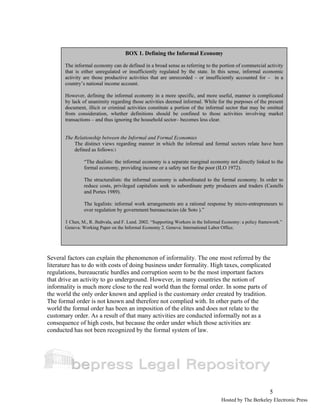
BOX 1. Defining the Informal Economy 
The informal economy can de defined in a broad sense as referring to the portion of commercial activity 
that is either unregulated or insufficiently regulated by the state. In this sense, informal economic 
activity are those productive activities that are unrecorded – or insufficiently accounted for – in a 
country’s national income account. 
However, defining the informal economy in a more specific, and more useful, manner is complicated 
by lack of unanimity regarding those activities deemed informal. While for the purposes of the present 
document, illicit or criminal activities constitute a portion of the informal sector that may be omitted 
from consideration, whether definitions should be confined to those activities involving market 
transactions – and thus ignoring the household sector– becomes less clear. 
The Relationship between the Informal and Formal Economies 
The distinct views regarding manner in which the informal and formal sectors relate have been 
defined as follows:1 
“The dualists: the informal economy is a separate marginal economy not directly linked to the 
formal economy, providing income or a safety net for the poor (ILO 1972). 
The structuralists: the informal economy is subordinated to the formal economy. In order to 
reduce costs, privileged capitalists seek to subordinate petty producers and traders (Castells 
and Portes 1989). 
The legalists: informal work arrangements are a rational response by micro-entrepreneurs to 
over regulation by government bureaucracies (de Soto ).” 
1 Chen, M., R. Jhabvala, and F. Lund. 2002. “Supporting Workers in the Informal Economy: a policy framework.” 
Geneva: Working Paper on the Informal Economy 2. Geneva: International Labor Office. 
Hosted by The Berkeley Electronic Press
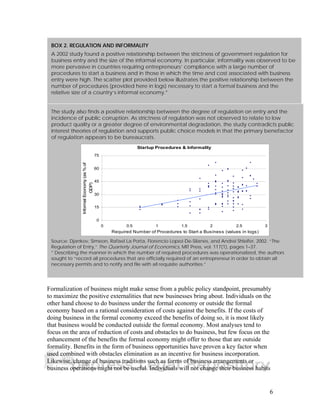
BOX 2. REGULATION AND INFORMALITY 
A 2002 study found a positive relationship between the strictness of government regulation for 
business entry and the size of the informal economy. In particular, informality was observed to be 
more pervasive in countries requiring entrepreneurs’ compliance with a large number of 
procedures to start a business and in those in which the time and cost associated with business 
entry were high. The scatter plot provided below illustrates the positive relationship between the 
number of procedures (provided here in logs) necessary to start a formal business and the 
relative size of a country’s informal economy.* 
The study also finds a positive relationship between the degree of regulation on entry and the 
incidence of public corruption. As strictness of regulation was not observed to relate to low 
product quality or a greater degree of environmental degradation, the study contradicts public 
interest theories of regulation and supports public choice models in that the primary benefactor 
of regulation appears to be bureaucrats. 
75 
60 
45 
30 
15 
Formalization of business might make sense from a public policy standpoint, presumably 
to maximize the positive externalities that new businesses bring about. Individuals on the 
other hand choose to do business under the formal economy or outside the formal 
economy based on a rational consideration of costs against the benefits. If the costs of 
doing business in the formal economy exceed the benefits of doing so, it is most likely 
that business would be conducted outside the formal economy. Most analyses tend to 
focus on the area of reduction of costs and obstacles to do business, but few focus on the 
enhancement of the benefits the formal economy might offer to those that are outside 
formality. Benefits in the form of business opportunities have proven a key factor when 
used combined with obstacles elimination as an incentive for business incorporation. 
Likewise, change of business traditions such as forms of business arrangements or 
business operations might not be useful. Individuals will not change their business habits 
6 
Startup Procedures & Informality 
0 
0 0.5 1 1.5 2 2.5 3 
Required Number of Procedures to Start a Business (values in logs) 
Informal Economy (as % of 
GDP) 
Source: Djankov, Simeon, Rafael La Porta, Florencio Lopez-De-Silanes, and Andrei Shleifer, 2002. “The 
Regulation of Entry,” The Quarterly Journal of Economics, MIT Press, vol. 117(1), pages 1–37. 
* Describing the manner in which the number of required procedures was operationalized, the authors 
sought to “record all procedures that are officially required of an entrepreneur in order to obtain all 
necessary permits and to notify and file with all requisite authorities.”
if they do not see a benefit. Again the cost of adapting to new rules and forms might 
exceed the expected benefits. In those cases, instead of imposing forms it will be better to 
recognize the existing form and incorporate it into the formal economy. 
7 
III. Magnitude 
A usual problem in this area is how to measure the size of the informal economy. If there 
is a lack of identification system that keeps record of the informal economy, if the 
informal businesses are not registered, it might be difficult to determine the real size of 
the informal economy. In addition, the contribution of the informal economy to the GDP 
of a country might be difficult to determine. However, some approaches have been made 
through different methodologies and the conclusion has been that the informal economy 
makes an important contribution to the GDP of many countries. In sub-Sahara Africa, 
excluding South Africa, the informal sector contributed 20-50% of the non-agricultural 
GDP during the year 2000. 
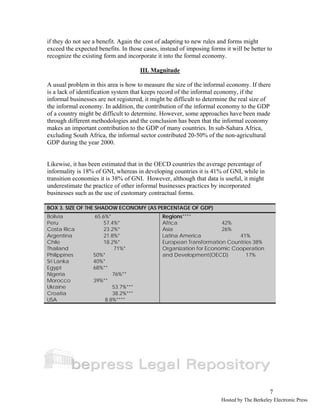
Likewise, it has been estimated that in the OECD countries the average percentage of 
informality is 18% of GNI, whereas in developing countries it is 41% of GNI, while in 
transition economies it is 38% of GNI. However, although that data is useful, it might 
underestimate the practice of other informal businesses practices by incorporated 
businesses such as the use of customary contractual forms. 
BOX 3. SIZE OF THE SHADOW ECONOMY (AS PERCENTAGE OF GDP) 
Bolivia 65.6%* 
Regions**** 
Peru 57.4%* 
Africa 42% 
Costa Rica 23.2%* 
Asia 26% 
Argentina 21.8%* 
Latina America 41% 
Chile 18.2%* 
European Transformation Countries 38% 
Thailand 71%* 
Organization for Economic Cooperation 
Philippines 50%* 
and Development(OECD) 17% 
Sri Lanka 40%* 
Egypt 68%** 
Nigeria 76%** 
Morocco 39%** 
Ukraine 53.7%*** 
Croatia 38.2%*** 
USA 8.8%**** 
Hosted by The Berkeley Electronic Press
8 
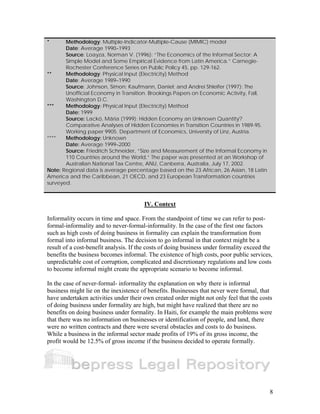
* Methodology: Multiple-Indicator-Multiple-Cause (MIMIC) model 
Date: Average 1990–1993 
Source: Loayza, Norman V. (1996): “The Economics of the Informal Sector: A 
Simple Model and Some Empirical Evidence from Latin America.” Carnegie- 
Rochester Conference Series on Public Policy 45, pp. 129-162. 
** Methodology: Physical Input (Electricity) Method 
Date: Average 1989–1990 
Source: Johnson, Simon; Kaufmann, Daniel; and Andrei Shleifer (1997): The 
Unofficial Economy in Transition. Brookings Papers on Economic Activity, Fall, 
Washington D.C. 
*** Methodology: Physical Input (Electricity) Method 
Date: 1999 
Source: Lackó, Mária (1999): Hidden Economy an Unknown Quantity? 
Comparative Analyses of Hidden Economies in Transition Countries in 1989-95. 
Working paper 9905. Department of Economics, University of Linz, Austria. 
**** Methodology: Unknown 
Date: Average 1999–2000 
Source: Friedrich Schneider, “Size and Measurement of the Informal Economy in 
110 Countries around the World,” The paper was presented at an Workshop of 
Australian National Tax Centre, ANU, Canberra, Australia, July 17, 2002. 
Note: Regional data is average percentage based on the 23 African, 26 Asian, 18 Latin 
America and the Caribbean, 21 OECD, and 23 European Transformation countries 
surveyed. 
IV. Context 
Informality occurs in time and space. From the standpoint of time we can refer to post-formal- 
informality and to never-formal-informality. In the case of the first one factors 
such as high costs of doing business in formality can explain the transformation from 
formal into informal business. The decision to go informal in that context might be a 
result of a cost-benefit analysis. If the costs of doing business under formality exceed the 
benefits the business becomes informal. The existence of high costs, poor public services, 
unpredictable cost of corruption, complicated and discretionary regulations and low costs 
to become informal might create the appropriate scenario to become informal. 
In the case of never-formal- informality the explanation on why there is informal 
business might lie on the inexistence of benefits. Businesses that never were formal, that 
have undertaken activities under their own created order might not only feel that the costs 
of doing business under formality are high, but might have realized that there are no 
benefits on doing business under formality. In Haiti, for example the main problems were 
that there was no information on businesses or identification of people, and land, there 
were no written contracts and there were several obstacles and costs to do business. 
While a business in the informal sector made profits of 19% of its gross income, the 
profit would be 12.5% of gross income if the business decided to operate formally.
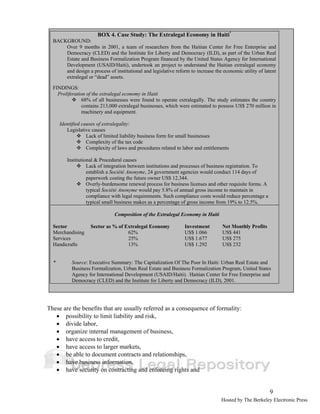
Over 9 months in 2001, a team of researchers from the Haitian Center for Free Enterprise and 
Democracy (CLED) and the Institute for Liberty and Democracy (ILD), as part of the Urban Real 
Estate and Business Formalization Program financed by the United States Agency for International 
Development (USAID/Haiti), undertook an project to understand the Haitian extralegal economy 
and design a process of institutional and legislative reform to increase the economic utility of latent 
extralegal or “dead” assets. 
™ 68% of all businesses were found to operate extralegally. The study estimates the country 
contains 213,000 extralegal businesses, which were estimated to possess US$ 270 million in 
machinery and equipment. 
Business Formalization, Urban Real Estate and Business Formalization Program, United States 
Agency for International Development (USAID/Haiti). Haitian Center for Free Enterprise and 
Democracy (CLED) and the Institute for Liberty and Democracy (ILD), 2001. 
9 
BOX 4. Case Study: The Extralegal Economy in Haiti* 
BACKGROUND: 
FINDINGS: 
Proliferation of the extralegal economy in Haiti 
Identified causes of extralegality: 
Legislative causes 
™ Lack of limited liability business form for small businesses 
™ Complexity of the tax code 
™ Complexity of laws and procedures related to labor and entitlements 
Institutional & Procedural causes 
™ Lack of integration between institutions and processes of business registration. To 
establish a Société Anonyme, 24 government agencies would conduct 114 days of 
paperwork costing the future owner US$ 12,344. 
™ Overly-burdensome renewal process for business licenses and other requisite forms. A 
typical Société Anonyme would pay 5.8% of annual gross income to maintain in 
compliance with legal requirements. Such compliance costs would reduce percentage a 
typical small business makes as a percentage of gross income from 19% to 12.5%. 
Composition of the Extralegal Economy in Haiti 
Sector Sector as % of Extralegal Economy Investment Net Monthly Profits 
Merchandising 62% US$ 1.066 US$ 441 
Services 25% US$ 1.677 US$ 275 
Handicrafts 13% US$ 1.292 US$ 232 
* Source: Executive Summary: The Capitalization Of The Poor In Haiti: Urban Real Estate and 
These are the benefits that are usually referred as a consequence of formality: 
• possibility to limit liability and risk, 
• divide labor, 
• organize internal management of business, 
• have access to credit, 
• have access to larger markets, 
• be able to document contracts and relationships, 
• have business information, 
• have security on contracting and enforcing rights and 
Hosted by The Berkeley Electronic Press
10 
• have access to sophisticated technology. 
Yet they might not be sufficient to some people. In many cases the offer from the formal 
system is unknown or ignored for it is not relevant to the nature of activities they 
undertake; something that is especially true for survival activities under informality. In 
other cases the benefits the informal business is looking for should come under the form 
of business opportunities. When the market of the informal economy is larger than the 
formal economy the business opportunities lie under the informal sector, not under the 
formal sector and the cost-benefit analysis leans favorably to informality. 
There are different types of informality within the economy. There are informal 
businesses, informal employment, informal contracts, informal property and informal 
lending, among others. In all these cases the transactions, possession, financing and labor 
are conducted outside the formal legal system. They either go undocumented, 
unregistered, unreported for accounting purposes and unenforceable by the formal system 
mechanisms. Likewise, there are different levels of informality. There are agents who are 
fully informal. For example, someone might have a business of food manufacturing 
which is not registered, which relies on the skills of the owner, which uses owner’s 
family members as temporary labor, which does not have title of the land where it 
operates and which is financed by the owner’s own savings and occasionally by informal 
lenders who charge very high rates. This business probably is unlikely to do business 
with the formal economy and hence does not conduct any operation in the formal 
economy. But there are other informal businesses that are subcontracted by the formal 
economy, are required to document specific transactions and therefore can be considered 
partially formal. In this sense, the evidence shows that the interaction between formal and 
informal businesses maters. There is a tendency for firms that operate for domestic 
market as opposed to those that export, which lack foreign investments, and are located in 
urban areas but not the capital city to engage more in unofficial activities. 
Likewise, registered businesses might use labor from the informal economy in order to 
avoid hiring costs. In this case a formal business is partially informal. In this sense 
informal practices might be very common among formal businesses. For example, a 
recent study by the World Bank found that a sample of companies surveyed in year 2000 
all around the world did not report 19% of gross revenues.(G. Battra et al, “The Firms 
Speak” 2002) 
A common assumption with the informal economy is to consider it as homogeneous. It is 
not. There are different kinds of informal businesses depending on the industry, the 
geographic region and the size. There are informal businesses in agriculture, in domestic 
services, in manufacturing, in construction and commerce, among others. There are also 
rural and urban informal businesses. The latter tends to interact more with formal 
businesses. Likewise, with the informal economy there are different sizes of informal 
businesses. For example there are the so-called survival business and there are the micro 
enterprises, which should not be confused with the SMEs (Small, Medium Enterprises), 
which in principle are registered businesses and are relatively easy to measure.
11 
V. Impact 
Informality can bring about positive or negative impacts. For governments, informality 
can be a problem. The governments cannot collect taxes from informal businesses and in 
turn are unable to finance the provision of good public services. In some kind of vicious 
circle the governments might be pushing businesses to informality due to lack of good 
public services, such as rule of law. The governments then increase the tax rates to those 
that remain under formality creating an additional incentive to be informal. 
For the governments, the informal sector might also be a solution for unemployment 
problems. Where the formal economy cannot absorb the surplus of labor, due to its own 
limitations, the informal sector is the ideal remedy. Maybe for that reason, some 
governments tolerate informality to a large extent. Others even get to the point of seeing 
informality as a means to address the issue of unemployment and have created a 
favorable framework for promoting the informal economy. That is the case of China after 
the mid- 1990s. 
BOX 5. Case Study: Assisting the Informal Economy in Shanghai* 
BACKGROUND: 
To address the shifts in employment and economic organization associated with its overall economic 
liberalization efforts – particularly the high unemployment associated with the reform of state-owned 
sector in the 1990s – the Chinese Government has sought means to address the country’s large 
informal economy. Some of the country’s most successful policies to ease and encourage workers’ 
transition from the informal to the formal sector have been initiated by the Shanghai Municipal 
Government. 
POLICY INITIATIVES: 
In 1996, to address the high unemployment resulting from the closing of state-owned enterprises 
(SOEs), –985,000 Shanghai citizens lost jobs due to SOE closings from 1996 to 2000 – the Shanghai 
Municipal Government initiated a series of policy measures to provide general economic support for 
the newly unemployed and facilitate workers’ transition into the formal economy. As part of the 
municipality’s larger adjustment assistance program, the Shanghai Government created a policy 
whereby workers in the informal sector could associate to form a novel economic classification 
deemed informal labor organizations. During the six years following the creation of the new 
classification, 14,364 informal labor organizations were formed. In 2001, the organizations employed 
154,839 workers, 97% of which had been unemployed prior to the initiative. 
While informal labor organizations remained technically outside of the formal economy, they 
received government assistance to encourage their growth and eventual incorporation into the formal 
sector. The policy was supplemented by a public works program, which provided employment to a 
portion of informal labor organizations in public services such as street cleaning, security, and the 
maintenance of public facilities. The Shanghai government provided additional assistance to the 
informal economy by offering of training, social insurance, preferential tax treatment, and subsidized 
credit to informal ventures. 
The success of Shanghai’s adjustment assistance program is illustrated in the drastic reduction in 
unemployment since the initiative. The Shanghai Labor Bureau found that, of the nearly one million 
citizens laid off due to SOE closings, only 16,200 remained unemployed in 2001. 
* Source: Howell, Jude, Good Practice Study in Shanghai on Employment Services for the 
Informal Economy, International Labor Office, Geneva, 2002 
Hosted by The Berkeley Electronic Press
For some of the economic agents informality can be a problem. Although informality 
creates jobs and generates income, that might not be sufficient to some. People under 
informality lack access to certain kind of protection that the government might provide, 
such as social security. But the most important problem that informality might pose to 
those doing business therein is the impossibility to grow. With lack of access to finance 
and technology, the informal business might be condemned to be small and not 
competitive. Some might be condemned to be poor. 
On the other hand, others able to make an income above the poverty line, might find 
informality sufficient to satisfy their expectations. In some developed countries, arguably 
the surge of self-employed people under the “new economy” who trade goods and 
services over the internet might be considered part of an emerging self-sufficient informal 
economy. 
In terms of jobs informality creates different kinds of jobs. “Informal employment 
comprises one half to three quarters of non-agricultural employment in developing 
countries: specifically 48 per cent in North Africa, 51 pr cent in Latin America , 65 per 
cent in Asia and 72 per cent in sub-Saharan Africa” (ILO, 2002:7). Among informal 
employees there are self-employed, wage employed and the non-wage employed, usually 
family members –frequently women and boys and girls—or people who get the job to be 
trained on labor skills. 
12
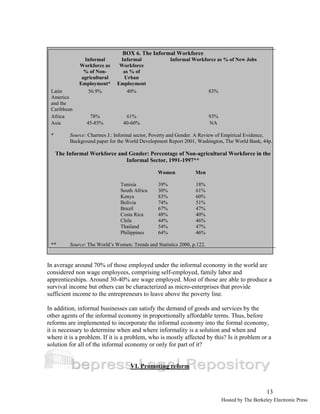
BOX 6. The Informal Workforce 
In average around 70% of those employed under the informal economy in the world are 
considered non wage employees, comprising self-employed, family labor and 
apprenticeships. Around 30-40% are wage employed. Most of those are able to produce a 
survival income but others can be characterized as micro-enterprises that provide 
sufficient income to the entrepreneurs to leave above the poverty line. 
In addition, informal businesses can satisfy the demand of goods and services by the 
other agents of the informal economy in proportionally affordable terms. Thus, before 
reforms are implemented to incorporate the informal economy into the formal economy, 
it is necessary to determine when and where informality is a solution and when and 
where it is a problem. If it is a problem, who is mostly affected by this? Is it problem or a 
solution for all of the informal economy or only for part of it? 
13 
VI. Promoting reform 
Informal 
Workforce as 
% of Non-agricultural 
Employment* 
Informal 
Workforce 
as % of 
Urban 
Employment 
Informal Workforce as % of New Jobs 
Latin 
America 
and the 
Caribbean 
56.9% 40% 83% 
Africa 78% 61% 93% 
Asia 45-85% 40-60% NA 
* Source: Charmes J.: Informal sector, Poverty and Gender. A Review of Empirical Evidence, 
Background paper for the World Development Report 2001, Washington, The World Bank, 44p. 
The Informal Workforce and Gender: Percentage of Non-agricultural Workforce in the 
Informal Sector, 1991-1997** 
Women Men 
Tunisia 39% 18% 
South Africa 30% 61% 
Kenya 83% 60% 
Bolivia 74% 51% 
Brazil 67% 47% 
Costa Rica 48% 40% 
Chile 44% 46% 
Thailand 54% 47% 
Philippines 64% 46% 
** Source: The World’s Women: Trends and Statistics 2000, p.122. 
Hosted by The Berkeley Electronic Press
In the recent years there has been a change on the biased view of the informal economy 
as a temporary and marginal factor. The informal economy already creates income, jobs 
and consumption, albeit at a limited scale. If it could be liberated from factors that 
impede its growth and its interaction with the formal economy, it could make a big 
difference. In Egypt, for example the Institute Liberty and Democracy estimated that the 
incorporation of the informal economy into the formal economy would increase the value 
of the incomes and holdings could mean a growth of 2% of the GDP per year. 
14
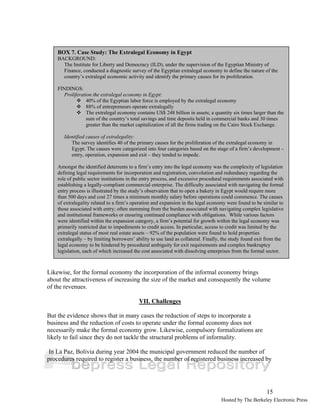
BOX 7. Case Study: The Extralegal Economy in Egypt 
BACKGROUND: 
The Institute for Liberty and Democracy (ILD), under the supervision of the Egyptian Ministry of 
Finance, conducted a diagnostic survey of the Egyptian extralegal economy to define the nature of the 
country’s extralegal economic activity and identify the primary causes for its proliferation. 
FINDINGS: 
Proliferation the extralegal economy in Egypt: 
™ 40% of the Egyptian labor force is employed by the extralegal economy 
™ 88% of entrepreneurs operate extralegally 
™ The extralegal economy contains US$ 248 billion in assets; a quantity six times larger than the 
sum of the country’s total savings and time deposits held in commercial banks and 30 times 
greater than the market capitalization of all the firms trading on the Cairo Stock Exchange. 
Identified causes of extralegality: 
The survey identifies 40 of the primary causes for the proliferation of the extralegal economy in 
Egypt. The causes were categorized into four categories based on the stage of a firm’s development – 
entry, operation, expansion and exit – they tended to impede. 
Amongst the identified deterrents to a firm’s entry into the legal economy was the complexity of legislation 
defining legal requirements for incorporation and registration, convolution and redundancy regarding the 
role of public sector institutions in the entry process, and excessive procedural requirements associated with 
establishing a legally-compliant commercial enterprise. The difficulty associated with navigating the formal 
entry process is illustrated by the study’s observation that to open a bakery in Egypt would require more 
than 500 days and cost 27 times a minimum monthly salary before operations could commence. The causes 
of extralegality related to a firm’s operation and expansion in the legal economy were found to be similar to 
those associated with entry; often stemming from the burden associated with navigating complex legislative 
and institutional frameworks or ensuring continued compliance with obligations. While various factors 
were identified within the expansion category, a firm’s potential for growth within the legal economy was 
primarily restricted due to impediments to credit access. In particular, access to credit was limited by the 
extralegal status of most real estate assets – 92% of the population were found to hold properties 
extralegally – by limiting borrowers’ ability to use land as collateral. Finally, the study found exit from the 
legal economy to be hindered by procedural ambiguity for exit requirements and complex bankruptcy 
legislation, each of which increased the cost associated with dissolving enterprises from the formal sector. 
Likewise, for the formal economy the incorporation of the informal economy brings 
about the attractiveness of increasing the size of the market and consequently the volume 
of the revenues. 
15 
VII. Challenges 
But the evidence shows that in many cases the reduction of steps to incorporate a 
business and the reduction of costs to operate under the formal economy does not 
necessarily make the formal economy grow. Likewise, compulsory formalizations are 
likely to fail since they do not tackle the structural problems of informality. 
In La Paz, Bolivia during year 2004 the municipal government reduced the number of 
procedures required to register a business, the number of registered business increased by 
Hosted by The Berkeley Electronic Press
20 percent. However, the size of the informal sector has remained at a high of 67% of the 
GNP. 
The experience shows that there is no unique recipe to integrate the formal and the 
informal sectors. Each case is different. Thorough diagnostics of the circumstances of 
each country, its economy, its industries and the different sectors of the informal 
economy is necessary before an attempt to present recommendations for reform can be 
initiated. 
Moreover, although all the reforms cannot be undertaken simultaneously, it seems that 
holistic approaches as opposed to isolated approaches have proved to be much more 
successful. 
16 
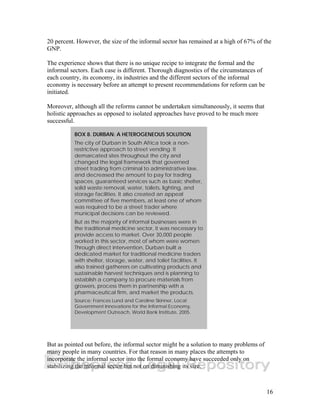
BOX 8. DURBAN: A HETEROGENEOUS SOLUTION. 
The city of Durban in South Africa took a non-restrictive 
approach to street vending. It 
demarcated sites throughout the city and 
changed the legal framework that governed 
street trading from criminal to administrative law, 
and decreased the amount to pay for trading 
spaces, guaranteed services such as basic shelter, 
solid waste removal, water, toilets, lighting, and 
storage facilities. It also created an appeal 
committee of five members, at least one of whom 
was required to be a street trader where 
municipal decisions can be reviewed. 
But as the majority of informal businesses were in 
the traditional medicine sector, it was necessary to 
provide access to market. Over 30,000 people 
worked in this sector, most of whom were women. 
Through direct intervention, Durban built a 
dedicated market for traditional medicine traders 
with shelter, storage, water, and toilet facilities. It 
also trained gatherers on cultivating products and 
sustainable harvest techniques and is planning to 
establish a company to procure materials from 
growers, process them in partnership with a 
pharmaceutical firm, and market the products. 
Source: Frances Lund and Caroline Skinner, Local 
Government Innovations for the Informal Economy, 
Development Outreach, World Bank Institute, 2005. 
But as pointed out before, the informal sector might be a solution to many problems of 
many people in many countries. For that reason in many places the attempts to 
incorporate the informal sector into the formal economy have succeeded only on 
stabilizing the informal sector but not on diminishing its size.
17 
VIII. Issues Affecting Implementation: 
• Reduction Of Cost To Enter And Exit But No Benefit. 
The most commonly mentioned issue that affects the success of formalization is the lack 
of benefits. Economic agents in general and business in particular might be left with no 
option but to remain informal, even after reforms, if there is no benefit for them on the 
formal sector. 
The costs of entering or exiting the formal market might be high, but if the benefits of 
registering exceed that cost, formalization is most likely to remain equal. If in exchange 
for formalizing the agents will make more money or will receive better services, better 
protection or better access to credit and training, the equation might favor formalization. 
But if the costs of formalizing are taken to a minimum but they are not faced with 
tangible benefits, the equation will favor informality. In most cases, the lack of benefits is 
so palpable that the agents do not have any option but to be informal. For example, when 
the informal market is larger, when the public services provided by the government are 
poor, when there is no access to credit or training in the formal sector, when there is no 
protection to their rights under formality, the cost of becoming formal might disappear 
and even so formalization will not diminish. 
Reforms that intend to foster formalization need to look at costs reduction and benefits 
provision in equal terms. But in many cases some governments are not in position to 
invest in public services if they cannot collect taxes from the informal sector. 
BOX 9. VIETNAM’S ENTERPRISE LAW 
In 2000, Vietnam passed the Enterprise Law to simplify 
business registration procedures and reduce the number 
of requisite licenses and permits. Prior to this, attaining 
legal status for a start-up required compliance with 16 
different procedures and, after accounting for direct 
expenses and lost time, cost entrepreneurs an average of 
1.8 times the per capita GDP in 1999 to start a business. 
Under the new law, the time estimated for ensuring a start-up’s 
legal compliance fell from 98 days to 7. While the law 
has been implemented in cities, its implementation in rural 
areas has proved less successful. 
Reduction of procedures seems to not yet have played an 
important role in pushing businesses to formalize and 
hence reduce informality. According to estimates, only 
40% of newly registered firms operated previously in the 
informal economy. 
Sources: World Bank online discussion on informal economy, The 
Informal Economy: Large and Growing in Most Developing 
Countries 2003 
Hosted by The Berkeley Electronic Press
18 
• Partial Reduction Of Cost. 
Some costs might be reduced but others might remain. For example, costs of 
incorporation of a business might be reduced, but unnecessary steps required to operate 
might remain. 
Likewise, the implementation of reforms related to the incorporation of business that are 
not accompanied with reforms to terminate a business have proven to be an obstacle on 
the implementation of business formalization reforms. Economic agents want to know 
that they can enter and exit the market freely. They want to be able to disaffect assets 
from one business and allocate them to another. Creditors also want to be able to collect 
debts through the liquidation of the debtor’s assets. When that is not possible, businesses 
do not formalize in spite of reduction of costs and steps to incorporate and even in spite 
of the existence of a business opportunity. For this reason the implementation of modern 
and viable bankruptcy laws is also necessary. Entrepreneurs need to have a framework 
that guarantees easy entry, operation and exit from the formal market. 
• Lack Of Knowledge. 
In many places there is no knowledge of the advantages of formality and of the steps 
necessary to become formal. Countries might undertake substantial and beneficial 
reforms addressed at eliminating obstacles to become formal and at promoting benefits. 
However, people might not know about that and might remain under informality with the 
assumption that it is very difficult and costly to become formal. Thus, an important 
deterrent on implementing formalization reforms can be the failure to promote demand 
through information campaigns and rights education on formalization. 
• Non Tailored Reforms. 
Not all the informal agents are similar. As mentioned before the informal sector is 
heterogeneous and needs to be treated as such. Policies that promote formalization in 
urban areas might not function in rural areas. Likewise, what works for example for 
microenterprises in the furniture industry might not work for a self-employed person in 
the agriculture industry. Thus, formalization policies should be tailored to the realities of 
the specific informal sector while productivity is increased and working conditions are 
improved, and regulations and restrictions when necessary are kept at a minimum 
• Informal Businesses Not Ready For Formality. 
Businesses might require coaching to be fully incorporated into the formal economy. 
Market customs, ways of doing business, demands of customers, among others can be 
challenging to informal businesses. They might not have the capability and resources to 
respond to the requirements of the formal market in terms of time, quantity and quality. 
In some countries programs are promoted to foster cooperation and creation of clusters of 
informal businesses while costs of incorporation are reduced and benefits are increased. 
But a sudden incorporation of informal businesses into the formal economy might be 
traumatic and create a sense among others that still remain under informality that the 
formal sector is not worth the sacrifice.
19 
• Reforms That Intend To Change Customary Form. Better To Harmonize. 
In many countries the informal sector has created its own order. It is usually fed from 
tradition and seems to work relatively well in the absence of any other option. In many 
cases contracts are undertaken orally or written in a non-harmonized way. Businesses 
exist and conduct transactions with relatively success in spite of the fact that there is no 
limited liability, that there is no business information record and that there is no division 
between labor and management. Attempts to formalize those sectors occasionally fail to 
take into account the existing order, the customary rules, the ius cogens. 
On the other hand, the traditional forms might work well at some level, within a small 
community where everybody knows everybody. But when there is need to interact with 
other community of informal agents, the forms of one community might not work well in 
the other. The forms might not be harmonized and centralized information on businesses 
and individuals might be lacking. In those cases the solution is not easy and is not 
unique. However, to ignore the existing customary, traditional order might not be a good 
recipe for success. To work with the existing order might be much more useful. For 
example to perfect, harmonize and standardize the business forms used by the informal 
sector and incorporate them in the formal sector might be a better way to integrate both 
sectors. 
Hosted by The Berkeley Electronic Press
BOX 10. CASE STUDY: THE EXTRALEGAL ECONOMY IN TANZANIA 
BACKGROUND 
For a period of more than 10 months in 2004–2005, ILD, at the request of the Government of 
Tanzania, conducted an extensive survey to discern “how the nation’s extralegal economy 
actually operates and how the official legal system interacts with it.” 
FINDINGS 
Proliferation of an extralegal economy in Tanzania 
While Tanzania has created much of the legal framework for citizens’ participation in the 
legal economy, the majority of the country’s economic activity takes place extralegally. 
™ 98% of all businesses were found to operate extralegally. 
™ 89% of properties were found to be held extralegally. 
™ The extralegal economy contains US$ 29 billion in assets, representing a quantity ten 
times greater than the country’s cumulative inflow of foreign direct investment since 
its independence in 1964. 
The Tanzanian economic model 
While the majority of economic activity in Tanzania is unregulated by the state, the extralegal 
economy was found to contain a considerable degree of the structural characteristics most 
frequently associated with the formal sector. In particular, whereas legal contracts, public 
courts, and traditional financing remain largely absent from commerce, extralegal 
mechanisms fill roles that are functionally similar to their counterparts in the legal economy. 
The study identifies 17 “archetypes” within the extralegal economy that typify the indigenous 
Tanzanian extralegal economic model. Among the identified archetypes were extralegal 
documents such as: contracts, titles, guarantees, and declarations of extrajudicial rulings; 
mechanisms for price-setting; and means for defining and governing the organization of 
business relationships. 
Identified causes of extralegality: 
The survey identified 67 of the primary causes for the proliferation of the extralegal economy 
in Tanzania. The causes are characterized by a general discrepancy and, in some cases, 
incompatibility between economic and social realities and the content of legislative and 
regulatory requirements. Illustrating the role of such cleavages in preventing participation in 
the formal sector, the study noted that the majority of the documents necessary to legally 
operate a business are found only in English, whereas the greater proportion of the country’s 
citizens speaks Kiswahili or tribal languages. Regarding the cost of compliance with legal 
requirements, the survey notes that a poor Tanzanian entrepreneur would, over the 50 year 
life of a business, expect to wait 32,216 days—1,118 of which would be spend inside 
government offices—for approval of the various required permits and spend almost US$ 
180,000 in income and fees. The difficulties associated with complying with regulation was 
also noted to limit credit access as the prohibitive cost of property registration reduces the 
potential for guaranteeing loans based on real property 
Source: Executive Summary, Program to Formalize the Assets of the Poor of Tanzania and Strengthen the 
Rule of Law, ILD, Lima, Peru. 2005. 
20
21 
• Policies Made Without Consultation 
Many countries intend to implement formalization reforms that were not the product of 
consultation with the stakeholders. Consensus had not been built and the policies 
originate rejection at different levels. 
The evidence shows that formalization programs are much more successful if they are 
inclusive of all the interested parties rather than exclusive. The sense of having 
contributed to the outcome of public policies creates a strong bond that usually is 
beneficial in terms of compliance. Likewise, obscurity on the meaning of regulations 
tends to be ameliorated. Having participated in the production of the rules makes people 
understand them easier; something that contributes to their applicability and enforcement. 
• Lack of Access To Credit. 
Informal businesses might fail to grow due to lack of financing. In general businesses 
grow out of investments made out of the entrepreneurs’ own funds, investors’ funds or 
credit. In the case of the informal businesses those three options are limited. The 
entrepreneurs’ own funds are dearth and are mostly devoted to survival matters such as 
housing and meals, which take priority to business financing. If something is left it can be 
invested in the business. In absence of funds to invest in the business most informal 
entrepreneurs rely on loans from family. 
On the other hand, the lack of formalization hinders the possibility of investors financing 
operations of the businesses. Investors take risks and wait for investments to yield 
returns, but they need certainty. Investors usually invest in businesses through bonds or 
stocks either privately or publicly through exchange markets. When the business is not 
registered, when there is no information about that business, when there is no legal 
framework for equity investments in businesses entities and when there is no stock 
exchange market the investors fail to make investments in others’ businesses and those 
businesses miss the opportunity to finance their operations through other parties’ 
investments. 
Informal entrepreneurs also have the possibility of obtaining a personal loan. However, in 
the informal sector the loans available are scarce (in some cases available only through 
pawn shops), usually cover a small fraction of what is needed and charge very high 
interests. Microfinance institutions are not always in place or might not be well endowed 
or might require guarantees that the informal entrepreneurs are in no position to give. For 
example, if the guarantee demanded is mortgage, only the entrepreneurs who have title to 
land will be able to obtain credit. In Honduras where only 16% of the population has title 
to land that factor leaves out an important part of the population. 
But businesses intrinsically have other assets upon which collaterals can be granted. 
Businesses rely on many moveable mechanisms for their operations, some tangible and 
some intangible. Things such as machinery or vehicles can be used as a collateral for 
obtaining a credit. But intangibles such as accounts receivable, business inventories, 
merchandise and even the good name of the business –“good will”—or know-how duly 
registered under the intellectual property registry can be moveable guarantees that open 
Hosted by The Berkeley Electronic Press
the door to credit. However, many countries lack the legal framework that allows 
moveable guarantees. Some allow moveable guarantees only on tangible assets such as 
machinery and vehicles, but do not have the framework on intangible moveable 
guarantees. And even then, the registry of moveable guarantee is not in place or has 
outdated information. Thus, a crucial element in the path towards empowering the poor 
who do business in the informal economy is the implementation of a legal framework on 
all moveable guarantees, along with a moveable guarantee registry. Due to the nature of 
the moveable guarantees, the registry is essential. It provides information on the collateral 
and makes it traceable. The Organization of American States has produced a model law 
on moveable guarantees which --it is advocated—should be accompanied with an 
electronic registry of guarantees. 
22 
• Lack of suitable financing And Training programs That Affect 
Sustainability. 
Most donors’ funds are devoted to programs that help informal business with credit 
through the creation of microfinance institutions or through specifically crafted 
endowments. Another big part of the donor’s funding is devoted to training of informal 
entrepreneurs. Both initiatives although highly appreciated are bound to have a limited 
success due to the intrinsic limitations of the informal sector. Businesses might have 
access to credit and training, but if they remain in the informal sector their possibilities of 
using economies of scale are limited in time and space. 
Another related problem has to do with the inexistence of programs to promote credit and 
training for small businesses once they are formalized. Costs and barriers to do business 
might be reduced and benefits might be found in the formal economy, but the programs 
devoted to access to credit and training are only available for informal businesses, not for 
small recently incorporated businesses. Businesses might formalize but end up being in a 
world where they do not know how to do business or where there are no tools for them to 
be competitive. 
• Corruption: The Hidden Cost. 
Corruption is regularly mentioned as a factor that dissuades formalization. Corruption is 
bad not only from the ethical standpoint and from the legal standpoint. It is also bad from 
the economic standpoint. Corruption increases the transaction costs, not only per se, but 
because businesses cannot determine in advance the cost of corruption. 
Excessive and discretionary regulations seem to be a source of corruption. Thus, even 
when formalization costs are kept low and benefits lie on the formal economy, the 
existence of corruption might deter formalization of economic activities. 
In that sense, eliminating corruption requires administrative reforms on the reduction of 
bureaucratic steps and discretion, greater transparency, changes in institutional 
incentives, education and punishments and above all the political will to remove corrupt 
officials.
23 
• Unstable Institutions, Poor Services. 
All businesses are affected by unstable institutions. Predictability, an important factor for 
all kinds of businesses is seriously affected when the institutions are unstable. For 
example, when laws change suddenly, when rights are not respected and when there are 
not mechanisms that guarantee continuity of policies, businesses do not flourish. 
Specifically, when informal businesses might have their own customary way of 
organizing and doing things, the idea of adapting to a new order that is unstable 
discourages incorporation in the formal economy. 
In addition, the formal sector might not provide sufficient or efficient public services. 
Informal businesses might be suspicious of the idea of formalizing without receiving 
reliable public services. Poor infrastructure for example might deter the growth of formal 
businesses. In those cases the cost of formalizing exceeds the benefits. 
As a tool to encourage formalization, governments are called to better their investment 
climates in terms of stability and predictability while good public services are provided. 
• Unreliable Enforcement Mechanisms. 
Key to formalization is the enforcement mechanisms for rights and contracts. When the 
formal sector does not present a sound offer in this area, the economic agents in general 
and businesses in particular might see another incentive to not formalize. 
The informal sector might have its own enforcement mechanisms through peer pressure, 
de facto enforcement or other kind of customary way. Those might not be sufficient in a 
competitive economy, but might be sufficient to an economic agent who is in the 
informal economy only for survival. 
Enforcement mechanisms are present in credit and business information data, judicial 
systems and alternative dispute resolution mechanisms business. An accurate system of 
information data might be sufficient to enforce rights. A failing party would not be 
interested on being recorded as a default debtor, for example. Reputation is central to 
ensuring contract performance in all societies. In deciding whether to contract with a 
party, the economic agents are guided by what they know about the other party’s history 
of complying its obligations. In this sense, proper individual, land and businesses 
identification systems complemented with on-going information is essential to enforce 
rights. Land and businesses registries endowed with old, irrelevant and non-public 
information are of no use. 
But judicial systems are the natural venues to enforce contracts and rights. When the 
judicial systems are corrupt, slow, unprofessional and unpredictable the cost of being 
exposed to them is so high that deters any benefit of becoming formal. Poorly trained 
judges and lawyers, lack of proper human and physical infrastructure and lack of accurate 
information on the current law –for example due to the lack of publication of precedents 
in common law systems—are factors that added to unstable legal and institutional 
frameworks create the picture of a chaotic judicial system. 
Hosted by The Berkeley Electronic Press
In addition, alternative dispute resolution mechanisms might not be developed, or might 
be only available to elites or might be available but unknown. Moreover, the alternative 
dispute resolution mechanisms are insufficient to substitute the judicial system. They are 
only complements. In some cases the alternative dispute resolution mechanism is not 
self-sufficient. For example, arbitral awards might require the assistance of courts for 
enforcement. 
Occasionally, total reforms of the judicial systems are unfeasible or costly. Solutions such 
as recognition of some enforcement mechanisms of the informal sector might work. 
Likewise, the creation of special forum for settling disputes natural to the informal 
economy might be of use. For example courts or arbitration centers which handle small 
amount disputes and which conduct proceedings orally and deliver decisions instantly 
might provide solutions to undertakings that just incorporated from the informal 
economy. 
24 
IX. Final considerations: 
• What moves a business to be formal? 
It seems that in many countries lowering costs and reducing steps to incorporate a 
business in itself does not motivate businesses to register. The existence of direct 
benefits in the formal sector appears to be necessary to motivate formalization. 
The implementation of incentives program tied to formalization could be useful. 
For example, through government procurement business opportunities can be set-aside 
for small entrepreneurs, which in turn are asked to be formally registered to 
have access to those opportunities. However, there are few empirical studies on 
the impact of the incentives programs tied to formalization. It might happen that 
the informal entrepreneurs are not ready to take advantage of business 
opportunities set aside for them. Even after formalization the demands of 
procurement processes may be overwhelming to some informal entrepreneurs. 
Bidding requirements such as previous experience, financial stability and volume, 
timing and quality requirements might be too much for the newly registered 
businesses. Few of them could be able to successfully comply with those 
procurement demands. As a consequence some of the formalization incentive 
programs end up benefiting small businesses registered long time ago but play a 
limited role on increasing the levels of business formalization. Due to that, some 
formalization incentives programs have been accompanied with a reduction on the 
amount of procurement requirements and have been customized to the reality of 
newly registered small businesses. But even in those cases, it is not clear how 
relevant the impact of those programs is in terms of moving entrepreneurs from 
the informal to the formal sector. 
• What can complement the business formalization incentive programs? 
In many cases, the informal entrepreneurs fail to take advantage of the benefits 
offered by the formal economy due to incapacity to comply with the demands of
the formal economy. For example, even if a bidding opportunity is set-aside for 
newly registered small businesses, the entrepreneurs might lack the experience to 
cope with the demands. In those cases, the possibility of partnering with other 
entrepreneurs who have that experience under the legal form of a joint venture or 
any other kind of ad-hoc relationships could be useful. For instance, small 
entrepreneurs could form clusters through contractual arrangements only for 
exporting purposes. But two things appear to be necessary for the formalization of 
clusters: Firstly, the existence of a modern and flexible legal framework on behalf 
of business associations. Secondly, wide knowledge of the business formalization 
incentive programs and of the business partnering possibilities is of paramount 
importance. 
Likewise, training in terms of how to satisfy the quality, timing and quantity 
requests of the formal economy might be of great usefulness in order to 
complement the business formalization incentive programs. In the same direction, 
an informal entrepreneur might fail to benefit from set-aside business 
opportunities because they might require an investment of funds that he/she lacks 
and on which he/she lacks access to credit. 
Thus, coaching and mentoring programs tailored to newly registered businesses 
can be instruments that complement the business formalization incentive 
programs. Its impact and usefulness needs to be researched. Similarly, the legal 
reforms that foster the formation of clusters and microcredit programs along with 
legal reforms that allow guarantees on account receivables and inventories need to 
be researched. 
25 
• Is there a threshold after which it makes sense to formalize a business? 
In some cases, even in the absence of business formalization incentive programs, 
some informal entrepreneurs find sufficient benefits in the formal economy to 
formalize. The key here is to find that threshold after which it makes sense to 
formalize a business. Does it make sense for businesses of specific size to 
formalize? Is there a point in terms of business development after which the 
business does not grow if it does not formalize? If so, what are the most common 
benefits that informal entrepreneurs find in the formal economy after they have 
reached that level? 
In some countries, legal reforms have been necessary to accommodate the needs 
to the upcoming business class. For example, the implementation of legal reforms 
whereby individual entrepreneurs are allowed to register and limit their business 
liability to their business ventures has been instrumental to motivate certain type 
of businesses to formalize. Likewise, the creation of one-stop-shops for small 
businesses could make formalization more appealing. In El Salvador a one-stop-shop 
for small businesses has been in charge not only of concentrating all steps 
necessary to formalize a business; it has also been in charge of compiling 
information about governmental business opportunities suitable to small 
businesses. After a business is registered, the Salvadorian small business one- 
Hosted by The Berkeley Electronic Press
stop-shop introduces information of that business in a database in terms of 
products and services offered, including, among others production capacity and 
geographic location. The one-stop-shop then matches specific procurement 
opportunities with the information of its database, contacts the businesses and 
eventually offers assistance to bid. 
However, the impact of assistance programs tailored to the realities of upcoming 
informal businesses has yet to be measured. Given the fact that the informal 
economy is extremely heterogeneous, some of those programs have proved to be 
of use for businesses of certain size or at certain level of growth or in a specific 
type of industry and not in others. Thus, more studies are needed to find out what 
can move informal businesses to the formal economy. If somehow it can be found 
that there is a point in the growth history of informal businesses where the 
tendency to formalize is pressing, many programs can be implemented to help 
informal businesses get to that level of development and hence make natural for 
them to become formal. However, studies need to be undertaken to determine 
what measures can be taken to make the transition smoothly and successful. 
26

Informalpaper

  • 1.
    Northwestern University Schoolof Law Law and Economics Papers Year 2006 Paper 1 Informal economy: is it a problem, a solution or both? The perspective of the informal business Omar E. Garcia-Bolivar BG Consulting This working paper is hosted by The Berkeley Electronic Press (bepress) and may not be commercially reproduced without the permission of the copyright holder. http://law.bepress.com/nwwps/lep/1 Copyright c 2006 by the author.
  • 2.
    Informal economy: isit a problem, a solution or both? The perspective of the informal business Abstract There are two ways to conduct operations in the economy: formally and informally. The activities that occur outside the legal framework are considered informal. It can be that activities conducted informally are of legal nature, that is they are not of criminal nature, but yet they are conducted without following the formalities established by the official legal framework and thus are considered informal.In this sense, usually the informal sector is characterized by ease to entry, low-resource base, family ownership, labor intensive, adapted technology, and informal processes for acquiring skills. This paper deals with these issues: is infomality bad, why it happens, is it good, how can it be solved?
  • 3.
    1 Informal economy:is it a problem, a solution or both? The perspective of the informal business by Omar E. García-Bolívar1 1 Founding partner of BG Consulting, an economic development consulting firm, and its President. He was part of the US Agency for International Development team that assisted the United Nations High Commission on Legal Empowerment of the Poor for its 2006 report. He is a lawyer admitted to practice law in Venezuela, New York, Washington, D.C. and the U.S. Court of International Trade. He has completed graduate studies in political science, a Masters in Law from Southern Methodist University, Dallas, Texas and Masters in Philosophy and Ph.D studies in Law and Foreign Investment from University of Edinburgh, United Kingdom in 1997. Mr. García-Bolívar is an arbitrator before the International Center for Settlement of Investment Disputes (ICSID) and the World Intellectual Property Organization (WIPO), a member of the American Arbitration Association International Panel, and listed in the ICC Arbitrator Database. He is Chair of the Inter-American Legal Affairs Committee of the International Law Section of the Washington, D.C Bar. He is also a professional fellow of the Law Institute of the Americas at Southern Methodist University, Dallas Texas and member of the board of editors of Law and Business Review of the Americas. He is associate editor of Transnational Dispute Management. Mr. García-Bolívar was listed in the 2005 edition of Marquis Who’s Who in American Law. Email: omargarcia@bg-consulting.com. Hosted by The Berkeley Electronic Press
  • 4.
  • 5.
    3 Table ofcontent I. Introduction II. Concept III. Magnitude IV. Context V. Impact VI. Promoting reform VII. Challenges VIII. Issues affecting implementation IX. Final considerations Hosted by The Berkeley Electronic Press
  • 6.
    4 I. Introduction There are two ways to conduct operations in the economy: formally and informally. The activities that occur outside the legal framework are considered informal. It can be that activities conducted informally are of legal nature, that is they are not of criminal nature, but yet they are conducted without following the formalities established by the official legal framework and thus are considered informal. Typical informal activities are found for example in: • unregistered businesses, • self-employed manufacturers, • temporary street vendors and • casual retailers. In this sense, usually the informal sector is characterized by ease to entry, low-resource base, family ownership, labor intensive, adapted technology, and informal processes for acquiring skills. There are also informal activities when a registered business does not document a transaction or when it uses a legal instrument with a different purpose, such as when a check is post dated. All those activities occur daily in the world. Some occur in the rural areas, some in urban areas, some in developed countries, some in developing countries, some are performed by people earning an income below the minimum wage, some are performed by people earning an income above the minimum wage. Those unrecorded activities bring about benefits to the economy. II. Concept Informal business can be defined as that one in which the common traits are low level of technology, few capital requirements, simple division of labor and little differentiation of ownership of means of production. But in many cases there are businesses that are partially informal and partially formal. They comply with some of the regulations but not with others.
  • 7.
    Several factors canexplain the phenomenon of informality. The one most referred by the literature has to do with costs of doing business under formality. High taxes, complicated regulations, bureaucratic hurdles and corruption seem to be the most important factors that drive an activity to go underground. However, in many countries the notion of informality is much more close to the real world than the formal order. In some parts of the world the only order known and applied is the customary order created by tradition. The formal order is not known and therefore not complied with. In other parts of the world the formal order has been an imposition of the elites and does not relate to the customary order. As a result of that many activities are conducted informally not as a consequence of high costs, but because the order under which those activities are conducted has not been recognized by the formal system of law. 5 BOX 1. Defining the Informal Economy The informal economy can de defined in a broad sense as referring to the portion of commercial activity that is either unregulated or insufficiently regulated by the state. In this sense, informal economic activity are those productive activities that are unrecorded – or insufficiently accounted for – in a country’s national income account. However, defining the informal economy in a more specific, and more useful, manner is complicated by lack of unanimity regarding those activities deemed informal. While for the purposes of the present document, illicit or criminal activities constitute a portion of the informal sector that may be omitted from consideration, whether definitions should be confined to those activities involving market transactions – and thus ignoring the household sector– becomes less clear. The Relationship between the Informal and Formal Economies The distinct views regarding manner in which the informal and formal sectors relate have been defined as follows:1 “The dualists: the informal economy is a separate marginal economy not directly linked to the formal economy, providing income or a safety net for the poor (ILO 1972). The structuralists: the informal economy is subordinated to the formal economy. In order to reduce costs, privileged capitalists seek to subordinate petty producers and traders (Castells and Portes 1989). The legalists: informal work arrangements are a rational response by micro-entrepreneurs to over regulation by government bureaucracies (de Soto ).” 1 Chen, M., R. Jhabvala, and F. Lund. 2002. “Supporting Workers in the Informal Economy: a policy framework.” Geneva: Working Paper on the Informal Economy 2. Geneva: International Labor Office. Hosted by The Berkeley Electronic Press
  • 8.
    BOX 2. REGULATIONAND INFORMALITY A 2002 study found a positive relationship between the strictness of government regulation for business entry and the size of the informal economy. In particular, informality was observed to be more pervasive in countries requiring entrepreneurs’ compliance with a large number of procedures to start a business and in those in which the time and cost associated with business entry were high. The scatter plot provided below illustrates the positive relationship between the number of procedures (provided here in logs) necessary to start a formal business and the relative size of a country’s informal economy.* The study also finds a positive relationship between the degree of regulation on entry and the incidence of public corruption. As strictness of regulation was not observed to relate to low product quality or a greater degree of environmental degradation, the study contradicts public interest theories of regulation and supports public choice models in that the primary benefactor of regulation appears to be bureaucrats. 75 60 45 30 15 Formalization of business might make sense from a public policy standpoint, presumably to maximize the positive externalities that new businesses bring about. Individuals on the other hand choose to do business under the formal economy or outside the formal economy based on a rational consideration of costs against the benefits. If the costs of doing business in the formal economy exceed the benefits of doing so, it is most likely that business would be conducted outside the formal economy. Most analyses tend to focus on the area of reduction of costs and obstacles to do business, but few focus on the enhancement of the benefits the formal economy might offer to those that are outside formality. Benefits in the form of business opportunities have proven a key factor when used combined with obstacles elimination as an incentive for business incorporation. Likewise, change of business traditions such as forms of business arrangements or business operations might not be useful. Individuals will not change their business habits 6 Startup Procedures & Informality 0 0 0.5 1 1.5 2 2.5 3 Required Number of Procedures to Start a Business (values in logs) Informal Economy (as % of GDP) Source: Djankov, Simeon, Rafael La Porta, Florencio Lopez-De-Silanes, and Andrei Shleifer, 2002. “The Regulation of Entry,” The Quarterly Journal of Economics, MIT Press, vol. 117(1), pages 1–37. * Describing the manner in which the number of required procedures was operationalized, the authors sought to “record all procedures that are officially required of an entrepreneur in order to obtain all necessary permits and to notify and file with all requisite authorities.”
  • 9.
    if they donot see a benefit. Again the cost of adapting to new rules and forms might exceed the expected benefits. In those cases, instead of imposing forms it will be better to recognize the existing form and incorporate it into the formal economy. 7 III. Magnitude A usual problem in this area is how to measure the size of the informal economy. If there is a lack of identification system that keeps record of the informal economy, if the informal businesses are not registered, it might be difficult to determine the real size of the informal economy. In addition, the contribution of the informal economy to the GDP of a country might be difficult to determine. However, some approaches have been made through different methodologies and the conclusion has been that the informal economy makes an important contribution to the GDP of many countries. In sub-Sahara Africa, excluding South Africa, the informal sector contributed 20-50% of the non-agricultural GDP during the year 2000. Likewise, it has been estimated that in the OECD countries the average percentage of informality is 18% of GNI, whereas in developing countries it is 41% of GNI, while in transition economies it is 38% of GNI. However, although that data is useful, it might underestimate the practice of other informal businesses practices by incorporated businesses such as the use of customary contractual forms. BOX 3. SIZE OF THE SHADOW ECONOMY (AS PERCENTAGE OF GDP) Bolivia 65.6%* Regions**** Peru 57.4%* Africa 42% Costa Rica 23.2%* Asia 26% Argentina 21.8%* Latina America 41% Chile 18.2%* European Transformation Countries 38% Thailand 71%* Organization for Economic Cooperation Philippines 50%* and Development(OECD) 17% Sri Lanka 40%* Egypt 68%** Nigeria 76%** Morocco 39%** Ukraine 53.7%*** Croatia 38.2%*** USA 8.8%**** Hosted by The Berkeley Electronic Press
  • 10.
    8 * Methodology:Multiple-Indicator-Multiple-Cause (MIMIC) model Date: Average 1990–1993 Source: Loayza, Norman V. (1996): “The Economics of the Informal Sector: A Simple Model and Some Empirical Evidence from Latin America.” Carnegie- Rochester Conference Series on Public Policy 45, pp. 129-162. ** Methodology: Physical Input (Electricity) Method Date: Average 1989–1990 Source: Johnson, Simon; Kaufmann, Daniel; and Andrei Shleifer (1997): The Unofficial Economy in Transition. Brookings Papers on Economic Activity, Fall, Washington D.C. *** Methodology: Physical Input (Electricity) Method Date: 1999 Source: Lackó, Mária (1999): Hidden Economy an Unknown Quantity? Comparative Analyses of Hidden Economies in Transition Countries in 1989-95. Working paper 9905. Department of Economics, University of Linz, Austria. **** Methodology: Unknown Date: Average 1999–2000 Source: Friedrich Schneider, “Size and Measurement of the Informal Economy in 110 Countries around the World,” The paper was presented at an Workshop of Australian National Tax Centre, ANU, Canberra, Australia, July 17, 2002. Note: Regional data is average percentage based on the 23 African, 26 Asian, 18 Latin America and the Caribbean, 21 OECD, and 23 European Transformation countries surveyed. IV. Context Informality occurs in time and space. From the standpoint of time we can refer to post-formal- informality and to never-formal-informality. In the case of the first one factors such as high costs of doing business in formality can explain the transformation from formal into informal business. The decision to go informal in that context might be a result of a cost-benefit analysis. If the costs of doing business under formality exceed the benefits the business becomes informal. The existence of high costs, poor public services, unpredictable cost of corruption, complicated and discretionary regulations and low costs to become informal might create the appropriate scenario to become informal. In the case of never-formal- informality the explanation on why there is informal business might lie on the inexistence of benefits. Businesses that never were formal, that have undertaken activities under their own created order might not only feel that the costs of doing business under formality are high, but might have realized that there are no benefits on doing business under formality. In Haiti, for example the main problems were that there was no information on businesses or identification of people, and land, there were no written contracts and there were several obstacles and costs to do business. While a business in the informal sector made profits of 19% of its gross income, the profit would be 12.5% of gross income if the business decided to operate formally.
  • 11.
    Over 9 monthsin 2001, a team of researchers from the Haitian Center for Free Enterprise and Democracy (CLED) and the Institute for Liberty and Democracy (ILD), as part of the Urban Real Estate and Business Formalization Program financed by the United States Agency for International Development (USAID/Haiti), undertook an project to understand the Haitian extralegal economy and design a process of institutional and legislative reform to increase the economic utility of latent extralegal or “dead” assets. ™ 68% of all businesses were found to operate extralegally. The study estimates the country contains 213,000 extralegal businesses, which were estimated to possess US$ 270 million in machinery and equipment. Business Formalization, Urban Real Estate and Business Formalization Program, United States Agency for International Development (USAID/Haiti). Haitian Center for Free Enterprise and Democracy (CLED) and the Institute for Liberty and Democracy (ILD), 2001. 9 BOX 4. Case Study: The Extralegal Economy in Haiti* BACKGROUND: FINDINGS: Proliferation of the extralegal economy in Haiti Identified causes of extralegality: Legislative causes ™ Lack of limited liability business form for small businesses ™ Complexity of the tax code ™ Complexity of laws and procedures related to labor and entitlements Institutional & Procedural causes ™ Lack of integration between institutions and processes of business registration. To establish a Société Anonyme, 24 government agencies would conduct 114 days of paperwork costing the future owner US$ 12,344. ™ Overly-burdensome renewal process for business licenses and other requisite forms. A typical Société Anonyme would pay 5.8% of annual gross income to maintain in compliance with legal requirements. Such compliance costs would reduce percentage a typical small business makes as a percentage of gross income from 19% to 12.5%. Composition of the Extralegal Economy in Haiti Sector Sector as % of Extralegal Economy Investment Net Monthly Profits Merchandising 62% US$ 1.066 US$ 441 Services 25% US$ 1.677 US$ 275 Handicrafts 13% US$ 1.292 US$ 232 * Source: Executive Summary: The Capitalization Of The Poor In Haiti: Urban Real Estate and These are the benefits that are usually referred as a consequence of formality: • possibility to limit liability and risk, • divide labor, • organize internal management of business, • have access to credit, • have access to larger markets, • be able to document contracts and relationships, • have business information, • have security on contracting and enforcing rights and Hosted by The Berkeley Electronic Press
  • 12.
    10 • haveaccess to sophisticated technology. Yet they might not be sufficient to some people. In many cases the offer from the formal system is unknown or ignored for it is not relevant to the nature of activities they undertake; something that is especially true for survival activities under informality. In other cases the benefits the informal business is looking for should come under the form of business opportunities. When the market of the informal economy is larger than the formal economy the business opportunities lie under the informal sector, not under the formal sector and the cost-benefit analysis leans favorably to informality. There are different types of informality within the economy. There are informal businesses, informal employment, informal contracts, informal property and informal lending, among others. In all these cases the transactions, possession, financing and labor are conducted outside the formal legal system. They either go undocumented, unregistered, unreported for accounting purposes and unenforceable by the formal system mechanisms. Likewise, there are different levels of informality. There are agents who are fully informal. For example, someone might have a business of food manufacturing which is not registered, which relies on the skills of the owner, which uses owner’s family members as temporary labor, which does not have title of the land where it operates and which is financed by the owner’s own savings and occasionally by informal lenders who charge very high rates. This business probably is unlikely to do business with the formal economy and hence does not conduct any operation in the formal economy. But there are other informal businesses that are subcontracted by the formal economy, are required to document specific transactions and therefore can be considered partially formal. In this sense, the evidence shows that the interaction between formal and informal businesses maters. There is a tendency for firms that operate for domestic market as opposed to those that export, which lack foreign investments, and are located in urban areas but not the capital city to engage more in unofficial activities. Likewise, registered businesses might use labor from the informal economy in order to avoid hiring costs. In this case a formal business is partially informal. In this sense informal practices might be very common among formal businesses. For example, a recent study by the World Bank found that a sample of companies surveyed in year 2000 all around the world did not report 19% of gross revenues.(G. Battra et al, “The Firms Speak” 2002) A common assumption with the informal economy is to consider it as homogeneous. It is not. There are different kinds of informal businesses depending on the industry, the geographic region and the size. There are informal businesses in agriculture, in domestic services, in manufacturing, in construction and commerce, among others. There are also rural and urban informal businesses. The latter tends to interact more with formal businesses. Likewise, with the informal economy there are different sizes of informal businesses. For example there are the so-called survival business and there are the micro enterprises, which should not be confused with the SMEs (Small, Medium Enterprises), which in principle are registered businesses and are relatively easy to measure.
  • 13.
    11 V. Impact Informality can bring about positive or negative impacts. For governments, informality can be a problem. The governments cannot collect taxes from informal businesses and in turn are unable to finance the provision of good public services. In some kind of vicious circle the governments might be pushing businesses to informality due to lack of good public services, such as rule of law. The governments then increase the tax rates to those that remain under formality creating an additional incentive to be informal. For the governments, the informal sector might also be a solution for unemployment problems. Where the formal economy cannot absorb the surplus of labor, due to its own limitations, the informal sector is the ideal remedy. Maybe for that reason, some governments tolerate informality to a large extent. Others even get to the point of seeing informality as a means to address the issue of unemployment and have created a favorable framework for promoting the informal economy. That is the case of China after the mid- 1990s. BOX 5. Case Study: Assisting the Informal Economy in Shanghai* BACKGROUND: To address the shifts in employment and economic organization associated with its overall economic liberalization efforts – particularly the high unemployment associated with the reform of state-owned sector in the 1990s – the Chinese Government has sought means to address the country’s large informal economy. Some of the country’s most successful policies to ease and encourage workers’ transition from the informal to the formal sector have been initiated by the Shanghai Municipal Government. POLICY INITIATIVES: In 1996, to address the high unemployment resulting from the closing of state-owned enterprises (SOEs), –985,000 Shanghai citizens lost jobs due to SOE closings from 1996 to 2000 – the Shanghai Municipal Government initiated a series of policy measures to provide general economic support for the newly unemployed and facilitate workers’ transition into the formal economy. As part of the municipality’s larger adjustment assistance program, the Shanghai Government created a policy whereby workers in the informal sector could associate to form a novel economic classification deemed informal labor organizations. During the six years following the creation of the new classification, 14,364 informal labor organizations were formed. In 2001, the organizations employed 154,839 workers, 97% of which had been unemployed prior to the initiative. While informal labor organizations remained technically outside of the formal economy, they received government assistance to encourage their growth and eventual incorporation into the formal sector. The policy was supplemented by a public works program, which provided employment to a portion of informal labor organizations in public services such as street cleaning, security, and the maintenance of public facilities. The Shanghai government provided additional assistance to the informal economy by offering of training, social insurance, preferential tax treatment, and subsidized credit to informal ventures. The success of Shanghai’s adjustment assistance program is illustrated in the drastic reduction in unemployment since the initiative. The Shanghai Labor Bureau found that, of the nearly one million citizens laid off due to SOE closings, only 16,200 remained unemployed in 2001. * Source: Howell, Jude, Good Practice Study in Shanghai on Employment Services for the Informal Economy, International Labor Office, Geneva, 2002 Hosted by The Berkeley Electronic Press
  • 14.
    For some ofthe economic agents informality can be a problem. Although informality creates jobs and generates income, that might not be sufficient to some. People under informality lack access to certain kind of protection that the government might provide, such as social security. But the most important problem that informality might pose to those doing business therein is the impossibility to grow. With lack of access to finance and technology, the informal business might be condemned to be small and not competitive. Some might be condemned to be poor. On the other hand, others able to make an income above the poverty line, might find informality sufficient to satisfy their expectations. In some developed countries, arguably the surge of self-employed people under the “new economy” who trade goods and services over the internet might be considered part of an emerging self-sufficient informal economy. In terms of jobs informality creates different kinds of jobs. “Informal employment comprises one half to three quarters of non-agricultural employment in developing countries: specifically 48 per cent in North Africa, 51 pr cent in Latin America , 65 per cent in Asia and 72 per cent in sub-Saharan Africa” (ILO, 2002:7). Among informal employees there are self-employed, wage employed and the non-wage employed, usually family members –frequently women and boys and girls—or people who get the job to be trained on labor skills. 12
  • 15.
    BOX 6. TheInformal Workforce In average around 70% of those employed under the informal economy in the world are considered non wage employees, comprising self-employed, family labor and apprenticeships. Around 30-40% are wage employed. Most of those are able to produce a survival income but others can be characterized as micro-enterprises that provide sufficient income to the entrepreneurs to leave above the poverty line. In addition, informal businesses can satisfy the demand of goods and services by the other agents of the informal economy in proportionally affordable terms. Thus, before reforms are implemented to incorporate the informal economy into the formal economy, it is necessary to determine when and where informality is a solution and when and where it is a problem. If it is a problem, who is mostly affected by this? Is it problem or a solution for all of the informal economy or only for part of it? 13 VI. Promoting reform Informal Workforce as % of Non-agricultural Employment* Informal Workforce as % of Urban Employment Informal Workforce as % of New Jobs Latin America and the Caribbean 56.9% 40% 83% Africa 78% 61% 93% Asia 45-85% 40-60% NA * Source: Charmes J.: Informal sector, Poverty and Gender. A Review of Empirical Evidence, Background paper for the World Development Report 2001, Washington, The World Bank, 44p. The Informal Workforce and Gender: Percentage of Non-agricultural Workforce in the Informal Sector, 1991-1997** Women Men Tunisia 39% 18% South Africa 30% 61% Kenya 83% 60% Bolivia 74% 51% Brazil 67% 47% Costa Rica 48% 40% Chile 44% 46% Thailand 54% 47% Philippines 64% 46% ** Source: The World’s Women: Trends and Statistics 2000, p.122. Hosted by The Berkeley Electronic Press
  • 16.
    In the recentyears there has been a change on the biased view of the informal economy as a temporary and marginal factor. The informal economy already creates income, jobs and consumption, albeit at a limited scale. If it could be liberated from factors that impede its growth and its interaction with the formal economy, it could make a big difference. In Egypt, for example the Institute Liberty and Democracy estimated that the incorporation of the informal economy into the formal economy would increase the value of the incomes and holdings could mean a growth of 2% of the GDP per year. 14
  • 17.
    BOX 7. CaseStudy: The Extralegal Economy in Egypt BACKGROUND: The Institute for Liberty and Democracy (ILD), under the supervision of the Egyptian Ministry of Finance, conducted a diagnostic survey of the Egyptian extralegal economy to define the nature of the country’s extralegal economic activity and identify the primary causes for its proliferation. FINDINGS: Proliferation the extralegal economy in Egypt: ™ 40% of the Egyptian labor force is employed by the extralegal economy ™ 88% of entrepreneurs operate extralegally ™ The extralegal economy contains US$ 248 billion in assets; a quantity six times larger than the sum of the country’s total savings and time deposits held in commercial banks and 30 times greater than the market capitalization of all the firms trading on the Cairo Stock Exchange. Identified causes of extralegality: The survey identifies 40 of the primary causes for the proliferation of the extralegal economy in Egypt. The causes were categorized into four categories based on the stage of a firm’s development – entry, operation, expansion and exit – they tended to impede. Amongst the identified deterrents to a firm’s entry into the legal economy was the complexity of legislation defining legal requirements for incorporation and registration, convolution and redundancy regarding the role of public sector institutions in the entry process, and excessive procedural requirements associated with establishing a legally-compliant commercial enterprise. The difficulty associated with navigating the formal entry process is illustrated by the study’s observation that to open a bakery in Egypt would require more than 500 days and cost 27 times a minimum monthly salary before operations could commence. The causes of extralegality related to a firm’s operation and expansion in the legal economy were found to be similar to those associated with entry; often stemming from the burden associated with navigating complex legislative and institutional frameworks or ensuring continued compliance with obligations. While various factors were identified within the expansion category, a firm’s potential for growth within the legal economy was primarily restricted due to impediments to credit access. In particular, access to credit was limited by the extralegal status of most real estate assets – 92% of the population were found to hold properties extralegally – by limiting borrowers’ ability to use land as collateral. Finally, the study found exit from the legal economy to be hindered by procedural ambiguity for exit requirements and complex bankruptcy legislation, each of which increased the cost associated with dissolving enterprises from the formal sector. Likewise, for the formal economy the incorporation of the informal economy brings about the attractiveness of increasing the size of the market and consequently the volume of the revenues. 15 VII. Challenges But the evidence shows that in many cases the reduction of steps to incorporate a business and the reduction of costs to operate under the formal economy does not necessarily make the formal economy grow. Likewise, compulsory formalizations are likely to fail since they do not tackle the structural problems of informality. In La Paz, Bolivia during year 2004 the municipal government reduced the number of procedures required to register a business, the number of registered business increased by Hosted by The Berkeley Electronic Press
  • 18.
    20 percent. However,the size of the informal sector has remained at a high of 67% of the GNP. The experience shows that there is no unique recipe to integrate the formal and the informal sectors. Each case is different. Thorough diagnostics of the circumstances of each country, its economy, its industries and the different sectors of the informal economy is necessary before an attempt to present recommendations for reform can be initiated. Moreover, although all the reforms cannot be undertaken simultaneously, it seems that holistic approaches as opposed to isolated approaches have proved to be much more successful. 16 BOX 8. DURBAN: A HETEROGENEOUS SOLUTION. The city of Durban in South Africa took a non-restrictive approach to street vending. It demarcated sites throughout the city and changed the legal framework that governed street trading from criminal to administrative law, and decreased the amount to pay for trading spaces, guaranteed services such as basic shelter, solid waste removal, water, toilets, lighting, and storage facilities. It also created an appeal committee of five members, at least one of whom was required to be a street trader where municipal decisions can be reviewed. But as the majority of informal businesses were in the traditional medicine sector, it was necessary to provide access to market. Over 30,000 people worked in this sector, most of whom were women. Through direct intervention, Durban built a dedicated market for traditional medicine traders with shelter, storage, water, and toilet facilities. It also trained gatherers on cultivating products and sustainable harvest techniques and is planning to establish a company to procure materials from growers, process them in partnership with a pharmaceutical firm, and market the products. Source: Frances Lund and Caroline Skinner, Local Government Innovations for the Informal Economy, Development Outreach, World Bank Institute, 2005. But as pointed out before, the informal sector might be a solution to many problems of many people in many countries. For that reason in many places the attempts to incorporate the informal sector into the formal economy have succeeded only on stabilizing the informal sector but not on diminishing its size.
  • 19.
    17 VIII. IssuesAffecting Implementation: • Reduction Of Cost To Enter And Exit But No Benefit. The most commonly mentioned issue that affects the success of formalization is the lack of benefits. Economic agents in general and business in particular might be left with no option but to remain informal, even after reforms, if there is no benefit for them on the formal sector. The costs of entering or exiting the formal market might be high, but if the benefits of registering exceed that cost, formalization is most likely to remain equal. If in exchange for formalizing the agents will make more money or will receive better services, better protection or better access to credit and training, the equation might favor formalization. But if the costs of formalizing are taken to a minimum but they are not faced with tangible benefits, the equation will favor informality. In most cases, the lack of benefits is so palpable that the agents do not have any option but to be informal. For example, when the informal market is larger, when the public services provided by the government are poor, when there is no access to credit or training in the formal sector, when there is no protection to their rights under formality, the cost of becoming formal might disappear and even so formalization will not diminish. Reforms that intend to foster formalization need to look at costs reduction and benefits provision in equal terms. But in many cases some governments are not in position to invest in public services if they cannot collect taxes from the informal sector. BOX 9. VIETNAM’S ENTERPRISE LAW In 2000, Vietnam passed the Enterprise Law to simplify business registration procedures and reduce the number of requisite licenses and permits. Prior to this, attaining legal status for a start-up required compliance with 16 different procedures and, after accounting for direct expenses and lost time, cost entrepreneurs an average of 1.8 times the per capita GDP in 1999 to start a business. Under the new law, the time estimated for ensuring a start-up’s legal compliance fell from 98 days to 7. While the law has been implemented in cities, its implementation in rural areas has proved less successful. Reduction of procedures seems to not yet have played an important role in pushing businesses to formalize and hence reduce informality. According to estimates, only 40% of newly registered firms operated previously in the informal economy. Sources: World Bank online discussion on informal economy, The Informal Economy: Large and Growing in Most Developing Countries 2003 Hosted by The Berkeley Electronic Press
  • 20.
    18 • PartialReduction Of Cost. Some costs might be reduced but others might remain. For example, costs of incorporation of a business might be reduced, but unnecessary steps required to operate might remain. Likewise, the implementation of reforms related to the incorporation of business that are not accompanied with reforms to terminate a business have proven to be an obstacle on the implementation of business formalization reforms. Economic agents want to know that they can enter and exit the market freely. They want to be able to disaffect assets from one business and allocate them to another. Creditors also want to be able to collect debts through the liquidation of the debtor’s assets. When that is not possible, businesses do not formalize in spite of reduction of costs and steps to incorporate and even in spite of the existence of a business opportunity. For this reason the implementation of modern and viable bankruptcy laws is also necessary. Entrepreneurs need to have a framework that guarantees easy entry, operation and exit from the formal market. • Lack Of Knowledge. In many places there is no knowledge of the advantages of formality and of the steps necessary to become formal. Countries might undertake substantial and beneficial reforms addressed at eliminating obstacles to become formal and at promoting benefits. However, people might not know about that and might remain under informality with the assumption that it is very difficult and costly to become formal. Thus, an important deterrent on implementing formalization reforms can be the failure to promote demand through information campaigns and rights education on formalization. • Non Tailored Reforms. Not all the informal agents are similar. As mentioned before the informal sector is heterogeneous and needs to be treated as such. Policies that promote formalization in urban areas might not function in rural areas. Likewise, what works for example for microenterprises in the furniture industry might not work for a self-employed person in the agriculture industry. Thus, formalization policies should be tailored to the realities of the specific informal sector while productivity is increased and working conditions are improved, and regulations and restrictions when necessary are kept at a minimum • Informal Businesses Not Ready For Formality. Businesses might require coaching to be fully incorporated into the formal economy. Market customs, ways of doing business, demands of customers, among others can be challenging to informal businesses. They might not have the capability and resources to respond to the requirements of the formal market in terms of time, quantity and quality. In some countries programs are promoted to foster cooperation and creation of clusters of informal businesses while costs of incorporation are reduced and benefits are increased. But a sudden incorporation of informal businesses into the formal economy might be traumatic and create a sense among others that still remain under informality that the formal sector is not worth the sacrifice.
  • 21.
    19 • ReformsThat Intend To Change Customary Form. Better To Harmonize. In many countries the informal sector has created its own order. It is usually fed from tradition and seems to work relatively well in the absence of any other option. In many cases contracts are undertaken orally or written in a non-harmonized way. Businesses exist and conduct transactions with relatively success in spite of the fact that there is no limited liability, that there is no business information record and that there is no division between labor and management. Attempts to formalize those sectors occasionally fail to take into account the existing order, the customary rules, the ius cogens. On the other hand, the traditional forms might work well at some level, within a small community where everybody knows everybody. But when there is need to interact with other community of informal agents, the forms of one community might not work well in the other. The forms might not be harmonized and centralized information on businesses and individuals might be lacking. In those cases the solution is not easy and is not unique. However, to ignore the existing customary, traditional order might not be a good recipe for success. To work with the existing order might be much more useful. For example to perfect, harmonize and standardize the business forms used by the informal sector and incorporate them in the formal sector might be a better way to integrate both sectors. Hosted by The Berkeley Electronic Press
  • 22.
    BOX 10. CASESTUDY: THE EXTRALEGAL ECONOMY IN TANZANIA BACKGROUND For a period of more than 10 months in 2004–2005, ILD, at the request of the Government of Tanzania, conducted an extensive survey to discern “how the nation’s extralegal economy actually operates and how the official legal system interacts with it.” FINDINGS Proliferation of an extralegal economy in Tanzania While Tanzania has created much of the legal framework for citizens’ participation in the legal economy, the majority of the country’s economic activity takes place extralegally. ™ 98% of all businesses were found to operate extralegally. ™ 89% of properties were found to be held extralegally. ™ The extralegal economy contains US$ 29 billion in assets, representing a quantity ten times greater than the country’s cumulative inflow of foreign direct investment since its independence in 1964. The Tanzanian economic model While the majority of economic activity in Tanzania is unregulated by the state, the extralegal economy was found to contain a considerable degree of the structural characteristics most frequently associated with the formal sector. In particular, whereas legal contracts, public courts, and traditional financing remain largely absent from commerce, extralegal mechanisms fill roles that are functionally similar to their counterparts in the legal economy. The study identifies 17 “archetypes” within the extralegal economy that typify the indigenous Tanzanian extralegal economic model. Among the identified archetypes were extralegal documents such as: contracts, titles, guarantees, and declarations of extrajudicial rulings; mechanisms for price-setting; and means for defining and governing the organization of business relationships. Identified causes of extralegality: The survey identified 67 of the primary causes for the proliferation of the extralegal economy in Tanzania. The causes are characterized by a general discrepancy and, in some cases, incompatibility between economic and social realities and the content of legislative and regulatory requirements. Illustrating the role of such cleavages in preventing participation in the formal sector, the study noted that the majority of the documents necessary to legally operate a business are found only in English, whereas the greater proportion of the country’s citizens speaks Kiswahili or tribal languages. Regarding the cost of compliance with legal requirements, the survey notes that a poor Tanzanian entrepreneur would, over the 50 year life of a business, expect to wait 32,216 days—1,118 of which would be spend inside government offices—for approval of the various required permits and spend almost US$ 180,000 in income and fees. The difficulties associated with complying with regulation was also noted to limit credit access as the prohibitive cost of property registration reduces the potential for guaranteeing loans based on real property Source: Executive Summary, Program to Formalize the Assets of the Poor of Tanzania and Strengthen the Rule of Law, ILD, Lima, Peru. 2005. 20
  • 23.
    21 • PoliciesMade Without Consultation Many countries intend to implement formalization reforms that were not the product of consultation with the stakeholders. Consensus had not been built and the policies originate rejection at different levels. The evidence shows that formalization programs are much more successful if they are inclusive of all the interested parties rather than exclusive. The sense of having contributed to the outcome of public policies creates a strong bond that usually is beneficial in terms of compliance. Likewise, obscurity on the meaning of regulations tends to be ameliorated. Having participated in the production of the rules makes people understand them easier; something that contributes to their applicability and enforcement. • Lack of Access To Credit. Informal businesses might fail to grow due to lack of financing. In general businesses grow out of investments made out of the entrepreneurs’ own funds, investors’ funds or credit. In the case of the informal businesses those three options are limited. The entrepreneurs’ own funds are dearth and are mostly devoted to survival matters such as housing and meals, which take priority to business financing. If something is left it can be invested in the business. In absence of funds to invest in the business most informal entrepreneurs rely on loans from family. On the other hand, the lack of formalization hinders the possibility of investors financing operations of the businesses. Investors take risks and wait for investments to yield returns, but they need certainty. Investors usually invest in businesses through bonds or stocks either privately or publicly through exchange markets. When the business is not registered, when there is no information about that business, when there is no legal framework for equity investments in businesses entities and when there is no stock exchange market the investors fail to make investments in others’ businesses and those businesses miss the opportunity to finance their operations through other parties’ investments. Informal entrepreneurs also have the possibility of obtaining a personal loan. However, in the informal sector the loans available are scarce (in some cases available only through pawn shops), usually cover a small fraction of what is needed and charge very high interests. Microfinance institutions are not always in place or might not be well endowed or might require guarantees that the informal entrepreneurs are in no position to give. For example, if the guarantee demanded is mortgage, only the entrepreneurs who have title to land will be able to obtain credit. In Honduras where only 16% of the population has title to land that factor leaves out an important part of the population. But businesses intrinsically have other assets upon which collaterals can be granted. Businesses rely on many moveable mechanisms for their operations, some tangible and some intangible. Things such as machinery or vehicles can be used as a collateral for obtaining a credit. But intangibles such as accounts receivable, business inventories, merchandise and even the good name of the business –“good will”—or know-how duly registered under the intellectual property registry can be moveable guarantees that open Hosted by The Berkeley Electronic Press
  • 24.
    the door tocredit. However, many countries lack the legal framework that allows moveable guarantees. Some allow moveable guarantees only on tangible assets such as machinery and vehicles, but do not have the framework on intangible moveable guarantees. And even then, the registry of moveable guarantee is not in place or has outdated information. Thus, a crucial element in the path towards empowering the poor who do business in the informal economy is the implementation of a legal framework on all moveable guarantees, along with a moveable guarantee registry. Due to the nature of the moveable guarantees, the registry is essential. It provides information on the collateral and makes it traceable. The Organization of American States has produced a model law on moveable guarantees which --it is advocated—should be accompanied with an electronic registry of guarantees. 22 • Lack of suitable financing And Training programs That Affect Sustainability. Most donors’ funds are devoted to programs that help informal business with credit through the creation of microfinance institutions or through specifically crafted endowments. Another big part of the donor’s funding is devoted to training of informal entrepreneurs. Both initiatives although highly appreciated are bound to have a limited success due to the intrinsic limitations of the informal sector. Businesses might have access to credit and training, but if they remain in the informal sector their possibilities of using economies of scale are limited in time and space. Another related problem has to do with the inexistence of programs to promote credit and training for small businesses once they are formalized. Costs and barriers to do business might be reduced and benefits might be found in the formal economy, but the programs devoted to access to credit and training are only available for informal businesses, not for small recently incorporated businesses. Businesses might formalize but end up being in a world where they do not know how to do business or where there are no tools for them to be competitive. • Corruption: The Hidden Cost. Corruption is regularly mentioned as a factor that dissuades formalization. Corruption is bad not only from the ethical standpoint and from the legal standpoint. It is also bad from the economic standpoint. Corruption increases the transaction costs, not only per se, but because businesses cannot determine in advance the cost of corruption. Excessive and discretionary regulations seem to be a source of corruption. Thus, even when formalization costs are kept low and benefits lie on the formal economy, the existence of corruption might deter formalization of economic activities. In that sense, eliminating corruption requires administrative reforms on the reduction of bureaucratic steps and discretion, greater transparency, changes in institutional incentives, education and punishments and above all the political will to remove corrupt officials.
  • 25.
    23 • UnstableInstitutions, Poor Services. All businesses are affected by unstable institutions. Predictability, an important factor for all kinds of businesses is seriously affected when the institutions are unstable. For example, when laws change suddenly, when rights are not respected and when there are not mechanisms that guarantee continuity of policies, businesses do not flourish. Specifically, when informal businesses might have their own customary way of organizing and doing things, the idea of adapting to a new order that is unstable discourages incorporation in the formal economy. In addition, the formal sector might not provide sufficient or efficient public services. Informal businesses might be suspicious of the idea of formalizing without receiving reliable public services. Poor infrastructure for example might deter the growth of formal businesses. In those cases the cost of formalizing exceeds the benefits. As a tool to encourage formalization, governments are called to better their investment climates in terms of stability and predictability while good public services are provided. • Unreliable Enforcement Mechanisms. Key to formalization is the enforcement mechanisms for rights and contracts. When the formal sector does not present a sound offer in this area, the economic agents in general and businesses in particular might see another incentive to not formalize. The informal sector might have its own enforcement mechanisms through peer pressure, de facto enforcement or other kind of customary way. Those might not be sufficient in a competitive economy, but might be sufficient to an economic agent who is in the informal economy only for survival. Enforcement mechanisms are present in credit and business information data, judicial systems and alternative dispute resolution mechanisms business. An accurate system of information data might be sufficient to enforce rights. A failing party would not be interested on being recorded as a default debtor, for example. Reputation is central to ensuring contract performance in all societies. In deciding whether to contract with a party, the economic agents are guided by what they know about the other party’s history of complying its obligations. In this sense, proper individual, land and businesses identification systems complemented with on-going information is essential to enforce rights. Land and businesses registries endowed with old, irrelevant and non-public information are of no use. But judicial systems are the natural venues to enforce contracts and rights. When the judicial systems are corrupt, slow, unprofessional and unpredictable the cost of being exposed to them is so high that deters any benefit of becoming formal. Poorly trained judges and lawyers, lack of proper human and physical infrastructure and lack of accurate information on the current law –for example due to the lack of publication of precedents in common law systems—are factors that added to unstable legal and institutional frameworks create the picture of a chaotic judicial system. Hosted by The Berkeley Electronic Press
  • 26.
    In addition, alternativedispute resolution mechanisms might not be developed, or might be only available to elites or might be available but unknown. Moreover, the alternative dispute resolution mechanisms are insufficient to substitute the judicial system. They are only complements. In some cases the alternative dispute resolution mechanism is not self-sufficient. For example, arbitral awards might require the assistance of courts for enforcement. Occasionally, total reforms of the judicial systems are unfeasible or costly. Solutions such as recognition of some enforcement mechanisms of the informal sector might work. Likewise, the creation of special forum for settling disputes natural to the informal economy might be of use. For example courts or arbitration centers which handle small amount disputes and which conduct proceedings orally and deliver decisions instantly might provide solutions to undertakings that just incorporated from the informal economy. 24 IX. Final considerations: • What moves a business to be formal? It seems that in many countries lowering costs and reducing steps to incorporate a business in itself does not motivate businesses to register. The existence of direct benefits in the formal sector appears to be necessary to motivate formalization. The implementation of incentives program tied to formalization could be useful. For example, through government procurement business opportunities can be set-aside for small entrepreneurs, which in turn are asked to be formally registered to have access to those opportunities. However, there are few empirical studies on the impact of the incentives programs tied to formalization. It might happen that the informal entrepreneurs are not ready to take advantage of business opportunities set aside for them. Even after formalization the demands of procurement processes may be overwhelming to some informal entrepreneurs. Bidding requirements such as previous experience, financial stability and volume, timing and quality requirements might be too much for the newly registered businesses. Few of them could be able to successfully comply with those procurement demands. As a consequence some of the formalization incentive programs end up benefiting small businesses registered long time ago but play a limited role on increasing the levels of business formalization. Due to that, some formalization incentives programs have been accompanied with a reduction on the amount of procurement requirements and have been customized to the reality of newly registered small businesses. But even in those cases, it is not clear how relevant the impact of those programs is in terms of moving entrepreneurs from the informal to the formal sector. • What can complement the business formalization incentive programs? In many cases, the informal entrepreneurs fail to take advantage of the benefits offered by the formal economy due to incapacity to comply with the demands of
  • 27.
    the formal economy.For example, even if a bidding opportunity is set-aside for newly registered small businesses, the entrepreneurs might lack the experience to cope with the demands. In those cases, the possibility of partnering with other entrepreneurs who have that experience under the legal form of a joint venture or any other kind of ad-hoc relationships could be useful. For instance, small entrepreneurs could form clusters through contractual arrangements only for exporting purposes. But two things appear to be necessary for the formalization of clusters: Firstly, the existence of a modern and flexible legal framework on behalf of business associations. Secondly, wide knowledge of the business formalization incentive programs and of the business partnering possibilities is of paramount importance. Likewise, training in terms of how to satisfy the quality, timing and quantity requests of the formal economy might be of great usefulness in order to complement the business formalization incentive programs. In the same direction, an informal entrepreneur might fail to benefit from set-aside business opportunities because they might require an investment of funds that he/she lacks and on which he/she lacks access to credit. Thus, coaching and mentoring programs tailored to newly registered businesses can be instruments that complement the business formalization incentive programs. Its impact and usefulness needs to be researched. Similarly, the legal reforms that foster the formation of clusters and microcredit programs along with legal reforms that allow guarantees on account receivables and inventories need to be researched. 25 • Is there a threshold after which it makes sense to formalize a business? In some cases, even in the absence of business formalization incentive programs, some informal entrepreneurs find sufficient benefits in the formal economy to formalize. The key here is to find that threshold after which it makes sense to formalize a business. Does it make sense for businesses of specific size to formalize? Is there a point in terms of business development after which the business does not grow if it does not formalize? If so, what are the most common benefits that informal entrepreneurs find in the formal economy after they have reached that level? In some countries, legal reforms have been necessary to accommodate the needs to the upcoming business class. For example, the implementation of legal reforms whereby individual entrepreneurs are allowed to register and limit their business liability to their business ventures has been instrumental to motivate certain type of businesses to formalize. Likewise, the creation of one-stop-shops for small businesses could make formalization more appealing. In El Salvador a one-stop-shop for small businesses has been in charge not only of concentrating all steps necessary to formalize a business; it has also been in charge of compiling information about governmental business opportunities suitable to small businesses. After a business is registered, the Salvadorian small business one- Hosted by The Berkeley Electronic Press
  • 28.
    stop-shop introduces informationof that business in a database in terms of products and services offered, including, among others production capacity and geographic location. The one-stop-shop then matches specific procurement opportunities with the information of its database, contacts the businesses and eventually offers assistance to bid. However, the impact of assistance programs tailored to the realities of upcoming informal businesses has yet to be measured. Given the fact that the informal economy is extremely heterogeneous, some of those programs have proved to be of use for businesses of certain size or at certain level of growth or in a specific type of industry and not in others. Thus, more studies are needed to find out what can move informal businesses to the formal economy. If somehow it can be found that there is a point in the growth history of informal businesses where the tendency to formalize is pressing, many programs can be implemented to help informal businesses get to that level of development and hence make natural for them to become formal. However, studies need to be undertaken to determine what measures can be taken to make the transition smoothly and successful. 26