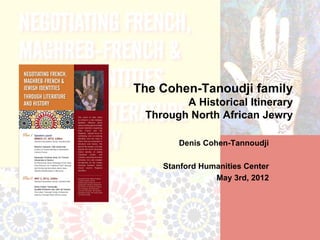
The Cohen-Tanoudji family
        A Historical Itinerary
 Through North African Jewry

       Denis Cohen-Tannoudji

    Stanford Humanities Center
                May 3rd, 2012
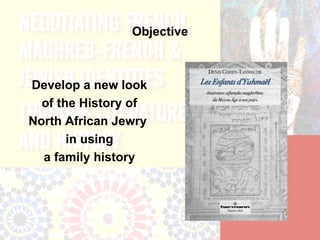
Objective


Develop a new look
  of the History of
North African Jewry
       in using
  a family history
Rationale

North African Jewry history : a low historical consciousness
    – In particular among Jews from North Africa, among the Cohen-Tanoudji


North African Jewry history : an under developed topic
    – Few historians developed it compared to Ashkenazi or Western Sefaradic
      Jewry History


50 years after the exodus of the Sefaradic Jews from Muslim world
    – Why did the Jews leave ?
    – Was the creation of the State of Israel the only reason ?
    – The last Cohen-Tanoudji who was still living in North Africa died in 2003


The difficulty to understand the “new antisemitism” in France since 2000
    – Was it only due to the importation in France of the third “Intifada” ?
A unique approach

A unique family name

A genealogical continuity through centuries
used as an historical marker

At each generation, one or several family
members left some written sources
Methodology


Yosef Hayim Yerushalmi
      (1932-2009)

 Columbia University
Methodology

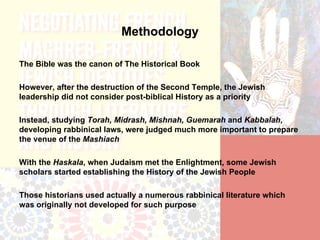
The Bible was the canon of The Historical Book

However, after the destruction of the Second Temple, the Jewish
leadership did not consider post-biblical History as a priority

Instead, studying Torah, Midrash, Mishnah, Guemarah and Kabbalah,
developing rabbinical laws, were judged much more important to prepare
the venue of the Mashiach

With the Haskala, when Judaism met the Enlightment, some Jewish
scholars started establishing the History of the Jewish People

Those historians used actually a numerous rabbinical literature which
was originally not developed for such purpose
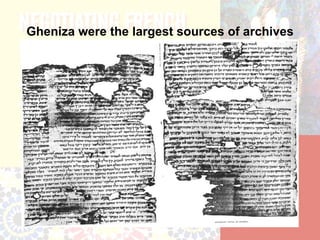
Gheniza were the largest sources of archives
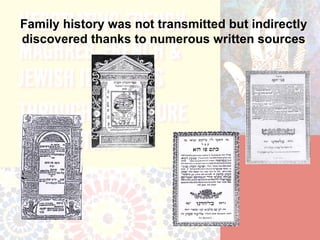
Family history was not transmitted but indirectly
discovered thanks to numerous written sources
A new look at North African Jewry History

•   The origins of North African Jewry and the Sefaradic civilization

•   The rise and the fall of the Spanish Golden Age(s)

•   The light and the darkness of the Ottoman Empire

•   From the Spanish repulsion to the French attraction

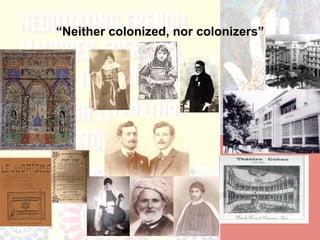
•   “Neither colonized, nor colonizers”

•   Dragged in the Second World War

•   The Exodus of the Jews from Muslim world
The origins of North African Jewry
             and the Sefaradic civilization
Jews are already in North Africa during the Roman & Byzantine Empires
    – Carthage archeology
    – Early Christian literature (Tertullian, Saint Augustine)


Berber population could have been partly judaized, but certainly not more
than elsewhere

First North African Jews were instead Judean population being
berberized
    – Cohen-Tanoudji (Priest from Tangier), a Judean name with a Berber touch


The Kahina Queen was certainly not Jewish but Christian
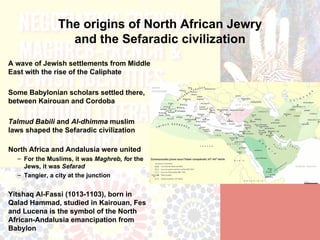
The origins of North African Jewry
                 and the Sefaradic civilization
A wave of Jewish settlements from Middle
East with the rise of the Caliphate

Some Babylonian scholars settled there,
between Kairouan and Cordoba

Talmud Babili and Al-dhimma muslim
laws shaped the Sefaradic civilization

North Africa and Andalusia were united
  – For the Muslims, it was Maghreb, for the
    Jews, it was Sefarad
  – Tangier, a city at the junction


Yitshaq Al-Fassi (1013-1103), born in
Qalad Hammad, studied in Kairouan, Fes
and Lucena is the symbol of the North
African-Andalusia emancipation from
Babylon
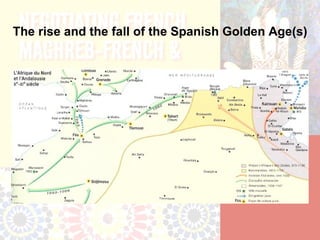
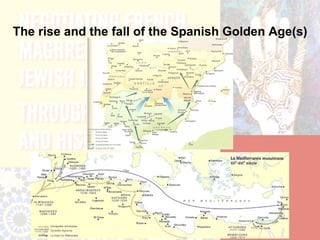
The rise and the fall of the Spanish Golden Age(s)

 1492, as the End of the Spanish Jewish Golden Age, is a well known event among
 collective memories

 It is however more complicated… there were two Spanish Golden Ages, one under
 Omayyad rules, another, later, under Christian rules

 The Almoravides (1054), the Beni Hilâl (1060) and then the Almohades (1147) forced
 all the non-muslim communities of North Africa and Andalusia to convert to Islam,
 to leave or die

 North African Christians disappeared, Andalusia Jews left for Castilla and Aragon,
 Maghrebi Jews converted to Islam or left for Egypt and Sicily
     –   A Cohen family from Tangiers fled from Morocco to Sicily where the family name is
         noticed in 1354 in Palermo among North African Jews established there


 Sefaradic civilization moved from Kairouan and Cordoba to Toledo and Cairo
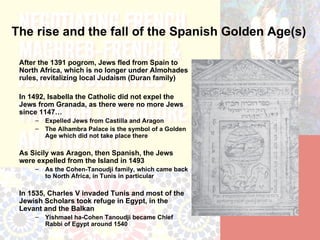
The rise and the fall of the Spanish Golden Age(s)

 After the 1391 pogrom, Jews fled from Spain to
 North Africa, which is no longer under Almohades
 rules, revitalizing local Judaism (Duran family)

 In 1492, Isabella the Catholic did not expel the
 Jews from Granada, as there were no more Jews
 since 1147…
     –   Expelled Jews from Castilla and Aragon
     –   The Alhambra Palace is the symbol of a Golden
         Age which did not take place there

 As Sicily was Aragon, then Spanish, the Jews
 were expelled from the Island in 1493
     –   As the Cohen-Tanoudji family, which came back
         to North Africa, in Tunis in particular

 In 1535, Charles V invaded Tunis and most of the
 Jewish Scholars took refuge in Egypt, in the
 Levant and the Balkan
     –   Yishmael ha-Cohen Tanoudji became Chief
         Rabbi of Egypt around 1540
The light and the darkness
                    of the Ottoman Empire
A new Jewish Golden Age under the reign of Suleiman and Selim II
    – A haven for Spanish and Portuguese Jewish refugees
    – A political, intellectual and religious renewal, in particular in Galilee
         • Gracia and Yosef ha-Nassi political involvements, or the premices of Zionism
         • Yosef Caro unifying the Jewish Law with its rabbinical codification
         • Yitzhaq Luria Ashkenazi, inspiring a new messianic message, the Tikkun Olam


Rabbi Yishmael ha-Cohen Tanoudji participated to this renewal
    – His “Book of Memory”, published in 1555 in Ferrara (Italy), is indeed not
      about history but a rabbinical guide for Jewish life
    – Solicited in 1570 by Yosef ha-Nassi about Herem of his physician

But after Selim II death, the start of a long decline for the Ottoman
Caliphate and a period of hardness for its Jews
    – Al-Dhimma became stricter for non-muslim minorities
    – No more immigration of Marrano Jews from Spain and Portugal who
      preferred to settle in Amsterdam, Leghorn and Bordeaux
The light and the darkness
                   of the Ottoman Empire
Despite those tough times, Erets Yisrael remains a unification factor
among Jews, especially among Western and Eastern Sefaradic Jews
    – Shabbatai Zvi, the fake Mashiach in 1666


The Emissaries of the Palestinian Yeshivot financially supported by the
wealthy Jewish Communities of Amsterdam and Leghorn
    – Ya’acov Vega from Leghorn
    – Ya’acov Pereira from Amsterdam


The Cohen-Tanoudji as actors of this phenomenon
    – Shalom Cohen-Tanoudji, emissary of Jerusalem, settled in Tunis in 1680
    – His brother or cousin, Shmuel Cohen-Tanoudji, emissary of Jerusalem in
      North Africa, Rishon le-Tsion in 1700
    – His son, Yehuda ha-Cohen Tanoudji, emissary of Jerusalem, signed in 1708
      the Herem against Nehemiah Hayoun, a disciple of Shabbatai Zvi,
The Regency of Tunis in the 18th century,
           an unknown Golden Age
A stable political power with some independence from the Sublime Gate

The Al-Dhimma laws not too severely applied to Jews compared to other
Ottoman provinces

A significant Sefaradic immigration from Leghorn started around 1650

Tunis has then the largest urban Jewish population of North Africa

The largest trade center between North Africa and Europe

The most numerous Jewish literature of North Africa, with Hebraic books
published generally in Leghorn
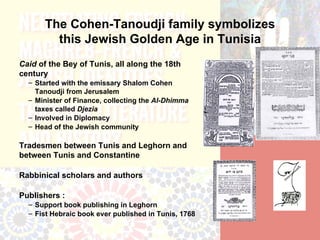
The Cohen-Tanoudji family symbolizes
         this Jewish Golden Age in Tunisia
Caid of the Bey of Tunis, all along the 18th
century
  – Started with the emissary Shalom Cohen
    Tanoudji from Jerusalem
  – Minister of Finance, collecting the Al-Dhimma
    taxes called Djezia
  – Involved in Diplomacy
  – Head of the Jewish community

Tradesmen between Tunis and Leghorn and
between Tunis and Constantine

Rabbinical scholars and authors

Publishers :
  – Support book publishing in Leghorn
  – Fist Hebraic book ever published in Tunis, 1768
From the Spanish repulsion
                  to the French attraction
Spanish and Portuguese failed invasions of North Africa were celebrated
by Jews as “Small Purim”

Sefaradic emancipation and the French Enlightment started to diffuse
among North African Jewish elites before 1830 French invasion of Algeria
    – Leghorn Jews and the ones from Amsterdam are the first emancipated
      Jews of Europe, much before the French Revolution
    – Trade with France and French Italy exposes Jews of Tunis and Algiers to
      the Enlightment
    – Joseph Coen Tanugi from Leghorn, the first member of the family to
      become French citizen in 1798, much before his cousins settled in 1780 in
      Constantine, Algeria, conquered by France in 1837

In parallel, the situation of the Jews of the Ottoman Caliphate deteriorated
    – Pogroms of Algiers in 1805 and of Tetouan in 1860
    – The Damas Affair in 1840

French colonialism brought at least one positive element, it liberated the
Jews from the Al-Dhimma servitude
“Neither colonized, nor colonizers”

North African Jews become French subjects: 1830 in Algeria, 1881
in Tunisia, 1912 in Morocco


In 1870, Jews from Algeria received the French citizenship without
asking for it
    – 1865 Law already enabled Jews and Muslims to become French
      citizen, but only few hundreds committed


Tradition, Emancipation, Self-Emancipation
    – Mass schooling with Alliance and French Schools
    – Plural political views: Traditionalist, Socialist, Zionist, Nationalist
    – Renewal of rabbinical literature, new cultural and intellectual
      fields
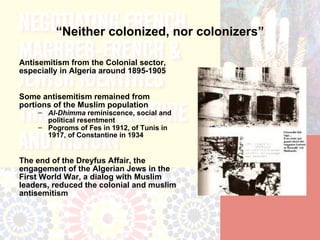
“Neither colonized, nor colonizers”

Antisemitism from the Colonial sector,
especially in Algeria around 1895-1905


Some antisemitism remained from
portions of the Muslim population
    – Al-Dhimma reminiscence, social and
      political resentment
    – Pogroms of Fes in 1912, of Tunis in
      1917, of Constantine in 1934


The end of the Dreyfus Affair, the
engagement of the Algerian Jews in the
First World War, a dialog with Muslim
leaders, reduced the colonial and muslim
antisemitism
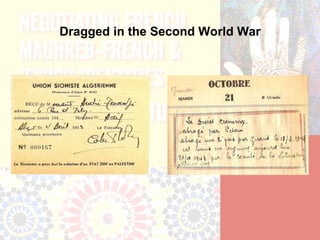
Dragged in the Second World War

North Africa under Vichy rules as of July 1940
    –   Social, economical and political exclusion of the Jews
    –   Algerian Jews lost their French citizenship, with the Crémieux Decree abolished

Revival of antisemitism from colonial and muslim sectors

Wansee Conference outcome included North African Jewry as part as French
Jewry to be annihilated
    –   Thousands of Jews, from North Africa, living in France are deported in death camps

Anglo-American invasion of Algeria and Morocco in November 1942 saved the
North African Jews from their annihilation fate

Tunisia, as Libya, under Nazi occupation until May 1943
    –   Thousands of Jews deported in war camps, a dozen deported in Auschwitz

In parallel, Giraud takes the lead of the Free North Africa, while still banning Jews
from political rights
    –   Second abrogation of Crémieux Decree, Jewish soldiers still in war camps

It is only when Tunisia is finally liberated, and when De Gaulle replaced Giraud, that
North African Jews take fully back their political rights
Dragged in the Second World War
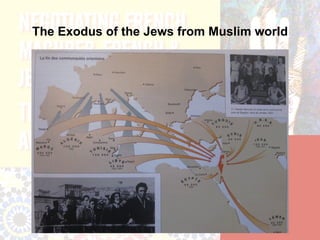
The Exodus of the Jews from Muslim world

If the decolonization and the rebirth of Israel weaken the situation of the
Million of Jews from Muslim world…

…many other reasons however forced this Sefaradic population to leave
their countries
    – Against periodic pogroms, they were somehow protected by the colonial
      powers, France and Great Britain
    – They generally had political rights compared to the colonized population
    – They did not want to go back to the Al-Dhimma framework, or being
      marginalized by the arabization or islamization of their countries
    – Part of the population, either Religious or secular Zionists, were positively
      attracted by Israel
    – Some new Arab regimes such as Egypt, Iraq and Libya, had explicit
      antisemitic policies, forcing their Jews to leave
    – Jews massively left Algeria, together with the French population

Israel became the refuge for 600 000 Jews from Muslim countries
    – France was the sanctuary for 300 000, especially for the Cohen-Tanoudji
The Exodus of the Jews from Muslim world
Where and who are they today ?

Most of the Sefaradic communities who took refuge in Israel were
amputated of their elites who fled to France, Canada, Argentina, UK and
the US
    – Mostly observant Jews and Arab speakers
    – Installation in refugee camps (Ma’abarot) at the periphery of the country
    – Social and cultural marginalization by the secular Ashkenazi pioneers of
      the young State of Israel,
    – It took decades to reduce the social and economical gap for those who
      represent now a small majority of the Jewish population of Israel

Sefaradic population who emigrated to France succeeded its social and
economical integration
    – Most of them were already French speakers, a majority, French citizens
    – Could benefit from the 1945-1975 French economical boom, even if a
      significant portion still faces social difficulties in French suburbs
    – Participated fully to French scientific, artistic and intellectual creativity
         • Its symbolic example, the Nobel Prize for Claude Cohen-Tannoudji in 1997
Key learnings

Even with few thousands Jews in Morocco, Iran and Turkey, and hundreds in
Tunisia today, the Jewish presence in Muslim lands in over

Arab nationalism has succeeded where the Almohades failed, emptying North
Africa of its Jews

French Jews with North African roots are not French “Pieds noirs”, their cultural
and historical identities are much more complex

In France suburbs, young authors of antisemitic acts are not only social victims,
they regenerate old hate mechanisms which pre-existed in North Africa

Developing historical knowledge is the proper way to deconstruct solid myths,
while avoiding reconstructing new ones
     –   Jewish-Muslim “Golden Ages” did exist
     –   But it appeared only during some limited periods of the History, when Al-Dhimma
         laws were permissively relaxed
     –   Jewish condition were comparatively better in Muslim world than in Christian
         environment (Mark Cohen, Under Crescent and Cross, Princeton)
Thank You Very Much

Dct stanford-03 may2012

  • 1.
    The Cohen-Tanoudji family A Historical Itinerary Through North African Jewry Denis Cohen-Tannoudji Stanford Humanities Center May 3rd, 2012
  • 2.
    Objective Develop a newlook of the History of North African Jewry in using a family history
  • 3.
    Rationale North African Jewryhistory : a low historical consciousness – In particular among Jews from North Africa, among the Cohen-Tanoudji North African Jewry history : an under developed topic – Few historians developed it compared to Ashkenazi or Western Sefaradic Jewry History 50 years after the exodus of the Sefaradic Jews from Muslim world – Why did the Jews leave ? – Was the creation of the State of Israel the only reason ? – The last Cohen-Tanoudji who was still living in North Africa died in 2003 The difficulty to understand the “new antisemitism” in France since 2000 – Was it only due to the importation in France of the third “Intifada” ?
  • 4.
    A unique approach Aunique family name A genealogical continuity through centuries used as an historical marker At each generation, one or several family members left some written sources
  • 5.
    Methodology Yosef Hayim Yerushalmi (1932-2009) Columbia University
  • 6.
    Methodology The Bible wasthe canon of The Historical Book However, after the destruction of the Second Temple, the Jewish leadership did not consider post-biblical History as a priority Instead, studying Torah, Midrash, Mishnah, Guemarah and Kabbalah, developing rabbinical laws, were judged much more important to prepare the venue of the Mashiach With the Haskala, when Judaism met the Enlightment, some Jewish scholars started establishing the History of the Jewish People Those historians used actually a numerous rabbinical literature which was originally not developed for such purpose
  • 7.
    Gheniza were thelargest sources of archives
  • 8.
    Family history wasnot transmitted but indirectly discovered thanks to numerous written sources
  • 9.
    A new lookat North African Jewry History • The origins of North African Jewry and the Sefaradic civilization • The rise and the fall of the Spanish Golden Age(s) • The light and the darkness of the Ottoman Empire • From the Spanish repulsion to the French attraction • “Neither colonized, nor colonizers” • Dragged in the Second World War • The Exodus of the Jews from Muslim world
  • 10.
    The origins ofNorth African Jewry and the Sefaradic civilization Jews are already in North Africa during the Roman & Byzantine Empires – Carthage archeology – Early Christian literature (Tertullian, Saint Augustine) Berber population could have been partly judaized, but certainly not more than elsewhere First North African Jews were instead Judean population being berberized – Cohen-Tanoudji (Priest from Tangier), a Judean name with a Berber touch The Kahina Queen was certainly not Jewish but Christian
  • 11.
    The origins ofNorth African Jewry and the Sefaradic civilization A wave of Jewish settlements from Middle East with the rise of the Caliphate Some Babylonian scholars settled there, between Kairouan and Cordoba Talmud Babili and Al-dhimma muslim laws shaped the Sefaradic civilization North Africa and Andalusia were united – For the Muslims, it was Maghreb, for the Jews, it was Sefarad – Tangier, a city at the junction Yitshaq Al-Fassi (1013-1103), born in Qalad Hammad, studied in Kairouan, Fes and Lucena is the symbol of the North African-Andalusia emancipation from Babylon
  • 12.
    The rise andthe fall of the Spanish Golden Age(s) 1492, as the End of the Spanish Jewish Golden Age, is a well known event among collective memories It is however more complicated… there were two Spanish Golden Ages, one under Omayyad rules, another, later, under Christian rules The Almoravides (1054), the Beni Hilâl (1060) and then the Almohades (1147) forced all the non-muslim communities of North Africa and Andalusia to convert to Islam, to leave or die North African Christians disappeared, Andalusia Jews left for Castilla and Aragon, Maghrebi Jews converted to Islam or left for Egypt and Sicily – A Cohen family from Tangiers fled from Morocco to Sicily where the family name is noticed in 1354 in Palermo among North African Jews established there Sefaradic civilization moved from Kairouan and Cordoba to Toledo and Cairo
  • 13.
    The rise andthe fall of the Spanish Golden Age(s)
  • 14.
    The rise andthe fall of the Spanish Golden Age(s)
  • 15.
    The rise andthe fall of the Spanish Golden Age(s) After the 1391 pogrom, Jews fled from Spain to North Africa, which is no longer under Almohades rules, revitalizing local Judaism (Duran family) In 1492, Isabella the Catholic did not expel the Jews from Granada, as there were no more Jews since 1147… – Expelled Jews from Castilla and Aragon – The Alhambra Palace is the symbol of a Golden Age which did not take place there As Sicily was Aragon, then Spanish, the Jews were expelled from the Island in 1493 – As the Cohen-Tanoudji family, which came back to North Africa, in Tunis in particular In 1535, Charles V invaded Tunis and most of the Jewish Scholars took refuge in Egypt, in the Levant and the Balkan – Yishmael ha-Cohen Tanoudji became Chief Rabbi of Egypt around 1540
  • 16.
    The light andthe darkness of the Ottoman Empire A new Jewish Golden Age under the reign of Suleiman and Selim II – A haven for Spanish and Portuguese Jewish refugees – A political, intellectual and religious renewal, in particular in Galilee • Gracia and Yosef ha-Nassi political involvements, or the premices of Zionism • Yosef Caro unifying the Jewish Law with its rabbinical codification • Yitzhaq Luria Ashkenazi, inspiring a new messianic message, the Tikkun Olam Rabbi Yishmael ha-Cohen Tanoudji participated to this renewal – His “Book of Memory”, published in 1555 in Ferrara (Italy), is indeed not about history but a rabbinical guide for Jewish life – Solicited in 1570 by Yosef ha-Nassi about Herem of his physician But after Selim II death, the start of a long decline for the Ottoman Caliphate and a period of hardness for its Jews – Al-Dhimma became stricter for non-muslim minorities – No more immigration of Marrano Jews from Spain and Portugal who preferred to settle in Amsterdam, Leghorn and Bordeaux
  • 17.
    The light andthe darkness of the Ottoman Empire Despite those tough times, Erets Yisrael remains a unification factor among Jews, especially among Western and Eastern Sefaradic Jews – Shabbatai Zvi, the fake Mashiach in 1666 The Emissaries of the Palestinian Yeshivot financially supported by the wealthy Jewish Communities of Amsterdam and Leghorn – Ya’acov Vega from Leghorn – Ya’acov Pereira from Amsterdam The Cohen-Tanoudji as actors of this phenomenon – Shalom Cohen-Tanoudji, emissary of Jerusalem, settled in Tunis in 1680 – His brother or cousin, Shmuel Cohen-Tanoudji, emissary of Jerusalem in North Africa, Rishon le-Tsion in 1700 – His son, Yehuda ha-Cohen Tanoudji, emissary of Jerusalem, signed in 1708 the Herem against Nehemiah Hayoun, a disciple of Shabbatai Zvi,
  • 18.
    The Regency ofTunis in the 18th century, an unknown Golden Age A stable political power with some independence from the Sublime Gate The Al-Dhimma laws not too severely applied to Jews compared to other Ottoman provinces A significant Sefaradic immigration from Leghorn started around 1650 Tunis has then the largest urban Jewish population of North Africa The largest trade center between North Africa and Europe The most numerous Jewish literature of North Africa, with Hebraic books published generally in Leghorn
  • 19.
    The Cohen-Tanoudji familysymbolizes this Jewish Golden Age in Tunisia Caid of the Bey of Tunis, all along the 18th century – Started with the emissary Shalom Cohen Tanoudji from Jerusalem – Minister of Finance, collecting the Al-Dhimma taxes called Djezia – Involved in Diplomacy – Head of the Jewish community Tradesmen between Tunis and Leghorn and between Tunis and Constantine Rabbinical scholars and authors Publishers : – Support book publishing in Leghorn – Fist Hebraic book ever published in Tunis, 1768
  • 20.
    From the Spanishrepulsion to the French attraction Spanish and Portuguese failed invasions of North Africa were celebrated by Jews as “Small Purim” Sefaradic emancipation and the French Enlightment started to diffuse among North African Jewish elites before 1830 French invasion of Algeria – Leghorn Jews and the ones from Amsterdam are the first emancipated Jews of Europe, much before the French Revolution – Trade with France and French Italy exposes Jews of Tunis and Algiers to the Enlightment – Joseph Coen Tanugi from Leghorn, the first member of the family to become French citizen in 1798, much before his cousins settled in 1780 in Constantine, Algeria, conquered by France in 1837 In parallel, the situation of the Jews of the Ottoman Caliphate deteriorated – Pogroms of Algiers in 1805 and of Tetouan in 1860 – The Damas Affair in 1840 French colonialism brought at least one positive element, it liberated the Jews from the Al-Dhimma servitude
  • 21.
    “Neither colonized, norcolonizers” North African Jews become French subjects: 1830 in Algeria, 1881 in Tunisia, 1912 in Morocco In 1870, Jews from Algeria received the French citizenship without asking for it – 1865 Law already enabled Jews and Muslims to become French citizen, but only few hundreds committed Tradition, Emancipation, Self-Emancipation – Mass schooling with Alliance and French Schools – Plural political views: Traditionalist, Socialist, Zionist, Nationalist – Renewal of rabbinical literature, new cultural and intellectual fields
  • 22.
  • 23.
    “Neither colonized, norcolonizers” Antisemitism from the Colonial sector, especially in Algeria around 1895-1905 Some antisemitism remained from portions of the Muslim population – Al-Dhimma reminiscence, social and political resentment – Pogroms of Fes in 1912, of Tunis in 1917, of Constantine in 1934 The end of the Dreyfus Affair, the engagement of the Algerian Jews in the First World War, a dialog with Muslim leaders, reduced the colonial and muslim antisemitism
  • 24.
    Dragged in theSecond World War North Africa under Vichy rules as of July 1940 – Social, economical and political exclusion of the Jews – Algerian Jews lost their French citizenship, with the Crémieux Decree abolished Revival of antisemitism from colonial and muslim sectors Wansee Conference outcome included North African Jewry as part as French Jewry to be annihilated – Thousands of Jews, from North Africa, living in France are deported in death camps Anglo-American invasion of Algeria and Morocco in November 1942 saved the North African Jews from their annihilation fate Tunisia, as Libya, under Nazi occupation until May 1943 – Thousands of Jews deported in war camps, a dozen deported in Auschwitz In parallel, Giraud takes the lead of the Free North Africa, while still banning Jews from political rights – Second abrogation of Crémieux Decree, Jewish soldiers still in war camps It is only when Tunisia is finally liberated, and when De Gaulle replaced Giraud, that North African Jews take fully back their political rights
  • 25.
    Dragged in theSecond World War
  • 26.
    The Exodus ofthe Jews from Muslim world If the decolonization and the rebirth of Israel weaken the situation of the Million of Jews from Muslim world… …many other reasons however forced this Sefaradic population to leave their countries – Against periodic pogroms, they were somehow protected by the colonial powers, France and Great Britain – They generally had political rights compared to the colonized population – They did not want to go back to the Al-Dhimma framework, or being marginalized by the arabization or islamization of their countries – Part of the population, either Religious or secular Zionists, were positively attracted by Israel – Some new Arab regimes such as Egypt, Iraq and Libya, had explicit antisemitic policies, forcing their Jews to leave – Jews massively left Algeria, together with the French population Israel became the refuge for 600 000 Jews from Muslim countries – France was the sanctuary for 300 000, especially for the Cohen-Tanoudji
  • 27.
    The Exodus ofthe Jews from Muslim world
  • 28.
    Where and whoare they today ? Most of the Sefaradic communities who took refuge in Israel were amputated of their elites who fled to France, Canada, Argentina, UK and the US – Mostly observant Jews and Arab speakers – Installation in refugee camps (Ma’abarot) at the periphery of the country – Social and cultural marginalization by the secular Ashkenazi pioneers of the young State of Israel, – It took decades to reduce the social and economical gap for those who represent now a small majority of the Jewish population of Israel Sefaradic population who emigrated to France succeeded its social and economical integration – Most of them were already French speakers, a majority, French citizens – Could benefit from the 1945-1975 French economical boom, even if a significant portion still faces social difficulties in French suburbs – Participated fully to French scientific, artistic and intellectual creativity • Its symbolic example, the Nobel Prize for Claude Cohen-Tannoudji in 1997
  • 29.
    Key learnings Even withfew thousands Jews in Morocco, Iran and Turkey, and hundreds in Tunisia today, the Jewish presence in Muslim lands in over Arab nationalism has succeeded where the Almohades failed, emptying North Africa of its Jews French Jews with North African roots are not French “Pieds noirs”, their cultural and historical identities are much more complex In France suburbs, young authors of antisemitic acts are not only social victims, they regenerate old hate mechanisms which pre-existed in North Africa Developing historical knowledge is the proper way to deconstruct solid myths, while avoiding reconstructing new ones – Jewish-Muslim “Golden Ages” did exist – But it appeared only during some limited periods of the History, when Al-Dhimma laws were permissively relaxed – Jewish condition were comparatively better in Muslim world than in Christian environment (Mark Cohen, Under Crescent and Cross, Princeton)
  • 30.