Data Assessment Results


Pricing Data Assessment Approach

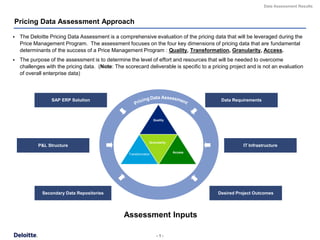
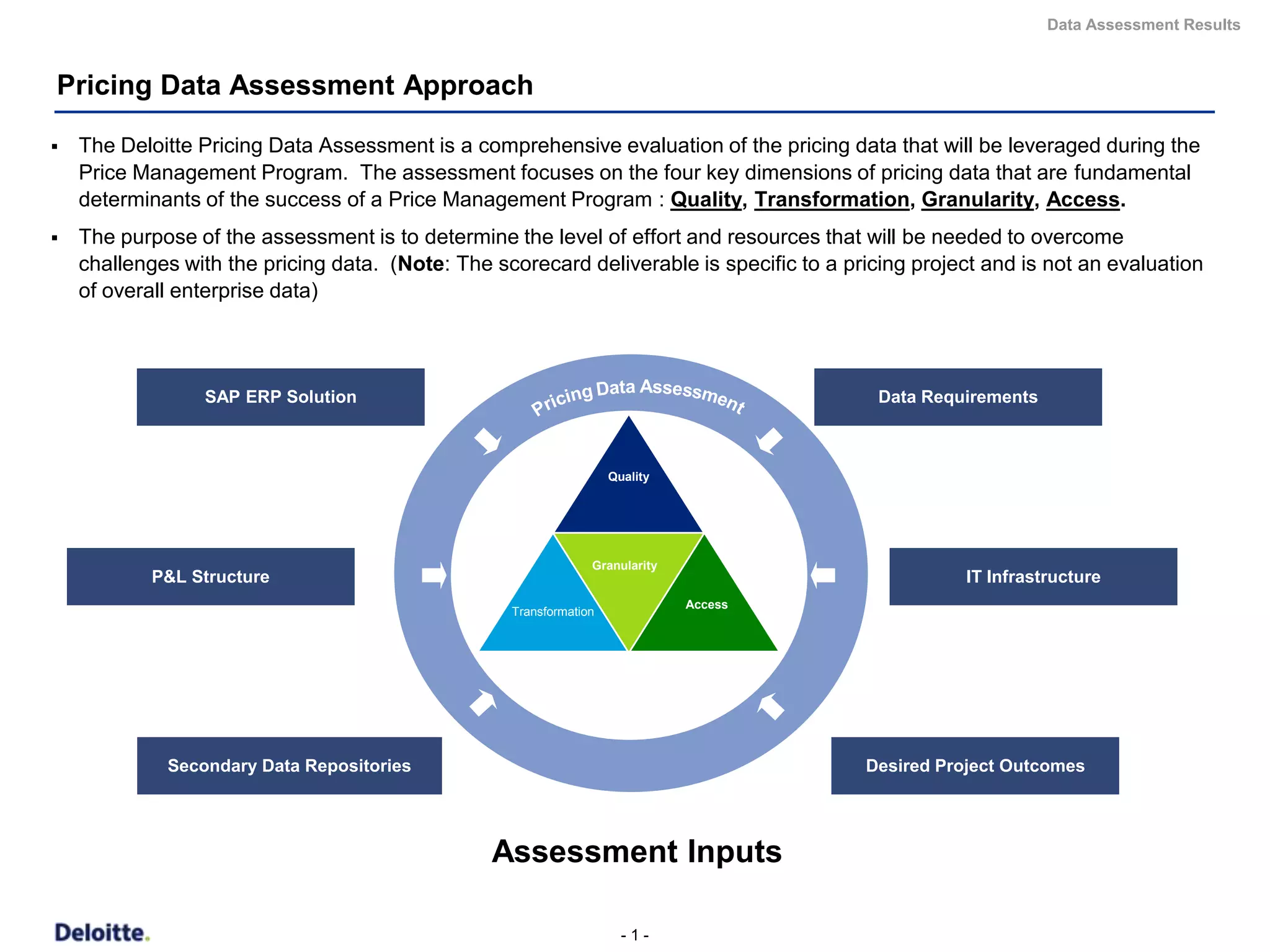
๏‚ง   The Deloitte Pricing Data Assessment is a comprehensive evaluation of the pricing data that will be leveraged during the
    Price Management Program. The assessment focuses on the four key dimensions of pricing data that are fundamental
    determinants of the success of a Price Management Program : Quality, Transformation, Granularity, Access.
๏‚ง   The purpose of the assessment is to determine the level of effort and resources that will be needed to overcome
    challenges with the pricing data. (Note: The scorecard deliverable is specific to a pricing project and is not an evaluation
    of overall enterprise data)


                 SAP ERP Solution                                                           Data Requirements


                                                                    Quality


                                                                Granularity
            P&L Structure                                                                            IT Infrastructure
                                                                              Access
                                                   Transformation


             Secondary Data Repositories                                                  Desired Project Outcomes


                                                 Assessment Inputs

                                                                      -1-
Data Assessment Results


Pricing Data Assessment
The process for conducting a Pricing Data Assessment involves an evaluation of a representative sample of pricing-related
data from all businesses across multiple dimensions and regions. The goal of the assessment is to understand the current
state of pricing data to enable more accurate scoping and planning.


         Identify Pricing                                                       Extract and Validate
                                             Identify Data Sources                                                      Assess Data
        Data Requirements                                                           Sample Data

๏‚ก   Create a list of data required   ๏‚ก   Isolate sources of data for    ๏‚ก    Extract sample data from       ๏‚ก   Assess quality, accessibility,
    to meet the pricing needs of         each business and region            identified sources for each        granularity and
    the business                                                             business and region                transformation of data to be
                                     ๏‚ก   Document data availability                                             used for price management
        ๏‚ก   TPA / Proof-of-                                             ๏‚ก    Validate extracts against
            Concept                  ๏‚ก   Identify who originates and         financial statements           ๏‚ก   Document assessment for
                                         manages the data                                                       each business and region
        ๏‚ก   Segmentation                 โ€“   User input                 ๏‚ก    Ensure completeness and
                                                                             consistency of data extracts
        ๏‚ก   Optimization                 โ€“   Database extract
                                         โ€“   Extraction process
๏‚ก   Based on data specifications
    from [vendor] interfaces and
    functionality

๏‚ก   Driven by waterfall design
    and potential dimensions of
    analysis


                               1 week                                                  1 week                                1 week


                                                                       -2-
Data Assessment Results


Pricing Data Assessment Summary

                            High Level Findings                                                       Supporting Information
                                   Quality                                              [Department 1]                      [Department 2]
 Assessment Score
       Low (0-3)                                                                ๏‚ก Data within [tool x] is           ๏‚ก Data and operational
                                                                                  necessary for allocation and        complexity indicated by x-
       Average (3-6)                                                              will complicate the integration     xxxX more records per $1MM
       High (6-9)                                                                 with a second interface             revenue and x.x-y.yX more
                                                                                                                      records per billing line item
                                                                                ๏‚ก Lack of customer hierarchy
                                                                                  data will present biggest         ๏‚ก xx% variance in transactions
 Transformation                                             Access                challenge within [department1]      vs. P&L may indicate need for
                                                                                  due to proliferated ship-toโ€™s       modified extraction process
                                                                                ๏‚ก There are many large and          ๏‚ก Lack of attribute field usage
                                                                                  complex CTS elements                and โ€•Nullsโ€– add complexity
                                                                                ๏‚ก Assessment Score: 4.6             ๏‚ก Assessment Score: 2.7


                                  Granularity
                                                                                        [Department 3]                      [Department 4]
                       LB        PMD            PGG   ELE
                                                                                ๏‚ก Low number of very high           ๏‚ก Appears to be the easiest
๏‚ก Single global SAP deployment for 95-97% of business (all in-                    revenue transactions may            division to implement
  scope areas) supports consistent data structure                                 limit effectiveness of
                                                                                                                    ๏‚ก Low number of very large
๏‚ก There is very granular information for transactional pricing, but               transactional analysis
                                                                                                                      customers enables rich
  detailed cost breakouts and cost-to-serve allocations will require
                                                                                ๏‚ก Highest proportion of standard      hierarchy and segmentation
  significant data transformation
                                                                                  cost indicates there will be
๏‚ก A detailed review of the extracted data revealed a number of                                                      ๏‚ก Low number of transactions
                                                                                  more complex allocations
                                                                                                                      and revenue may limit
  areas where the data was inconsistent with expectations
                                                                                ๏‚ก Material master complexity will     effectiveness of transactional
   โˆ’     E.g., Revenue was matched to the P&L +/-6%; however,                     be prevalent given that             analysis and reduce
         the deviations within individual sales orgs and profit centers           [department 3] has 2-5X more        opportunity size
         may indicate the extracted data lacks certain in-scope areas             base materials
                                                                                                                    ๏‚ก Assessment Score: 6.4
   โˆ’     Limited usage of product and customer segmentation fields              ๏‚ก Assessment Score: 5.4


                                                                          -3-
Data Assessment Results


Assessment Scorecard: Pricing Data Quality Dimension

                                                                                                                       Business Unit Assessment Score *
  Dimension          Criteria         Weight                             Summary Findings                              [Dep1]   [Dep2]   [Dep3]   [Dep4]
                                                + Deloitte and [vendor] Data requests mapped to SAP tables
                                                + Three month extract pulled from ODS Pricing table, Rental
                                                  revenue waterfall SAP transaction, customer master, material
                Completeness           25%        master, and reference look-up tables                                   9        9        3        9
                                                โˆ’ Missing transactional revenue for [dep3](e.g., prepaid contracts)
                                                โˆ’ Did not receive receivables data or contract data
                                                โˆ’ Transaction fields with values not included in look-up tables
                                                โˆ’ P&L revenue matched transaction revenue +6% but [dep3] is
  Pricing                                         off by xx% and there are instances of significant variation by
   Data         Accuracy               20%        sales org and profit center                                            9        3        1        9
  Quality                                       + Updates are made as separate correction entries vs. changes
                                                โˆ’ Customer and Material proliferation / duplication across
                 Duplication           20%                                                                               3        3        1        3
                                                  different Sales Orgs will make analysis more complex
 โ€•Ability to use
    current                                     โˆ’ 140+ SOs with potentially inconsistent use of discrete pricing
 captured data                                    processes . Measurement of true discount will be complex.
within a pricing Consistency           15%      โˆ’ [dep3] has different processes that affects field usage (e.g.,         3        3        1        3
transformation                                    69% of customers have โ€•No Segmentโ€– when references
     โ€” not                                        industry)
incorrectnessโ€–                                  โˆ’ List price field doesnโ€™t always represent true list price; is used
                                                  for โ€•goal seekโ€– purposes
                Integrity              15%                                                                               3        3        1        3
                                                โˆ’ The extract process for rental revenue provides different fields
                                                  from ODS extract, adds complexity to future data pulls
                                                + Base Unit of Measure is foundation in SAP
                                                โˆ’ NULL values in the transaction data will require cleansing
                Conformity              5%                                                                               9        9        3        9
                                                โˆ’ Exchange rate and rental discount fields are stored as text
                                                โˆ’ Leading zeros were lost in some extracts, requires cleansing
               *Score:                                                                                                  6.0      4.8      1.6      6.0
               1 (Low): Significantly more effort will be required
               3 (Average): Average level of effort will be required
               9 (High): Less than average effort will be required
                                                                             -4-
Data Assessment Results


Assessment Scorecard: Pricing Data Access Dimension

                                                                                                                        Business Unit Assessment Score *
  Dimension           Criteria         Weight                             Summary Findings                              [Dep1]   [Dep2]   [Dep3]   [Dep4]
                                                 + Single global SAP deployment for 95-97% of business (all in-
                                                   scope areas) supports consistent data structures
                                                 + Single SQL dB platform across all applications
                 Data Sources           30%      โˆ’ Detailed distribution data is maintained in [tool] which is a full     1        9        3        9
                                                   secondary interface
                                                 โˆ’ Data extracted for assessment indicates additional complexity
                                                   in the underlying data sources for [dep3] transactions
   Pricing                                       + Extraction from R1 data cube allows for increased performance
    Data         Ease of                         + BW & ODS should contain the level of detail for most of the
                                        25%                                                                               3        9        9        9
   Access        Extraction                        extracts This will mean good performance
                                                 + Uniform extraction tools for SQL-based platform
                                                 โˆ’ SQL queries and scripts are ad-hoc / manual but have been
  โ€•Accessibility
                                                   documented and stored
for IT resources
    to extract   Sustainability         20%      โˆ’ Working with European resources will require additional                9        9        3        9
necessary data                                     logistical support during the course of the project
   specific to a                                 + Logistics has run monthly reports to collect [tool] data
      pricing                                    + Closing process takes five work days at the end of every month
transformationโ€–
                 Timeliness             10%      + Copy of the production (R1) is refreshed weekly                        9        9        3        9
                                                 โˆ’ Stored procedures can take very long to run for waterfall data
                                                 โˆ’ Special access was required to pull information from certain
                                                   environments, which may slow down data extraction
                 Security               10%                                                                               3        3        3        3
                                                 โˆ’ Sales Orgs and Finance will need to allow clear communication
                                                   with the team about P&L data
                                                 โˆ’ Certain information is not included in ODS table (e.g.,
                 Sequence                5%                                                                               9        9        9        9
                                                   intercompany drop ship ) and may need to be added

                                                                                                                         4.1      8.0      4.4      8.0
                *Score:
                1 (Low): Significantly more effort will be required
                3 (Average): Average level of effort will be required
                9 (High): Less than average effort will be required
                                                                              -5-
Data Assessment Results


Assessment Scorecard: Pricing Data Granularity Dimension

                                                                                                                             Business Unit Assessment Score *
  Dimension              Criteria         Weight                             Summary Findings                                [Dep1]   [Dep2]   [Dep3]   [Dep4]
                                                    โˆ’ COGS is often allocated using reference plant vs. mfg plant
                                                    + Rich data is collected from 3rd party carriers
                    Cost Information       30%      โˆ’ Rental transactions do not include any cost information                  9        9        3        9
                                                    โˆ’ Lack general ledger level cost information
                                                    โˆ’ Fixed/Variable breakout and detailed cost build-up are tracked
                                                    โˆ’ SAP conditions types necessitates tribal knowledge to interpret
                    Interpretability       20%                                                                                 3        3        3        3
                                                    + โ€•Condition classโ€– field helps understand the condition types
                                                    โˆ’ Distribution costs in [tool] will complicate the process of building
 Pricing    Format                         15%        the CTS component build.                                                 1        3        3        3
   Data                                             โˆ’ Payment information will be tied to invoice number vs. line item
Granularity                                         โˆ’ Where NRP is used, it does not always reflect a โ€•true list priceโ€–
                                                    โˆ’ Specific reasons for price determination can not be identified in
                                                      the data (e.g., reference price, market discount, geographic
โ€•Level of detail    Price Information      15%        discount, customer discount)                                             1        1        1        1
  needed for                                        โˆ’ Quantity Tier Groupings can complicate transaction data
  transaction
                                                    + Free of charge Items flagged in sales doc item category field
level analysisโ€–
                                                    โˆ’ Proliferation of customer sold-toโ€™s not part of a single hierarchy
                                                      across sales organizations
                    Hierarchy
                                           15%      โˆ’ Rep/customer relationship is mostly static, but they do realign          3        1        1        9
                    Information
                                                      some times which will affect sales incentive data
                                                    + โ€•Same-asโ€– materials can be identified using base material
                                                    + Surcharges can be identified through specific condition types
                    Fees and                        โˆ’ Associating fees to transaction lines will be complex for [dep3]
                                            5%                                                                                 9        9        3        9
                    Services                        โˆ’ There is a fee that can be charged for โ€•order onlyโ€– customers
                                                      (i.e., without telemetry) but not always used
                   *Score:                                                                                                    4.5      4.5      2.4      5.7
                   1 (Low): Significantly more effort will be required
                   3 (Average): Average level of effort will be required
                   9 (High): Less than average effort will be required
                                                                                 -6-
Data Assessment Results


Assessment Scorecard: Pricing Data Transformation Dimension

                                                                                                                        Business Unit Assessment Score *
  Dimension             Criteria         Weight                            Summary Findings                             [Dep1]   [Dep2]   [Dep3]   [Dep4]
                                                   โˆ’ SAP condition types require tribal knowledge to unify
                                                     customers, materials, etc.
                                                   โˆ’ AP Cancel invoices need to be transformed to find
                   Unification            40%        corresponding debit, may span across time periods                    3        3        1        3
                                                   โˆ’ Creating single transaction set for rental will be complex
                                                   โˆ’ Have to convert to USD when extracting raw data
                                                   + Quantity of conditions within one invoice line item may expedite
                                                     waterfall development
                                                   + Information for customer cost-to-serve is tracked in SAP
  Pricing  Allocations                    30%                                                                             3        3        3        3
                                                   โˆ’ Allocations within CO-PA are at various aggregate levels
   Data
                                                   โˆ’ Agent commissions are paid at the end of time period and arenโ€™t
Transform-                                           tied back to a sales transaction (mechanics are stored in SAP)
   ation
                                                   โˆ’ Insufficient decimals in SAP requires extra business logic
                                                   โˆ’ Dates are formatted as text; requires cleansing for consistency
                   Ease of
 โ€•How close is                            10%      โˆ’ [dep3] has 20-250X more data records per $1MM revenue                3        9        1        9
                   Manipulation
the raw data to                                      relative to other business units and 1.5 -4.5 more data records
    a price                                          per billing line item, adds complexity to waterfall manipulation
   waterfallโ€–                                      + Because of the diversity within condition types + the standard
                                                     SAP implementation exclusions seem predictable
                   Exclusions             10%                                                                             3        3        3        3
                                                   + Intercompany transactions can be identified for exclusion
                                                   โˆ’ Healthcare transaction may be difficult to identify
                                                   โˆ’ Cost data is only updated annually, but index fluctuates often
                   Decision Support        5%      โˆ’ Similar materials are not tied to a common base product              1        3        3        3
                                                   + Manual changes can be identified at the transaction level
                                                   โˆ’ Rental transactions have a prior transaction dependency that
                   Relevancy               5%                                                                             9        9        1        9
                                                     drive a change in current transaction profitability

                  *Score:                                                                                                3.2      3.9      1.9      3.9
                  1 (Low): Significantly more effort will be required
                  3 (Average): Average level of effort will be required
                  9 (High): Less than average effort will be required          -7-

Dcom be-en-data-assessment-approach

  • 1.
    Data Assessment Results PricingData Assessment Approach ๏‚ง The Deloitte Pricing Data Assessment is a comprehensive evaluation of the pricing data that will be leveraged during the Price Management Program. The assessment focuses on the four key dimensions of pricing data that are fundamental determinants of the success of a Price Management Program : Quality, Transformation, Granularity, Access. ๏‚ง The purpose of the assessment is to determine the level of effort and resources that will be needed to overcome challenges with the pricing data. (Note: The scorecard deliverable is specific to a pricing project and is not an evaluation of overall enterprise data) SAP ERP Solution Data Requirements Quality Granularity P&L Structure IT Infrastructure Access Transformation Secondary Data Repositories Desired Project Outcomes Assessment Inputs -1-
  • 2.
    Data Assessment Results PricingData Assessment The process for conducting a Pricing Data Assessment involves an evaluation of a representative sample of pricing-related data from all businesses across multiple dimensions and regions. The goal of the assessment is to understand the current state of pricing data to enable more accurate scoping and planning. Identify Pricing Extract and Validate Identify Data Sources Assess Data Data Requirements Sample Data ๏‚ก Create a list of data required ๏‚ก Isolate sources of data for ๏‚ก Extract sample data from ๏‚ก Assess quality, accessibility, to meet the pricing needs of each business and region identified sources for each granularity and the business business and region transformation of data to be ๏‚ก Document data availability used for price management ๏‚ก TPA / Proof-of- ๏‚ก Validate extracts against Concept ๏‚ก Identify who originates and financial statements ๏‚ก Document assessment for manages the data each business and region ๏‚ก Segmentation โ€“ User input ๏‚ก Ensure completeness and consistency of data extracts ๏‚ก Optimization โ€“ Database extract โ€“ Extraction process ๏‚ก Based on data specifications from [vendor] interfaces and functionality ๏‚ก Driven by waterfall design and potential dimensions of analysis 1 week 1 week 1 week -2-
  • 3.
    Data Assessment Results PricingData Assessment Summary High Level Findings Supporting Information Quality [Department 1] [Department 2] Assessment Score Low (0-3) ๏‚ก Data within [tool x] is ๏‚ก Data and operational necessary for allocation and complexity indicated by x- Average (3-6) will complicate the integration xxxX more records per $1MM High (6-9) with a second interface revenue and x.x-y.yX more records per billing line item ๏‚ก Lack of customer hierarchy data will present biggest ๏‚ก xx% variance in transactions Transformation Access challenge within [department1] vs. P&L may indicate need for due to proliferated ship-toโ€™s modified extraction process ๏‚ก There are many large and ๏‚ก Lack of attribute field usage complex CTS elements and โ€•Nullsโ€– add complexity ๏‚ก Assessment Score: 4.6 ๏‚ก Assessment Score: 2.7 Granularity [Department 3] [Department 4] LB PMD PGG ELE ๏‚ก Low number of very high ๏‚ก Appears to be the easiest ๏‚ก Single global SAP deployment for 95-97% of business (all in- revenue transactions may division to implement scope areas) supports consistent data structure limit effectiveness of ๏‚ก Low number of very large ๏‚ก There is very granular information for transactional pricing, but transactional analysis customers enables rich detailed cost breakouts and cost-to-serve allocations will require ๏‚ก Highest proportion of standard hierarchy and segmentation significant data transformation cost indicates there will be ๏‚ก A detailed review of the extracted data revealed a number of ๏‚ก Low number of transactions more complex allocations and revenue may limit areas where the data was inconsistent with expectations ๏‚ก Material master complexity will effectiveness of transactional โˆ’ E.g., Revenue was matched to the P&L +/-6%; however, be prevalent given that analysis and reduce the deviations within individual sales orgs and profit centers [department 3] has 2-5X more opportunity size may indicate the extracted data lacks certain in-scope areas base materials ๏‚ก Assessment Score: 6.4 โˆ’ Limited usage of product and customer segmentation fields ๏‚ก Assessment Score: 5.4 -3-
  • 4.
    Data Assessment Results AssessmentScorecard: Pricing Data Quality Dimension Business Unit Assessment Score * Dimension Criteria Weight Summary Findings [Dep1] [Dep2] [Dep3] [Dep4] + Deloitte and [vendor] Data requests mapped to SAP tables + Three month extract pulled from ODS Pricing table, Rental revenue waterfall SAP transaction, customer master, material Completeness 25% master, and reference look-up tables 9 9 3 9 โˆ’ Missing transactional revenue for [dep3](e.g., prepaid contracts) โˆ’ Did not receive receivables data or contract data โˆ’ Transaction fields with values not included in look-up tables โˆ’ P&L revenue matched transaction revenue +6% but [dep3] is Pricing off by xx% and there are instances of significant variation by Data Accuracy 20% sales org and profit center 9 3 1 9 Quality + Updates are made as separate correction entries vs. changes โˆ’ Customer and Material proliferation / duplication across Duplication 20% 3 3 1 3 different Sales Orgs will make analysis more complex โ€•Ability to use current โˆ’ 140+ SOs with potentially inconsistent use of discrete pricing captured data processes . Measurement of true discount will be complex. within a pricing Consistency 15% โˆ’ [dep3] has different processes that affects field usage (e.g., 3 3 1 3 transformation 69% of customers have โ€•No Segmentโ€– when references โ€” not industry) incorrectnessโ€– โˆ’ List price field doesnโ€™t always represent true list price; is used for โ€•goal seekโ€– purposes Integrity 15% 3 3 1 3 โˆ’ The extract process for rental revenue provides different fields from ODS extract, adds complexity to future data pulls + Base Unit of Measure is foundation in SAP โˆ’ NULL values in the transaction data will require cleansing Conformity 5% 9 9 3 9 โˆ’ Exchange rate and rental discount fields are stored as text โˆ’ Leading zeros were lost in some extracts, requires cleansing *Score: 6.0 4.8 1.6 6.0 1 (Low): Significantly more effort will be required 3 (Average): Average level of effort will be required 9 (High): Less than average effort will be required -4-
  • 5.
    Data Assessment Results AssessmentScorecard: Pricing Data Access Dimension Business Unit Assessment Score * Dimension Criteria Weight Summary Findings [Dep1] [Dep2] [Dep3] [Dep4] + Single global SAP deployment for 95-97% of business (all in- scope areas) supports consistent data structures + Single SQL dB platform across all applications Data Sources 30% โˆ’ Detailed distribution data is maintained in [tool] which is a full 1 9 3 9 secondary interface โˆ’ Data extracted for assessment indicates additional complexity in the underlying data sources for [dep3] transactions Pricing + Extraction from R1 data cube allows for increased performance Data Ease of + BW & ODS should contain the level of detail for most of the 25% 3 9 9 9 Access Extraction extracts This will mean good performance + Uniform extraction tools for SQL-based platform โˆ’ SQL queries and scripts are ad-hoc / manual but have been โ€•Accessibility documented and stored for IT resources to extract Sustainability 20% โˆ’ Working with European resources will require additional 9 9 3 9 necessary data logistical support during the course of the project specific to a + Logistics has run monthly reports to collect [tool] data pricing + Closing process takes five work days at the end of every month transformationโ€– Timeliness 10% + Copy of the production (R1) is refreshed weekly 9 9 3 9 โˆ’ Stored procedures can take very long to run for waterfall data โˆ’ Special access was required to pull information from certain environments, which may slow down data extraction Security 10% 3 3 3 3 โˆ’ Sales Orgs and Finance will need to allow clear communication with the team about P&L data โˆ’ Certain information is not included in ODS table (e.g., Sequence 5% 9 9 9 9 intercompany drop ship ) and may need to be added 4.1 8.0 4.4 8.0 *Score: 1 (Low): Significantly more effort will be required 3 (Average): Average level of effort will be required 9 (High): Less than average effort will be required -5-
  • 6.
    Data Assessment Results AssessmentScorecard: Pricing Data Granularity Dimension Business Unit Assessment Score * Dimension Criteria Weight Summary Findings [Dep1] [Dep2] [Dep3] [Dep4] โˆ’ COGS is often allocated using reference plant vs. mfg plant + Rich data is collected from 3rd party carriers Cost Information 30% โˆ’ Rental transactions do not include any cost information 9 9 3 9 โˆ’ Lack general ledger level cost information โˆ’ Fixed/Variable breakout and detailed cost build-up are tracked โˆ’ SAP conditions types necessitates tribal knowledge to interpret Interpretability 20% 3 3 3 3 + โ€•Condition classโ€– field helps understand the condition types โˆ’ Distribution costs in [tool] will complicate the process of building Pricing Format 15% the CTS component build. 1 3 3 3 Data โˆ’ Payment information will be tied to invoice number vs. line item Granularity โˆ’ Where NRP is used, it does not always reflect a โ€•true list priceโ€– โˆ’ Specific reasons for price determination can not be identified in the data (e.g., reference price, market discount, geographic โ€•Level of detail Price Information 15% discount, customer discount) 1 1 1 1 needed for โˆ’ Quantity Tier Groupings can complicate transaction data transaction + Free of charge Items flagged in sales doc item category field level analysisโ€– โˆ’ Proliferation of customer sold-toโ€™s not part of a single hierarchy across sales organizations Hierarchy 15% โˆ’ Rep/customer relationship is mostly static, but they do realign 3 1 1 9 Information some times which will affect sales incentive data + โ€•Same-asโ€– materials can be identified using base material + Surcharges can be identified through specific condition types Fees and โˆ’ Associating fees to transaction lines will be complex for [dep3] 5% 9 9 3 9 Services โˆ’ There is a fee that can be charged for โ€•order onlyโ€– customers (i.e., without telemetry) but not always used *Score: 4.5 4.5 2.4 5.7 1 (Low): Significantly more effort will be required 3 (Average): Average level of effort will be required 9 (High): Less than average effort will be required -6-
  • 7.
    Data Assessment Results AssessmentScorecard: Pricing Data Transformation Dimension Business Unit Assessment Score * Dimension Criteria Weight Summary Findings [Dep1] [Dep2] [Dep3] [Dep4] โˆ’ SAP condition types require tribal knowledge to unify customers, materials, etc. โˆ’ AP Cancel invoices need to be transformed to find Unification 40% corresponding debit, may span across time periods 3 3 1 3 โˆ’ Creating single transaction set for rental will be complex โˆ’ Have to convert to USD when extracting raw data + Quantity of conditions within one invoice line item may expedite waterfall development + Information for customer cost-to-serve is tracked in SAP Pricing Allocations 30% 3 3 3 3 โˆ’ Allocations within CO-PA are at various aggregate levels Data โˆ’ Agent commissions are paid at the end of time period and arenโ€™t Transform- tied back to a sales transaction (mechanics are stored in SAP) ation โˆ’ Insufficient decimals in SAP requires extra business logic โˆ’ Dates are formatted as text; requires cleansing for consistency Ease of โ€•How close is 10% โˆ’ [dep3] has 20-250X more data records per $1MM revenue 3 9 1 9 Manipulation the raw data to relative to other business units and 1.5 -4.5 more data records a price per billing line item, adds complexity to waterfall manipulation waterfallโ€– + Because of the diversity within condition types + the standard SAP implementation exclusions seem predictable Exclusions 10% 3 3 3 3 + Intercompany transactions can be identified for exclusion โˆ’ Healthcare transaction may be difficult to identify โˆ’ Cost data is only updated annually, but index fluctuates often Decision Support 5% โˆ’ Similar materials are not tied to a common base product 1 3 3 3 + Manual changes can be identified at the transaction level โˆ’ Rental transactions have a prior transaction dependency that Relevancy 5% 9 9 1 9 drive a change in current transaction profitability *Score: 3.2 3.9 1.9 3.9 1 (Low): Significantly more effort will be required 3 (Average): Average level of effort will be required 9 (High): Less than average effort will be required -7-