Sanjivani Rural EducationSociety’s
Sanjivani College of Engineering, Kopargaon-423 603
(An Autonomous Institute, Affiliated to Savitribai Phule Pune University, Pune)
NACC ‘A’ Grade Accredited, ISO 9001:2015 Certified
Department of Computer Engineering
(NBA Accredited)
Prof. Monika Agrawal
Assistant Professor
E-mail : agrawalmonikacomp@sanjivani.org.in
Contact No: 8770361037
Course:CO210
Database Management System
Lecture-03 DBMS Languages
2.
Data Definition
Language
DEPARTMENT OFCOMPUTER ENGINEERING, Sanjivani COE, Kopargaon 2
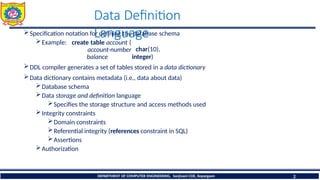
Specification notation for defining the database schema
Example: create table account (
account-number
balance
char(10),
integer)
DDL compiler generates a set of tables stored in a data dictionary
Data dictionary contains metadata (i.e., data about data)
Database schema
Data storage and definition language
Specifies the storage structure and access methods used
Integrity constraints
Domain constraints
Referential integrity (references constraint in SQL)
Assertions
Authorization
3.
Data Manipulation Language(DML)
DEPARTMENT OF COMPUTER ENGINEERING, Sanjivani COE, Kopargaon 3
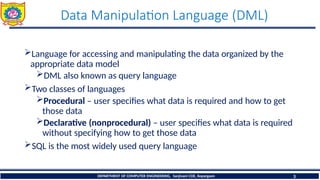
Language for accessing and manipulating the data organized by the
appropriate data model
DML also known as query language
Two classes of languages
Procedural – user specifies what data is required and how to get
those data
Declarative (nonprocedural) – user specifies what data is required
without specifying how to get those data
SQL is the most widely used query language
4.
SQL
DEPARTMENT OF COMPUTERENGINEERING, Sanjivani COE, Kopargaon 4
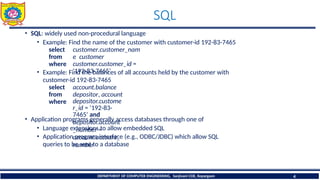
• SQL: widely used non-procedural language
• Example: Find the name of the customer with customer-id 192-83-7465
select
from
where
customer.customer_nam
e customer
customer.customer_id =
‘192-83-7465’
• Example: Find the balances of all accounts held by the customer with
customer-id 192-83-7465
select
from
where
account.balance
depositor, account
depositor.custome
r_id = ‘192-83-
7465’ and
depositor.account
_number =
account.account_
number
• Application programs generally access databases through one of
• Language extensions to allow embedded SQL
• Application program interface (e.g., ODBC/JDBC) which allow SQL
queries to be sent to a database
5.
Database Architecture
DEPARTMENT OFCOMPUTER ENGINEERING, Sanjivani COE, Kopargaon 5
The architecture of a database systems is greatly influenced by
the underlying computer system on which the database is running:
• Centralized
• Client-server
• Parallel (multi-processor)
• Distributed
6.
Database Users
DEPARTMENT OFCOMPUTER ENGINEERING, Sanjivani COE, Kopargaon 6
Users are differentiated by the way they expect to interact with
the system
• Naïve users – invoke one of the permanent application
programs that have been written previously
• Examples, people accessing database over the web,
bank tellers, clerical staff
• Application programmers – interact with system through
DML calls. Application Programmers also referred as System
Analysts, are the back-end programmers who writes the code
for the application programs.
• Sophisticated users – Sophisticated users can be engineers,
scientists, business analyst, who are familiar with the
database. They can develop their own database applications
according to their requirement. They don’t write the program
code but they interact the database by writing SQL queries.
• Specialized users – write specialized database applications
7.
Database Administrator
DEPARTMENT OFCOMPUTER ENGINEERING, Sanjivani COE, Kopargaon 7
• Coordinates all the activities of the database system; the database administrator has a good
understanding of the enterprise’s information resources and needs.
• Database administrator's duties include:
• Schema definition
• Storage structure and access method definition
• Schema and physical organization modification
• Granting user authority to access the database
• Specifying integrity constraints
• Acting as communicator with users.
• Monitoring performance and responding to changes in requirements