DBIx::DataModel 2.0 in detail YAPC::EU::2011, Riga [email_address] Département Office
Agenda Introduction : Object-Relational Mappings & UML DBIx::DataModel  2.0 Architecture Modelling the schema Selecting data Row objects and statement objects Joins Inserts and updates Customization Strengths and limitations of DBIx::DataModel today on CPAN : v 1.99_05
Object-Relational Mappers
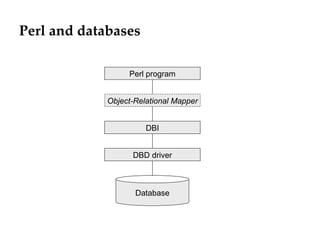
Perl and databases Database DBD driver DBI Object-Relational Mapper Perl program
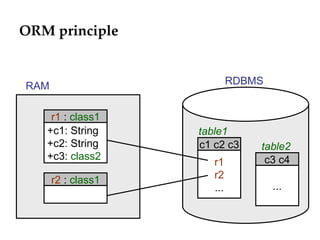
ORM principle r1 r2 ... c1 c2 c3 ... c3 c4 +c1: String +c2: String +c3:  class2 r1  :  class1 RDBMS r2  :  class1 RAM table1 table2
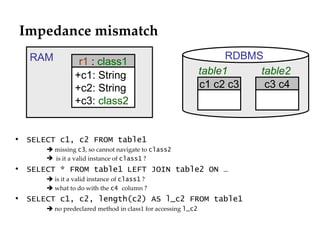
Impedance mismatch SELECT c1, c2 FROM table1    missing  c3 , so cannot navigate to  class2 is it a valid instance of  class1  ? SELECT * FROM table1 LEFT JOIN table2 ON …    is it a valid instance of  class1  ?    what to do with the  c4  column ? SELECT c1, c2, length(c2) AS l_c2 FROM table1    no predeclared method in class1 for accessing  l_c2 c1 c2 c3 c3 c4 +c1: String +c2: String +c3:  class2 r1  :  class1 RDBMS RAM table1 table2
The Unified Modeling Language (UML)
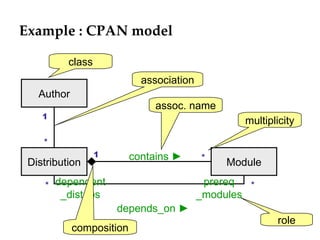
Example : CPAN model Author Distribution Module 1 * 1 * * multiplicity role class association dependent _distribs * prereq _modules contains ► assoc. name composition depends_on ►
Modelling a schema
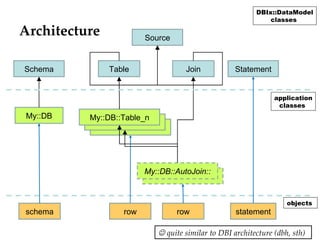
Architecture Schema Source Table Join Statement My::DB My::DB::Table_n My::DB::AutoJoin:: row statement row DBIx::DataModel classes  application classes  objects  schema    quite similar to DBI architecture (dbh, sth)
All definitions in one single file use DBIx::DataModel; DBIx::DataModel-> Schema ("My::DB") -> Table (qw/Author  author  author_id /) ->Table(qw/Distribution  distribution  distrib_id/) ->Table(qw/Module  module  module_id /) -> Association ([qw/Author  author  1  /], [qw/Distribution  distribs  0..* /]) -> Composition ([qw/Distribution  distrib  1  /], [qw/Module  modules  1..* /]); creates package  My::DB creates package  My::DB::Author adds methods into both packages
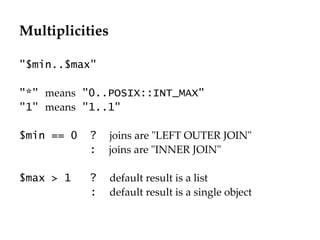
Multiplicities "$min..$max" "*"  means  "0..POSIX::INT_MAX" "1"  means  "1..1" $min == 0  ?  joins are "LEFT OUTER JOIN"   :  joins are "INNER JOIN" $max > 1  ?  default result is a list :  default result is a single object
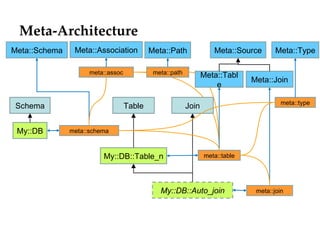
Meta-Architecture Schema Table Join My::DB My::DB::Table_n My::DB::Auto_join Meta::Source Meta::Table Meta::Join meta::table meta::join meta::schema Meta::Schema Meta::Path Meta::Association Meta::Type meta::assoc meta::path meta::type
Data retrieval
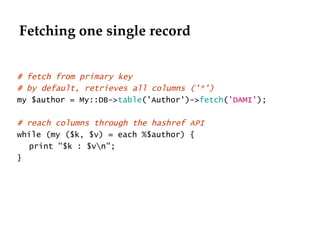
Fetching one single record # fetch from primary key # by default, retrieves all columns ('*')  my $author = My::DB-> table ('Author')-> fetch ( 'DAMI' ); # reach columns through the hashref API while (my ($k, $v) = each %$author) { print "$k : $v\n"; }
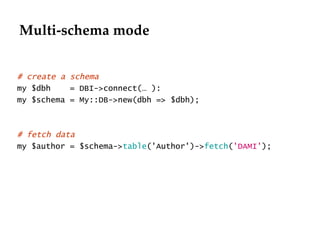
Multi-schema mode # create a schema my $dbh  = DBI->connect(… ): my $schema = My::DB->new(dbh => $dbh); # fetch data my $author = $schema-> table ('Author')-> fetch ( 'DAMI' );
Fetching a list of records # select multiple records  my $recent_distribs = My::DB->table('Distribution') -> select ( -columns   => [qw/ distrib_name d_release /], -where   => { d_release  => {'>' => $some_date}}, -order_by  => [qw/ -d_release +distrib_name /],  ); foreach my $distrib (@$recent_distribs) { ... }
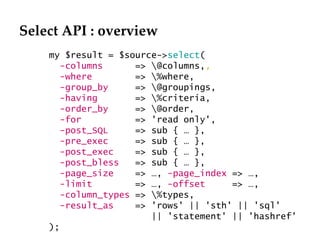
Select API : overview my $result = $source-> select ( -columns   => \@columns, ,  -where   => \%where,  -group_by   => \@groupings,  -having   => \%criteria,  -order_by   => \@order,  -for   => 'read only', -post_SQL   => sub { … }, -pre_exec   => sub { … },  -post_exec   => sub { … },  -post_bless  => sub { … }, -page_size   => …,  -page_index  => …,  -limit  => …,  -offset  => …,  -column_types  => \%types,  -result_as   => 'rows' || 'sth' || 'sql' || 'statement' || 'hashref' );
Arguments to select()
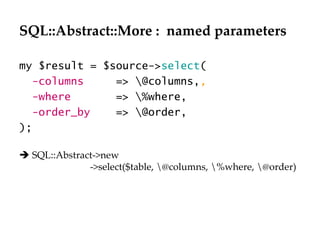
SQL::Abstract::More :  named parameters my $result = $source-> select ( -columns   => \@columns, ,  -where   => \%where,  -order_by   => \@order, );     SQL::Abstract->new   ->select($table, \@columns, \%where, \@order)
SQL::Abstract::More : extensions -columns   => [qw/col1 |alias1  max(col2) |alias2 /] SELECT col1 AS alias1, max(col2) AS alias2 -columns  => [ -DISTINCT  => qw/col1 col2 col3/] SELECT DISTINCT col1, col2, col3  -order_by   => [qw/col1  + col2  – col3/] SELECT … ORDER BY col1, col2 ASC, col3 DESC -for   => "update" || "read only" SELECT …  FOR UPDATE
Grouping -group_by   => [qw/col1 col2 …/] -having   => { col1 => {&quot;<&quot; => val1} , col2 => ... } SELECT …  GROUP BY col1, col2  HAVING col1 < ? AND col2 …    separate call to SQL::Abstract and re-injection into the SQL
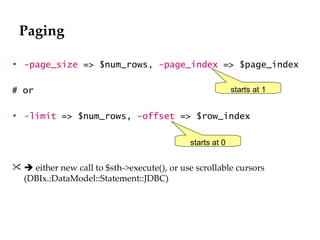
Paging -page_size   => $num_rows,  -page_index   => $page_index # or -limit   => $num_rows,  -offset   => $row_index    either new call to $sth->execute(), or use scrollable cursors  (DBIx.:DataModel::Statement::JDBC) starts at 1 starts at 0
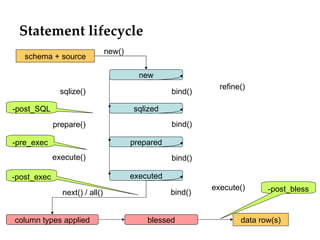
Callbacks -post_SQL   => sub { … }, -pre_exec   => sub { … },  -post_exec   => sub { … },  -post_bless  => sub { … }, hooks to various states within the  statement lifecycle  (see later) sometimes useful for DB-specific features
Polymorphic result -result_as  => 'rows' (default)  : arrayref of row objects 'firstrow'  : a single row object (or undef) 'hashref'  : hashref keyed by primary keys [hashref => @cols] : cascaded hashref 'flat_arrayref'  : flattened values from each row 'statement'  : a  statement  object (iterator) 'fast_statement'  : statement reusing same memory 'sth'  : DBI statement handle 'sql'  : ($sql, @bind_values) 'subquery'  : \[&quot;($sql)&quot;, @bind]       don't need method variants : select_hashref(), select_arrayref(), etc.
Row objects
A row object  … is just a hashref keys are column names values are column values nothing else actually, when in multi-schema mode, there is an additional  __schema  field is blessed into the table class has a  metadm  method (accessor to the metaclass) has a  schema  method (accessor to the schema) has methods for navigating to related tables can be dumped as is to Dumper / YAML / JSON / XML to Perl debugger
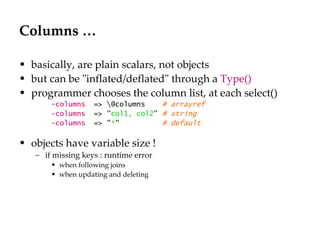
Columns … basically, are plain scalars, not objects but can be &quot;inflated/deflated&quot; through a  Type() programmer chooses the column list, at each select() -columns   => \@columns  # arrayref  -columns   => &quot; col1, col2 &quot;  # string -columns   => &quot; * &quot;  # default  objects have variable size ! if missing keys : runtime error when following joins when updating and deleting
Navigation to associated tables Method names come from association declarations Exactly like a  select () automatically chooses  –result_as => 'rows' || 'firstrow' from multiplicity information  # ->Association([qw/Author  author  1  /], #  [qw/Distribution  distribs  0..* /]) my $author = $distrib-> author (); my $other_distribs = $author-> distribs ( -columns  => [qw/. . ./],  -where  => { . . . }, -order_by => [qw/. . ./], );
Statement objects
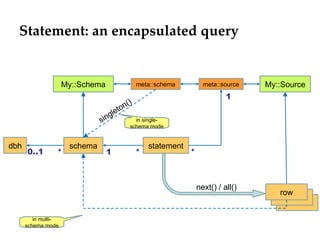
Statement: an encapsulated query statement meta::source My::Source 1 1 * * schema dbh 0..1 * row next() / all() My::Schema meta::schema in single-schema mode in multi-schema mode singleton()
Statement lifecycle new sqlized prepared executed schema + source data row(s) new() sqlize() prepare() execute() bind() refine() bind() bind() bind() execute() next() / all() blessed column types applied -post_bless -pre_exec -post_exec -post_SQL
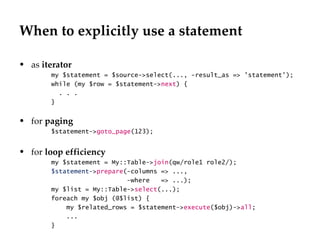
When to explicitly use a statement as  iterator my $statement = $source->select(..., -result_as => 'statement'); while (my $row = $statement-> next ) { . . . } for  paging $statement-> goto_page (123); for  loop efficiency my $statement = My::Table-> join (qw/role1 role2/);  $statement- > prepare (-columns => ..., -where  => ...);  my $list = My::Table-> select (...);  foreach my $obj (@$list) { my $related_rows = $statement-> execute ($obj)-> all ; ...  }
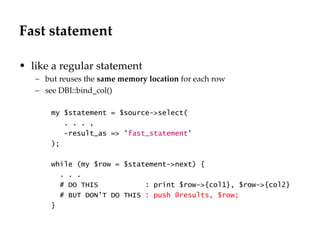
Fast statement like a regular statement but reuses the  same memory location  for each row see DBI::bind_col() my $statement = $source->select(  . . . , -result_as => ' fast_statement ' ); while (my $row = $statement->next) { . . . # DO THIS  : print $row->{col1}, $row->{col2} # BUT DON'T DO THIS  : push @results, $row; }
Database joins
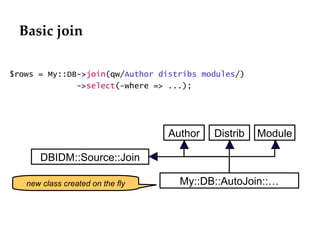
Basic join $rows = My::DB-> join (qw/ Author distribs modules /) -> select (-where => ...); Author Distrib Module My::DB::AutoJoin::… DBIDM::Source::Join new class created on the fly
Left / inner joins ->Association([qw/Author  author  1  /], [qw/Distribution  distribs  0..*  /]) # default : LEFT OUTER JOIN ->Composition([qw/Distribution  distrib  1  /], [qw/Module  modules  1..*  /]); # default : INNER JOIN # but defaults can be overridden My::DB->join([qw/Author  <=>  distribs/)-> . . .  My::DB->join([qw/Distribution  =>  modules /)-> . . .
Join from an instance $rows = $author-> join (qw/ distribs modules /)->select(   -columns => [qw/distrib_name module_name/], -where  => { d_release => {'<' => $date}  }, ); SELECT  distrib_name, module_name FROM  distribution  INNER JOIN   module ON  distribution.distrib_id = module.distrib_id WHERE  distrib.author_id = $author->{author_id} AND  d_release < $date
Insert / Update
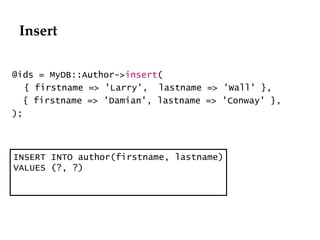
Insert @ids = MyDB::Author-> insert ( { firstname => 'Larry',  lastname => 'Wall' }, { firstname => 'Damian', lastname => 'Conway' }, ); INSERT INTO author(firstname, lastname) VALUES (?, ?)
Bulk insert @ids = MyDB::Author-> insert ( [qw/firstname lastname/], [qw/Larry  Wall  /], [qw/Damian  Conway  /], );
Insert into / cascaded insert @id_trees = $author-> insert_into_distribs ( {distrib_name => 'DBIx-DataModel', modules => [  {module_name => 'DBIx::DataModel', ..}, {module_name => 'DBIx::DataModel::Statement', ..}, ]}, {distrib_name => 'Pod-POM-Web',  … }, -returning => {}, );
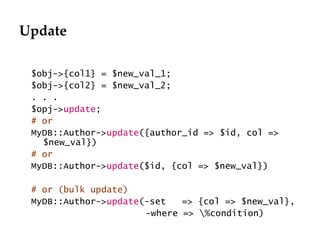
Update $obj->{col1} = $new_val_1; $obj->{col2} = $new_val_2; . . . $opj-> update ; # or MyDB::Author-> update ({author_id => $id, col => $new_val}) # or MyDB::Author-> update ($id, {col => $new_val}) # or (bulk update) MyDB::Author-> update (-set  => {col => $new_val},   -where => \%condition)
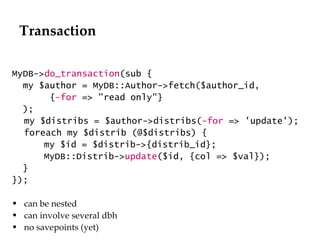
Transaction MyDB-> do_transaction (sub { my $author = MyDB::Author->fetch($author_id, { -for  => &quot;read only&quot;} ); my $distribs = $author->distribs( -for  => 'update'); foreach my $distrib (@$distribs) { my $id = $distrib->{distrib_id}; MyDB::Distrib-> update ($id, {col => $val}); } }); can be nested can involve several dbh no savepoints (yet)
Other features
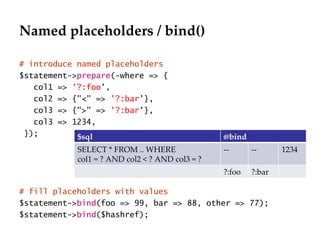
Named placeholders / bind() # introduce named placeholders $statement-> prepare (-where => { col1 =>  '?:foo ', col2 => {&quot;<&quot; =>  '?:bar '}, col3 => {&quot;>&quot; =>  '?:bar '}, col3 => 1234, }); # fill placeholders with values $statement-> bind (foo => 99, bar => 88, other => 77); $statement-> bind ($hashref); $sql @bind SELECT * FROM .. WHERE col1 = ? AND col2 < ? AND col3 = ? -- -- 1234 ?:foo ?:bar
Types (inflate/deflate) # declare a Type My::DB -> Type ( Multivalue   =>   from_DB  =>  sub {$_[ 0 ]  =  [split /;/ ,  $_[ 0 ]] } , to_DB  =>  sub {$_[ 0 ]  =  join &quot;;&quot; ,  @$_[ 0 ]  }, ); # apply it to some columns in a table My::DB::Author->metadm-> define_column_type ( Multivalue  => qw/hobbies languages/, );
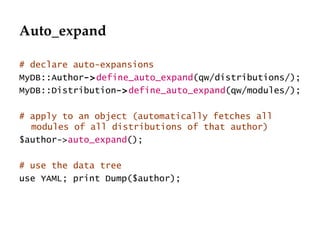
Auto_expand # declare auto-expansions MyDB::Author -> define_auto_expand (qw/distributions/); MyDB::Distribution -> define_auto_expand (qw/modules/); # apply to an object (automatically fetches all modules of all distributions of that author) $author-> auto_expand ();  # use the data tree use YAML; print Dump($author);
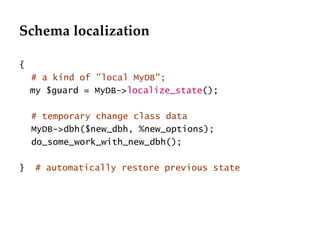
Schema localization { # a kind of &quot;local MyDB&quot;; my $guard = MyDB-> localize_state (); # temporary change class data MyDB->dbh($new_dbh, %new_options); do_some_work_with_new_dbh(); }  # automatically restore previous state
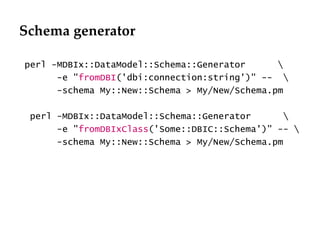
Schema generator perl -MDBIx::DataModel::Schema::Generator  \ -e &quot; fromDBI ('dbi:connection:string')&quot; --  \ -schema My::New::Schema > My/New/Schema.pm perl -MDBIx::DataModel::Schema::Generator  \ -e &quot; fromDBIxClass ('Some::DBIC::Schema')&quot; -- \ -schema My::New::Schema > My/New/Schema.pm
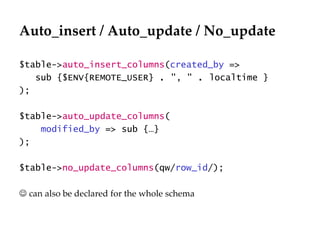
Auto_insert / Auto_update / No_update $table-> auto_insert_columns ( created_by  => sub { $ENV{REMOTE_USER}  .  &quot;, &quot;  .  localtime } );  $table-> auto_update_columns ( modified_by  => sub {… }  );  $table-> no_update_columns (qw/ row_id /);    can also be declared for the whole schema
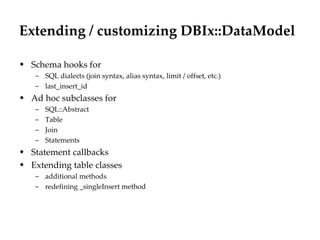
Extending / customizing DBIx::DataModel Schema hooks for SQL dialects (join syntax, alias syntax, limit / offset, etc.) last_insert_id Ad hoc subclasses for SQL::Abstract Table Join Statements Statement callbacks Extending table classes additional methods redefining _singleInsert method
Conclusion
Strengths centralized definitions of tables & associations efficiency improved API for SQL::Abstract  clear conceptual distinction between data  sources     (tables and joinss), database  statements   (stateful objects representing SQL queries) data  rows     (lightweight blessed hashrefs) concise and flexible syntax for joins used in production for mission-critical app  (running Geneva courts)
Limitations tiny community no schema versioning no object caching nor 'dirty columns'  no 'cascaded update' nor 'insert or create'
Lots of documentation SYNOPSIS AND DESCRIPTION DESIGN QUICKSTART REFERENCE COOKBOOK MISC INTERNALS GLOSSARY
THANK YOU FOR YOUR ATTENTION
Bonus slides
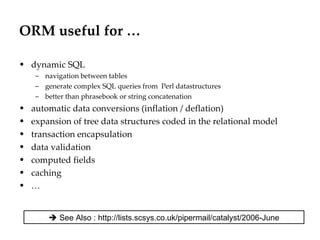
ORM: What for ? [catalyst list] On Thu, 2006-06-08, Steve  wrote: Not intending to start any sort of rancorous discussion, but I was wondering whether someone could illuminate me a little? I'm comfortable with SQL, and with DBI. I write basic  SQL that runs just fine on all databases, or more  complex SQL when I want to target a single database  (ususally postgresql). What value does an ORM add for a user like me?
ORM useful for … dynamic SQL navigation between tables generate complex SQL queries from  Perl datastructures better than phrasebook or string concatenation automatic data conversions (inflation / deflation) expansion of tree data structures coded in the relational model transaction encapsulation  data validation computed fields caching …    See Also : http://lists.scsys.co.uk/pipermail/catalyst/2006-June
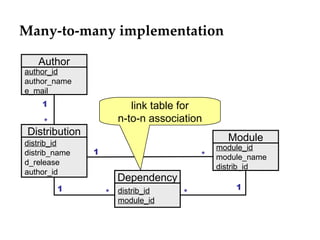
Many-to-many implementation author_id author_name e_mail 1 * 1 * * * Author distrib_id module_id Dependency distrib_id distrib_name d_release author_id Distribution module_id module_name distrib_id Module 1 1 link table for n-to-n association
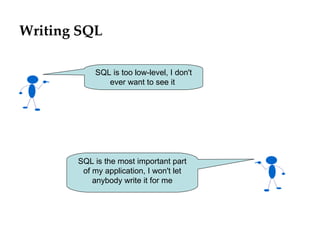
Writing SQL SQL is too low-level, I don't ever want to see it  SQL is the most important part of my application, I won't let anybody write it for me
Why hashref instead of OO accessors ? Perl builtin rich API for hashes (keys, values, slices, string interpolation) good for import / export in YAML/XML/JSON easier to follow steps in Perl debugger faster than OO accessor methods visually clear distinction between lvalue / rvalue my $val = $hashref->{column}; $hashref->{column} = $val; visually clear distinction between  $row->{column} / $row->remote_table()
Callback example WITH RECURSIVE nodetree(level, id, pid, sort) AS (  SELECT 1, id, parent, '{1}'::int[] FROM nodes WHERE parent IS NULL      UNION  SELECT level+1,p.id, parent, sort||p.id FROM nodetree pr  JOIN nodes p ON p.parent = pr.id ) SELECT * FROM nodetree ORDER BY sort; my $with_clause = &quot;WITH RECURSIVE …&quot;; DBIx::DataModel->Schema('Tst') ->Table(qw/Nodetree nodetree id/); my $result = Tst::Nodetree-> select  ( -post_SQL  => sub {my $sql = shift;  $sql =~ s/^/$with_clause/;  return $sql, @_ }, -orderBy  => 'sort', );
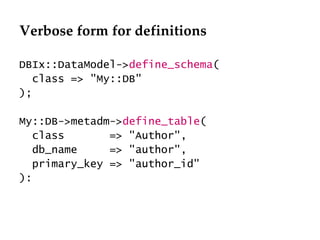
Verbose form for definitions DBIx::DataModel-> define_schema ( class => &quot;My::DB&quot; ); My::DB->metadm-> define_table ( class  => &quot;Author&quot;, db_name  => &quot;author&quot;, primary_key => &quot;author_id&quot; ):
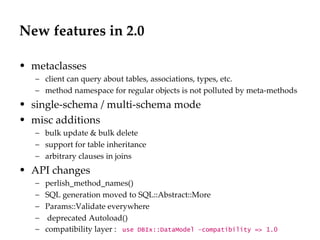
New features in 2.0 metaclasses client can query about tables, associations, types, etc. method namespace for regular objects is not polluted by meta-methods single-schema / multi-schema mode misc additions bulk update & bulk delete support for table inheritance arbitrary clauses in joins API changes perlish_method_names() SQL generation moved to SQL::Abstract::More Params::Validate everywhere deprecated Autoload() compatibility layer :  use DBIx::DataModel –compatibility => 1.0
Migration to v2.0 deploy DBIx::DataModel 2.0 -compatibility => 1.0 test change client code according to new API test suppress compatibility layer
DBIx::DataModel history 2005 : 1st CPAN publication (v0.10, 16.09.05) 2006 : YAPC::EU::06 Birmingham presentation 2008 : heavy refactoring (v1.03, 23.09.08) statement object implicit schema name 2011: heavy refactoring metaobject layer multi-schema mode API renaming

DBIx-DataModel v2.0 in detail

  • 1.
    DBIx::DataModel 2.0 indetail YAPC::EU::2011, Riga [email_address] Département Office
  • 2.
    Agenda Introduction :Object-Relational Mappings & UML DBIx::DataModel 2.0 Architecture Modelling the schema Selecting data Row objects and statement objects Joins Inserts and updates Customization Strengths and limitations of DBIx::DataModel today on CPAN : v 1.99_05
  • 3.
  • 4.
    Perl and databasesDatabase DBD driver DBI Object-Relational Mapper Perl program
  • 5.
    ORM principle r1r2 ... c1 c2 c3 ... c3 c4 +c1: String +c2: String +c3: class2 r1 : class1 RDBMS r2 : class1 RAM table1 table2
  • 6.
    Impedance mismatch SELECTc1, c2 FROM table1  missing c3 , so cannot navigate to class2 is it a valid instance of class1 ? SELECT * FROM table1 LEFT JOIN table2 ON …  is it a valid instance of class1 ?  what to do with the c4 column ? SELECT c1, c2, length(c2) AS l_c2 FROM table1  no predeclared method in class1 for accessing l_c2 c1 c2 c3 c3 c4 +c1: String +c2: String +c3: class2 r1 : class1 RDBMS RAM table1 table2
  • 7.
    The Unified ModelingLanguage (UML)
  • 8.
    Example : CPANmodel Author Distribution Module 1 * 1 * * multiplicity role class association dependent _distribs * prereq _modules contains ► assoc. name composition depends_on ►
  • 9.
  • 10.
    Architecture Schema SourceTable Join Statement My::DB My::DB::Table_n My::DB::AutoJoin:: row statement row DBIx::DataModel classes application classes objects schema  quite similar to DBI architecture (dbh, sth)
  • 11.
    All definitions inone single file use DBIx::DataModel; DBIx::DataModel-> Schema (&quot;My::DB&quot;) -> Table (qw/Author author author_id /) ->Table(qw/Distribution distribution distrib_id/) ->Table(qw/Module module module_id /) -> Association ([qw/Author author 1 /], [qw/Distribution distribs 0..* /]) -> Composition ([qw/Distribution distrib 1 /], [qw/Module modules 1..* /]); creates package My::DB creates package My::DB::Author adds methods into both packages
  • 12.
    Multiplicities &quot;$min..$max&quot; &quot;*&quot; means &quot;0..POSIX::INT_MAX&quot; &quot;1&quot; means &quot;1..1&quot; $min == 0 ? joins are &quot;LEFT OUTER JOIN&quot; : joins are &quot;INNER JOIN&quot; $max > 1 ? default result is a list : default result is a single object
  • 13.
    Meta-Architecture Schema TableJoin My::DB My::DB::Table_n My::DB::Auto_join Meta::Source Meta::Table Meta::Join meta::table meta::join meta::schema Meta::Schema Meta::Path Meta::Association Meta::Type meta::assoc meta::path meta::type
  • 14.
  • 15.
    Fetching one singlerecord # fetch from primary key # by default, retrieves all columns ('*') my $author = My::DB-> table ('Author')-> fetch ( 'DAMI' ); # reach columns through the hashref API while (my ($k, $v) = each %$author) { print &quot;$k : $v\n&quot;; }
  • 16.
    Multi-schema mode #create a schema my $dbh = DBI->connect(… ): my $schema = My::DB->new(dbh => $dbh); # fetch data my $author = $schema-> table ('Author')-> fetch ( 'DAMI' );
  • 17.
    Fetching a listof records # select multiple records my $recent_distribs = My::DB->table('Distribution') -> select ( -columns => [qw/ distrib_name d_release /], -where => { d_release => {'>' => $some_date}}, -order_by => [qw/ -d_release +distrib_name /], ); foreach my $distrib (@$recent_distribs) { ... }
  • 18.
    Select API :overview my $result = $source-> select ( -columns => \@columns, , -where => \%where, -group_by => \@groupings, -having => \%criteria, -order_by => \@order, -for => 'read only', -post_SQL => sub { … }, -pre_exec => sub { … }, -post_exec => sub { … }, -post_bless => sub { … }, -page_size => …, -page_index => …, -limit => …, -offset => …, -column_types => \%types, -result_as => 'rows' || 'sth' || 'sql' || 'statement' || 'hashref' );
  • 19.
  • 20.
    SQL::Abstract::More : named parameters my $result = $source-> select ( -columns => \@columns, , -where => \%where, -order_by => \@order, );  SQL::Abstract->new ->select($table, \@columns, \%where, \@order)
  • 21.
    SQL::Abstract::More : extensions-columns => [qw/col1 |alias1 max(col2) |alias2 /] SELECT col1 AS alias1, max(col2) AS alias2 -columns => [ -DISTINCT => qw/col1 col2 col3/] SELECT DISTINCT col1, col2, col3 -order_by => [qw/col1 + col2 – col3/] SELECT … ORDER BY col1, col2 ASC, col3 DESC -for => &quot;update&quot; || &quot;read only&quot; SELECT … FOR UPDATE
  • 22.
    Grouping -group_by => [qw/col1 col2 …/] -having => { col1 => {&quot;<&quot; => val1} , col2 => ... } SELECT … GROUP BY col1, col2 HAVING col1 < ? AND col2 …  separate call to SQL::Abstract and re-injection into the SQL
  • 23.
    Paging -page_size => $num_rows, -page_index => $page_index # or -limit => $num_rows, -offset => $row_index  either new call to $sth->execute(), or use scrollable cursors (DBIx.:DataModel::Statement::JDBC) starts at 1 starts at 0
  • 24.
    Callbacks -post_SQL => sub { … }, -pre_exec => sub { … }, -post_exec => sub { … }, -post_bless => sub { … }, hooks to various states within the statement lifecycle (see later) sometimes useful for DB-specific features
  • 25.
    Polymorphic result -result_as => 'rows' (default) : arrayref of row objects 'firstrow' : a single row object (or undef) 'hashref' : hashref keyed by primary keys [hashref => @cols] : cascaded hashref 'flat_arrayref' : flattened values from each row 'statement' : a statement object (iterator) 'fast_statement' : statement reusing same memory 'sth' : DBI statement handle 'sql' : ($sql, @bind_values) 'subquery' : \[&quot;($sql)&quot;, @bind]   don't need method variants : select_hashref(), select_arrayref(), etc.
  • 26.
  • 27.
    A row object … is just a hashref keys are column names values are column values nothing else actually, when in multi-schema mode, there is an additional __schema field is blessed into the table class has a metadm method (accessor to the metaclass) has a schema method (accessor to the schema) has methods for navigating to related tables can be dumped as is to Dumper / YAML / JSON / XML to Perl debugger
  • 28.
    Columns … basically,are plain scalars, not objects but can be &quot;inflated/deflated&quot; through a Type() programmer chooses the column list, at each select() -columns => \@columns # arrayref -columns => &quot; col1, col2 &quot; # string -columns => &quot; * &quot; # default objects have variable size ! if missing keys : runtime error when following joins when updating and deleting
  • 29.
    Navigation to associatedtables Method names come from association declarations Exactly like a select () automatically chooses –result_as => 'rows' || 'firstrow' from multiplicity information # ->Association([qw/Author author 1 /], # [qw/Distribution distribs 0..* /]) my $author = $distrib-> author (); my $other_distribs = $author-> distribs ( -columns => [qw/. . ./], -where => { . . . }, -order_by => [qw/. . ./], );
  • 30.
  • 31.
    Statement: an encapsulatedquery statement meta::source My::Source 1 1 * * schema dbh 0..1 * row next() / all() My::Schema meta::schema in single-schema mode in multi-schema mode singleton()
  • 32.
    Statement lifecycle newsqlized prepared executed schema + source data row(s) new() sqlize() prepare() execute() bind() refine() bind() bind() bind() execute() next() / all() blessed column types applied -post_bless -pre_exec -post_exec -post_SQL
  • 33.
    When to explicitlyuse a statement as iterator my $statement = $source->select(..., -result_as => 'statement'); while (my $row = $statement-> next ) { . . . } for paging $statement-> goto_page (123); for loop efficiency my $statement = My::Table-> join (qw/role1 role2/); $statement- > prepare (-columns => ..., -where => ...); my $list = My::Table-> select (...); foreach my $obj (@$list) { my $related_rows = $statement-> execute ($obj)-> all ; ... }
  • 34.
    Fast statement likea regular statement but reuses the same memory location for each row see DBI::bind_col() my $statement = $source->select( . . . , -result_as => ' fast_statement ' ); while (my $row = $statement->next) { . . . # DO THIS : print $row->{col1}, $row->{col2} # BUT DON'T DO THIS : push @results, $row; }
  • 35.
  • 36.
    Basic join $rows= My::DB-> join (qw/ Author distribs modules /) -> select (-where => ...); Author Distrib Module My::DB::AutoJoin::… DBIDM::Source::Join new class created on the fly
  • 37.
    Left / innerjoins ->Association([qw/Author author 1 /], [qw/Distribution distribs 0..* /]) # default : LEFT OUTER JOIN ->Composition([qw/Distribution distrib 1 /], [qw/Module modules 1..* /]); # default : INNER JOIN # but defaults can be overridden My::DB->join([qw/Author <=> distribs/)-> . . . My::DB->join([qw/Distribution => modules /)-> . . .
  • 38.
    Join from aninstance $rows = $author-> join (qw/ distribs modules /)->select( -columns => [qw/distrib_name module_name/], -where => { d_release => {'<' => $date} }, ); SELECT distrib_name, module_name FROM distribution INNER JOIN module ON distribution.distrib_id = module.distrib_id WHERE distrib.author_id = $author->{author_id} AND d_release < $date
  • 39.
  • 40.
    Insert @ids =MyDB::Author-> insert ( { firstname => 'Larry', lastname => 'Wall' }, { firstname => 'Damian', lastname => 'Conway' }, ); INSERT INTO author(firstname, lastname) VALUES (?, ?)
  • 41.
    Bulk insert @ids= MyDB::Author-> insert ( [qw/firstname lastname/], [qw/Larry Wall /], [qw/Damian Conway /], );
  • 42.
    Insert into /cascaded insert @id_trees = $author-> insert_into_distribs ( {distrib_name => 'DBIx-DataModel', modules => [ {module_name => 'DBIx::DataModel', ..}, {module_name => 'DBIx::DataModel::Statement', ..}, ]}, {distrib_name => 'Pod-POM-Web', … }, -returning => {}, );
  • 43.
    Update $obj->{col1} =$new_val_1; $obj->{col2} = $new_val_2; . . . $opj-> update ; # or MyDB::Author-> update ({author_id => $id, col => $new_val}) # or MyDB::Author-> update ($id, {col => $new_val}) # or (bulk update) MyDB::Author-> update (-set => {col => $new_val}, -where => \%condition)
  • 44.
    Transaction MyDB-> do_transaction(sub { my $author = MyDB::Author->fetch($author_id, { -for => &quot;read only&quot;} ); my $distribs = $author->distribs( -for => 'update'); foreach my $distrib (@$distribs) { my $id = $distrib->{distrib_id}; MyDB::Distrib-> update ($id, {col => $val}); } }); can be nested can involve several dbh no savepoints (yet)
  • 45.
  • 46.
    Named placeholders /bind() # introduce named placeholders $statement-> prepare (-where => { col1 => '?:foo ', col2 => {&quot;<&quot; => '?:bar '}, col3 => {&quot;>&quot; => '?:bar '}, col3 => 1234, }); # fill placeholders with values $statement-> bind (foo => 99, bar => 88, other => 77); $statement-> bind ($hashref); $sql @bind SELECT * FROM .. WHERE col1 = ? AND col2 < ? AND col3 = ? -- -- 1234 ?:foo ?:bar
  • 47.
    Types (inflate/deflate) #declare a Type My::DB -> Type ( Multivalue => from_DB => sub {$_[ 0 ] = [split /;/ , $_[ 0 ]] } , to_DB => sub {$_[ 0 ] = join &quot;;&quot; , @$_[ 0 ] }, ); # apply it to some columns in a table My::DB::Author->metadm-> define_column_type ( Multivalue => qw/hobbies languages/, );
  • 48.
    Auto_expand # declareauto-expansions MyDB::Author -> define_auto_expand (qw/distributions/); MyDB::Distribution -> define_auto_expand (qw/modules/); # apply to an object (automatically fetches all modules of all distributions of that author) $author-> auto_expand (); # use the data tree use YAML; print Dump($author);
  • 49.
    Schema localization {# a kind of &quot;local MyDB&quot;; my $guard = MyDB-> localize_state (); # temporary change class data MyDB->dbh($new_dbh, %new_options); do_some_work_with_new_dbh(); } # automatically restore previous state
  • 50.
    Schema generator perl-MDBIx::DataModel::Schema::Generator \ -e &quot; fromDBI ('dbi:connection:string')&quot; -- \ -schema My::New::Schema > My/New/Schema.pm perl -MDBIx::DataModel::Schema::Generator \ -e &quot; fromDBIxClass ('Some::DBIC::Schema')&quot; -- \ -schema My::New::Schema > My/New/Schema.pm
  • 51.
    Auto_insert / Auto_update/ No_update $table-> auto_insert_columns ( created_by => sub { $ENV{REMOTE_USER} . &quot;, &quot; . localtime } ); $table-> auto_update_columns ( modified_by => sub {… } ); $table-> no_update_columns (qw/ row_id /);  can also be declared for the whole schema
  • 52.
    Extending / customizingDBIx::DataModel Schema hooks for SQL dialects (join syntax, alias syntax, limit / offset, etc.) last_insert_id Ad hoc subclasses for SQL::Abstract Table Join Statements Statement callbacks Extending table classes additional methods redefining _singleInsert method
  • 53.
  • 54.
    Strengths centralized definitionsof tables & associations efficiency improved API for SQL::Abstract clear conceptual distinction between data sources (tables and joinss), database statements (stateful objects representing SQL queries) data rows (lightweight blessed hashrefs) concise and flexible syntax for joins used in production for mission-critical app (running Geneva courts)
  • 55.
    Limitations tiny communityno schema versioning no object caching nor 'dirty columns' no 'cascaded update' nor 'insert or create'
  • 56.
    Lots of documentationSYNOPSIS AND DESCRIPTION DESIGN QUICKSTART REFERENCE COOKBOOK MISC INTERNALS GLOSSARY
  • 57.
    THANK YOU FORYOUR ATTENTION
  • 58.
  • 59.
    ORM: What for? [catalyst list] On Thu, 2006-06-08, Steve wrote: Not intending to start any sort of rancorous discussion, but I was wondering whether someone could illuminate me a little? I'm comfortable with SQL, and with DBI. I write basic SQL that runs just fine on all databases, or more complex SQL when I want to target a single database (ususally postgresql). What value does an ORM add for a user like me?
  • 60.
    ORM useful for… dynamic SQL navigation between tables generate complex SQL queries from Perl datastructures better than phrasebook or string concatenation automatic data conversions (inflation / deflation) expansion of tree data structures coded in the relational model transaction encapsulation data validation computed fields caching …  See Also : http://lists.scsys.co.uk/pipermail/catalyst/2006-June
  • 61.
    Many-to-many implementation author_idauthor_name e_mail 1 * 1 * * * Author distrib_id module_id Dependency distrib_id distrib_name d_release author_id Distribution module_id module_name distrib_id Module 1 1 link table for n-to-n association
  • 62.
    Writing SQL SQLis too low-level, I don't ever want to see it SQL is the most important part of my application, I won't let anybody write it for me
  • 63.
    Why hashref insteadof OO accessors ? Perl builtin rich API for hashes (keys, values, slices, string interpolation) good for import / export in YAML/XML/JSON easier to follow steps in Perl debugger faster than OO accessor methods visually clear distinction between lvalue / rvalue my $val = $hashref->{column}; $hashref->{column} = $val; visually clear distinction between $row->{column} / $row->remote_table()
  • 64.
    Callback example WITHRECURSIVE nodetree(level, id, pid, sort) AS ( SELECT 1, id, parent, '{1}'::int[] FROM nodes WHERE parent IS NULL     UNION SELECT level+1,p.id, parent, sort||p.id FROM nodetree pr JOIN nodes p ON p.parent = pr.id ) SELECT * FROM nodetree ORDER BY sort; my $with_clause = &quot;WITH RECURSIVE …&quot;; DBIx::DataModel->Schema('Tst') ->Table(qw/Nodetree nodetree id/); my $result = Tst::Nodetree-> select ( -post_SQL => sub {my $sql = shift; $sql =~ s/^/$with_clause/; return $sql, @_ }, -orderBy => 'sort', );
  • 65.
    Verbose form fordefinitions DBIx::DataModel-> define_schema ( class => &quot;My::DB&quot; ); My::DB->metadm-> define_table ( class => &quot;Author&quot;, db_name => &quot;author&quot;, primary_key => &quot;author_id&quot; ):
  • 66.
    New features in2.0 metaclasses client can query about tables, associations, types, etc. method namespace for regular objects is not polluted by meta-methods single-schema / multi-schema mode misc additions bulk update & bulk delete support for table inheritance arbitrary clauses in joins API changes perlish_method_names() SQL generation moved to SQL::Abstract::More Params::Validate everywhere deprecated Autoload() compatibility layer : use DBIx::DataModel –compatibility => 1.0
  • 67.
    Migration to v2.0deploy DBIx::DataModel 2.0 -compatibility => 1.0 test change client code according to new API test suppress compatibility layer
  • 68.
    DBIx::DataModel history 2005: 1st CPAN publication (v0.10, 16.09.05) 2006 : YAPC::EU::06 Birmingham presentation 2008 : heavy refactoring (v1.03, 23.09.08) statement object implicit schema name 2011: heavy refactoring metaobject layer multi-schema mode API renaming