
Corruption: Concept,
Theories, Risk Assessment,
Methods and Cases
A Half-Day Training Prepared for
Haromaya University Ethics and Anti
Corruption Student Club
Prepared by: Abey Doni
Objectives of The Training
 To define the concept of Corruption;
 To Explain the Types of Corruption;
 Train the Trainee on Risk assessment
techniques and ways to prevent
Corruption;
 Explain different ways to combat
corruption;
 Show cases of corruption in the
Construction Sector Globally through
Examples.
Deliverables :
 At the end of the Training the trainee
will be able to:
◦ Define the concept of Corruption;
◦ Explain the types of Corruption;
◦ Work on the ways to identify corruption
risk areas;
◦ Know the different methods to fight
corruption;
◦ See the impact of corruption in the
construction Sector Globally.
Content of The Training
1. Definition of the concept of Corruption
2. Theories and View points about
corruption
3. Types of Corruption
4. Methods to identify corruption
vulnerable areas
5. Methods to fight Corruption
6. Cases of Corruption in the Construction
Sector
7. Conclusion– the ultimate cost
Definition of the concept of
Corruption
 Joint work of Shah and
Schacter(2004) defined Corruption as
the exercise of official powers against
public interest or the abuse of public
office for private gains.
 The term ‘corruption’ came from Latin
word called ‘corruptio’ and it means
that bribe and destroy.
Theories and View points about
corruption
 We will see two major theories and
view points from reputed model
builders, which include;
◦ Klitgaard Model,
◦ Jeff Huther and Anwar Shah from The
World Bank.
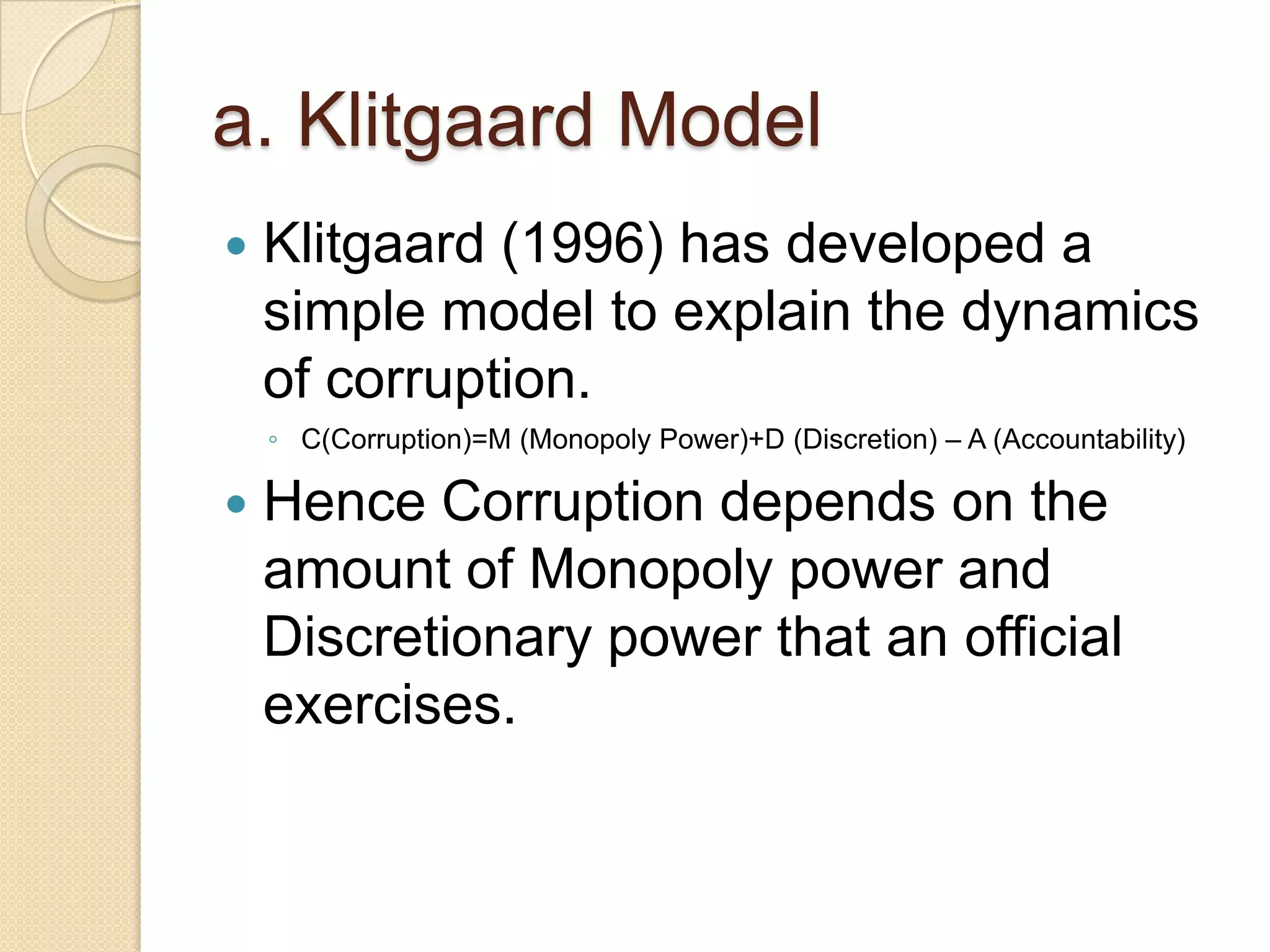
a. Klitgaard Model
 Klitgaard (1996) has developed a
simple model to explain the dynamics
of corruption.
◦ C(Corruption)=M (Monopoly Power)+D (Discretion) – A (Accountability)
 Hence Corruption depends on the
amount of Monopoly power and
Discretionary power that an official
exercises.
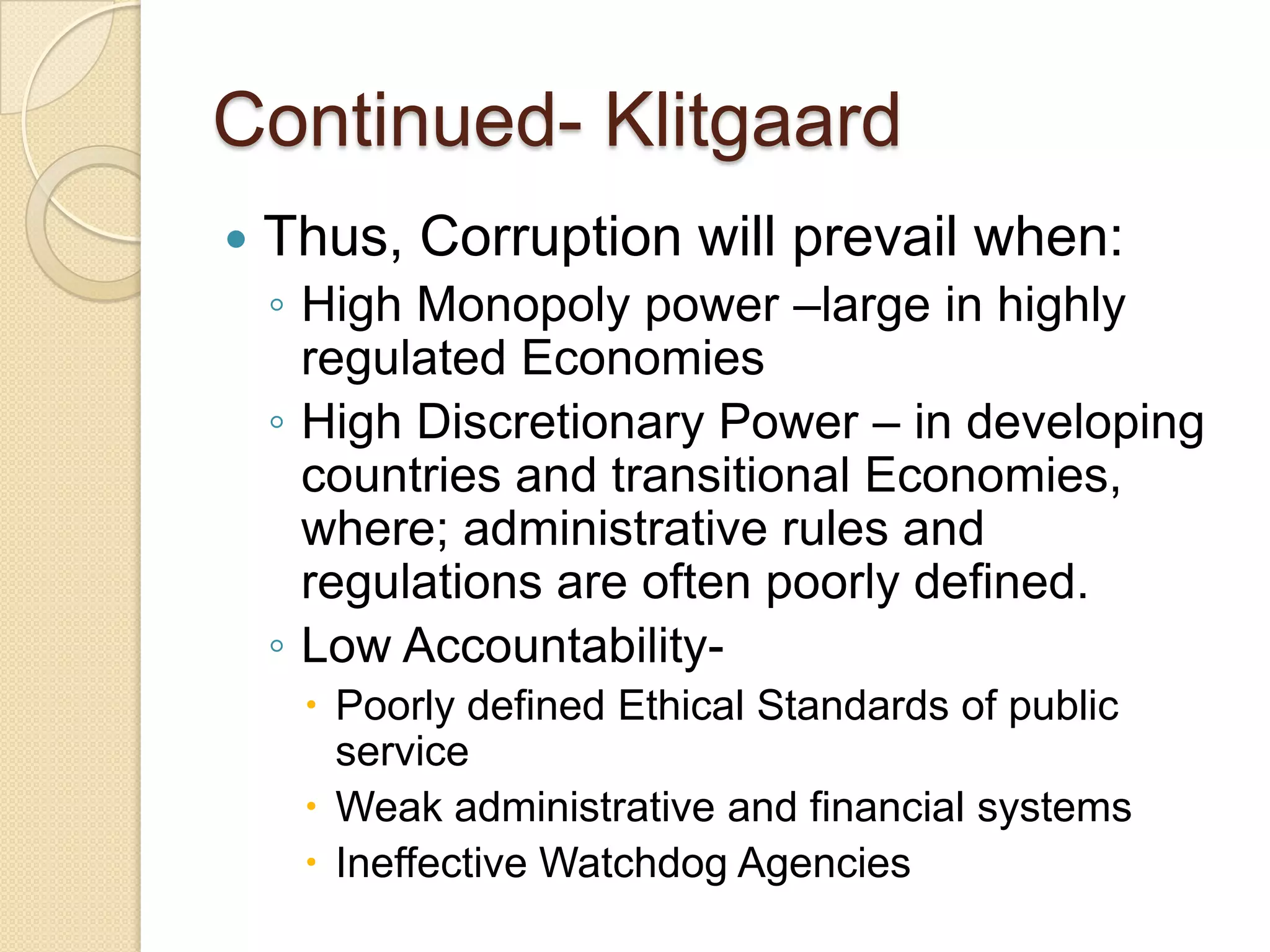
Continued- Klitgaard
 Thus, Corruption will prevail when:
◦ High Monopoly power –large in highly
regulated Economies
◦ High Discretionary Power – in developing
countries and transitional Economies,
where; administrative rules and
regulations are often poorly defined.
◦ Low Accountability-
 Poorly defined Ethical Standards of public
service
 Weak administrative and financial systems
 Ineffective Watchdog Agencies
b. Jeff Huther and Anwar
Shah
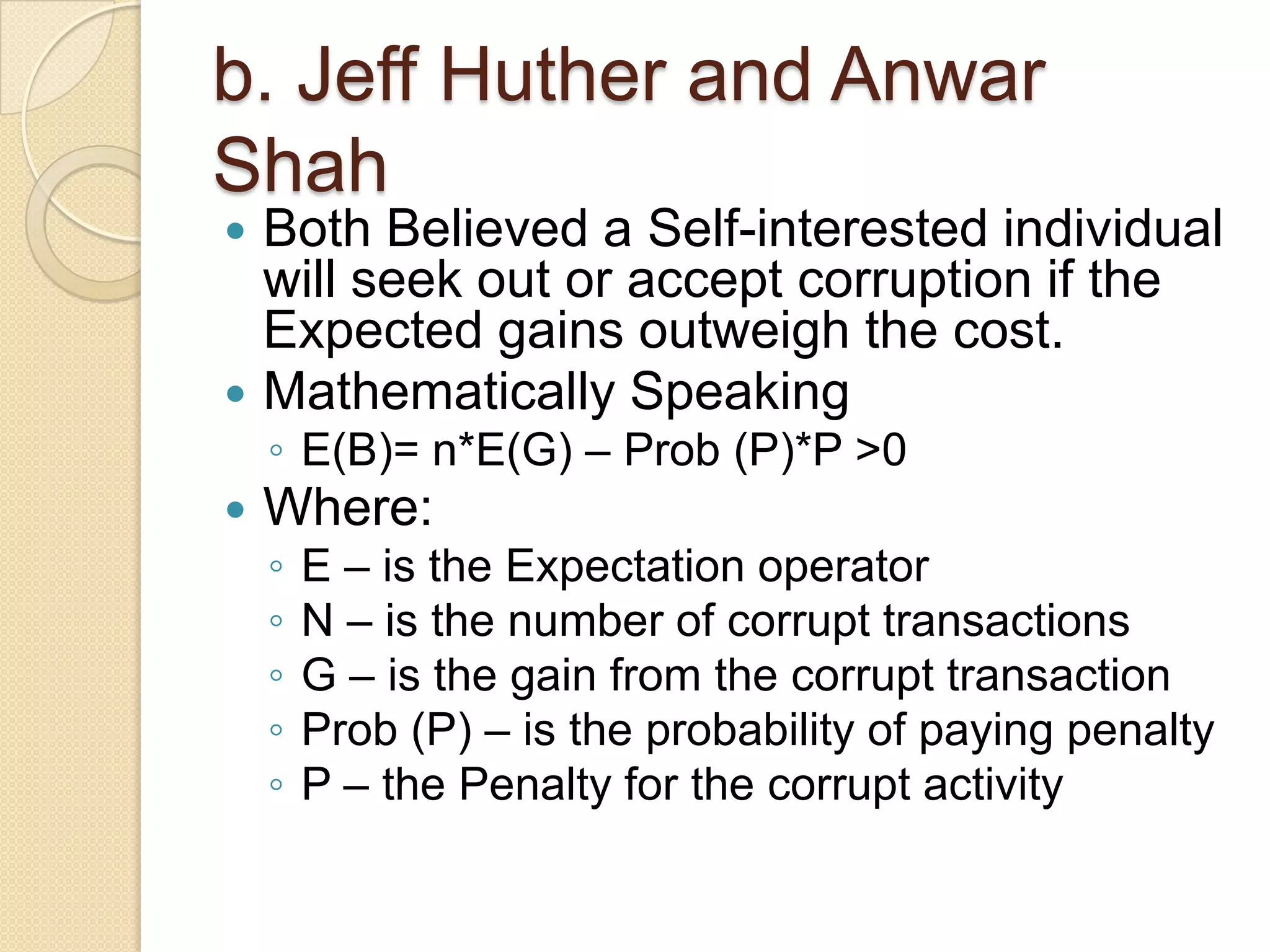
 Both Believed a Self-interested individual
will seek out or accept corruption if the
Expected gains outweigh the cost.
 Mathematically Speaking
◦ E(B)= n*E(G) – Prob (P)*P >0
 Where:
◦ E – is the Expectation operator
◦ N – is the number of corrupt transactions
◦ G – is the gain from the corrupt transaction
◦ Prob (P) – is the probability of paying penalty
◦ P – the Penalty for the corrupt activity
Continued- Huther J. & A.
Shah
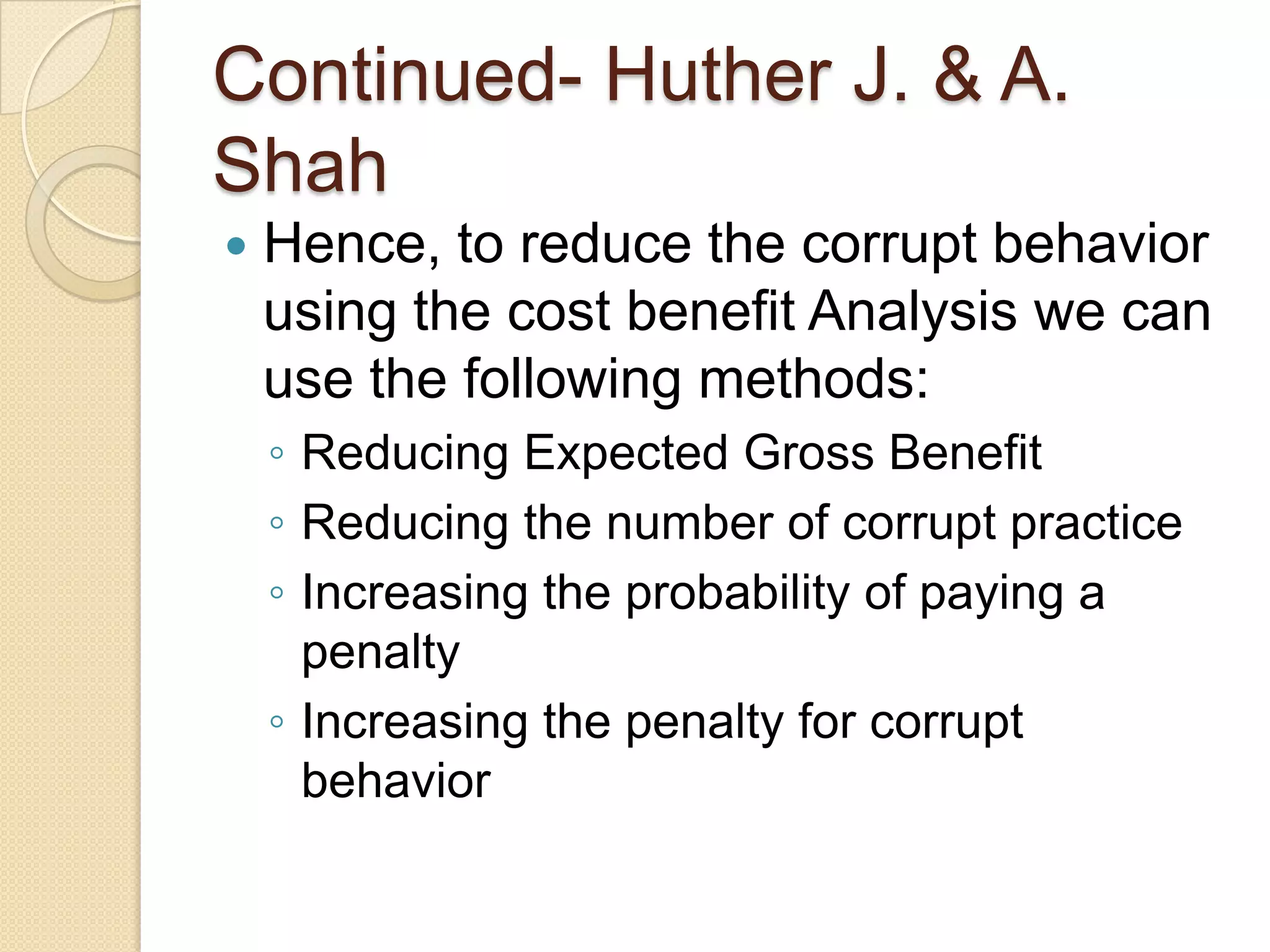
 Hence, to reduce the corrupt behavior
using the cost benefit Analysis we can
use the following methods:
◦ Reducing Expected Gross Benefit
◦ Reducing the number of corrupt practice
◦ Increasing the probability of paying a
penalty
◦ Increasing the penalty for corrupt
behavior
Continued- Huther J. & A.
Shah
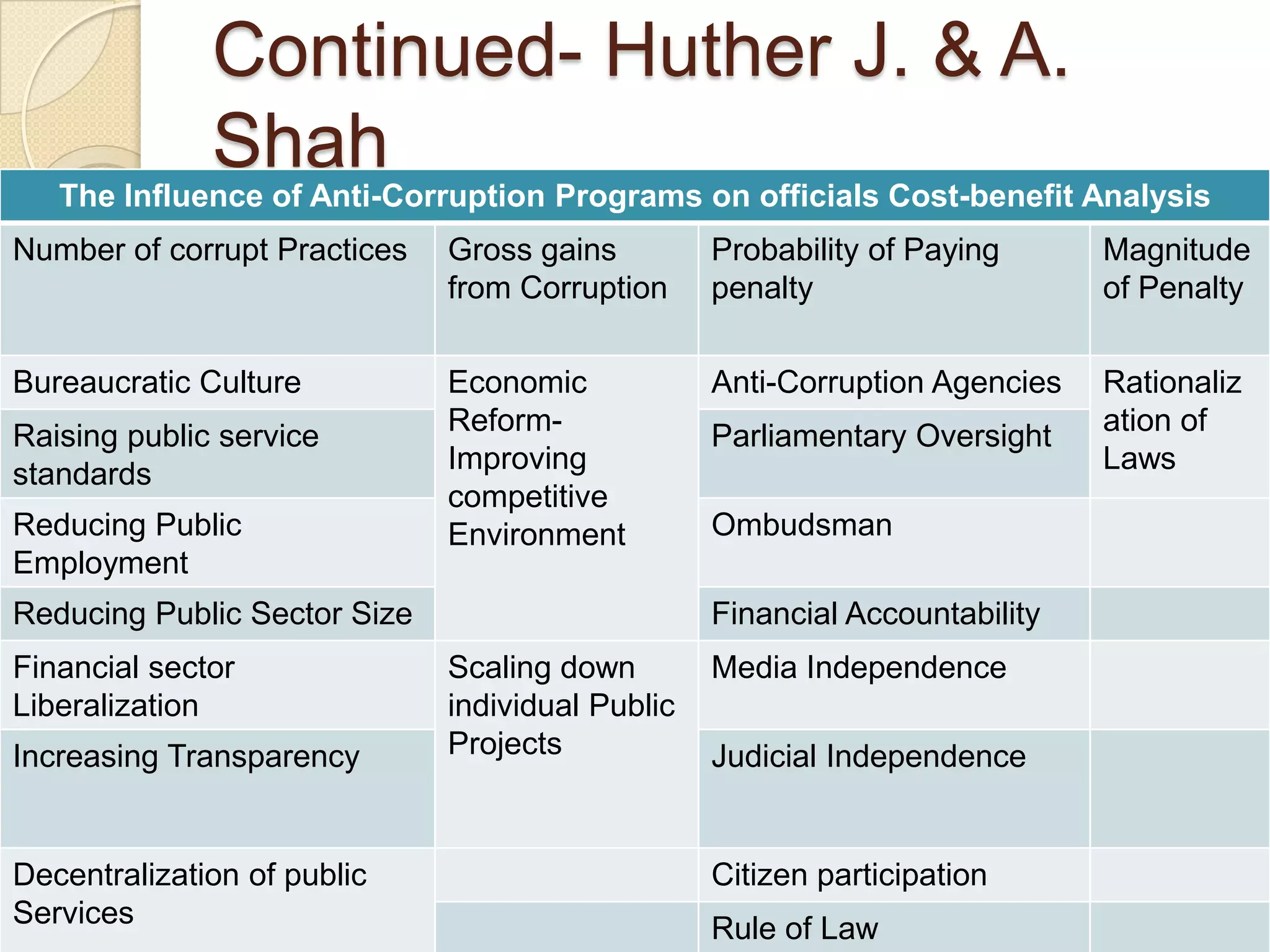
The Influence of Anti-Corruption Programs on officials Cost-benefit Analysis
Number of corrupt Practices Gross gains
from Corruption
Probability of Paying
penalty
Magnitude
of Penalty
Bureaucratic Culture Economic
Reform-
Improving
competitive
Environment
Anti-Corruption Agencies Rationaliz
ation of
Laws
Raising public service
standards
Parliamentary Oversight
Reducing Public
Employment
Ombudsman
Reducing Public Sector Size Financial Accountability
Financial sector
Liberalization
Scaling down
individual Public
Projects
Media Independence
Increasing Transparency Judicial Independence
Decentralization of public
Services
Citizen participation
Rule of Law
Types of Corruption
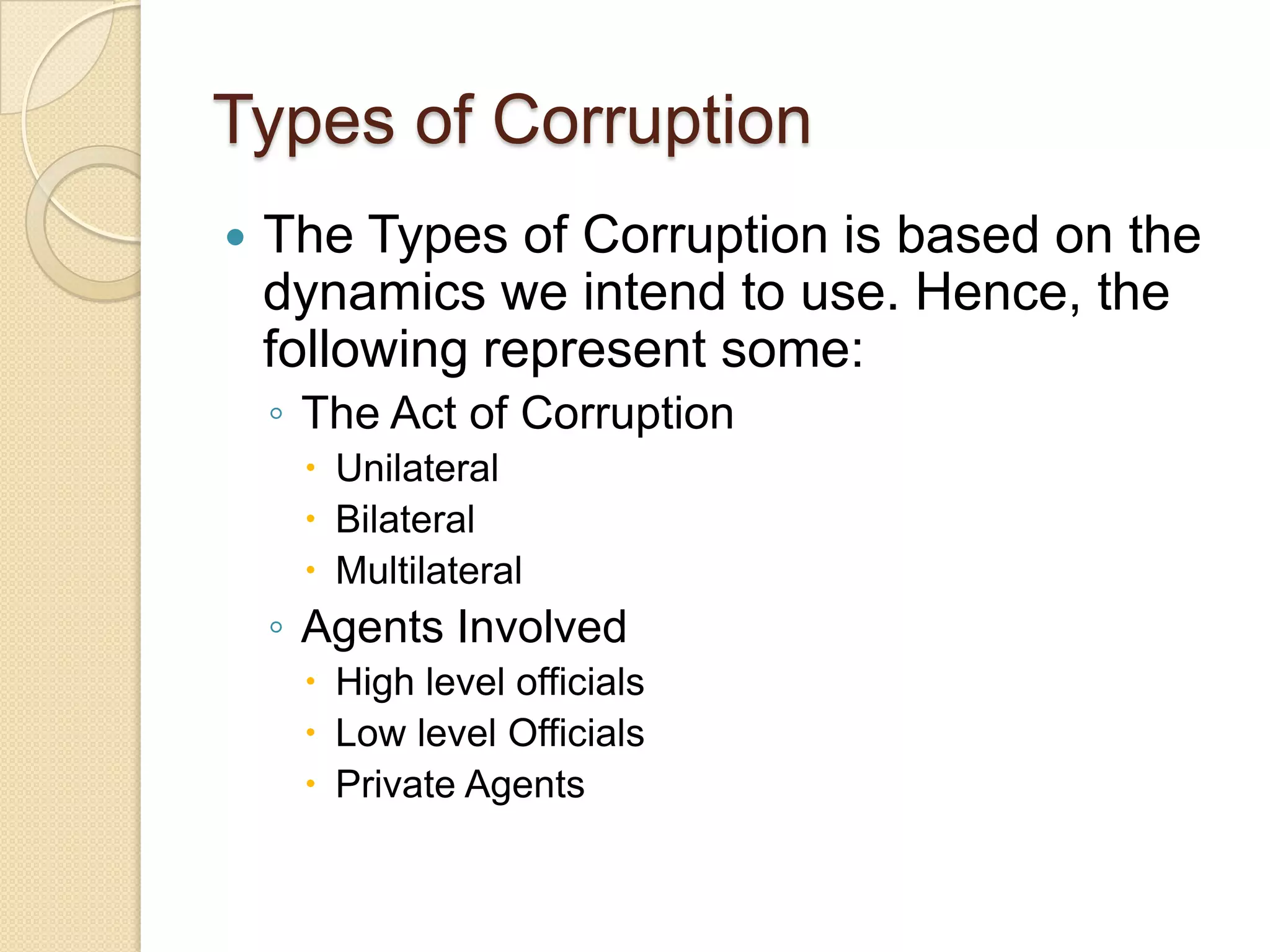
 The Types of Corruption is based on the
dynamics we intend to use. Hence, the
following represent some:
◦ The Act of Corruption
 Unilateral
 Bilateral
 Multilateral
◦ Agents Involved
 High level officials
 Low level Officials
 Private Agents
Types-Continued …
◦ Budgetary Functions
 Expenditures
 Revenues
◦ Size of the Corruption
 Grand Corruption
 Petty Corruption
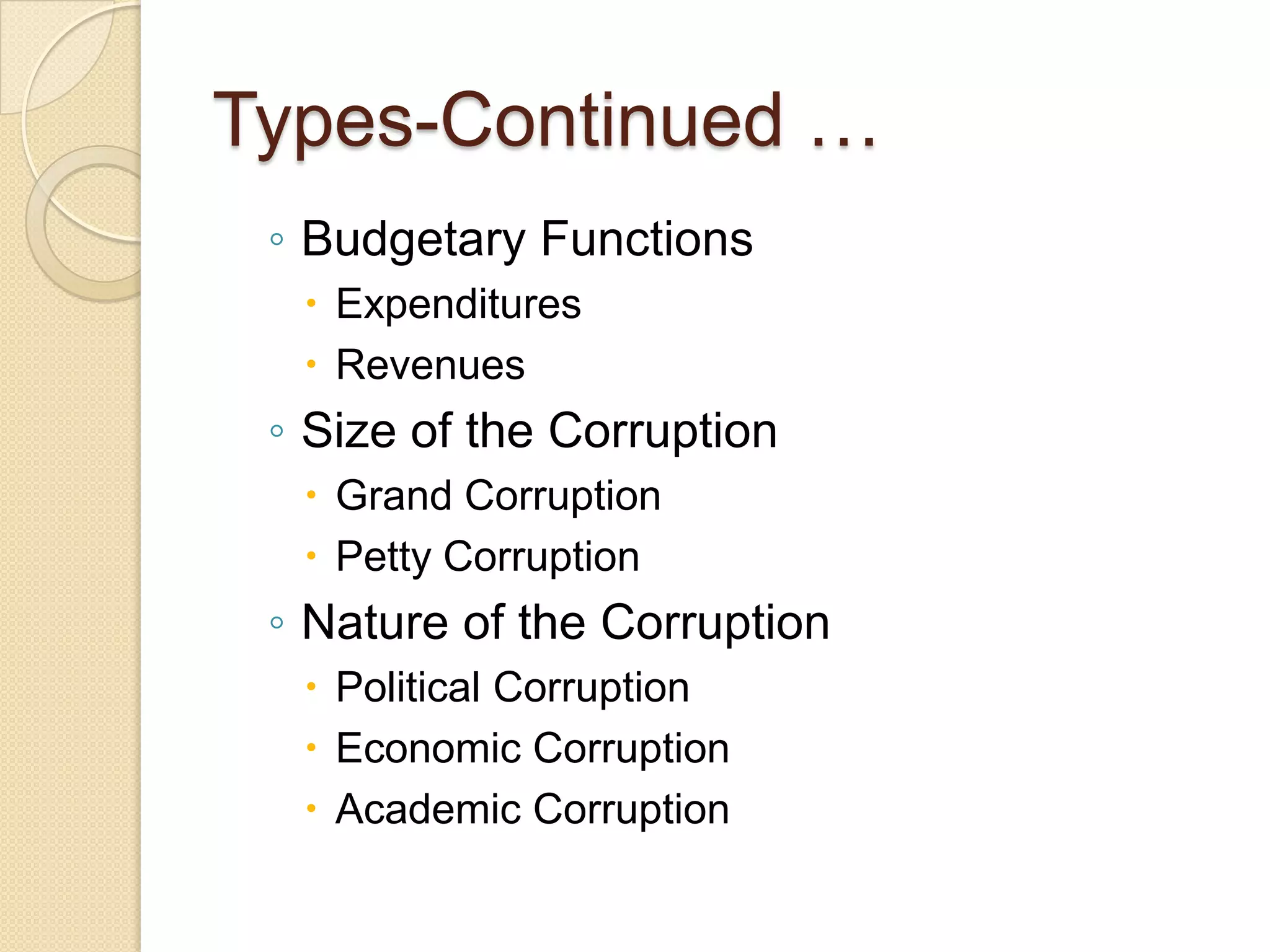
◦ Nature of the Corruption
 Political Corruption
 Economic Corruption
 Academic Corruption
Methods to identify corruption
vulnerable areas
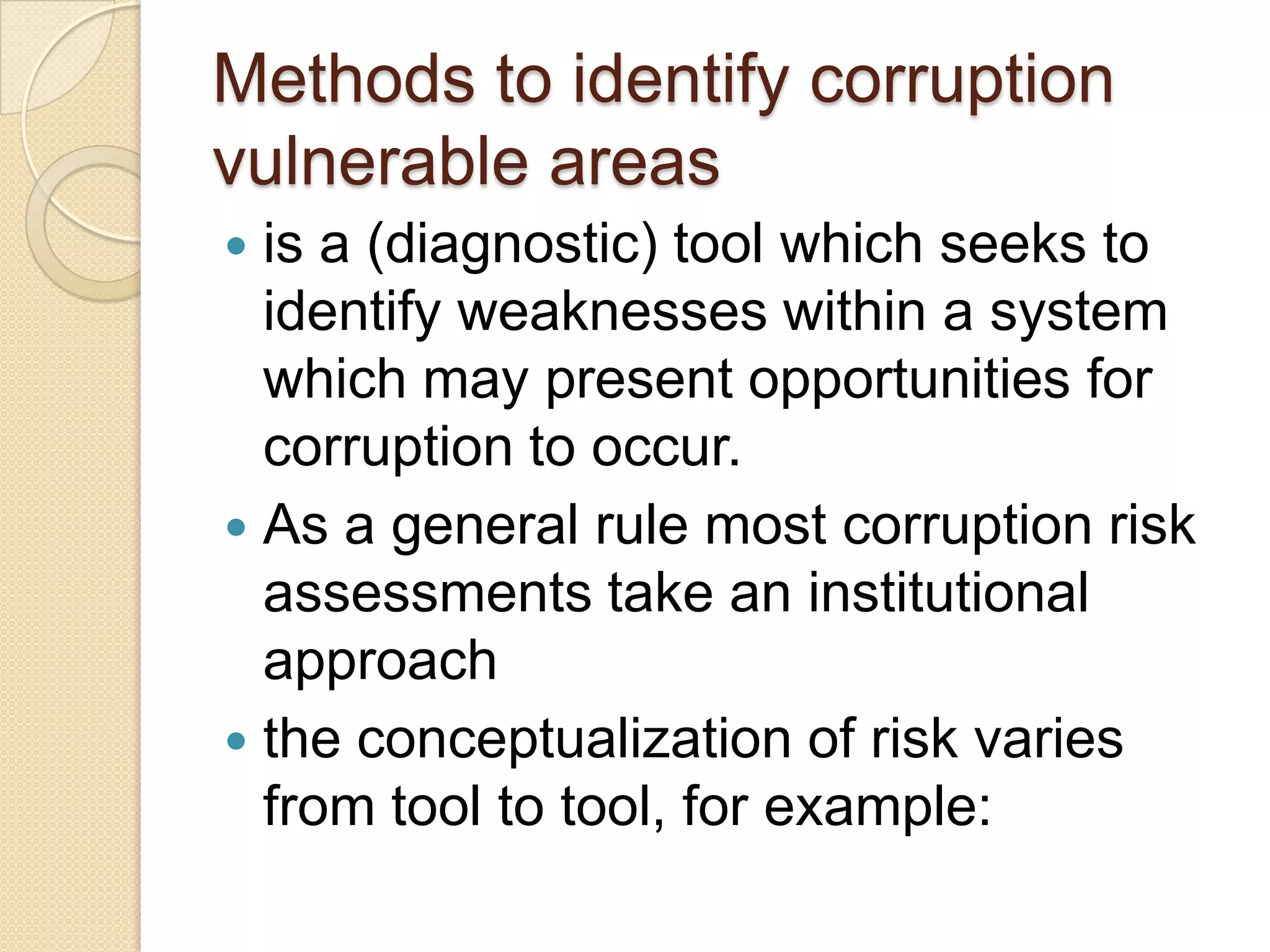
 is a (diagnostic) tool which seeks to
identify weaknesses within a system
which may present opportunities for
corruption to occur.
 As a general rule most corruption risk
assessments take an institutional
approach
 the conceptualization of risk varies
from tool to tool, for example:
Methods-Continued…
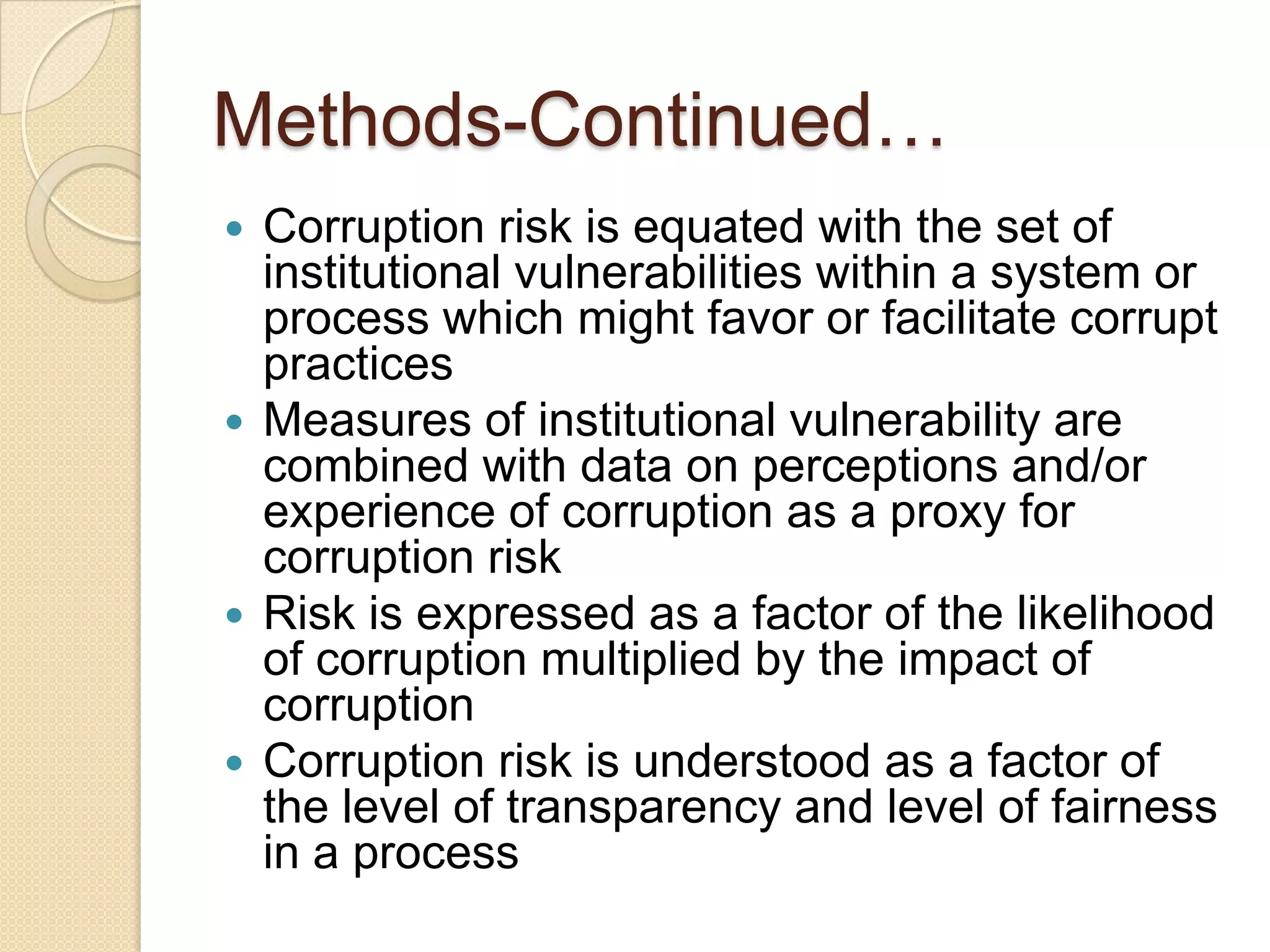
 Corruption risk is equated with the set of
institutional vulnerabilities within a system or
process which might favor or facilitate corrupt
practices
 Measures of institutional vulnerability are
combined with data on perceptions and/or
experience of corruption as a proxy for
corruption risk
 Risk is expressed as a factor of the likelihood
of corruption multiplied by the impact of
corruption
 Corruption risk is understood as a factor of
the level of transparency and level of fairness
in a process
Methods-Continued…
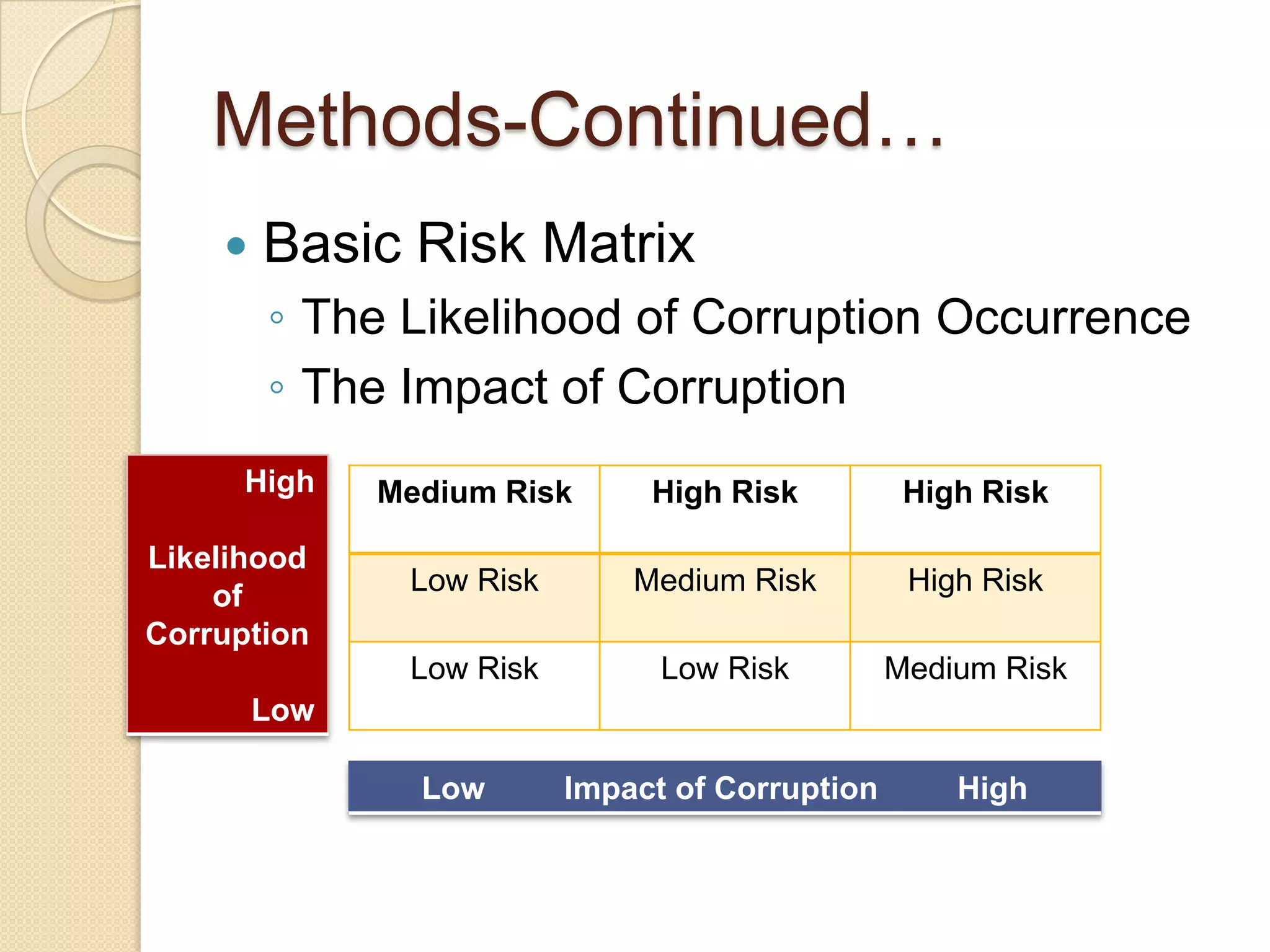
 Basic Risk Matrix
◦ The Likelihood of Corruption Occurrence
◦ The Impact of Corruption
Medium Risk High Risk High Risk
Low Risk Medium Risk High Risk
Low Risk Low Risk Medium Risk
Low Impact of Corruption High
High
Likelihood
of
Corruption
Low
Methods to fight Corruption
 There are different ways to combat
Corruption that are used by different
countries.
 Here for our training purpose we will
consider three ways including:
◦ Penal-Administrative Approach
◦ National Integrity System
◦ The Hong Kong Model
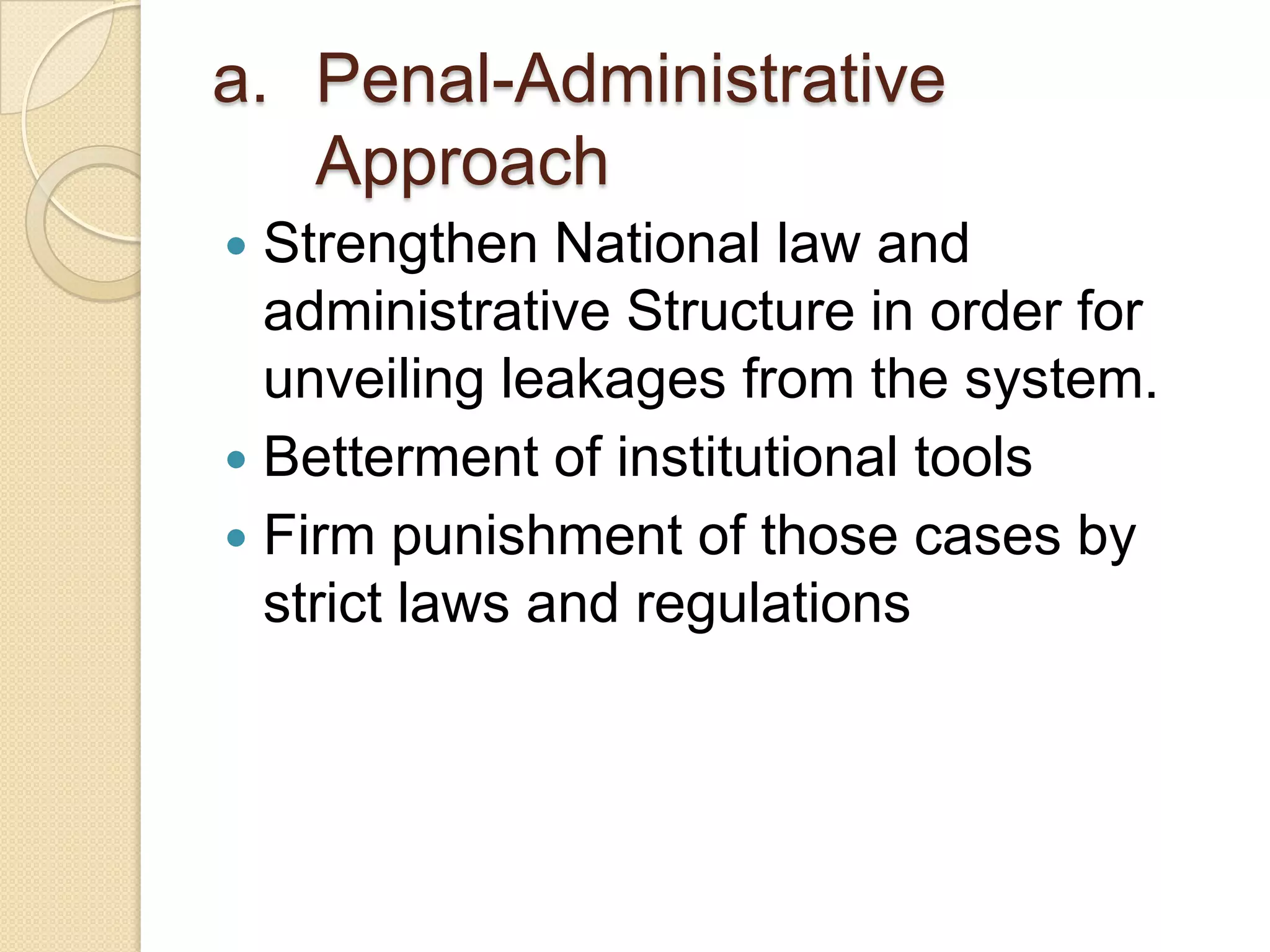
a. Penal-Administrative
Approach
 Strengthen National law and
administrative Structure in order for
unveiling leakages from the system.
 Betterment of institutional tools
 Firm punishment of those cases by
strict laws and regulations
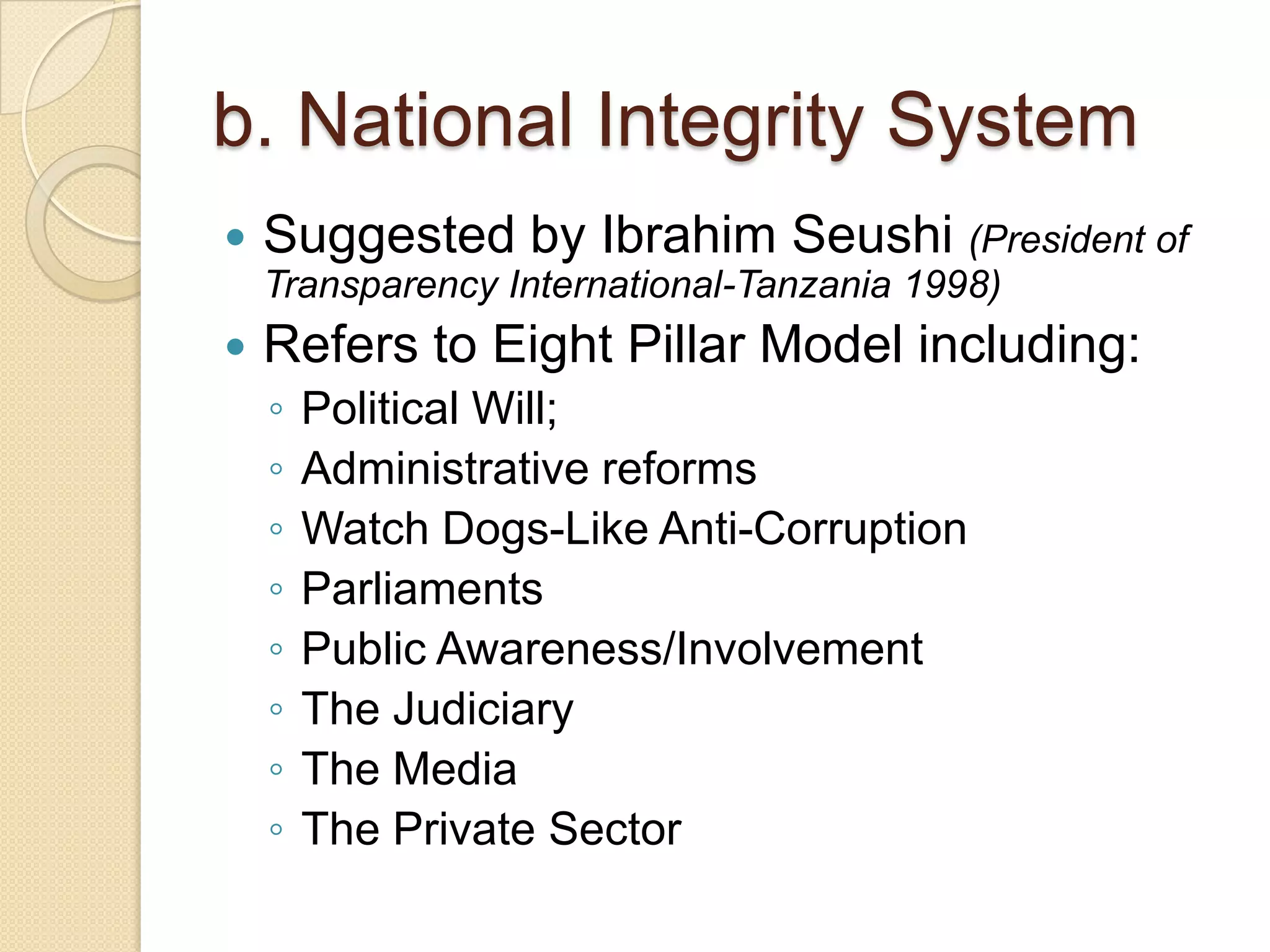
b. National Integrity System
 Suggested by Ibrahim Seushi (President of
Transparency International-Tanzania 1998)
 Refers to Eight Pillar Model including:
◦ Political Will;
◦ Administrative reforms
◦ Watch Dogs-Like Anti-Corruption
◦ Parliaments
◦ Public Awareness/Involvement
◦ The Judiciary
◦ The Media
◦ The Private Sector
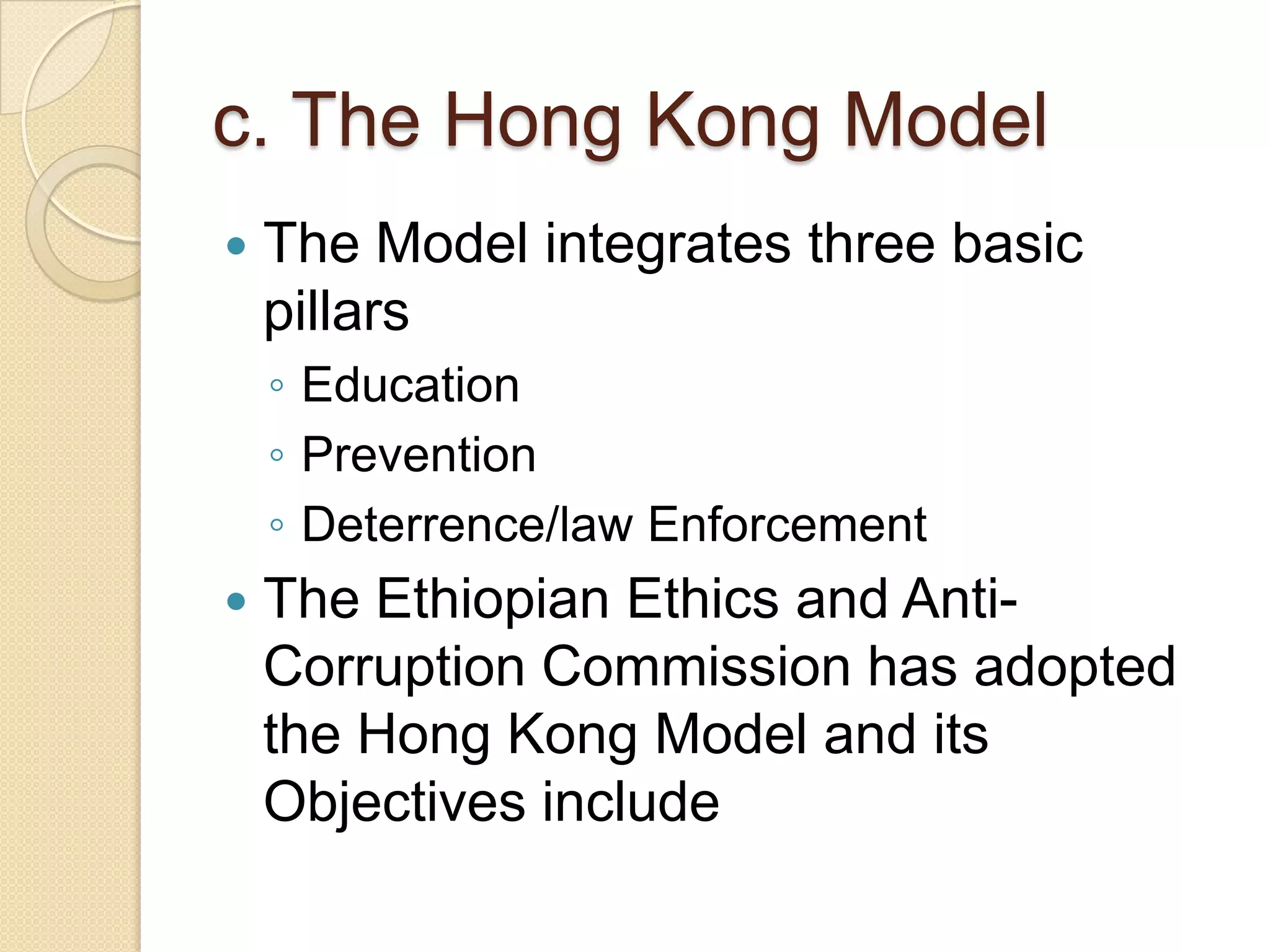
c. The Hong Kong Model
 The Model integrates three basic
pillars
◦ Education
◦ Prevention
◦ Deterrence/law Enforcement
 The Ethiopian Ethics and Anti-
Corruption Commission has adopted
the Hong Kong Model and its
Objectives include
Continued …Basic Objectives of the
FEACC
 In cooperation with relevant bodies, to
strive to create awareness in Ethiopian
society that corruption will not be
tolerated by promoting Ethics and Anti-
Corruption Education;
 In cooperation with relevant bodies, to
prevent corruption offences and other
improprieties, and;
 To Expose, Investigate and prosecute
corruption offences and other
improprieties.
Cases of Corruption in the
Construction Sector
 Corruption in the construction sector is
one of the most difficult problems due
to
◦ Its High Spending nature
◦ Ease with which many corrupt practices
can be hidden
◦ Any lack of Capacity, Transparency or
accountability tends to accentuate the risk
by
 Increasing the opportunities for corrupt
practices and
Bangladesh
Bangladesh-Continued …
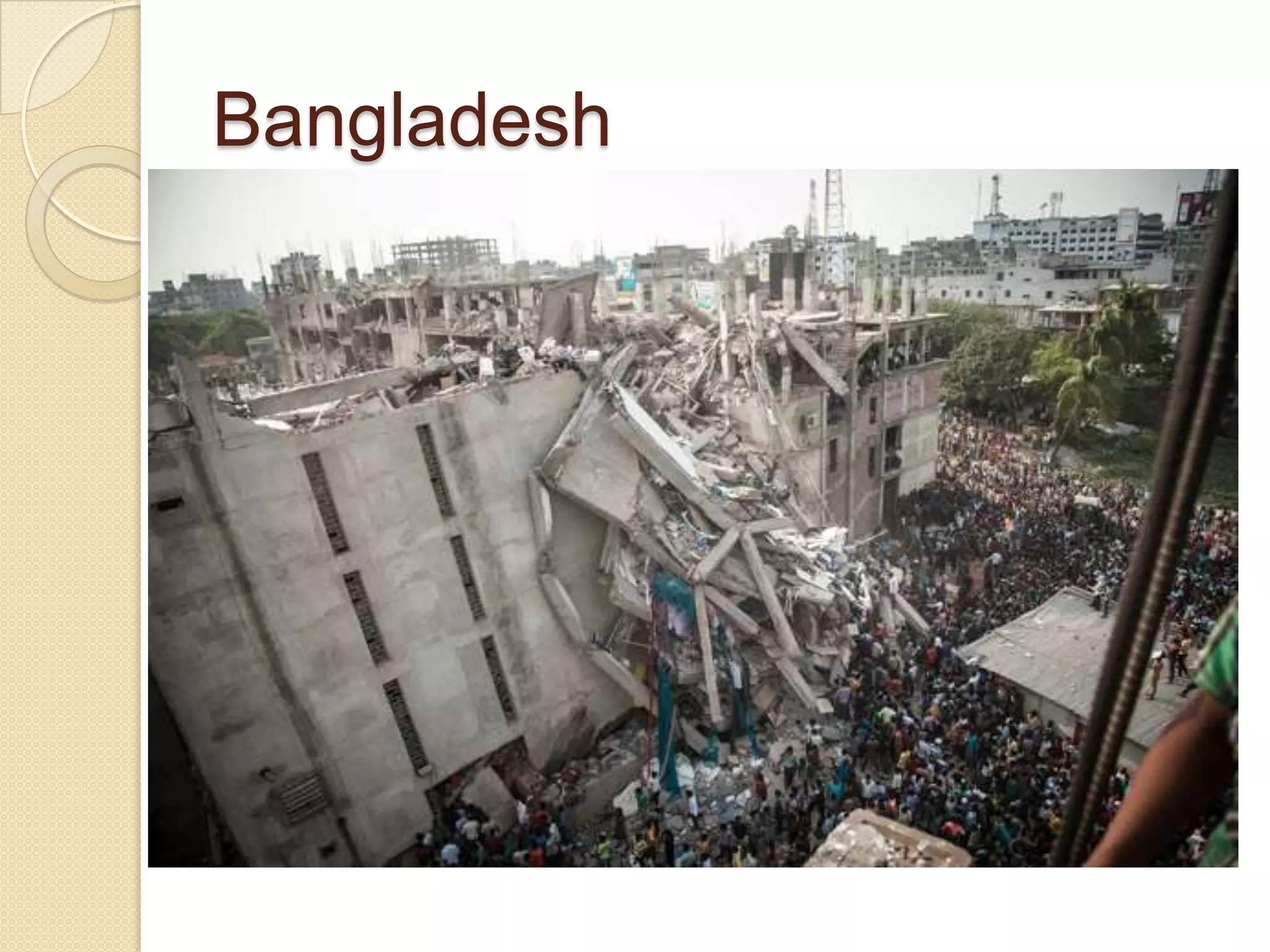
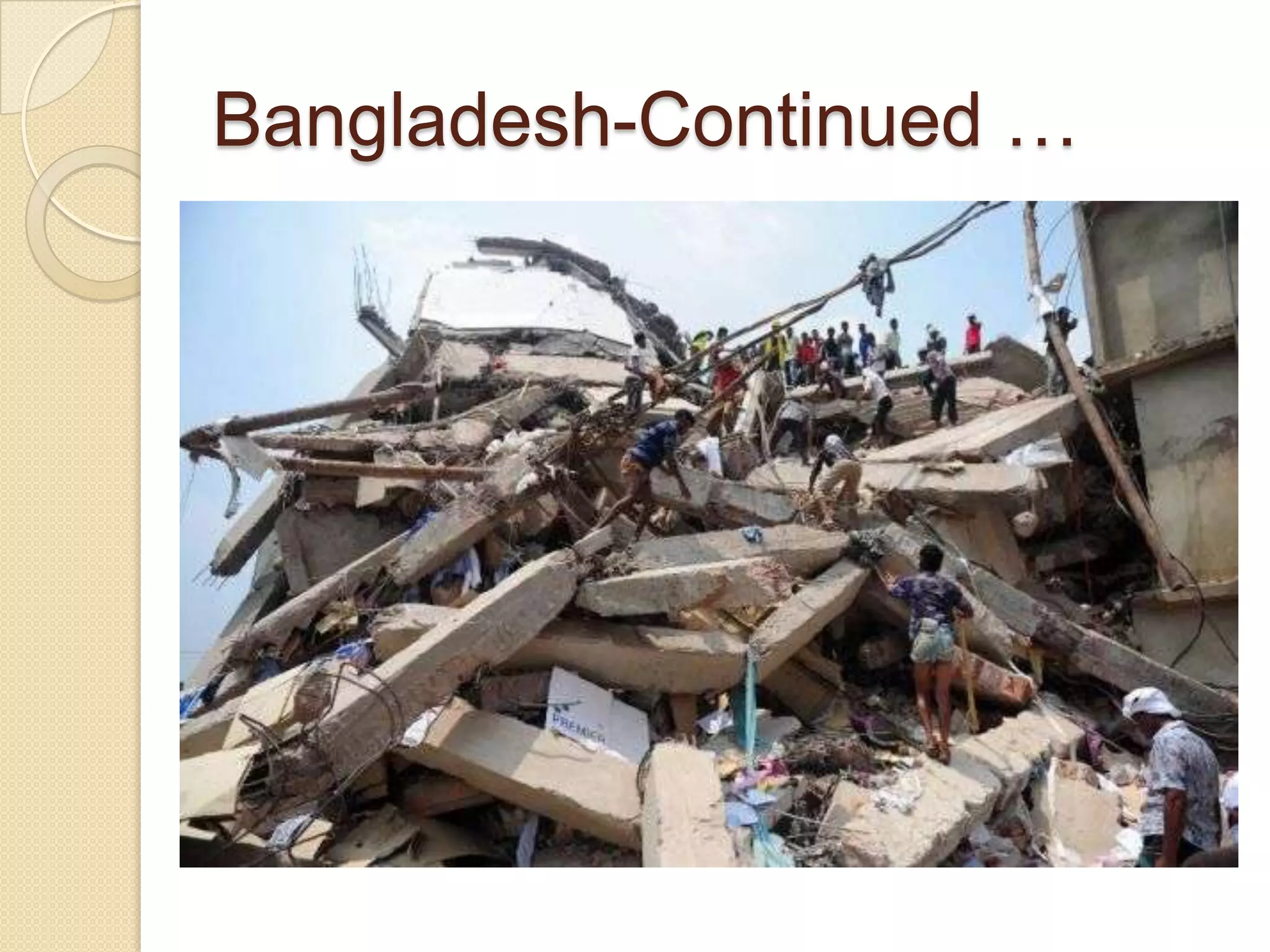
 ‘Rana Plaza’ :- An eight-storey building
collapsed in Savar, on the outskirts of
Dhaka.
 a complex that included a shopping
centre and six garment factories.
 At least 250 people were killed
 The building violated applicable
building codes.
 According to reports its foundation was
unstable; part of the complex had been
built on a pond filled with sand.
(Bangladesh’s home minister,
Muhiuddin Khan Alamgir, )
Bangladesh-Continued …
Tanzania
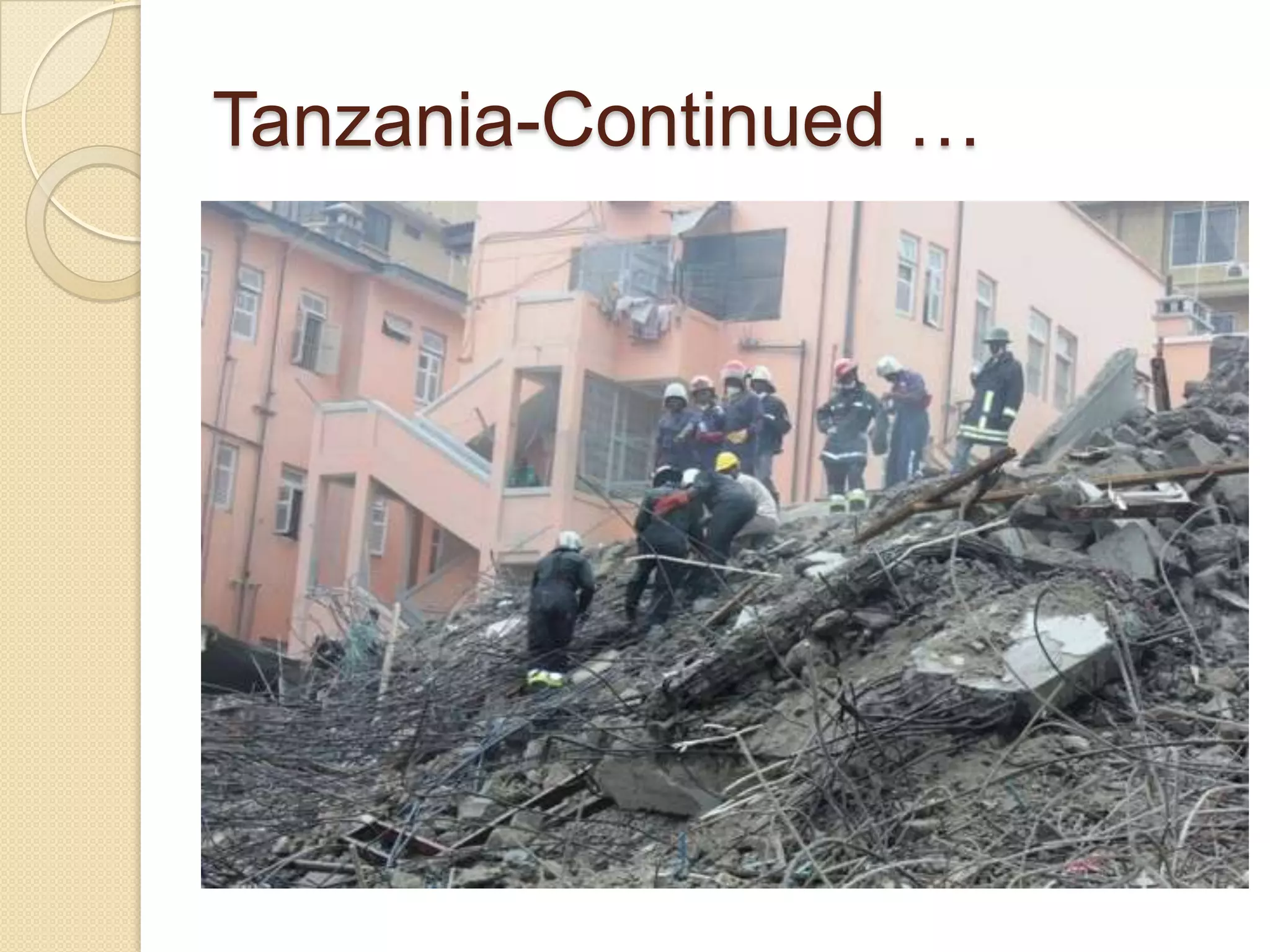
 In 2006, a three-storey building
collapsed in the outskirts of Dare
Salaam, injuring several people.
 Two years later, a 10-storey building
collapsed in the city centre, injuring
scores of people. Yet another team
was formed to investigate the
mayhem, but the findings never came
out.
Tanzania-Continued …
 Again on March 28, 2013. a 14-
storey building was collapsed, in Dare
Salaam
 The building was being constructed under a
joint scheme between a private investor and
the public agency, the National Housing
Corporation.
 President Kikwete, for example, has said
corruption is so endemic that public tenders
are not won by the most competent firms but
by the most corrupt.
 killing more than 36 people and crushing
several cars.
Conclusion – the ultimate cost
 All in all Corruption :
◦ Claims the Life of peoples
◦ The Cost of replacement and repairing
◦ The Opportunity cost of damage-Time
value
◦ Breeds Artificial Inefficiency
◦ Competition and Ability will be replaced
with Financial Muscle
◦ Rule of Law disappears and so On.
 Thus Fight Corruption and let Fight
Others
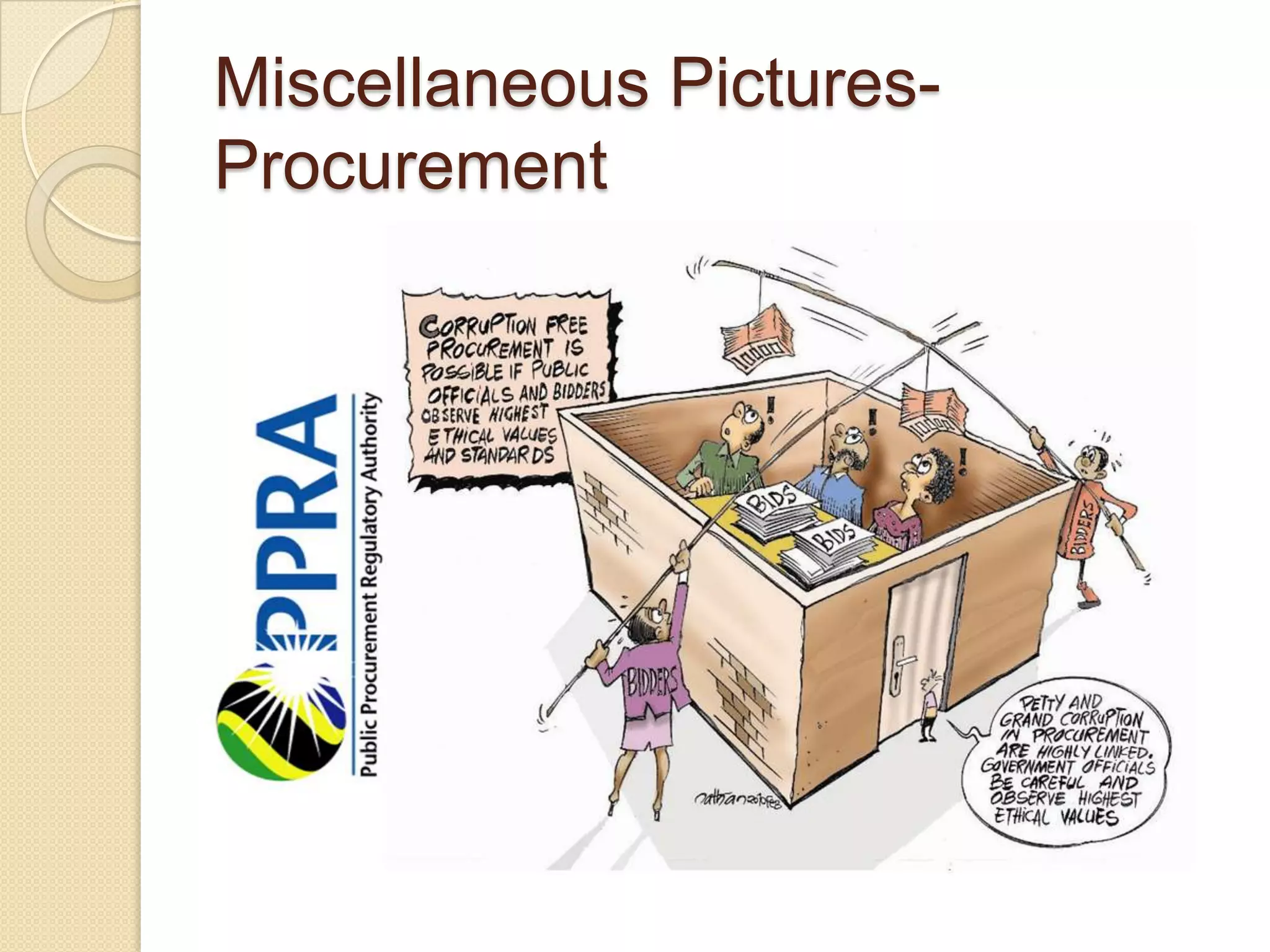
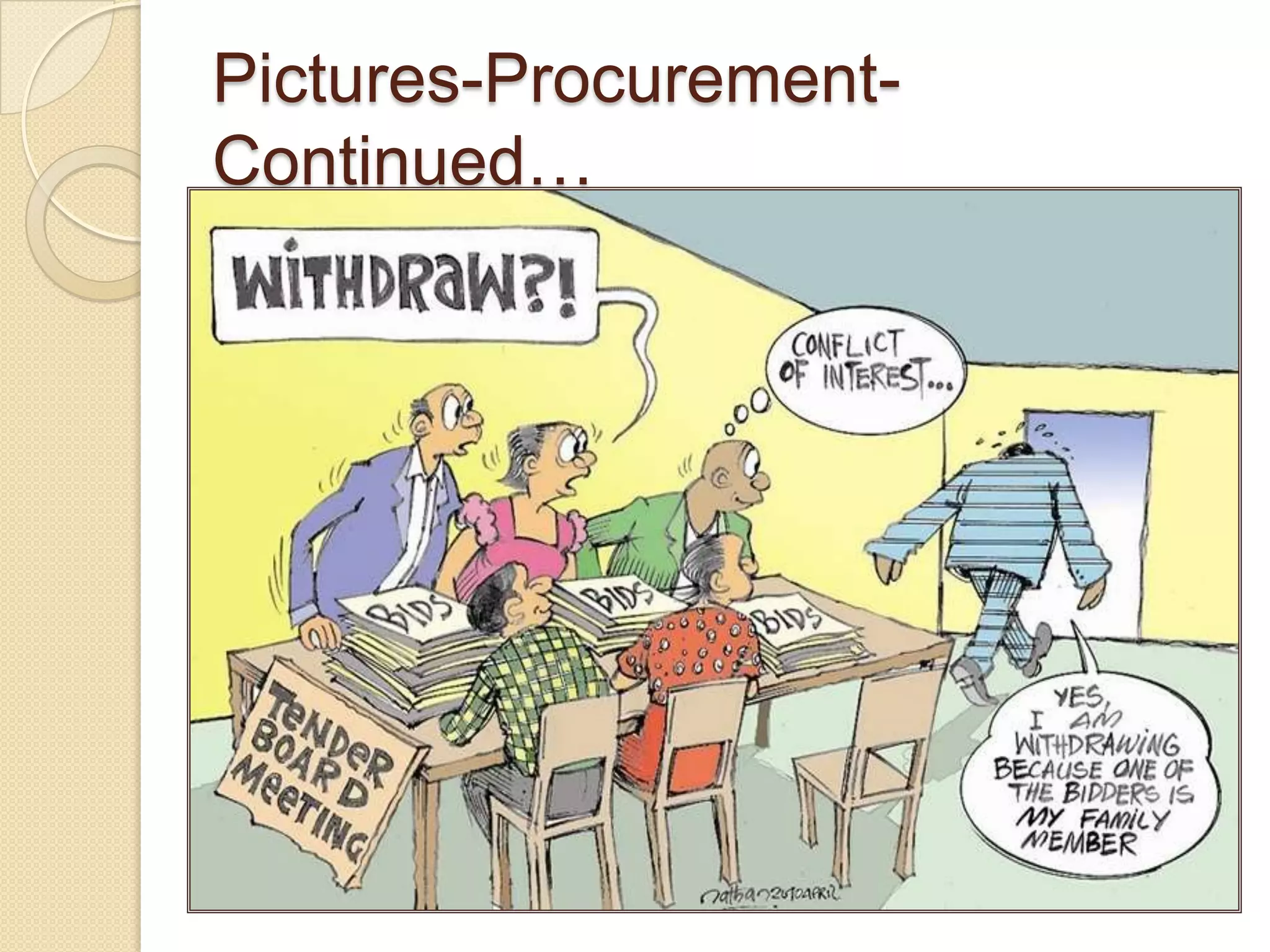
Miscellaneous Pictures-
Procurement
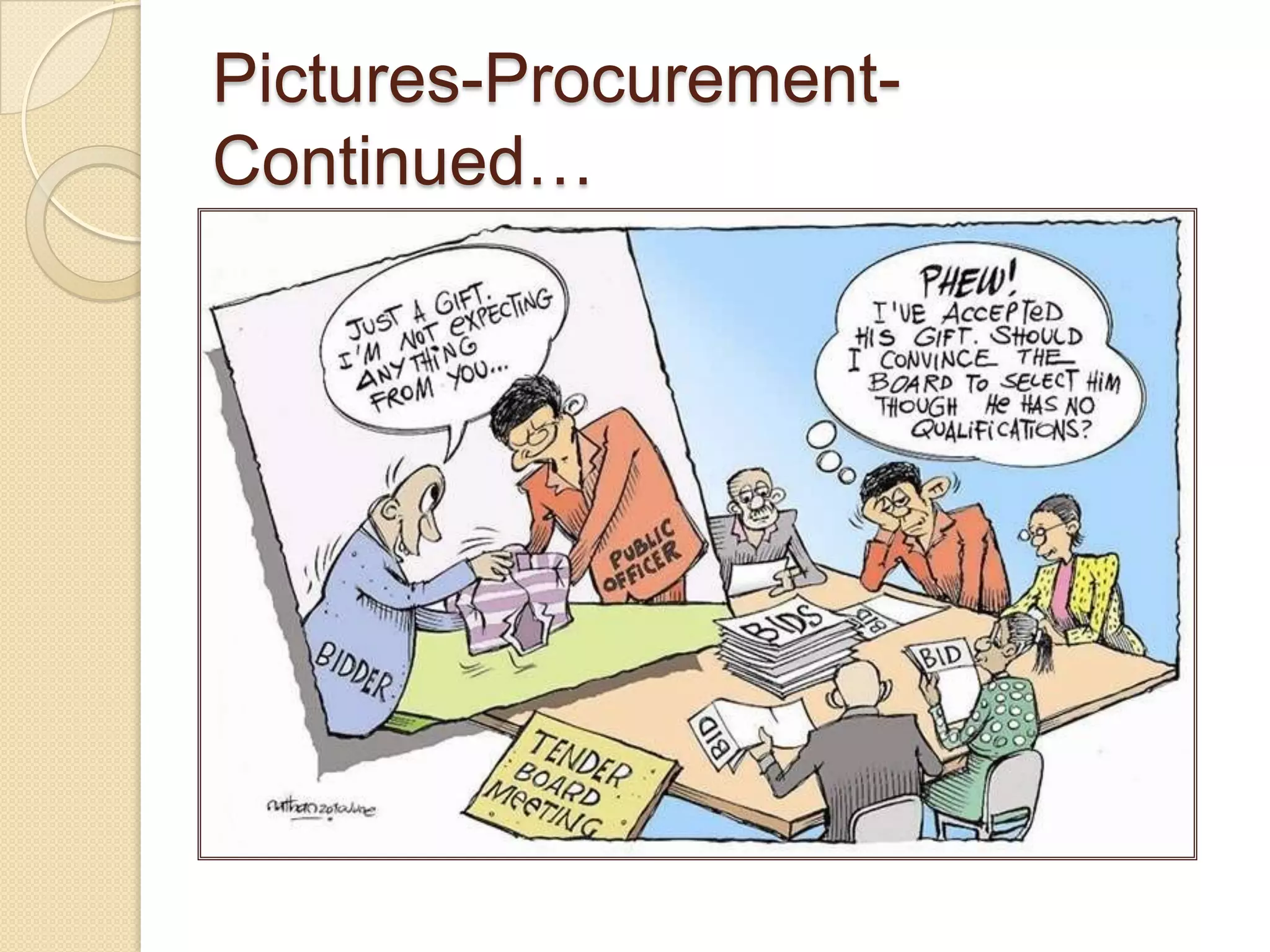
Pictures-Procurement-
Continued…
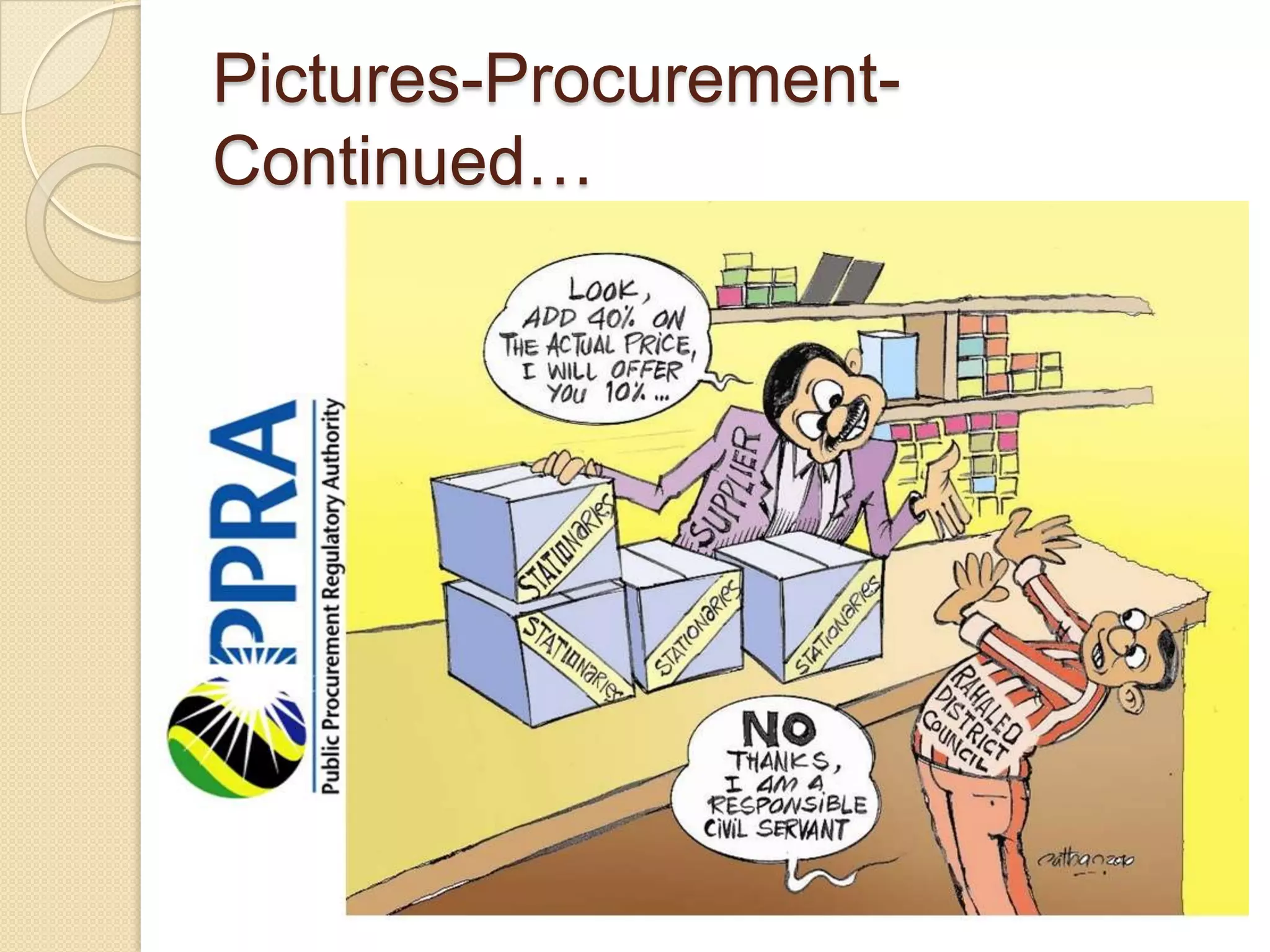
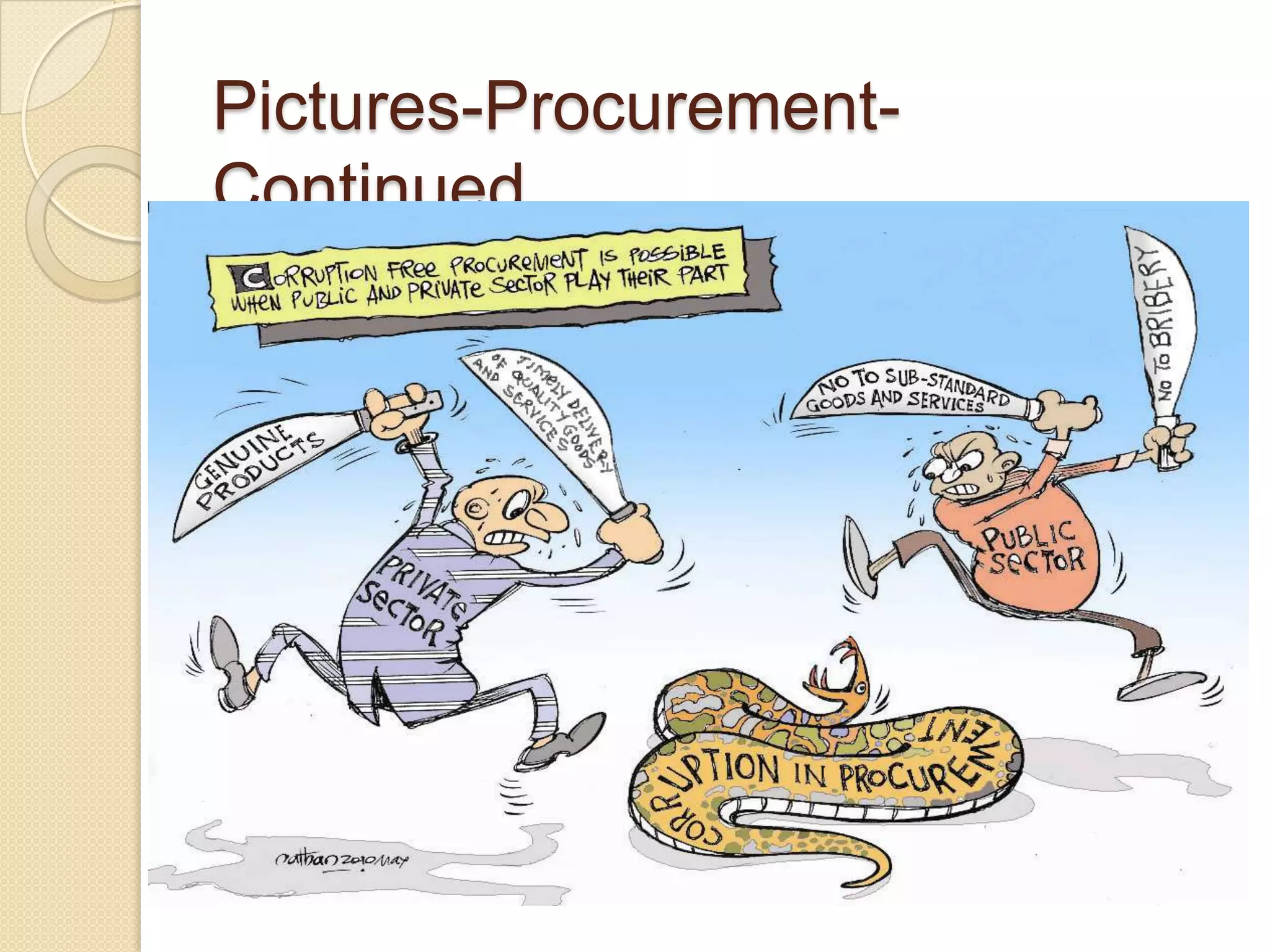
Pictures-Procurement-
Continued…
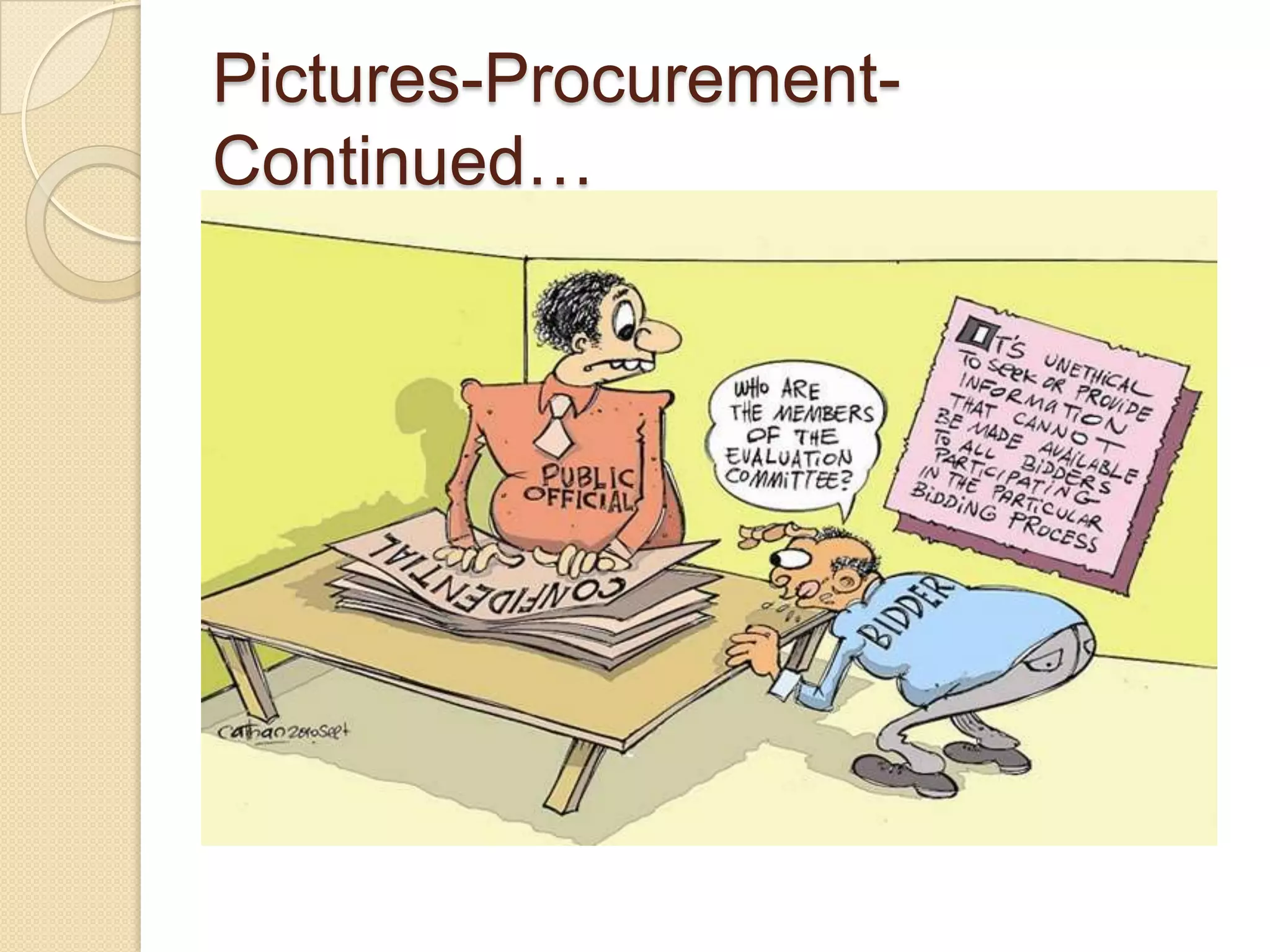
Pictures-Procurement-
Continued…
Pictures-Procurement-
Continued…
Pictures-Procurement-
Continued…
Thank You

Training for hu student club-eac

  • 1.
    Corruption: Concept, Theories, RiskAssessment, Methods and Cases A Half-Day Training Prepared for Haromaya University Ethics and Anti Corruption Student Club Prepared by: Abey Doni
  • 2.
    Objectives of TheTraining  To define the concept of Corruption;  To Explain the Types of Corruption;  Train the Trainee on Risk assessment techniques and ways to prevent Corruption;  Explain different ways to combat corruption;  Show cases of corruption in the Construction Sector Globally through Examples.
  • 3.
    Deliverables :  Atthe end of the Training the trainee will be able to: ◦ Define the concept of Corruption; ◦ Explain the types of Corruption; ◦ Work on the ways to identify corruption risk areas; ◦ Know the different methods to fight corruption; ◦ See the impact of corruption in the construction Sector Globally.
  • 4.
    Content of TheTraining 1. Definition of the concept of Corruption 2. Theories and View points about corruption 3. Types of Corruption 4. Methods to identify corruption vulnerable areas 5. Methods to fight Corruption 6. Cases of Corruption in the Construction Sector 7. Conclusion– the ultimate cost
  • 5.
    Definition of theconcept of Corruption  Joint work of Shah and Schacter(2004) defined Corruption as the exercise of official powers against public interest or the abuse of public office for private gains.  The term ‘corruption’ came from Latin word called ‘corruptio’ and it means that bribe and destroy.
  • 6.
    Theories and Viewpoints about corruption  We will see two major theories and view points from reputed model builders, which include; ◦ Klitgaard Model, ◦ Jeff Huther and Anwar Shah from The World Bank.
  • 7.
    a. Klitgaard Model Klitgaard (1996) has developed a simple model to explain the dynamics of corruption. ◦ C(Corruption)=M (Monopoly Power)+D (Discretion) – A (Accountability)  Hence Corruption depends on the amount of Monopoly power and Discretionary power that an official exercises.
  • 8.
    Continued- Klitgaard  Thus,Corruption will prevail when: ◦ High Monopoly power –large in highly regulated Economies ◦ High Discretionary Power – in developing countries and transitional Economies, where; administrative rules and regulations are often poorly defined. ◦ Low Accountability-  Poorly defined Ethical Standards of public service  Weak administrative and financial systems  Ineffective Watchdog Agencies
  • 9.
    b. Jeff Hutherand Anwar Shah  Both Believed a Self-interested individual will seek out or accept corruption if the Expected gains outweigh the cost.  Mathematically Speaking ◦ E(B)= n*E(G) – Prob (P)*P >0  Where: ◦ E – is the Expectation operator ◦ N – is the number of corrupt transactions ◦ G – is the gain from the corrupt transaction ◦ Prob (P) – is the probability of paying penalty ◦ P – the Penalty for the corrupt activity
  • 10.
    Continued- Huther J.& A. Shah  Hence, to reduce the corrupt behavior using the cost benefit Analysis we can use the following methods: ◦ Reducing Expected Gross Benefit ◦ Reducing the number of corrupt practice ◦ Increasing the probability of paying a penalty ◦ Increasing the penalty for corrupt behavior
  • 11.
    Continued- Huther J.& A. Shah The Influence of Anti-Corruption Programs on officials Cost-benefit Analysis Number of corrupt Practices Gross gains from Corruption Probability of Paying penalty Magnitude of Penalty Bureaucratic Culture Economic Reform- Improving competitive Environment Anti-Corruption Agencies Rationaliz ation of Laws Raising public service standards Parliamentary Oversight Reducing Public Employment Ombudsman Reducing Public Sector Size Financial Accountability Financial sector Liberalization Scaling down individual Public Projects Media Independence Increasing Transparency Judicial Independence Decentralization of public Services Citizen participation Rule of Law
  • 12.
    Types of Corruption The Types of Corruption is based on the dynamics we intend to use. Hence, the following represent some: ◦ The Act of Corruption  Unilateral  Bilateral  Multilateral ◦ Agents Involved  High level officials  Low level Officials  Private Agents
  • 13.
    Types-Continued … ◦ BudgetaryFunctions  Expenditures  Revenues ◦ Size of the Corruption  Grand Corruption  Petty Corruption ◦ Nature of the Corruption  Political Corruption  Economic Corruption  Academic Corruption
  • 14.
    Methods to identifycorruption vulnerable areas  is a (diagnostic) tool which seeks to identify weaknesses within a system which may present opportunities for corruption to occur.  As a general rule most corruption risk assessments take an institutional approach  the conceptualization of risk varies from tool to tool, for example:
  • 15.
    Methods-Continued…  Corruption riskis equated with the set of institutional vulnerabilities within a system or process which might favor or facilitate corrupt practices  Measures of institutional vulnerability are combined with data on perceptions and/or experience of corruption as a proxy for corruption risk  Risk is expressed as a factor of the likelihood of corruption multiplied by the impact of corruption  Corruption risk is understood as a factor of the level of transparency and level of fairness in a process
  • 16.
    Methods-Continued…  Basic RiskMatrix ◦ The Likelihood of Corruption Occurrence ◦ The Impact of Corruption Medium Risk High Risk High Risk Low Risk Medium Risk High Risk Low Risk Low Risk Medium Risk Low Impact of Corruption High High Likelihood of Corruption Low
  • 17.
    Methods to fightCorruption  There are different ways to combat Corruption that are used by different countries.  Here for our training purpose we will consider three ways including: ◦ Penal-Administrative Approach ◦ National Integrity System ◦ The Hong Kong Model
  • 18.
    a. Penal-Administrative Approach  StrengthenNational law and administrative Structure in order for unveiling leakages from the system.  Betterment of institutional tools  Firm punishment of those cases by strict laws and regulations
  • 19.
    b. National IntegritySystem  Suggested by Ibrahim Seushi (President of Transparency International-Tanzania 1998)  Refers to Eight Pillar Model including: ◦ Political Will; ◦ Administrative reforms ◦ Watch Dogs-Like Anti-Corruption ◦ Parliaments ◦ Public Awareness/Involvement ◦ The Judiciary ◦ The Media ◦ The Private Sector
  • 20.
    c. The HongKong Model  The Model integrates three basic pillars ◦ Education ◦ Prevention ◦ Deterrence/law Enforcement  The Ethiopian Ethics and Anti- Corruption Commission has adopted the Hong Kong Model and its Objectives include
  • 21.
    Continued …Basic Objectivesof the FEACC  In cooperation with relevant bodies, to strive to create awareness in Ethiopian society that corruption will not be tolerated by promoting Ethics and Anti- Corruption Education;  In cooperation with relevant bodies, to prevent corruption offences and other improprieties, and;  To Expose, Investigate and prosecute corruption offences and other improprieties.
  • 22.
    Cases of Corruptionin the Construction Sector  Corruption in the construction sector is one of the most difficult problems due to ◦ Its High Spending nature ◦ Ease with which many corrupt practices can be hidden ◦ Any lack of Capacity, Transparency or accountability tends to accentuate the risk by  Increasing the opportunities for corrupt practices and
  • 23.
  • 24.
    Bangladesh-Continued …  ‘RanaPlaza’ :- An eight-storey building collapsed in Savar, on the outskirts of Dhaka.  a complex that included a shopping centre and six garment factories.  At least 250 people were killed  The building violated applicable building codes.  According to reports its foundation was unstable; part of the complex had been built on a pond filled with sand. (Bangladesh’s home minister, Muhiuddin Khan Alamgir, )
  • 25.
  • 26.
    Tanzania  In 2006,a three-storey building collapsed in the outskirts of Dare Salaam, injuring several people.  Two years later, a 10-storey building collapsed in the city centre, injuring scores of people. Yet another team was formed to investigate the mayhem, but the findings never came out.
  • 27.
  • 28.
    Tanzania-Continued …  Againon March 28, 2013. a 14- storey building was collapsed, in Dare Salaam  The building was being constructed under a joint scheme between a private investor and the public agency, the National Housing Corporation.  President Kikwete, for example, has said corruption is so endemic that public tenders are not won by the most competent firms but by the most corrupt.  killing more than 36 people and crushing several cars.
  • 29.
    Conclusion – theultimate cost  All in all Corruption : ◦ Claims the Life of peoples ◦ The Cost of replacement and repairing ◦ The Opportunity cost of damage-Time value ◦ Breeds Artificial Inefficiency ◦ Competition and Ability will be replaced with Financial Muscle ◦ Rule of Law disappears and so On.  Thus Fight Corruption and let Fight Others
  • 30.
  • 31.
  • 32.
  • 33.
  • 34.
  • 35.
  • 36.