DEPARTMENT OF COMPUTER SCIENCE
& ENGINEERING
Domain Winning Camp 2022
Subject Name: IT SKILLS
Day: 6
Topics Covered:Cursor,Big data,Data Mining
and Data Warehouse
DISCOVER . LEARN . EMPOWER
1
•Prerequisite,Objective and Outcome
• Prerequisite
• Students should have basic knowledge of sql queries
• Sql operations,joins
• Sql queries and procedures
• Objective
• To retrieve data, one row at a time, from a result set
• Outcome
• Student is able to manipulate the whole result set at once.
2
Topic:
•Implementing procedure using cursor
•Introduction to Big data,Data mining and Data warehouse
3
CURSORS
• A cursor is a temporary work area created in the system memory when a
SQL statement is executed.
• A cursor contains information on a select statement and the rows of data
accessed by it.
• This temporary work area is used to store the data retrieved from the
database, and perform intermediate operations before output is displayed
to the client.
• A cursor can hold more than one row, but can process only one row at a
time.
NEED FOR CURSORS?
Cursor is a mechanism that provides a way to select multiple rows of data from
the database and then process each row individually inside a PL/SQL program.
The cursor first points at row1 and once it is processed it then
advances to row2 and so on.
Implicit Cursors
• These are created by default when DML statements like, INSERT, UPDATE, and
DELETE statements are executed.
• The user is not aware of this happening & will not be able to control or process
the information.
• When an implicit cursor is working, DBMS performs the open, fetches and close
automatically
The following table provides the description of the
most used attributes −
Attribute Name Description
%ISOPEN
Returns TRUE if cursor is open, FALSE if cursor is closed.
SQL%ISOPEN always returns FALSE.
%FOUND
Returns TRUE if successful fetch has been executed, FALSE if no row was
returned. SQL%FOUND is used to access it.
%NOTFOUND
Return TRUE if no row was returned, FALSE if successful fetch has been
executed. SQL%NOTFOUND is used to access it.
%ROWCOUNT
Returns the number of rows affected by the query.
SQL%ROWCOUNT is used to access it.
Example
Write a pl/sql program to update the salary of customers by Rs 500
Select * from customers;
The following program will update the table and
increase the salary of each customer by 500 and use
the SQL%ROWCOUNT attribute to determine the
number of rows affected −
• DECLARE
• total_rows number(2);
• BEGIN
• UPDATE customers
• SET salary = salary + 500;
• IF sql%notfound THEN
• dbms_output.put_line('no customers selected');
• ELSIF sql%found THEN
• total_rows := sql%rowcount;
• dbms_output.put_line( total_rows || ‘customers selected ');
• END IF;
• END;
Result:
6 customers selected
PL/SQL procedure successfully completed.
Select * from customers;
+‐‐‐‐+‐‐‐‐‐‐‐‐‐‐+‐‐‐‐‐+‐‐‐‐‐‐‐‐‐‐‐+‐‐‐‐‐‐‐‐‐‐+
| ID | NAME | AGE | ADDRESS | SALARY |
+‐‐‐‐+‐‐‐‐‐‐‐‐‐‐+‐‐‐‐‐+‐‐‐‐‐‐‐‐‐‐‐+‐‐‐‐‐‐‐‐‐‐+
| 1 | Ramesh | 32 | Ahmedabad | 2500.00 |
| 2 | Khilan | 25 | Delhi | 2000.00 |
| 3 | kaushik | 23 | Kota | 2500.00 |
| 4 | Chaitali | 25 | Mumbai | 7000.00 |
| 5 | Hardik | 27 | Bhopal | 9000.00 |
| 6 | Komal | 22 | MP | 5000.00 |
Explicit cursors
• Explicit cursors are programmer defined cursors for gaining more control over
the context area.
• An explicit cursor should be defined in the declaration section of the PL/SQL
Block.
• It is created on a SELECT Statement which returns more than one row.
The following table provides the description of
the most used attributes −
Attribute Name Description
%ISOPEN
Returns TRUE if cursor is open, FALSE if cursor is closed.
CursorName%ISOPEN is used to access it.
%FOUND
Returns TRUE if successful fetch has been executed, FALSE if no row was
returned.
CursorName%FOUND is used to access it.
%NOTFOUND
Return TRUE if no row was returned, FALSE if successful fetch has been
executed.
CursorName%NOTFOUND is used to access it.
%ROWCOUNT
Returns the number of rows affected by the query.
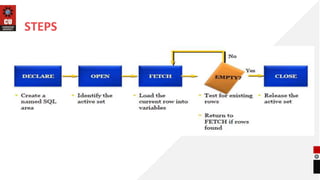
Explicit cursor involves four steps:
1.Declaring the cursor for initializing in the memory
2.Opening the cursor for allocating memory
3.Fetching the cursor for retrieving data
4.Closing the cursor to release allocated memory
STEPS
Declaring the Cursor
Syntax:
• CURSOR cursor_name IS select_statement;
For example:
• CURSOR c_customers IS
• SELECT id, name, address FROM customers;
Opening the Cursor
Syntax:
• OPEN cursor_name;
Example:
• OPEN c_customers;
Fetching the Cursor
• Fetching the cursor involves accessing one row at a time.
Syntax:
• FETCH cursor_name INTO record_name;
Example:
• FETCH c_customers INTO c_id, c_name, c_addr;
Closing the Cursor
• Closing the cursor means releasing the allocated memory.
Syntax:
• CLOSE cursor_name;
Example:
• CLOSE c_customers;
EXAMPLE
• DECLARE
• c_id customers.id%type;
• c_name customers.name%type;
• c_addr customers.address%type;
• CURSOR c_customers IS SELECT id, name, address FROM customers;
• BEGIN
• OPEN c_customers;
• LOOP
• FETCH c_customers into c_id, c_name, c_addr;
• EXIT WHEN c_customers%notfound;
• dbms_output.put_line(c_id || ' ' || c_name || ' ' || c_addr);
• END LOOP;
• CLOSE c_customers;
• END;
RESULT:
1 Ramesh Ahmedabad
2 Khilan Delhi
3 kaushik Kota
4 Chaitali Mumbai
5 Hardik Bhopal
6 Komal MP
PL/SQL procedure successfully completed.
Advantages
• Using Cursor we can perform row by row processing .
• We can perform row wise validation or operations on each
row.
• Allow application to access and move around in a set of data rows, rather then
merely retrieve a complete result set.
•Disadvantages
• Uses more resources
• Speed and performance issues.
• Increased network roundtrip.
Dataware house VS DataMining
20
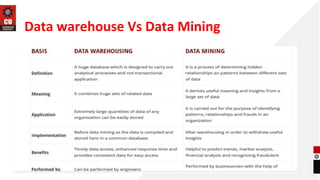
Data warehouse Vs Data Mining
21
Big Data (4vs of Bigdata)
22
TECHNOLOGIES FOR BIG DATA
PRACTICE QUESTIONS
• Write a program in PL/SQL to print the prime numbers between 1 to 50
• PL/SQL program to check whether a number is positive, negative or zero.
• Creating a PL/SQL program to implement cursors
• Write a program in PL/SQL to print 1st n numbers with a difference of 3 and
starting from 1.
24
Interview Question
1. What is cursor?
2. What are the components of a PL/SQL Block?
3. What are the types of cursor?
4. What do you mean by implicit cursor?
5. What do you mean by explicit cursor?
6. Difference between implicit and explicit cursor?
7. Is it possible to pass parameters in cursor?
8. What do you mean by %rowcount in oracle?
9. Difference between dataware house and data mining?
10.What are four Vs of big data?
11.What is index in dbms
25
References
• https://www.slideshare.net/ravi_LCET/data-warehousedata-mining-big-data
• https://dwbi1.wordpress.com/2012/07/14/what-is-big-data-data-warehouse-
data-mining/
• https://www.sciencedirect.com/book/9780123814791/data-mining-concepts-
and-techniques
• https://nptel.ac.in/courses/106/104/106104189/
• https://nptel.ac.in/courses/110/107/110107095/
• http://charting-ahead.corsairs.network/basics-of-building-a-data-warehouse-
part-1-4f54141308f3
• https://networkinterview.com/data-warehousing-and-data-mining
• https://dzone.com/articles/why-is-big-data-in-buzz
THANK YOU

Day 6.pptx

  • 1.
    DEPARTMENT OF COMPUTERSCIENCE & ENGINEERING Domain Winning Camp 2022 Subject Name: IT SKILLS Day: 6 Topics Covered:Cursor,Big data,Data Mining and Data Warehouse DISCOVER . LEARN . EMPOWER 1
  • 2.
    •Prerequisite,Objective and Outcome •Prerequisite • Students should have basic knowledge of sql queries • Sql operations,joins • Sql queries and procedures • Objective • To retrieve data, one row at a time, from a result set • Outcome • Student is able to manipulate the whole result set at once. 2
  • 3.
    Topic: •Implementing procedure usingcursor •Introduction to Big data,Data mining and Data warehouse 3
  • 4.
    CURSORS • A cursoris a temporary work area created in the system memory when a SQL statement is executed. • A cursor contains information on a select statement and the rows of data accessed by it. • This temporary work area is used to store the data retrieved from the database, and perform intermediate operations before output is displayed to the client. • A cursor can hold more than one row, but can process only one row at a time.
  • 5.
    NEED FOR CURSORS? Cursoris a mechanism that provides a way to select multiple rows of data from the database and then process each row individually inside a PL/SQL program. The cursor first points at row1 and once it is processed it then advances to row2 and so on.
  • 6.
    Implicit Cursors • Theseare created by default when DML statements like, INSERT, UPDATE, and DELETE statements are executed. • The user is not aware of this happening & will not be able to control or process the information. • When an implicit cursor is working, DBMS performs the open, fetches and close automatically
  • 7.
    The following tableprovides the description of the most used attributes − Attribute Name Description %ISOPEN Returns TRUE if cursor is open, FALSE if cursor is closed. SQL%ISOPEN always returns FALSE. %FOUND Returns TRUE if successful fetch has been executed, FALSE if no row was returned. SQL%FOUND is used to access it. %NOTFOUND Return TRUE if no row was returned, FALSE if successful fetch has been executed. SQL%NOTFOUND is used to access it. %ROWCOUNT Returns the number of rows affected by the query. SQL%ROWCOUNT is used to access it.
  • 8.
    Example Write a pl/sqlprogram to update the salary of customers by Rs 500 Select * from customers;
  • 9.
    The following programwill update the table and increase the salary of each customer by 500 and use the SQL%ROWCOUNT attribute to determine the number of rows affected − • DECLARE • total_rows number(2); • BEGIN • UPDATE customers • SET salary = salary + 500; • IF sql%notfound THEN • dbms_output.put_line('no customers selected'); • ELSIF sql%found THEN • total_rows := sql%rowcount; • dbms_output.put_line( total_rows || ‘customers selected '); • END IF; • END;
  • 10.
    Result: 6 customers selected PL/SQLprocedure successfully completed. Select * from customers; +‐‐‐‐+‐‐‐‐‐‐‐‐‐‐+‐‐‐‐‐+‐‐‐‐‐‐‐‐‐‐‐+‐‐‐‐‐‐‐‐‐‐+ | ID | NAME | AGE | ADDRESS | SALARY | +‐‐‐‐+‐‐‐‐‐‐‐‐‐‐+‐‐‐‐‐+‐‐‐‐‐‐‐‐‐‐‐+‐‐‐‐‐‐‐‐‐‐+ | 1 | Ramesh | 32 | Ahmedabad | 2500.00 | | 2 | Khilan | 25 | Delhi | 2000.00 | | 3 | kaushik | 23 | Kota | 2500.00 | | 4 | Chaitali | 25 | Mumbai | 7000.00 | | 5 | Hardik | 27 | Bhopal | 9000.00 | | 6 | Komal | 22 | MP | 5000.00 |
  • 11.
    Explicit cursors • Explicitcursors are programmer defined cursors for gaining more control over the context area. • An explicit cursor should be defined in the declaration section of the PL/SQL Block. • It is created on a SELECT Statement which returns more than one row.
  • 12.
    The following tableprovides the description of the most used attributes − Attribute Name Description %ISOPEN Returns TRUE if cursor is open, FALSE if cursor is closed. CursorName%ISOPEN is used to access it. %FOUND Returns TRUE if successful fetch has been executed, FALSE if no row was returned. CursorName%FOUND is used to access it. %NOTFOUND Return TRUE if no row was returned, FALSE if successful fetch has been executed. CursorName%NOTFOUND is used to access it. %ROWCOUNT Returns the number of rows affected by the query.
  • 13.
    Explicit cursor involvesfour steps: 1.Declaring the cursor for initializing in the memory 2.Opening the cursor for allocating memory 3.Fetching the cursor for retrieving data 4.Closing the cursor to release allocated memory
  • 14.
  • 15.
    Declaring the Cursor Syntax: •CURSOR cursor_name IS select_statement; For example: • CURSOR c_customers IS • SELECT id, name, address FROM customers; Opening the Cursor Syntax: • OPEN cursor_name; Example: • OPEN c_customers;
  • 16.
    Fetching the Cursor •Fetching the cursor involves accessing one row at a time. Syntax: • FETCH cursor_name INTO record_name; Example: • FETCH c_customers INTO c_id, c_name, c_addr; Closing the Cursor • Closing the cursor means releasing the allocated memory. Syntax: • CLOSE cursor_name; Example: • CLOSE c_customers;
  • 17.
    EXAMPLE • DECLARE • c_idcustomers.id%type; • c_name customers.name%type; • c_addr customers.address%type; • CURSOR c_customers IS SELECT id, name, address FROM customers; • BEGIN • OPEN c_customers; • LOOP • FETCH c_customers into c_id, c_name, c_addr; • EXIT WHEN c_customers%notfound; • dbms_output.put_line(c_id || ' ' || c_name || ' ' || c_addr); • END LOOP; • CLOSE c_customers; • END;
  • 18.
    RESULT: 1 Ramesh Ahmedabad 2Khilan Delhi 3 kaushik Kota 4 Chaitali Mumbai 5 Hardik Bhopal 6 Komal MP PL/SQL procedure successfully completed.
  • 19.
    Advantages • Using Cursorwe can perform row by row processing . • We can perform row wise validation or operations on each row. • Allow application to access and move around in a set of data rows, rather then merely retrieve a complete result set. •Disadvantages • Uses more resources • Speed and performance issues. • Increased network roundtrip.
  • 20.
    Dataware house VSDataMining 20
  • 21.
    Data warehouse VsData Mining 21
  • 22.
    Big Data (4vsof Bigdata) 22
  • 23.
  • 24.
    PRACTICE QUESTIONS • Writea program in PL/SQL to print the prime numbers between 1 to 50 • PL/SQL program to check whether a number is positive, negative or zero. • Creating a PL/SQL program to implement cursors • Write a program in PL/SQL to print 1st n numbers with a difference of 3 and starting from 1. 24
  • 25.
    Interview Question 1. Whatis cursor? 2. What are the components of a PL/SQL Block? 3. What are the types of cursor? 4. What do you mean by implicit cursor? 5. What do you mean by explicit cursor? 6. Difference between implicit and explicit cursor? 7. Is it possible to pass parameters in cursor? 8. What do you mean by %rowcount in oracle? 9. Difference between dataware house and data mining? 10.What are four Vs of big data? 11.What is index in dbms 25
  • 26.
    References • https://www.slideshare.net/ravi_LCET/data-warehousedata-mining-big-data • https://dwbi1.wordpress.com/2012/07/14/what-is-big-data-data-warehouse- data-mining/ •https://www.sciencedirect.com/book/9780123814791/data-mining-concepts- and-techniques • https://nptel.ac.in/courses/106/104/106104189/ • https://nptel.ac.in/courses/110/107/110107095/ • http://charting-ahead.corsairs.network/basics-of-building-a-data-warehouse- part-1-4f54141308f3 • https://networkinterview.com/data-warehousing-and-data-mining • https://dzone.com/articles/why-is-big-data-in-buzz
  • 27.