ELIT 10 CLASS 18
Discussion 
ď‚§Stone Butch Blues 
Author Introductions: 
ď‚§Bruce Coville 
ď‚§M. E. Kerr 
AGENDA
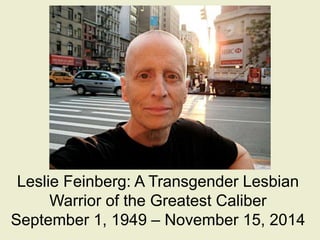
Leslie Feinberg: A Transgender Lesbian 
Warrior of the Greatest Caliber 
September 1, 1949 – November 15, 2014
QUESTIONS THAT A LGBTQ CRITIC ASKS 
1. How does the literary text illustrate the problematics of 
sexuality and sexual "identity," that is, the ways in 
which human sexuality does not fall neatly into the 
separate categories defined by the words homosexual 
and heterosexual? 
2. What elements in the text exist in the middle, between 
the perceived masculine/feminine binary? In other 
words, what elements exhibit traits of both? 
3. What elements of the text can be perceived as being 
masculine (active, powerful) and feminine (passive, 
marginalized) and how do the characters support these 
traditional roles?
PRESENTATION: 
STONE BUTCH BLUES 
 Stone Butch Blues (1993) is a legendary novel about a 
working class butch woman who struggles to find herself as 
she works in factories and blue collar jobs in the 1960s. Part 
autobiography, the book introduced Feinberg as a pivotal 
voice in the LGBT and has continued to be cited as one of 
the most important pieces of written work about lesbian 
women. 
 Leslie Feinberg, 65, passed away last Monday. Ze died from 
c omplications r elated to “multiple tic k -borne co-infections, 
including Lyme dis ease.” Her los s is a s ignificant marker in 
LGBTQ history. 
 Feinberg described hirself as a "white, working class, secular 
Jewish, transgender lesbian." Feinberg preferred the use of 
"ze/hir" pronouns. Feinberg's last words were reported by the 
Advocate to be "Remember me as a revolutionary 
communist .”
WHY DOES CONFORMITY MATTER? 
 “ I didn’t want to be different. I longed to be everything 
grownups wanted, so they would love me. I followed all 
their rules, tried my best to please. But there was 
something about me that made them knit their 
eyebrows and frown. No one ever offered a name for 
what was wrong with me. That’s what made me afraid it 
was really bad. I only came to recognize its melody 
through this constant refrain: “Is that a boy or a girl?”” 
(Feinberg 13) 
 “For a moment in that mirror I saw the woman I was 
growing up to be staring back at me. She looked scared 
and sad. I wondered if I was brave enough to grow up 
and be her.” (21) 
 “Whatever the world thought was wrong with me, I 
finally begun to agree they were right. Guilt burned like 
vomit in my throat.” (Feinberg 23)
WHY THE VIOLENCE? 
 “Par t of the nightmare was that it all s eemed s o matter of fac t. I 
c ouldn’t mak e it s top, I c ouldn’t es c ape it, and s o I pr etended it 
was n’t happening. I look ed at the s k y, at how pale and plac id it 
was. I imagined it was the ocean and the clouds were white - 
capped waves” ( 41). 
 “ I never told you what they did to us down ther e -queens in one 
tank, stone butches in the next -but you knew. One at a time they 
would drag our brothers out of the cells, slapping and punching 
them, locking the bars behind them fast in case we lost control 
and tr ied to s top them, as if we c ould. They’d handcuff a br other ’s 
wrists to his ankles or chain him, face against the bars. They 
made us watc h. Sometimes we’d c atch the eyes of the ter rorized 
victim, or the soon-to-be, c aught in the vis e of tor ture, and we’d 
s ay gently, “ I’m with you honey, look at me, it’s OK, we’ll tak e you 
home” (Feinberg 8). 
 “ They c uffed my hands s o tight behind my bac k I almost c r ied out. 
Then the cop unzipped his pants real slow, with a smirk on his 
face, and ordered me on my k nees” (10).
WHY THE CRUELTY? 
 “Either eat me or eat my s hit, bulldagger.” 
 “ I c alled him later that night and he r ac ed over. “ J ack s et 
yo u u p , J e ss.” […] I h a d tr o uble fo llowing wh a t Du ffy wa s 
s a yin g. It wa s n ’t ju s t th a t my min d wa s h a z y with p a in killers, 
I d id n ’t wa n t to u n d e rstand” ( 9 2). 
 “ ”You k now”, Duffy added, “ I don’t think I r eally r ealized how 
hard it is for you. I know what jerks the guys at work can be 
s ometimes.”……..”Bu t wh e n I we n t to th e h o s pita l with yo u , I 
s aw h ow th e y tr e ated yo u , h ow th e y ta lk e d a b o u t yo u ,” h e 
rubbed his face. When he looked back at me, I saw tears in 
h is e ye s . “ I fe lt s o h e lp le ss yo u k n ow? I k e p t ye llin g a t th em 
that you were a human being that you mattered, and it was 
lik e th e y we r e n’t lis te ning to me” ” (93).
WHAT’S THE DAMAGE? 
 “ I drifted in and out of consci o u s n es s. I rememb e r Theres a 
propping me up against a brick wall in the precinct parking lot and 
assessing the damage with her eyes. she chewed her lower lip and 
finger e d the blood y places on my shirt” (136) . 
 “ Jacqu e l i n e touche d my cheek. “Al’s right, really. It’s selfis h of us 
girls, I guess. We want you to be strong enough to survive the shit 
you take. We love how strong you are. But butches get the shit 
kicked out of their hearts too. And I guess we just sometimes wish 
there was a way to protect your hearts and keep you all tender for 
us, you know? ”” (37) 
 “Deep down, my insides seethed. I knew I was stone, too. It was a 
home alarm system that didn’t seem to have an on -off switch. Once 
instal led, the sirens went off and the gates shut, even if the 
intrud e r was lovin g” (94 ) 
 “The lonel iness became more and more unbearable. I ached to be 
touche d. I feared I was disap p e ar i n g and I’d cease to exist if 
someo n e didn’t touch me” (185).
HOW DOES JESS COPE? 
“This time I didn’t try to hide my excitement. I 
was passing.” (172) 
“At first, everything was fun. The world stopped 
feeling like a gauntlet I had to run through. But 
very quickly I discovered that passing didn’t just 
mean slipping below the surface, it meant being 
buried alive. I was still me inside, trapped in 
there with all my wounds and fears. But I was 
no longer me on the outside” (173). 
“I know the difference between what I can’t do 
and what I refuse to do!”
QHQ: FIRST HALF 
Q: What is the significance of Feinberg 
starting the novel with an intimate letter from 
Jess to Theresa? 
Q: Why is the ring so important to Jess? 
Q: If Jess hadn’t been confined to a Mental 
ward, how differently would the story have 
turned out?
QUESTIONS THAT A LGBTQ CRITIC ASKS 
1. How does the literary text illustrate the problematics of 
sexuality and sexual "identity," that is, the ways in 
which human sexuality does not fall neatly into the 
separate categories defined by the words homosexual 
and heterosexual? 
2. What elements in the text exist in the middle, between 
the perceived masculine/feminine binary? In other 
words, what elements exhibit traits of both? 
3. What elements of the text can be perceived as being 
masculine (active, powerful) and feminine (passive, 
marginalized) and how do the characters support these 
traditional roles?
Author Introduction: Bruce Coville 
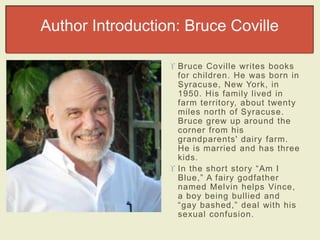
 Bruce Covil le writes books 
for children. He was born in 
Syracuse, New York, in 
1950. His family lived in 
farm territory, about twenty 
miles north of Syracuse. 
Bruce grew up around the 
corner from his 
grandparents' dairy farm. 
He is married and has three 
kids. 
 In the short story “Am I 
Blue,” A fairy godfat h er 
named Melvin helps Vince, 
a boy being bullied and 
“gay bashed ,” deal with his 
sexual confusion.
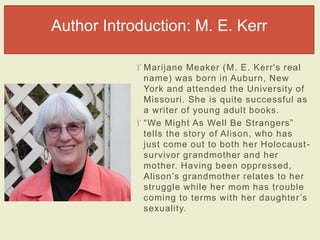
Author Introduction: M. E. Kerr 
 Marijane Meaker (M. E. Kerr's real 
name) was born in Auburn, New 
York and attended the University of 
Missouri. She is quite successful as 
a writer of young adult books. 
 “We Might As Well Be Str angers” 
tells the story of Alison, who has 
just come out to both her Holocaust - 
survivor grandmother and her 
mother. Having been oppressed, 
Alis on’s gr andmother r elates to her 
struggle while her mom has trouble 
c oming to terms with her daughter ’s 
sexuality.
Reading 
 “Am I Blue?” by Bruce Coville 
 “We Might As Well Be Strangers” by 
M.E. Kerr 
Post # 18 QHQ from either 
short story: Before 6 on 
Tuesday Night. No kidding.

Elit 10 class 18

  • 1.
  • 2.
    Discussion Stone ButchBlues Author Introductions: Bruce Coville M. E. Kerr AGENDA
  • 3.
    Leslie Feinberg: ATransgender Lesbian Warrior of the Greatest Caliber September 1, 1949 – November 15, 2014
  • 4.
    QUESTIONS THAT ALGBTQ CRITIC ASKS 1. How does the literary text illustrate the problematics of sexuality and sexual "identity," that is, the ways in which human sexuality does not fall neatly into the separate categories defined by the words homosexual and heterosexual? 2. What elements in the text exist in the middle, between the perceived masculine/feminine binary? In other words, what elements exhibit traits of both? 3. What elements of the text can be perceived as being masculine (active, powerful) and feminine (passive, marginalized) and how do the characters support these traditional roles?
  • 5.
    PRESENTATION: STONE BUTCHBLUES  Stone Butch Blues (1993) is a legendary novel about a working class butch woman who struggles to find herself as she works in factories and blue collar jobs in the 1960s. Part autobiography, the book introduced Feinberg as a pivotal voice in the LGBT and has continued to be cited as one of the most important pieces of written work about lesbian women.  Leslie Feinberg, 65, passed away last Monday. Ze died from c omplications r elated to “multiple tic k -borne co-infections, including Lyme dis ease.” Her los s is a s ignificant marker in LGBTQ history.  Feinberg described hirself as a "white, working class, secular Jewish, transgender lesbian." Feinberg preferred the use of "ze/hir" pronouns. Feinberg's last words were reported by the Advocate to be "Remember me as a revolutionary communist .”
  • 6.
    WHY DOES CONFORMITYMATTER?  “ I didn’t want to be different. I longed to be everything grownups wanted, so they would love me. I followed all their rules, tried my best to please. But there was something about me that made them knit their eyebrows and frown. No one ever offered a name for what was wrong with me. That’s what made me afraid it was really bad. I only came to recognize its melody through this constant refrain: “Is that a boy or a girl?”” (Feinberg 13)  “For a moment in that mirror I saw the woman I was growing up to be staring back at me. She looked scared and sad. I wondered if I was brave enough to grow up and be her.” (21)  “Whatever the world thought was wrong with me, I finally begun to agree they were right. Guilt burned like vomit in my throat.” (Feinberg 23)
  • 7.
    WHY THE VIOLENCE?  “Par t of the nightmare was that it all s eemed s o matter of fac t. I c ouldn’t mak e it s top, I c ouldn’t es c ape it, and s o I pr etended it was n’t happening. I look ed at the s k y, at how pale and plac id it was. I imagined it was the ocean and the clouds were white - capped waves” ( 41).  “ I never told you what they did to us down ther e -queens in one tank, stone butches in the next -but you knew. One at a time they would drag our brothers out of the cells, slapping and punching them, locking the bars behind them fast in case we lost control and tr ied to s top them, as if we c ould. They’d handcuff a br other ’s wrists to his ankles or chain him, face against the bars. They made us watc h. Sometimes we’d c atch the eyes of the ter rorized victim, or the soon-to-be, c aught in the vis e of tor ture, and we’d s ay gently, “ I’m with you honey, look at me, it’s OK, we’ll tak e you home” (Feinberg 8).  “ They c uffed my hands s o tight behind my bac k I almost c r ied out. Then the cop unzipped his pants real slow, with a smirk on his face, and ordered me on my k nees” (10).
  • 8.
    WHY THE CRUELTY?  “Either eat me or eat my s hit, bulldagger.”  “ I c alled him later that night and he r ac ed over. “ J ack s et yo u u p , J e ss.” […] I h a d tr o uble fo llowing wh a t Du ffy wa s s a yin g. It wa s n ’t ju s t th a t my min d wa s h a z y with p a in killers, I d id n ’t wa n t to u n d e rstand” ( 9 2).  “ ”You k now”, Duffy added, “ I don’t think I r eally r ealized how hard it is for you. I know what jerks the guys at work can be s ometimes.”……..”Bu t wh e n I we n t to th e h o s pita l with yo u , I s aw h ow th e y tr e ated yo u , h ow th e y ta lk e d a b o u t yo u ,” h e rubbed his face. When he looked back at me, I saw tears in h is e ye s . “ I fe lt s o h e lp le ss yo u k n ow? I k e p t ye llin g a t th em that you were a human being that you mattered, and it was lik e th e y we r e n’t lis te ning to me” ” (93).
  • 9.
    WHAT’S THE DAMAGE?  “ I drifted in and out of consci o u s n es s. I rememb e r Theres a propping me up against a brick wall in the precinct parking lot and assessing the damage with her eyes. she chewed her lower lip and finger e d the blood y places on my shirt” (136) .  “ Jacqu e l i n e touche d my cheek. “Al’s right, really. It’s selfis h of us girls, I guess. We want you to be strong enough to survive the shit you take. We love how strong you are. But butches get the shit kicked out of their hearts too. And I guess we just sometimes wish there was a way to protect your hearts and keep you all tender for us, you know? ”” (37)  “Deep down, my insides seethed. I knew I was stone, too. It was a home alarm system that didn’t seem to have an on -off switch. Once instal led, the sirens went off and the gates shut, even if the intrud e r was lovin g” (94 )  “The lonel iness became more and more unbearable. I ached to be touche d. I feared I was disap p e ar i n g and I’d cease to exist if someo n e didn’t touch me” (185).
  • 10.
    HOW DOES JESSCOPE? “This time I didn’t try to hide my excitement. I was passing.” (172) “At first, everything was fun. The world stopped feeling like a gauntlet I had to run through. But very quickly I discovered that passing didn’t just mean slipping below the surface, it meant being buried alive. I was still me inside, trapped in there with all my wounds and fears. But I was no longer me on the outside” (173). “I know the difference between what I can’t do and what I refuse to do!”
  • 11.
    QHQ: FIRST HALF Q: What is the significance of Feinberg starting the novel with an intimate letter from Jess to Theresa? Q: Why is the ring so important to Jess? Q: If Jess hadn’t been confined to a Mental ward, how differently would the story have turned out?
  • 12.
    QUESTIONS THAT ALGBTQ CRITIC ASKS 1. How does the literary text illustrate the problematics of sexuality and sexual "identity," that is, the ways in which human sexuality does not fall neatly into the separate categories defined by the words homosexual and heterosexual? 2. What elements in the text exist in the middle, between the perceived masculine/feminine binary? In other words, what elements exhibit traits of both? 3. What elements of the text can be perceived as being masculine (active, powerful) and feminine (passive, marginalized) and how do the characters support these traditional roles?
  • 13.
    Author Introduction: BruceCoville  Bruce Covil le writes books for children. He was born in Syracuse, New York, in 1950. His family lived in farm territory, about twenty miles north of Syracuse. Bruce grew up around the corner from his grandparents' dairy farm. He is married and has three kids.  In the short story “Am I Blue,” A fairy godfat h er named Melvin helps Vince, a boy being bullied and “gay bashed ,” deal with his sexual confusion.
  • 14.
    Author Introduction: M.E. Kerr  Marijane Meaker (M. E. Kerr's real name) was born in Auburn, New York and attended the University of Missouri. She is quite successful as a writer of young adult books.  “We Might As Well Be Str angers” tells the story of Alison, who has just come out to both her Holocaust - survivor grandmother and her mother. Having been oppressed, Alis on’s gr andmother r elates to her struggle while her mom has trouble c oming to terms with her daughter ’s sexuality.
  • 15.
    Reading  “AmI Blue?” by Bruce Coville  “We Might As Well Be Strangers” by M.E. Kerr Post # 18 QHQ from either short story: Before 6 on Tuesday Night. No kidding.