Theoretical Foundation of
Nursing
Nelia B. Perez, RN, PhD, DNS
History of Nursing Education
• Nursing is the protection, promotion, and
optimization of health and abilities,
prevention of illness and injury, alleviation
of suffering through diagnosis and
treatment of human response, and
advocacy in the care of individuals,
families, communities, and populations
Definition of Nursing
• Nursing encompasses autonomous and
collaborative care of individuals of all
ages, families, groups, and communities,
sick or well in all settings. Nursing
includes the promotion of health,
prevention of illness, and the care of ill,
disabled, and dying people (International
Council of Nurses, 2002).
Definition of Nursing
• Advocacy, promotion of a safe
environment, research, participation in
shaping health policy and in patient and
health systems management, and
education are also key nursing roles (ICN,
2002).
Definition of Nursing
• Nursing = Care of Others
• Blend of Art and Science
History of Nursing
• Ancient Civilizations through the
Renaissance
– Illness had supernatural causes
– Women delivered custodial care to family
– Medicine men treated disease
– As civilizations grew priests were seen as
physicians
– Under Christianity educated and wealthy
women dedicated themselves to care of
the sick
– Phoebe became the 1st Deaconess
• During the Crusades all-male military
orders flourished and all-female religious
orders declined
• During the Renaissance medicine moved
into the University
• Male nurses vanished from profession
• Home major locality for nursing care
• Only poor hospitalized, cared for by
prostitutes and female criminals
History of Nursing
• Colonialism and Revolution
– Physicians not required to have license
– Hospital care only available in cities
– Mentally ill “warehoused”
– More soldiers died in Revolutionary War due
to disease than wounds
History of Nursing
• Industrialization
– Population explosion
– Increased incidence illness, injury, and early
mortality
– Hospitals opened
– Schools of nursing started: Sisters of Charity,
Kaiserworth school of nursing in Germany
1836, Dr Joseph Warrington in Philadelphia
1839
History of Nursing
• Influence of War
– Crimean war, notable for Florence Nightingale
– American Civil War, emergence of early nursing
leaders
– Training for nurses more apprenticeship than
education, hospital-based schools of nursing
– WWI, female nurses under control of male hospital
administrators and physicians
– WWII, large # women working outside home
– Increased need for nurses
– Move into university and college settings
History of Nursing
• Influence of War
– Korean War, growth of AD programs in
community colleges
– Vietnam War, expansion civilian hospitals,
advancement of specialization
– Concept of nursing diagnosis
– Masters and PhD programs in nursing
Current Trends in Nursing
• Change in education, disappearance of hospital based
schools of nursing
• Nursing shortage
• Evidence-based practice
• Decreased hospital length of stay
• Community based nursing
• Aging population
• Increase in chronic health conditions
• Culturally competent nursing care
• Increase costs of health care/managed care
Major Factors to Evolution of
Nursing
• Industrial revolution
• Wars
• Closure of diploma programs
• Nursing shortage
• Movement from inpatient to outpatient
• Increasing costs of health care
Florence Nightingale
• Wealthy well-educated
• In Crimean War reduced soldiers mortality
from 42.7% to 2.2% in 6 months
• Established training school for nurses
• Wrote books about healthcare and nursing
education “Notes on Nursing”
Florence Nightingale
• 1st Nursing Theorist
• Nursing is separate and distinct from
medicine
• All women are natural nurses
• Emphasized importance of environment:
fresh air, cleanliness, nutrition
• Maintained accurate records, 1st Nursing
Researcher
Is Nursing a Profession?
• Well-defined body of specific and unique knowledge that undergoes
continual growth through research
• Services provided are vital to human beings and the welfare of
society
• Practitioners have autonomy and control their own policies and
activities
• Practitioners are motivated by the service they provide and consider
their work important to their lives (altruism)
• Practitioners decisions and conduct are guided by a code of ethics
• Professional organization sets standards
• Practitioners receive education in institutions of higher learning
Registered Nursing Education
• Diploma in Nursing
• Associate Degree in Nursing
• Baccalaureate in Nursing
• Direct entry Masters Degree in Nursing
• Advanced practice Masters in Nursing
• PhD in Nursing
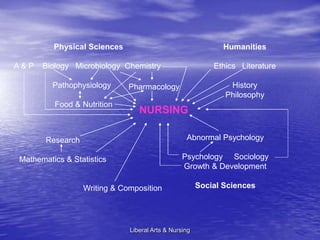
Liberal Arts & Nursing
NURSING
Physical Sciences
A & P Biology Microbiology Chemistry
Pathophysiology
Food & Nutrition
Abnormal Psychology
Psychology Sociology
Growth & Development
Social Sciences
Humanities
Ethics Literature
History
Philosophy
Pharmacology
Writing & Composition
Research
Mathematics & Statistics
Professional Nursing Organizations
• American Nurses Association (ANA):
establishes standards of practice,
encourages research to advance nursing
practice, and represents nursing for
legislative actions
• National Student Nurses’ Association
(NSNA)
– OSNA
Professional Nursing Organizations
• National League for Nursing (NLN): foster
development and improvement of nursing
education; voluntary accreditation
• American Association of Colleges of Nursing
(AACN): national accreditation for collegiate
nursing programs
• International Council of Nurses (ICN)
• Specialty Nursing Organizations: Sigma Theta
Tau International Honor Society of Nursing
Professional Organizations and
Nursing Process
• Term 1st used in 1955
• ANA Standards of Nursing Practice
• Canadian Nurses Association standard of
effective use of nursing process
• Joint Commission of Accreditation of Healthcare
Organizations requires care documentation
according to nursing process
• ANA recommends educational programs
incorporate nursing process
Day 1 TFN Lec.ppt

Day 1 TFN Lec.ppt

  • 1.
  • 2.
    History of NursingEducation • Nursing is the protection, promotion, and optimization of health and abilities, prevention of illness and injury, alleviation of suffering through diagnosis and treatment of human response, and advocacy in the care of individuals, families, communities, and populations
  • 3.
    Definition of Nursing •Nursing encompasses autonomous and collaborative care of individuals of all ages, families, groups, and communities, sick or well in all settings. Nursing includes the promotion of health, prevention of illness, and the care of ill, disabled, and dying people (International Council of Nurses, 2002).
  • 4.
    Definition of Nursing •Advocacy, promotion of a safe environment, research, participation in shaping health policy and in patient and health systems management, and education are also key nursing roles (ICN, 2002).
  • 5.
    Definition of Nursing •Nursing = Care of Others • Blend of Art and Science
  • 6.
    History of Nursing •Ancient Civilizations through the Renaissance – Illness had supernatural causes – Women delivered custodial care to family – Medicine men treated disease – As civilizations grew priests were seen as physicians – Under Christianity educated and wealthy women dedicated themselves to care of the sick – Phoebe became the 1st Deaconess
  • 7.
    • During theCrusades all-male military orders flourished and all-female religious orders declined • During the Renaissance medicine moved into the University • Male nurses vanished from profession • Home major locality for nursing care • Only poor hospitalized, cared for by prostitutes and female criminals
  • 8.
    History of Nursing •Colonialism and Revolution – Physicians not required to have license – Hospital care only available in cities – Mentally ill “warehoused” – More soldiers died in Revolutionary War due to disease than wounds
  • 9.
    History of Nursing •Industrialization – Population explosion – Increased incidence illness, injury, and early mortality – Hospitals opened – Schools of nursing started: Sisters of Charity, Kaiserworth school of nursing in Germany 1836, Dr Joseph Warrington in Philadelphia 1839
  • 10.
    History of Nursing •Influence of War – Crimean war, notable for Florence Nightingale – American Civil War, emergence of early nursing leaders – Training for nurses more apprenticeship than education, hospital-based schools of nursing – WWI, female nurses under control of male hospital administrators and physicians – WWII, large # women working outside home – Increased need for nurses – Move into university and college settings
  • 11.
    History of Nursing •Influence of War – Korean War, growth of AD programs in community colleges – Vietnam War, expansion civilian hospitals, advancement of specialization – Concept of nursing diagnosis – Masters and PhD programs in nursing
  • 12.
    Current Trends inNursing • Change in education, disappearance of hospital based schools of nursing • Nursing shortage • Evidence-based practice • Decreased hospital length of stay • Community based nursing • Aging population • Increase in chronic health conditions • Culturally competent nursing care • Increase costs of health care/managed care
  • 13.
    Major Factors toEvolution of Nursing • Industrial revolution • Wars • Closure of diploma programs • Nursing shortage • Movement from inpatient to outpatient • Increasing costs of health care
  • 14.
    Florence Nightingale • Wealthywell-educated • In Crimean War reduced soldiers mortality from 42.7% to 2.2% in 6 months • Established training school for nurses • Wrote books about healthcare and nursing education “Notes on Nursing”
  • 15.
    Florence Nightingale • 1stNursing Theorist • Nursing is separate and distinct from medicine • All women are natural nurses • Emphasized importance of environment: fresh air, cleanliness, nutrition • Maintained accurate records, 1st Nursing Researcher
  • 16.
    Is Nursing aProfession? • Well-defined body of specific and unique knowledge that undergoes continual growth through research • Services provided are vital to human beings and the welfare of society • Practitioners have autonomy and control their own policies and activities • Practitioners are motivated by the service they provide and consider their work important to their lives (altruism) • Practitioners decisions and conduct are guided by a code of ethics • Professional organization sets standards • Practitioners receive education in institutions of higher learning
  • 17.
    Registered Nursing Education •Diploma in Nursing • Associate Degree in Nursing • Baccalaureate in Nursing • Direct entry Masters Degree in Nursing • Advanced practice Masters in Nursing • PhD in Nursing
  • 18.
    Liberal Arts &Nursing NURSING Physical Sciences A & P Biology Microbiology Chemistry Pathophysiology Food & Nutrition Abnormal Psychology Psychology Sociology Growth & Development Social Sciences Humanities Ethics Literature History Philosophy Pharmacology Writing & Composition Research Mathematics & Statistics
  • 19.
    Professional Nursing Organizations •American Nurses Association (ANA): establishes standards of practice, encourages research to advance nursing practice, and represents nursing for legislative actions • National Student Nurses’ Association (NSNA) – OSNA
  • 20.
    Professional Nursing Organizations •National League for Nursing (NLN): foster development and improvement of nursing education; voluntary accreditation • American Association of Colleges of Nursing (AACN): national accreditation for collegiate nursing programs • International Council of Nurses (ICN) • Specialty Nursing Organizations: Sigma Theta Tau International Honor Society of Nursing
  • 21.
    Professional Organizations and NursingProcess • Term 1st used in 1955 • ANA Standards of Nursing Practice • Canadian Nurses Association standard of effective use of nursing process • Joint Commission of Accreditation of Healthcare Organizations requires care documentation according to nursing process • ANA recommends educational programs incorporate nursing process