FOUNDATION OF NURSING
NSC 211
AJAYI CROWTHER
INTRODUCTION TO NURSING
• Nursing is a profession within the health care sector.
• Nursing as a profession has existed throughout history, although it has evolved considerably over
time. In the current healthcare system, Nurses are one of the most trusted healthcare professionals
with a significant role to play in the treatment and medical care of the sick.
• It focused on the care of individuals, families and communities so they may attain, maintain or
recover optimal health and quality of life.
• Nurses may be differentiated from other health care professionals or providers by their approach of
care, training and the scope of practice.
INTRODUCTION TO NURSING
• Nursing profession is a learned profession that is both a science and an art.
• Nursing as a science requires a unified body of knowledge concerned with specific subject matter,
the skills and methodology necessary to provide such knowledge.
• Nursing as an art requires the application of the acquired knowledge and skill to bring about
desired results .i.e. application of knowledge or skill acquired as a Nurse to help individuals,
families, groups or communities maintain or achieve optimal health.
• Nursing is the oldest of the arts and the youngest of all medical professions.
WHAT IS NURSING?
• The term “Nurse” evolve from the Latin word nutrix, which means to nourish, nurture or cherish.
• Nursing is the largest, the most diverse, and one of the most respected of all the health care professions.
• Nursing refers to the process of caring for the health of human beings and assisting individuals in
meeting their needs while also teaching them the basics of caring for themselves.
• Nightingale defined Nursing over 100years ago as the “act of utilizing the environment of the patient to
assist him in his recovery”. (Florence Nightingale, 1860).
• Nursing encompasses autonomous and collaborative care of individuals of all ages, families, groups and
communities, sick or well and in all settings. Nursing includes the promotion of health, prevention of
illness and the care of ill, disables and dying people. (Short version definition by ICN).
WHAT IS NURSING?
• The unique function of nurses in caring for individuals, sick or well, is to assess their responses to
their health status and to assist them in the performance of those activities contributing to health or
recovery or to dignified death that they would perform unaided if they had the necessary strength, will
or knowledge, and to do this in such a way as to help them gain full or partial independence as rapidly
as possible. (Virginia Henderson, 1977).
• Nursing is the protection, promotion and optimization of health and abilities, prevention of illness and
injury, alleviation of suffering through the diagnosis and treatment of human response and advocacy in
the care of individuals, families, communities and populations. (American Nurses Association).
HISTORY OF NURSING
• The term nurse originates from the Latin word nutrix, which means to suckle. This is because it
referred primarily to a wet-nurse in the early days and only evolved into a person who cares for the
sick in the late 16th century.
EARLY HISTORY
• The first known documents that mention nursing as a profession were written approximately 300 AD.
In this period, the Roman Empire endeavored to build a hospital in each town that was under its rule,
leading to a high requirement for people ( “nurses”) to provide medical care alongside the doctors.
• The profession of nursing became considerably more prominent in Europe in the middle ages, due to
the drive for medical care from the Catholic church.
HISTORY OF NURSING CONT’D.
• During this period, there were many advancements and innovations that took place, which eventually
went on to form the base of modern nursing, as we know it.
• The first Spanish hospital was built in the late 500s to early 600s in Merida, Spain with the intent to care
for any sick individuals regardless of ethnic origin or religion. Several others were created in the
following centuries but their upkeep was neglected until Emperor Charlemagne began to restore them
and update the supplies and equipment in the 800s.
• Throughout the 10th and 11th centuries, the ‘Nursing profession’ expanded due to changes in rulings in
Europe. Hospitals began to be included as part of monasteries and other religious places and the ‘nurses’
provided a range of medical care services, as was required, even beyond traditional healthcare.
HISTORY OF NURSING CONT’D.
• This all-encompassing model gained popularity and continues to be responsible for the wide range of
duties a nurse is responsible for today.
• At the beginning of the 17th century, the nursing as a profession was rare due to various reasons, such as
the closing of monasteries that housed the hospitals. However, in some regions of Europe where the
Catholic church remained in power, the hospitals remained and caregivers (nurses) retained their role
MODERN NURSING
• Florence Nightingale was a nurse who tended to injured soldiers in the Crimean War in the 1850s and
played a significant role in changing the nature of the nursing profession in the 19th century.
• Although the origins of nursing predate the mid-19th century, the history of professional nursing
traditionally begins with Florence Nightingale.
HISTORY OF NURSING
• Nightingale, the well-educated daughter of wealthy British parents, defied social conventions and
decided to become a nurse.
• In 1854, Nightingale had the opportunity to test her beliefs during Britain’s Crimean War. Newspaper
stories reporting that sick and wounded Russian soldiers nursed by religious orders fared much better
than British soldiers inflamed public opinion.
• In response, she volunteered to care for the wounded soldiers and the British government asked her to
take a small group of people (‘nurses’) to the military hospital at Scutari .
• Within days of their arrival, Nightingale and her ‘nurses’ had reorganized the barracks hospital in
accordance with 19th-century science.
HISTORY OF NURSING CONT’D.
• They scrubbed the wall, windows opened for ventilation, nourishing food prepared and served, and
medications and treatments were efficiently administered.
• Within weeks death rates plummeted, and soldiers were no longer sickened by infectious diseases
arising from poor sanitary conditions.
• Within months a grateful public knew of the work of the “Lady with the Lamp,” who made nightly
rounds comforting the sick and wounded. By the end of the 19th century, the entire Western world
shared Nightingale’s belief in the worth of educated nurses.
• Nightingale’s achievements overshadowed other ways to nurse the sick.
• For centuries, most nursing of the sick had taken place at home and had been the responsibility of
families, friends, and respected community members with reputations as effective healers.
HISTORY OF NURSING CONT’D.
• During epidemics, such as cholera, typhus, and smallpox, men took on active nursing roles. For example,
Stephen Girard, a wealthy French-born banker, won the hearts of citizens of his adopted city of
Philadelphia for his courageous and compassionate nursing of the victims of the 1793 yellow fever.
• As urbanization and industrialization spread, those without families to care for them found themselves in
hospitals where the quality of nursing care varied enormously. Some patients received excellent care.
Women from religious nursing orders were particularly known for the quality of the nursing care they
provided in the hospitals they established.
• Other hospitals depended on recovering patients or hired men and women for the nursing care of patients.
Sometimes this care was excellent; other times it was deplorable and the unreliability of hospital-based
nursing care became a particular problem by the late 19th century, when changes in medical practices and
treatments required competent nurses.
HISTORY OF NURSING CONT’D.
• The convergence of hospitals’ needs, physicians’ wishes and women’s desire for meaningful work led to
a new health care professional: the trained nurse.
• Hospitals established their own training schools for nurses. In exchange for lectures and clinical
instructions, students provided the hospital with two or three years of skilled free Nursing care.
• This hospital-based educational model had significant long-term implications. It bound the education of
nurses to hospitals rather than colleges, a tie that was not definitively broken until the latter half of the
20th century.
• The hospital-based training model also reinforced segregation in society and in the health care system ,
F.I; African American student nurses were barred from almost all American hospitals & training schools.
HISTORY OF NURSING CONT’D.
• They could seek training only in schools established by African American hospitals. Most of all, the
hospital-based training model strengthened the cultural stereotyping of nursing as women’s work.
• Only a few hospitals provided training to maintain men’s traditional roles within nursing.
• Still, nurses transformed hospitals. In addition to the skilled, compassionate care they rendered to
patients, they established an orderly, routine, and systemized environment within which patients
healed.
• During this time, the role of nurses continued to expand due to the need for their presence on the front
lines of wars, where poor hygiene standards often led to fatal infections in the injuries. Nightingale
campaigned for improved hygiene standards in the hospital while attending to the wounded soldiers,
which drastically reduced the number of deaths from infections.
HISTORY OF NURSING CONT’D.
• The profession of nursing was pushed further forward in 1860 with the opening of the very first
Nursing school in London. This was the beginning of many other schools for new nurses so that they
received appropriate training and education before they began practice on the field.
• However, the need for nurses expanded with the world wars in the twentieth century, and many nurses
were required to begin providing care without adequate training. Since this time, education institutions
for nurses have continued to expand.
• The profession has also branched out into various specializations or specialties' with further education
in particular fields of nursing care, such as pediatrics or oncology etc.
• They attended to increasingly complicated diseases and administered treatments and medication
regimen.
HISTORY OF NURSING CONT’D.
• They maintained the aseptic and infection-control protocols that allowed more complex and invasive
surgeries to proceed. In addition, they experimented with different models of nursing interventions that
humanized increasingly technical and impersonal medical procedures.
• Outside hospitals, trained nurses quickly became critical in the fight against infectious diseases.
• In the early 20th century, the newly discovered “germ theory” of disease (the knowledge that many
illnesses were caused by bacteria) caused considerable alarm in countries around the world.
• Teaching methods of preventing the spread of diseases, such as tuberculosis, pneumonia, and influenza,
became the domain of the visiting nurses in the United States and the district nurses in the United
Kingdom and Europe.
HISTORY OF NURSING CONT’D.
• These nurses cared for infected patients in the patients’ homes and taught families and communities the
measures necessary to prevent spreading infection. They were particularly committed to working with
poor and immigrant communities, which often had little access to other health care services.
• The work of these nurses contributed to a dramatic decline in the mortality and morbidity rates from
infectious diseases for children and adults. At the same time, independent contractors called private-duty
nurses cared for sick individuals in their homes.
• The nurses performed important clinical work and supported families who had the financial resources to
afford care, but the unregulated health care labour market left them vulnerable to competition from both
untrained nurses and each year’s class of newly graduated trained nurses. Very soon, the supply of
private-duty nurses was greater than the demand from families.
HISTORY OF NURSING CONT’D.
• By the 20th century, nurses in industrialized countries began to establish professional associations to
set standards that differentiated the work of trained nurses from both assistive-nursing personnel and
untrained nurses. More important, they successfully sought licensing protection for the practice of
registered nursing.
• Later on, Nurses in some countries turned to collective bargaining and labour organizations to assist
them in asserting their and their patients’ rights to improve conditions and make quality nursing care
possible
• By the mid-1930s the increasing technological and clinical demands of patient care, the escalating
needs of patients for intensive nursing, and the resulting movement of such care out of homes and into
hospitals demanded hospital staffs of trained rather than student nurses.
HISTORY OF NURSING CONT’D.
• By the mid-1950s hospitals were the largest single employer of registered nurses. This trend continues,
although as changes in health care systems have reemphasized care at home, a proportionately greater
number of nurses work in outpatient clinics, home care, public health, and other community-based
health care organizations.
• Other important changes in nursing occurred during the latter half of the 20th century.
• The profession grew more diverse. For example, in the United States, the National Organization of
Coloured Graduate Nurses (NOCGN) capitalized on the acute shortage of nurses during World War II
and successfully pushed for the desegregation of both the military nursing corps and the nursing
associations.
• The American Nurses Association (ANA) desegregated in 1949, one of the first national professional
associations to do so. As a result, in 1951, feeling its goals fulfilled, the NOCGN dissolved.
HISTORY OF NURSING CONT’D.
• But by the late 1960s some African American nurses felt that the ANA had neither the time nor the
resources to adequately address all their concerns. The National Black Nurses Association (NBNA)
formed in 1971 as a parallel organization to the ANA.
• Nursing’s educational structure also changed. Dependence on hospital-based training schools declined
and those schools were replaced with college programs either in community or technical colleges or in
universities.
• In addition, more systematic and widespread programs of graduate education began to emerge.
• These programs prepare nurses not only for roles in management and education but also for roles as
clinical specialists and nurse practitioners.
HISTORY OF NURSING CONT’D.
• Nurses no longer had to seek doctoral degrees in fields other than nursing. By the 1970s nurses were
establishing their own doctoral programs, emphasizing the nursing knowledge and science and
research needed to address pressing nursing care and care-delivery issues.
• During the second half of the 20th century, nurses responded to rising numbers of sick patients with
innovative reorganizations of their patterns of care. For example, critical care units in hospitals began
when nurses started grouping their most critically ill patients together to provide more effective use of
modern technology.
• In addition, experiments with models of progressive patient care and primary nursing reemphasized
the responsibility of one nurse for one patient in spite of the often-overwhelming bureaucratic
demands by hospitals on nurses’ time.
HISTORY OF NURSING IN NIGERIA
• The history of Nursing and Midwifery Council of Nigeria has a lot in common with other allied professions,
particularly in the health industry except that it came into existence before most if not all of them.
• Indeed, Nursing was among the first five recognized and accepted professions in the colonial era, hence
recognition was transferred from the Home government. Nursing and Midwifery services were given prime
of place because of their relevance and direct impact to the life, health and well-being of the individual
family and community.
• Therefore, in the attempt to modernize Nursing Education and Practice in the colony at least to cope with the
developmental pace. The colonial Government decided to introduce, gradually, Nursing and Midwifery
education on a formal basis, to enable them render modern and scientific Nursing and Midwifery care to the
civil servants and their families.
HISTORY OF NURSING IN NIGERIA
• In 1930, the Midwives Ordinance which established the defunct Midwives Board was promulgated
to regulate Midwifery education and practice in Nigeria.
• In 1947, the Nursing Council of Nigeria was established by the Registration of Nurses Ordinance
of August 1947 to regulate and control the education and practice of Nursing in Nigeria.
• From the humble beginning through the pioneering Midwives Ordinance of 1930 with its major
Amendment known as the Midwives Act of 1966 to the first Nurses Ordinance of August 1947 and
series of Amendment, such as Ordinances of 1957, 1959, the Nurses Act, No. 2 of 1970; the Nurses
Amendment Act No. 30, of 20th July, 1974, what started as two separate bodies were merged
together into one big effective body by the enabling decree 89 of 1979.
HISTORY OF NURSING IN NIGERIA
• Since then it grew and developed more and more in status, functions and responsibilities as well as influence and
authority as one of the foremost statutory professional regulating body with the largest scope, jurisdiction and
professional personnel to control, supervise and regulate.
• The Nursing and Midwifery Council of Nigeria known as "The Council" is the only professional Council for all
grades and Cadres of Nurses and Midwives. It is the only legal and administrative, corporate and statutory body
charged with specific functions to perform on behalf of the Federal Government of Nigeria to ensure the delivery of
safe and effective Nursing and Midwifery care to the public.
• The Nursing profession also has been strengthened by its increasing emphasis on national and international work in
developing countries and by its advocacy of healthy and safe environments. The international scope of Nursing is
supported by the World Health Organization (WHO), which recognizes nursing as the backbone of most health care
systems around the world.
SCOPE OF NURSING PRACTICE
• According to the International Council of Nurses (ICN), the scope of Nursing practice “encompasses
autonomous and collaborative care of individuals of all ages, families, groups, and communities, sick or
well and in all settings.”
• National Nursing associations further clarify the scope of nursing practice by establishing particular
practice standards and codes of ethics.
• National and state agencies also regulate the scope of nursing practice. Together, these bodies set forth
legal parameters and guidelines for the practice of nurses as clinicians, educators, administrators, or
researchers and education for Nursing practice
• Nurses enter practice as generalists. They care for individuals and families of all ages in homes,
hospitals, schools, long-term-care facilities, outpatient clinics, and medical offices.
SCOPE OF NURSING CONT’D.
• Many countries require three to four years of education at the university level for generalist practice, although
variations exist. For example, in the United States, nurses can enter generalist practice through a two-year program
in a community college or a four-year program in a college or university
• Preparation for specialization in nursing or advanced Nursing practice usually occurs at the Master’s level.
University degree in Nursing is required for entrance to Master’s programs.
• These programs emphasize the assessment and management of illnesses, pharmacology, health education, and
supervised practice in specialty fields, such as pediatrics, mental health, women’s health, community health, or
geriatrics.
• Research preparation in Nursing takes place at the doctoral level.
• Coursework emphasizes Nursing knowledge and science and research methods.
• An original and substantive research study is required for completion of the doctoral degree.
TRENDS IN NURSING
• Each year, we see new trends emerge in Nursing from changes in patient population, legislation
and regulations to changing technologies amongst others.
• Nursing professionals are typically exposed to the most change as they are navigating the front
lines of patient care.
• Nursing is a profession that evolve and progress at a rapid pace based on the ever changing needs
of the health care consumers, technology and the daily influx of innovations of the 21st
century.
• The current trends in Nursing are multifactorial and it includes the following;
TRENDS IN NURSING CONTD.,
 TRANSITION TO INFORMATICS
As technology produces more data, supports better record-keeping and allows for detailed analysis,
health informatics has become increasingly important in health care.
Similarly, the field of Nursing informatics is emerging, supporting evidence-based Nursing practice
and improved patient care through better data collection, information analysis, easier and faster
collaboration between health care professionals and identification of both large and small scale health
and patient trends.
As they are situated on the front line of patient care, Nurse informaticists are especially suited for
playing a greater role in health care planning and decision-making.
TRENDS IN NURSING CONTD.,
 SHORTAGE OF NURSES/ HIGH DEMAND OF NURSES GLOBALLY
There has been an acute shortage of Nurses across the globe with increasing world population, higher life
expectancy due to improved health care and low output of Nursing training institutions making the gap in
Nurse-population ratio remains wide and never stops increasing.
 HIGHER DEGREES REQUIRED
As more hospitals and healthcare institutions strive for magnet status, they require more of their nurses to be
at least BNSc prepared.
The overarching emphasis on use of specific frameworks in guiding of Nursing practice, including
integration of evidence based practice has made the demand for higher degrees more pressing in Nursing
today.
TRENDS IN NURSING CONTD.,
 MASSIVE INCREASE IN ONLINE TRAINING
Most universities in Nigeria have responded to the call for more Nurses with higher degree and better
educational preparedness by increasing their online courses for Nursing programs that provide
Registered Nurses (RN) to BNSc degrees.
 LONG DISTANCE NURSING CARE (TELENURSING)
One of the newest way of caring for patients or clients is Telemedicine or Telenursing.
Telenursing refers to the use of information technology in the provision of nursing services whenever
physical distance exists between patient and nurse.
It is a part of telemedicine and has many points of contacts with other medical and non-medical
applications, such as telediagnosis, teleconsultation, and telemonitoring etc.
TRENDS IN NURSING CONTD.,
 LONG DISTANCE NURSING CARE CONT’D.
Telenursing is growing in many countries because of the preoccupation in driving down the costs of health
care, an increase in the number of aging and chronically ill population and the increase in coverage of health
care to distant in rural, small or sparsely populated regions.
Among its many benefits, telenursing may help solve problems like;
 increasing shortages of nurses
 reduce distances and save travel time
 keep patients out of hospital.
A greater degree of job satisfaction has been registered among telenurses
CONCEPT OF NURSING PRACTICE
• Concepts are the building blocks of theory. They are abstract ideas or mental images of
phenomena.
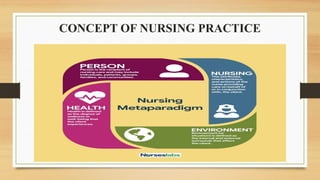
• The nursing profession is built upon four (4) key concepts: person, environment, health and
nursing.
• These four concepts encompasses the key tenets of Nursing philosophy and practice and define the
means by which individuals should be viewed and treated within the Nursing profession.
• The four concepts are interrelated and each is built upon the foundation of the concept that
precedes it.
CONCEPT OF NURSING PRACTICE
CONCEPT OF NURSING PRACTICE CONT’D.
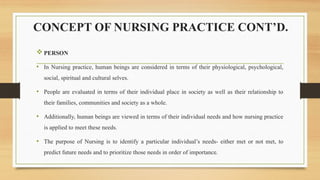
 PERSON
• In Nursing practice, human beings are considered in terms of their physiological, psychological,
social, spiritual and cultural selves.
• People are evaluated in terms of their individual place in society as well as their relationship to
their families, communities and society as a whole.
• Additionally, human beings are viewed in terms of their individual needs and how nursing practice
is applied to meet these needs.
• The purpose of Nursing is to identify a particular individual’s needs- either met or not met, to
predict future needs and to prioritize those needs in order of importance.
CONCEPT OF NURSING PRACTICE CONT’D.
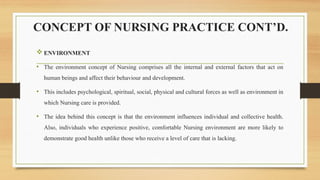
 ENVIRONMENT
• The environment concept of Nursing comprises all the internal and external factors that act on
human beings and affect their behaviour and development.
• This includes psychological, spiritual, social, physical and cultural forces as well as environment in
which Nursing care is provided.
• The idea behind this concept is that the environment influences individual and collective health.
Also, individuals who experience positive, comfortable Nursing environment are more likely to
demonstrate good health unlike those who receive a level of care that is lacking.
CONCEPT OF NURSING PRACTICE CONT’D.
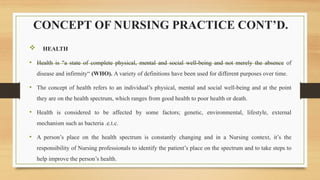
 HEALTH
• Health is "a state of complete physical, mental and social well-being and not merely the absence of
disease and infirmity“ (WHO). A variety of definitions have been used for different purposes over time.
• The concept of health refers to an individual’s physical, mental and social well-being and at the point
they are on the health spectrum, which ranges from good health to poor health or death.
• Health is considered to be affected by some factors; genetic, environmental, lifestyle, external
mechanism such as bacteria .e.t.c.
• A person’s place on the health spectrum is constantly changing and in a Nursing context, it’s the
responsibility of Nursing professionals to identify the patient’s place on the spectrum and to take steps to
help improve the person’s health.
CONCEPT OF NURSING PRACTICE CONT’D.
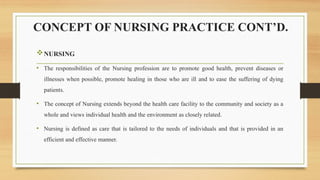
NURSING
• The responsibilities of the Nursing profession are to promote good health, prevent diseases or
illnesses when possible, promote healing in those who are ill and to ease the suffering of dying
patients.
• The concept of Nursing extends beyond the health care facility to the community and society as a
whole and views individual health and the environment as closely related.
• Nursing is defined as care that is tailored to the needs of individuals and that is provided in an
efficient and effective manner.