decision factors
new research from
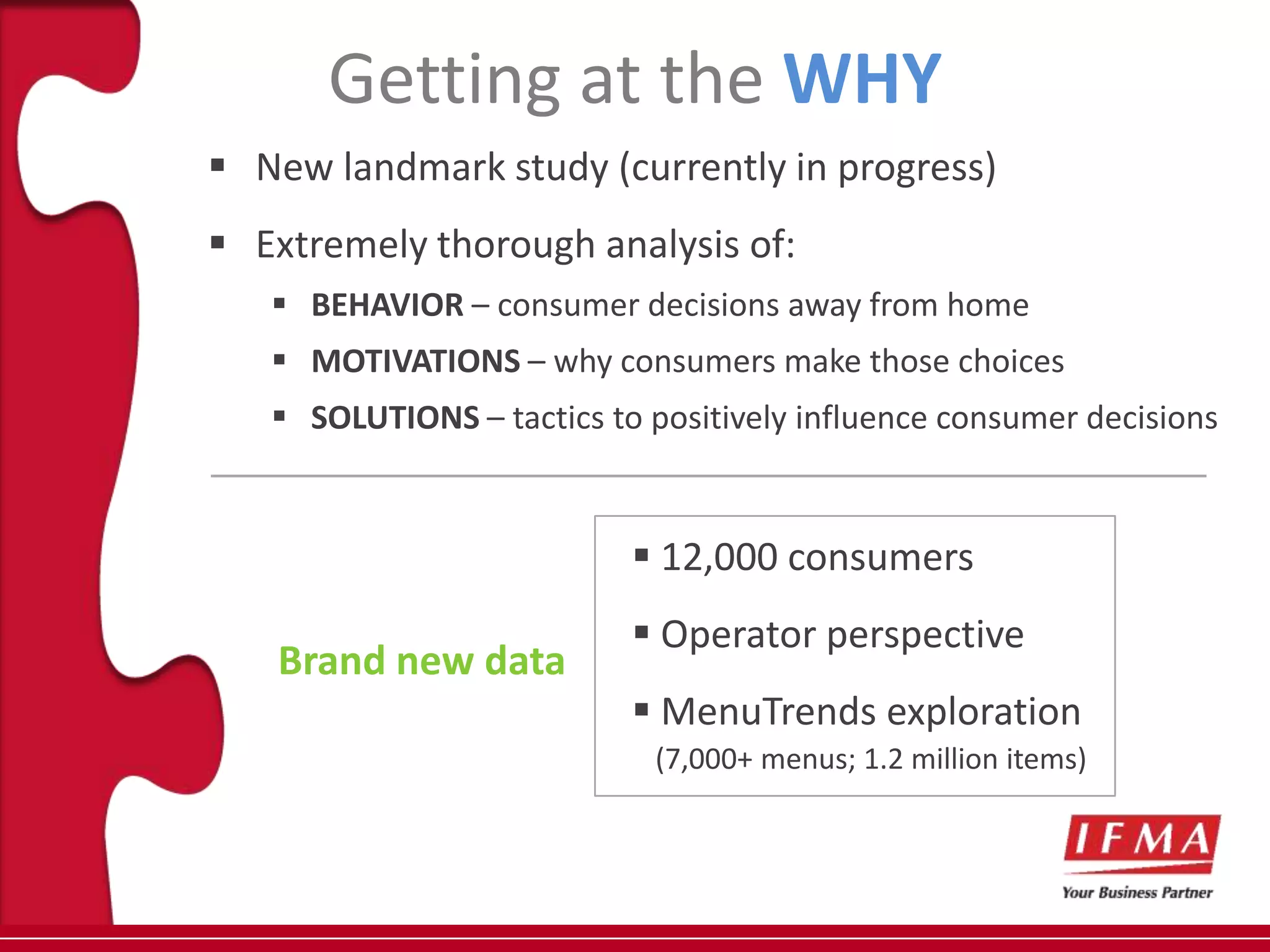
Getting at the WHY
 New landmark study (currently in progress)
 Extremely thorough analysis of:
    BEHAVIOR – consumer decisions away from home
    MOTIVATIONS – why consumers make those choices
    SOLUTIONS – tactics to positively influence consumer decisions


                            12,000 consumers
                            Operator perspective
   Brand new data
                            MenuTrends exploration
                            (7,000+ menus; 1.2 million items)
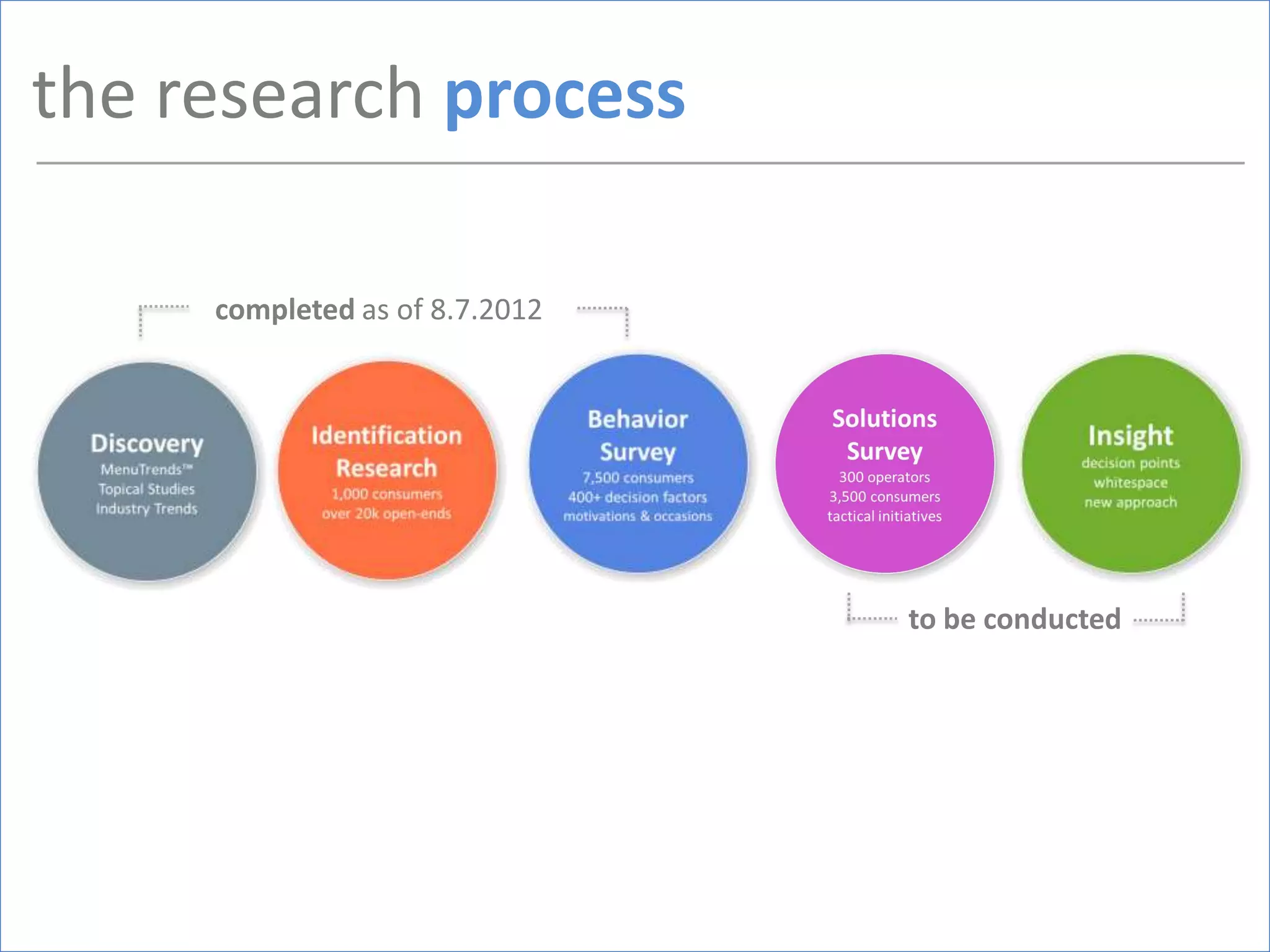
the research process

     completed as of 8.7.2012


                                to be conducted
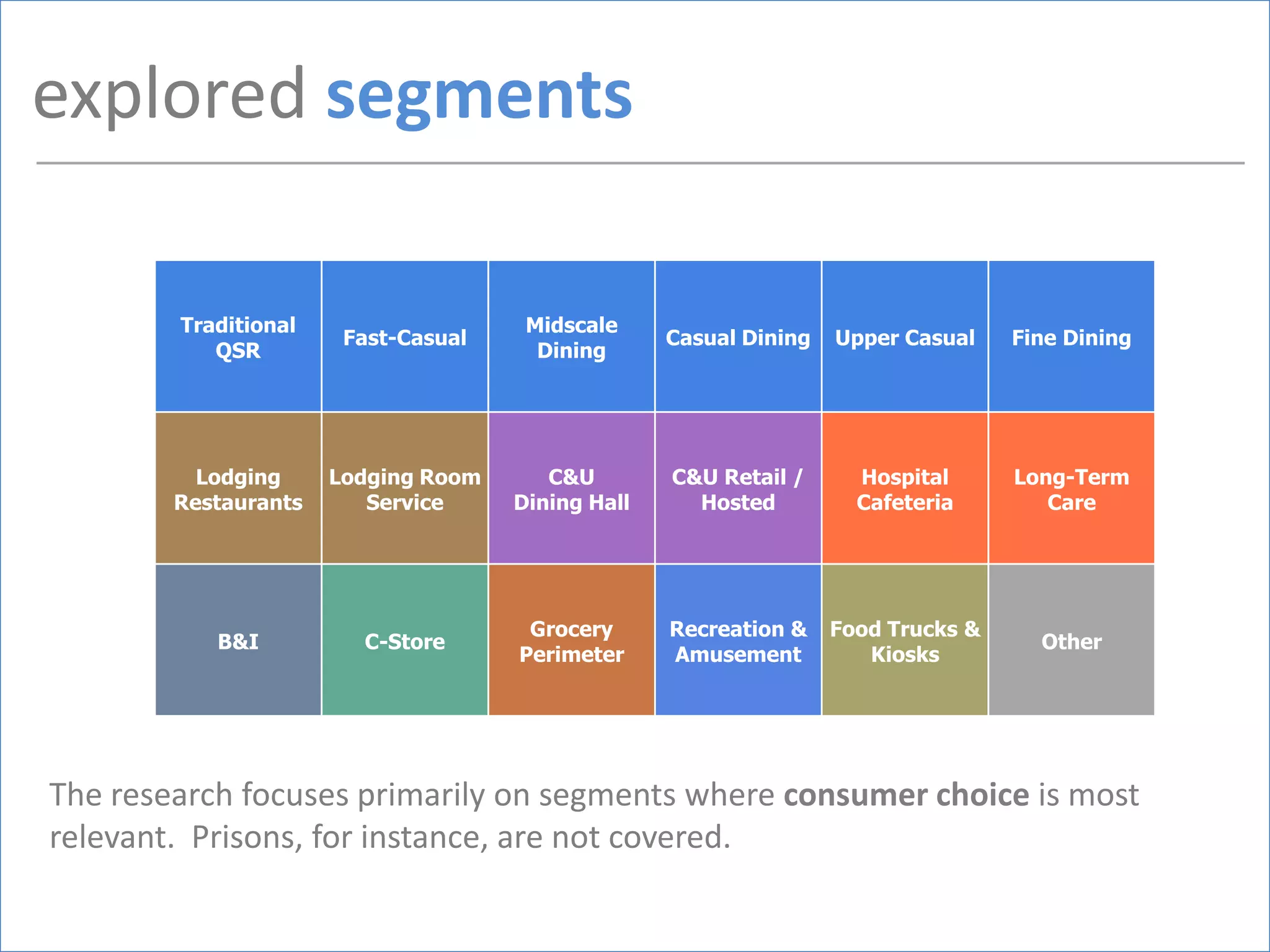
explored segments

        Traditional                   Midscale
                       Fast-Casual                 Casual Dining   Upper Casual    Fine Dining
           QSR                         Dining


          Lodging     Lodging Room      C&U        C&U Retail /      Hospital      Long-Term
        Restaurants      Service     Dining Hall     Hosted          Cafeteria        Care


                                      Grocery      Recreation &    Food Trucks &
           B&I          C-Store                                                      Other
                                     Perimeter     Amusement          Kiosks


The research focuses primarily on segments where consumer choice is most
relevant. Prisons, for instance, are not covered.
Guided by a special research committee
  IFMA CONSUMER PLANNING PROGRAM
   Bill McClellan, Dawn Food Products (Chair)
   Rick Kirkpatrick, Sweet Street Desserts (Vice Chair)

  SPECIAL RESEARCH COMMITTEE
   Nelly Bentz, Heinz North America
   Andrea Hickman, McCain Foods
   Bernie McGorry, Dawn Food Products
   Mike Stammer, Hillshire Brands
   Donna Surma, Basic American Foods
   Devon Gerchar, IFMA
   Jim Green, IFMA
These pages feature just a short sneak peak
            of this new landmark research.
        For more information about the study, please contact IFMA.
how and why consumers
venue decisions   choose WHERE to eat
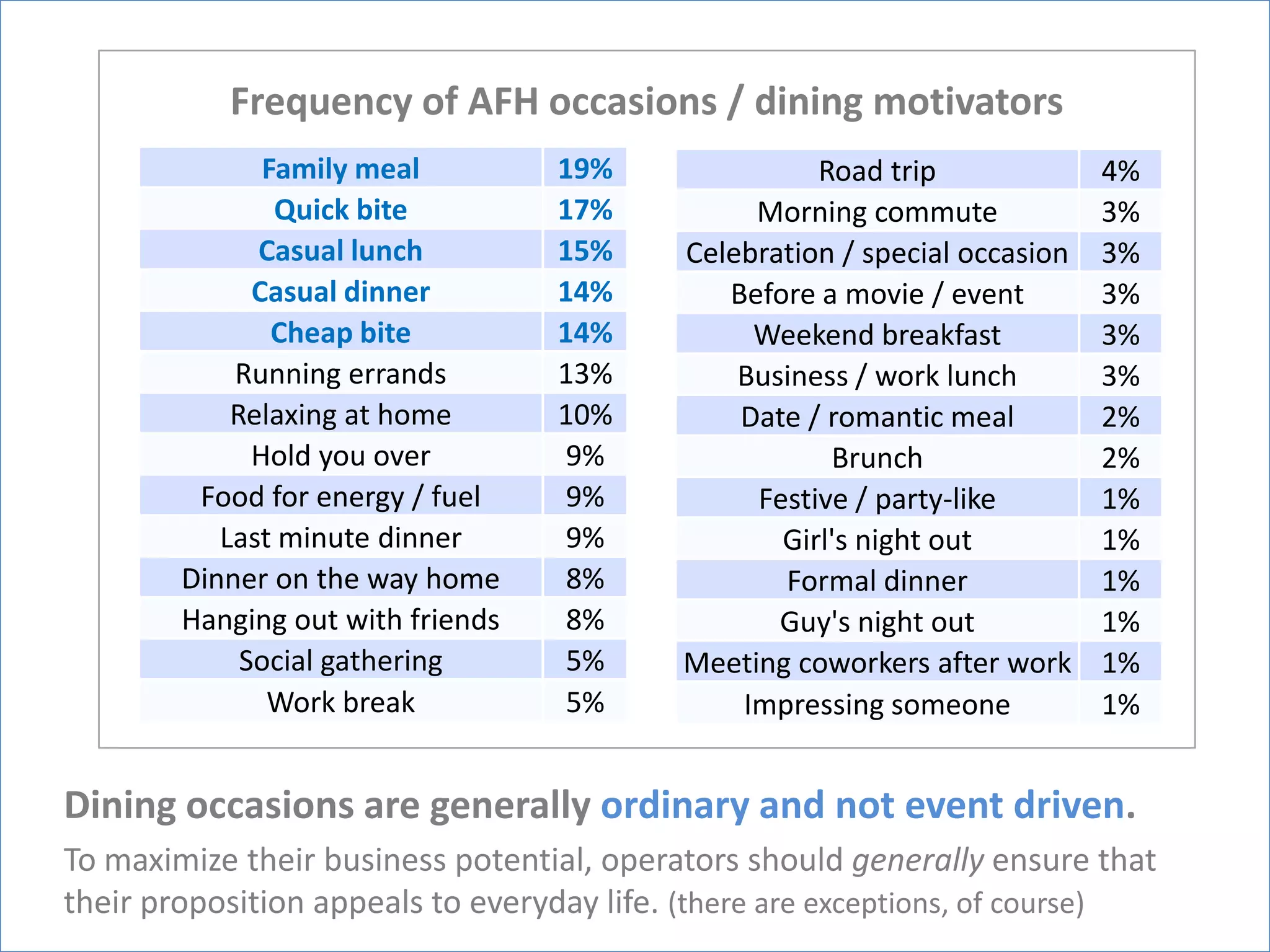
Frequency of AFH occasions / dining motivators
               Family meal         19%               Road trip              4%
                Quick bite         17%          Morning commute             3%
              Casual lunch         15%     Celebration / special occasion   3%
              Casual dinner        14%        Before a movie / event        3%
                Cheap bite         14%          Weekend breakfast           3%
            Running errands        13%         Business / work lunch        3%
            Relaxing at home       10%         Date / romantic meal         2%
              Hold you over         9%                Brunch                2%
         Food for energy / fuel     9%          Festive / party-like        1%
           Last minute dinner       9%            Girl's night out          1%
        Dinner on the way home      8%            Formal dinner             1%
        Hanging out with friends    8%            Guy's night out           1%
             Social gathering       5%     Meeting coworkers after work     1%
               Work break           5%         Impressing someone           1%


Dining occasions are generally ordinary and not event driven.
To maximize their business potential, operators should generally ensure that
their proposition appeals to everyday life. (there are exceptions, of course)
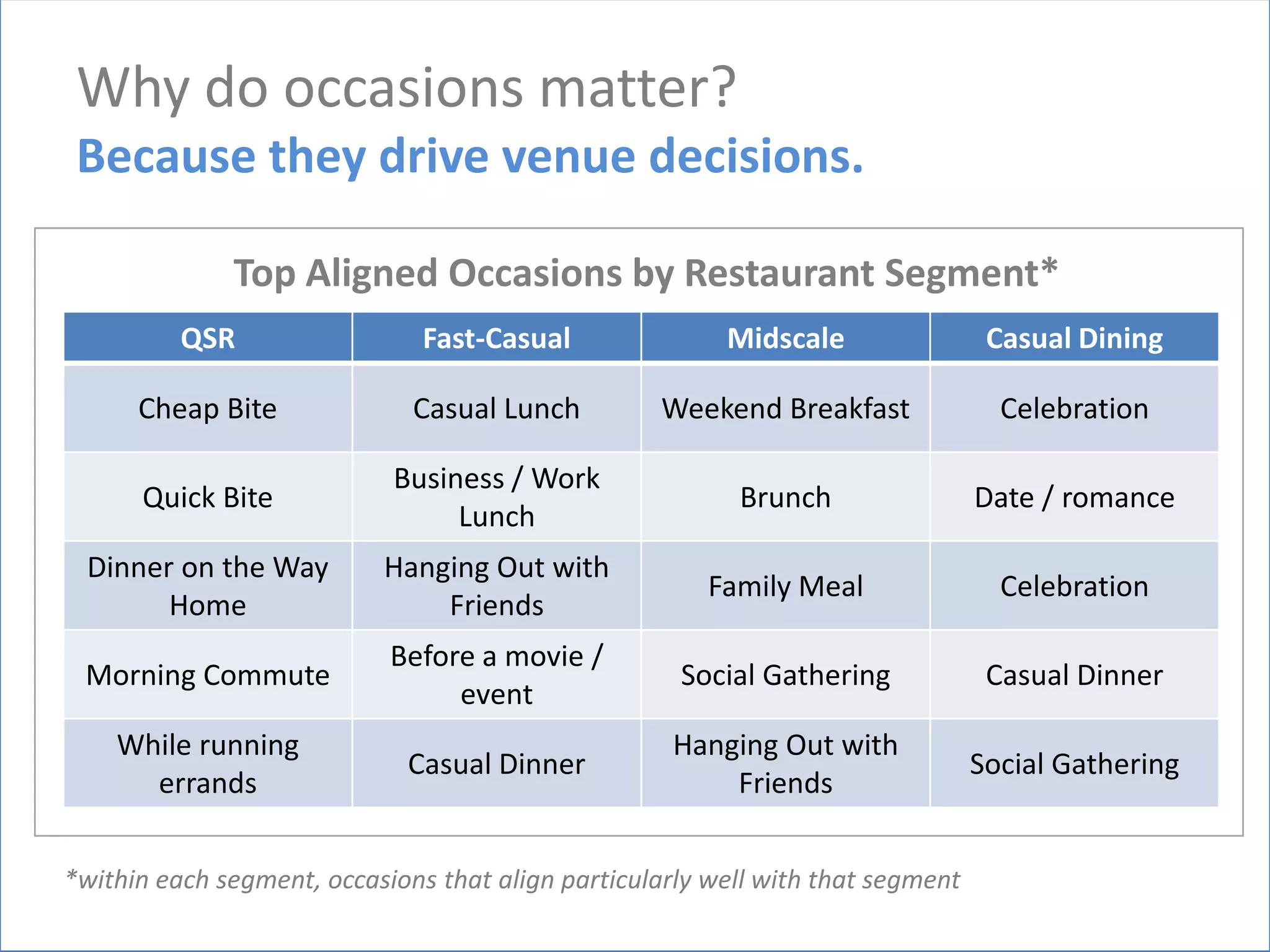
Why do occasions matter?
 Because they drive venue decisions.

              Top Aligned Occasions by Restaurant Segment*
          QSR                  Fast-Casual               Midscale                 Casual Dining

      Cheap Bite              Casual Lunch         Weekend Breakfast               Celebration

                            Business / Work
      Quick Bite                                          Brunch                 Date / romance
                                 Lunch
  Dinner on the Way        Hanging Out with
                                                        Family Meal                Celebration
        Home                   Friends
                            Before a movie /
 Morning Commute                                     Social Gathering             Casual Dinner
                                 event
    While running                                   Hanging Out with
                             Casual Dinner                                       Social Gathering
      errands                                           Friends


*within each segment, occasions that align particularly well with that segment
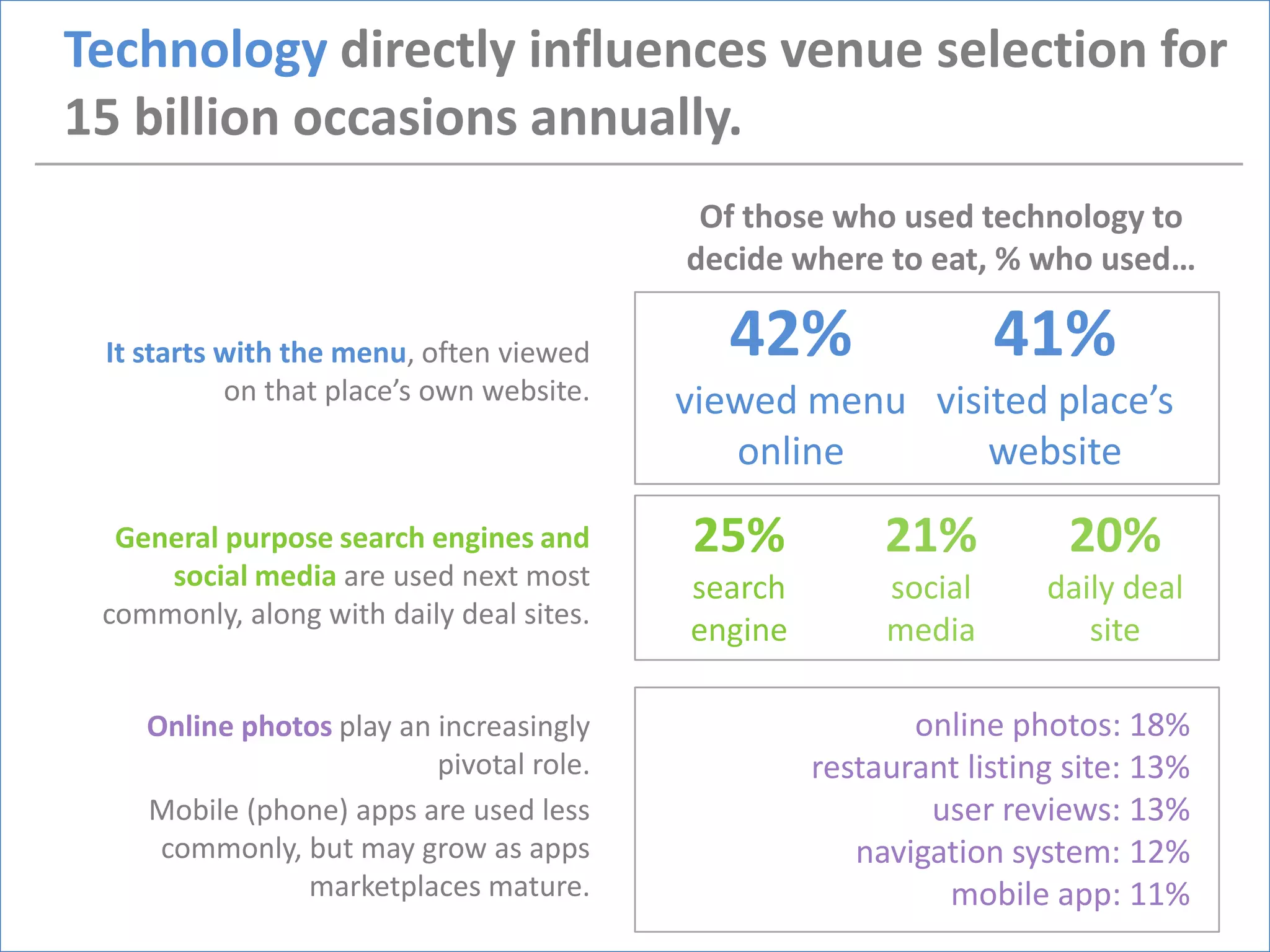
Technology directly influences venue selection for
15 billion occasions annually.
                                           Of those who used technology to
                                          decide where to eat, % who used…

 It starts with the menu, often viewed      42%                  41%
           on that place’s own website.   viewed menu visited place’s
                                             online       website
  General purpose search engines and      25%           21%           20%
     social media are used next most      search        social      daily deal
 commonly, along with daily deal sites.
                                          engine        media          site

    Online photos play an increasingly                    online photos: 18%
                          pivotal role.            restaurant listing site: 13%
    Mobile (phone) apps are used less                      user reviews: 13%
     commonly, but may grow as apps                   navigation system: 12%
               marketplaces mature.                         mobile app: 11%
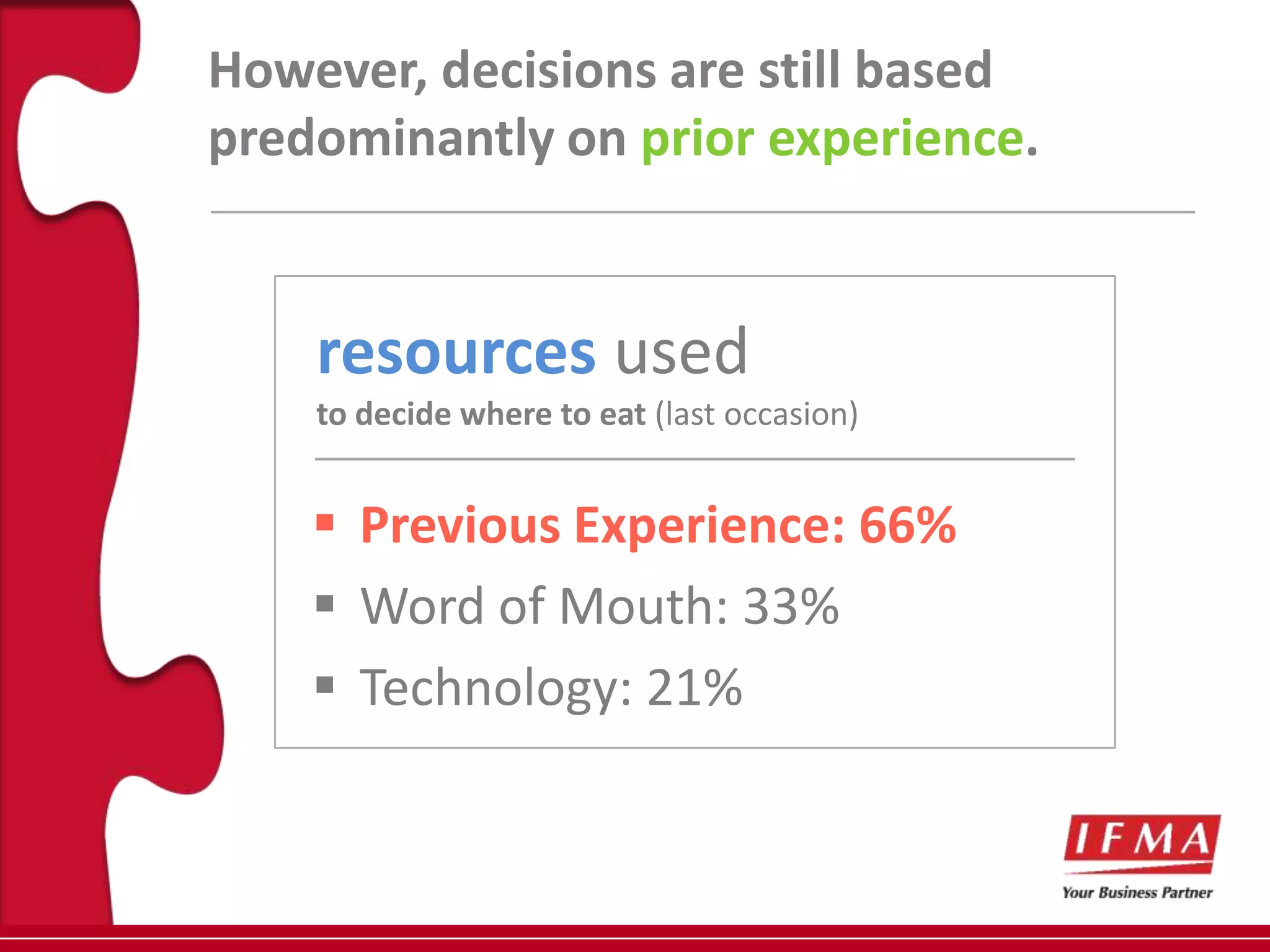
However, decisions are still based
predominantly on prior experience.


    resources used
    to decide where to eat (last occasion)


     Previous Experience: 66%
     Word of Mouth: 33%
     Technology: 21%
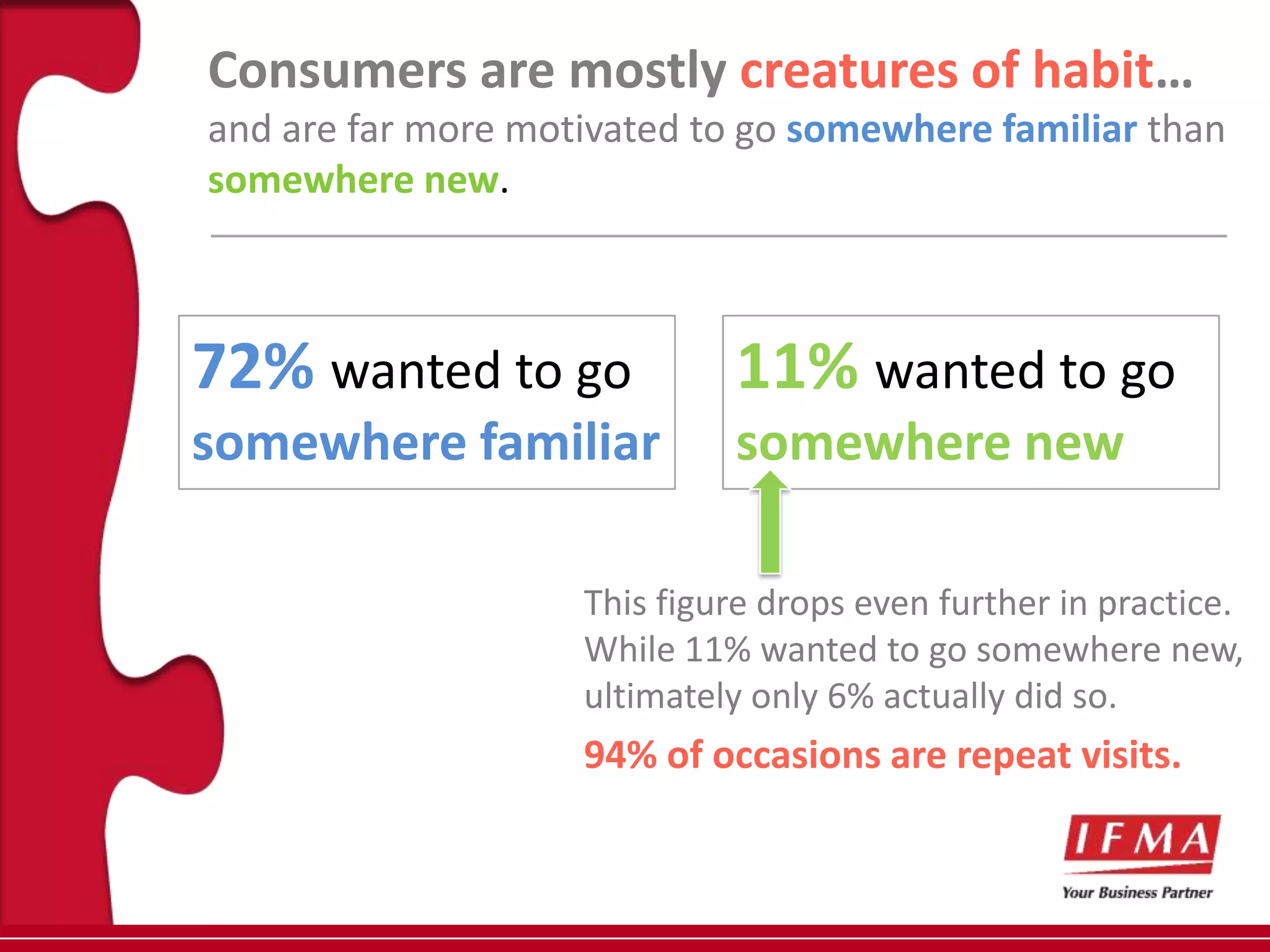
Consumers are mostly creatures of habit…
and are far more motivated to go somewhere familiar than
somewhere new.


72% wanted to go             11% wanted to go
somewhere familiar           somewhere new

                    This figure drops even further in practice.
                    While 11% wanted to go somewhere new,
                    ultimately only 6% actually did so.
                    94% of occasions are repeat visits.
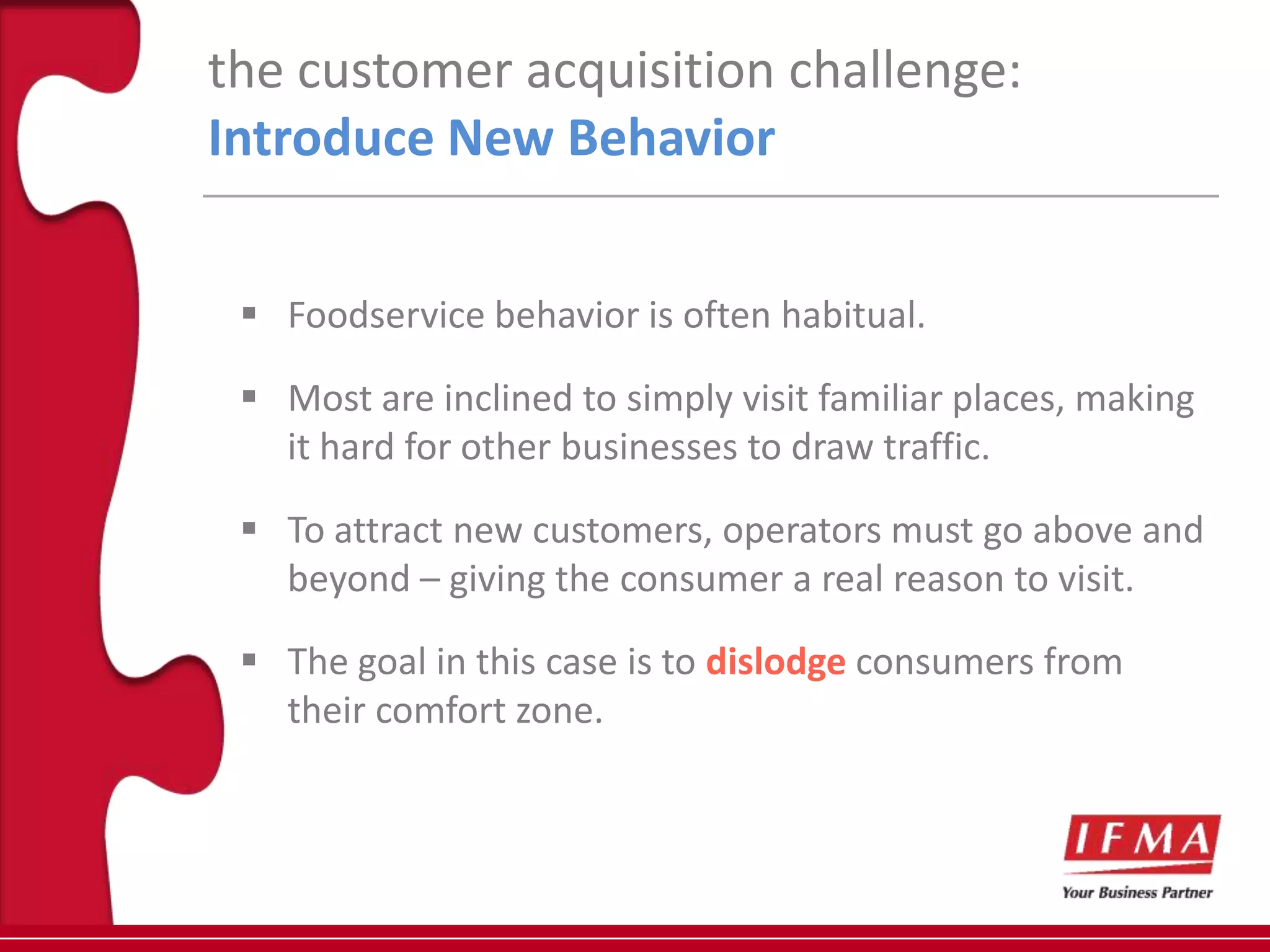
the customer acquisition challenge:
Introduce New Behavior


  Foodservice behavior is often habitual.

  Most are inclined to simply visit familiar places, making
   it hard for other businesses to draw traffic.

  To attract new customers, operators must go above and
   beyond – giving the consumer a real reason to visit.

  The goal in this case is to dislodge consumers from
   their comfort zone.
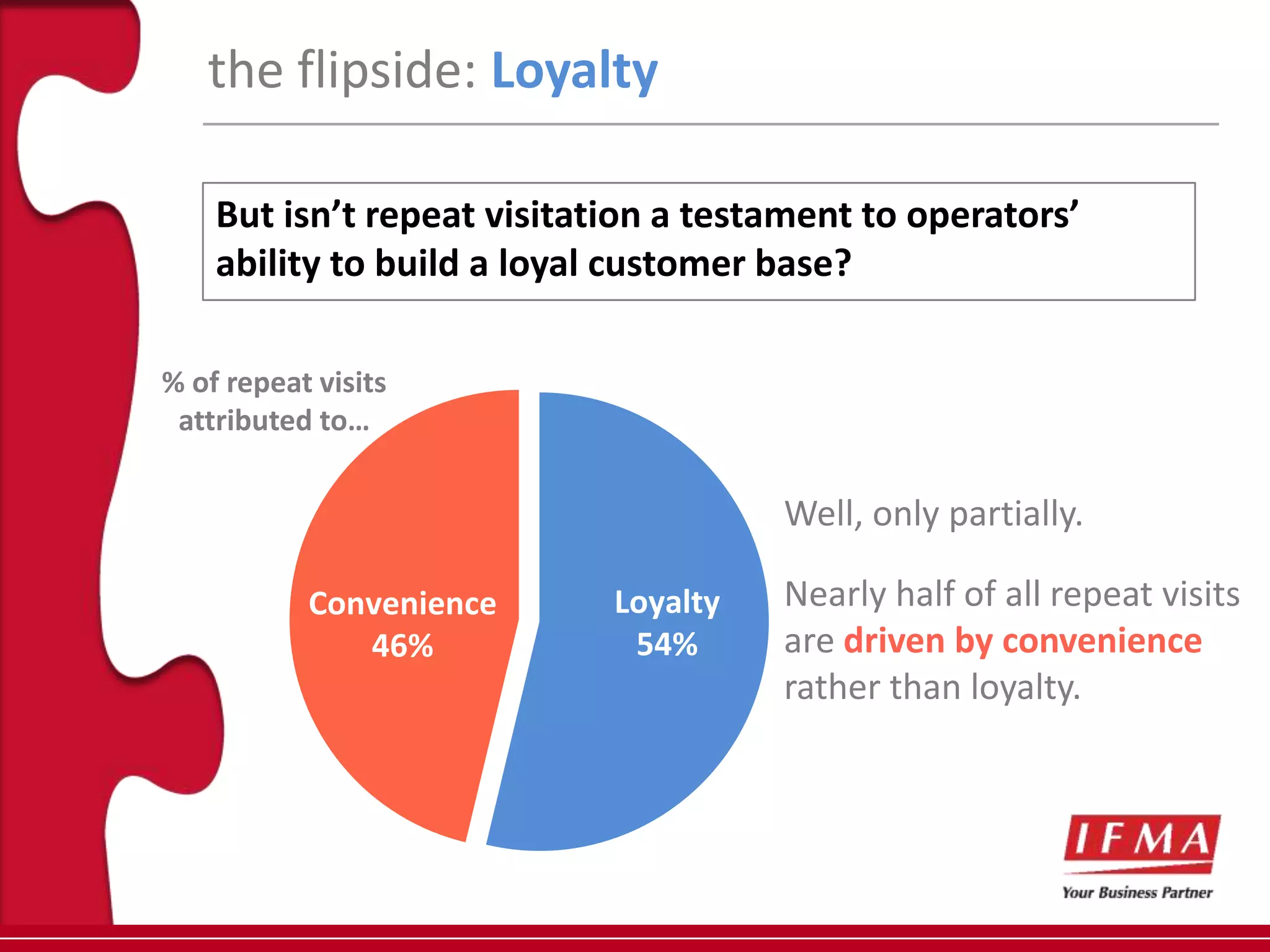
the flipside: Loyalty

    But isn’t repeat visitation a testament to operators’
    ability to build a loyal customer base?

% of repeat visits
 attributed to…

                                      Well, only partially.

           Convenience      Loyalty   Nearly half of all repeat visits
              46%            54%      are driven by convenience
                                      rather than loyalty.
True loyalty is more common to certain industry segments.
Fast-casuals, for instance, draw far more loyalty traffic than do QSRs.

             Fine Dining                                          80%

           Upper Casual                                      75%

             Fast Casual                                    73%

          Casual Dining                               64%

                Delivery                              62%

            Coffee Shop                             59%

       Buffet Restaurant                            58%

               Midscale                             58%

       Supermarket deli                         53%
                                                                  [repeat visits]
                    QSR                       48%
                                                             % visiting out of
                C-Store                 40%

               Cafeteria    18%
                                                                   LOYALTY
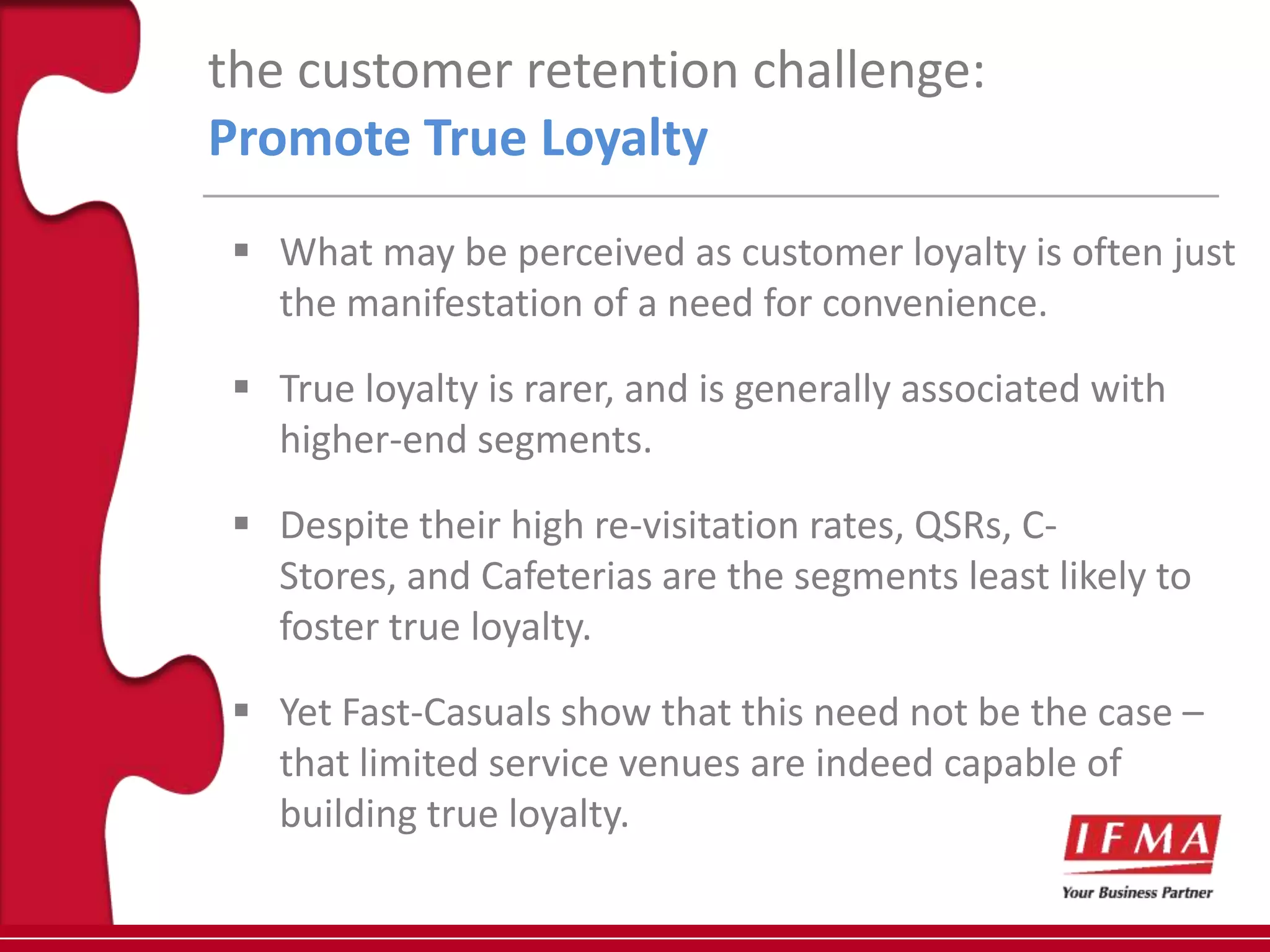
the customer retention challenge:
Promote True Loyalty
  What may be perceived as customer loyalty is often just
   the manifestation of a need for convenience.

  True loyalty is rarer, and is generally associated with
   higher-end segments.

  Despite their high re-visitation rates, QSRs, C-
   Stores, and Cafeterias are the segments least likely to
   foster true loyalty.

  Yet Fast-Casuals show that this need not be the case –
   that limited service venues are indeed capable of
   building true loyalty.
how and why consumers
menu decisions   choose WHAT to eat
a little context about the menu


   Following several years of
                                                         97.9
 increase, average menu size                                       96.4       96.1
 began to decrease following
 2008’s economic downturn.                                                              93.4        93.3
                                                92.6
   During this time, operators           90.3
    became more guarded in
their approach to introducing                             Average Menu Size
   new items – often favoring                              (items per menu)
  nostalgic old-time favorites.   82.3                 [excludes beverages; “all day menus” only]


                                  2005 2006 2007 2008 2009 2010 2011 2012
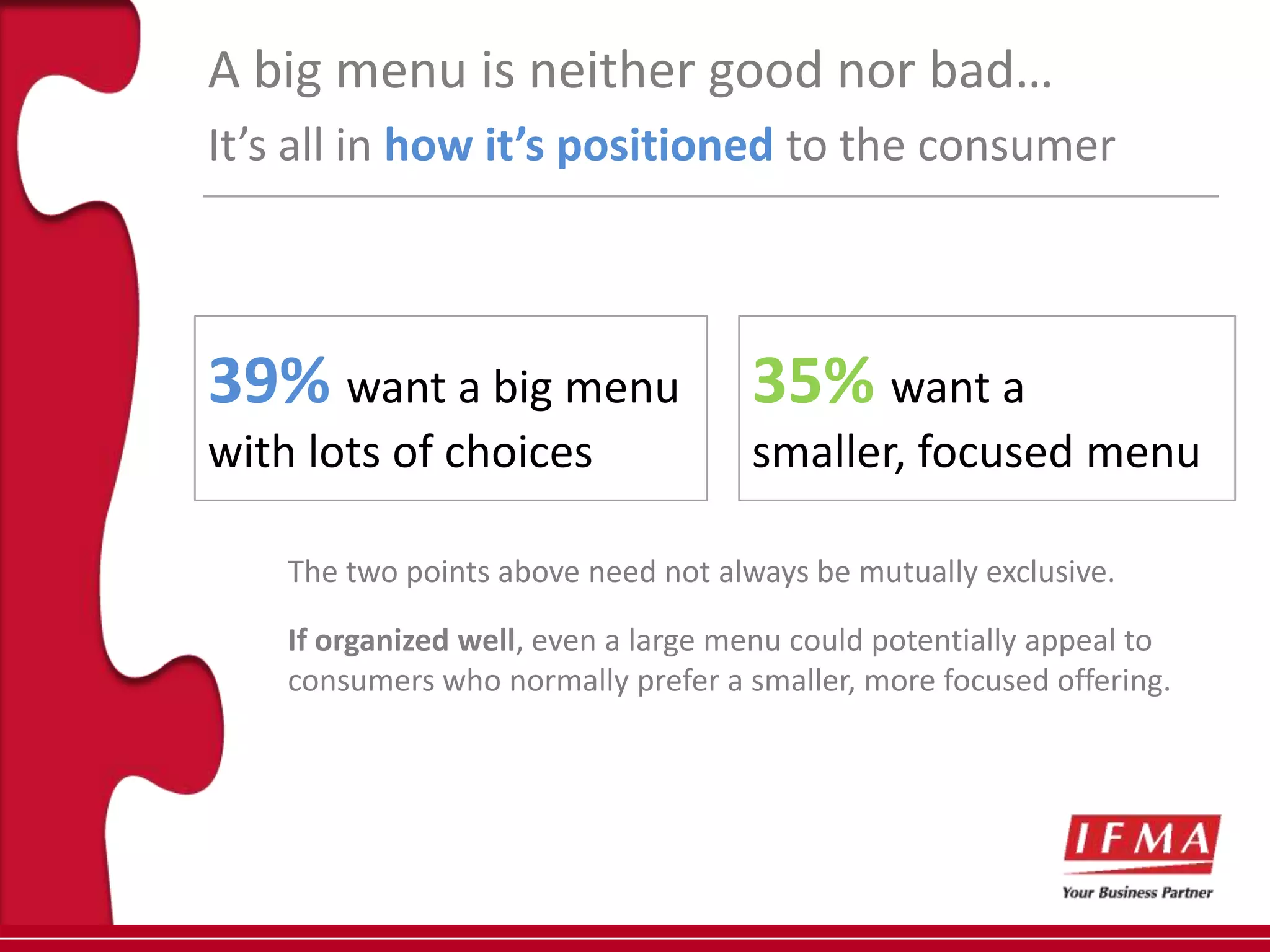
A big menu is neither good nor bad…
It’s all in how it’s positioned to the consumer


39% want a big menu                  35% want a
with lots of choices                 smaller, focused menu

    The two points above need not always be mutually exclusive.

    If organized well, even a large menu could potentially appeal to
    consumers who normally prefer a smaller, more focused offering.
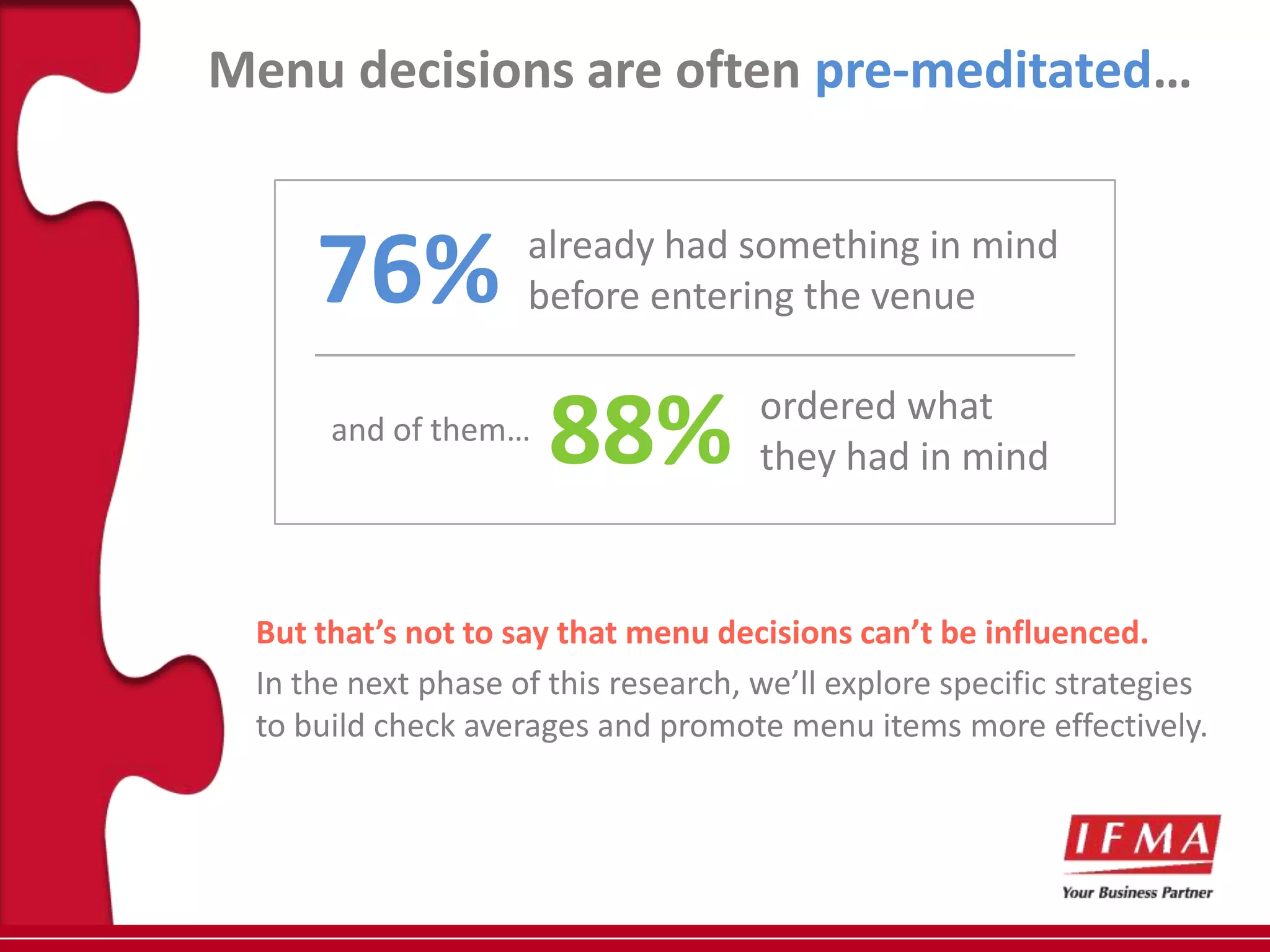
Menu decisions are often pre-meditated…


     76%            already had something in mind
                    before entering the venue


      and of them…
                      88%            ordered what
                                     they had in mind


 But that’s not to say that menu decisions can’t be influenced.
 In the next phase of this research, we’ll explore specific strategies
 to build check averages and promote menu items more effectively.
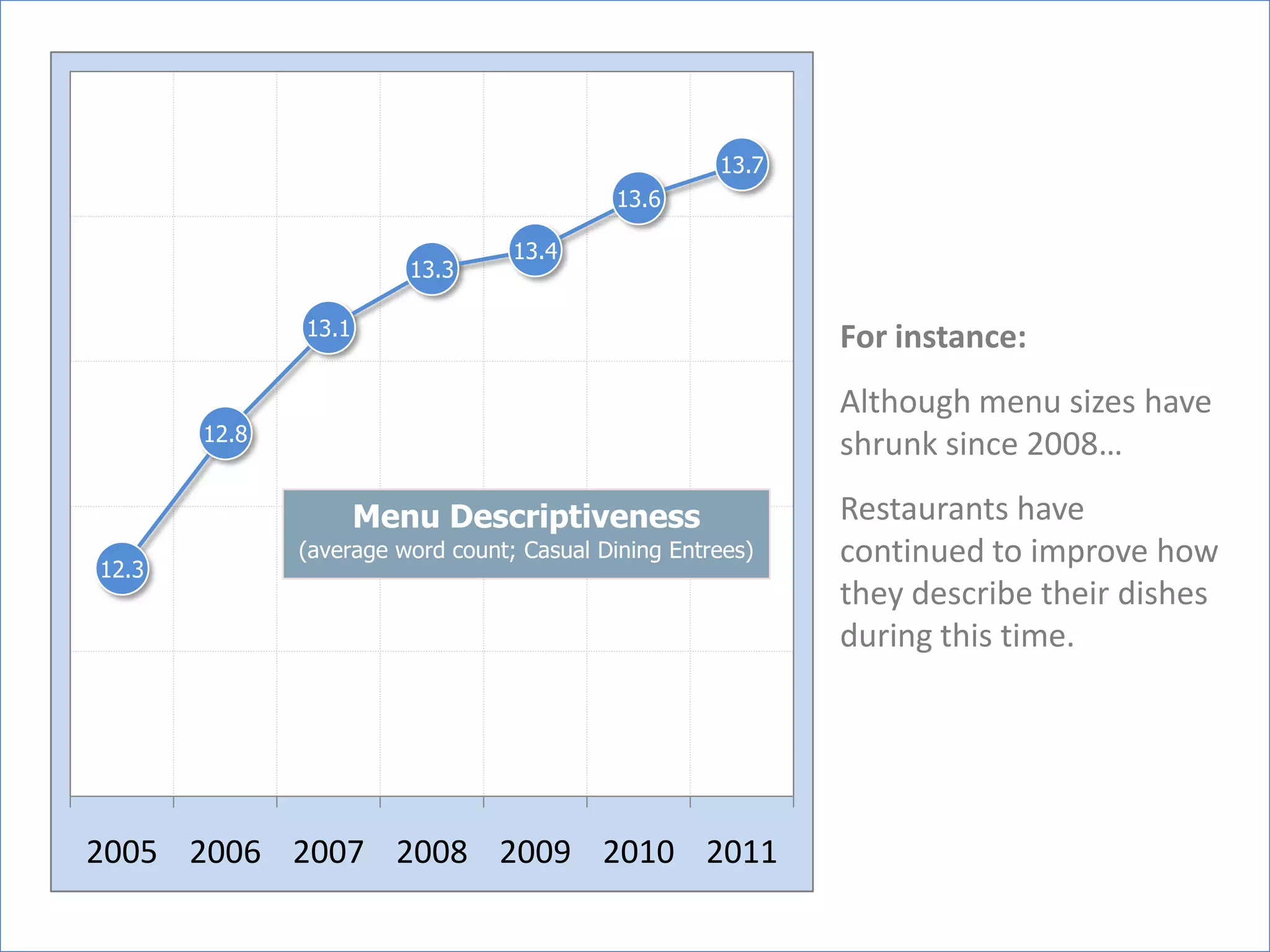
13.7
                                            13.6

                                  13.4
                        13.3

              13.1                                          For instance:
                                                            Although menu sizes have
       12.8
                                                            shrunk since 2008…

                     Menu Descriptiveness                   Restaurants have
              (average word count; Casual Dining Entrees)   continued to improve how
12.3
                                                            they describe their dishes
                                                            during this time.


2005 2006 2007 2008 2009 2010 2011
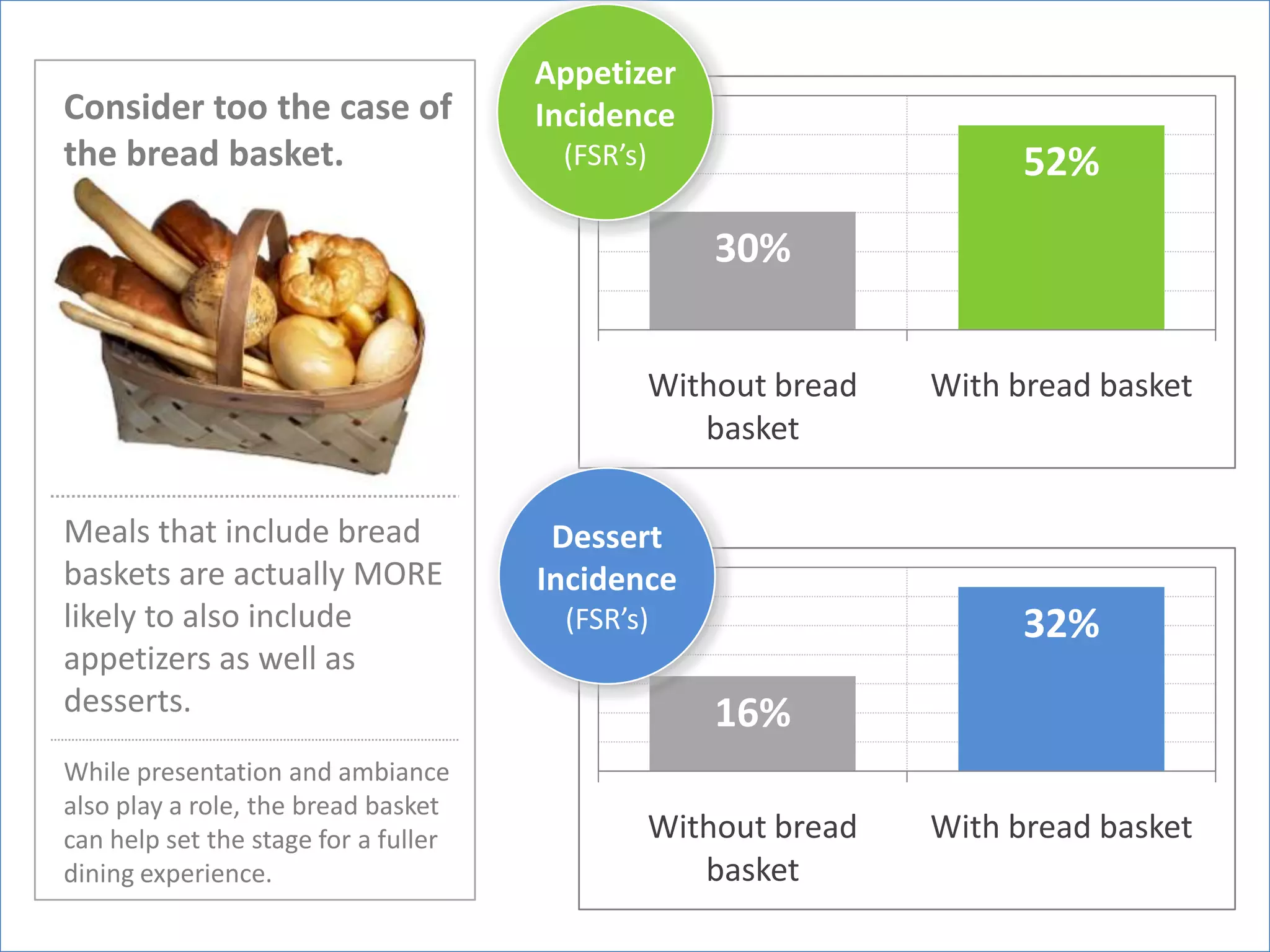
Appetizer
Consider too the case of              Incidence
the bread basket.                      (FSR’s)                         52%
                                                     30%


                                                 Without bread   With bread basket
                                                    basket

Meals that include bread               Dessert
baskets are actually MORE             Incidence
likely to also include                 (FSR’s)                         32%
appetizers as well as
desserts.                                            16%
While presentation and ambiance
also play a role, the bread basket
can help set the stage for a fuller              Without bread   With bread basket
dining experience.                                  basket
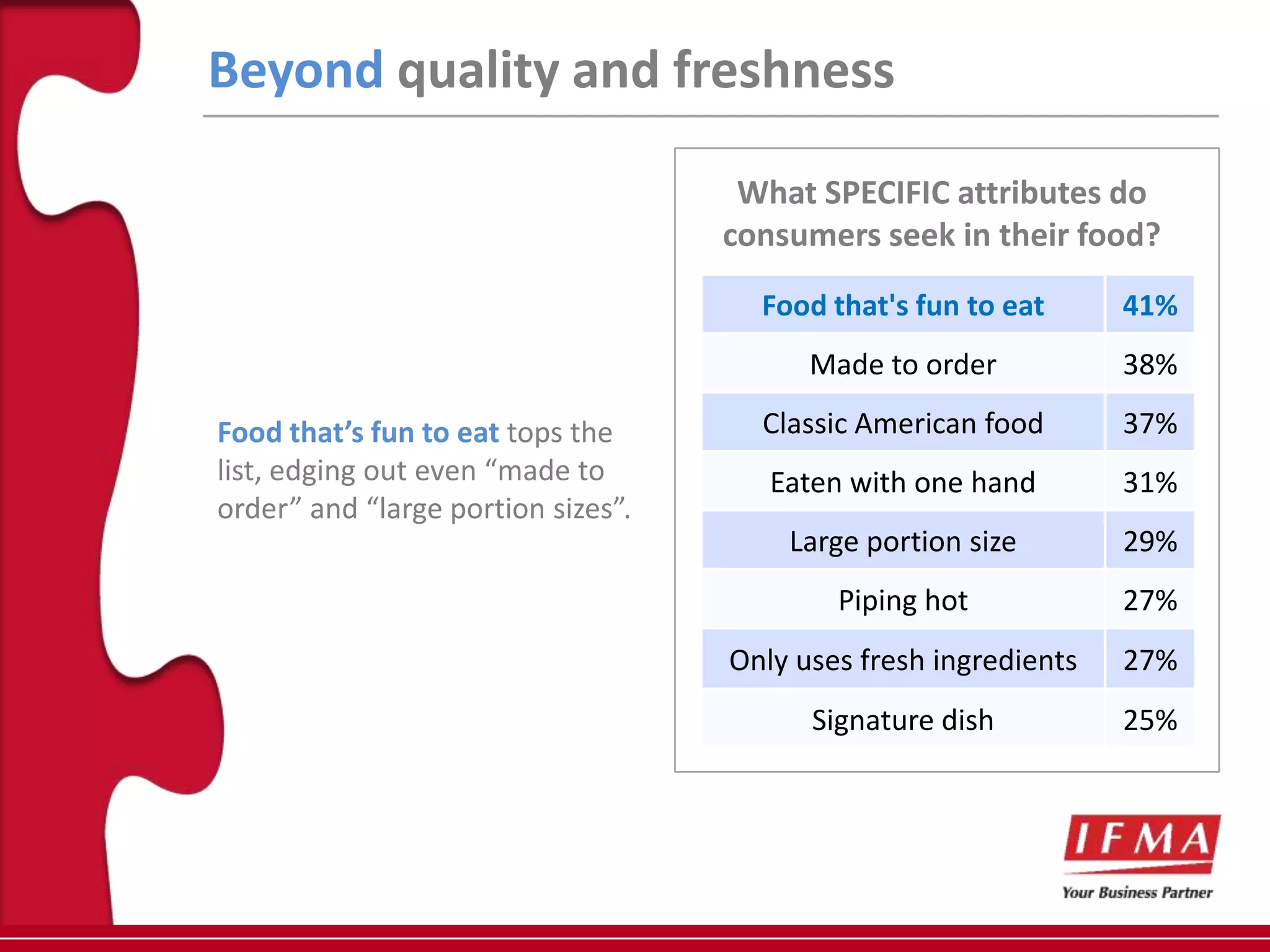
Beyond quality and freshness

                                     What SPECIFIC attributes do
                                    consumers seek in their food?
                                      Food that's fun to eat      41%
                                          Made to order           38%

Food that’s fun to eat tops the       Classic American food       37%
list, edging out even “made to         Eaten with one hand        31%
order” and “large portion sizes”.
                                        Large portion size        29%
                                            Piping hot            27%
                                    Only uses fresh ingredients   27%
                                          Signature dish          25%
Beyond quality and freshness
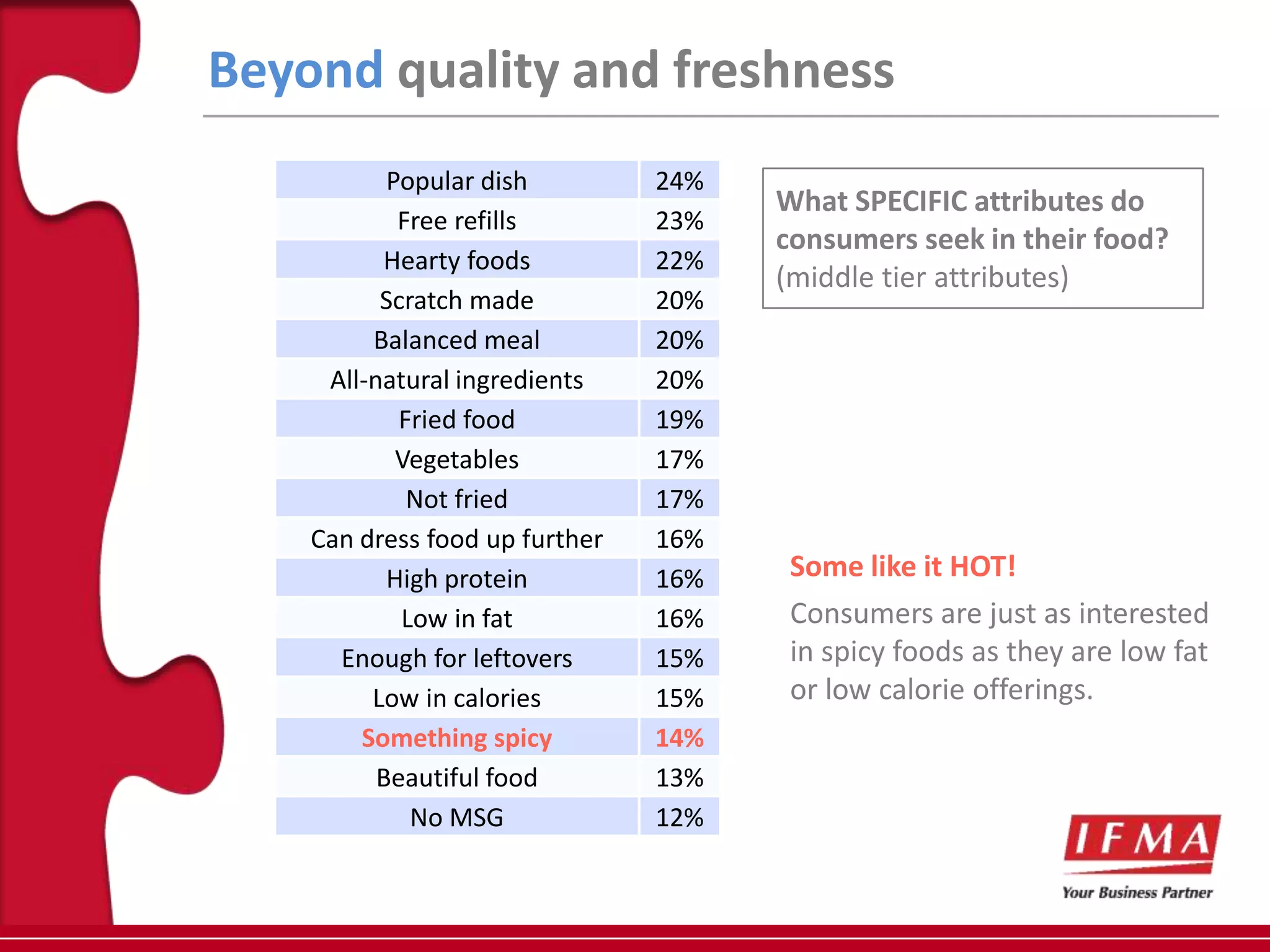
           Popular dish         24%
                                      What SPECIFIC attributes do
            Free refills        23%
                                      consumers seek in their food?
          Hearty foods          22%
                                      (middle tier attributes)
          Scratch made          20%
         Balanced meal          20%
     All-natural ingredients    20%
            Fried food          19%
            Vegetables          17%
             Not fried          17%
    Can dress food up further   16%
           High protein         16%    Some like it HOT!
            Low in fat          16%    Consumers are just as interested
      Enough for leftovers      15%    in spicy foods as they are low fat
         Low in calories        15%    or low calorie offerings.
        Something spicy         14%
          Beautiful food        13%
             No MSG             12%
Beyond quality and freshness
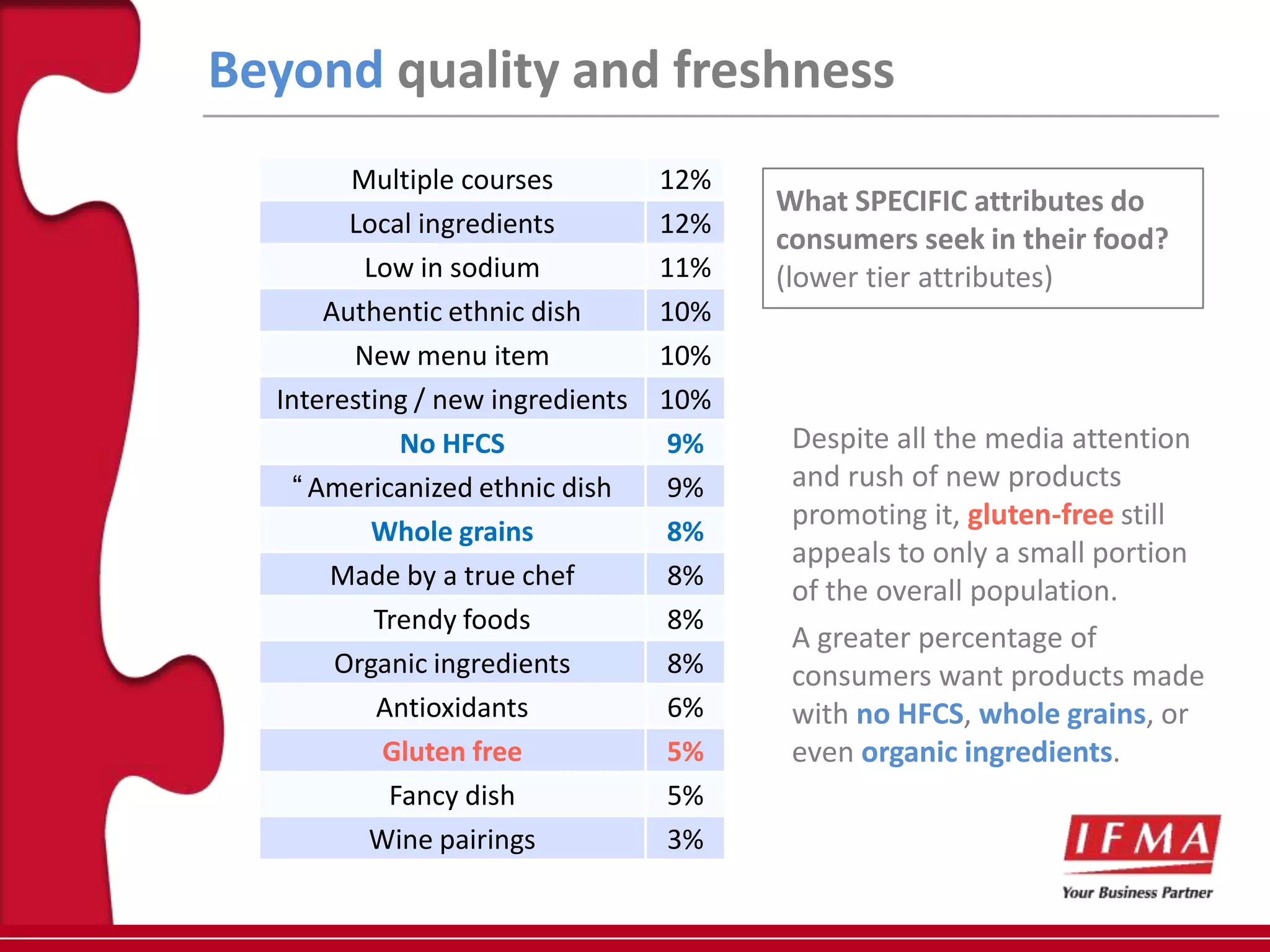
        Multiple courses          12%
                                        What SPECIFIC attributes do
        Local ingredients         12%
                                        consumers seek in their food?
         Low in sodium            11%   (lower tier attributes)
      Authentic ethnic dish       10%
        New menu item             10%
  Interesting / new ingredients   10%
             No HFCS              9%     Despite all the media attention
    “Americanized ethnic dish      9%    and rush of new products
                                         promoting it, gluten-free still
          Whole grains            8%
                                         appeals to only a small portion
       Made by a true chef         8%
                                         of the overall population.
          Trendy foods             8%
                                         A greater percentage of
       Organic ingredients         8%    consumers want products made
           Antioxidants            6%    with no HFCS, whole grains, or
           Gluten free            5%     even organic ingredients.
            Fancy dish             5%
          Wine pairings            3%
building solutions to
next steps   influence behavior
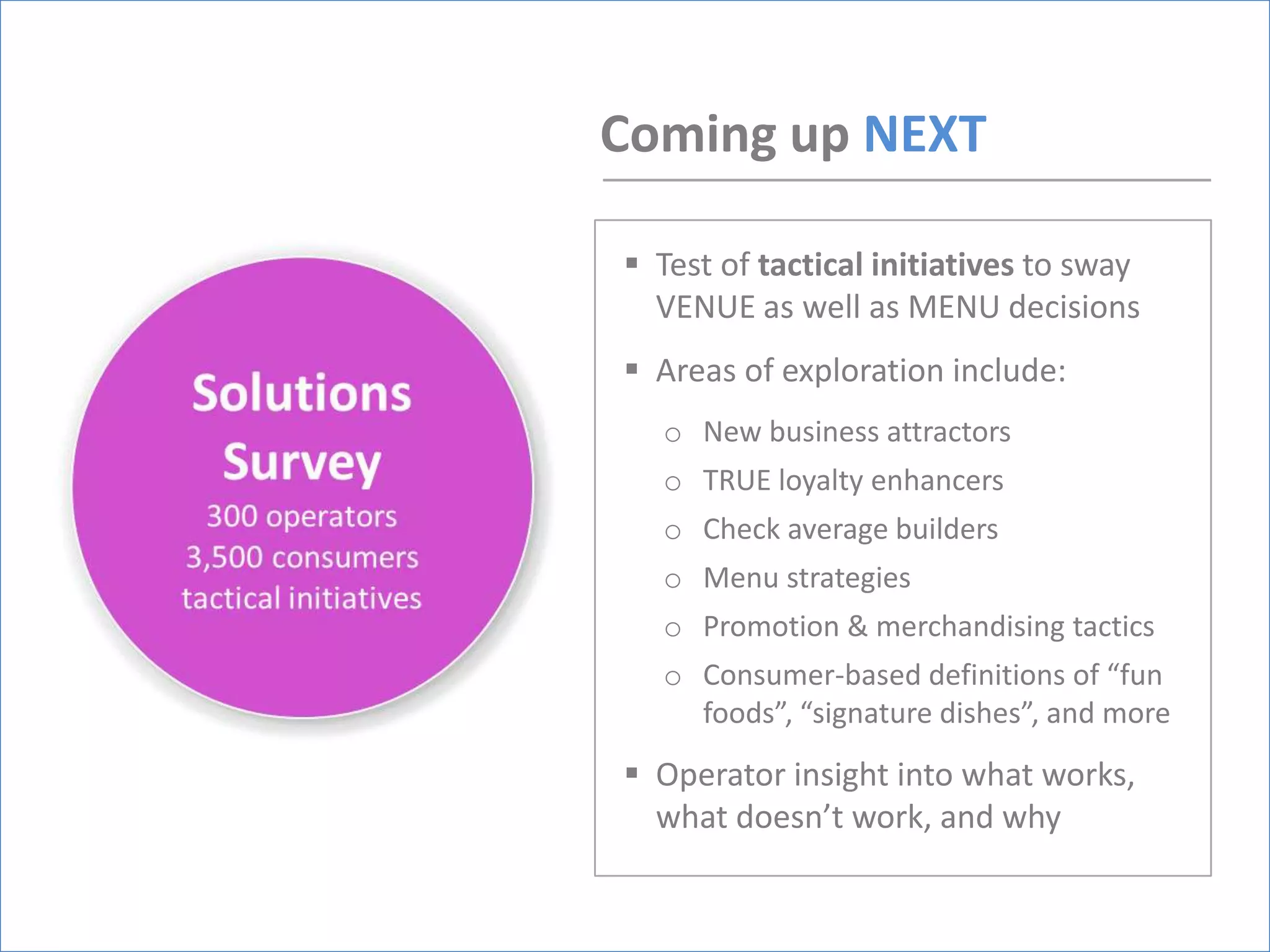
Coming up NEXT

 Test of tactical initiatives to sway
  VENUE as well as MENU decisions
 Areas of exploration include:
  o New business attractors
  o TRUE loyalty enhancers
  o Check average builders
  o Menu strategies
  o Promotion & merchandising tactics
  o Consumer-based definitions of “fun
    foods”, “signature dishes”, and more
 Operator insight into what works,
  what doesn’t work, and why
Do you have a venue or menu solution you’d like to test?
          Contact IFMA to include your ideas in the research.

Datassential Decision Making Factors Presentation from MSLF

  • 1.
  • 2.
    Getting at theWHY  New landmark study (currently in progress)  Extremely thorough analysis of:  BEHAVIOR – consumer decisions away from home  MOTIVATIONS – why consumers make those choices  SOLUTIONS – tactics to positively influence consumer decisions  12,000 consumers  Operator perspective Brand new data  MenuTrends exploration (7,000+ menus; 1.2 million items)
  • 3.
    the research process completed as of 8.7.2012 to be conducted
  • 4.
    explored segments Traditional Midscale Fast-Casual Casual Dining Upper Casual Fine Dining QSR Dining Lodging Lodging Room C&U C&U Retail / Hospital Long-Term Restaurants Service Dining Hall Hosted Cafeteria Care Grocery Recreation & Food Trucks & B&I C-Store Other Perimeter Amusement Kiosks The research focuses primarily on segments where consumer choice is most relevant. Prisons, for instance, are not covered.
  • 5.
    Guided by aspecial research committee IFMA CONSUMER PLANNING PROGRAM  Bill McClellan, Dawn Food Products (Chair)  Rick Kirkpatrick, Sweet Street Desserts (Vice Chair) SPECIAL RESEARCH COMMITTEE  Nelly Bentz, Heinz North America  Andrea Hickman, McCain Foods  Bernie McGorry, Dawn Food Products  Mike Stammer, Hillshire Brands  Donna Surma, Basic American Foods  Devon Gerchar, IFMA  Jim Green, IFMA
  • 6.
    These pages featurejust a short sneak peak of this new landmark research. For more information about the study, please contact IFMA.
  • 7.
    how and whyconsumers venue decisions choose WHERE to eat
  • 8.
    Frequency of AFHoccasions / dining motivators Family meal 19% Road trip 4% Quick bite 17% Morning commute 3% Casual lunch 15% Celebration / special occasion 3% Casual dinner 14% Before a movie / event 3% Cheap bite 14% Weekend breakfast 3% Running errands 13% Business / work lunch 3% Relaxing at home 10% Date / romantic meal 2% Hold you over 9% Brunch 2% Food for energy / fuel 9% Festive / party-like 1% Last minute dinner 9% Girl's night out 1% Dinner on the way home 8% Formal dinner 1% Hanging out with friends 8% Guy's night out 1% Social gathering 5% Meeting coworkers after work 1% Work break 5% Impressing someone 1% Dining occasions are generally ordinary and not event driven. To maximize their business potential, operators should generally ensure that their proposition appeals to everyday life. (there are exceptions, of course)
  • 9.
    Why do occasionsmatter? Because they drive venue decisions. Top Aligned Occasions by Restaurant Segment* QSR Fast-Casual Midscale Casual Dining Cheap Bite Casual Lunch Weekend Breakfast Celebration Business / Work Quick Bite Brunch Date / romance Lunch Dinner on the Way Hanging Out with Family Meal Celebration Home Friends Before a movie / Morning Commute Social Gathering Casual Dinner event While running Hanging Out with Casual Dinner Social Gathering errands Friends *within each segment, occasions that align particularly well with that segment
  • 10.
    Technology directly influencesvenue selection for 15 billion occasions annually. Of those who used technology to decide where to eat, % who used… It starts with the menu, often viewed 42% 41% on that place’s own website. viewed menu visited place’s online website General purpose search engines and 25% 21% 20% social media are used next most search social daily deal commonly, along with daily deal sites. engine media site Online photos play an increasingly online photos: 18% pivotal role. restaurant listing site: 13% Mobile (phone) apps are used less user reviews: 13% commonly, but may grow as apps navigation system: 12% marketplaces mature. mobile app: 11%
  • 11.
    However, decisions arestill based predominantly on prior experience. resources used to decide where to eat (last occasion)  Previous Experience: 66%  Word of Mouth: 33%  Technology: 21%
  • 12.
    Consumers are mostlycreatures of habit… and are far more motivated to go somewhere familiar than somewhere new. 72% wanted to go 11% wanted to go somewhere familiar somewhere new This figure drops even further in practice. While 11% wanted to go somewhere new, ultimately only 6% actually did so. 94% of occasions are repeat visits.
  • 13.
    the customer acquisitionchallenge: Introduce New Behavior  Foodservice behavior is often habitual.  Most are inclined to simply visit familiar places, making it hard for other businesses to draw traffic.  To attract new customers, operators must go above and beyond – giving the consumer a real reason to visit.  The goal in this case is to dislodge consumers from their comfort zone.
  • 14.
    the flipside: Loyalty But isn’t repeat visitation a testament to operators’ ability to build a loyal customer base? % of repeat visits attributed to… Well, only partially. Convenience Loyalty Nearly half of all repeat visits 46% 54% are driven by convenience rather than loyalty.
  • 15.
    True loyalty ismore common to certain industry segments. Fast-casuals, for instance, draw far more loyalty traffic than do QSRs. Fine Dining 80% Upper Casual 75% Fast Casual 73% Casual Dining 64% Delivery 62% Coffee Shop 59% Buffet Restaurant 58% Midscale 58% Supermarket deli 53% [repeat visits] QSR 48% % visiting out of C-Store 40% Cafeteria 18% LOYALTY
  • 16.
    the customer retentionchallenge: Promote True Loyalty  What may be perceived as customer loyalty is often just the manifestation of a need for convenience.  True loyalty is rarer, and is generally associated with higher-end segments.  Despite their high re-visitation rates, QSRs, C- Stores, and Cafeterias are the segments least likely to foster true loyalty.  Yet Fast-Casuals show that this need not be the case – that limited service venues are indeed capable of building true loyalty.
  • 17.
    how and whyconsumers menu decisions choose WHAT to eat
  • 18.
    a little contextabout the menu Following several years of 97.9 increase, average menu size 96.4 96.1 began to decrease following 2008’s economic downturn. 93.4 93.3 92.6 During this time, operators 90.3 became more guarded in their approach to introducing Average Menu Size new items – often favoring (items per menu) nostalgic old-time favorites. 82.3 [excludes beverages; “all day menus” only] 2005 2006 2007 2008 2009 2010 2011 2012
  • 19.
    A big menuis neither good nor bad… It’s all in how it’s positioned to the consumer 39% want a big menu 35% want a with lots of choices smaller, focused menu The two points above need not always be mutually exclusive. If organized well, even a large menu could potentially appeal to consumers who normally prefer a smaller, more focused offering.
  • 20.
    Menu decisions areoften pre-meditated… 76% already had something in mind before entering the venue and of them… 88% ordered what they had in mind But that’s not to say that menu decisions can’t be influenced. In the next phase of this research, we’ll explore specific strategies to build check averages and promote menu items more effectively.
  • 21.
    13.7 13.6 13.4 13.3 13.1 For instance: Although menu sizes have 12.8 shrunk since 2008… Menu Descriptiveness Restaurants have (average word count; Casual Dining Entrees) continued to improve how 12.3 they describe their dishes during this time. 2005 2006 2007 2008 2009 2010 2011
  • 22.
    Appetizer Consider too thecase of Incidence the bread basket. (FSR’s) 52% 30% Without bread With bread basket basket Meals that include bread Dessert baskets are actually MORE Incidence likely to also include (FSR’s) 32% appetizers as well as desserts. 16% While presentation and ambiance also play a role, the bread basket can help set the stage for a fuller Without bread With bread basket dining experience. basket
  • 23.
    Beyond quality andfreshness What SPECIFIC attributes do consumers seek in their food? Food that's fun to eat 41% Made to order 38% Food that’s fun to eat tops the Classic American food 37% list, edging out even “made to Eaten with one hand 31% order” and “large portion sizes”. Large portion size 29% Piping hot 27% Only uses fresh ingredients 27% Signature dish 25%
  • 24.
    Beyond quality andfreshness Popular dish 24% What SPECIFIC attributes do Free refills 23% consumers seek in their food? Hearty foods 22% (middle tier attributes) Scratch made 20% Balanced meal 20% All-natural ingredients 20% Fried food 19% Vegetables 17% Not fried 17% Can dress food up further 16% High protein 16% Some like it HOT! Low in fat 16% Consumers are just as interested Enough for leftovers 15% in spicy foods as they are low fat Low in calories 15% or low calorie offerings. Something spicy 14% Beautiful food 13% No MSG 12%
  • 25.
    Beyond quality andfreshness Multiple courses 12% What SPECIFIC attributes do Local ingredients 12% consumers seek in their food? Low in sodium 11% (lower tier attributes) Authentic ethnic dish 10% New menu item 10% Interesting / new ingredients 10% No HFCS 9% Despite all the media attention “Americanized ethnic dish 9% and rush of new products promoting it, gluten-free still Whole grains 8% appeals to only a small portion Made by a true chef 8% of the overall population. Trendy foods 8% A greater percentage of Organic ingredients 8% consumers want products made Antioxidants 6% with no HFCS, whole grains, or Gluten free 5% even organic ingredients. Fancy dish 5% Wine pairings 3%
  • 26.
    building solutions to nextsteps influence behavior
  • 27.
    Coming up NEXT Test of tactical initiatives to sway VENUE as well as MENU decisions  Areas of exploration include: o New business attractors o TRUE loyalty enhancers o Check average builders o Menu strategies o Promotion & merchandising tactics o Consumer-based definitions of “fun foods”, “signature dishes”, and more  Operator insight into what works, what doesn’t work, and why
  • 28.
    Do you havea venue or menu solution you’d like to test? Contact IFMA to include your ideas in the research.