Beyond the Horizon
A White Paper to the Industry on Systemic Risk • August 2013
About DTCC
DTCChasoperatingfacilitiesanddatacentersaroundthe
worldand,throughitssubsidiaries,automates,centralizes,and
standardizesthepost-tradeprocessingoffinancialtransactionsfor
thousandsofinstitutionsworldwide.With40yearsofexperience,
DTCCisthepremierpost-trademarketinfrastructureforthe
globalfinancialservicesindustry,simplifyingthecomplexitiesof
clearance,settlement,assetservicing,globaldatamanagement
andinformationservicesforequities,corporateandmunicipal
bonds,governmentandmortgage-backedsecurities,derivatives,
moneymarketinstruments,syndicatedloans,mutualfunds,
alternativeinvestmentproducts,andinsurancetransactions.
In2012,DTCC’ssubsidiariesprocessedsecuritiestransactions
valuedatapproximatelyUS$1.6quadrillion.Itsdepositoryprovides
custodyandassetservicingforsecuritiesissuesfrom131
countriesandterritoriesvaluedatUS$37.2trillion.DTCC’sglobal
traderepositoriesrecordmorethanUS$500trillioningrossnotional
valueoftransactionsmadeworldwide.
FollowusonTwitter:http://twitter.com/The_DTCC.
TABLE OF CONTENTS
SCOPE STATEMENT...................................................................................................................................................i
FOREWORD ............................................................................................................................................................ii
EXECUTIVE SUMMARY............................................................................................................................................iii
DISCUSSION OF KEY RISKS.....................................................................................................................................1
Cyber Security.....................................................................................................................................................1
Impact of New Regulations.................................................................................................................................4
High Frequency Trading ......................................................................................................................................6
Counterparty Risk...............................................................................................................................................8
Collateral .........................................................................................................................................................10
Market Quality...................................................................................................................................................13
Liquidity Risk....................................................................................................................................................15
CCPs as Single Points of Concentration............................................................................................................18
Interconnectedness Risk...................................................................................................................................20
Securities Settlement........................................................................................................................................21
Business Continuity Risk..................................................................................................................................23
Shadow Banking...............................................................................................................................................24
Eurozone Risks..................................................................................................................................................25
Conclusion.........................................................................................................................................................27
APPENDIX: GLOSSARY OF KEY TERMS ..................................................................................................................28
i
SCOPE STATEMENT
The strategic goal of this paper is to promote systemic-risk awareness and mitigation across the global
financial industry. We hope this paper informs and elevates the discussion on the rapidly evolving spectrum
of systemic risks facing financial markets. Where relevant, we offer actions and recommendations, as well as
a strategic perspective for the industry, regulators and policymakers and other key stakeholders globally.
This paper is derived from DTCC subject matter expertise; member feedback; engagement with regula-
tors; global risk experts; and other primary and secondary sources. We extend a special thanks to all DTCC
employees who helped inform this paper. We also recognize our partners, Members, stakeholders and all the
risk professionals and academics around the world for the vital work they are doing to advance the field of
systemic risk.
The paper intentionally focuses on the U.S. and Europe, given the depth and breadth of regulatory progress
and movement in these two geographies since the 2008 financial crisis and to reflect the geographic scope of
DTCC’s core business activities today. We intend to assess and explore systemic risk developments in other
regions in the future.
We recognize that the rapidly evolving regulatory response and the dynamic nature of these systemic
threats require us to regularly update this paper. To that end, we welcome and appreciate feedback from read-
ers to help inform future iterations of this white paper.
This white paper should not be regarded as a definitive or exhaustive description of either the risks
that DTCC is currently managing or its risk management framework and activities. Nothing in this white
paper shall be deemed to impose any obligations on DTCC that are not set forth in the existing Rules for
each DTCC subsidiary. In the case of any discrepancy between this white paper and the Rules, the Rules
shall govern.
ii
FOREWORD
The financial crisis of 2008 sparked a period of unprecedented transformation that, nearly five years later,
continues to fundamentally alter the face of the industry in all parts of the world, along with DTCC’s role in
it. Despite widespread changes in market structure and the ongoing re-regulation of global markets, the abil-
ity of the financial system to effectively manage systemic risk remains a top concern of market participants
and policymakers around the world.
While a great deal of progress has been made in recent years to reduce the level of risk in the system, his-
tory has shown that systemic threats will continue to emerge and remain difficult to anticipate. These threats
are magnified when you consider that many risks are of a different nature and require varied responses to
mitigate. Furthermore, the risks that may arise from significant interconnections or interdependencies among
members of the financial system may cause widespread market instability if an institution is unable to meets
its obligations to its counterparties.
These points were reinforced earlier this year in the World Economic Forum’s Global Risks survey of 1,000
business leaders and academics, who expressed “fear of continued systemic financial failures.” This shifting
paradigm is changing the risk calculus, requiring market participants to gain a deeper understanding of
how new systemic risks might impact the safety and soundness of global financial markets and of the steps
the industry should take to protect the stability and integrity of the financial system. As we have witnessed
in recent years, an unforeseen crisis has the potential to ripple through the entire financial system with
devastating impact.
Historically, the financial industry has viewed risk management in terms of the more traditional exposures
such as credit, market, liquidity, operational and compliance risks. In the past few years, we have expanded
our risk management efforts by taking a proactive approach to systemic risk identification, to either help
avoid or reduce systemic repercussions in the market, where feasible.
This white paper is intended to provide a broad framework to support ongoing industry discussions and
be used as a resource for our Members, stakeholders and the industry at large. We hope you share this
paper with your colleagues and join the dialogue DTCC will be leading in the coming months and years on
this vital issue.
		
Robert Druskin 	 Michael Bodson	
DTCC Executive Chairman 	 DTCC President & CEO
iii
EXECUTIVE SUMMARY
Despite progress over the past five years, DTCC has found that systemic risks facing the global financial ser-
vices industry are growing in complexity and are more difficult to anticipate, and that new gaps in protecting
against new and unidentified threats continue to surface.
This paper identifies several factors impeding the industry’s ability to protect itself from emerging threats
including a rise in cyber attacks that can easily thwart U.S. and E.U. industry safeguards and laws; the speed of
high-frequency trades relative to industry risk infrastructures; the concentrated nature of key clearance and
settlement functions within a few firms; and regulatory safeguards that are either years from implementation
or introduce new forms of risk.
In September 2011, DTCC published “The Role of DTCC in Mitigating Systemic Risk” (“2011 White Paper”).
One of the primary goals of the 2011 White Paper was to serve as the starting point for an ongoing dialogue
between DTCC and its Members, as well as its regulators and other stakeholders both domestically and inter-
nationally. The 2011 White Paper covered a wide range of systemic issues facing the financial industry and led
to a number of risk mitigation efforts.
Since 2011, the financial industry has experienced an increased threat from certain systemic risks -- cyber
attacks, for example. As the nature of systemic threats continues to change, industry participants need to
understand these risks more clearly in order to be able to mitigate them. Those systemic threats that emerge
quickly and without warning generally present a greater analytical challenge compared to risks that are more
mature. This reality is also reflected in the recent emergence of more explicit regulatory requirements to
monitor and address systemic risks.
In light of the above, DTCC in mid-2012 created an internal Systemic Risk Council (“the Council”), com-
prised of senior representatives from all key control and business areas and staff from its core subsidiaries
and affiliates. The Council is dedicated to monitoring and advising on systemic risks on an ongoing basis and
is supportive of a robust level of dialogue between DTCC and its stakeholders. The publication of this new
systemic risk white paper (“2013 Systemic Risk White Paper”) underscores that ongoing commitment.
During our extensive engagement with the regulatory community and industry over the past year, a recur-
ring comment was that DTCC’s ability to prioritize the issues raised in the 2011 White Paper facilitated the
optimization of finite resources. To enlarge this discussion of priorities, DTCC recently conducted a systemic
risk survey among its Members, asking firms to identify the top five risks they believe pose the greatest threat
to their respective firms and to the broad economy. In addition, DTCC held a number of bilateral meetings
with prudential and market/securities regulators, industry groups and risk associations to elicit their opinions
about the most pressing systemic threats facing the markets and firms within their respective jurisdictions.
Certain events such as 9/11 simply cannot be foreseen. However, others can be anticipated and monitored
as they evolve. Some potential systemic developments that DTCC has continued to monitor over the course of
the last year include cyber security threats, regulatory changes and their implications, the sustained volumes
of high frequency trading in certain markets and the wave of compliance-related breaches.
This Executive Summary provides a synopsis of some of the key risks covered in the main body of the paper.
Cyber Security: This issue has emerged as arguably the top systemic threat, facing not only the global financial
markets and associated infrastructures, but also world governments and military establishments. DTCC places
an extremely high organizational focus on mitigating this issue and our Chief Information Security Officer’s
strong industry engagement and leadership underscore that commitment. DTCC has robust internal cyber se-
curity policies and procedures and actively participates in industry-coordinated exercises aimed at increasing
resiliency against cyber attacks. Despite all of these efforts and given the diverse and global nature of cyber
attacks, DTCC does not expect this risk to dissipate significantly in the near term.
iv
Impact of New Regulations: Since the financial crisis of approximately five years ago, a tremendous volume of
new and enhanced financial regulations has been enacted. Collectively, these regulations have led to, among
other benefits, a much healthier banking sector. Because a significant portion of new rules are not yet in
place, the benefits of some new regulations will be realized in the months and years to come. The financial
industry has expressed concerns that, while well intentioned and necessary, the regulations may actually lead
to an entirely new set of risks because of their sheer scope and complexity.
High Frequency Trading (“HFT”): HFT and other similar practices have come under substantial scrutiny in recent
years due to high-profile technology-based events such as the so-called “flash crash” in 2010, the difficulties
encountered during the initial public offerings of BATS Global Markets, Inc. and Facebook, Inc., and the Knight
Capital trading glitch. Some industry participants are at odds over the question of whether the benefits that
HFT brings to the securities markets in terms of efficiency and liquidity, outweigh the technological challenges
associated with this activity. DTCC has developed some proposals, which are subject to regulatory approval as
proposed rule changes for National Securities Clearing Corporation (NSCC), that could contribute to the efforts
to mitigate risks associated with HFT.
Counterparty Risk: Several years removed from the financial crisis, there is an ongoing industry debate about
whether the “too-big-to-fail” issue has been sufficiently mitigated. Today, the top U.S. banks still control the
vast majority of total assets within the sector and just a few provide some of the most critical services for the
securities industry. DTCC is not immune to this risk given the concentration of its clearance and settlement
activities with some of the largest U.S. banks. A critical question going forward is whether financial regulators
can make effective use of the enhanced level of transparency they now have into the activities of systemi-
cally important financial institutions (“SIFIs”). This transparency should afford regulators the opportunity to
identify emerging systemic threats building up within the banking sector and to take necessary actions to
minimize risk for the industry.
Collateral: While collateral serves as a core risk mitigation tool for the securities industry, there are growing
concerns globally about potential risks associated with a future shortage of high-quality collateral, possible
pro-cyclical impacts of collateral requirements, and operational challenges related to collateral management.
Some of these risks may be precipitated by new regulatory rules around central clearing of over-the-counter
(“OTC”) derivatives, while others represent flaws inherent in the market structure of global collateral manage-
ment practices. While mitigating all of these risks is beyond DTCC’s control, DTCC is attempting to partially
address the operational risks associated with collateral by developing a new collateral processing service
called “Margin Transit.” This service is intended to increase efficiency, reduce risk and support the growing
collateral needs of industry participants by enabling straight-through processing of collateral associated with
OTC bilateral and cleared derivative products.
Market Quality: The numerous compliance violations and fines against financial institutions, including the
well-documented LIBOR scandal and gaps in corporate risk governance, have the potential to erode the level
of trust market participants have in the financial services industry, as well as the trust market counterparties
may have in one another. The severity of these breaches has increased recently, with record fines imposed
and criminal charges filed. If corporate risk governance and internal control breaches continue, a future event
may lead to the failure of a firm, which in turn can cause a contagion effect in the broader industry.
CCPs as Single Points of Concentration: DTCC has a long history of sound financial and operational performance
through many business cycles and credit events. Nonetheless, due to the systemically important status
of DTCC’s depository subsidiary The Depository Trust Company (“DTC”) and central counterparty (“CCP”)
subsidiaries The National Securities Clearing Corporation (“NSCC”) and The Fixed Income Clearing Corpora-
tion (“FICC”), the insolvency of one or more of these entities could have a substantial impact on the financial
system. Consequently, it is a matter of best practice for DTCC to understand the implications of such an event.
DTCC is in the process of creating a comprehensive set of recovery and resolution plans for each of its Sys-
temically Important Financial Market Utility (“SIFMU”) subsidiaries. One of the many considerations of these
v
plans is to address the continuation of critical clearance and settlement services for the industry.
Business Continuity Risk: Superstorm Sandy in 2012 served as a painful reminder about the potential devastating
impact of unforeseen physical events. While DTCC’s business continuity practices allowed the organization to
continue to provide critical clearing and settlement services to the industry, a number of near-and long-term
initiatives have been identified to further enhance DTCC’s resilience against a wide range of events.
The following pages of this document explore in more detail these and other potential risks, including key
regulatory developments in both Europe and the United States.
1
DISCUSSION OF KEY RISKS
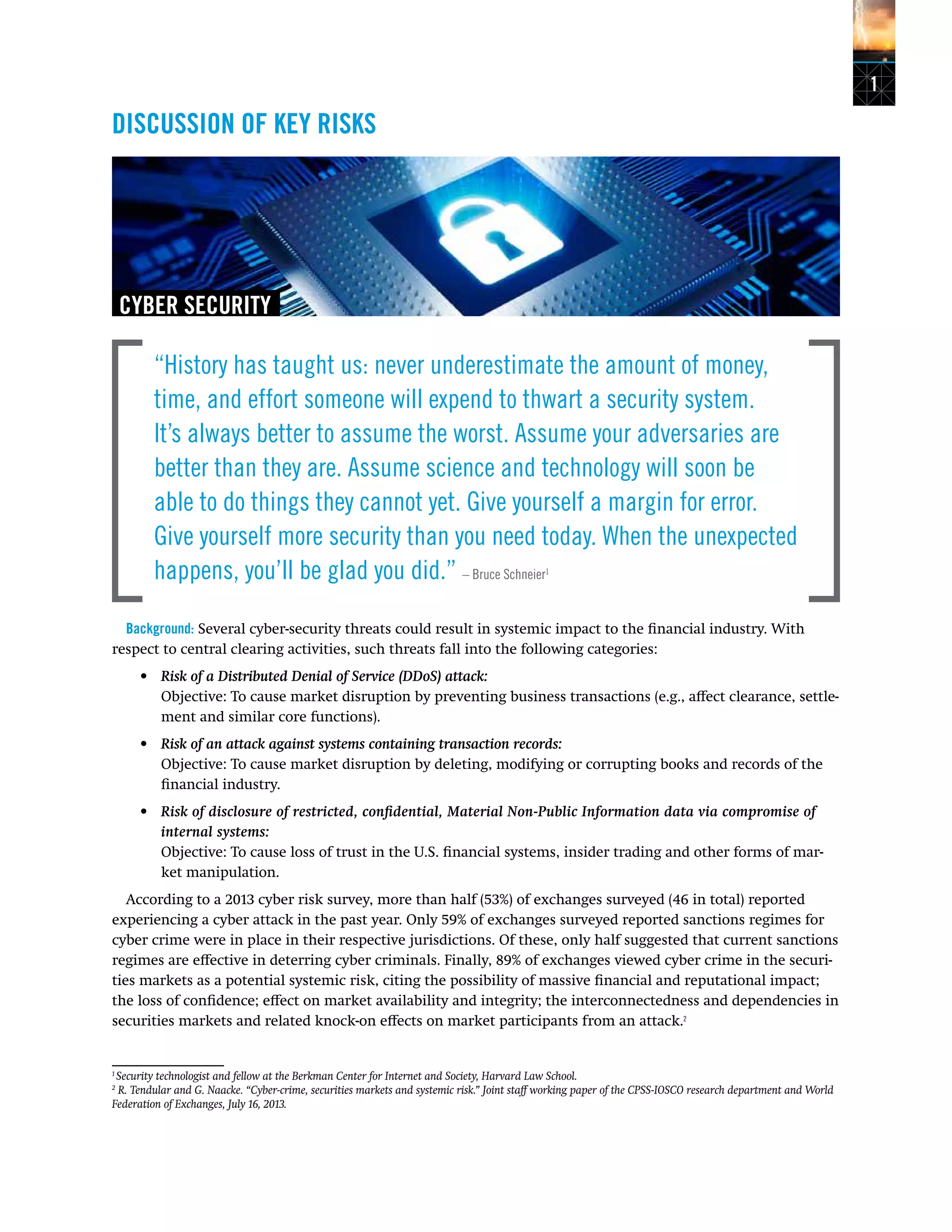
CYBER SECURITY
“History has taught us: never underestimate the amount of money,
time, and effort someone will expend to thwart a security system.
It’s always better to assume the worst. Assume your adversaries are
better than they are. Assume science and technology will soon be
able to do things they cannot yet. Give yourself a margin for error.
Give yourself more security than you need today. When the unexpected
happens, you’ll be glad you did.” – Bruce Schneier1
Background: Several cyber-security threats could result in systemic impact to the financial industry. With
respect to central clearing activities, such threats fall into the following categories:
•	 Risk of a Distributed Denial of Service (DDoS) attack:
Objective: To cause market disruption by preventing business transactions (e.g., affect clearance, settle-
ment and similar core functions).
•	 Risk of an attack against systems containing transaction records:
Objective: To cause market disruption by deleting, modifying or corrupting books and records of the
financial industry.
•	 Risk of disclosure of restricted, confidential, Material Non-Public Information data via compromise of
internal systems:
Objective: To cause loss of trust in the U.S. financial systems, insider trading and other forms of mar-
ket manipulation.
According to a 2013 cyber risk survey, more than half (53%) of exchanges surveyed (46 in total) reported
experiencing a cyber attack in the past year. Only 59% of exchanges surveyed reported sanctions regimes for
cyber crime were in place in their respective jurisdictions. Of these, only half suggested that current sanctions
regimes are effective in deterring cyber criminals. Finally, 89% of exchanges viewed cyber crime in the securi-
ties markets as a potential systemic risk, citing the possibility of massive financial and reputational impact;
the loss of confidence; effect on market availability and integrity; the interconnectedness and dependencies in
securities markets and related knock-on effects on market participants from an attack.2
1
Security technologist and fellow at the Berkman Center for Internet and Society, Harvard Law School.
2
R. Tendular and G. Naacke. “Cyber-crime, securities markets and systemic risk.” Joint staff working paper of the CPSS-IOSCO research department and World
Federation of Exchanges, July 16, 2013.
2
DDoS Attacks: In the last 12 months, DDoS attacks against financial institutions have dramatically increased.
DDoS attacks typically attempt to flood the bandwidth and network connectivity between a financial institution
and the broader Internet. Such an attack is carried out by sending a large volume of requests from compro-
mised machines to the institution’s website. Prior to last year, these attacks were launched from infected
desktops and home personal computers. Recently, these attacks have been launched from compromised serv-
ers (up to ~6000 servers), which have significantly more capacity and outgoing bandwidth. For example, prior
to 2012, the peak volumes of DDoS attacks against financial institutions were approximately one to two giga-
bits per second (Gbps). Recent attacks have peaked at close to 150 Gbps, or approximately 15 times the provi-
sioned bandwidth at a typical financial institution. The attacks have been unrelenting and are getting more
sophisticated by the day. Financial institutions are spending more and more of their resources in attempts to
ward off these attacks.
Advanced Persistent Threats (APT): APT attacks are stealthier than DDoS attacks because APT attacks are not public.
Their objective is not to disrupt Internet-facing communications, but rather to infiltrate an institution’s sys-
tems and monitor or ex-filtrate data to a server outside the firm. APT attacks are very difficult to detect, unlike
DDoS attacks, which are visible and often publicized prior to an attack. In an APT attack the infected malware
could be sent by a variety of means including e-mail attachments or compromised websites. The attackers
often use social networking tools to perform reconnaissance and identify key employees at a firm. The attack-
ers then compromise the machines of those individuals, and propagate horizontally and vertically within the
target organization.
Threat Actors: Typically APT attacks are launched by hactivists, nation states and more recently paid hackers
who are compensated by the amount of impact they have on the target. These actors typically are outside the
jurisdictional boundaries of industrially mature nations and thus very difficult to apprehend and prosecute.
Additionally, the compromised servers are often legitimate servers that were compromised because of vulner-
ability in their systems (e.g., not keeping the system patched to the latest version).
DTCC/Industry Actions: Recognizing that threat information sharing is key to protecting the financial industry,
in 1999 major industry participants established an organization called the Financial Services Information
Sharing and Analysis Center (FS-ISAC). The objective of this organization is to share information about physi-
cal and cyber-security threats and vulnerabilities in order to help protect critical infrastructures in the United
States. DTCC’s Chief Information Security Officer serves on and is Vice Chair of the Board of Directors of FS-
ISAC. Additionally, DTCC is a member of the Threat Intelligence Committee, Clearinghouse, Exchange Forum,
and Cyber Intelligence Group.
DTCC is also working with the industry, the U.S. Treasury Department and U.S. Department of Homeland
Security (DHS) to define “critical infrastructure” and to drive closer cooperation between the U.S. federal gov-
ernment and the key industry players. DTCC is also a member of the “Partnering for Cyber Resiliency” group
at the World Economic Forum3
. DTCC actively shares threat intelligence with its peers in the industry and
discusses the effectiveness of various mitigation techniques against the various types of attacks.
In response to recent attacks against financial institutions, DTCC has been enhancing its defenses and devel-
oping a strategy that plays to its strengths. The three-tiered strategy will involve carrier mitigation, protection
at DTCC’s network perimeter and enhancements to DTCC’s internal environment.
To protect against APT attacks DTCC is working toward implementing a strategy that will allow it to better pre-
vent, detect and recover from a compromise of its network. DTCC is also incorporating layered defenses to prevent
a horizontal and/or vertical propagation of a machine within its network if that machine is compromised.
Regulatory Response: On February 12, 2013, President Obama issued the cyber security Executive Order (EO),4
3
The World Economic Forum’s Partnering for Cyber Resilience is a global, multi-industry, multi-stakeholder initiative to improve cyber resilience, raise business
standards and to contribute to a safer and stronger connected society.
4
http://op.bna.com/der.nsf/id/sbay-94uv4x/$File/aacybereo021213.pdf
3
which provides for the development of a “cyber security framework” for critical infrastructure and increased
information sharing and processing of security clearances for owners and operators of key sectors; it also
directs the DHS to identify the “most critical of critical” infrastructure. Following issuance of the EO, U.S.
Senate and House committees conducted several hearings on cyber security to examine the order and begin
work on new legislation.
Given the number of cyber security issues that have affected the financial services industry over the past
year, there has been increased regulatory focus in this area. The frequency and intensity of threats, such as
denial of service attacks and the number of data security breaches, has raised concerns that the securities
industry is vulnerable to disruption and unauthorized access to customer account information. The Financial
Industry Regulatory Authority, Inc. (“FINRA”) has stated that its primary concern is the integrity of firms’ poli-
cies, procedures and controls that are aimed at protecting sensitive customer data.5
It is expected that FINRA’s
evaluation of such controls may take the form of examinations and targeted investigations.
Meanwhile in Europe, on February 7, 2013, the European Commission published a proposal for a Directive to
address Network and Information Security (NIS) and its broader cyber-security strategy. This proposed Direc-
tive reflects the growing importance of cyber security for the European economy and society, and aims at in-
creasing Europe’s preparedness and strengthening its responses to wider and more complex cyber incidents.
The proposed Directive (expected to be implemented in 2016) will impact the private sector’s IT infrastructure
and includes the following five key priorities:
1.	 Achieving cyber resilience;
2.	 Drastically reducing cyber-related crime;
3.	 Developing cyber-defense policy and capabilities related to the Common Security and Defense Policy;
4.	 Developing the industrial and technological resources for cyber security;
5.	 Establishing a coherent international cyber space policy for the European Union and promoting core
E.U. values.
Looking Ahead: DTCC expects cyber attacks to escalate and become more sophisticated in the future. Attackers
benefit from their anonymity and lack of attribution as well as their existence outside U.S. and E.U. jurisdic-
tional boundaries, all of which minimize the probability of prosecution. Due to the asymmetric nature of the
Internet, it is very inexpensive for an attacker to launch an attack and very expensive for the defender to de-
fend against those attacks. Protection from these risks can be enhanced through closer information sharing,
increased real-time exchange of threat intelligence and stronger prosecution across international boundaries.
DTCC will engage the industry to determine actions that can be taken jointly to reduce the risk. Strategies
such as leveraging DTCC’s private network to communicate in case of network disruption and enabling the
industry’s small and medium participants to utilize the private network are under consideration.
5
FINRA. 2013 Regulatory and Examination Priorities Letter. January, 11, 2013.
4
IMPACT OF NEW REGULATIONS
“Unintended consequences from regulating or legislating to achieve
a goal can occur and cause havoc in the markets or an economy.”
– Mark Skousen6
Background: Since the financial crisis of 2008, sweeping new and enhanced financial regulations have been
enacted, such as the Dodd–Frank Wall Street Reform and Consumer Protection Act (“Dodd-Frank Act”), the Eu-
ropean Market Infrastructure Regulation (“EMIR”); the Basel III requirements; proposed rules on trading and
transparency within the European Union called Markets in Financial Instruments Directive (MiFID II); as well
as the legislative work of global regulatory bodies such as the Financial Stability Board (“FSB”), the Committee
on Payment and Settlement Systems (“CPSS”) and the International Organization of Securities Commissions
(“IOSCO”).
These efforts have contributed significantly to improved levels of risk capital and liquidity, an increased
level of transparency in the markets and the development of living wills for entities deemed to be “SIFIs.”
However, some observers have raised concerns that well-intentioned efforts may be partially offset by unin-
tended downstream consequences. Many firms struggle to understand the ultimate impact of each proposed
regulation on their organizations and on the industry as a whole, while simultaneously preparing to comply
with those rules and regulations and maintaining strong oversight of their daily business operations. Below is
a brief summary of some recent views expressed by public officials and industry experts:
•	 The U.S. Government Accountability Office, in response to the Dodd-Frank Act: “The implementation of
many of these reforms remains ongoing and the effectiveness of some remains an open question.”7
•	 Ms. Sheila Bair (former chair of the Federal Deposit Insurance Corporation): “We’ve accomplished a lot
since the crisis…but many of the old problems remain, like Basel letting banks model their own risk. And it’s all got-
ten much more complicated.”8
•	 Mr. Wayne Abernathy, Executive Vice President of the American Bankers Association: “The costs and efforts of
complying with all these rules are no longer worth the safety and soundness dividend they provide.”9
•	 Commissioner Scott O’Malia, the U.S. Commodity Futures Trading Commission: “The Commission now re-
ceives data on thousands of swaps each day. So far, none of our computer programs load this data without crashing.
In a rush to promulgate the reporting rules, the Commission failed to specify the data format reporting parties must
use when sending their swaps to swap data repositories.”10
6
Professor of Management, Grantham University, and editor-in-chief, “Forecasts and Strategies”.
7
“Financial Regulatory Reform - Regulators Have Faced Challenges Finalizing Key Reforms and Unaddressed Areas Pose Potential Risk,” January 23, 2013.
Available at http://www.gao.gov/assets/660/651401.pdf.
8
Yalman Onaran, “Basel Becomes Babel as Conflicting Rules Undermine Bank Safety,” Bloomberg.com , January 2, 2013.
9
Yalman Onaran, “Basel Becomes Babel as Conflicting Rules Undermine Safety,” Bloomberg.com, January 2, 2013.	
10
“O’Malia Slams CFTC’s Swap Data as Unusable, Servers as Unstable,” Bank Compliance Week, March 19, 2013.
5
•	 Mr. Thomas Donohue, President and Chief Executive Officer of the U.S. Chamber of Commerce: “At the
top of the list for our capital markets is the ongoing confusion over the mass of regulatory rulemaking spawned by
Dodd-Frank. The law was written in anger and on the faulty premise that regulators could and should eliminate all
risks from the system.”11
DTCC recently conducted a survey of its U.S. membership regarding the top risks they and the larger indus-
try face. The potential negative consequences of new regulations received the highest ranking.12
Some of the
specific concerns expressed by industry members include:
•	 The struggle to sustain normal business operations with a reduced post-financial crisis workforce,
while assessing and responding to numerous proposed rules and regulations;
•	 The complexity, inconsistency and volume of new regulations are diverting the industry’s attention
from critical, day-to-day risk management activities;
•	 The required move toward central clearing of most OTC derivatives may lead to collateral shortages
and increase the concentration of risk at central clearing counterparties;
•	 The lack of coordination among members of the international regulatory community (e.g., between
the U.S. and the E.U., and even between multiple domestic regulators) could result in potential
inconsistencies and gaps in regulations and;
•	 Proposed regulatory reforms intended to reduce the likelihood of “runs” on certain money market
funds may actually prompt investors to redeem prior to breaching pre-set thresholds beyond which no
redemptions will be permitted.
Notwithstanding these concerns, DTCC appreciates the necessity for the ongoing efforts by regulatory au-
thorities and others that are focused on reducing systemic risk and avoiding future crises.
DTCC/Industry Actions: One of DTCC’s five core corporate strategies is to “promote and support cost-effective
regulatory compliance on behalf of our clients.” One example of how DTCC is addressing this goal is by taking
a leadership role in the FSB Legal Entity Identifier (“LEI”) initiative, which will allow the industry and regulators
to clearly identify entities involved in reportable financial transactions such as OTC derivatives and securities
trades. LEI will enable financial institutions to improve their own counterparty risk management and help them
to comply with regulations designed to enhance exposure tracking and reporting.
DTCC’s global trade repositories (“TRs”) initiative will also support the industry’s efforts to comply with new
regulations. Since the 2008 crisis, TRs have evolved to provide many critical functions, including transpar-
ency into the opaque OTC derivatives market. The ongoing development of TRs will lead to the creation of
new tools for regulators and systemic risk managers to more effectively analyze market concentrations and
risk distributions in the financial system.13
At the same time, these TRs will help the industry meet new swap
reporting mandates. However, should regulators not make optimal use of this data and/or if the trend toward
fragmentation of TRs in certain jurisdictions continues, the full risk-mitigation benefits of TRs will not likely
be realized.
Looking Ahead: Since a significant portion of new regulations have not yet been implemented, DTCC recogniz-
es there is an ongoing opportunity to partner with its Members and the industry at large in order to identify:
(i) ways in which market participants can work together to minimize the impact of pending regulations on
resources; (ii) ways in which the industry can better prepare for the rollout of certain regulations, and (iii)
opportunities to collaborate to provide a common voice to regulatory bodies through comments on proposed
regulations. In addition, DTCC will strive to identify opportunities to communicate to its supervisors, where
appropriate, concerns about specific regulations it believes may present unintended risks for the industry.
11
Risk Magazine, April 23, 2013.
12
See DTCC press release at http://dtcc.com/news/press/releases/2013/dtcc_survey_shows_impact_of_new_regulations.php.
13
Michael C. Bodson, President and CEO, DTCC, “New Infrastructures for a Sounder Financial System,” Financial Stability Review, April 2013.
6
HIGH FREQUENCY TRADING
“There is more to life than just increasing its speed.” — Mahatma Gandhi
Background: High frequency trading (“HFT”) is a broad label applied to computerized strategies that rely on
the rapid placement of orders, many of which are immediately updated or cancelled, for purposes such as
market making and statistical arbitrage. While computerized trading is viewed by some as a practice that in-
creases liquidity and market efficiency, others see it as a potential source of market disruption and increased
volatility. There is also growing concern over computerized trading strategies that are thought to manipulate
the market and profit from artificially increased price movements. HFT and other similar practices have
garnered significant attention over the past few years as a result of several high-profile events. Some examples
include: the so-called “flash crash” on May 6, 2010, and the 2012 software glitch that occurred in Knight Capital’s
trading program and caused that firm to incur significant financial losses.
Mary Schapiro, former Chairman of the U.S. Securities and Exchange Commission (“SEC”), recently addressed
these issues: “… perhaps the strongest message from the Knight Capital episode is that the party committing an error may
very well end up bearing a massive financial loss. That, more than anything, sends a wake-up call to the entire industry. Nonethe-
less, our concern is not whether a single firm might fail, but whether it causes collateral damage to investors and their confidence
in the integrity and stability of our markets.”14
In 2009, HFT accounted for approximately 61% of U.S. equity volumes. Since that time, HFT market share has
declined to approximately 51% of trading volumes. The timeliness of execution is currently measured in milli-
seconds (thousandths of a second) and increasingly in microseconds (millionths of a second). Prior to 2007 the
execution speed of the NYSE was greater than five seconds.15
DTCC/Industry Actions: DTCC is in a unique position to analyze opportunities to mitigate potential HFT-related
risks given; (i) its role as the cross-market clearing agency for the U.S. cash markets, and (ii) the position of
DTCC’s subsidiary, NSCC, as the sole aggregation point and subsequent clearer of all trades and therefore as
the ultimate receiver of the potential risks resulting from technology-related and similar events.
Following the Knight Capital event, DTCC’s Board of Directors formed a special-purpose Market Structure
Committee, with an advisory council comprised of representatives from market participants. The Commit-
tee’s responsibilities include conducting a full review of the Knight Capital event and articulating lessons
learned, assessing the systemic risks faced by DTCC and market participants from the occurrence of similar
events, recommending preventive measures to minimize the risk of future similar events, and recommending
approaches to minimize the impact of future similar events. To date, the Committee has addressed and met
most of its responsibilities and will continue to work toward its goals.
In connection with the efforts of its Board’s Market Structure Committee, DTCC has developed a number of
proposals, which are subject to regulatory approval as proposed rule changes for NSCC, that could contribute
to the efforts to mitigate risks in the market, including:
14
Introductory Remark at SEC’s Market Technology Roundtable, October 2012.
15
Larry Tabb, founder and CEO, TABB Group, written testimony to the United States Senate Committee on Banking, Housing, and Urban Affairs, Washington,
D.C., September 20, 2012.
7
•	 Real-Time Trade Submission: On June 28, 2013, the SEC approved NSCC’s proposal to modify NSCC’s
trade submission practices to require all locked-in trade data to be submitted on a near-real-time basis,
and to prohibit practices such as pre-netting. The proposal, which will be implemented no earlier than
seven months following the SEC’s approval, will significantly reduce the operational and systemic
risks that result from trade data not being submitted in real time, especially from firms that delay
trade submission by pre-netting their data. Notably, pre-netting and delaying submission of trade data
to the clearing agency until late in the trading day limit NSCC’s ability to effectively monitor and thus
manage counterparty credit risk exposure on an intra-day basis.16
•	 DTCC’s Limit Monitoring Risk Management tool, which would allow NSCC clearing firm Members to
set post-trading limits or triggers for their correspondents, clients and equity trading desks. The tool
will receive trading activity from NSCC’s Uniform Trade Capture (UTC) platform, aggregate the transac-
tions, and send out electronic messages to those clearing firm Members when these pre-set trading
limits are being reached. These messages will go to the clearing firm Members that set the trading
limits, and not to any other third parties.
Regulatory Response: In Europe, algorithmic trading has been a source of frequent debate and varying opinions
within the securities industry and among regulators. HFT has been at the core of discussions on the revised
MiFID II. In Germany, where HFT accounts for approximately 40% of trading volumes on Deutsche Boerse AG’s
cash market, Xetra, and approximately 30% of transactions on Eurex, Europe’s largest derivatives exchange,
lawmakers approved the “Act for the Prevention of Risks and the Abuse of High Frequency Trading” on Febru-
ary 28, 2013.17
This new regulation requires HFT firms to register with BaFin, Germany’s national regulator. As
a result, traders will have to meet stricter requirements and possibly face higher fees by trading venues for
excessive trading patterns. Specifically, HFT traders in Germany will be subject to authorization under the
German Banking Act (Ger: Kreditwesengesetz) and supervision by the national financial supervisory authority
Bundesanstalt für Finanzdienstleistungsaufsicht (“BaFin”).
In the U.S., FINRA has disclosed that it may institute new exams and targeted investigations, which could
address whether broker-dealers have firm-wide disconnect mechanisms (sometimes referred to as “kill
switches”), as well as procedures for responding to widespread system malfunctions.
In 2012, the SEC hosted a Market Technology Roundtable. The 2012 SEC Roundtable focused on the rela-
tionship between the operational stability and integrity of the securities markets and the ways that market
participants design, implement, and manage complex and interconnected trading technologies.
In 2013, the SEC proposed new rules to require certain key market participants to have comprehensive
policies and procedures in place surrounding their technological systems. If adopted, Regulation Systems
Compliance and Integrity (Regulation SCI) would replace the current SEC voluntary compliance program with
enforceable rules designed to better insulate the markets from vulnerabilities posed by systems technology
issues. Under proposed Regulation SCI, self-regulatory organizations, certain alternative trading systems, plan
processors, and certain exempt clearing agencies would be required to carefully design, develop, test, main-
tain, and surveil systems that are integral to their operations. The proposed rules would require them to en-
sure their core technology meets certain standards, conducts business continuity testing, and provides certain
notifications in the event of systems disruptions and other events.
Looking Ahead: The DTCC Board’s Market Structure Committee will continue to review and consider initia-
tives that can address the market risks raised by high-frequency-trading practices. In addition to the afore-
mentioned Real-Time Trade Submission and Limit Monitoring initiatives, DTCC will also continue to evaluate
additional internal initiatives designed to incrementally reduce the risk of HFT activities to the industry.
16
Release No. 34-69890; File No. SR-NSCC-2013-05, June 28, 2013.
17
http://www.orrick.com/Events-and-Publications/Documents/4890.pdf
8
COUNTERPARTY RISK
“There’s plenty of money around; the trouble is, everyone owes it to
everyone else.”— Anonymous
Background: As evidenced during the 2008 financial crisis, the failure of a large market participant can have
widespread ramifications across the industry and the global economy. While balance sheets are clearly in
better shape vis-à-vis the pre-crisis period, attempts to reduce risk concentration in the industry have not
been achieved. Today, the top U.S. banks still control the vast majority of total assets within the sector. Ad-
ditionally, and perhaps more importantly, just a few of these banks provide critical services for the securities
industry, positioning them as not just large banks, but as important infrastructures for the industry. Beyond
asset size, the interconnectedness of large global banks within the global credit and securities markets has
only increased in recent years. As a result, contagion risk can spread more quickly through the system and the
failure of a large bank may have ramifications beyond traditional credit/counterparty exposures. The section
of this paper on Interconnectedness risk covers this in more detail.
Regulatory Response: As mentioned in the previous sections, regulators in the U.S., the E.U and elsewhere
have issued a number of new financial requirements aimed directly at reducing the degree of credit exposure
to which the securities industry and global economies are susceptible. The most recent example includes a
proposal by the Federal Deposit Insurance Corporation (“FDIC”), the Board of Governors of the Federal Reserve
Bank (“Federal Reserve”) and the U.S. Office of the Comptroller of the Currency (“OCC”) that would require
eight of the largest U.S. banks to hold substantially higher capital in 2018. Despite these developments and the
significantly improved financial condition of financial institutions since the financial crisis, regulators remain
concerned that many firms still pose grave threats to the global industry and world economy.
As a result of new regulatory requirements with which SIFIs must comply, including the requirement to re-
port all derivative positions to global trade repositories, prudential regulators should be in a position to iden-
tify early signs of financial stress emerging at SIFIs and to take pre-emptive action to minimize the likelihood
of those firms’ failure. Therefore, regulators must develop an efficient process to maximize the risk mitigation
value of the data they will receive via these new global repositories.
DTCC/Industry Actions: Underscoring the above concerns, DTCC’s previously mentioned survey of its U.S. Mem-
bers in early 2013 revealed that 61% of respondents ranked the distress or failure of a large financial institu-
tion as a top-five concern for their respective firms. Additionally, 35% of respondents felt that the risk of a
systemic event has increased over the past six months.
DTCC’s clearing agency subsidiaries, NSCC and FICC, act as central counterparties to the U.S. securities
markets that they serve. DTCC’s business strategy entails protecting the safety and soundness of the clearing
and settlement system by ensuring settlement can continue in the face of a Member failure, thereby reducing
the risk of loss. As such, DTCC employs a robust, enterprise-wide risk management regime that is designed to
mitigate against a wide range of potential risks, including credit risk. Specifically, DTCC takes measures aimed
9
at ensuring its central counterparties have adequate financial resources at all times to cover, at a minimum,
the potential credit exposure resulting from the failure of a Member (and its affiliates) and of its clearing
agency subsidiaries to which each of those clearing agencies has its largest exposure.
DTCC employs a robust membership process that entails a thorough review prior to approval by one of
DTCC’s risk committees. Upon approval of membership, DTCC monitors the financial health of each Member
through credit and financial reviews performed by its Credit Risk Unit. Each Member receives regular reviews
(generally monthly or quarterly) and a credit risk rating to rank those Members based on the outcome of
those reviews.
Each Member is then subject to DTCC’s margining methodologies, whose intent is to hold sufficient levels
of margin to mitigate the portfolio risk of guaranteed positions. DTCC monitors and margins each Member
portfolio based on the potential market risks the guaranteed positions in the portfolio present. DTCC’s mar-
gin requirement components include, but are not limited to, (i) mark-to-market – a re-valuation of the portfo-
lio that is performed at the start of day and at multiple intervals intra-day, and (ii) value-at-risk – a calculation
that determines the potential portfolio valuation over a three-day holding period. DTCC regularly performs
back test and stress test calculations to ensure that its subsidiaries hold appropriate levels of margin.
Looking Ahead: “Too-big-to-fail” remains a fiercely debated topic within the financial industry, with global
regulators generally remaining skeptical that this risk has been sufficiently mitigated nearly five years after
the financial crisis. Indeed, U.S. banking regulators are planning a new, more stringent, capital framework
for the U.S. SIFIs. Meanwhile, some SIFIs have become increasingly vocal by publicly expressing their oppos-
ing views, maintaining that the sector has sufficient capital and liquidity relative to its risk taking activities.
Some banking leaders have expressed concern that additional actions by regulators to impose more restric-
tive requirements may hinder their ability to lend and may therefore negatively affect the recovery of the
broader economy.
DTCC continues to explore ways it can further enhance its overall risk management procedures related to
its Members. One example of an initiative currently underway is an effort to document and analyze all critical
roles and services provided by certain SIFIs across DTCC’s organization (e.g., direct Member, clearing bank,
settlement bank, line-of-credit provider, issuer paying agent, etc.) This interconnectedness analysis will allow
for a more holistic assessment of the aggregate risks that such firms pose to DTCC and to explore ways such
risks may be at least partially mitigated.
10
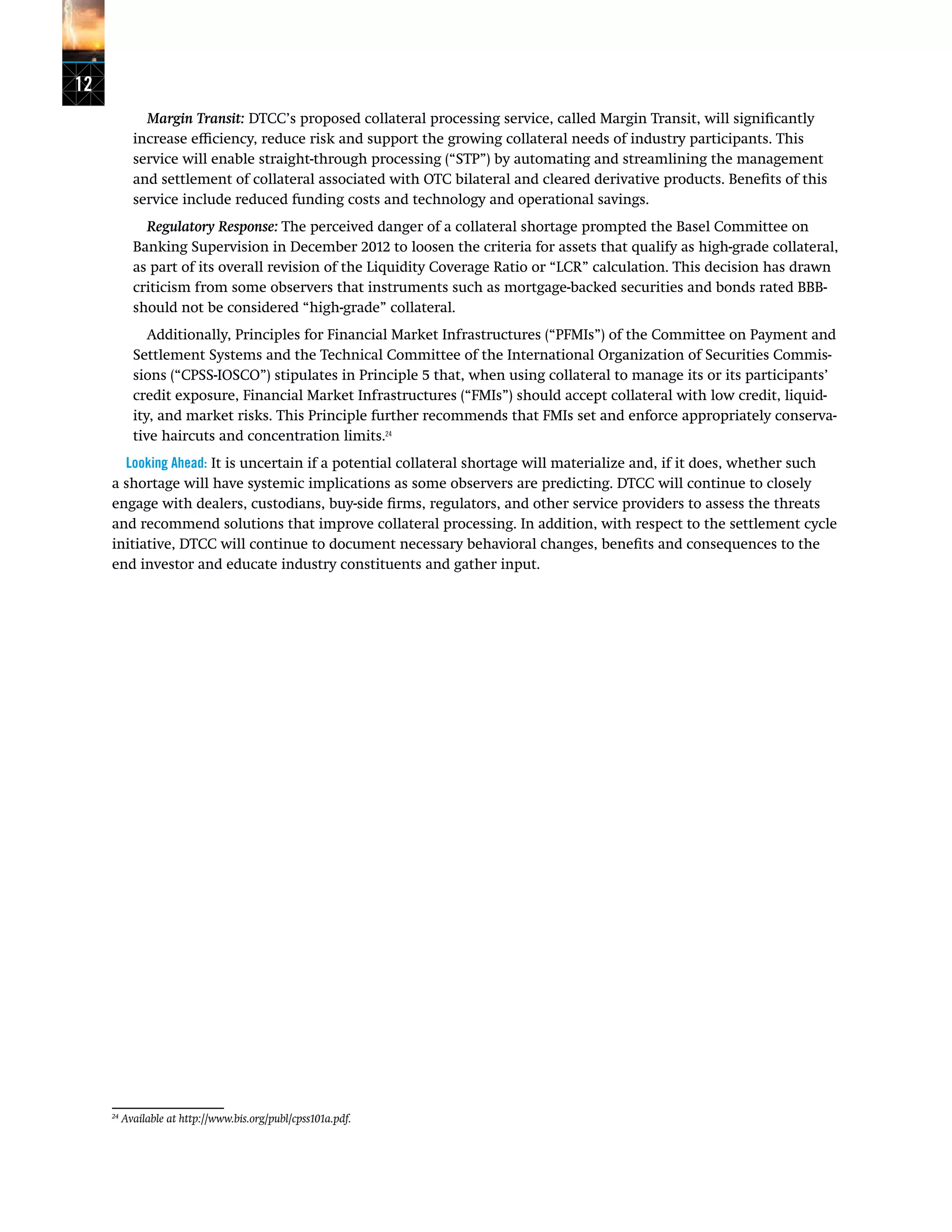
COLLATERAL
“Credit comes from the Latin ‘credere’, ‘to believe’, for credit is the
belief that the money you’re lending will someday be returned….”
–Robert Rowland Smith18
Background: Broadly speaking, the leverage and opacity associated with bilateral OTC derivatives are per-
ceived to have contributed to both the transmission and amplification of losses during the recent financial cri-
sis. In response, a series of new OTC derivatives regulations have been enacted, with the objective of increas-
ing resiliency and enhancing transparency in this market. Two key elements of Title VII of the Dodd-Frank
Act and of EMIR in Europe require the shifting of OTC derivative transactions to clearing agencies and central
counterparties, as well as the posting of higher capital amounts for non-centrally cleared derivative contracts.
Two important issues related to collateral should be considered in the effort to address these risks: (i) the
potential scarcity of high quality/liquid collateral in the future, and (ii) the need for significantly improved
transparency and efficiency within the collateral management process.
Potential Scarcity of Collateral: The U.S. Office of the Comptroller of the Currency estimated that initial margin
requirements could total over US$2 trillion globally under certain circumstances. Other industry estimates related to
the Dodd-Frank Act in the U.S. and EMIR in Europe indicate a potential need for additional collateral of between US$4
and US$5 trillion in USD equivalents globally.
At the same time, the International Monetary Fund has estimated that sovereign downgrades could reduce the sup-
ply of collateral by up to US$9 trillion by 2016.19
The increased demand for high-quality liquid assets may force some
firms, in order to continue to participate in clearing, to borrow these assets by pledging less-liquid assets like equities
or corporate debt. Moreover, borrowing may become even more difficult because banks may soon face their own
funding pressures as a result of Basel III’s capital and liquidity buffers.
Although the benefits of reducing aggregate unsecured risk in the market should not be minimized, the looming
shortage of quality collateral, fueled by the move toward a centrally cleared environment for derivatives, is emerging
as a critical challenge for the industry. If this risk materializes, it could create a vicious cycle should a regional collat-
eral shortage quickly become a global shortage that is more systemic in scope and severity.
Increased margin requirements during stressed market periods may have a serious impact on market liquidity.
Forced selling of assets by counterparties in order to generate more cash to fund margin requirements during market
disruptions adds to economic and market stress. Such actions could exert further downward pressure on asset prices,
resulting in additional collateral requirements.
Operational Inefficiencies/Lack of Transparency: The second area of concern relates to (i) the need for more scalable
margin processes, (ii) the lack of transparency and certainty regarding the settlement of daily margin obliga-
tions, leading to challenges in forecasting funding needs, (iii) the challenges of coping with the increased
18
Consultant, writer, lecturer on philosophy and literature.
19
International Monetary Fund, Global Financial Stability Report, April 2012.
11
liquidity drain in the future, and (iv) the fact that managing the settlement of payments has become a major
pain point (i.e., it continues to rely on manual processes including faxes, data entry into various proprietary
custody systems, emails and telephone calls).
DTCC/Industry Actions: In response to the expected growing level of challenges associated with collateral man-
agement in the near future, DTCC suggests that the industry focus its efforts on the following core goals:
•	 Enhanced transparency of collateral availability, collateral location and collateral values;
•	 Efficient processing of global movements of cash and securities settlement via Margin Transit; and
•	 Aggregated regulatory and risk reporting through “living will” reporting, trade repository record keep-
ing, collateral record keeping, exposure calculation and public benchmarking.
DTCC has been involved in initiatives that will address risks related to collateral and is undertaking, in
conjunction with other industry participants, a detailed study related to developing services within DTCC’s
existing platforms that could improve the quality of collateral transparency. Services under consideration in-
clude enhancing dispute identification and resolution around collateral mark-to-market issues and enhancing
straight-through processing. Additional initiatives include:
NYPC: DTCC commenced its efforts to improve collateral efficiency for the industry with the forma-
tion of New York Portfolio Clearing, LLC (“NYPC”) in 2010.20
NYPC has a cross-margining arrangement
with DTCC’s FICC subsidiary under which a clearing Member that is also a Member of FICC (or that has a
permitted affiliate that is a Member of FICC) may elect to have its positions in eligible cash securities cross-
margined against NYPC-cleared futures positions.21
Shortened Settlement Cycle Initiative: An industry initiative aimed at shortening the settlement cycle
could also help to address the risks related to collateral, particularly as they relate to posting margin. For
example, NSCC collects margin for its Clearing Fund in order to cover the potential loss of liquidating a de-
faulting Member’s open portfolio. NSCC has measured the amount of margin it would collect in a normal
environment and a stress environment in a T+3 versus T+2 and T+1 settlement cycle. According to a recent
study, NSCC’s Clearing Fund requirements would be reduced 15% or 25% in an average environment and
reduced 24% or 37% in a stress environment for T+2 and T+1, respectively.22
DTCC and Euroclear: In May 2013 DTCC and Euroclear announced the creation of a joint service aimed at
alleviating a growing industry-wide strain on liquid collateral. The firms signed a memorandum of under-
standing that will allow them to create a single pool of collateral and increase the mobilization of assets
around the global financial system. DTCC and Euroclear will establish mutual technology links that will
enable client firms, such as broker-dealers, to manage collateral assets held at both firms’ depositories as a
single pool. By pooling assets within a single system, dealers will be able to move their assets between the
U.S. and Europe during European and American trading hours.
EMCF and EuroCCP: A recently executed business combination between European clearing houses
European Multilateral Clearing Facility NV (“EMCF”) and DTCC’s European subsidiary, European Central
Counterparty Ltd. (“EuroCCP”), could help make clearing and settlement more efficient in Europe and lead
to the reduction of collateral obligations as a result of portfolio margining and a single guaranty fund. In
addition, economies of scale are expected from increased processing volumes, reduction in costs through
system rationalization and more efficient netting, which may lead to reduced margin requirements.23
20
NYPC is a joint venture derivatives clearinghouse organized as a Delaware limited liability company and owned equally by NYSE Euronext and DTCC.
21
The “one-pot” cross-margining arrangement between NYPC and FICC allows (i) joint clearing members and (ii) clearing members and their cross-margining
affiliates to have their margin requirements for eligible NYPC and FICC positions determined on a combined basis, with NYPC and FICC each having a security
interest in clearing members’ margin deposits and other collateral to secure clearing members’ obligations to NYPC and FICC.
22
The Boston Consulting Group, commissioned by DTCC, “Cost Benefit Analysis of Shortening the Settlement Cycle,” October 2012. http://www.dtcc.com/down-
loads/leadership/whitepapers/BCG_2012.pdf
23
Current owners of EMCF – ABN AMRO Clearing Bank and NASDAQ OMX – and current owner of EuroCCP – DTCC – along with BATS Chi-X Europe have
entered into a memorandum of understanding to become equal shareholders in the new combined clearing house.
12
Margin Transit: DTCC’s proposed collateral processing service, called Margin Transit, will significantly
increase efficiency, reduce risk and support the growing collateral needs of industry participants. This
service will enable straight-through processing (“STP”) by automating and streamlining the management
and settlement of collateral associated with OTC bilateral and cleared derivative products. Benefits of this
service include reduced funding costs and technology and operational savings.
Regulatory Response: The perceived danger of a collateral shortage prompted the Basel Committee on
Banking Supervision in December 2012 to loosen the criteria for assets that qualify as high-grade collateral,
as part of its overall revision of the Liquidity Coverage Ratio or “LCR” calculation. This decision has drawn
criticism from some observers that instruments such as mortgage-backed securities and bonds rated BBB-
should not be considered “high-grade” collateral.
Additionally, Principles for Financial Market Infrastructures (“PFMIs”) of the Committee on Payment and
Settlement Systems and the Technical Committee of the International Organization of Securities Commis-
sions (“CPSS-IOSCO”) stipulates in Principle 5 that, when using collateral to manage its or its participants’
credit exposure, Financial Market Infrastructures (“FMIs”) should accept collateral with low credit, liquid-
ity, and market risks. This Principle further recommends that FMIs set and enforce appropriately conserva-
tive haircuts and concentration limits.24
Looking Ahead: It is uncertain if a potential collateral shortage will materialize and, if it does, whether such
a shortage will have systemic implications as some observers are predicting. DTCC will continue to closely
engage with dealers, custodians, buy-side firms, regulators, and other service providers to assess the threats
and recommend solutions that improve collateral processing. In addition, with respect to the settlement cycle
initiative, DTCC will continue to document necessary behavioral changes, benefits and consequences to the
end investor and educate industry constituents and gather input.
24
Available at http://www.bis.org/publ/cpss101a.pdf.
13
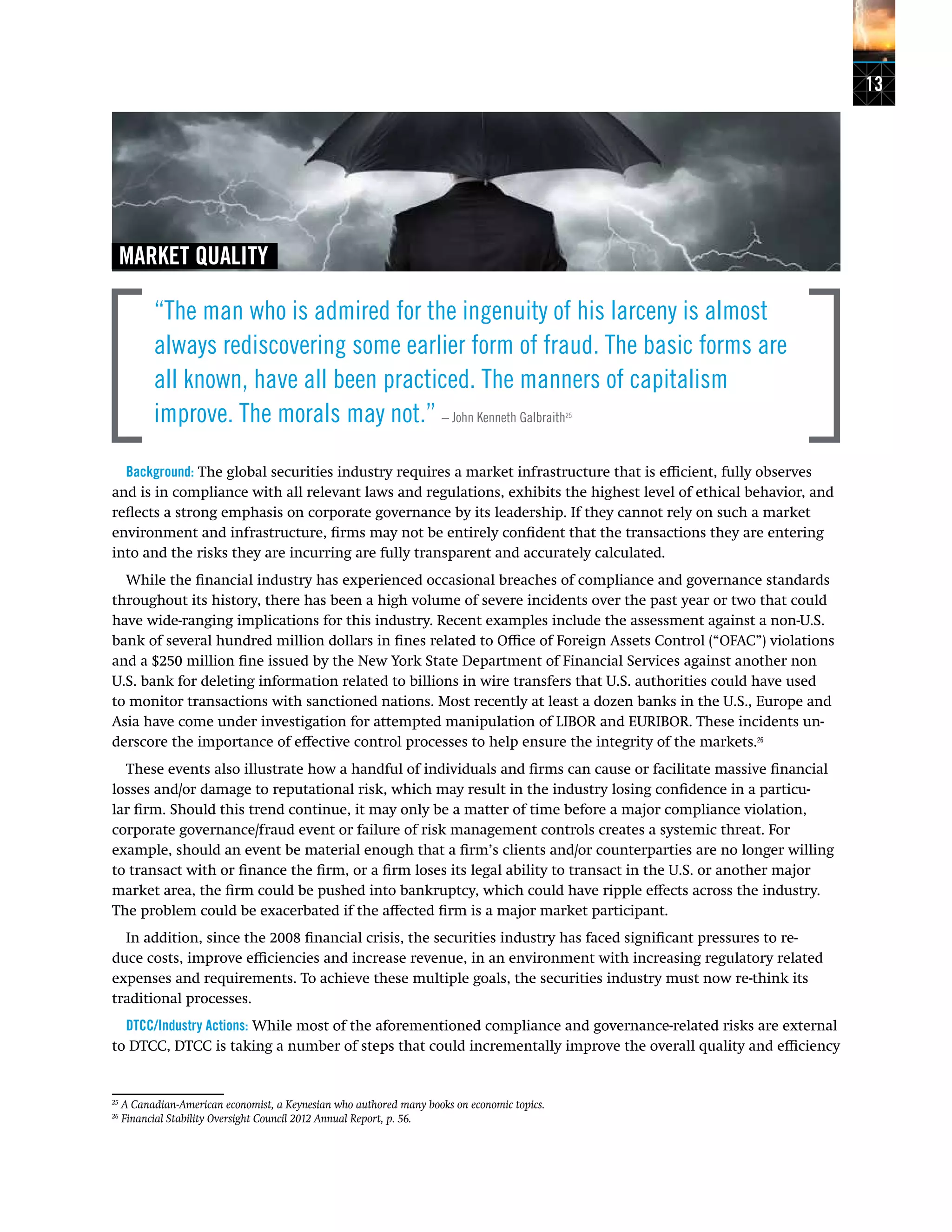
MARKET QUALITY
“The man who is admired for the ingenuity of his larceny is almost
always rediscovering some earlier form of fraud. The basic forms are
all known, have all been practiced. The manners of capitalism
improve. The morals may not.” – John Kenneth Galbraith25
Background: The global securities industry requires a market infrastructure that is efficient, fully observes
and is in compliance with all relevant laws and regulations, exhibits the highest level of ethical behavior, and
reflects a strong emphasis on corporate governance by its leadership. If they cannot rely on such a market
environment and infrastructure, firms may not be entirely confident that the transactions they are entering
into and the risks they are incurring are fully transparent and accurately calculated.
While the financial industry has experienced occasional breaches of compliance and governance standards
throughout its history, there has been a high volume of severe incidents over the past year or two that could
have wide-ranging implications for this industry. Recent examples include the assessment against a non-U.S.
bank of several hundred million dollars in fines related to Office of Foreign Assets Control (“OFAC”) violations
and a $250 million fine issued by the New York State Department of Financial Services against another non
U.S. bank for deleting information related to billions in wire transfers that U.S. authorities could have used
to monitor transactions with sanctioned nations. Most recently at least a dozen banks in the U.S., Europe and
Asia have come under investigation for attempted manipulation of LIBOR and EURIBOR. These incidents un-
derscore the importance of effective control processes to help ensure the integrity of the markets.26
These events also illustrate how a handful of individuals and firms can cause or facilitate massive financial
losses and/or damage to reputational risk, which may result in the industry losing confidence in a particu-
lar firm. Should this trend continue, it may only be a matter of time before a major compliance violation,
corporate governance/fraud event or failure of risk management controls creates a systemic threat. For
example, should an event be material enough that a firm’s clients and/or counterparties are no longer willing
to transact with or finance the firm, or a firm loses its legal ability to transact in the U.S. or another major
market area, the firm could be pushed into bankruptcy, which could have ripple effects across the industry.
The problem could be exacerbated if the affected firm is a major market participant.
In addition, since the 2008 financial crisis, the securities industry has faced significant pressures to re-
duce costs, improve efficiencies and increase revenue, in an environment with increasing regulatory related
expenses and requirements. To achieve these multiple goals, the securities industry must now re-think its
traditional processes.
DTCC/Industry Actions: While most of the aforementioned compliance and governance-related risks are external
to DTCC, DTCC is taking a number of steps that could incrementally improve the overall quality and efficiency
25
A Canadian-American economist, a Keynesian who authored many books on economic topics.
26
Financial Stability Oversight Council 2012 Annual Report, p. 56.
14
of the securities marketplace. For example, in response to industry concerns regarding heightened risk aware-
ness and regulatory compliance, DTCC is analyzing plans to introduce the following:
•	 Customer Data & Documentation (CDD), or central collection and validation of institutional customer docu-
ments and data for onboarding/maintenance, is targeted for rollout in 2013 and expected to contribute
significantly to improving governance in the securities industry.
•	 Standing Settlement Instructions (SSI), which will involve the central maintenance of a “golden copy”
of all standard settlement instructions on a broader scale than is currently available.
•	 Trade Processing Utility (TPU), which is (i) an outsourcing facility for common institutional trade pro-
cessing functions performed by broker-dealers extending from notice of execution (NOE) to creation of
initial settlement instructions, and (ii) a settlement utility to process all settlement transactions in the
local market with the CSD/Agent.
Regulatory Response: This year, the U.S. Department of Justice’s case against a large U.K. bank highlighted the
potential risks associated with the business non-U.S. financial institutions transact through their U.S. affiliates.
Key priorities of the SEC’s 2013 National Examination Program (“NEP”) include two of the core aspects of
market conduct: (i) fraud detection and prevention, and (ii) corporate governance and enterprise risk man-
agement. With respect to fraud detection and prevention, in its risk-based approach to targeting registrants
and business practices, the NEP will continue to utilize and enhance its quantitative and qualitative tools and
analyses to seek to identify market participants engaged in fraudulent or unethical behavior. With respect to
corporate governance and enterprise risk management, the NEP will continue to meet with senior manage-
ment and Boards of Directors of entities registered with the SEC and their affiliates to discuss enterprise risk
and, in particular, how firms govern and manage financial, legal, compliance, operational and reputational
risks. For example, the SEC has joined the Federal Reserve in monitoring reform of tri-party repurchase agree-
ments and practices.27
In FINRA’s 2013 exam priorities letter, examiners noted the agency’s continued focus on Anti-Money Laun-
dering (AML) compliance, particularly at firms with higher-risk business models due to their clients, products
and service mix, or location in which they operate.
Other sections of this white paper also address market conduct issues indirectly. For example, the sections
regarding High Frequency Trading and Cyber Security refer to specific regulatory developments aimed at im-
proving overall market standards. Consequently, this section is not intended to serve as an exhaustive review
of all regulatory developments related to this risk.
Looking Ahead: No easy or single solution exists to address the inherently broad issue of market quality and
conduct. This risk is complicated by the fact that one aspect of this topic, fraud, represents a human behavior
that has historically proven to be a challenge to identify and prevent. Nonetheless, because firms and individ-
uals involved in breaches of conduct have suffered both financial and reputational damage by that conduct,
and because global, regional and national regulators are paying close attention to such issues, there may be
reason to expect the overall quality of market conduct to improve incrementally going forward.
27
National Examination Program (“NEP”) of the Office of Compliance, Inspections and Examinations, February 21, 2013.
15
LIQUIDITY RISK
“We (e.g., central banks) must keep a great store of ready money
always available, and advance out of it very freely in periods of
panic, and in times of incipient alarm.” –Walter Bagehot28
	
Background: The actions and responsibilities of DTCC’s subsidiaries impact global liquidity in a multitude of
ways and, while the attractiveness of these entities for the marketplace lies in their risk mitigation strategies,
these strategies have inherent risks themselves.
This section of the White Paper discusses potential risks resulting from the activities of DTCC subsidiar-
ies DTC, NSCC, FICC/GSD and FICC/MBSD along with mitigants to these risks, and the context of the benefits
those activities present.
Liquidity Impacts from a Member Default:
In a bilateral securities trade the failure of the purchasing counterparty poses two immediate risks to the
non-defaulting counterparty: market risk from having to replace the transaction in the market; and fund-
ing risk from not receiving the cash on settlement date as expected. While the role of DTCC’s subsidiaries in
managing market risk is well known, DTC, NSCC, FICC/GSD and FICC/MBSD also seek to maintain sufficient
resources to satisfy the purchase obligations of failed Members so that non-defaulting Members are paid for
their deliveries. The liquidity mitigation measures differ across DTC, NSCC, FICC/GSD and FICC/MBSD due to
their differing market structures and security types:
Securities Depository: DTC‘s Participants are subject to “net debit caps.” These caps limit the size of the
net settlement debit any Participant or family of Participants can incur or owe to DTC. Once the cap is
reached, no more valued purchase obligations will be processed for that Participant until it either pays
cash intraday (a “settlement progress payment”) or generates credits. Settlement debits must be fully col-
lateralized for each Participant.
DTC currently limits the maximum net debit cap per Participant to $1.8 billion and per affiliated family
to $3 billion. DTC maintains liquid resources in excess of $3 billion in the form of a cash Participants Fund
of $1.3 billion and a committed credit facility of $1.9 billion, to cover the maximum family debit. Further,
DTC may lower net debit caps on credit concerns or in the event DTC’s liquid resources become impaired.
In any case, the system is designed so that liquidity resources will be sufficient to complete system wide
net settlement among non-defaulting Participants despite the failure of the largest Participant family to
pay its net settlement debit.
Central Counterparties: DTCC determines its liquidity needs based on observed historical peaks, updated
daily. The settlement cycles at NSCC, FICC/GSD and FICC/MBSD mean that potential liquidity needs are
28
19th
Century British journalist who wrote extensively about economics and government.
16
driven by cash obligations for securities deliveries as the defaulting member’s portfolio may not be in a
position to deliver securities to generate credits incorporated into the net settlement amount. DTCC’s CCPs
employ different methodologies to address funding requirements in the event of a Member default but one
common factor is their ability to borrow from the respective Clearing Fund as necessary. In the aftermath
of a sudden, unexpected Member default these funds will typically increase due to higher market volatility
leading to higher initial and variation margins. This will provide additional liquid resources to reduce the
likelihood of drawing on back-up liquidity.
It is also important to note that through the settling all of the long positions of the defaulting Member,
an amount that is greater than the projected net settlement amount of the defaulting Member, the CCPs
are also temporarily releasing excess liquidity into the marketplace at a time of stress until the portfolio
liquidation is complete.
NSCC: In addition to the Clearing Fund, NSCC maintains a committed credit facility (currently $12.7 billion).
The facility is backed by a consortium of banks including Members and non-Members of NSCC. The facil-
ity provides access to same-day funds on a committed basis at known costs and pre-set collateral haircuts.
As securities in NSCC generally settle on a standard T+3 settlement cycle, NSCC may also generate liquidity
through shortened settlement cycle sales (T+1 / T+2) as needed.
FICC/MBSD: In addition to its Clearing Fund, FICC/MBSD maintains master repurchase agreement (“repo”)
relationships with a selection of market participants which permit FICC/MBSD to source funding in the liquid
agency MBS repo market if necessary. Also, due to the nature of the TBA market, unless a Member failed im-
mediately prior to a Class Settlement Day, FICC/MBSD would have the opportunity to reduce the defaulting
Member’s positions prior to settlement day.
In the event that the agency MBS repo market is impaired and FICC/MBSD is unable to decrease the posi-
tions prior to settlement, FICC/MBSD maintains a Capped Contingency Liquidity Facility that mandates Mem-
bers to provide committed funding up to predefined levels based on activity.
FICC/GSD: In addition to its Clearing Fund, FICC/GSD maintains repo relationships with a selection of mar-
ket participants. The repo market capacity exceeds $2 trillion per day. In addition to providing the GCF Repo
tri-party repo product, FICC/GSD regularly monitors the health and historical capacity of the repo market and
its ability to absorb potential funding requirements at FICC/GSD in the event of a Member default.
Liquidity Impacts from DTCC Funding Activities
Drawdown of committed facilities: DTC and NSCC maintain a syndicated committed credit facility and FICC/
MBSD, as part of its Rules, maintains the Capped Contingency Liquidity Facility. Drawing upon these facilities
would likely only occur during times of market turmoil surrounding a Member default. The DTC/NSCC credit
facility and the FICC/MBSD Capped Contingency Liquidity Facility have never been drawn on.
Mitigants:
•	 Commitments are capped at pre-defined levels, which allows facility lenders to incorporate the expo-
sure into their liquidity planning. Due to the nature of these facilities, this planning should encompass
times of market stress;
•	 To the extent that affected firms are Members of the CCPs, they will benefit from the timely payment
of their securities deliveries;
•	 Facility commitments are provided by a wide range of entities ensuring, significant geographic diver-
sification. To the extent that a market dislocation affects only one particular sector or location, this
diversification should reduce the risk of a systemic event.
Use of Cash Collateral: The CCPs invest cash deposits overnight in the marketplace. In the event of a Member
default, this cash may be applied to fund settlement and withdrawn from the overnight cash market.
17
Mitigants:
•	 DTCC’s CCPs only invest collected deposits for overnight term and so this potential roll-over risk will
be incorporated into the liquidity plans of the CCPs’ investment counterparties;
•	 To the extent that affected firms are Members of the CCPs they will benefit from the timely payment
of their securities deliveries.
Market Action: The CCPs may take market action such as repo financing or shortened settlement sales. Such
action may put pressure on the financing markets.
Mitigants:
•	 FICC regularly monitors the depth of the repo market for applicable securities to ensure that they
could likely withstand required volumes;
•	 In a default situation, FICC will generally be replacing the defaulting market participant when FICC
comes to the repo market so it may not be adding incremental volumes;
•	 While DTCC is confident that shortened settlement transactions will be available, such transactions
are on a best-efforts basis;
•	 To the extent that affected firms are Members of the CCPs they will benefit from the timely payment
of their securities deliveries.
Liquidity Impacts from Collateral Collection
In order to mitigate losses to the CCPs and non-defaulting Members in the event of a Member default, DTCC’s CCPs
collect collateral broadly based on the relative ‘riskiness’ of the Members and their portfolios of guaranteed transactions.
Large market moves and periods of increased volatility will generally result in increased collateral requirements to
cover actual mark-to-market losses on portfolios and potential losses from further market moves during the liquida-
tion period in the event the CCP needs to liquidate the portfolio following a Member default. It is likely that this will
occur in conjunction with enhanced collateral calls from other industry utilities and bilateral agreements. Industry
utilities generally hold this collateral rather than pass it through to counterparties, resulting in a potentially signifi-
cant net drain of liquidity from market participants during times of general market stress.
To some extent this pro-cyclicality is unavoidable without setting collateral requirements at levels to protect utili-
ties ‘through-the-cycle’, essentially locking up the collateral in advance and permanently reducing liquidity stocks.
Mitigants:
•	 Where large calls are driven by a sudden market dislocation impacting the mark-to-market of the cur-
rent portfolio, this will be released as the positions settle (e.g., within three days at NSCC for a stan-
dard settling position);
•	 Increased collateral requirements reduce the likelihood of drawing on committed facilities in the
event of a Member default;
•	 Cash collected in satisfaction of increased collateral requirements, in the absence of a default, will be
invested back in the market overnight;
•	 Increased collateral requirements reduce the exposure to individual Members and families within the
CCP. In the event of a default the additional collateral provides additional protection to the non-de-
faulting Members from losses attributable to the defaulting Member;
•	 DTCC’s CCPs have incorporated forward-looking indicators as part of its credit and market risk surveil-
lance – such as credit default swap spreads, equity price changes, and market-implied volatility. These
can be used to supplement market data and financial reporting that are lagging economic or credit indi-
cators. Leading indicators may provide signals of emerging market risk or credit deterioration.
18
CCPs AS SINGLE POINTS OF CONCENTRATION
“Having concentrated risk on the clearing house, it must be
redistributed back to market participants in ways that are clear and
which incentivize market discipline. Otherwise CCPs would be too big
or too important to fail.” –Paul Tucker29
Background: DTCC’s services cover a very large portion of securities activities in the United States and a
portion of equity transactions in Europe. For example, through its subsidiaries, DTCC clears and settles ap-
proximately US$1.5 quadrillion in transactions per year, safe keeps and services US$40 trillion in securities
on deposit and processes US$3 trillion worth of entitlement payments (dividends, redemptions and corporate
actions). As such a critical infrastructure for the securities industry, DTCC bears responsibility for providing
ongoing transparency to the industry about the risks its subsidiaries pose to the market, the risk management
tools and processes in place to reduce such risks and the residual risks that cannot be fully mitigated.
Starting in 2011, DTCC has been publishing regularly updated Member risk handbooks covering its U.S. sub-
sidiaries DTC and NSCC, along with MBSD and GSD (together known as FICC). These handbooks are just one
part of DTCC’s overall Member transparency program, the goal of which is to ensure that Members have suf-
ficient information about the risks they face in transacting through DTCC’s subsidiaries. Other aspects of this
program include periodic white papers, bilateral meetings with Members on systemic risk topics and periodic
meetings with DTCC’s Risk Advisory Council, to name a few.30
Some of the specific risks DTCC Members are exposed to as a result of their membership are covered in
more detail elsewhere in this paper (including the sections on Liquidity and Interconnectedness). This section
covers the broader impact of a potential insolvency of a DTCC subsidiary on the financial industry as a whole.
DTCC/Industry Actions: Due to the systemically important status of DTC, NSCC and FICC, the insolvency of one or
more of these entities could have a significant impact on the financial system. Consequently, it is a matter of best
practice for DTCC to understand the implications of such an event, even if the probability is remote. The assess-
ment of this risk entails analyzing the types of potential insolvency proceedings that may be applicable to DTCC’s
subsidiaries under pre-existing law and in light of the relevant Dodd-Frank Act provisions. It also requires anticipat-
ing the types of transactions that would likely be outstanding at the time of distress or insolvency.
DTCC is in the process of creating a comprehensive set of recovery and resolution plans (“R&R plans”) for each
of its SIFMU subsidiaries. With regard to “recovery,” the initial goals of these plans are to: (i) moderate or eliminate
the risk of funding deficiency or financial loss caused by multiple Member failures; (ii) augment current-state miti-
29
Deputy Governor , Financial Stability, Bank of England Chairman, Basel Committee on Payment and Settlement Systems.
30
An informal advisory council comprised of representatives from 11 of DTCC’s Members, designed to advise DTCC on a wide range of risk-related issues.
19
gants against these risks, and/or otherwise support company resiliency in distress. Concerning “resolution,” DTCC’s
key objective includes: (i) continuation of the functions necessary for the continuation of settlement services and
other critical operations for future transactions, as well as orderly settlement of past transactions (e.g., operations,
systems, applications, and data processing) and (ii) insulation of DTCC’s non-SIFMU subsidiaries and any solvent
SIFMU subsidiaries from the resolution proceedings of one or more SIFMU subsidiaries.
Regulatory Response: One of the core goals of CPSS-IOSCO’s new Principles for Financial Market Infrastructures
(“FMIs”) is to ensure that FMIs operate as smoothly as possible in normal circumstances and in times of market
stress.31
Under CPSS-IOSCO’s Principles 3 and 15, an FMI should prepare appropriate plans for its recovery or orderly
wind-down based on the results of its self-assessment against such principles. Where applicable, an FMI should also
provide relevant authorities with the information needed for purposes of resolution planning. Additionally, an FMI
should maintain sufficient liquid net assets funded by equity to implement this plan.
Looking Ahead: Given its long history of sound financial and operational performance through many business
cycles and credit events (e.g., Lehman, MF Global), DTCC is confident in its ability to sustain business opera-
tions through volatile market periods that might occur in the future. Nonetheless, in accordance with regula-
tory recommendations and best practices, DTCC will create R&R plans for its systemically important subsidiaries
and will work closely with its supervisors and Members as it formulates these plans.
31
Committee on Payment and Settlement Systems, Technical Committee of the International Organization of Securities Commissions, Principles for Financial
Market Infrastructures, April 2012.
20
INTERCONNECTEDNESS RISK
“When we try to pick anything out by itself, we find it hitched to
everything else in the universe.” –John Muir32
Background: DTCC and its subsidiaries rely on a vast network of interconnected entities to provide its services. This
network includes, but is not limited to, clearing and settling banks, liquidity providers, issuing and paying agents,
infrastructure providers, and a host of other organizations.
The various subsidiaries within the DTCC complex itself are also linked to each other (through several cross-margin-
ing, netting and other agreements) and to other external financial market infrastructures.
While these linkages greatly improve the effectiveness and efficiency of DTCC’s activities and processes, they create
a complex network of interdependent legal, credit, liquidity, and operational risks. They present another source of
systemic risk by increasing the potential for operational and other disruptions to spread quickly and widely – possibly
even beyond DTCC in a worst-case scenario.
A small number of large institutions provide crucial infrastructure and other services to DTCC’s subsidiaries, in ad-
dition to being Members of these subsidiaries themselves. As such, it is particularly important to focus on concentra-
tion risk in this context.33
DTCC/Industry Actions: As mentioned earlier, DTCC plans to further enhance its risk management capabilities by creat-
ing a comprehensive set of R&R Plans for DTC, NSCC and FICC. These plans will describe in detail what should be
done in case a key interdependent entity fails to perform its core functions, not as a result of a temporary problem,
but due to its own insolvency or another irreversible event.
To this end, DTCC will analyze how risks can be transferred between interconnected entities, taking into account
the contractual agreements between such entities, as well as the volumes of securities movements and flows of funds
passing through them.
As part of this analysis, DTCC will also identify limits in what it can do to mitigate certain risks that are inherent to
the structure of the market in which it operates. The concentration of the clearing bank business that supports FICC’s
activities, where only two such banks remain after several rounds of market consolidation, is a good example of struc-
tural concentration risk that cannot be readily mitigated by DTCC.
Regulatory Response: Recently published recommendations by CPSS-IOSCO explicitly reflect concerns about intercon-
nectedness risks and mandate that financial market infrastructures develop appropriate risk-management tools to
monitor and address these risks.
Looking Ahead: DTCC’s R&R Plans will explicitly address interconnectedness risks by describing what should be done
if a key interconnected entity fails. Analyzing, monitoring and mitigating the full array of interconnectedness risks
on an ongoing basis is the next step towards enhancing DTCC’s risk management practices. This is a complex chal-
lenge that will require a multi-year effort, as well as close and continued coordination with industry participants and
regulators alike. The need to look at risks holistically rather than in isolation is at the core of DTCC’s commitment to
monitor and manage systemic risks.
32
naturalist and conservationist
33
The reliance on a limited number of settling banks presents concentration risk that may materialize in case of default or operational failure. Another example
of concentration risk can be found in the process of handling entitlement payments. For this process, DTC depends on a widespread network of paying agents
to process $3 trillion worth of entitlement payments (dividends, principal and interest payments, redemptions and corporate actions) per year. This activity has
become increasingly concentrated over the past decade, resulting in the associated operational risk becoming similarly concentrated.
21
SECURITIES SETTLEMENT
“Only in growth, reform, and change, paradoxically enough, is true
security to be found.” – Anne Morrow Lindbergh34
Background: To further reduce systemic risk, DTC has identified a number of major structural modifications,
described below, that will improve intraday finality and fundamentally alter the way trades in equities, corporate
debt and municipal debt securities are settled in the U.S. These enhancements incorporate the recently published
recommendations by CPSS-IOSCO and are multi-year projects representing DTC’s vision for the future of settle-
ment finality and risk reduction. They are expected to further improve the safety and soundness of the U.S. system
for years to come, while at the same time aligning DTC’s settlement system more closely to global standards.
DTCC/Industry Actions: In order to allow its Participants to project resource needs over the next five years, DTC
published a proposed implementation timeline for each enhancement in December 2012 as part of a white
paper entitled “A Roadmap for Promoting Intraday Settlement Finality in U.S. Markets.”35
Given that some of these
enhancements are still being refined and more detailed descriptions will follow at a later date, they are de-
scribed below at a high level:
Settlement matching will require receiving DTC Participants to match (authorize or approve) Deliver
Order (DO) and Payment Order (PO) transactions prior to DTC attempting to process transactions, reducing
the need for reclamation transactions (reclaims). It also eliminates the credit and liquidity risk associated
with certain reclaims that are currently permitted to bypass DTC’s collateral and net debit cap controls.
Once matching is extended to all valued DOs and POs, reclaims will not be permitted to override controls
since the receiver will have agreed to the transaction prior to receiving it. Settlement matching, which is
the global standard used in almost every other major central securities depository and international cen-
tral securities depository throughout the world, will be extended in a manner that promotes institutional
trade affirmation and encourages STP for institutional transactions. Implementation will be achieved by
leveraging the existing infrastructure in place to match/affirm institutional transactions and to submit
transactions, via an automated STP process, to DTC for settlement.
CNS for Value will seek to modify the way transactions resulting from NSCC’s Continuous Net Settle-
ment (CNS) service are processed in DTC. With CNS for Value, CNS transactions will be processed as valued
transactions in DTC instead of the current free of payment transactions. The proposed CNS for Value
enhancement eliminates risk in DTC by reducing the contagion risk that losses in DTC or NSCC could spill
over into each other. CNS for Value also offers participants greater intraday liquidity efficiency by allowing
Members’ NSCC credits to offset their DTC debits and provides DTC and NSCC with better risk monitor-
ing tools. Additionally, it positions DTC to introduce alternative settlement models (e.g., multiple intraday
34
American author, aviator, and spouse of fellow aviator Charles Lindbergh
35
http://www.dtcc.com/downloads/leadership/whitepapers/Settlement_White_Paper_Dec_10.pdf
22
settlement slices and settlement prefunding) at a later date should such models be warranted.
Improving intraday finality for MMI transactions will be achieved through structural changes to DTC’s
Money Market Instruments (MMI) program. These program modifications, which are designed to address
concerns expressed by an industry-established Blue Sky MMI Task Force, will align issuance and maturity
activity within specific issuers, thus eliminating the need for intraday reversals of processed MMI activ-
ity in case an MMI issuer fails. By eliminating MMI reversals, intraday settlement finality will be further
enhanced.
The Shortened Settlement Cycle initiative analyzes the business case for shortening the settlement cycle
for U.S equity and corporate and municipal debt transactions from its current three days (T+3) to two days
(T+2) or one day (T+1). Shortening the settlement cycle would reduce market risk associated with trades
between trade date and settlement date as well as reduce liquidity and collateral requirements. In addi-
tion, many of the “enablers” associated with shortening the settlement cycle, such as settlement matching
described above, would further reduce risk and costs by improving straight-through processing.
Looking Ahead: Settlement matching will be implemented in phases from the second quarter of 2013 through
2014. A full description of the various phases and a detailed implementation timeline can be found in DTCC’s
white papers and subsequent Important Notices36
.
The CNS for Value business case will be completed in the fourth quarter of 2013. If the business case war-
rants further advancement of the initiative, a Service Description and timeline will be available in the fourth
quarter of 2013.
Improving intraday finality for MMI transactions will be achieved through a phased approach out to the
first quarter of 2015, which is described in a DTCC white paper.37
The shortened settlement cycle paper, issued by DTCC in October 2012, outlines the findings of an industry
study and identifies proposed next steps. DTCC plans to continue vetting the results of this study and present
an industry recommendation in the second half of 2013.38
36
http://www.dtcc.com/downloads/legal/imp_notices/2013/dtc/set/0847-13.pdf
37
http://www.dtcc.com/downloads/leadership/whitepapers/MMI_Whitepaper_11Dec12.pdf
38
Boston Consulting Group study. http://www.dtcc.com/downloads/leadership/whitepapers/BCG_2012.pdf
23
BUSINESS CONTINUITY RISK
“Know your enemy and know yourself and you can fight a hundred
battles without disaster.” –Sun Tzu39
Background: Under the Dodd-Frank Act, DTCC subsidiaries FICC, NSCC and DTC are designated as SIFMUs, spe-
cific to their core clearing and settlement activities for the U.S. market. To support this important role, DTCC
employs a Business Continuity Management (“BCM”) program that is designed to recover and resume services
following a catastrophe. As a key industry leader and participant, DTCC is currently taking steps to increase
resiliency across the enterprise and the sector, enhancing the effectiveness of the program.
As evidenced by Superstorm Sandy, DTCC and its industry partners need to continually consider and plan
for the impact of events that may appear to have a low probability of occurrence. Accordingly, DTCC’s Board
and internal management have recently undertaken an initiative that will support the organization’s ability
to recover and resume core services and business support activities in ways that are commensurate with the
risk to the enterprise and the sector. In doing so, DTCC hopes to ensure that sub-sectors it supports have the
appropriate resilience. The lack of a robust BCM program could engender systemic risk if DTCC was unable to
recover operations in a timely manner, creating a ripple effect across product offerings and the sector.
DTCC Actions: To strengthen its BCM program, DTCC launched an initiative called “BCM 3.0” in 2012. Its
primary goals include:
•	 Creation of a risk-based approach to BCM;
•	 Elimination of possible control gaps through:
i)	 Integration of recovery plans to a singular view of personnel, facilities, and infrastructure;
ii)	 Mapping of discrete assets to business processes;
iii)	 Creation of a comprehensive exercise program that tests end-to-end processes;
iv)	 Transition to a more nuanced set of impact scenarios.
Looking Ahead: DTCC’s current BCM practices have been time-tested and proven, and allowed the organization
to continue to provide critical clearing and settlement services to the industry, most recently during Super-
storm Sandy. In addition, the aforementioned BCM 3.0 initiative includes several significant 2013 milestones
that will further enhance DTCC’s capability to address physical events in the near term.
39
Ancient Chinese military general and strategist
24
SHADOW BANKING
“Shadow banking, over-the-counter derivatives,
these are the areas that absolutely amplified
the last crisis and will do so again unless we
complete our agenda.” – Mark Carney40
Background: The term shadow banking is generally used to categorize seg-
ments or activities within the financial services industry that perform credit
intermediation outside the traditional banking system both directly and
through their interconnectedness with the banking system.
Only a portion of shadow banking is conducted by firms and the remainder is facilitated by markets, in
particular wholesale short-term funding markets. A few examples include hedge funds, money market funds
or other vehicles with deposit-like characteristics, finance or insurance companies providing credit guarantees
and structured investment vehicles (“SIVs”).
According to the FSB, non-bank financial intermediation grew rapidly before the crisis (in parallel with the
regular banking system), from an estimated Euro 26 trillion in 2002 to Euro 51 trillion in 2011, representing
25% to 30% of the total financial system and half the size of bank assets.
Furthermore, shadow banking activities may also grow with the implementation of the new Basel III and Solven-
cy II prudential requirements, which impose additional obligations on traditional banks and insurance companies.
Shadow banking activities may bring certain benefits to the economy -- for example, providing investors al-
ternatives to bank deposits, alternative funding for the real economy, risk diversification and the channeling
of resources towards specific needs. However, DTCC is concerned that these activities may pose risk to finan-
cial stability should, for example, a non-bank financial institution become financially stressed and lack access
to central bank liquidity. This situation could cause liquidity to dry up suddenly in the broader industry.
Problems in the shadow banking sector can potentially lead to liquidity and solvency issues of the regulated
entities through interconnections. For example, during the financial crisis many banks needed to support
their money market funds and financial institutions were forced to provide financial support for Asset Backed
Commercial Paper programs.
Regulatory Response: G20 leaders identified shadow banking as one of the remaining issues of financial sector
regulation that warranted attention. In this context the FSB in November 2012 issued its second annual shad-
ow banking monitoring report to the G20, calling for greater control of shadow banking. This report focused
on the following five specific areas:
(i) 	 to mitigate the spill-over effect between the regular banking system and the shadow banking system;
(ii) 	 to reduce the susceptibility of money market funds to “runs”;
(iii) 	to assess and mitigate systemic risks posed by other shadow banking entities;
(iv) 	to assess and align the incentives associated with securitization; and
(v) 	 to dampen risks and pro-cyclical incentives associated with secured financing contracts, such as repos,
and securities lending that may exacerbate funding strains in times of “runs.”
In June 2013, the U.S. Securities and Exchange Commission (“SEC”) released for public comment its proposal
to further reform the regulatory structure governing money market funds and address the perceived systemic
risks money market funds present.
40
The current Governor of the Bank of England and the Chairman of the Financial Stability Board.
25
•	 The first piece of the SEC’s proposal would require prime funds used by institutional investors to tran-
sition from a stable $1 per share to a floating net asset value (NAV).
•	 The second proposal would give fund boards for institutional and retail funds the authority to impose
so-called “liquidity fees and redemption gates” during times of stress.
A draft proposal on a money market funds (MMFs) regulation from the European Commission is expected
to introduce new capital requirement rules for MMFs to ensure a minimum level of daily and weekly liquid
assets. The Commission is expected to propose that the maximum exposure an MMF may have to a single
counterparty will be 5% of the portfolio assets. Moreover, the concentration rules are expected to contain a
provision that MMFs have at most 25% exposure to a single repo counterparty. The aggregate amount of cash
provided to the same counterparty of an MMF in reverse repurchase agreements could not exceed 20% of its
assets. The Commission is expected to present its final proposal in 2013.
In 2012 the European Parliament adopted a resolution on shadow banking in response to the European
Commission’s 2012 Green Paper on the subject, noting the following: (i) the size of the global shadow banking
system represents 25% to 30% of the total financial system and (ii) the Commission’s Green Paper represents a
first step towards the stricter monitoring and supervision of shadow banking.
CPSS-IOSCO recommends additional safeguards for those MMFs using amortized cost accounting and offering
constant net asset value (CNAV) per share. Furthermore, CPSS-IOSCO recommends a conversion of CNAV MMFs
to floating NAV MMFs through limited use of amortized cost accounting only for assets maturing below 60 days.
Looking Ahead: DTCC is concerned that, should the substantial amount of pending regulation in the U.S. and
Europe prove ineffective or be significantly delayed, the industry will face similar vulnerabilities that precipi-
tated the 2008 financial crisis. As mentioned earlier, such regulation could also have unintended impacts; for
example, it could potentially drive down liquidty pools in the marketplace further straining the system.
DTCC will strive to contribute to risk mitigation related to shadow banking whenever practical. One such
example is DTCC’s participation in the industry’s LEI initiative, aimed at helping the industry more effectively
monitor and manage risk exposures.
EUROZONE RISKS
“While there is a much lower likelihood of
disorderly events in the euro zone, there are still
significant obstacles to deeper integration, as
well as country-specific economic and political
vulnerabilities.” –Nouriel Roubini41
Background: Across its risk organization DTCC is committed to ongoing
monitoring of potential contagion risks such as a financial crisis in the Eurozone. In recent months there has
been some modest improvement in the overall risk climate in the Eurozone, driven mainly by central bank
efforts, positive developments in Greece and the ability of other smaller Eurozone countries to hold a number
of successful bond auctions. These and other encouraging signs notwithstanding, as evidenced by the early
2013 brief banking crisis in Cyprus, periods of relative calm within the Eurozone can change in short order,
leading to serious turbulence and fragility in the global credit markets.
41
Cofounder and chairman of Roubini Global Economics, an independent, global macroeconomic strategy research firm.
26
Underscoring the above are the results of a recent survey of investors conducted by Fitch Ratings. Only 41%
of respondents believe the worst of the Eurozone crisis is over. The survey found that while sentiment towards
the Eurozone has improved significantly in the past year, the region’s economy continues to struggle and its
political leaders have made little progress on long-term initiatives towards a more unified fiscal strategy. These
continued headwinds threaten to disrupt the improved sentiment and reignite the sovereign debt concerns,
supporting the cautious view expressed in Fitch’s survey. Furthermore, a recent DTCC survey of its U.S. mem-
bership revealed that nearly 60% of respondents ranked a partial or full breakup of the Eurozone as a top-five
concern for the broad economy.42
DTCC Actions: It is important to stress that any significant impact on DTCC’s operations or financial condi-
tion that might occur as a result of a dislocation in the Eurozone would primarily be transmitted to DTCC via
overall volatility in the credit and securities markets and/or the distress of a particular Member that is heavily
exposed to the region. The protracted Eurozone crisis has been an area of focus for DTCC’s risk management
functions. In 2011 DTCC established a cross-functional Eurozone working group whose primary goals were to
analyze how potential fallout from the crisis might impact DTCC directly or indirectly. Scenario analyses were
conducted to identify if there were any areas of DTCC’s infrastructure or risk processes that could be strength-
ened should any number of events occur and to establish various action plans to carry out necessary changes.
As a result, DTCC implemented a number of internal risk enhancements to better prepare for potential fallout
from a Eurozone event.
Furthermore, DTCC’s risk organization has identified, and tracks on a regular basis, a number of financial
metrics designed to provide an early warning signal of potential stress in Eurozone credit, securities or fund-
ing markets.
Regulatory Response: The Eurogroup President, Jeroen Dijsselbloem, stated recently that the rapid implementa-
tion of the agreed rules on bank capital requirements and the Single Supervisory Mechanism (SSM) are ”essen-
tial” for the financial stability in the Eurozone.43
The SSM will place all systemically important Eurozone banks
under the direct supervision of the European Central Bank, and Europe will begin to focus on how to resolve
banks if and when they fail; therefore, the establishment of a Single Resolution Mechanism (SRM) is a prior-
ity. The SRM will form the second pillar of the Banking Union in addition to the SSM, with a single resolution
authority and common resolution fund, financed through levies on the sector itself, to deal with failing banks
in an orderly manner.
Looking Ahead: A sovereign credit default and/or partial break-up or realignment of the Eurozone union as
currently constructed is a possibility, but the timing and nature of such events are far too challenging to predict
with any reliability. As such, given the vast number and wide range of severity associated with potential scenari-
os that could materialize, DTCC believes that its current approach to monitoring the Eurozone issue is prudent.
42
http://dtcc.com/news/press/releases/2013/dtcc_survey_shows_impact_of_new_regulations.php.
43
Memo to the Ministry of Finance-January 20, 2013.
27
CONCLUSION
This paper offers some examples of actions taken by DTCC and the broader industry toward addressing a
number of potential systemic threats. Some of these threats are inherent in the market structure of the secu-
rities industry as well as in DTCC’s proprietary clearing and settlement processes. Other systemic threats may
arise from events that are exogenous to DTCC.
It is necessary to stress that, most systemic threats are dynamic by their very nature. To ensure the issues
covered in this paper remain at the forefront of industry discussion, DTCC plans to conduct extensive out-
reach in the coming months via risk forums, webinars and surveys. Given DTCC’s role as a critical infrastruc-
ture for the securities industry, and DTC, NSCC and FICC’s designations as SIFMUs, we recognize the impor-
tance of providing transparency and thought leadership related to systemic threats.
However, only through close engagement and action among all key industry participants are we likely to
achieve our collective goal of incrementally reducing the systemic risks we face.
We actively encourage our Members and other industry stakeholders to contribute their thoughts on
these proposed choices as part of the ongoing dialogue we are promoting. Input can be provided via email
to mleibrock@dtcc.com, via telephone to Michael Leibrock on 001 212 855 3243, or in personal meetings
(subject to availability).
28
APPENDIX: GLOSSARY OF KEY TERMS
Accelerated Trade Guarantee: The applied guarantee on trade date upon validation for locked-in trades and com-
parison for non-locked-in trades instead of T+1, effectively switching from midnight to real time, mitigating
risk and providing greater trade certainty. Midnight of T+1 represents a delay before the central counter-
party (CCP) steps in between the two sides of a trade and assumes the buyer’s credit risk and the seller’s
delivery risk in the event either side defaults.
Advanced Persistent Threats (APTs): Nation states or non-state actors achieving intelligence or military objectives.
ATPs are characterized by their escalation of technical means or constant attempts to penetrate a target
until they achieve their objectives.
Anti-Money Laundering (AML): The effort to increase awareness of the risks and responsibilities that come with
working in the finance industry and the effort to prevent money laundering, the practice of disguising the
ownership of the source of illegally obtained funds through a series of transactions to “clean” the funds so
they appear to be proceeds from legal activities. Criminal activity, such as drug trafficking, terrorism, and
the activities of organized crime, generates cash proceeds that are typically laundered. Money laundering is a
diverse and often complex process and generally involves three stages: placement, layering and integration.
Basel III: An extension of the Basel II Framework, with introduced new capital and liquidity standards to
strengthen the regulation, supervision and risk management of the banking sector.
Central Securities Depository (CSD): An institution that holds immobilized or dematerialized securities in book-entry
form for a specific market and that is responsible for the centralized transfer against payment by entries on
its books and records. A CSD may perform the following functions: determining eligibility, immobilizing
securities, re-registration in nominee name, book-entry movements, end-of-day cash settlements, collecting
and distributing income and dividends and interconnecting multiple depositories.
Common Security and Defense Policy: Formerly known as the European Security and Defense Policy (ESDP). The
Common Security and Defense Policy is a major element of the Common Foreign and Security Policy of the
European Union (E.U.) and is the domain of E.U. policy covering defense and military aspects as well as civil-
ian crisis management.
Deliver Order (DO): The term used to define a book-entry movement of shares of a particular security between two
DTC Participants , which may be free of value or versus payment.
Depository Trust Company (DTC): A user-governed corporation and wholly-owned subsidiary of DTCC which itself is
user owned that is responsible for: (i) holding deposited securities owned by Participants , (ii) arranging the
receipt and delivery of securities between users by debiting and crediting their respective accounts, and (iii)
arranging for payment of monies between users in the settlement of transactions.
European Market Infrastructure Regulation (EMIR): Established August 16, 2012, EMIR regulates OTC derivatives, central
counterparties, and trade repositories. It gives policy makers and supervisors a transparent market view
by ensuring that all European derivative transactions are reported to trade repositories and is accessible to
supervisory authorities, including the European Securities and Markets Authority (ESMA).
European Securities and Markets Authority (ESMA): An independent E.U. Authority that contributes to safeguarding the
stability of the European Union’s financial system by ensuring the integrity, transparency, efficiency and
orderly functioning of securities markets, as well as enhancing investor protection.
EURIBOR: The Euro Interbank Offered Rate, ‘EURIBOR®’; the money market reference rate for the euro as well as
the Euro OverNight Index Average ‘EONIA®’, which is the effective overnight reference rate for the euro.
Financial Market Utilities (FMUs): Entities of the financial system infrastructure that aid in the critical role of clear-
ing and settling of transactions between financial institutions. Their participants, financial institutions, are
subject to certain procedures, infrastructure, and risk management conditions.
29
Financial Stability Board (FSB): An entity established to coordinate at the international level the work of national
financial authorities and international standard setting bodies and to develop and promote the implemen-
tation of effective regulatory, supervisory and other financial sector policies. It brings together national
authorities responsible for financial stability in significant international financial centers, international
financial institutions, sector-specific international groupings of regulators and supervisors, and committees
of central bank experts.
The Financial Industry Regulatory Authority, Inc. (FINRA): The largest independent regulator of securities firms doing
business with the public in the United States. Its core mission is to pursue investor protection and market
integrity, which it carries it out by overseeing virtually every aspect of the brokerage industry. All told, FIN-
RA oversees about 4,250 brokerage firms, about 162,155 branch offices and approximately 629,525 brokers.
Fixed Income Clearing Corporation (FICC): The DTCC subsidiary created in 2003 to reduce costs and give DTCC cus-
tomers a common approach to fixed income transaction processing by integrating the Government Securi-
ties Clearing Corporation and the Mortgage-Backed Securities Clearing Corporation.
The Government Securities Division (GSD): A division of FICC and the leading provider of trade comparison, netting
and settlement for the government securities marketplace. The GSD’s comparison and netting systems are
used to compare transactions in eligible Treasury bills, notes, bonds and zero-coupon securities, as well as
book-entry non-mortgage-backed agency securities.
The Mortgage-Backed Securities Division (MBSD): The division of FICC that provides post-trade comparison, netting,
and risk management and pool notification services to the mortgage-backed securities market.
Gigabits Per Second (Gbps): A data transfer speed measurement for high-speed networks such as Gigabit Ethernet.
When used to describe data transfer rates, a gigabit equals 1,000,000,000 bits.
GCF Repo® Service: Enables dealers to trade general collateral repos, based on rate, term and underlying prod-
uct, throughout the day without requiring intra-day, trade-for-trade settlement on a delivery-versus-payment
(DVP) basis. The service helps foster a highly liquid market for securities financing. To participate, dealers
must be netting members of FICC’s Government Securities Division (GSD).
Hactivists: Threat actors. They are nation states or hackers who are paid for the impact and damage they cause.
Largest Provisional Net Credit (LPNC): A control that ensures that reversing a failed money market instrument (MMI)
issue transaction does not cause risk management controls to be overridden.
Legal Entity Identifier (LEI): A single, universal standard identifier assigned to any organization or firm involved in
a financial transaction internationally.
LIBOR: London InterBank Offer Rate. The average of interbank offered rates for dollar deposits in the London
market based on quotations at five major banks. The rate is published daily in the Wall Street Journal.
Material Non-Public Information: Material Non-Public Information is information that is not published or dissemi-
nated to the public and involves a substantial likelihood that a reasonable investor would consider it impor-
tant in making a decision to purchase, sell or hold securities.
Markets in Financial Instruments Directive (MIFID II): An E.U.-wide legal instrument that fosters cross-border securities
market integration by removing barriers to competition in the trading of securities with the objective of
using effective competition as a means to ultimately lower the costs for issuers to raise capital and investors
to trade. It sets the regulatory framework for electronic trading platforms (multilateral trading facilities or
MTFs) to compete with national stock exchanges, helping to provide investors the possibility to seek out the
best price for securities at the lowest transaction cost.
Money Market Instruments (MMIs): Debt securities such as commercial paper or medium-term notes.
National Securities Clearing Corporation (NSCC): The DTCC subsidiary that provides clearing, settlement, risk manage-
ment, central counterparty services and a guarantee of completion for certain transactions for virtually all
30
broker-to-broker trades involving equities, corporate and municipal debt, American depositary receipts,
exchange-traded funds, and unit investment trusts.
Net Debit Caps: A risk management control that prevents a Participant from incurring a debit balance (i.e., the
amount due to DTC) that exceeds its allocated net debit cap limit. Net Debit Caps are set at levels below
DTC’s liquidity, ensuring that any single Participant’s debit can be financed.
New York Portfolio Clearing, LLC (NYPC): A joint venture derivatives clearinghouse owned equally by NYSE Euronext
and DTCC that clears interest rate futures contracts and cross-margins eligible positions against U.S. Trea-
sury and agency securities and repurchase agreements cleared by DTCC’s Fixed Income Clearing Corpora-
tion subsidiary. NYPC is registered with the Commodity Futures Trading Commission (CFTC) as a derivatives
clearing organization and initially accepts for clearing U.S. dollar-denominated U.S. Treasury and Eurodollar
futures contracts traded on NYSE Liffe U.S.
Notice of Execution (NOE): Enables broker-dealers to report the execution of trades that cannot be definitively con-
firmed since the trade is a block to be allocated among a number of accounts. NOE is only used if confirma-
tion information required for trade input is not complete.
Office of Foreign Assets Control (OFAC): The office of the U.S Department of the Treasury that administers and enforc-
es economic and trade sanctions based on U.S. foreign policy and national security goals against targeted
foreign countries and regimes, terrorists, international narcotics traffickers, those engaged in activities re-
lated to the proliferation of weapons of mass destruction, and other threats to the national security, foreign
policy or economy of the United States.
Options Clearing Corp. (OCC): Founded in 1973, the world’s largest equity derivatives clearing organization.
Payment Order (PO): A transaction in which a Participant charges another Participant for changes in value for
outstanding stock loans or option contract premiums.
Principles for Financial Market Utilities: A set of 24 Principles concerning the general organization, credit and liquid-
ity risk management, settlement, central securities depositories and exchange-of-value settlement systems,
default management, general business and operational risk management, access, efficiency, and transpar-
ency of Financial Market Utilities (FMUs). It strengthens the standards for systemically important payment
systems, central counterparties, central securities depositories, and settlement systems as well as gives
guidance for OTC derivatives CCPs and trade repositories. Additionally, it defines responsibilities of central
banks, market regulators, and relevant authorities for FMUs in implementing these standards.
Real-Time Trade Submission: The submission of data on a trade-by-trade basis promptly after trade execution, in
any format and by any communication method acceptable to NSCC, reducing operational risk and strength-
ening business continuity by promoting the safe storage of transaction data at the clearing agency level. It
allows the NSCC’s Risk Management group to begin analysis of trades earlier and thereby monitor market
risks as they evolve during the trading day.
Settlement Progress Payments (SPP): An intraday funds transfer sent via Fedwire to a DTC Participant settlement account.
P4863AUGUST2013
Thisdescriptionisforinformationalpurposes.ThisServiceis
governedbyapplicableRules,Procedures,andServiceGuidesfor
eachDTCCsubsidiary,whichcontainthefullterms,conditions
andlimitationsapplicabletothisService.Wemayprovideyouwith
additionalinformationaboutourproductsandservicesfrom time
totime.Ifatanytimeyouwishtoberemovedfromourdistribution
list,pleasesendan emailtoPrivacyOffice@dtcc.com.
TolearnaboutcareeropportunitiesatDTCC,pleasegoto
dtcc.com/careers.
This paper is available electronically at www.dtcc.com.

Beyond_the_Horizon_White_Paper_Systemic_Risk

  • 1.
    Beyond the Horizon AWhite Paper to the Industry on Systemic Risk • August 2013
  • 2.
    About DTCC DTCChasoperatingfacilitiesanddatacentersaroundthe worldand,throughitssubsidiaries,automates,centralizes,and standardizesthepost-tradeprocessingoffinancialtransactionsfor thousandsofinstitutionsworldwide.With40yearsofexperience, DTCCisthepremierpost-trademarketinfrastructureforthe globalfinancialservicesindustry,simplifyingthecomplexitiesof clearance,settlement,assetservicing,globaldatamanagement andinformationservicesforequities,corporateandmunicipal bonds,governmentandmortgage-backedsecurities,derivatives, moneymarketinstruments,syndicatedloans,mutualfunds, alternativeinvestmentproducts,andinsurancetransactions. In2012,DTCC’ssubsidiariesprocessedsecuritiestransactions valuedatapproximatelyUS$1.6quadrillion.Itsdepositoryprovides custodyandassetservicingforsecuritiesissuesfrom131 countriesandterritoriesvaluedatUS$37.2trillion.DTCC’sglobal traderepositoriesrecordmorethanUS$500trillioningrossnotional valueoftransactionsmadeworldwide. FollowusonTwitter:http://twitter.com/The_DTCC.
  • 3.
    TABLE OF CONTENTS SCOPESTATEMENT...................................................................................................................................................i FOREWORD ............................................................................................................................................................ii EXECUTIVE SUMMARY............................................................................................................................................iii DISCUSSION OF KEY RISKS.....................................................................................................................................1 Cyber Security.....................................................................................................................................................1 Impact of New Regulations.................................................................................................................................4 High Frequency Trading ......................................................................................................................................6 Counterparty Risk...............................................................................................................................................8 Collateral .........................................................................................................................................................10 Market Quality...................................................................................................................................................13 Liquidity Risk....................................................................................................................................................15 CCPs as Single Points of Concentration............................................................................................................18 Interconnectedness Risk...................................................................................................................................20 Securities Settlement........................................................................................................................................21 Business Continuity Risk..................................................................................................................................23 Shadow Banking...............................................................................................................................................24 Eurozone Risks..................................................................................................................................................25 Conclusion.........................................................................................................................................................27 APPENDIX: GLOSSARY OF KEY TERMS ..................................................................................................................28
  • 4.
    i SCOPE STATEMENT The strategicgoal of this paper is to promote systemic-risk awareness and mitigation across the global financial industry. We hope this paper informs and elevates the discussion on the rapidly evolving spectrum of systemic risks facing financial markets. Where relevant, we offer actions and recommendations, as well as a strategic perspective for the industry, regulators and policymakers and other key stakeholders globally. This paper is derived from DTCC subject matter expertise; member feedback; engagement with regula- tors; global risk experts; and other primary and secondary sources. We extend a special thanks to all DTCC employees who helped inform this paper. We also recognize our partners, Members, stakeholders and all the risk professionals and academics around the world for the vital work they are doing to advance the field of systemic risk. The paper intentionally focuses on the U.S. and Europe, given the depth and breadth of regulatory progress and movement in these two geographies since the 2008 financial crisis and to reflect the geographic scope of DTCC’s core business activities today. We intend to assess and explore systemic risk developments in other regions in the future. We recognize that the rapidly evolving regulatory response and the dynamic nature of these systemic threats require us to regularly update this paper. To that end, we welcome and appreciate feedback from read- ers to help inform future iterations of this white paper. This white paper should not be regarded as a definitive or exhaustive description of either the risks that DTCC is currently managing or its risk management framework and activities. Nothing in this white paper shall be deemed to impose any obligations on DTCC that are not set forth in the existing Rules for each DTCC subsidiary. In the case of any discrepancy between this white paper and the Rules, the Rules shall govern.
  • 5.
    ii FOREWORD The financial crisisof 2008 sparked a period of unprecedented transformation that, nearly five years later, continues to fundamentally alter the face of the industry in all parts of the world, along with DTCC’s role in it. Despite widespread changes in market structure and the ongoing re-regulation of global markets, the abil- ity of the financial system to effectively manage systemic risk remains a top concern of market participants and policymakers around the world. While a great deal of progress has been made in recent years to reduce the level of risk in the system, his- tory has shown that systemic threats will continue to emerge and remain difficult to anticipate. These threats are magnified when you consider that many risks are of a different nature and require varied responses to mitigate. Furthermore, the risks that may arise from significant interconnections or interdependencies among members of the financial system may cause widespread market instability if an institution is unable to meets its obligations to its counterparties. These points were reinforced earlier this year in the World Economic Forum’s Global Risks survey of 1,000 business leaders and academics, who expressed “fear of continued systemic financial failures.” This shifting paradigm is changing the risk calculus, requiring market participants to gain a deeper understanding of how new systemic risks might impact the safety and soundness of global financial markets and of the steps the industry should take to protect the stability and integrity of the financial system. As we have witnessed in recent years, an unforeseen crisis has the potential to ripple through the entire financial system with devastating impact. Historically, the financial industry has viewed risk management in terms of the more traditional exposures such as credit, market, liquidity, operational and compliance risks. In the past few years, we have expanded our risk management efforts by taking a proactive approach to systemic risk identification, to either help avoid or reduce systemic repercussions in the market, where feasible. This white paper is intended to provide a broad framework to support ongoing industry discussions and be used as a resource for our Members, stakeholders and the industry at large. We hope you share this paper with your colleagues and join the dialogue DTCC will be leading in the coming months and years on this vital issue. Robert Druskin Michael Bodson DTCC Executive Chairman DTCC President & CEO
  • 6.
    iii EXECUTIVE SUMMARY Despite progressover the past five years, DTCC has found that systemic risks facing the global financial ser- vices industry are growing in complexity and are more difficult to anticipate, and that new gaps in protecting against new and unidentified threats continue to surface. This paper identifies several factors impeding the industry’s ability to protect itself from emerging threats including a rise in cyber attacks that can easily thwart U.S. and E.U. industry safeguards and laws; the speed of high-frequency trades relative to industry risk infrastructures; the concentrated nature of key clearance and settlement functions within a few firms; and regulatory safeguards that are either years from implementation or introduce new forms of risk. In September 2011, DTCC published “The Role of DTCC in Mitigating Systemic Risk” (“2011 White Paper”). One of the primary goals of the 2011 White Paper was to serve as the starting point for an ongoing dialogue between DTCC and its Members, as well as its regulators and other stakeholders both domestically and inter- nationally. The 2011 White Paper covered a wide range of systemic issues facing the financial industry and led to a number of risk mitigation efforts. Since 2011, the financial industry has experienced an increased threat from certain systemic risks -- cyber attacks, for example. As the nature of systemic threats continues to change, industry participants need to understand these risks more clearly in order to be able to mitigate them. Those systemic threats that emerge quickly and without warning generally present a greater analytical challenge compared to risks that are more mature. This reality is also reflected in the recent emergence of more explicit regulatory requirements to monitor and address systemic risks. In light of the above, DTCC in mid-2012 created an internal Systemic Risk Council (“the Council”), com- prised of senior representatives from all key control and business areas and staff from its core subsidiaries and affiliates. The Council is dedicated to monitoring and advising on systemic risks on an ongoing basis and is supportive of a robust level of dialogue between DTCC and its stakeholders. The publication of this new systemic risk white paper (“2013 Systemic Risk White Paper”) underscores that ongoing commitment. During our extensive engagement with the regulatory community and industry over the past year, a recur- ring comment was that DTCC’s ability to prioritize the issues raised in the 2011 White Paper facilitated the optimization of finite resources. To enlarge this discussion of priorities, DTCC recently conducted a systemic risk survey among its Members, asking firms to identify the top five risks they believe pose the greatest threat to their respective firms and to the broad economy. In addition, DTCC held a number of bilateral meetings with prudential and market/securities regulators, industry groups and risk associations to elicit their opinions about the most pressing systemic threats facing the markets and firms within their respective jurisdictions. Certain events such as 9/11 simply cannot be foreseen. However, others can be anticipated and monitored as they evolve. Some potential systemic developments that DTCC has continued to monitor over the course of the last year include cyber security threats, regulatory changes and their implications, the sustained volumes of high frequency trading in certain markets and the wave of compliance-related breaches. This Executive Summary provides a synopsis of some of the key risks covered in the main body of the paper. Cyber Security: This issue has emerged as arguably the top systemic threat, facing not only the global financial markets and associated infrastructures, but also world governments and military establishments. DTCC places an extremely high organizational focus on mitigating this issue and our Chief Information Security Officer’s strong industry engagement and leadership underscore that commitment. DTCC has robust internal cyber se- curity policies and procedures and actively participates in industry-coordinated exercises aimed at increasing resiliency against cyber attacks. Despite all of these efforts and given the diverse and global nature of cyber attacks, DTCC does not expect this risk to dissipate significantly in the near term.
  • 7.
    iv Impact of NewRegulations: Since the financial crisis of approximately five years ago, a tremendous volume of new and enhanced financial regulations has been enacted. Collectively, these regulations have led to, among other benefits, a much healthier banking sector. Because a significant portion of new rules are not yet in place, the benefits of some new regulations will be realized in the months and years to come. The financial industry has expressed concerns that, while well intentioned and necessary, the regulations may actually lead to an entirely new set of risks because of their sheer scope and complexity. High Frequency Trading (“HFT”): HFT and other similar practices have come under substantial scrutiny in recent years due to high-profile technology-based events such as the so-called “flash crash” in 2010, the difficulties encountered during the initial public offerings of BATS Global Markets, Inc. and Facebook, Inc., and the Knight Capital trading glitch. Some industry participants are at odds over the question of whether the benefits that HFT brings to the securities markets in terms of efficiency and liquidity, outweigh the technological challenges associated with this activity. DTCC has developed some proposals, which are subject to regulatory approval as proposed rule changes for National Securities Clearing Corporation (NSCC), that could contribute to the efforts to mitigate risks associated with HFT. Counterparty Risk: Several years removed from the financial crisis, there is an ongoing industry debate about whether the “too-big-to-fail” issue has been sufficiently mitigated. Today, the top U.S. banks still control the vast majority of total assets within the sector and just a few provide some of the most critical services for the securities industry. DTCC is not immune to this risk given the concentration of its clearance and settlement activities with some of the largest U.S. banks. A critical question going forward is whether financial regulators can make effective use of the enhanced level of transparency they now have into the activities of systemi- cally important financial institutions (“SIFIs”). This transparency should afford regulators the opportunity to identify emerging systemic threats building up within the banking sector and to take necessary actions to minimize risk for the industry. Collateral: While collateral serves as a core risk mitigation tool for the securities industry, there are growing concerns globally about potential risks associated with a future shortage of high-quality collateral, possible pro-cyclical impacts of collateral requirements, and operational challenges related to collateral management. Some of these risks may be precipitated by new regulatory rules around central clearing of over-the-counter (“OTC”) derivatives, while others represent flaws inherent in the market structure of global collateral manage- ment practices. While mitigating all of these risks is beyond DTCC’s control, DTCC is attempting to partially address the operational risks associated with collateral by developing a new collateral processing service called “Margin Transit.” This service is intended to increase efficiency, reduce risk and support the growing collateral needs of industry participants by enabling straight-through processing of collateral associated with OTC bilateral and cleared derivative products. Market Quality: The numerous compliance violations and fines against financial institutions, including the well-documented LIBOR scandal and gaps in corporate risk governance, have the potential to erode the level of trust market participants have in the financial services industry, as well as the trust market counterparties may have in one another. The severity of these breaches has increased recently, with record fines imposed and criminal charges filed. If corporate risk governance and internal control breaches continue, a future event may lead to the failure of a firm, which in turn can cause a contagion effect in the broader industry. CCPs as Single Points of Concentration: DTCC has a long history of sound financial and operational performance through many business cycles and credit events. Nonetheless, due to the systemically important status of DTCC’s depository subsidiary The Depository Trust Company (“DTC”) and central counterparty (“CCP”) subsidiaries The National Securities Clearing Corporation (“NSCC”) and The Fixed Income Clearing Corpora- tion (“FICC”), the insolvency of one or more of these entities could have a substantial impact on the financial system. Consequently, it is a matter of best practice for DTCC to understand the implications of such an event. DTCC is in the process of creating a comprehensive set of recovery and resolution plans for each of its Sys- temically Important Financial Market Utility (“SIFMU”) subsidiaries. One of the many considerations of these
  • 8.
    v plans is toaddress the continuation of critical clearance and settlement services for the industry. Business Continuity Risk: Superstorm Sandy in 2012 served as a painful reminder about the potential devastating impact of unforeseen physical events. While DTCC’s business continuity practices allowed the organization to continue to provide critical clearing and settlement services to the industry, a number of near-and long-term initiatives have been identified to further enhance DTCC’s resilience against a wide range of events. The following pages of this document explore in more detail these and other potential risks, including key regulatory developments in both Europe and the United States.
  • 9.
    1 DISCUSSION OF KEYRISKS CYBER SECURITY “History has taught us: never underestimate the amount of money, time, and effort someone will expend to thwart a security system. It’s always better to assume the worst. Assume your adversaries are better than they are. Assume science and technology will soon be able to do things they cannot yet. Give yourself a margin for error. Give yourself more security than you need today. When the unexpected happens, you’ll be glad you did.” – Bruce Schneier1 Background: Several cyber-security threats could result in systemic impact to the financial industry. With respect to central clearing activities, such threats fall into the following categories: • Risk of a Distributed Denial of Service (DDoS) attack: Objective: To cause market disruption by preventing business transactions (e.g., affect clearance, settle- ment and similar core functions). • Risk of an attack against systems containing transaction records: Objective: To cause market disruption by deleting, modifying or corrupting books and records of the financial industry. • Risk of disclosure of restricted, confidential, Material Non-Public Information data via compromise of internal systems: Objective: To cause loss of trust in the U.S. financial systems, insider trading and other forms of mar- ket manipulation. According to a 2013 cyber risk survey, more than half (53%) of exchanges surveyed (46 in total) reported experiencing a cyber attack in the past year. Only 59% of exchanges surveyed reported sanctions regimes for cyber crime were in place in their respective jurisdictions. Of these, only half suggested that current sanctions regimes are effective in deterring cyber criminals. Finally, 89% of exchanges viewed cyber crime in the securi- ties markets as a potential systemic risk, citing the possibility of massive financial and reputational impact; the loss of confidence; effect on market availability and integrity; the interconnectedness and dependencies in securities markets and related knock-on effects on market participants from an attack.2 1 Security technologist and fellow at the Berkman Center for Internet and Society, Harvard Law School. 2 R. Tendular and G. Naacke. “Cyber-crime, securities markets and systemic risk.” Joint staff working paper of the CPSS-IOSCO research department and World Federation of Exchanges, July 16, 2013.
  • 10.
    2 DDoS Attacks: Inthe last 12 months, DDoS attacks against financial institutions have dramatically increased. DDoS attacks typically attempt to flood the bandwidth and network connectivity between a financial institution and the broader Internet. Such an attack is carried out by sending a large volume of requests from compro- mised machines to the institution’s website. Prior to last year, these attacks were launched from infected desktops and home personal computers. Recently, these attacks have been launched from compromised serv- ers (up to ~6000 servers), which have significantly more capacity and outgoing bandwidth. For example, prior to 2012, the peak volumes of DDoS attacks against financial institutions were approximately one to two giga- bits per second (Gbps). Recent attacks have peaked at close to 150 Gbps, or approximately 15 times the provi- sioned bandwidth at a typical financial institution. The attacks have been unrelenting and are getting more sophisticated by the day. Financial institutions are spending more and more of their resources in attempts to ward off these attacks. Advanced Persistent Threats (APT): APT attacks are stealthier than DDoS attacks because APT attacks are not public. Their objective is not to disrupt Internet-facing communications, but rather to infiltrate an institution’s sys- tems and monitor or ex-filtrate data to a server outside the firm. APT attacks are very difficult to detect, unlike DDoS attacks, which are visible and often publicized prior to an attack. In an APT attack the infected malware could be sent by a variety of means including e-mail attachments or compromised websites. The attackers often use social networking tools to perform reconnaissance and identify key employees at a firm. The attack- ers then compromise the machines of those individuals, and propagate horizontally and vertically within the target organization. Threat Actors: Typically APT attacks are launched by hactivists, nation states and more recently paid hackers who are compensated by the amount of impact they have on the target. These actors typically are outside the jurisdictional boundaries of industrially mature nations and thus very difficult to apprehend and prosecute. Additionally, the compromised servers are often legitimate servers that were compromised because of vulner- ability in their systems (e.g., not keeping the system patched to the latest version). DTCC/Industry Actions: Recognizing that threat information sharing is key to protecting the financial industry, in 1999 major industry participants established an organization called the Financial Services Information Sharing and Analysis Center (FS-ISAC). The objective of this organization is to share information about physi- cal and cyber-security threats and vulnerabilities in order to help protect critical infrastructures in the United States. DTCC’s Chief Information Security Officer serves on and is Vice Chair of the Board of Directors of FS- ISAC. Additionally, DTCC is a member of the Threat Intelligence Committee, Clearinghouse, Exchange Forum, and Cyber Intelligence Group. DTCC is also working with the industry, the U.S. Treasury Department and U.S. Department of Homeland Security (DHS) to define “critical infrastructure” and to drive closer cooperation between the U.S. federal gov- ernment and the key industry players. DTCC is also a member of the “Partnering for Cyber Resiliency” group at the World Economic Forum3 . DTCC actively shares threat intelligence with its peers in the industry and discusses the effectiveness of various mitigation techniques against the various types of attacks. In response to recent attacks against financial institutions, DTCC has been enhancing its defenses and devel- oping a strategy that plays to its strengths. The three-tiered strategy will involve carrier mitigation, protection at DTCC’s network perimeter and enhancements to DTCC’s internal environment. To protect against APT attacks DTCC is working toward implementing a strategy that will allow it to better pre- vent, detect and recover from a compromise of its network. DTCC is also incorporating layered defenses to prevent a horizontal and/or vertical propagation of a machine within its network if that machine is compromised. Regulatory Response: On February 12, 2013, President Obama issued the cyber security Executive Order (EO),4 3 The World Economic Forum’s Partnering for Cyber Resilience is a global, multi-industry, multi-stakeholder initiative to improve cyber resilience, raise business standards and to contribute to a safer and stronger connected society. 4 http://op.bna.com/der.nsf/id/sbay-94uv4x/$File/aacybereo021213.pdf
  • 11.
    3 which provides forthe development of a “cyber security framework” for critical infrastructure and increased information sharing and processing of security clearances for owners and operators of key sectors; it also directs the DHS to identify the “most critical of critical” infrastructure. Following issuance of the EO, U.S. Senate and House committees conducted several hearings on cyber security to examine the order and begin work on new legislation. Given the number of cyber security issues that have affected the financial services industry over the past year, there has been increased regulatory focus in this area. The frequency and intensity of threats, such as denial of service attacks and the number of data security breaches, has raised concerns that the securities industry is vulnerable to disruption and unauthorized access to customer account information. The Financial Industry Regulatory Authority, Inc. (“FINRA”) has stated that its primary concern is the integrity of firms’ poli- cies, procedures and controls that are aimed at protecting sensitive customer data.5 It is expected that FINRA’s evaluation of such controls may take the form of examinations and targeted investigations. Meanwhile in Europe, on February 7, 2013, the European Commission published a proposal for a Directive to address Network and Information Security (NIS) and its broader cyber-security strategy. This proposed Direc- tive reflects the growing importance of cyber security for the European economy and society, and aims at in- creasing Europe’s preparedness and strengthening its responses to wider and more complex cyber incidents. The proposed Directive (expected to be implemented in 2016) will impact the private sector’s IT infrastructure and includes the following five key priorities: 1. Achieving cyber resilience; 2. Drastically reducing cyber-related crime; 3. Developing cyber-defense policy and capabilities related to the Common Security and Defense Policy; 4. Developing the industrial and technological resources for cyber security; 5. Establishing a coherent international cyber space policy for the European Union and promoting core E.U. values. Looking Ahead: DTCC expects cyber attacks to escalate and become more sophisticated in the future. Attackers benefit from their anonymity and lack of attribution as well as their existence outside U.S. and E.U. jurisdic- tional boundaries, all of which minimize the probability of prosecution. Due to the asymmetric nature of the Internet, it is very inexpensive for an attacker to launch an attack and very expensive for the defender to de- fend against those attacks. Protection from these risks can be enhanced through closer information sharing, increased real-time exchange of threat intelligence and stronger prosecution across international boundaries. DTCC will engage the industry to determine actions that can be taken jointly to reduce the risk. Strategies such as leveraging DTCC’s private network to communicate in case of network disruption and enabling the industry’s small and medium participants to utilize the private network are under consideration. 5 FINRA. 2013 Regulatory and Examination Priorities Letter. January, 11, 2013.
  • 12.
    4 IMPACT OF NEWREGULATIONS “Unintended consequences from regulating or legislating to achieve a goal can occur and cause havoc in the markets or an economy.” – Mark Skousen6 Background: Since the financial crisis of 2008, sweeping new and enhanced financial regulations have been enacted, such as the Dodd–Frank Wall Street Reform and Consumer Protection Act (“Dodd-Frank Act”), the Eu- ropean Market Infrastructure Regulation (“EMIR”); the Basel III requirements; proposed rules on trading and transparency within the European Union called Markets in Financial Instruments Directive (MiFID II); as well as the legislative work of global regulatory bodies such as the Financial Stability Board (“FSB”), the Committee on Payment and Settlement Systems (“CPSS”) and the International Organization of Securities Commissions (“IOSCO”). These efforts have contributed significantly to improved levels of risk capital and liquidity, an increased level of transparency in the markets and the development of living wills for entities deemed to be “SIFIs.” However, some observers have raised concerns that well-intentioned efforts may be partially offset by unin- tended downstream consequences. Many firms struggle to understand the ultimate impact of each proposed regulation on their organizations and on the industry as a whole, while simultaneously preparing to comply with those rules and regulations and maintaining strong oversight of their daily business operations. Below is a brief summary of some recent views expressed by public officials and industry experts: • The U.S. Government Accountability Office, in response to the Dodd-Frank Act: “The implementation of many of these reforms remains ongoing and the effectiveness of some remains an open question.”7 • Ms. Sheila Bair (former chair of the Federal Deposit Insurance Corporation): “We’ve accomplished a lot since the crisis…but many of the old problems remain, like Basel letting banks model their own risk. And it’s all got- ten much more complicated.”8 • Mr. Wayne Abernathy, Executive Vice President of the American Bankers Association: “The costs and efforts of complying with all these rules are no longer worth the safety and soundness dividend they provide.”9 • Commissioner Scott O’Malia, the U.S. Commodity Futures Trading Commission: “The Commission now re- ceives data on thousands of swaps each day. So far, none of our computer programs load this data without crashing. In a rush to promulgate the reporting rules, the Commission failed to specify the data format reporting parties must use when sending their swaps to swap data repositories.”10 6 Professor of Management, Grantham University, and editor-in-chief, “Forecasts and Strategies”. 7 “Financial Regulatory Reform - Regulators Have Faced Challenges Finalizing Key Reforms and Unaddressed Areas Pose Potential Risk,” January 23, 2013. Available at http://www.gao.gov/assets/660/651401.pdf. 8 Yalman Onaran, “Basel Becomes Babel as Conflicting Rules Undermine Bank Safety,” Bloomberg.com , January 2, 2013. 9 Yalman Onaran, “Basel Becomes Babel as Conflicting Rules Undermine Safety,” Bloomberg.com, January 2, 2013. 10 “O’Malia Slams CFTC’s Swap Data as Unusable, Servers as Unstable,” Bank Compliance Week, March 19, 2013.
  • 13.
    5 • Mr. ThomasDonohue, President and Chief Executive Officer of the U.S. Chamber of Commerce: “At the top of the list for our capital markets is the ongoing confusion over the mass of regulatory rulemaking spawned by Dodd-Frank. The law was written in anger and on the faulty premise that regulators could and should eliminate all risks from the system.”11 DTCC recently conducted a survey of its U.S. membership regarding the top risks they and the larger indus- try face. The potential negative consequences of new regulations received the highest ranking.12 Some of the specific concerns expressed by industry members include: • The struggle to sustain normal business operations with a reduced post-financial crisis workforce, while assessing and responding to numerous proposed rules and regulations; • The complexity, inconsistency and volume of new regulations are diverting the industry’s attention from critical, day-to-day risk management activities; • The required move toward central clearing of most OTC derivatives may lead to collateral shortages and increase the concentration of risk at central clearing counterparties; • The lack of coordination among members of the international regulatory community (e.g., between the U.S. and the E.U., and even between multiple domestic regulators) could result in potential inconsistencies and gaps in regulations and; • Proposed regulatory reforms intended to reduce the likelihood of “runs” on certain money market funds may actually prompt investors to redeem prior to breaching pre-set thresholds beyond which no redemptions will be permitted. Notwithstanding these concerns, DTCC appreciates the necessity for the ongoing efforts by regulatory au- thorities and others that are focused on reducing systemic risk and avoiding future crises. DTCC/Industry Actions: One of DTCC’s five core corporate strategies is to “promote and support cost-effective regulatory compliance on behalf of our clients.” One example of how DTCC is addressing this goal is by taking a leadership role in the FSB Legal Entity Identifier (“LEI”) initiative, which will allow the industry and regulators to clearly identify entities involved in reportable financial transactions such as OTC derivatives and securities trades. LEI will enable financial institutions to improve their own counterparty risk management and help them to comply with regulations designed to enhance exposure tracking and reporting. DTCC’s global trade repositories (“TRs”) initiative will also support the industry’s efforts to comply with new regulations. Since the 2008 crisis, TRs have evolved to provide many critical functions, including transpar- ency into the opaque OTC derivatives market. The ongoing development of TRs will lead to the creation of new tools for regulators and systemic risk managers to more effectively analyze market concentrations and risk distributions in the financial system.13 At the same time, these TRs will help the industry meet new swap reporting mandates. However, should regulators not make optimal use of this data and/or if the trend toward fragmentation of TRs in certain jurisdictions continues, the full risk-mitigation benefits of TRs will not likely be realized. Looking Ahead: Since a significant portion of new regulations have not yet been implemented, DTCC recogniz- es there is an ongoing opportunity to partner with its Members and the industry at large in order to identify: (i) ways in which market participants can work together to minimize the impact of pending regulations on resources; (ii) ways in which the industry can better prepare for the rollout of certain regulations, and (iii) opportunities to collaborate to provide a common voice to regulatory bodies through comments on proposed regulations. In addition, DTCC will strive to identify opportunities to communicate to its supervisors, where appropriate, concerns about specific regulations it believes may present unintended risks for the industry. 11 Risk Magazine, April 23, 2013. 12 See DTCC press release at http://dtcc.com/news/press/releases/2013/dtcc_survey_shows_impact_of_new_regulations.php. 13 Michael C. Bodson, President and CEO, DTCC, “New Infrastructures for a Sounder Financial System,” Financial Stability Review, April 2013.
  • 14.
    6 HIGH FREQUENCY TRADING “Thereis more to life than just increasing its speed.” — Mahatma Gandhi Background: High frequency trading (“HFT”) is a broad label applied to computerized strategies that rely on the rapid placement of orders, many of which are immediately updated or cancelled, for purposes such as market making and statistical arbitrage. While computerized trading is viewed by some as a practice that in- creases liquidity and market efficiency, others see it as a potential source of market disruption and increased volatility. There is also growing concern over computerized trading strategies that are thought to manipulate the market and profit from artificially increased price movements. HFT and other similar practices have garnered significant attention over the past few years as a result of several high-profile events. Some examples include: the so-called “flash crash” on May 6, 2010, and the 2012 software glitch that occurred in Knight Capital’s trading program and caused that firm to incur significant financial losses. Mary Schapiro, former Chairman of the U.S. Securities and Exchange Commission (“SEC”), recently addressed these issues: “… perhaps the strongest message from the Knight Capital episode is that the party committing an error may very well end up bearing a massive financial loss. That, more than anything, sends a wake-up call to the entire industry. Nonethe- less, our concern is not whether a single firm might fail, but whether it causes collateral damage to investors and their confidence in the integrity and stability of our markets.”14 In 2009, HFT accounted for approximately 61% of U.S. equity volumes. Since that time, HFT market share has declined to approximately 51% of trading volumes. The timeliness of execution is currently measured in milli- seconds (thousandths of a second) and increasingly in microseconds (millionths of a second). Prior to 2007 the execution speed of the NYSE was greater than five seconds.15 DTCC/Industry Actions: DTCC is in a unique position to analyze opportunities to mitigate potential HFT-related risks given; (i) its role as the cross-market clearing agency for the U.S. cash markets, and (ii) the position of DTCC’s subsidiary, NSCC, as the sole aggregation point and subsequent clearer of all trades and therefore as the ultimate receiver of the potential risks resulting from technology-related and similar events. Following the Knight Capital event, DTCC’s Board of Directors formed a special-purpose Market Structure Committee, with an advisory council comprised of representatives from market participants. The Commit- tee’s responsibilities include conducting a full review of the Knight Capital event and articulating lessons learned, assessing the systemic risks faced by DTCC and market participants from the occurrence of similar events, recommending preventive measures to minimize the risk of future similar events, and recommending approaches to minimize the impact of future similar events. To date, the Committee has addressed and met most of its responsibilities and will continue to work toward its goals. In connection with the efforts of its Board’s Market Structure Committee, DTCC has developed a number of proposals, which are subject to regulatory approval as proposed rule changes for NSCC, that could contribute to the efforts to mitigate risks in the market, including: 14 Introductory Remark at SEC’s Market Technology Roundtable, October 2012. 15 Larry Tabb, founder and CEO, TABB Group, written testimony to the United States Senate Committee on Banking, Housing, and Urban Affairs, Washington, D.C., September 20, 2012.
  • 15.
    7 • Real-Time TradeSubmission: On June 28, 2013, the SEC approved NSCC’s proposal to modify NSCC’s trade submission practices to require all locked-in trade data to be submitted on a near-real-time basis, and to prohibit practices such as pre-netting. The proposal, which will be implemented no earlier than seven months following the SEC’s approval, will significantly reduce the operational and systemic risks that result from trade data not being submitted in real time, especially from firms that delay trade submission by pre-netting their data. Notably, pre-netting and delaying submission of trade data to the clearing agency until late in the trading day limit NSCC’s ability to effectively monitor and thus manage counterparty credit risk exposure on an intra-day basis.16 • DTCC’s Limit Monitoring Risk Management tool, which would allow NSCC clearing firm Members to set post-trading limits or triggers for their correspondents, clients and equity trading desks. The tool will receive trading activity from NSCC’s Uniform Trade Capture (UTC) platform, aggregate the transac- tions, and send out electronic messages to those clearing firm Members when these pre-set trading limits are being reached. These messages will go to the clearing firm Members that set the trading limits, and not to any other third parties. Regulatory Response: In Europe, algorithmic trading has been a source of frequent debate and varying opinions within the securities industry and among regulators. HFT has been at the core of discussions on the revised MiFID II. In Germany, where HFT accounts for approximately 40% of trading volumes on Deutsche Boerse AG’s cash market, Xetra, and approximately 30% of transactions on Eurex, Europe’s largest derivatives exchange, lawmakers approved the “Act for the Prevention of Risks and the Abuse of High Frequency Trading” on Febru- ary 28, 2013.17 This new regulation requires HFT firms to register with BaFin, Germany’s national regulator. As a result, traders will have to meet stricter requirements and possibly face higher fees by trading venues for excessive trading patterns. Specifically, HFT traders in Germany will be subject to authorization under the German Banking Act (Ger: Kreditwesengesetz) and supervision by the national financial supervisory authority Bundesanstalt für Finanzdienstleistungsaufsicht (“BaFin”). In the U.S., FINRA has disclosed that it may institute new exams and targeted investigations, which could address whether broker-dealers have firm-wide disconnect mechanisms (sometimes referred to as “kill switches”), as well as procedures for responding to widespread system malfunctions. In 2012, the SEC hosted a Market Technology Roundtable. The 2012 SEC Roundtable focused on the rela- tionship between the operational stability and integrity of the securities markets and the ways that market participants design, implement, and manage complex and interconnected trading technologies. In 2013, the SEC proposed new rules to require certain key market participants to have comprehensive policies and procedures in place surrounding their technological systems. If adopted, Regulation Systems Compliance and Integrity (Regulation SCI) would replace the current SEC voluntary compliance program with enforceable rules designed to better insulate the markets from vulnerabilities posed by systems technology issues. Under proposed Regulation SCI, self-regulatory organizations, certain alternative trading systems, plan processors, and certain exempt clearing agencies would be required to carefully design, develop, test, main- tain, and surveil systems that are integral to their operations. The proposed rules would require them to en- sure their core technology meets certain standards, conducts business continuity testing, and provides certain notifications in the event of systems disruptions and other events. Looking Ahead: The DTCC Board’s Market Structure Committee will continue to review and consider initia- tives that can address the market risks raised by high-frequency-trading practices. In addition to the afore- mentioned Real-Time Trade Submission and Limit Monitoring initiatives, DTCC will also continue to evaluate additional internal initiatives designed to incrementally reduce the risk of HFT activities to the industry. 16 Release No. 34-69890; File No. SR-NSCC-2013-05, June 28, 2013. 17 http://www.orrick.com/Events-and-Publications/Documents/4890.pdf
  • 16.
    8 COUNTERPARTY RISK “There’s plentyof money around; the trouble is, everyone owes it to everyone else.”— Anonymous Background: As evidenced during the 2008 financial crisis, the failure of a large market participant can have widespread ramifications across the industry and the global economy. While balance sheets are clearly in better shape vis-à-vis the pre-crisis period, attempts to reduce risk concentration in the industry have not been achieved. Today, the top U.S. banks still control the vast majority of total assets within the sector. Ad- ditionally, and perhaps more importantly, just a few of these banks provide critical services for the securities industry, positioning them as not just large banks, but as important infrastructures for the industry. Beyond asset size, the interconnectedness of large global banks within the global credit and securities markets has only increased in recent years. As a result, contagion risk can spread more quickly through the system and the failure of a large bank may have ramifications beyond traditional credit/counterparty exposures. The section of this paper on Interconnectedness risk covers this in more detail. Regulatory Response: As mentioned in the previous sections, regulators in the U.S., the E.U and elsewhere have issued a number of new financial requirements aimed directly at reducing the degree of credit exposure to which the securities industry and global economies are susceptible. The most recent example includes a proposal by the Federal Deposit Insurance Corporation (“FDIC”), the Board of Governors of the Federal Reserve Bank (“Federal Reserve”) and the U.S. Office of the Comptroller of the Currency (“OCC”) that would require eight of the largest U.S. banks to hold substantially higher capital in 2018. Despite these developments and the significantly improved financial condition of financial institutions since the financial crisis, regulators remain concerned that many firms still pose grave threats to the global industry and world economy. As a result of new regulatory requirements with which SIFIs must comply, including the requirement to re- port all derivative positions to global trade repositories, prudential regulators should be in a position to iden- tify early signs of financial stress emerging at SIFIs and to take pre-emptive action to minimize the likelihood of those firms’ failure. Therefore, regulators must develop an efficient process to maximize the risk mitigation value of the data they will receive via these new global repositories. DTCC/Industry Actions: Underscoring the above concerns, DTCC’s previously mentioned survey of its U.S. Mem- bers in early 2013 revealed that 61% of respondents ranked the distress or failure of a large financial institu- tion as a top-five concern for their respective firms. Additionally, 35% of respondents felt that the risk of a systemic event has increased over the past six months. DTCC’s clearing agency subsidiaries, NSCC and FICC, act as central counterparties to the U.S. securities markets that they serve. DTCC’s business strategy entails protecting the safety and soundness of the clearing and settlement system by ensuring settlement can continue in the face of a Member failure, thereby reducing the risk of loss. As such, DTCC employs a robust, enterprise-wide risk management regime that is designed to mitigate against a wide range of potential risks, including credit risk. Specifically, DTCC takes measures aimed
  • 17.
    9 at ensuring itscentral counterparties have adequate financial resources at all times to cover, at a minimum, the potential credit exposure resulting from the failure of a Member (and its affiliates) and of its clearing agency subsidiaries to which each of those clearing agencies has its largest exposure. DTCC employs a robust membership process that entails a thorough review prior to approval by one of DTCC’s risk committees. Upon approval of membership, DTCC monitors the financial health of each Member through credit and financial reviews performed by its Credit Risk Unit. Each Member receives regular reviews (generally monthly or quarterly) and a credit risk rating to rank those Members based on the outcome of those reviews. Each Member is then subject to DTCC’s margining methodologies, whose intent is to hold sufficient levels of margin to mitigate the portfolio risk of guaranteed positions. DTCC monitors and margins each Member portfolio based on the potential market risks the guaranteed positions in the portfolio present. DTCC’s mar- gin requirement components include, but are not limited to, (i) mark-to-market – a re-valuation of the portfo- lio that is performed at the start of day and at multiple intervals intra-day, and (ii) value-at-risk – a calculation that determines the potential portfolio valuation over a three-day holding period. DTCC regularly performs back test and stress test calculations to ensure that its subsidiaries hold appropriate levels of margin. Looking Ahead: “Too-big-to-fail” remains a fiercely debated topic within the financial industry, with global regulators generally remaining skeptical that this risk has been sufficiently mitigated nearly five years after the financial crisis. Indeed, U.S. banking regulators are planning a new, more stringent, capital framework for the U.S. SIFIs. Meanwhile, some SIFIs have become increasingly vocal by publicly expressing their oppos- ing views, maintaining that the sector has sufficient capital and liquidity relative to its risk taking activities. Some banking leaders have expressed concern that additional actions by regulators to impose more restric- tive requirements may hinder their ability to lend and may therefore negatively affect the recovery of the broader economy. DTCC continues to explore ways it can further enhance its overall risk management procedures related to its Members. One example of an initiative currently underway is an effort to document and analyze all critical roles and services provided by certain SIFIs across DTCC’s organization (e.g., direct Member, clearing bank, settlement bank, line-of-credit provider, issuer paying agent, etc.) This interconnectedness analysis will allow for a more holistic assessment of the aggregate risks that such firms pose to DTCC and to explore ways such risks may be at least partially mitigated.
  • 18.
    10 COLLATERAL “Credit comes fromthe Latin ‘credere’, ‘to believe’, for credit is the belief that the money you’re lending will someday be returned….” –Robert Rowland Smith18 Background: Broadly speaking, the leverage and opacity associated with bilateral OTC derivatives are per- ceived to have contributed to both the transmission and amplification of losses during the recent financial cri- sis. In response, a series of new OTC derivatives regulations have been enacted, with the objective of increas- ing resiliency and enhancing transparency in this market. Two key elements of Title VII of the Dodd-Frank Act and of EMIR in Europe require the shifting of OTC derivative transactions to clearing agencies and central counterparties, as well as the posting of higher capital amounts for non-centrally cleared derivative contracts. Two important issues related to collateral should be considered in the effort to address these risks: (i) the potential scarcity of high quality/liquid collateral in the future, and (ii) the need for significantly improved transparency and efficiency within the collateral management process. Potential Scarcity of Collateral: The U.S. Office of the Comptroller of the Currency estimated that initial margin requirements could total over US$2 trillion globally under certain circumstances. Other industry estimates related to the Dodd-Frank Act in the U.S. and EMIR in Europe indicate a potential need for additional collateral of between US$4 and US$5 trillion in USD equivalents globally. At the same time, the International Monetary Fund has estimated that sovereign downgrades could reduce the sup- ply of collateral by up to US$9 trillion by 2016.19 The increased demand for high-quality liquid assets may force some firms, in order to continue to participate in clearing, to borrow these assets by pledging less-liquid assets like equities or corporate debt. Moreover, borrowing may become even more difficult because banks may soon face their own funding pressures as a result of Basel III’s capital and liquidity buffers. Although the benefits of reducing aggregate unsecured risk in the market should not be minimized, the looming shortage of quality collateral, fueled by the move toward a centrally cleared environment for derivatives, is emerging as a critical challenge for the industry. If this risk materializes, it could create a vicious cycle should a regional collat- eral shortage quickly become a global shortage that is more systemic in scope and severity. Increased margin requirements during stressed market periods may have a serious impact on market liquidity. Forced selling of assets by counterparties in order to generate more cash to fund margin requirements during market disruptions adds to economic and market stress. Such actions could exert further downward pressure on asset prices, resulting in additional collateral requirements. Operational Inefficiencies/Lack of Transparency: The second area of concern relates to (i) the need for more scalable margin processes, (ii) the lack of transparency and certainty regarding the settlement of daily margin obliga- tions, leading to challenges in forecasting funding needs, (iii) the challenges of coping with the increased 18 Consultant, writer, lecturer on philosophy and literature. 19 International Monetary Fund, Global Financial Stability Report, April 2012.
  • 19.
    11 liquidity drain inthe future, and (iv) the fact that managing the settlement of payments has become a major pain point (i.e., it continues to rely on manual processes including faxes, data entry into various proprietary custody systems, emails and telephone calls). DTCC/Industry Actions: In response to the expected growing level of challenges associated with collateral man- agement in the near future, DTCC suggests that the industry focus its efforts on the following core goals: • Enhanced transparency of collateral availability, collateral location and collateral values; • Efficient processing of global movements of cash and securities settlement via Margin Transit; and • Aggregated regulatory and risk reporting through “living will” reporting, trade repository record keep- ing, collateral record keeping, exposure calculation and public benchmarking. DTCC has been involved in initiatives that will address risks related to collateral and is undertaking, in conjunction with other industry participants, a detailed study related to developing services within DTCC’s existing platforms that could improve the quality of collateral transparency. Services under consideration in- clude enhancing dispute identification and resolution around collateral mark-to-market issues and enhancing straight-through processing. Additional initiatives include: NYPC: DTCC commenced its efforts to improve collateral efficiency for the industry with the forma- tion of New York Portfolio Clearing, LLC (“NYPC”) in 2010.20 NYPC has a cross-margining arrangement with DTCC’s FICC subsidiary under which a clearing Member that is also a Member of FICC (or that has a permitted affiliate that is a Member of FICC) may elect to have its positions in eligible cash securities cross- margined against NYPC-cleared futures positions.21 Shortened Settlement Cycle Initiative: An industry initiative aimed at shortening the settlement cycle could also help to address the risks related to collateral, particularly as they relate to posting margin. For example, NSCC collects margin for its Clearing Fund in order to cover the potential loss of liquidating a de- faulting Member’s open portfolio. NSCC has measured the amount of margin it would collect in a normal environment and a stress environment in a T+3 versus T+2 and T+1 settlement cycle. According to a recent study, NSCC’s Clearing Fund requirements would be reduced 15% or 25% in an average environment and reduced 24% or 37% in a stress environment for T+2 and T+1, respectively.22 DTCC and Euroclear: In May 2013 DTCC and Euroclear announced the creation of a joint service aimed at alleviating a growing industry-wide strain on liquid collateral. The firms signed a memorandum of under- standing that will allow them to create a single pool of collateral and increase the mobilization of assets around the global financial system. DTCC and Euroclear will establish mutual technology links that will enable client firms, such as broker-dealers, to manage collateral assets held at both firms’ depositories as a single pool. By pooling assets within a single system, dealers will be able to move their assets between the U.S. and Europe during European and American trading hours. EMCF and EuroCCP: A recently executed business combination between European clearing houses European Multilateral Clearing Facility NV (“EMCF”) and DTCC’s European subsidiary, European Central Counterparty Ltd. (“EuroCCP”), could help make clearing and settlement more efficient in Europe and lead to the reduction of collateral obligations as a result of portfolio margining and a single guaranty fund. In addition, economies of scale are expected from increased processing volumes, reduction in costs through system rationalization and more efficient netting, which may lead to reduced margin requirements.23 20 NYPC is a joint venture derivatives clearinghouse organized as a Delaware limited liability company and owned equally by NYSE Euronext and DTCC. 21 The “one-pot” cross-margining arrangement between NYPC and FICC allows (i) joint clearing members and (ii) clearing members and their cross-margining affiliates to have their margin requirements for eligible NYPC and FICC positions determined on a combined basis, with NYPC and FICC each having a security interest in clearing members’ margin deposits and other collateral to secure clearing members’ obligations to NYPC and FICC. 22 The Boston Consulting Group, commissioned by DTCC, “Cost Benefit Analysis of Shortening the Settlement Cycle,” October 2012. http://www.dtcc.com/down- loads/leadership/whitepapers/BCG_2012.pdf 23 Current owners of EMCF – ABN AMRO Clearing Bank and NASDAQ OMX – and current owner of EuroCCP – DTCC – along with BATS Chi-X Europe have entered into a memorandum of understanding to become equal shareholders in the new combined clearing house.
  • 20.
    12 Margin Transit: DTCC’sproposed collateral processing service, called Margin Transit, will significantly increase efficiency, reduce risk and support the growing collateral needs of industry participants. This service will enable straight-through processing (“STP”) by automating and streamlining the management and settlement of collateral associated with OTC bilateral and cleared derivative products. Benefits of this service include reduced funding costs and technology and operational savings. Regulatory Response: The perceived danger of a collateral shortage prompted the Basel Committee on Banking Supervision in December 2012 to loosen the criteria for assets that qualify as high-grade collateral, as part of its overall revision of the Liquidity Coverage Ratio or “LCR” calculation. This decision has drawn criticism from some observers that instruments such as mortgage-backed securities and bonds rated BBB- should not be considered “high-grade” collateral. Additionally, Principles for Financial Market Infrastructures (“PFMIs”) of the Committee on Payment and Settlement Systems and the Technical Committee of the International Organization of Securities Commis- sions (“CPSS-IOSCO”) stipulates in Principle 5 that, when using collateral to manage its or its participants’ credit exposure, Financial Market Infrastructures (“FMIs”) should accept collateral with low credit, liquid- ity, and market risks. This Principle further recommends that FMIs set and enforce appropriately conserva- tive haircuts and concentration limits.24 Looking Ahead: It is uncertain if a potential collateral shortage will materialize and, if it does, whether such a shortage will have systemic implications as some observers are predicting. DTCC will continue to closely engage with dealers, custodians, buy-side firms, regulators, and other service providers to assess the threats and recommend solutions that improve collateral processing. In addition, with respect to the settlement cycle initiative, DTCC will continue to document necessary behavioral changes, benefits and consequences to the end investor and educate industry constituents and gather input. 24 Available at http://www.bis.org/publ/cpss101a.pdf.
  • 21.
    13 MARKET QUALITY “The manwho is admired for the ingenuity of his larceny is almost always rediscovering some earlier form of fraud. The basic forms are all known, have all been practiced. The manners of capitalism improve. The morals may not.” – John Kenneth Galbraith25 Background: The global securities industry requires a market infrastructure that is efficient, fully observes and is in compliance with all relevant laws and regulations, exhibits the highest level of ethical behavior, and reflects a strong emphasis on corporate governance by its leadership. If they cannot rely on such a market environment and infrastructure, firms may not be entirely confident that the transactions they are entering into and the risks they are incurring are fully transparent and accurately calculated. While the financial industry has experienced occasional breaches of compliance and governance standards throughout its history, there has been a high volume of severe incidents over the past year or two that could have wide-ranging implications for this industry. Recent examples include the assessment against a non-U.S. bank of several hundred million dollars in fines related to Office of Foreign Assets Control (“OFAC”) violations and a $250 million fine issued by the New York State Department of Financial Services against another non U.S. bank for deleting information related to billions in wire transfers that U.S. authorities could have used to monitor transactions with sanctioned nations. Most recently at least a dozen banks in the U.S., Europe and Asia have come under investigation for attempted manipulation of LIBOR and EURIBOR. These incidents un- derscore the importance of effective control processes to help ensure the integrity of the markets.26 These events also illustrate how a handful of individuals and firms can cause or facilitate massive financial losses and/or damage to reputational risk, which may result in the industry losing confidence in a particu- lar firm. Should this trend continue, it may only be a matter of time before a major compliance violation, corporate governance/fraud event or failure of risk management controls creates a systemic threat. For example, should an event be material enough that a firm’s clients and/or counterparties are no longer willing to transact with or finance the firm, or a firm loses its legal ability to transact in the U.S. or another major market area, the firm could be pushed into bankruptcy, which could have ripple effects across the industry. The problem could be exacerbated if the affected firm is a major market participant. In addition, since the 2008 financial crisis, the securities industry has faced significant pressures to re- duce costs, improve efficiencies and increase revenue, in an environment with increasing regulatory related expenses and requirements. To achieve these multiple goals, the securities industry must now re-think its traditional processes. DTCC/Industry Actions: While most of the aforementioned compliance and governance-related risks are external to DTCC, DTCC is taking a number of steps that could incrementally improve the overall quality and efficiency 25 A Canadian-American economist, a Keynesian who authored many books on economic topics. 26 Financial Stability Oversight Council 2012 Annual Report, p. 56.
  • 22.
    14 of the securitiesmarketplace. For example, in response to industry concerns regarding heightened risk aware- ness and regulatory compliance, DTCC is analyzing plans to introduce the following: • Customer Data & Documentation (CDD), or central collection and validation of institutional customer docu- ments and data for onboarding/maintenance, is targeted for rollout in 2013 and expected to contribute significantly to improving governance in the securities industry. • Standing Settlement Instructions (SSI), which will involve the central maintenance of a “golden copy” of all standard settlement instructions on a broader scale than is currently available. • Trade Processing Utility (TPU), which is (i) an outsourcing facility for common institutional trade pro- cessing functions performed by broker-dealers extending from notice of execution (NOE) to creation of initial settlement instructions, and (ii) a settlement utility to process all settlement transactions in the local market with the CSD/Agent. Regulatory Response: This year, the U.S. Department of Justice’s case against a large U.K. bank highlighted the potential risks associated with the business non-U.S. financial institutions transact through their U.S. affiliates. Key priorities of the SEC’s 2013 National Examination Program (“NEP”) include two of the core aspects of market conduct: (i) fraud detection and prevention, and (ii) corporate governance and enterprise risk man- agement. With respect to fraud detection and prevention, in its risk-based approach to targeting registrants and business practices, the NEP will continue to utilize and enhance its quantitative and qualitative tools and analyses to seek to identify market participants engaged in fraudulent or unethical behavior. With respect to corporate governance and enterprise risk management, the NEP will continue to meet with senior manage- ment and Boards of Directors of entities registered with the SEC and their affiliates to discuss enterprise risk and, in particular, how firms govern and manage financial, legal, compliance, operational and reputational risks. For example, the SEC has joined the Federal Reserve in monitoring reform of tri-party repurchase agree- ments and practices.27 In FINRA’s 2013 exam priorities letter, examiners noted the agency’s continued focus on Anti-Money Laun- dering (AML) compliance, particularly at firms with higher-risk business models due to their clients, products and service mix, or location in which they operate. Other sections of this white paper also address market conduct issues indirectly. For example, the sections regarding High Frequency Trading and Cyber Security refer to specific regulatory developments aimed at im- proving overall market standards. Consequently, this section is not intended to serve as an exhaustive review of all regulatory developments related to this risk. Looking Ahead: No easy or single solution exists to address the inherently broad issue of market quality and conduct. This risk is complicated by the fact that one aspect of this topic, fraud, represents a human behavior that has historically proven to be a challenge to identify and prevent. Nonetheless, because firms and individ- uals involved in breaches of conduct have suffered both financial and reputational damage by that conduct, and because global, regional and national regulators are paying close attention to such issues, there may be reason to expect the overall quality of market conduct to improve incrementally going forward. 27 National Examination Program (“NEP”) of the Office of Compliance, Inspections and Examinations, February 21, 2013.
  • 23.
    15 LIQUIDITY RISK “We (e.g.,central banks) must keep a great store of ready money always available, and advance out of it very freely in periods of panic, and in times of incipient alarm.” –Walter Bagehot28 Background: The actions and responsibilities of DTCC’s subsidiaries impact global liquidity in a multitude of ways and, while the attractiveness of these entities for the marketplace lies in their risk mitigation strategies, these strategies have inherent risks themselves. This section of the White Paper discusses potential risks resulting from the activities of DTCC subsidiar- ies DTC, NSCC, FICC/GSD and FICC/MBSD along with mitigants to these risks, and the context of the benefits those activities present. Liquidity Impacts from a Member Default: In a bilateral securities trade the failure of the purchasing counterparty poses two immediate risks to the non-defaulting counterparty: market risk from having to replace the transaction in the market; and fund- ing risk from not receiving the cash on settlement date as expected. While the role of DTCC’s subsidiaries in managing market risk is well known, DTC, NSCC, FICC/GSD and FICC/MBSD also seek to maintain sufficient resources to satisfy the purchase obligations of failed Members so that non-defaulting Members are paid for their deliveries. The liquidity mitigation measures differ across DTC, NSCC, FICC/GSD and FICC/MBSD due to their differing market structures and security types: Securities Depository: DTC‘s Participants are subject to “net debit caps.” These caps limit the size of the net settlement debit any Participant or family of Participants can incur or owe to DTC. Once the cap is reached, no more valued purchase obligations will be processed for that Participant until it either pays cash intraday (a “settlement progress payment”) or generates credits. Settlement debits must be fully col- lateralized for each Participant. DTC currently limits the maximum net debit cap per Participant to $1.8 billion and per affiliated family to $3 billion. DTC maintains liquid resources in excess of $3 billion in the form of a cash Participants Fund of $1.3 billion and a committed credit facility of $1.9 billion, to cover the maximum family debit. Further, DTC may lower net debit caps on credit concerns or in the event DTC’s liquid resources become impaired. In any case, the system is designed so that liquidity resources will be sufficient to complete system wide net settlement among non-defaulting Participants despite the failure of the largest Participant family to pay its net settlement debit. Central Counterparties: DTCC determines its liquidity needs based on observed historical peaks, updated daily. The settlement cycles at NSCC, FICC/GSD and FICC/MBSD mean that potential liquidity needs are 28 19th Century British journalist who wrote extensively about economics and government.
  • 24.
    16 driven by cashobligations for securities deliveries as the defaulting member’s portfolio may not be in a position to deliver securities to generate credits incorporated into the net settlement amount. DTCC’s CCPs employ different methodologies to address funding requirements in the event of a Member default but one common factor is their ability to borrow from the respective Clearing Fund as necessary. In the aftermath of a sudden, unexpected Member default these funds will typically increase due to higher market volatility leading to higher initial and variation margins. This will provide additional liquid resources to reduce the likelihood of drawing on back-up liquidity. It is also important to note that through the settling all of the long positions of the defaulting Member, an amount that is greater than the projected net settlement amount of the defaulting Member, the CCPs are also temporarily releasing excess liquidity into the marketplace at a time of stress until the portfolio liquidation is complete. NSCC: In addition to the Clearing Fund, NSCC maintains a committed credit facility (currently $12.7 billion). The facility is backed by a consortium of banks including Members and non-Members of NSCC. The facil- ity provides access to same-day funds on a committed basis at known costs and pre-set collateral haircuts. As securities in NSCC generally settle on a standard T+3 settlement cycle, NSCC may also generate liquidity through shortened settlement cycle sales (T+1 / T+2) as needed. FICC/MBSD: In addition to its Clearing Fund, FICC/MBSD maintains master repurchase agreement (“repo”) relationships with a selection of market participants which permit FICC/MBSD to source funding in the liquid agency MBS repo market if necessary. Also, due to the nature of the TBA market, unless a Member failed im- mediately prior to a Class Settlement Day, FICC/MBSD would have the opportunity to reduce the defaulting Member’s positions prior to settlement day. In the event that the agency MBS repo market is impaired and FICC/MBSD is unable to decrease the posi- tions prior to settlement, FICC/MBSD maintains a Capped Contingency Liquidity Facility that mandates Mem- bers to provide committed funding up to predefined levels based on activity. FICC/GSD: In addition to its Clearing Fund, FICC/GSD maintains repo relationships with a selection of mar- ket participants. The repo market capacity exceeds $2 trillion per day. In addition to providing the GCF Repo tri-party repo product, FICC/GSD regularly monitors the health and historical capacity of the repo market and its ability to absorb potential funding requirements at FICC/GSD in the event of a Member default. Liquidity Impacts from DTCC Funding Activities Drawdown of committed facilities: DTC and NSCC maintain a syndicated committed credit facility and FICC/ MBSD, as part of its Rules, maintains the Capped Contingency Liquidity Facility. Drawing upon these facilities would likely only occur during times of market turmoil surrounding a Member default. The DTC/NSCC credit facility and the FICC/MBSD Capped Contingency Liquidity Facility have never been drawn on. Mitigants: • Commitments are capped at pre-defined levels, which allows facility lenders to incorporate the expo- sure into their liquidity planning. Due to the nature of these facilities, this planning should encompass times of market stress; • To the extent that affected firms are Members of the CCPs, they will benefit from the timely payment of their securities deliveries; • Facility commitments are provided by a wide range of entities ensuring, significant geographic diver- sification. To the extent that a market dislocation affects only one particular sector or location, this diversification should reduce the risk of a systemic event. Use of Cash Collateral: The CCPs invest cash deposits overnight in the marketplace. In the event of a Member default, this cash may be applied to fund settlement and withdrawn from the overnight cash market.
  • 25.
    17 Mitigants: • DTCC’s CCPsonly invest collected deposits for overnight term and so this potential roll-over risk will be incorporated into the liquidity plans of the CCPs’ investment counterparties; • To the extent that affected firms are Members of the CCPs they will benefit from the timely payment of their securities deliveries. Market Action: The CCPs may take market action such as repo financing or shortened settlement sales. Such action may put pressure on the financing markets. Mitigants: • FICC regularly monitors the depth of the repo market for applicable securities to ensure that they could likely withstand required volumes; • In a default situation, FICC will generally be replacing the defaulting market participant when FICC comes to the repo market so it may not be adding incremental volumes; • While DTCC is confident that shortened settlement transactions will be available, such transactions are on a best-efforts basis; • To the extent that affected firms are Members of the CCPs they will benefit from the timely payment of their securities deliveries. Liquidity Impacts from Collateral Collection In order to mitigate losses to the CCPs and non-defaulting Members in the event of a Member default, DTCC’s CCPs collect collateral broadly based on the relative ‘riskiness’ of the Members and their portfolios of guaranteed transactions. Large market moves and periods of increased volatility will generally result in increased collateral requirements to cover actual mark-to-market losses on portfolios and potential losses from further market moves during the liquida- tion period in the event the CCP needs to liquidate the portfolio following a Member default. It is likely that this will occur in conjunction with enhanced collateral calls from other industry utilities and bilateral agreements. Industry utilities generally hold this collateral rather than pass it through to counterparties, resulting in a potentially signifi- cant net drain of liquidity from market participants during times of general market stress. To some extent this pro-cyclicality is unavoidable without setting collateral requirements at levels to protect utili- ties ‘through-the-cycle’, essentially locking up the collateral in advance and permanently reducing liquidity stocks. Mitigants: • Where large calls are driven by a sudden market dislocation impacting the mark-to-market of the cur- rent portfolio, this will be released as the positions settle (e.g., within three days at NSCC for a stan- dard settling position); • Increased collateral requirements reduce the likelihood of drawing on committed facilities in the event of a Member default; • Cash collected in satisfaction of increased collateral requirements, in the absence of a default, will be invested back in the market overnight; • Increased collateral requirements reduce the exposure to individual Members and families within the CCP. In the event of a default the additional collateral provides additional protection to the non-de- faulting Members from losses attributable to the defaulting Member; • DTCC’s CCPs have incorporated forward-looking indicators as part of its credit and market risk surveil- lance – such as credit default swap spreads, equity price changes, and market-implied volatility. These can be used to supplement market data and financial reporting that are lagging economic or credit indi- cators. Leading indicators may provide signals of emerging market risk or credit deterioration.
  • 26.
    18 CCPs AS SINGLEPOINTS OF CONCENTRATION “Having concentrated risk on the clearing house, it must be redistributed back to market participants in ways that are clear and which incentivize market discipline. Otherwise CCPs would be too big or too important to fail.” –Paul Tucker29 Background: DTCC’s services cover a very large portion of securities activities in the United States and a portion of equity transactions in Europe. For example, through its subsidiaries, DTCC clears and settles ap- proximately US$1.5 quadrillion in transactions per year, safe keeps and services US$40 trillion in securities on deposit and processes US$3 trillion worth of entitlement payments (dividends, redemptions and corporate actions). As such a critical infrastructure for the securities industry, DTCC bears responsibility for providing ongoing transparency to the industry about the risks its subsidiaries pose to the market, the risk management tools and processes in place to reduce such risks and the residual risks that cannot be fully mitigated. Starting in 2011, DTCC has been publishing regularly updated Member risk handbooks covering its U.S. sub- sidiaries DTC and NSCC, along with MBSD and GSD (together known as FICC). These handbooks are just one part of DTCC’s overall Member transparency program, the goal of which is to ensure that Members have suf- ficient information about the risks they face in transacting through DTCC’s subsidiaries. Other aspects of this program include periodic white papers, bilateral meetings with Members on systemic risk topics and periodic meetings with DTCC’s Risk Advisory Council, to name a few.30 Some of the specific risks DTCC Members are exposed to as a result of their membership are covered in more detail elsewhere in this paper (including the sections on Liquidity and Interconnectedness). This section covers the broader impact of a potential insolvency of a DTCC subsidiary on the financial industry as a whole. DTCC/Industry Actions: Due to the systemically important status of DTC, NSCC and FICC, the insolvency of one or more of these entities could have a significant impact on the financial system. Consequently, it is a matter of best practice for DTCC to understand the implications of such an event, even if the probability is remote. The assess- ment of this risk entails analyzing the types of potential insolvency proceedings that may be applicable to DTCC’s subsidiaries under pre-existing law and in light of the relevant Dodd-Frank Act provisions. It also requires anticipat- ing the types of transactions that would likely be outstanding at the time of distress or insolvency. DTCC is in the process of creating a comprehensive set of recovery and resolution plans (“R&R plans”) for each of its SIFMU subsidiaries. With regard to “recovery,” the initial goals of these plans are to: (i) moderate or eliminate the risk of funding deficiency or financial loss caused by multiple Member failures; (ii) augment current-state miti- 29 Deputy Governor , Financial Stability, Bank of England Chairman, Basel Committee on Payment and Settlement Systems. 30 An informal advisory council comprised of representatives from 11 of DTCC’s Members, designed to advise DTCC on a wide range of risk-related issues.
  • 27.
    19 gants against theserisks, and/or otherwise support company resiliency in distress. Concerning “resolution,” DTCC’s key objective includes: (i) continuation of the functions necessary for the continuation of settlement services and other critical operations for future transactions, as well as orderly settlement of past transactions (e.g., operations, systems, applications, and data processing) and (ii) insulation of DTCC’s non-SIFMU subsidiaries and any solvent SIFMU subsidiaries from the resolution proceedings of one or more SIFMU subsidiaries. Regulatory Response: One of the core goals of CPSS-IOSCO’s new Principles for Financial Market Infrastructures (“FMIs”) is to ensure that FMIs operate as smoothly as possible in normal circumstances and in times of market stress.31 Under CPSS-IOSCO’s Principles 3 and 15, an FMI should prepare appropriate plans for its recovery or orderly wind-down based on the results of its self-assessment against such principles. Where applicable, an FMI should also provide relevant authorities with the information needed for purposes of resolution planning. Additionally, an FMI should maintain sufficient liquid net assets funded by equity to implement this plan. Looking Ahead: Given its long history of sound financial and operational performance through many business cycles and credit events (e.g., Lehman, MF Global), DTCC is confident in its ability to sustain business opera- tions through volatile market periods that might occur in the future. Nonetheless, in accordance with regula- tory recommendations and best practices, DTCC will create R&R plans for its systemically important subsidiaries and will work closely with its supervisors and Members as it formulates these plans. 31 Committee on Payment and Settlement Systems, Technical Committee of the International Organization of Securities Commissions, Principles for Financial Market Infrastructures, April 2012.
  • 28.
    20 INTERCONNECTEDNESS RISK “When wetry to pick anything out by itself, we find it hitched to everything else in the universe.” –John Muir32 Background: DTCC and its subsidiaries rely on a vast network of interconnected entities to provide its services. This network includes, but is not limited to, clearing and settling banks, liquidity providers, issuing and paying agents, infrastructure providers, and a host of other organizations. The various subsidiaries within the DTCC complex itself are also linked to each other (through several cross-margin- ing, netting and other agreements) and to other external financial market infrastructures. While these linkages greatly improve the effectiveness and efficiency of DTCC’s activities and processes, they create a complex network of interdependent legal, credit, liquidity, and operational risks. They present another source of systemic risk by increasing the potential for operational and other disruptions to spread quickly and widely – possibly even beyond DTCC in a worst-case scenario. A small number of large institutions provide crucial infrastructure and other services to DTCC’s subsidiaries, in ad- dition to being Members of these subsidiaries themselves. As such, it is particularly important to focus on concentra- tion risk in this context.33 DTCC/Industry Actions: As mentioned earlier, DTCC plans to further enhance its risk management capabilities by creat- ing a comprehensive set of R&R Plans for DTC, NSCC and FICC. These plans will describe in detail what should be done in case a key interdependent entity fails to perform its core functions, not as a result of a temporary problem, but due to its own insolvency or another irreversible event. To this end, DTCC will analyze how risks can be transferred between interconnected entities, taking into account the contractual agreements between such entities, as well as the volumes of securities movements and flows of funds passing through them. As part of this analysis, DTCC will also identify limits in what it can do to mitigate certain risks that are inherent to the structure of the market in which it operates. The concentration of the clearing bank business that supports FICC’s activities, where only two such banks remain after several rounds of market consolidation, is a good example of struc- tural concentration risk that cannot be readily mitigated by DTCC. Regulatory Response: Recently published recommendations by CPSS-IOSCO explicitly reflect concerns about intercon- nectedness risks and mandate that financial market infrastructures develop appropriate risk-management tools to monitor and address these risks. Looking Ahead: DTCC’s R&R Plans will explicitly address interconnectedness risks by describing what should be done if a key interconnected entity fails. Analyzing, monitoring and mitigating the full array of interconnectedness risks on an ongoing basis is the next step towards enhancing DTCC’s risk management practices. This is a complex chal- lenge that will require a multi-year effort, as well as close and continued coordination with industry participants and regulators alike. The need to look at risks holistically rather than in isolation is at the core of DTCC’s commitment to monitor and manage systemic risks. 32 naturalist and conservationist 33 The reliance on a limited number of settling banks presents concentration risk that may materialize in case of default or operational failure. Another example of concentration risk can be found in the process of handling entitlement payments. For this process, DTC depends on a widespread network of paying agents to process $3 trillion worth of entitlement payments (dividends, principal and interest payments, redemptions and corporate actions) per year. This activity has become increasingly concentrated over the past decade, resulting in the associated operational risk becoming similarly concentrated.
  • 29.
    21 SECURITIES SETTLEMENT “Only ingrowth, reform, and change, paradoxically enough, is true security to be found.” – Anne Morrow Lindbergh34 Background: To further reduce systemic risk, DTC has identified a number of major structural modifications, described below, that will improve intraday finality and fundamentally alter the way trades in equities, corporate debt and municipal debt securities are settled in the U.S. These enhancements incorporate the recently published recommendations by CPSS-IOSCO and are multi-year projects representing DTC’s vision for the future of settle- ment finality and risk reduction. They are expected to further improve the safety and soundness of the U.S. system for years to come, while at the same time aligning DTC’s settlement system more closely to global standards. DTCC/Industry Actions: In order to allow its Participants to project resource needs over the next five years, DTC published a proposed implementation timeline for each enhancement in December 2012 as part of a white paper entitled “A Roadmap for Promoting Intraday Settlement Finality in U.S. Markets.”35 Given that some of these enhancements are still being refined and more detailed descriptions will follow at a later date, they are de- scribed below at a high level: Settlement matching will require receiving DTC Participants to match (authorize or approve) Deliver Order (DO) and Payment Order (PO) transactions prior to DTC attempting to process transactions, reducing the need for reclamation transactions (reclaims). It also eliminates the credit and liquidity risk associated with certain reclaims that are currently permitted to bypass DTC’s collateral and net debit cap controls. Once matching is extended to all valued DOs and POs, reclaims will not be permitted to override controls since the receiver will have agreed to the transaction prior to receiving it. Settlement matching, which is the global standard used in almost every other major central securities depository and international cen- tral securities depository throughout the world, will be extended in a manner that promotes institutional trade affirmation and encourages STP for institutional transactions. Implementation will be achieved by leveraging the existing infrastructure in place to match/affirm institutional transactions and to submit transactions, via an automated STP process, to DTC for settlement. CNS for Value will seek to modify the way transactions resulting from NSCC’s Continuous Net Settle- ment (CNS) service are processed in DTC. With CNS for Value, CNS transactions will be processed as valued transactions in DTC instead of the current free of payment transactions. The proposed CNS for Value enhancement eliminates risk in DTC by reducing the contagion risk that losses in DTC or NSCC could spill over into each other. CNS for Value also offers participants greater intraday liquidity efficiency by allowing Members’ NSCC credits to offset their DTC debits and provides DTC and NSCC with better risk monitor- ing tools. Additionally, it positions DTC to introduce alternative settlement models (e.g., multiple intraday 34 American author, aviator, and spouse of fellow aviator Charles Lindbergh 35 http://www.dtcc.com/downloads/leadership/whitepapers/Settlement_White_Paper_Dec_10.pdf
  • 30.
    22 settlement slices andsettlement prefunding) at a later date should such models be warranted. Improving intraday finality for MMI transactions will be achieved through structural changes to DTC’s Money Market Instruments (MMI) program. These program modifications, which are designed to address concerns expressed by an industry-established Blue Sky MMI Task Force, will align issuance and maturity activity within specific issuers, thus eliminating the need for intraday reversals of processed MMI activ- ity in case an MMI issuer fails. By eliminating MMI reversals, intraday settlement finality will be further enhanced. The Shortened Settlement Cycle initiative analyzes the business case for shortening the settlement cycle for U.S equity and corporate and municipal debt transactions from its current three days (T+3) to two days (T+2) or one day (T+1). Shortening the settlement cycle would reduce market risk associated with trades between trade date and settlement date as well as reduce liquidity and collateral requirements. In addi- tion, many of the “enablers” associated with shortening the settlement cycle, such as settlement matching described above, would further reduce risk and costs by improving straight-through processing. Looking Ahead: Settlement matching will be implemented in phases from the second quarter of 2013 through 2014. A full description of the various phases and a detailed implementation timeline can be found in DTCC’s white papers and subsequent Important Notices36 . The CNS for Value business case will be completed in the fourth quarter of 2013. If the business case war- rants further advancement of the initiative, a Service Description and timeline will be available in the fourth quarter of 2013. Improving intraday finality for MMI transactions will be achieved through a phased approach out to the first quarter of 2015, which is described in a DTCC white paper.37 The shortened settlement cycle paper, issued by DTCC in October 2012, outlines the findings of an industry study and identifies proposed next steps. DTCC plans to continue vetting the results of this study and present an industry recommendation in the second half of 2013.38 36 http://www.dtcc.com/downloads/legal/imp_notices/2013/dtc/set/0847-13.pdf 37 http://www.dtcc.com/downloads/leadership/whitepapers/MMI_Whitepaper_11Dec12.pdf 38 Boston Consulting Group study. http://www.dtcc.com/downloads/leadership/whitepapers/BCG_2012.pdf
  • 31.
    23 BUSINESS CONTINUITY RISK “Knowyour enemy and know yourself and you can fight a hundred battles without disaster.” –Sun Tzu39 Background: Under the Dodd-Frank Act, DTCC subsidiaries FICC, NSCC and DTC are designated as SIFMUs, spe- cific to their core clearing and settlement activities for the U.S. market. To support this important role, DTCC employs a Business Continuity Management (“BCM”) program that is designed to recover and resume services following a catastrophe. As a key industry leader and participant, DTCC is currently taking steps to increase resiliency across the enterprise and the sector, enhancing the effectiveness of the program. As evidenced by Superstorm Sandy, DTCC and its industry partners need to continually consider and plan for the impact of events that may appear to have a low probability of occurrence. Accordingly, DTCC’s Board and internal management have recently undertaken an initiative that will support the organization’s ability to recover and resume core services and business support activities in ways that are commensurate with the risk to the enterprise and the sector. In doing so, DTCC hopes to ensure that sub-sectors it supports have the appropriate resilience. The lack of a robust BCM program could engender systemic risk if DTCC was unable to recover operations in a timely manner, creating a ripple effect across product offerings and the sector. DTCC Actions: To strengthen its BCM program, DTCC launched an initiative called “BCM 3.0” in 2012. Its primary goals include: • Creation of a risk-based approach to BCM; • Elimination of possible control gaps through: i) Integration of recovery plans to a singular view of personnel, facilities, and infrastructure; ii) Mapping of discrete assets to business processes; iii) Creation of a comprehensive exercise program that tests end-to-end processes; iv) Transition to a more nuanced set of impact scenarios. Looking Ahead: DTCC’s current BCM practices have been time-tested and proven, and allowed the organization to continue to provide critical clearing and settlement services to the industry, most recently during Super- storm Sandy. In addition, the aforementioned BCM 3.0 initiative includes several significant 2013 milestones that will further enhance DTCC’s capability to address physical events in the near term. 39 Ancient Chinese military general and strategist
  • 32.
    24 SHADOW BANKING “Shadow banking,over-the-counter derivatives, these are the areas that absolutely amplified the last crisis and will do so again unless we complete our agenda.” – Mark Carney40 Background: The term shadow banking is generally used to categorize seg- ments or activities within the financial services industry that perform credit intermediation outside the traditional banking system both directly and through their interconnectedness with the banking system. Only a portion of shadow banking is conducted by firms and the remainder is facilitated by markets, in particular wholesale short-term funding markets. A few examples include hedge funds, money market funds or other vehicles with deposit-like characteristics, finance or insurance companies providing credit guarantees and structured investment vehicles (“SIVs”). According to the FSB, non-bank financial intermediation grew rapidly before the crisis (in parallel with the regular banking system), from an estimated Euro 26 trillion in 2002 to Euro 51 trillion in 2011, representing 25% to 30% of the total financial system and half the size of bank assets. Furthermore, shadow banking activities may also grow with the implementation of the new Basel III and Solven- cy II prudential requirements, which impose additional obligations on traditional banks and insurance companies. Shadow banking activities may bring certain benefits to the economy -- for example, providing investors al- ternatives to bank deposits, alternative funding for the real economy, risk diversification and the channeling of resources towards specific needs. However, DTCC is concerned that these activities may pose risk to finan- cial stability should, for example, a non-bank financial institution become financially stressed and lack access to central bank liquidity. This situation could cause liquidity to dry up suddenly in the broader industry. Problems in the shadow banking sector can potentially lead to liquidity and solvency issues of the regulated entities through interconnections. For example, during the financial crisis many banks needed to support their money market funds and financial institutions were forced to provide financial support for Asset Backed Commercial Paper programs. Regulatory Response: G20 leaders identified shadow banking as one of the remaining issues of financial sector regulation that warranted attention. In this context the FSB in November 2012 issued its second annual shad- ow banking monitoring report to the G20, calling for greater control of shadow banking. This report focused on the following five specific areas: (i) to mitigate the spill-over effect between the regular banking system and the shadow banking system; (ii) to reduce the susceptibility of money market funds to “runs”; (iii) to assess and mitigate systemic risks posed by other shadow banking entities; (iv) to assess and align the incentives associated with securitization; and (v) to dampen risks and pro-cyclical incentives associated with secured financing contracts, such as repos, and securities lending that may exacerbate funding strains in times of “runs.” In June 2013, the U.S. Securities and Exchange Commission (“SEC”) released for public comment its proposal to further reform the regulatory structure governing money market funds and address the perceived systemic risks money market funds present. 40 The current Governor of the Bank of England and the Chairman of the Financial Stability Board.
  • 33.
    25 • The firstpiece of the SEC’s proposal would require prime funds used by institutional investors to tran- sition from a stable $1 per share to a floating net asset value (NAV). • The second proposal would give fund boards for institutional and retail funds the authority to impose so-called “liquidity fees and redemption gates” during times of stress. A draft proposal on a money market funds (MMFs) regulation from the European Commission is expected to introduce new capital requirement rules for MMFs to ensure a minimum level of daily and weekly liquid assets. The Commission is expected to propose that the maximum exposure an MMF may have to a single counterparty will be 5% of the portfolio assets. Moreover, the concentration rules are expected to contain a provision that MMFs have at most 25% exposure to a single repo counterparty. The aggregate amount of cash provided to the same counterparty of an MMF in reverse repurchase agreements could not exceed 20% of its assets. The Commission is expected to present its final proposal in 2013. In 2012 the European Parliament adopted a resolution on shadow banking in response to the European Commission’s 2012 Green Paper on the subject, noting the following: (i) the size of the global shadow banking system represents 25% to 30% of the total financial system and (ii) the Commission’s Green Paper represents a first step towards the stricter monitoring and supervision of shadow banking. CPSS-IOSCO recommends additional safeguards for those MMFs using amortized cost accounting and offering constant net asset value (CNAV) per share. Furthermore, CPSS-IOSCO recommends a conversion of CNAV MMFs to floating NAV MMFs through limited use of amortized cost accounting only for assets maturing below 60 days. Looking Ahead: DTCC is concerned that, should the substantial amount of pending regulation in the U.S. and Europe prove ineffective or be significantly delayed, the industry will face similar vulnerabilities that precipi- tated the 2008 financial crisis. As mentioned earlier, such regulation could also have unintended impacts; for example, it could potentially drive down liquidty pools in the marketplace further straining the system. DTCC will strive to contribute to risk mitigation related to shadow banking whenever practical. One such example is DTCC’s participation in the industry’s LEI initiative, aimed at helping the industry more effectively monitor and manage risk exposures. EUROZONE RISKS “While there is a much lower likelihood of disorderly events in the euro zone, there are still significant obstacles to deeper integration, as well as country-specific economic and political vulnerabilities.” –Nouriel Roubini41 Background: Across its risk organization DTCC is committed to ongoing monitoring of potential contagion risks such as a financial crisis in the Eurozone. In recent months there has been some modest improvement in the overall risk climate in the Eurozone, driven mainly by central bank efforts, positive developments in Greece and the ability of other smaller Eurozone countries to hold a number of successful bond auctions. These and other encouraging signs notwithstanding, as evidenced by the early 2013 brief banking crisis in Cyprus, periods of relative calm within the Eurozone can change in short order, leading to serious turbulence and fragility in the global credit markets. 41 Cofounder and chairman of Roubini Global Economics, an independent, global macroeconomic strategy research firm.
  • 34.
    26 Underscoring the aboveare the results of a recent survey of investors conducted by Fitch Ratings. Only 41% of respondents believe the worst of the Eurozone crisis is over. The survey found that while sentiment towards the Eurozone has improved significantly in the past year, the region’s economy continues to struggle and its political leaders have made little progress on long-term initiatives towards a more unified fiscal strategy. These continued headwinds threaten to disrupt the improved sentiment and reignite the sovereign debt concerns, supporting the cautious view expressed in Fitch’s survey. Furthermore, a recent DTCC survey of its U.S. mem- bership revealed that nearly 60% of respondents ranked a partial or full breakup of the Eurozone as a top-five concern for the broad economy.42 DTCC Actions: It is important to stress that any significant impact on DTCC’s operations or financial condi- tion that might occur as a result of a dislocation in the Eurozone would primarily be transmitted to DTCC via overall volatility in the credit and securities markets and/or the distress of a particular Member that is heavily exposed to the region. The protracted Eurozone crisis has been an area of focus for DTCC’s risk management functions. In 2011 DTCC established a cross-functional Eurozone working group whose primary goals were to analyze how potential fallout from the crisis might impact DTCC directly or indirectly. Scenario analyses were conducted to identify if there were any areas of DTCC’s infrastructure or risk processes that could be strength- ened should any number of events occur and to establish various action plans to carry out necessary changes. As a result, DTCC implemented a number of internal risk enhancements to better prepare for potential fallout from a Eurozone event. Furthermore, DTCC’s risk organization has identified, and tracks on a regular basis, a number of financial metrics designed to provide an early warning signal of potential stress in Eurozone credit, securities or fund- ing markets. Regulatory Response: The Eurogroup President, Jeroen Dijsselbloem, stated recently that the rapid implementa- tion of the agreed rules on bank capital requirements and the Single Supervisory Mechanism (SSM) are ”essen- tial” for the financial stability in the Eurozone.43 The SSM will place all systemically important Eurozone banks under the direct supervision of the European Central Bank, and Europe will begin to focus on how to resolve banks if and when they fail; therefore, the establishment of a Single Resolution Mechanism (SRM) is a prior- ity. The SRM will form the second pillar of the Banking Union in addition to the SSM, with a single resolution authority and common resolution fund, financed through levies on the sector itself, to deal with failing banks in an orderly manner. Looking Ahead: A sovereign credit default and/or partial break-up or realignment of the Eurozone union as currently constructed is a possibility, but the timing and nature of such events are far too challenging to predict with any reliability. As such, given the vast number and wide range of severity associated with potential scenari- os that could materialize, DTCC believes that its current approach to monitoring the Eurozone issue is prudent. 42 http://dtcc.com/news/press/releases/2013/dtcc_survey_shows_impact_of_new_regulations.php. 43 Memo to the Ministry of Finance-January 20, 2013.
  • 35.
    27 CONCLUSION This paper offerssome examples of actions taken by DTCC and the broader industry toward addressing a number of potential systemic threats. Some of these threats are inherent in the market structure of the secu- rities industry as well as in DTCC’s proprietary clearing and settlement processes. Other systemic threats may arise from events that are exogenous to DTCC. It is necessary to stress that, most systemic threats are dynamic by their very nature. To ensure the issues covered in this paper remain at the forefront of industry discussion, DTCC plans to conduct extensive out- reach in the coming months via risk forums, webinars and surveys. Given DTCC’s role as a critical infrastruc- ture for the securities industry, and DTC, NSCC and FICC’s designations as SIFMUs, we recognize the impor- tance of providing transparency and thought leadership related to systemic threats. However, only through close engagement and action among all key industry participants are we likely to achieve our collective goal of incrementally reducing the systemic risks we face. We actively encourage our Members and other industry stakeholders to contribute their thoughts on these proposed choices as part of the ongoing dialogue we are promoting. Input can be provided via email to mleibrock@dtcc.com, via telephone to Michael Leibrock on 001 212 855 3243, or in personal meetings (subject to availability).
  • 36.
    28 APPENDIX: GLOSSARY OFKEY TERMS Accelerated Trade Guarantee: The applied guarantee on trade date upon validation for locked-in trades and com- parison for non-locked-in trades instead of T+1, effectively switching from midnight to real time, mitigating risk and providing greater trade certainty. Midnight of T+1 represents a delay before the central counter- party (CCP) steps in between the two sides of a trade and assumes the buyer’s credit risk and the seller’s delivery risk in the event either side defaults. Advanced Persistent Threats (APTs): Nation states or non-state actors achieving intelligence or military objectives. ATPs are characterized by their escalation of technical means or constant attempts to penetrate a target until they achieve their objectives. Anti-Money Laundering (AML): The effort to increase awareness of the risks and responsibilities that come with working in the finance industry and the effort to prevent money laundering, the practice of disguising the ownership of the source of illegally obtained funds through a series of transactions to “clean” the funds so they appear to be proceeds from legal activities. Criminal activity, such as drug trafficking, terrorism, and the activities of organized crime, generates cash proceeds that are typically laundered. Money laundering is a diverse and often complex process and generally involves three stages: placement, layering and integration. Basel III: An extension of the Basel II Framework, with introduced new capital and liquidity standards to strengthen the regulation, supervision and risk management of the banking sector. Central Securities Depository (CSD): An institution that holds immobilized or dematerialized securities in book-entry form for a specific market and that is responsible for the centralized transfer against payment by entries on its books and records. A CSD may perform the following functions: determining eligibility, immobilizing securities, re-registration in nominee name, book-entry movements, end-of-day cash settlements, collecting and distributing income and dividends and interconnecting multiple depositories. Common Security and Defense Policy: Formerly known as the European Security and Defense Policy (ESDP). The Common Security and Defense Policy is a major element of the Common Foreign and Security Policy of the European Union (E.U.) and is the domain of E.U. policy covering defense and military aspects as well as civil- ian crisis management. Deliver Order (DO): The term used to define a book-entry movement of shares of a particular security between two DTC Participants , which may be free of value or versus payment. Depository Trust Company (DTC): A user-governed corporation and wholly-owned subsidiary of DTCC which itself is user owned that is responsible for: (i) holding deposited securities owned by Participants , (ii) arranging the receipt and delivery of securities between users by debiting and crediting their respective accounts, and (iii) arranging for payment of monies between users in the settlement of transactions. European Market Infrastructure Regulation (EMIR): Established August 16, 2012, EMIR regulates OTC derivatives, central counterparties, and trade repositories. It gives policy makers and supervisors a transparent market view by ensuring that all European derivative transactions are reported to trade repositories and is accessible to supervisory authorities, including the European Securities and Markets Authority (ESMA). European Securities and Markets Authority (ESMA): An independent E.U. Authority that contributes to safeguarding the stability of the European Union’s financial system by ensuring the integrity, transparency, efficiency and orderly functioning of securities markets, as well as enhancing investor protection. EURIBOR: The Euro Interbank Offered Rate, ‘EURIBOR®’; the money market reference rate for the euro as well as the Euro OverNight Index Average ‘EONIA®’, which is the effective overnight reference rate for the euro. Financial Market Utilities (FMUs): Entities of the financial system infrastructure that aid in the critical role of clear- ing and settling of transactions between financial institutions. Their participants, financial institutions, are subject to certain procedures, infrastructure, and risk management conditions.
  • 37.
    29 Financial Stability Board(FSB): An entity established to coordinate at the international level the work of national financial authorities and international standard setting bodies and to develop and promote the implemen- tation of effective regulatory, supervisory and other financial sector policies. It brings together national authorities responsible for financial stability in significant international financial centers, international financial institutions, sector-specific international groupings of regulators and supervisors, and committees of central bank experts. The Financial Industry Regulatory Authority, Inc. (FINRA): The largest independent regulator of securities firms doing business with the public in the United States. Its core mission is to pursue investor protection and market integrity, which it carries it out by overseeing virtually every aspect of the brokerage industry. All told, FIN- RA oversees about 4,250 brokerage firms, about 162,155 branch offices and approximately 629,525 brokers. Fixed Income Clearing Corporation (FICC): The DTCC subsidiary created in 2003 to reduce costs and give DTCC cus- tomers a common approach to fixed income transaction processing by integrating the Government Securi- ties Clearing Corporation and the Mortgage-Backed Securities Clearing Corporation. The Government Securities Division (GSD): A division of FICC and the leading provider of trade comparison, netting and settlement for the government securities marketplace. The GSD’s comparison and netting systems are used to compare transactions in eligible Treasury bills, notes, bonds and zero-coupon securities, as well as book-entry non-mortgage-backed agency securities. The Mortgage-Backed Securities Division (MBSD): The division of FICC that provides post-trade comparison, netting, and risk management and pool notification services to the mortgage-backed securities market. Gigabits Per Second (Gbps): A data transfer speed measurement for high-speed networks such as Gigabit Ethernet. When used to describe data transfer rates, a gigabit equals 1,000,000,000 bits. GCF Repo® Service: Enables dealers to trade general collateral repos, based on rate, term and underlying prod- uct, throughout the day without requiring intra-day, trade-for-trade settlement on a delivery-versus-payment (DVP) basis. The service helps foster a highly liquid market for securities financing. To participate, dealers must be netting members of FICC’s Government Securities Division (GSD). Hactivists: Threat actors. They are nation states or hackers who are paid for the impact and damage they cause. Largest Provisional Net Credit (LPNC): A control that ensures that reversing a failed money market instrument (MMI) issue transaction does not cause risk management controls to be overridden. Legal Entity Identifier (LEI): A single, universal standard identifier assigned to any organization or firm involved in a financial transaction internationally. LIBOR: London InterBank Offer Rate. The average of interbank offered rates for dollar deposits in the London market based on quotations at five major banks. The rate is published daily in the Wall Street Journal. Material Non-Public Information: Material Non-Public Information is information that is not published or dissemi- nated to the public and involves a substantial likelihood that a reasonable investor would consider it impor- tant in making a decision to purchase, sell or hold securities. Markets in Financial Instruments Directive (MIFID II): An E.U.-wide legal instrument that fosters cross-border securities market integration by removing barriers to competition in the trading of securities with the objective of using effective competition as a means to ultimately lower the costs for issuers to raise capital and investors to trade. It sets the regulatory framework for electronic trading platforms (multilateral trading facilities or MTFs) to compete with national stock exchanges, helping to provide investors the possibility to seek out the best price for securities at the lowest transaction cost. Money Market Instruments (MMIs): Debt securities such as commercial paper or medium-term notes. National Securities Clearing Corporation (NSCC): The DTCC subsidiary that provides clearing, settlement, risk manage- ment, central counterparty services and a guarantee of completion for certain transactions for virtually all

  • 38.
    30 broker-to-broker trades involvingequities, corporate and municipal debt, American depositary receipts, exchange-traded funds, and unit investment trusts. Net Debit Caps: A risk management control that prevents a Participant from incurring a debit balance (i.e., the amount due to DTC) that exceeds its allocated net debit cap limit. Net Debit Caps are set at levels below DTC’s liquidity, ensuring that any single Participant’s debit can be financed. New York Portfolio Clearing, LLC (NYPC): A joint venture derivatives clearinghouse owned equally by NYSE Euronext and DTCC that clears interest rate futures contracts and cross-margins eligible positions against U.S. Trea- sury and agency securities and repurchase agreements cleared by DTCC’s Fixed Income Clearing Corpora- tion subsidiary. NYPC is registered with the Commodity Futures Trading Commission (CFTC) as a derivatives clearing organization and initially accepts for clearing U.S. dollar-denominated U.S. Treasury and Eurodollar futures contracts traded on NYSE Liffe U.S. Notice of Execution (NOE): Enables broker-dealers to report the execution of trades that cannot be definitively con- firmed since the trade is a block to be allocated among a number of accounts. NOE is only used if confirma- tion information required for trade input is not complete. Office of Foreign Assets Control (OFAC): The office of the U.S Department of the Treasury that administers and enforc- es economic and trade sanctions based on U.S. foreign policy and national security goals against targeted foreign countries and regimes, terrorists, international narcotics traffickers, those engaged in activities re- lated to the proliferation of weapons of mass destruction, and other threats to the national security, foreign policy or economy of the United States. Options Clearing Corp. (OCC): Founded in 1973, the world’s largest equity derivatives clearing organization. Payment Order (PO): A transaction in which a Participant charges another Participant for changes in value for outstanding stock loans or option contract premiums. Principles for Financial Market Utilities: A set of 24 Principles concerning the general organization, credit and liquid- ity risk management, settlement, central securities depositories and exchange-of-value settlement systems, default management, general business and operational risk management, access, efficiency, and transpar- ency of Financial Market Utilities (FMUs). It strengthens the standards for systemically important payment systems, central counterparties, central securities depositories, and settlement systems as well as gives guidance for OTC derivatives CCPs and trade repositories. Additionally, it defines responsibilities of central banks, market regulators, and relevant authorities for FMUs in implementing these standards. Real-Time Trade Submission: The submission of data on a trade-by-trade basis promptly after trade execution, in any format and by any communication method acceptable to NSCC, reducing operational risk and strength- ening business continuity by promoting the safe storage of transaction data at the clearing agency level. It allows the NSCC’s Risk Management group to begin analysis of trades earlier and thereby monitor market risks as they evolve during the trading day. Settlement Progress Payments (SPP): An intraday funds transfer sent via Fedwire to a DTC Participant settlement account.
  • 39.
  • 40.