Lecturer: Laura Limo
Course Code: Comp 124
Course Name: DBMS I
Lecture 6: SQL Part 2
Devotional Meditation
Psalm 139:1-6
1
You have searched me, LORD, and you know me.
2
You know when I sit and when I rise; you perceive my thoughts from afar.
3
You discern my going out and my lying down; you are familiar with all my ways.
4
Before a word is on my tongue you, LORD, know it completely.
5
You hem me in behind and before, and you lay your hand upon me.
6
Such knowledge is too wonderful for me, too lofty for me to attain.
Lecture Outline
1. Recap from Previous class and assignment
2. Structured Query Language (SQL): Part 2
3. Class Activity
Data Manipulation Language (DML)
• Supports the processing or manipulation of data in
databases.
• This subset of SQL allows users to pose queries, insert,
delete and modify rows.
• SQL statements used to manipulate database objects
include:
• SELECT: used to extract data from a database
• UPDATE: used to modify/update data in a database.
• INSERT INTO: used to add new data items into a database.
• DELETE: used to delete data from a database.
• W3school (sql)
SQL INSERT INTO Syntax
• It adds new data records into the database.
• SQL INSERT INTO syntax:
1. INSERT INTO table_name
Values (value1, value2, value3,…);
2. INSERT INTO table_name (column1, column2, column3)
Values (value1, value2, value3,…);
• Syntax 1 does not specify the table columns for
data to be inserted, only the values. While syntax 2
specifies the columns where the values are to be
inserted.
SQL SELECT Syntax
• SELECT Statement, is a command used to construct database queries.
There are other additional clauses/elements in addition to the SELECT
statement e.g. FROM, WHERE.
• SQL SELECT syntax:
1. SELECT column_names
FROM table_name;
2. SELECT *
FROM table_name;
• Syntax 1 retrieves data from specified columns in that database table
while syntax 2 retrieves all data in the database table. The results of
the SQL query statement are stored in a table called result-set.
• The basic form of an SQL query:
• SELECT [DISTINCT] Column-list
• FROM table-list
• WHERE qualification
Basic SQL Query in Detail
• FROM clause: The from-list in the FROM clause is a list of
table names. A table name can be followed by a range variable
e.g. FROM Sailors S. Range variables need to be introduced
explicitly only when the FROM clause contains more than one
occurrence of a relation. They are used to improve the
readability of the query.
• SELECT clause: The select-list is a list of column names of
tables named in the from-list.
• WHERE clause: The qualification or condition in the WHERE
clause is boolean combination i.e. an expression using the
logical connectives AND, OR, and NOT, of conditions of the
form expression op expression, where op is one of the
comparison operators such as <,<=, =, <>, >=, >.
• DISTINCT: It is optionally used to retrieve query results that are
unique i.e. the results should not contain duplicates.
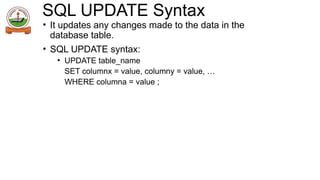
SQL UPDATE Syntax
• It updates any changes made to the data in the
database table.
• SQL UPDATE syntax:
• UPDATE table_name
SET columnx = value, columny = value, …
WHERE columna = value ;
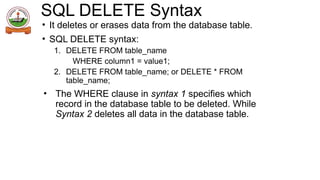
SQL DELETE Syntax
• It deletes or erases data from the database table.
• SQL DELETE syntax:
1. DELETE FROM table_name
WHERE column1 = value1;
2. DELETE FROM table_name; or DELETE * FROM
table_name;
• The WHERE clause in syntax 1 specifies which
record in the database table to be deleted. While
Syntax 2 deletes all data in the database table.

Database management system Lecture 6.pptx

  • 1.
    Lecturer: Laura Limo CourseCode: Comp 124 Course Name: DBMS I Lecture 6: SQL Part 2
  • 2.
    Devotional Meditation Psalm 139:1-6 1 Youhave searched me, LORD, and you know me. 2 You know when I sit and when I rise; you perceive my thoughts from afar. 3 You discern my going out and my lying down; you are familiar with all my ways. 4 Before a word is on my tongue you, LORD, know it completely. 5 You hem me in behind and before, and you lay your hand upon me. 6 Such knowledge is too wonderful for me, too lofty for me to attain.
  • 3.
    Lecture Outline 1. Recapfrom Previous class and assignment 2. Structured Query Language (SQL): Part 2 3. Class Activity
  • 4.
    Data Manipulation Language(DML) • Supports the processing or manipulation of data in databases. • This subset of SQL allows users to pose queries, insert, delete and modify rows. • SQL statements used to manipulate database objects include: • SELECT: used to extract data from a database • UPDATE: used to modify/update data in a database. • INSERT INTO: used to add new data items into a database. • DELETE: used to delete data from a database. • W3school (sql)
  • 5.
    SQL INSERT INTOSyntax • It adds new data records into the database. • SQL INSERT INTO syntax: 1. INSERT INTO table_name Values (value1, value2, value3,…); 2. INSERT INTO table_name (column1, column2, column3) Values (value1, value2, value3,…); • Syntax 1 does not specify the table columns for data to be inserted, only the values. While syntax 2 specifies the columns where the values are to be inserted.
  • 6.
    SQL SELECT Syntax •SELECT Statement, is a command used to construct database queries. There are other additional clauses/elements in addition to the SELECT statement e.g. FROM, WHERE. • SQL SELECT syntax: 1. SELECT column_names FROM table_name; 2. SELECT * FROM table_name; • Syntax 1 retrieves data from specified columns in that database table while syntax 2 retrieves all data in the database table. The results of the SQL query statement are stored in a table called result-set. • The basic form of an SQL query: • SELECT [DISTINCT] Column-list • FROM table-list • WHERE qualification
  • 7.
    Basic SQL Queryin Detail • FROM clause: The from-list in the FROM clause is a list of table names. A table name can be followed by a range variable e.g. FROM Sailors S. Range variables need to be introduced explicitly only when the FROM clause contains more than one occurrence of a relation. They are used to improve the readability of the query. • SELECT clause: The select-list is a list of column names of tables named in the from-list. • WHERE clause: The qualification or condition in the WHERE clause is boolean combination i.e. an expression using the logical connectives AND, OR, and NOT, of conditions of the form expression op expression, where op is one of the comparison operators such as <,<=, =, <>, >=, >. • DISTINCT: It is optionally used to retrieve query results that are unique i.e. the results should not contain duplicates.
  • 8.
    SQL UPDATE Syntax •It updates any changes made to the data in the database table. • SQL UPDATE syntax: • UPDATE table_name SET columnx = value, columny = value, … WHERE columna = value ;
  • 9.
    SQL DELETE Syntax •It deletes or erases data from the database table. • SQL DELETE syntax: 1. DELETE FROM table_name WHERE column1 = value1; 2. DELETE FROM table_name; or DELETE * FROM table_name; • The WHERE clause in syntax 1 specifies which record in the database table to be deleted. While Syntax 2 deletes all data in the database table.