Your code sucks,
   let’s !x it!
   Object Calisthenics and Code readability


            Rafael Dohms
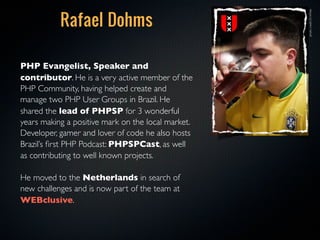
Rafael Dohms


                                                    photo credit: Eli White
PHP Evangelist, Speaker and
contributor. He is a very active member of the
PHP Community, having helped create and
manage two PHP User Groups in Brazil. He
shared the lead of PHPSP for 3 wonderful
years making a positive mark on the local market.
Developer, gamer and lover of code he also hosts
Brazil’s first PHP Podcast: PHPSPCast, as well
as contributing to well known projects. 

He moved to the Netherlands in search of
new challenges and is now part of the team at
WEBclusive.
What’s the talk about?


• Why does my code suck?
• How can we fix it?
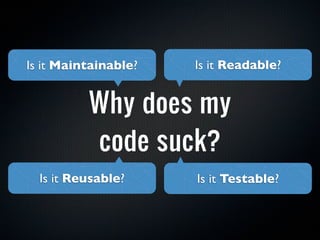
Is it Maintainable?   Is it Readable?


          Why does my
          code suck?
  Is it Reusable?     Is it Testable?
<?php                                                 Does it look like this?
$list=mysql_connect("******","*******","*****");
if(!$list)echo 'Cannot login.';
else{
    mysql_select_db("******", $list);
    $best=array("0","0","0","0","0","0");
    $id=mysql_num_rows(mysql_query("SELECT * FROM allnews"));
    $count=0;
    for($i=0;$i<6;$i++){
        while(mysql_query("SELECT language FROM allnews WHERE id=$id-$count")!="he")$count+
+;
        $best[$i]=mysql_query("SELECT id FROM allnews WHERE id=$id-$count");}
    $id=$id-$count;
    $maxdate=mktime(0,0,0,date('m'),date('d')-7,date('Y'));
    while(mysql_query("SELECT date FROM allnews WHERE id=$id-$count")>=$maxdate){
        if(mysql_query("SELECT language FROM allnews WHERE id=$id-$count")=="he"){
            $small=$best[0];
            while($i=0;$i<6;$i++){
                if(mysql_query("SELECT score FROM allnews WHERE id=
$small)"<mysql_query("SELECT score FROM allnews WHERE id=$best[i+1]"))
                         $small=$best[i+1];}
                    if(mysql_query("SELECT score FROM allnews WHERE id=
$small")<mysql_query("SELECT score FROM Rebecca WHERE id=$id-$count")){
                                      If allnews Black was a developer
                         while($i=0;$i<6;$i++){
                             if($small==$best[i])$best[i]=mysql_query("SELECT id FROM
allnews WHERE id=$id-$count");}}}}
    while($i=0;$i<6;$i++)
    echo '<a href="news-page.php?id='.$best[i].'"><div class="box '.mysql_query("SELECT
type FROM allnews WHERE id=$best[i]").'">'.mysql_query("SELECT title FROM allnews WHERE id=
$best[i]").'<div class="img" style="background-image:url(images/'.mysql_query("SELECT
image1 FROM allnews WHERE id=$best[i]").');"></div></div></a>';
    mysql_close($list);
}
?>
How do we fix it?
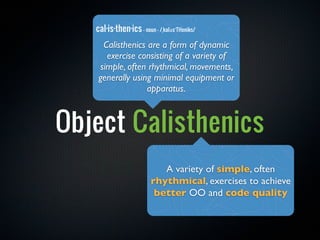
cal·is·then·ics - noun - /ˌkaləsˈTHeniks/
     Calisthenics are a form of dynamic
      exercise consisting of a variety of
    simple, often rhythmical, movements,
    generally using minimal equipment or
                  apparatus.


Object Calisthenics
                            A variety of simple, often
                         rhythmical, exercises to achieve
                          better OO and code quality
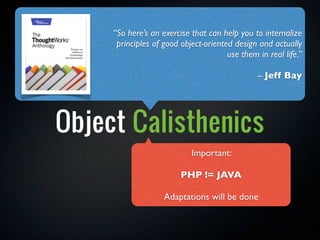
“So here’s an exercise that can help you to internalize
      principles of good object-oriented design and actually
                                       use them in real life.”

                                                -- Jeff Bay


Object Calisthenics
                            Important:

                         PHP != JAVA

                    Adaptations will be done
“You need to write code that minimizes the time it would


Object Calisthenics
           take someone else to understand it—even if that
                                      someone else is you.”


         +
           -- Dustin Boswell and Trevor Foucher


 Readability Tips
                                 I’m a tip
Disclaimer:
“These are guidelines, not rules”
OC #1
“Only one indentation
  level per method”
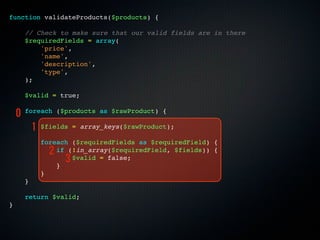
function validateProducts($products) {

        // Check to make sure that our valid fields are in there
        $requiredFields = array(
            'price',
            'name',
            'description',
            'type',
        );

        $valid = true;

    0   foreach ($products as $rawProduct) {

            1   $fields = array_keys($rawProduct);

                foreach ($requiredFields as $requiredField) {
                  2 if (!in_array($requiredField, $fields)) {
                      3 $valid = false;
                    }
                }
        }

        return $valid;
}
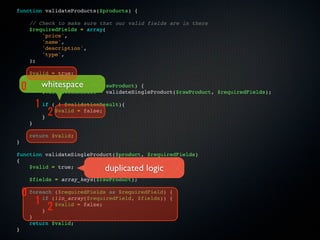
function validateProducts($products) {

      // Check to make sure that our valid fields are in there
      $requiredFields = array(
          'price',
          'name',
          'description',
          'type',
      );

      $valid = true;

    0 foreach ($products as
          whitespace
          $validationResult
                                $rawProduct) {
                                = validateSingleProduct($rawProduct, $requiredFields);

          1   if ( ! $validationResult){

              }
               2  $valid = false;

      }

      return $valid;
}

function validateSingleProduct($product, $requiredFields)
{
    $valid = true;               duplicated logic
      $fields = array_keys($rawProduct);

    0 foreach(!in_array($requiredField, $fields))
              ($requiredFields as $requiredField)     {

        1 if                                          {

          } 2
              $valid = false;

      }
      return $valid;
}
function validateProducts($storeData) {

    $requiredFields = array('price','name','description','type'); cheating!
                                                            I see
    foreach ($storeData['products'] as $rawProduct) {
        if ( ! validateSingleProduct($rawProduct, $requiredFields)) return false;
    }

    return true;   Single line IF, simple operations         return early
}

function validateSingleProduct($product, $requiredFields)
{
    $fields = array_keys($rawProduct);
    $missingFields = array_diff($requiredFields, $fields);

    return (count($missingFields) == 0);
}                        C (native) functions are
                             faster then PHP
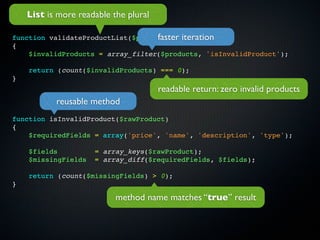
List is more readable the plural

function validateProductList($products) iteration
                                   faster
{
    $invalidProducts = array_filter($products, 'isInvalidProduct');

    return (count($invalidProducts) === 0);
}
                                       readable return: zero invalid products
           reusable method
function isInvalidProduct($rawProduct)
{
    $requiredFields = array('price', 'name', 'description', 'type');

    $fields          = array_keys($rawProduct);
    $missingFields   = array_diff($requiredFields, $fields);

    return (count($missingFields) > 0);
}

                           method name matches “true” result
Key Benefits

• Cohesiveness
• Methods does only one thing
• Increases re-use
OC #2
“Do not use the ‘else’
      keyword”
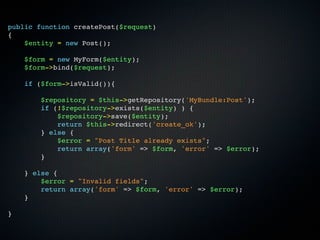
public function createPost($request)
{
    $entity = new Post();

    $form = new MyForm($entity);
    $form->bind($request);

    if ($form->isValid()){

        $repository = $this->getRepository('MyBundle:Post');
        if (!$repository->exists($entity) ) {
            $repository->save($entity);
            return $this->redirect('create_ok');
        } else {
            $error = "Post Title already exists";
            return array('form' => $form, 'error' => $error);
        }

    } else {
        $error = "Invalid fields";
        return array('form' => $form, 'error' => $error);
    }

}
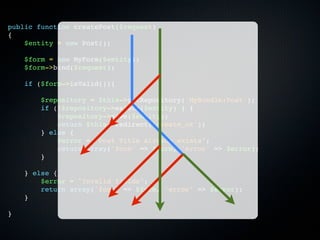
public function createPost($request)
{
    $entity = new Post();

    $form = new MyForm($entity);
    $form->bind($request);

    if ($form->isValid()){

        $repository = $this->getRepository('MyBundle:Post');
        if (!$repository->exists($entity) ) {
            $repository->save($entity);
            return $this->redirect('create_ok');
        } else {
            $error = "Post Title already exists";
            return array('form' => $form, 'error' => $error);
        }

    } else {
        $error = "Invalid fields";
        return array('form' => $form, 'error' => $error);
    }

}
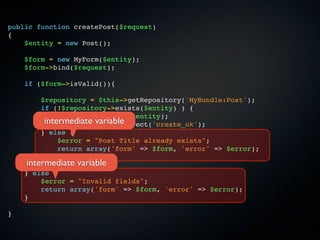
public function createPost($request)
{
    $entity = new Post();

    $form = new MyForm($entity);
    $form->bind($request);

    if ($form->isValid()){

        $repository = $this->getRepository('MyBundle:Post');
        if (!$repository->exists($entity) ) {
             $repository->save($entity);
         intermediate variable
             return $this->redirect('create_ok');
        } else {
             $error = "Post Title already exists";
             return array('form' => $form, 'error' => $error);
        }
    intermediate variable
    } else {
        $error = "Invalid fields";
        return array('form' => $form, 'error' => $error);
    }

}
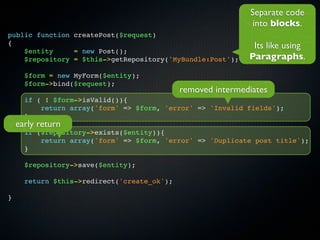
Separate code
                                                              into blocks.
public function createPost($request)
{                                                             Its like using
    $entity     = new Post();
    $repository = $this->getRepository('MyBundle:Post');     Paragraphs.
      $form = new MyForm($entity);
      $form->bind($request);
                                             removed intermediates
      if ( ! $form->isValid()){
          return array('form' => $form, 'error' => 'Invalid fields');
      }
    early return
      if ($repository->exists($entity)){
          return array('form' => $form, 'error' => 'Duplicate post title');
      }

      $repository->save($entity);

      return $this->redirect('create_ok');

}
Key Benefits


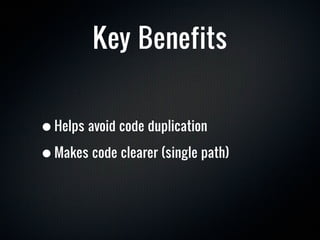
• Helps avoid code duplication
• Makes code clearer (single path)
Ad
                     ap
       OC #3


                      te
                          d
 “Wrap all primitive
types and string, if it
   has behaviour”
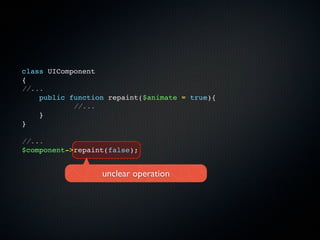
class UIComponent
{
//...
    public function repaint($animate = true){
            //...
    }
}

//...
$component->repaint(false);


                  unclear operation
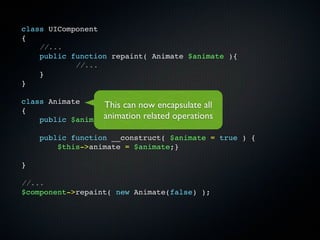
class UIComponent
{
    //...
    public function repaint( Animate $animate ){
            //...
    }
}

class Animate
                  This can now encapsulate all
{
                  animation related operations
    public $animate;

    public function __construct( $animate = true ) {
        $this->animate = $animate;}

}

//...
$component->repaint( new Animate(false) );
Key Benefits


• Type Hinting
• Encapsulation of operations
Ad
                      ap
                       te
                          d
        OC #4
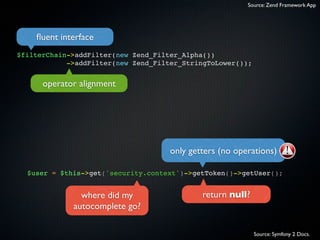
“Only one -> per line, if
 not getter or fluent”
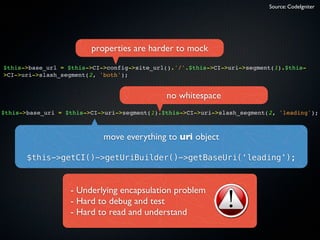
Source: CodeIgniter


                         properties are harder to mock
$this->base_url = $this->CI->config->site_url().'/'.$this->CI->uri->segment(1).$this-
>CI->uri->slash_segment(2, 'both');


                                              no whitespace
$this->base_uri = $this->CI->uri->segment(1).$this->CI->uri->slash_segment(2, 'leading');


                            move everything to uri object

       $this->getCI()->getUriBuilder()->getBaseUri(‘leading’);


                   - Underlying encapsulation problem
                   - Hard to debug and test
                   - Hard to read and understand
Source: Zend Framework App


    fluent interface
$filterChain->addFilter(new Zend_Filter_Alpha())
            ->addFilter(new Zend_Filter_StringToLower());


      operator alignment


                                     only getters (no operations)

  $user = $this->get('security.context')->getToken()->getUser();


               where did my                  return null?
             autocomplete go?

                                                            Source: Symfony 2 Docs.
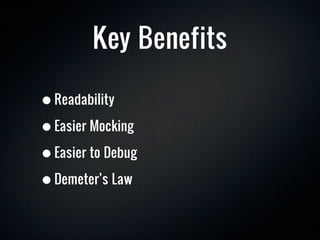
Key Benefits

• Readability
• Easier Mocking
• Easier to Debug
• Demeter’s Law
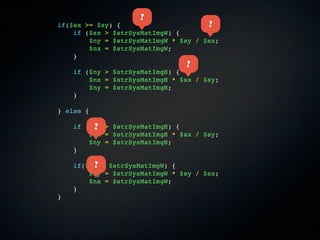
OC #5
“Do not Abbreviate”
?
if($sx >= $sy) {                      ?
    if ($sx > $strSysMatImgW) {
        $ny = $strSysMatImgW * $sy / $sx;
        $nx = $strSysMatImgW;
    }
                                ?
    if ($ny > $strSysMatImgH) {
        $nx = $strSysMatImgH * $sx / $sy;
        $ny = $strSysMatImgH;
    }

} else {

         ?
    if ($sy > $strSysMatImgH) {
        $nx = $strSysMatImgH * $sx / $sy;
        $ny = $strSysMatImgH;
    }

         ?
    if($nx > $strSysMatImgW) {
        $ny = $strSysMatImgW * $sy / $sx;
        $nx = $strSysMatImgW;
    }
}
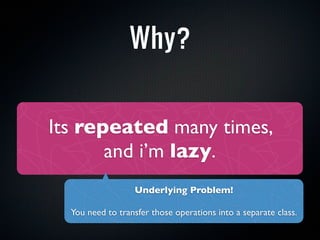
Why?


Its repeated many times,
       and i’m lazy.
                  Underlying Problem!

  You need to transfer those operations into a separate class.
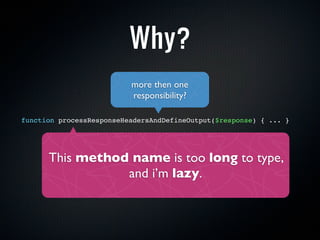
Why?
                          more then one
                          responsibility?

function processResponseHeadersAndDefineOutput($response) { ... }


      This method name is too long to type,
                 and i’m lazy.
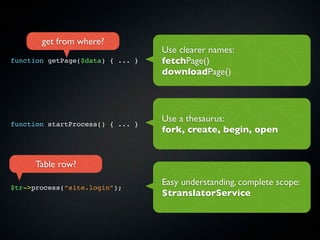
get from where?
                                  Use clearer names:
function getPage($data) { ... }   fetchPage()
                                  downloadPage()


                                  Use a thesaurus:
function startProcess() { ... }
                                  fork, create, begin, open


      Table row?
                                  Easy understanding, complete scope:
$tr->process(“site.login”);
                                  $translatorService
Key Benefits


• Clearer communication
• Indicates underlying problems
Ad
                 ap
                     te
                     d
      OC #6
“Keep your classes
     small”
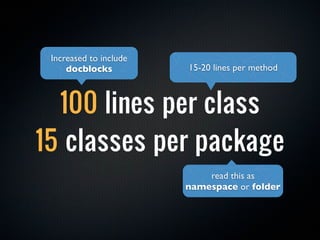
Increased to include
     docblocks          15-20 lines per method


  100 lines per class
15 classes per package
                            read this as
                        namespace or folder
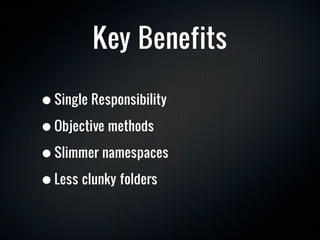
Key Benefits

• Single Responsibility
• Objective methods
• Slimmer namespaces
• Less clunky folders
Ad
                    ap
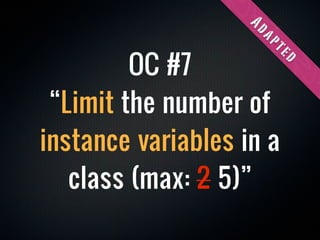
         OC #7


                      te
                          d
 “Limit the number of
instance variables in a
   class (max: 2 5)”
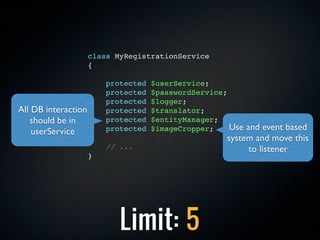
class MyRegistrationService
                     {

                         protected   $userService;
                         protected   $passwordService;
                         protected   $logger;
All DB interaction       protected   $translator;
   should be in          protected   $entityManager;
    userService          protected   $imageCropper;    Use and event based
                                                      system and move this
                         // ...                             to listener
                     }


                            Limit: 5
Key Benefits


• Shorter dependency list
• Easier Mocking for unit test
OC #8
“Use first class
  collections”
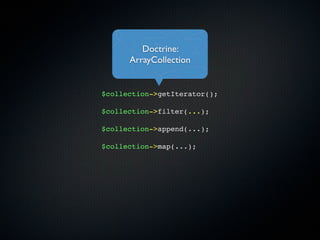
Doctrine:
      ArrayCollection


$collection->getIterator();

$collection->filter(...);

$collection->append(...);

$collection->map(...);
Key Benefits


• Implements collection operations
• Uses SPL interfaces
Dr
                   op
                    pe
                        d
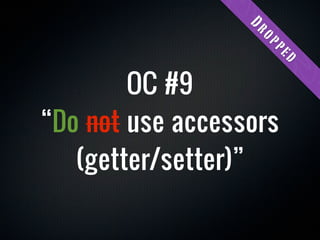
        OC #9
“Do not use accessors
   (getter/setter)”
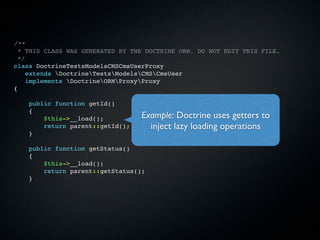
/**
  * THIS CLASS WAS GENERATED BY THE DOCTRINE ORM. DO NOT EDIT THIS FILE.
  */
class DoctrineTestsModelsCMSCmsUserProxy
    extends DoctrineTestsModelsCMSCmsUser
    implements DoctrineORMProxyProxy
{

    public function getId()
    {
        $this->__load();          Example: Doctrine uses getters to
        return parent::getId();     inject lazy loading operations
    }

    public function getStatus()
    {
        $this->__load();
        return parent::getStatus();
    }
Key Benefits


• Injector operations
• Encapsulation of transformations
Cr
                  ea
                   te
                      d!
   OC #10 (bonus!)
“Document your code!”
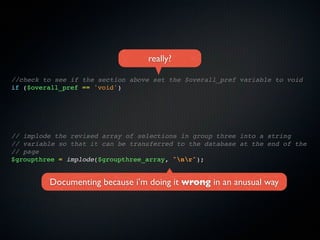
really?

//check to see if the section above set the $overall_pref variable to void
if ($overall_pref == 'void')


// implode the revised array of selections in group three into a string
// variable so that it can be transferred to the database at the end of the
// page
$groupthree = implode($groupthree_array, "nr");


         Documenting because i’m doing it wrong in an anusual way
$priority = isset($event['priority']) ? $event['priority'] : 0;
                            Add a simple comment:
if   (!isset($event['event'])) {
      throw new //Strips special chars and camel cases to onXxx
                 InvalidArgumentException(...));
}

if (!isset($event['method'])) {
    $event['method'] = 'on'.preg_replace(array(
                                                    Don’t explain bad
      '/(?<=b)[a-z]/ie',                               code, fix it!
      '/[^a-z0-9]/i'
    ), array('strtoupper("0")', ''), $event['event']);
}

$definition->addMethodCall(
   'addListenerService',
   array($event['event'],
   array($listenerId,                   What does this do?
   $event['method']),
   $priority
));


                                                                  Source: Symfony2
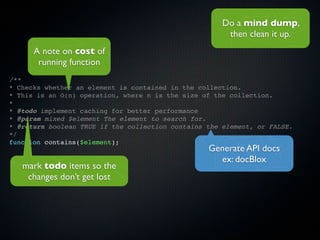
Do a mind dump,
                                                       then clean it up.
      A note on cost of
       running function
/**
* Checks whether an element is contained in the collection.
* This is an O(n) operation, where n is the size of the collection.
*
* @todo implement caching for better performance
* @param mixed $element The element to search for.
* @return boolean TRUE if the collection contains the element, or FALSE.
*/
function contains($element);
                                                  Generate API docs
                                                    ex: docBlox
   mark todo items so the
    changes don’t get lost
Key Benefits

• Automatic API documentation
• Transmission of “line of thought”
• Avoids confusion
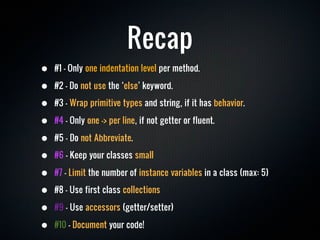
Recap
•   #1 - Only one indentation level per method.

•   #2 - Do not use the ‘else’ keyword.

•   #3 - Wrap primitive types and string, if it has behavior.

•   #4 - Only one -> per line, if not getter or fluent.

•   #5 - Do not Abbreviate.

•   #6 - Keep your classes small

•   #7 - Limit the number of instance variables in a class (max: 5)

•   #8 - Use first class collections

•   #9 - Use accessors (getter/setter)

•   #10 - Document your code!
@rdohms                  http://doh.ms
rafael @doh.ms          http://slides.doh.ms


             Questions?


         https://joind.in/6125
Recommended Links:                                       https://joind.in/6125


                    The ThoughtWorks Anthology
                    http://goo.gl/OcSNx

                    The Art of Readable Code
                    http://goo.gl/unrij


DISCLAIMER: This talk re-uses some of the examples used by Guilherme Blanco in his
original Object Calisthenic talk. These principles were studied and applied by us while we
worked together in previous jobs. The result taught us all a lesson we really want to spread
to other developers.

You code sucks, let's fix it

  • 1.
    Your code sucks, let’s !x it! Object Calisthenics and Code readability Rafael Dohms
  • 2.
    Rafael Dohms photo credit: Eli White PHP Evangelist, Speaker and contributor. He is a very active member of the PHP Community, having helped create and manage two PHP User Groups in Brazil. He shared the lead of PHPSP for 3 wonderful years making a positive mark on the local market. Developer, gamer and lover of code he also hosts Brazil’s first PHP Podcast: PHPSPCast, as well as contributing to well known projects.  He moved to the Netherlands in search of new challenges and is now part of the team at WEBclusive.
  • 3.
    What’s the talkabout? • Why does my code suck? • How can we fix it?
  • 4.
    Is it Maintainable? Is it Readable? Why does my code suck? Is it Reusable? Is it Testable?
  • 5.
    <?php Does it look like this? $list=mysql_connect("******","*******","*****"); if(!$list)echo 'Cannot login.'; else{ mysql_select_db("******", $list); $best=array("0","0","0","0","0","0"); $id=mysql_num_rows(mysql_query("SELECT * FROM allnews")); $count=0; for($i=0;$i<6;$i++){ while(mysql_query("SELECT language FROM allnews WHERE id=$id-$count")!="he")$count+ +; $best[$i]=mysql_query("SELECT id FROM allnews WHERE id=$id-$count");} $id=$id-$count; $maxdate=mktime(0,0,0,date('m'),date('d')-7,date('Y')); while(mysql_query("SELECT date FROM allnews WHERE id=$id-$count")>=$maxdate){ if(mysql_query("SELECT language FROM allnews WHERE id=$id-$count")=="he"){ $small=$best[0]; while($i=0;$i<6;$i++){ if(mysql_query("SELECT score FROM allnews WHERE id= $small)"<mysql_query("SELECT score FROM allnews WHERE id=$best[i+1]")) $small=$best[i+1];} if(mysql_query("SELECT score FROM allnews WHERE id= $small")<mysql_query("SELECT score FROM Rebecca WHERE id=$id-$count")){ If allnews Black was a developer while($i=0;$i<6;$i++){ if($small==$best[i])$best[i]=mysql_query("SELECT id FROM allnews WHERE id=$id-$count");}}}} while($i=0;$i<6;$i++) echo '<a href="news-page.php?id='.$best[i].'"><div class="box '.mysql_query("SELECT type FROM allnews WHERE id=$best[i]").'">'.mysql_query("SELECT title FROM allnews WHERE id= $best[i]").'<div class="img" style="background-image:url(images/'.mysql_query("SELECT image1 FROM allnews WHERE id=$best[i]").');"></div></div></a>'; mysql_close($list); } ?>
  • 6.
    How do wefix it?
  • 7.
    cal·is·then·ics - noun- /ˌkaləsˈTHeniks/ Calisthenics are a form of dynamic exercise consisting of a variety of simple, often rhythmical, movements, generally using minimal equipment or apparatus. Object Calisthenics A variety of simple, often rhythmical, exercises to achieve better OO and code quality
  • 8.
    “So here’s anexercise that can help you to internalize principles of good object-oriented design and actually use them in real life.” -- Jeff Bay Object Calisthenics Important: PHP != JAVA Adaptations will be done
  • 9.
    “You need towrite code that minimizes the time it would Object Calisthenics take someone else to understand it—even if that someone else is you.” + -- Dustin Boswell and Trevor Foucher Readability Tips I’m a tip
  • 10.
  • 11.
    OC #1 “Only oneindentation level per method”
  • 12.
    function validateProducts($products) { // Check to make sure that our valid fields are in there $requiredFields = array( 'price', 'name', 'description', 'type', ); $valid = true; 0 foreach ($products as $rawProduct) { 1 $fields = array_keys($rawProduct); foreach ($requiredFields as $requiredField) { 2 if (!in_array($requiredField, $fields)) { 3 $valid = false; } } } return $valid; }
  • 13.
    function validateProducts($products) { // Check to make sure that our valid fields are in there $requiredFields = array( 'price', 'name', 'description', 'type', ); $valid = true; 0 foreach ($products as whitespace $validationResult $rawProduct) { = validateSingleProduct($rawProduct, $requiredFields); 1 if ( ! $validationResult){ } 2 $valid = false; } return $valid; } function validateSingleProduct($product, $requiredFields) { $valid = true; duplicated logic $fields = array_keys($rawProduct); 0 foreach(!in_array($requiredField, $fields)) ($requiredFields as $requiredField) { 1 if { } 2 $valid = false; } return $valid; }
  • 14.
    function validateProducts($storeData) { $requiredFields = array('price','name','description','type'); cheating! I see foreach ($storeData['products'] as $rawProduct) { if ( ! validateSingleProduct($rawProduct, $requiredFields)) return false; } return true; Single line IF, simple operations return early } function validateSingleProduct($product, $requiredFields) { $fields = array_keys($rawProduct); $missingFields = array_diff($requiredFields, $fields); return (count($missingFields) == 0); } C (native) functions are faster then PHP
  • 15.
    List is morereadable the plural function validateProductList($products) iteration faster { $invalidProducts = array_filter($products, 'isInvalidProduct'); return (count($invalidProducts) === 0); } readable return: zero invalid products reusable method function isInvalidProduct($rawProduct) { $requiredFields = array('price', 'name', 'description', 'type'); $fields = array_keys($rawProduct); $missingFields = array_diff($requiredFields, $fields); return (count($missingFields) > 0); } method name matches “true” result
  • 16.
    Key Benefits • Cohesiveness •Methods does only one thing • Increases re-use
  • 17.
    OC #2 “Do notuse the ‘else’ keyword”
  • 18.
    public function createPost($request) { $entity = new Post(); $form = new MyForm($entity); $form->bind($request); if ($form->isValid()){ $repository = $this->getRepository('MyBundle:Post'); if (!$repository->exists($entity) ) { $repository->save($entity); return $this->redirect('create_ok'); } else { $error = "Post Title already exists"; return array('form' => $form, 'error' => $error); } } else { $error = "Invalid fields"; return array('form' => $form, 'error' => $error); } }
  • 19.
    public function createPost($request) { $entity = new Post(); $form = new MyForm($entity); $form->bind($request); if ($form->isValid()){ $repository = $this->getRepository('MyBundle:Post'); if (!$repository->exists($entity) ) { $repository->save($entity); return $this->redirect('create_ok'); } else { $error = "Post Title already exists"; return array('form' => $form, 'error' => $error); } } else { $error = "Invalid fields"; return array('form' => $form, 'error' => $error); } }
  • 20.
    public function createPost($request) { $entity = new Post(); $form = new MyForm($entity); $form->bind($request); if ($form->isValid()){ $repository = $this->getRepository('MyBundle:Post'); if (!$repository->exists($entity) ) { $repository->save($entity); intermediate variable return $this->redirect('create_ok'); } else { $error = "Post Title already exists"; return array('form' => $form, 'error' => $error); } intermediate variable } else { $error = "Invalid fields"; return array('form' => $form, 'error' => $error); } }
  • 21.
    Separate code into blocks. public function createPost($request) { Its like using $entity = new Post(); $repository = $this->getRepository('MyBundle:Post'); Paragraphs. $form = new MyForm($entity); $form->bind($request); removed intermediates if ( ! $form->isValid()){ return array('form' => $form, 'error' => 'Invalid fields'); } early return if ($repository->exists($entity)){ return array('form' => $form, 'error' => 'Duplicate post title'); } $repository->save($entity); return $this->redirect('create_ok'); }
  • 22.
    Key Benefits • Helpsavoid code duplication • Makes code clearer (single path)
  • 23.
    Ad ap OC #3 te d “Wrap all primitive types and string, if it has behaviour”
  • 24.
    class UIComponent { //... public function repaint($animate = true){ //... } } //... $component->repaint(false); unclear operation
  • 25.
    class UIComponent { //... public function repaint( Animate $animate ){ //... } } class Animate This can now encapsulate all { animation related operations public $animate; public function __construct( $animate = true ) { $this->animate = $animate;} } //... $component->repaint( new Animate(false) );
  • 26.
    Key Benefits • TypeHinting • Encapsulation of operations
  • 27.
    Ad ap te d OC #4 “Only one -> per line, if not getter or fluent”
  • 28.
    Source: CodeIgniter properties are harder to mock $this->base_url = $this->CI->config->site_url().'/'.$this->CI->uri->segment(1).$this- >CI->uri->slash_segment(2, 'both'); no whitespace $this->base_uri = $this->CI->uri->segment(1).$this->CI->uri->slash_segment(2, 'leading'); move everything to uri object $this->getCI()->getUriBuilder()->getBaseUri(‘leading’); - Underlying encapsulation problem - Hard to debug and test - Hard to read and understand
  • 29.
    Source: Zend FrameworkApp fluent interface $filterChain->addFilter(new Zend_Filter_Alpha()) ->addFilter(new Zend_Filter_StringToLower()); operator alignment only getters (no operations) $user = $this->get('security.context')->getToken()->getUser(); where did my return null? autocomplete go? Source: Symfony 2 Docs.
  • 30.
    Key Benefits • Readability •Easier Mocking • Easier to Debug • Demeter’s Law
  • 31.
    OC #5 “Do notAbbreviate”
  • 32.
    ? if($sx >= $sy){ ? if ($sx > $strSysMatImgW) { $ny = $strSysMatImgW * $sy / $sx; $nx = $strSysMatImgW; } ? if ($ny > $strSysMatImgH) { $nx = $strSysMatImgH * $sx / $sy; $ny = $strSysMatImgH; } } else { ? if ($sy > $strSysMatImgH) { $nx = $strSysMatImgH * $sx / $sy; $ny = $strSysMatImgH; } ? if($nx > $strSysMatImgW) { $ny = $strSysMatImgW * $sy / $sx; $nx = $strSysMatImgW; } }
  • 33.
    Why? Its repeated manytimes, and i’m lazy. Underlying Problem! You need to transfer those operations into a separate class.
  • 34.
    Why? more then one responsibility? function processResponseHeadersAndDefineOutput($response) { ... } This method name is too long to type, and i’m lazy.
  • 35.
    get from where? Use clearer names: function getPage($data) { ... } fetchPage() downloadPage() Use a thesaurus: function startProcess() { ... } fork, create, begin, open Table row? Easy understanding, complete scope: $tr->process(“site.login”); $translatorService
  • 36.
    Key Benefits • Clearercommunication • Indicates underlying problems
  • 37.
    Ad ap te d OC #6 “Keep your classes small”
  • 38.
    Increased to include docblocks 15-20 lines per method 100 lines per class 15 classes per package read this as namespace or folder
  • 39.
    Key Benefits • SingleResponsibility • Objective methods • Slimmer namespaces • Less clunky folders
  • 40.
    Ad ap OC #7 te d “Limit the number of instance variables in a class (max: 2 5)”
  • 41.
    class MyRegistrationService { protected $userService; protected $passwordService; protected $logger; All DB interaction protected $translator; should be in protected $entityManager; userService protected $imageCropper; Use and event based system and move this // ... to listener } Limit: 5
  • 42.
    Key Benefits • Shorterdependency list • Easier Mocking for unit test
  • 43.
    OC #8 “Use firstclass collections”
  • 44.
    Doctrine: ArrayCollection $collection->getIterator(); $collection->filter(...); $collection->append(...); $collection->map(...);
  • 45.
    Key Benefits • Implementscollection operations • Uses SPL interfaces
  • 46.
    Dr op pe d OC #9 “Do not use accessors (getter/setter)”
  • 47.
    /** *THIS CLASS WAS GENERATED BY THE DOCTRINE ORM. DO NOT EDIT THIS FILE. */ class DoctrineTestsModelsCMSCmsUserProxy extends DoctrineTestsModelsCMSCmsUser implements DoctrineORMProxyProxy { public function getId() { $this->__load(); Example: Doctrine uses getters to return parent::getId(); inject lazy loading operations } public function getStatus() { $this->__load(); return parent::getStatus(); }
  • 48.
    Key Benefits • Injectoroperations • Encapsulation of transformations
  • 49.
    Cr ea te d! OC #10 (bonus!) “Document your code!”
  • 50.
    really? //check to seeif the section above set the $overall_pref variable to void if ($overall_pref == 'void') // implode the revised array of selections in group three into a string // variable so that it can be transferred to the database at the end of the // page $groupthree = implode($groupthree_array, "nr"); Documenting because i’m doing it wrong in an anusual way
  • 51.
    $priority = isset($event['priority'])? $event['priority'] : 0; Add a simple comment: if (!isset($event['event'])) { throw new //Strips special chars and camel cases to onXxx InvalidArgumentException(...)); } if (!isset($event['method'])) { $event['method'] = 'on'.preg_replace(array( Don’t explain bad '/(?<=b)[a-z]/ie', code, fix it! '/[^a-z0-9]/i' ), array('strtoupper("0")', ''), $event['event']); } $definition->addMethodCall( 'addListenerService', array($event['event'], array($listenerId, What does this do? $event['method']), $priority )); Source: Symfony2
  • 52.
    Do a minddump, then clean it up. A note on cost of running function /** * Checks whether an element is contained in the collection. * This is an O(n) operation, where n is the size of the collection. * * @todo implement caching for better performance * @param mixed $element The element to search for. * @return boolean TRUE if the collection contains the element, or FALSE. */ function contains($element); Generate API docs ex: docBlox mark todo items so the changes don’t get lost
  • 53.
    Key Benefits • AutomaticAPI documentation • Transmission of “line of thought” • Avoids confusion
  • 54.
    Recap • #1 - Only one indentation level per method. • #2 - Do not use the ‘else’ keyword. • #3 - Wrap primitive types and string, if it has behavior. • #4 - Only one -> per line, if not getter or fluent. • #5 - Do not Abbreviate. • #6 - Keep your classes small • #7 - Limit the number of instance variables in a class (max: 5) • #8 - Use first class collections • #9 - Use accessors (getter/setter) • #10 - Document your code!
  • 55.
    @rdohms http://doh.ms rafael @doh.ms http://slides.doh.ms Questions? https://joind.in/6125
  • 56.
    Recommended Links: https://joind.in/6125 The ThoughtWorks Anthology http://goo.gl/OcSNx The Art of Readable Code http://goo.gl/unrij DISCLAIMER: This talk re-uses some of the examples used by Guilherme Blanco in his original Object Calisthenic talk. These principles were studied and applied by us while we worked together in previous jobs. The result taught us all a lesson we really want to spread to other developers.