Welcome
Name: Dhrumil I. Panchal
Sem: 6th Semester
Subject: .NET Technology
Branch: Computer Engineering (B.E.)
Year: 2019-20
Topic
Properties and Indexers in C#
Contain
 Properties
 Indexers
 Difference between Properties and
Indexers
Properties
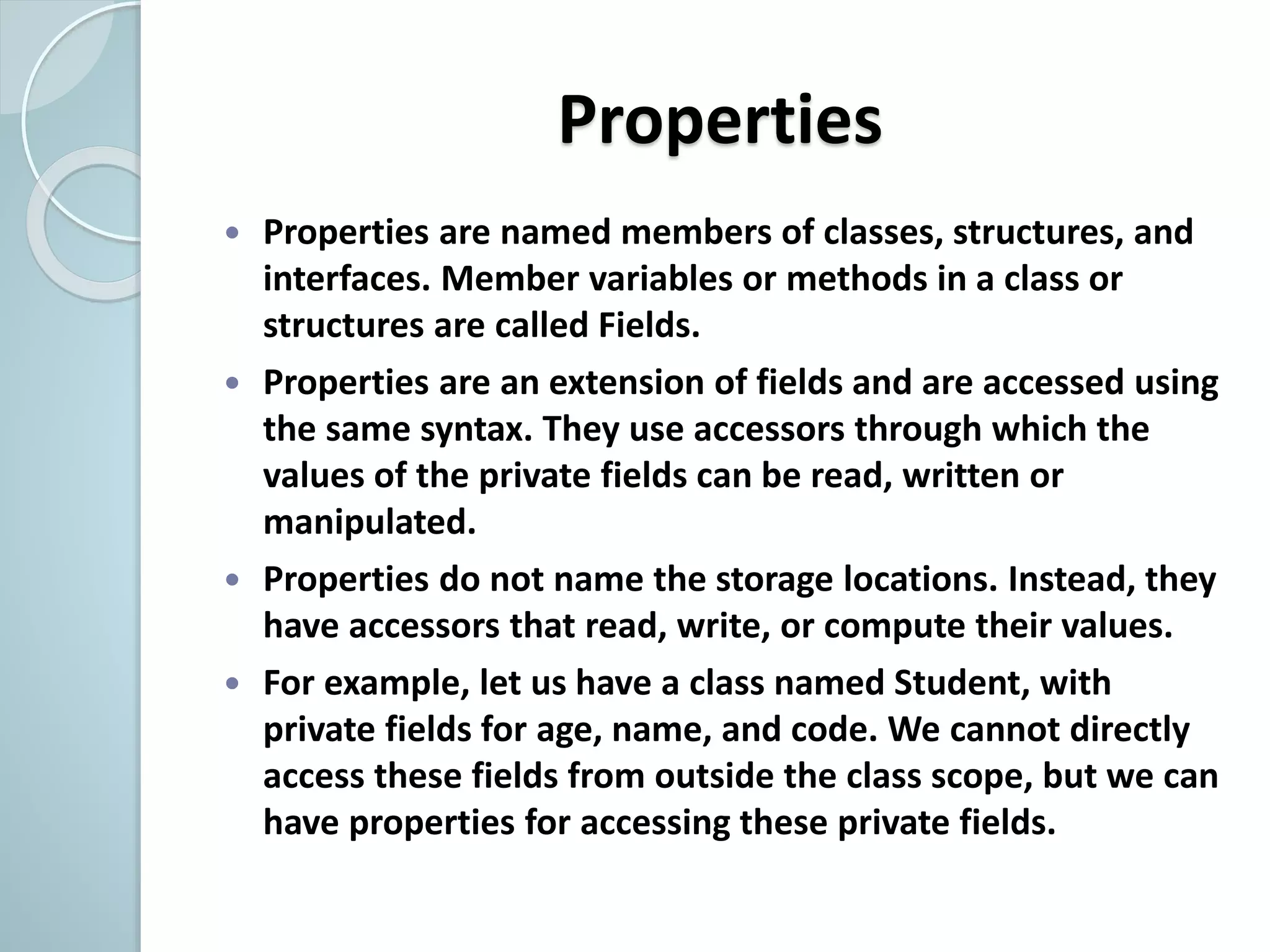
 Properties are named members of classes, structures, and
interfaces. Member variables or methods in a class or
structures are called Fields.
 Properties are an extension of fields and are accessed using
the same syntax. They use accessors through which the
values of the private fields can be read, written or
manipulated.
 Properties do not name the storage locations. Instead, they
have accessors that read, write, or compute their values.
 For example, let us have a class named Student, with
private fields for age, name, and code. We cannot directly
access these fields from outside the class scope, but we can
have properties for accessing these private fields.
Example
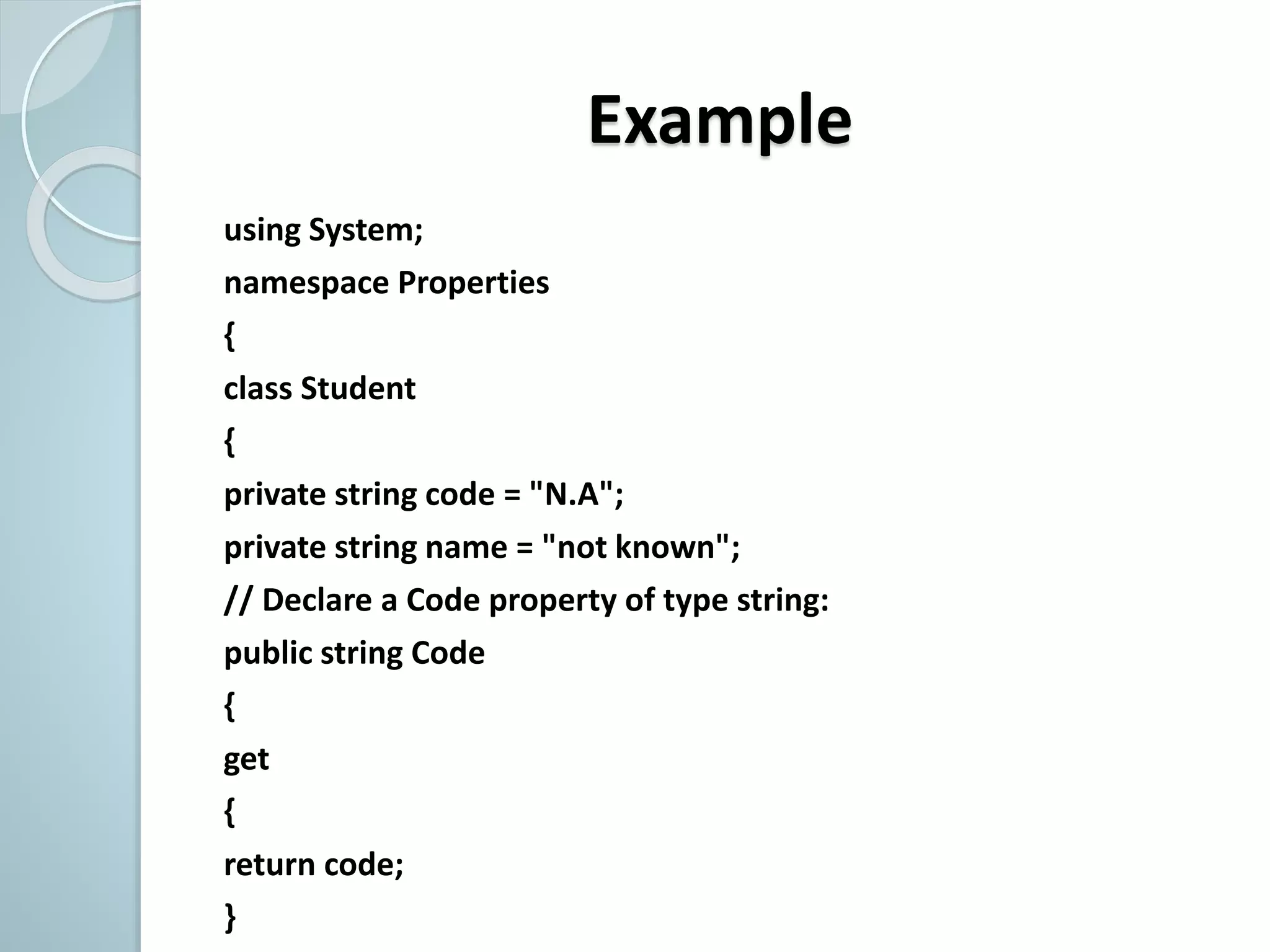
using System;
namespace Properties
{
class Student
{
private string code = "N.A";
private string name = "not known";
// Declare a Code property of type string:
public string Code
{
get
{
return code;
}
set
{
code = value;
}
}
// Declare a Name property of type string:
public string Name
{
get
{
return name;
}
set
{
name = value;
}
}
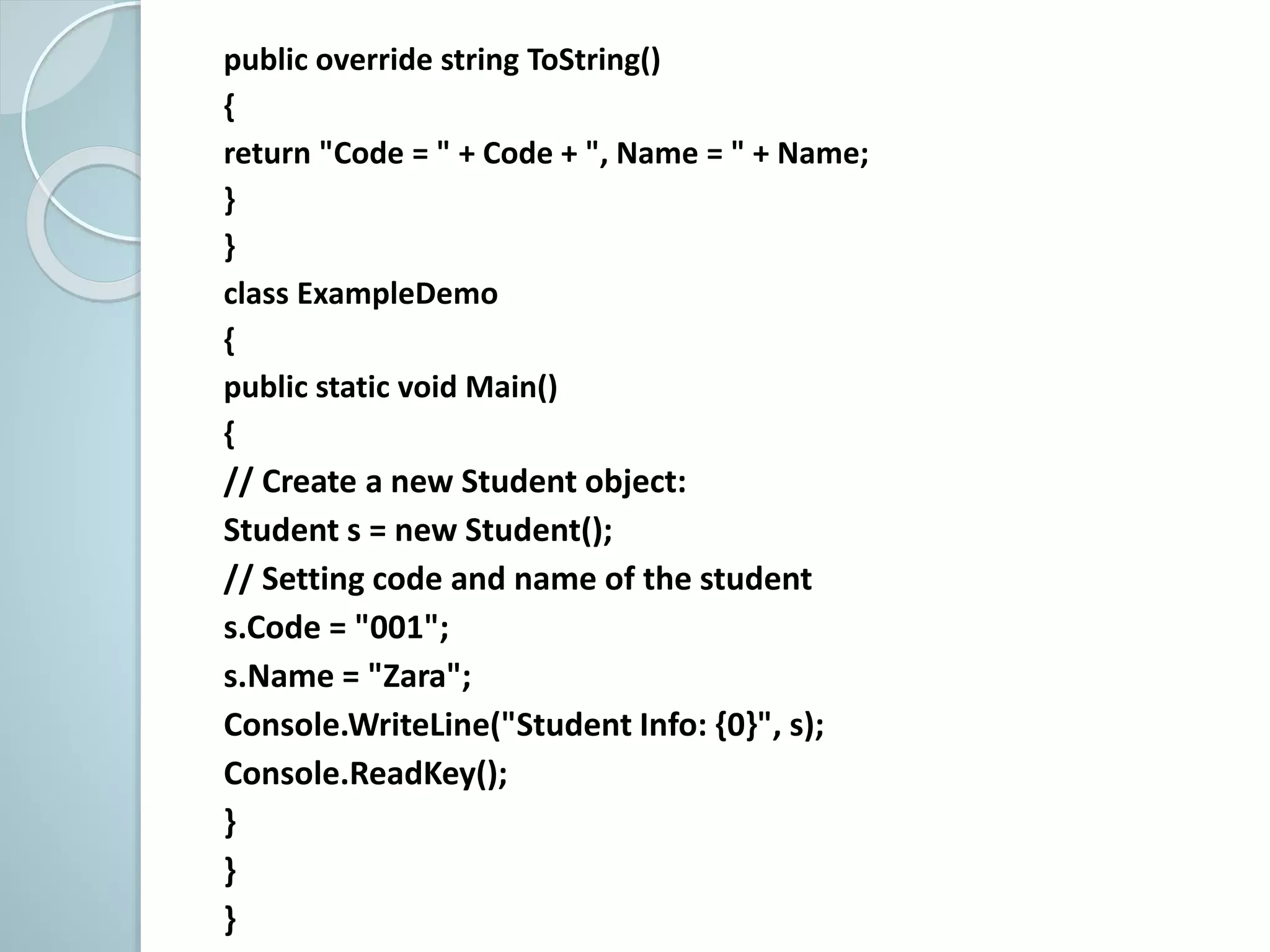
public override string ToString()
{
return "Code = " + Code + ", Name = " + Name;
}
}
class ExampleDemo
{
public static void Main()
{
// Create a new Student object:
Student s = new Student();
// Setting code and name of the student
s.Code = "001";
s.Name = "Zara";
Console.WriteLine("Student Info: {0}", s);
Console.ReadKey();
}
}
}
Indexers
 Indexer Concept is object act as an array.
 Indexer is an object to be indexed in the
same way as an array.
 Indexer modifier can be private, public,
protected or internal.
 The return type can be any valid C#
types.
 Indexers in C# must have at least one
parameter. Else the compiler will
generate a compilation error.
Example
using System;
using System.Collections;
namespace Indexers
{
class ParentClass
{
private string[] range = new string[5];
public string this[int indexrange]
{
get
{
return range[indexrange];
}
set
{
range[indexrange] = value;
}
}
}
/* The Above Class just act as array declaration using this pointer */
class childclass
{
public static void Main()
{
ParentClass obj = new ParentClass();
/* The Above Class ParentClass create one object name is obj */
obj[0] = "ONE";
obj[1] = "TWO";
obj[2] = "THREE";
obj[3] = "FOUR ";
obj[4] = "FIVE";
Console.WriteLine("{0}n,{1}n,{2}n,{3}n,{4}n", obj[0], obj[1],
obj[2], obj[3], obj[4]);
Console.ReadLine();
}
}
}
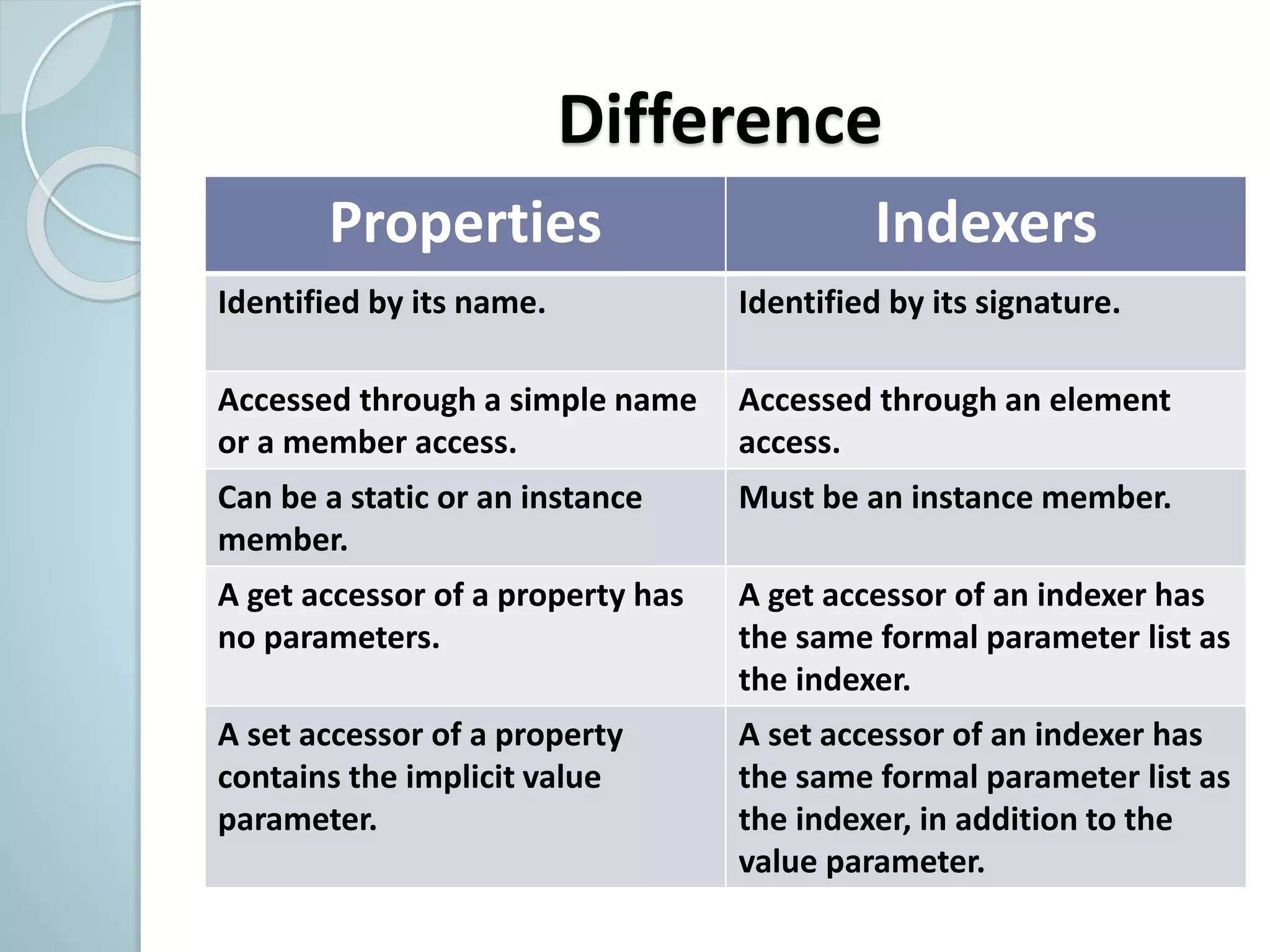
Difference
Properties Indexers
Identified by its name. Identified by its signature.
Accessed through a simple name
or a member access.
Accessed through an element
access.
Can be a static or an instance
member.
Must be an instance member.
A get accessor of a property has
no parameters.
A get accessor of an indexer has
the same formal parameter list as
the indexer.
A set accessor of a property
contains the implicit value
parameter.
A set accessor of an indexer has
the same formal parameter list as
the indexer, in addition to the
value parameter.
References
 Inspiration from Prof. Nitin R Patel
 Notes of .NET
 Textbook of .NET
 Images from Google Images
 Some my own Knowledge
Thank You
using System;
class ThankYou
{
static void Main()
{
Console.WriteLine(“Thank You");
}
}

Properties and Indexers

  • 1.
    Welcome Name: Dhrumil I.Panchal Sem: 6th Semester Subject: .NET Technology Branch: Computer Engineering (B.E.) Year: 2019-20
  • 2.
  • 3.
    Contain  Properties  Indexers Difference between Properties and Indexers
  • 4.
    Properties  Properties arenamed members of classes, structures, and interfaces. Member variables or methods in a class or structures are called Fields.  Properties are an extension of fields and are accessed using the same syntax. They use accessors through which the values of the private fields can be read, written or manipulated.  Properties do not name the storage locations. Instead, they have accessors that read, write, or compute their values.  For example, let us have a class named Student, with private fields for age, name, and code. We cannot directly access these fields from outside the class scope, but we can have properties for accessing these private fields.
  • 5.
    Example using System; namespace Properties { classStudent { private string code = "N.A"; private string name = "not known"; // Declare a Code property of type string: public string Code { get { return code; }
  • 6.
    set { code = value; } } //Declare a Name property of type string: public string Name { get { return name; } set { name = value; } }
  • 7.
    public override stringToString() { return "Code = " + Code + ", Name = " + Name; } } class ExampleDemo { public static void Main() { // Create a new Student object: Student s = new Student(); // Setting code and name of the student s.Code = "001"; s.Name = "Zara"; Console.WriteLine("Student Info: {0}", s); Console.ReadKey(); } } }
  • 8.
    Indexers  Indexer Conceptis object act as an array.  Indexer is an object to be indexed in the same way as an array.  Indexer modifier can be private, public, protected or internal.  The return type can be any valid C# types.  Indexers in C# must have at least one parameter. Else the compiler will generate a compilation error.
  • 9.
    Example using System; using System.Collections; namespaceIndexers { class ParentClass { private string[] range = new string[5]; public string this[int indexrange] { get { return range[indexrange]; }
  • 10.
    set { range[indexrange] = value; } } } /*The Above Class just act as array declaration using this pointer */ class childclass { public static void Main() { ParentClass obj = new ParentClass(); /* The Above Class ParentClass create one object name is obj */ obj[0] = "ONE"; obj[1] = "TWO"; obj[2] = "THREE"; obj[3] = "FOUR "; obj[4] = "FIVE";
  • 11.
  • 12.
    Difference Properties Indexers Identified byits name. Identified by its signature. Accessed through a simple name or a member access. Accessed through an element access. Can be a static or an instance member. Must be an instance member. A get accessor of a property has no parameters. A get accessor of an indexer has the same formal parameter list as the indexer. A set accessor of a property contains the implicit value parameter. A set accessor of an indexer has the same formal parameter list as the indexer, in addition to the value parameter.
  • 13.
    References  Inspiration fromProf. Nitin R Patel  Notes of .NET  Textbook of .NET  Images from Google Images  Some my own Knowledge
  • 14.
    Thank You using System; classThankYou { static void Main() { Console.WriteLine(“Thank You"); } }