Linked Lists: A Fundamental
Data Structure
Welcome to this exploration of linked lists, a core data structure that is
essential for understanding data storage and manipulation.
by Mosiuoa Wesi
Characteristics of Linked Lists
Dynamic Allocation
Linked lists utilize dynamic memory allocation, allowing
them to grow or shrink in size as needed. This dynamic
nature contrasts with static arrays where size is fixed.
Sequential Storage
Each element in a linked list is stored as a node containing
data and a pointer to the next node in the sequence. This
sequential structure differs from arrays, which store
elements contiguously.
Types of Linked Lists
Singly Linked List
The simplest type, with nodes
pointing to the next node,
allowing traversal in one
direction.
Doubly Linked List
Nodes have pointers to both
the next and previous nodes,
enabling bidirectional
traversal.
Circular Linked List
The last node points back to the first node, creating a loop. This
allows for efficient traversing, especially for cyclical data.
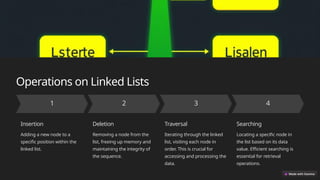
Operations on Linked Lists
Insertion
Adding a new node to a
specific position within the
linked list.
Deletion
Removing a node from the
list, freeing up memory and
maintaining the integrity of
the sequence.
Traversal
Iterating through the linked
list, visiting each node in
order. This is crucial for
accessing and processing the
data.
Searching
Locating a specific node in
the list based on its data
value. Efficient searching is
essential for retrieval
operations.
Advantages and Disadvantages of Linked Lists
Advantages
Dynamic allocation, efficient insertion and deletion at any
position, and flexibility for handling dynamic data.
Disadvantages
Requires more memory due to pointers, random access is
not efficient, and traversal requires visiting each node
sequentially.
Implementing Linked Lists in
Code
class Node:
def __init__(self, data):
self.data = data
self.next = None
Traversal and Searching in Linked Lists
Traversal
Iterating through the linked list by following pointers from
node to node.
Searching
Finding a specific node by comparing data values with the
data stored in each node.
Applications of Linked Lists
Stacks and Queues
Linked lists form the basis of
fundamental data structures
like stacks and queues, used
for managing data in specific
orders.
Graphs
Linked lists are used to
represent the connections
between nodes in graphs,
essential for network analysis
and pathfinding.
Dynamic Memory Allocation
They are fundamental for dynamically allocating and managing
memory in programming, ensuring efficient use of resources.

Linked-Lists-A-Fundamental-Data-Structure.pptx

  • 1.
    Linked Lists: AFundamental Data Structure Welcome to this exploration of linked lists, a core data structure that is essential for understanding data storage and manipulation. by Mosiuoa Wesi
  • 2.
    Characteristics of LinkedLists Dynamic Allocation Linked lists utilize dynamic memory allocation, allowing them to grow or shrink in size as needed. This dynamic nature contrasts with static arrays where size is fixed. Sequential Storage Each element in a linked list is stored as a node containing data and a pointer to the next node in the sequence. This sequential structure differs from arrays, which store elements contiguously.
  • 3.
    Types of LinkedLists Singly Linked List The simplest type, with nodes pointing to the next node, allowing traversal in one direction. Doubly Linked List Nodes have pointers to both the next and previous nodes, enabling bidirectional traversal. Circular Linked List The last node points back to the first node, creating a loop. This allows for efficient traversing, especially for cyclical data.
  • 4.
    Operations on LinkedLists Insertion Adding a new node to a specific position within the linked list. Deletion Removing a node from the list, freeing up memory and maintaining the integrity of the sequence. Traversal Iterating through the linked list, visiting each node in order. This is crucial for accessing and processing the data. Searching Locating a specific node in the list based on its data value. Efficient searching is essential for retrieval operations.
  • 5.
    Advantages and Disadvantagesof Linked Lists Advantages Dynamic allocation, efficient insertion and deletion at any position, and flexibility for handling dynamic data. Disadvantages Requires more memory due to pointers, random access is not efficient, and traversal requires visiting each node sequentially.
  • 6.
    Implementing Linked Listsin Code class Node: def __init__(self, data): self.data = data self.next = None
  • 7.
    Traversal and Searchingin Linked Lists Traversal Iterating through the linked list by following pointers from node to node. Searching Finding a specific node by comparing data values with the data stored in each node.
  • 8.
    Applications of LinkedLists Stacks and Queues Linked lists form the basis of fundamental data structures like stacks and queues, used for managing data in specific orders. Graphs Linked lists are used to represent the connections between nodes in graphs, essential for network analysis and pathfinding. Dynamic Memory Allocation They are fundamental for dynamically allocating and managing memory in programming, ensuring efficient use of resources.