Chapter 2
Data Structures
Assoc. Prof. Dr. Oğuz FINDIK
2016-2017
KBUZEM
KARABUK UNIVERSITY
1
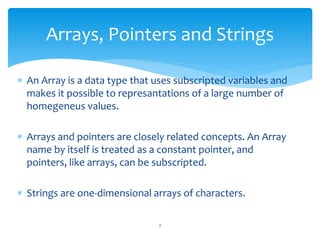
 An Array is a data type that uses subscripted variables and
makes it possible to represantations of a large number of
homegeneus values.
 Arrays and pointers are closely related concepts. An Array
name by itself is treated as a constant pointer, and
pointers, like arrays, can be subscripted.
 Strings are one-dimensional arrays of characters.
2
Arrays, Pointers and Strings
 Programs often use homogeneous data. For example we want
to store some grades and we should define as follows
 int grade0,grade1,grade2,grade3;
 We can define one array to hold these values.
 int grade[3];
 The integer 3 in the declerations represents the number of
elements in the array. The indexing of array elements always
starts at 0.
3
One-dimesional Arrays
 int a[size];
 Lower bound = 0
 Upper bound = size – 1
 Size upper bound + 1
 İt is a good way to define size of and Array as symbolic constant
 #define N 100
 int a[N];
 for(i=0;i<N;i++)
 sum +=a[i];
4
One-dimesional Arrays
 float f[5]={0.0,1.0,2.0,3.0,4.0};
 int a[100] = {0};
 int [] ={2,3,5,-7};
 char s[] = " abc"
 char s[] ={‘a’, ‘b’, ‘c’};
5
İnitialization
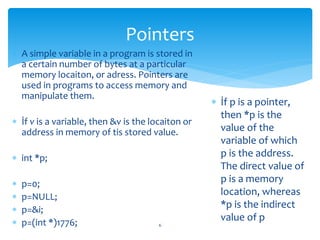
 A simple variable in a program is stored in
a certain number of bytes at a particular
memory locaiton, or adress. Pointers are
used in programs to access memory and
manipulate them.
 İf v is a variable, then &v is the locaiton or
address in memory of tis stored value.
 int *p;
 p=0;
 p=NULL;
 p=&i;
 p=(int *)1776; 6
Pointers
 İf p is a pointer,
then *p is the
value of the
variable of which
p is the address.
The direct value of
p is a memory
location, whereas
*p is the indirect
value of p
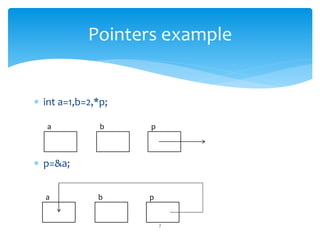
 int a=1,b=2,*p;
 p=&a;
7
Pointers example
a b p
a b p
8
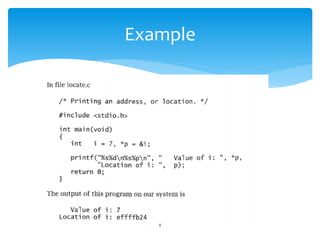
Example
9
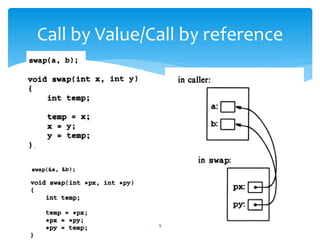
Call by Value/Call by reference
 An array name by itself is an adress, and pointers can be subscripted.
Pointer variable can take different addresses as values. In contrast, an
array name is an address, or pointer, that is fixed.
 Suppose that a is an array, iis an int and p is a pointer.
 a[i] is equivalent to *(a+i)
 p[i] is equivalent to *(p+i)
 #define N 100
 int a[N], i,*p,sum=0;
 p=a; is equivalent to p=&a[0]
p=a;
for(p=a;p<&a[N];++p) for(i=0;i<N;++i) for(i=0;i<N;++i)
sum +=*p; sum +=*(a+i) sum +=p[i];
10
The relationship between arrays and
Pointers
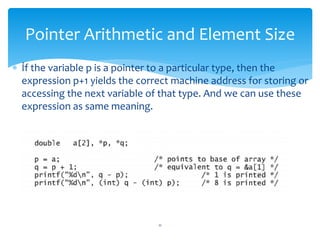
 İf the variable p is a pointer to a particular type, then the
expression p+1 yields the correct machine address for storing or
accessing the next variable of that type. And we can use these
expression as same meaning.
11
Pointer Arithmetic and Element Size
 #include <stdio.h>
 #include <stdlib.h>
 #define N 10
 int sum(int *);
 int main(void) {
 int a[10] = { 2, 3, 4, 5, 7, 8, 1, 2, 1, 6 };
 printf("Sum of array is:%d", sum(a));
 return 0;
 }
 int sum(int a[]) {
 int toplam = 0, *p;
 for (p = a; p < &a[N]; p++) {
 toplam += *p;
 }
 return toplam;
 }
12
Arrays as Function Arguments
 void swap(int *, int *);
 int main(void) {
 int a[10] = { 2, 3, 4, 5, 7, 8, 1, 2, 1, 6 };
 int i, j;
 for (i = 0; i < N; i++)
 for (j = N - 1; j > i; --j) {
 if (a[j - 1] > a[j])
 swap(&a[j - 1], &a[j]);
 }
 printf("{");
 for (i = 0; i < N; i++)
 printf("%d %s", a[i], (i < (N - 1)) ? "," : "}");
 return 0;
 } 13
Example Buble Sort
14
Dynamic Memory Allocation With
calloc() and malloc()
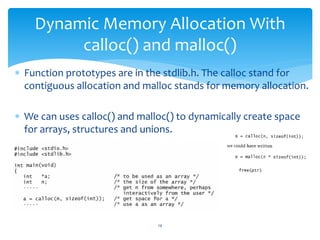
 Function prototypes are in the stdlib.h. The calloc stand for
contiguous allocation and malloc stands for memory allocation.
 We can uses calloc() and malloc() to dynamically create space
for arrays, structures and unions.

15
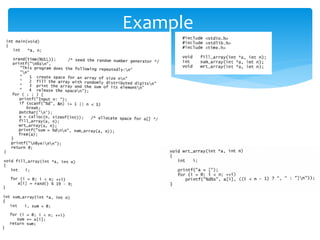
Example

Data structure week 2

  • 1.
    Chapter 2 Data Structures Assoc.Prof. Dr. Oğuz FINDIK 2016-2017 KBUZEM KARABUK UNIVERSITY 1
  • 2.
     An Arrayis a data type that uses subscripted variables and makes it possible to represantations of a large number of homegeneus values.  Arrays and pointers are closely related concepts. An Array name by itself is treated as a constant pointer, and pointers, like arrays, can be subscripted.  Strings are one-dimensional arrays of characters. 2 Arrays, Pointers and Strings
  • 3.
     Programs oftenuse homogeneous data. For example we want to store some grades and we should define as follows  int grade0,grade1,grade2,grade3;  We can define one array to hold these values.  int grade[3];  The integer 3 in the declerations represents the number of elements in the array. The indexing of array elements always starts at 0. 3 One-dimesional Arrays
  • 4.
     int a[size]; Lower bound = 0  Upper bound = size – 1  Size upper bound + 1  İt is a good way to define size of and Array as symbolic constant  #define N 100  int a[N];  for(i=0;i<N;i++)  sum +=a[i]; 4 One-dimesional Arrays
  • 5.
     float f[5]={0.0,1.0,2.0,3.0,4.0}; int a[100] = {0};  int [] ={2,3,5,-7};  char s[] = " abc"  char s[] ={‘a’, ‘b’, ‘c’}; 5 İnitialization
  • 6.
     A simplevariable in a program is stored in a certain number of bytes at a particular memory locaiton, or adress. Pointers are used in programs to access memory and manipulate them.  İf v is a variable, then &v is the locaiton or address in memory of tis stored value.  int *p;  p=0;  p=NULL;  p=&i;  p=(int *)1776; 6 Pointers  İf p is a pointer, then *p is the value of the variable of which p is the address. The direct value of p is a memory location, whereas *p is the indirect value of p
  • 7.
     int a=1,b=2,*p; p=&a; 7 Pointers example a b p a b p
  • 8.
  • 9.
  • 10.
     An arrayname by itself is an adress, and pointers can be subscripted. Pointer variable can take different addresses as values. In contrast, an array name is an address, or pointer, that is fixed.  Suppose that a is an array, iis an int and p is a pointer.  a[i] is equivalent to *(a+i)  p[i] is equivalent to *(p+i)  #define N 100  int a[N], i,*p,sum=0;  p=a; is equivalent to p=&a[0] p=a; for(p=a;p<&a[N];++p) for(i=0;i<N;++i) for(i=0;i<N;++i) sum +=*p; sum +=*(a+i) sum +=p[i]; 10 The relationship between arrays and Pointers
  • 11.
     İf thevariable p is a pointer to a particular type, then the expression p+1 yields the correct machine address for storing or accessing the next variable of that type. And we can use these expression as same meaning. 11 Pointer Arithmetic and Element Size
  • 12.
     #include <stdio.h> #include <stdlib.h>  #define N 10  int sum(int *);  int main(void) {  int a[10] = { 2, 3, 4, 5, 7, 8, 1, 2, 1, 6 };  printf("Sum of array is:%d", sum(a));  return 0;  }  int sum(int a[]) {  int toplam = 0, *p;  for (p = a; p < &a[N]; p++) {  toplam += *p;  }  return toplam;  } 12 Arrays as Function Arguments
  • 13.
     void swap(int*, int *);  int main(void) {  int a[10] = { 2, 3, 4, 5, 7, 8, 1, 2, 1, 6 };  int i, j;  for (i = 0; i < N; i++)  for (j = N - 1; j > i; --j) {  if (a[j - 1] > a[j])  swap(&a[j - 1], &a[j]);  }  printf("{");  for (i = 0; i < N; i++)  printf("%d %s", a[i], (i < (N - 1)) ? "," : "}");  return 0;  } 13 Example Buble Sort
  • 14.
    14 Dynamic Memory AllocationWith calloc() and malloc()  Function prototypes are in the stdlib.h. The calloc stand for contiguous allocation and malloc stands for memory allocation.  We can uses calloc() and malloc() to dynamically create space for arrays, structures and unions. 
  • 15.