Stack
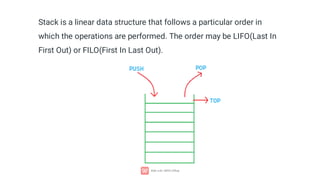
Stack is a linear data structure that follows a particular order in
which the operations are performed. The order may be LIFO(Last In
First Out) or FILO(First In Last Out).
•
•
•
•
•
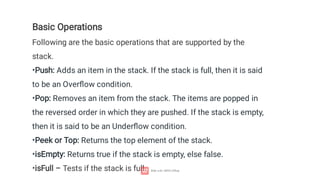
Basic Operations
Following are the basic operations that are supported by the
stack.
Push: Adds an item in the stack. If the stack is full, then it is said
to be an Overflow condition.
Pop: Removes an item from the stack. The items are popped in
the reversed order in which they are pushed. If the stack is empty,
then it is said to be an Underflow condition.
Peek or Top: Returns the top element of the stack.
isEmpty: Returns true if the stack is empty, else false.
isFull – Tests if the stack is full.
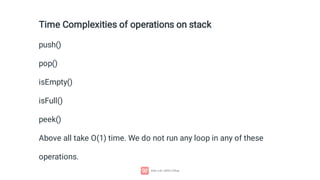
Time Complexities of operations on stack
push()
pop()
isEmpty()
isFull()
peek()
Above all take O(1) time. We do not run any loop in any of these
operations.
•
•
•
•
•
•
•
Applications of Stack
Redo-undo features at many places like editors, photoshop.
Forward and backward feature in web browsers
Used in many algorithms like Tower of Hanoi, tree traversals, stock span
problem, histogram problem.
Backtracking is one of the algorithm designing techniques.
In Graph Algorithms like Topological Sorting and Strongly Connected
Components
In Memory management, any modern computer uses a stack as the
primary management for a running purpose. Each program that is running
in a computer system has its own memory allocations
String reversal is also another application of stack.
•
•
Implementation
There are two ways to implement a stack:
Using array
Using linked list
•
•
•
•
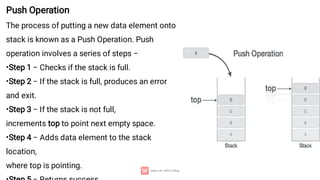
Push Operation
The process of putting a new data element onto
stack is known as a Push Operation. Push
operation involves a series of steps −
Step 1 − Checks if the stack is full.
Step 2 − If the stack is full, produces an error
and exit.
Step 3 − If the stack is not full,
increments top to point next empty space.
Step 4 − Adds data element to the stack
location,
where top is pointing.
•
•
•
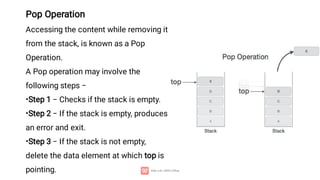
Pop Operation
Accessing the content while removing it
from the stack, is known as a Pop
Operation.
A Pop operation may involve the
following steps −
Step 1 − Checks if the stack is empty.
Step 2 − If the stack is empty, produces
an error and exit.
Step 3 − If the stack is not empty,
delete the data element at which top is
pointing.

4-Stack --------------------------------in C++.pdf

  • 1.
  • 2.
    Stack is alinear data structure that follows a particular order in which the operations are performed. The order may be LIFO(Last In First Out) or FILO(First In Last Out).
  • 3.
    • • • • • Basic Operations Following arethe basic operations that are supported by the stack. Push: Adds an item in the stack. If the stack is full, then it is said to be an Overflow condition. Pop: Removes an item from the stack. The items are popped in the reversed order in which they are pushed. If the stack is empty, then it is said to be an Underflow condition. Peek or Top: Returns the top element of the stack. isEmpty: Returns true if the stack is empty, else false. isFull – Tests if the stack is full.
  • 4.
    Time Complexities ofoperations on stack push() pop() isEmpty() isFull() peek() Above all take O(1) time. We do not run any loop in any of these operations.
  • 5.
    • • • • • • • Applications of Stack Redo-undofeatures at many places like editors, photoshop. Forward and backward feature in web browsers Used in many algorithms like Tower of Hanoi, tree traversals, stock span problem, histogram problem. Backtracking is one of the algorithm designing techniques. In Graph Algorithms like Topological Sorting and Strongly Connected Components In Memory management, any modern computer uses a stack as the primary management for a running purpose. Each program that is running in a computer system has its own memory allocations String reversal is also another application of stack.
  • 6.
    • • Implementation There are twoways to implement a stack: Using array Using linked list
  • 7.
    • • • • Push Operation The processof putting a new data element onto stack is known as a Push Operation. Push operation involves a series of steps − Step 1 − Checks if the stack is full. Step 2 − If the stack is full, produces an error and exit. Step 3 − If the stack is not full, increments top to point next empty space. Step 4 − Adds data element to the stack location, where top is pointing.
  • 8.
    • • • Pop Operation Accessing thecontent while removing it from the stack, is known as a Pop Operation. A Pop operation may involve the following steps − Step 1 − Checks if the stack is empty. Step 2 − If the stack is empty, produces an error and exit. Step 3 − If the stack is not empty, delete the data element at which top is pointing.