DATA REMEDIATION FOR EQUIPMENT FINANCE
richmondgrp.com
Richmond’s data remediation approach
Richmond Group
With fast-tracked covid-19 forbearance measures upon us, and
increasing amounts of complex data becoming available to businesses,
data errors are a fact of life.
This article summarises our strategy and top tips for successfully
remediating data errors.
richmondgrp.com
Data remediation for equipment finance
Introduction
Under pressure to move with speed, for example fast-tracking covid-19 forbearance measures, or
migrating data to a new system, the risk of data errors can increase or be seen as the price to pay for
progress.
Equipment finance is particularly susceptible to single data errors cascading to linked systems and
multiple periods. Addressing such errors calls for a considered approach.
Finally, people are fallible and prone to making mistakes, whether it be
the data entered manually into systems, the software programs they
create, or the processes they adopt to manage their business..
Typical data remediation scenarios
 As a part of system migration projects - data cleanup prior to
migration &/or resolving post-migration issues
 Business process improvement initiatives that uncover data issues
 Master Data Management projects, such as GDPR compliance
 Mergers and acquisitions
 Broken processes are detected
 Previously undetected system errors are uncovered
The impact of undetected or
uncorrected errors
 Damage to reputation with customers
 Mislead management into making decisions
based on inaccurate information
 Mean incomplete or erroneous information
is provided to regulators
 Be costly to correct, especially if erroneous
data remains undetected for some time
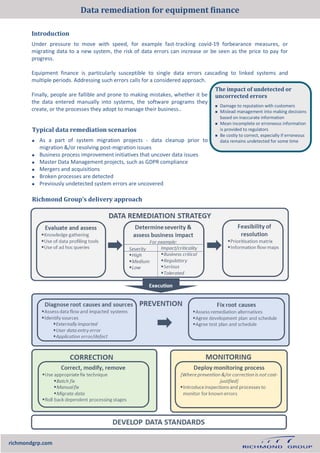
Richmond Group’s delivery approach
richmondgrp.com
Data remediation for equipment finance
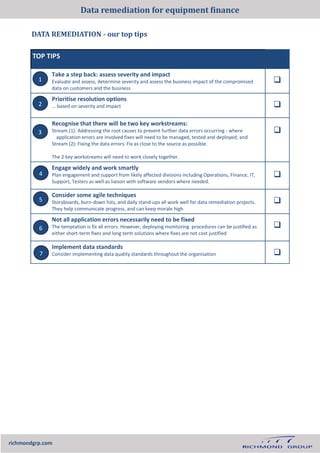
DATA REMEDIATION - our top tips
1
2
3
4
5
6
TOP TIPS
Take a step back: assess severity and impact
Evaluate and assess, determine severity and assess the business impact of the compromised
data on customers and the business

Prioritise resolution options
… based on severity and impact 
Recognise that there will be two key workstreams:
Stream (1): Addressing the root causes to prevent further data errors occurring - where
application errors are involved fixes will need to be managed, tested and deployed; and
Stream (2): Fixing the data errors. Fix as close to the source as possible.
The 2 key workstreams will need to work closely together.

Engage widely and work smartly
Plan engagement and support from likely affected divisions including Operations, Finance, IT,
Support, Testers as well as liaison with software vendors where needed.

Consider some agile techniques
Storyboards, burn-down lists, and daily stand-ups all work well for data remediation projects.
They help communicate progress, and can keep morale high

Not all application errors necessarily need to be fixed
The temptation is fix all errors. However, deploying monitoring procedures can be justified as
either short-term fixes and long term solutions where fixes are not cost justified

Implement data standards
Consider implementing data quality standards throughout the organisation 7
Contacts
www.richmondgrp.com
Richmond Group is a leading business transformation practice dedicated
exclusively to the equipment finance and leasing industry since 2000
Equipment finance and
leasing expertise
Deep understanding of
equipment finance
International
Delivering projects in Europe,
the Americas and Asia
Practical and pragmatic
Experienced,
knowledgeable, safe
David Pedreno
T: +44 7802 446137
E: dpedreno@richmondgrp.com
David Harmer
T:+41 78 808 01 99
E: dharmer@richmondgrp.com
Business
transformation
Systems
implementation
Data quality and
reporting
Richmond Consulting Group Ltd
22a St James Square, London SW1Y 4JH, United Kingdom

Data remediation article2

  • 1.
    DATA REMEDIATION FOREQUIPMENT FINANCE richmondgrp.com Richmond’s data remediation approach Richmond Group With fast-tracked covid-19 forbearance measures upon us, and increasing amounts of complex data becoming available to businesses, data errors are a fact of life. This article summarises our strategy and top tips for successfully remediating data errors.
  • 2.
    richmondgrp.com Data remediation forequipment finance Introduction Under pressure to move with speed, for example fast-tracking covid-19 forbearance measures, or migrating data to a new system, the risk of data errors can increase or be seen as the price to pay for progress. Equipment finance is particularly susceptible to single data errors cascading to linked systems and multiple periods. Addressing such errors calls for a considered approach. Finally, people are fallible and prone to making mistakes, whether it be the data entered manually into systems, the software programs they create, or the processes they adopt to manage their business.. Typical data remediation scenarios  As a part of system migration projects - data cleanup prior to migration &/or resolving post-migration issues  Business process improvement initiatives that uncover data issues  Master Data Management projects, such as GDPR compliance  Mergers and acquisitions  Broken processes are detected  Previously undetected system errors are uncovered The impact of undetected or uncorrected errors  Damage to reputation with customers  Mislead management into making decisions based on inaccurate information  Mean incomplete or erroneous information is provided to regulators  Be costly to correct, especially if erroneous data remains undetected for some time Richmond Group’s delivery approach
  • 3.
    richmondgrp.com Data remediation forequipment finance DATA REMEDIATION - our top tips 1 2 3 4 5 6 TOP TIPS Take a step back: assess severity and impact Evaluate and assess, determine severity and assess the business impact of the compromised data on customers and the business  Prioritise resolution options … based on severity and impact  Recognise that there will be two key workstreams: Stream (1): Addressing the root causes to prevent further data errors occurring - where application errors are involved fixes will need to be managed, tested and deployed; and Stream (2): Fixing the data errors. Fix as close to the source as possible. The 2 key workstreams will need to work closely together.  Engage widely and work smartly Plan engagement and support from likely affected divisions including Operations, Finance, IT, Support, Testers as well as liaison with software vendors where needed.  Consider some agile techniques Storyboards, burn-down lists, and daily stand-ups all work well for data remediation projects. They help communicate progress, and can keep morale high  Not all application errors necessarily need to be fixed The temptation is fix all errors. However, deploying monitoring procedures can be justified as either short-term fixes and long term solutions where fixes are not cost justified  Implement data standards Consider implementing data quality standards throughout the organisation 7
  • 4.
    Contacts www.richmondgrp.com Richmond Group isa leading business transformation practice dedicated exclusively to the equipment finance and leasing industry since 2000 Equipment finance and leasing expertise Deep understanding of equipment finance International Delivering projects in Europe, the Americas and Asia Practical and pragmatic Experienced, knowledgeable, safe David Pedreno T: +44 7802 446137 E: dpedreno@richmondgrp.com David Harmer T:+41 78 808 01 99 E: dharmer@richmondgrp.com Business transformation Systems implementation Data quality and reporting Richmond Consulting Group Ltd 22a St James Square, London SW1Y 4JH, United Kingdom