What is aData Model?
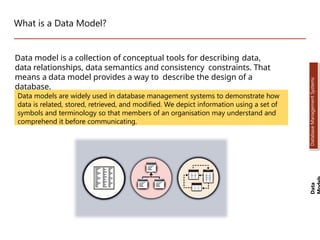
Data model is a collection of conceptual tools for describing data,
data relationships, data semantics and consistency constraints. That
means a data model provides a way to describe the design of a
database.
Data models are widely used in database management systems to demonstrate how
data is related, stored, retrieved, and modified. We depict information using a set of
symbols and terminology so that members of an organisation may understand and
comprehend it before communicating.
Data
Database
Management
Systems
Dr. Jay Sarraf, School of Computer Engineering, KIIT Deemed to be University
Dr. Jay Sarraf, School of Computer Engineering, KIIT Deemed to be University
Dr. Jay Sarraf, School of Computer Engineering, KIIT Deemed to be University
3.
Data model basicbuilding blocks
An entity is anything about which data are to be collected and stored. An
entity represents a particular type of object in the real world.
Set of entities of the same type that share the same properties are called
as entity sets.
An attribute is a characteristic of an entity.
A constraint is a restriction placed on the data. Constraints are important
because they help to ensure data integrity.
Entity
Entity Set
Attribute
Constraints
Data
Database
Management
Systems
Dr. Jay Sarraf, School of Computer Engineering, KIIT Deemed to be University
Dr. Jay Sarraf, School of Computer Engineering, KIIT Deemed to be University
Dr. Jay Sarraf, School of Computer Engineering, KIIT Deemed to be University
4.
Relationships
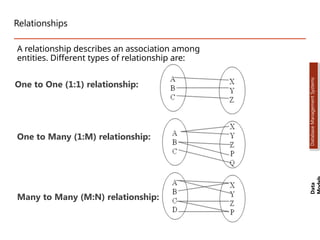
A relationship describesan association among
entities. Different types of relationship are:
One to One (1:1) relationship:
One to Many (1:M) relationship:
Many to Many (M:N) relationship:
Data
Database
Management
Systems
Dr. Jay Sarraf, School of Computer Engineering, KIIT Deemed to be University
Dr. Jay Sarraf, School of Computer Engineering, KIIT Deemed to be University
Dr. Jay Shool of Computer Engineering, KIIT Deemed to be University
5.
Hierarchical model
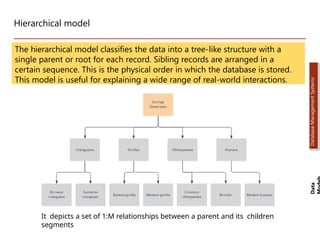
The hierarchicalmodel classifies the data into a tree-like structure with a
single parent or root for each record. Sibling records are arranged in a
certain sequence. This is the physical order in which the database is stored.
This model is useful for explaining a wide range of real-world interactions.
It depicts a set of 1:M relationships between a parent and its children
segments
Data
Database
Management
Systems
Dr. Jay Sarraf, School of Computer Engineering, KIIT Deemed to be University
D. Jay Sarraf, School of Computer Engineering, KIIT Deemed to be University
6.
Cont…
• It isvery simple and fast to traverse through a tree-like
structure.
• Any change in the parent node is automatically
reflected in the child node so, the integrity of data is
maintained.
Advantages of Hierarchical
Model
Disadvantages of Hierarchical
Model
• Complex relationships are not supported.
• As it does not support more than one parent of the child
node so if we have some complex relationship where a
child node needs to have two parent node then that
can't be represented using this model.
• If a parent node is deleted then the child node is
automatically deleted.
Data
Database
Management
Systems
Dr. Jay Sarraf, School of Computer Engineering, KIIT Deemed to be University
Dr. Jay Sarraf, School of Computer Engineering, KIIT Deemed to be University
7.
Network Model
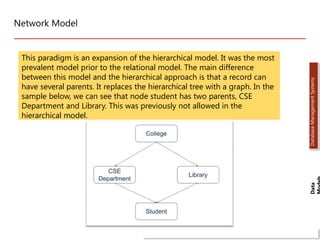
This paradigmis an expansion of the hierarchical model. It was the most
prevalent model prior to the relational model. The main difference
between this model and the hierarchical approach is that a record can
have several parents. It replaces the hierarchical tree with a graph. In the
sample below, we can see that node student has two parents, CSE
Department and Library. This was previously not allowed in the
hierarchical model.
Data
Database
Management
Systems
Dr. Jay Sarraf, School of Computer Engineering, KIIT Deemed to be University
Dr. Jay Sarraf, School of Computer Engineering, KIIT Deemed to be University
arraf, School of Computer Engineering, KIIT Deemed to be University
8.
Cont…
• When comparedto the hierarchical approach, data may be obtained more
quickly. This is because the data in the network model is more linked and there
may be more than one path to a certain node. As a result, the information
may be accessed in a variety of ways.
• Data integrity is present since there is a parent-child connection. Any changes
made to the parent record are mirrored in the child record.
Advantages of Network
Model
Disadvantages of Network
Model
• As additional relationships are added, the system may get increasingly
complicated. To operate with the model, a user needs have full understanding
of it.
• Any modification, such as an update, deletion, or insertion, is quite difficult.
Data
Database
Management
Systems
Dr. Jay Sarraf, School of Computer Engineering, KIIT Deemed to be University
Dr. Jay Sarraf, School of Computer Engineering, KIIT Deemed to be University
Dr. Jay Sarraf, School of Computer Engineering, KIIT Deemed to be University
9.
Entity-Relationship Model
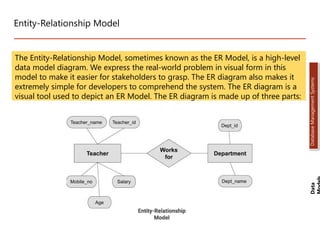
The Entity-RelationshipModel, sometimes known as the ER Model, is a high-level
data model diagram. We express the real-world problem in visual form in this
model to make it easier for stakeholders to grasp. The ER diagram also makes it
extremely simple for developers to comprehend the system. The ER diagram is a
visual tool used to depict an ER Model. The ER diagram is made up of three parts:
Data
Database
Management
Systems
Dr. Jay Sarraf, School of Computer Engineering, KIIT Deemed to be University
Dr. Jay Sarraf, School of Computer Engineering, KIIT Deemed to be University
10.
Cont…
Advantages of Entity-RelationshipModel
• Simple: Conceptually ER Model is very easy to build. If we know the relationship
between the attributes and the entities we can easily build the ER Diagram for
the model.
• Effective Communication Tool : This model is used widely by the database
designers for communicating their ideas.
• Easy Conversion to any Model : This model maps well to the relational model
and can be easily converted relational model by converting the ER model to the
table. This model can also be converted to any other model like network model,
hierarchical model etc.
Disadvantages of Entity-Relationship Model
• No industry standard for notation: There is no industry standard for developing
an ER model. So one developer might use notations which are not understood
by other developers.
• Hidden information: Some information might be lost or hidden in the ER model.
As it is a high-level view so there are chances that some details of information
might be hidden.
Data
Database
Management
Systems
Dr. Jay Sarraf, School of Computer Engineering, KIIT Deemed to be University
Dr. Jay Sarraf, School of Computer Engineering, KIIT Deemed to be University
Dr. Jay Sarraf, School of Computer Engineering, KIIT Deemed to be University
11.
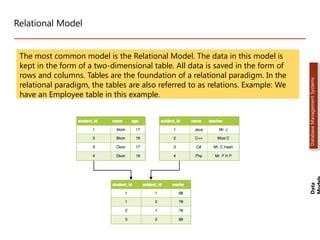
Relational Model
The mostcommon model is the Relational Model. The data in this model is
kept in the form of a two-dimensional table. All data is saved in the form of
rows and columns. Tables are the foundation of a relational paradigm. In the
relational paradigm, the tables are also referred to as relations. Example: We
have an Employee table in this example.
Data
Database
Management
Systems
Dr. Jay Sarraf, School of Computer Engineering, KIIT Deemed to be University
Dr. Jay Sarraf, School of Computer Engineering, KIIT Deemed to be University
r. Jay Sarraf, School of Computer Engineering, KIIT Deemed to be University
12.
Cont…
• Simple: Thismodel is more simple as compared to the network and
hierarchical model.
• Scalable: This model can be easily scaled as we can add as many rows and
columns we want.
• Structural Independence: We can make changes in database structure without
changing the way to access the data. When we can make changes to the
database structure without affecting the capability to DBMS to access the data
we can say that structural independence has been achieved.
Advantages of Relational Data
Model
Disadvantages of Relational Data
Model
• Hardware Overheads: For hiding the complexities and making things easier for
the user this model requires more powerful hardware computers and data
storage devices.
• Bad Design: As the relational model is very easy to design and use. So the users
don't need to know how the data is stored in order to access it. This ease of
design can lead to the development of a poor database which would slow down
if the database grows.
Data
Database
Management
Systems
Dr. Jay Sarraf, School of Computer Engineering, KIIT Deemed to be University
Dr. Jay Sarraf, School of Computer Engineering, KIIT Deemed to be University
Dr. Jay Sarraf, School of Computer Engineering, KIIT Deemed to be University
13.
Object-Oriented(OO) Model
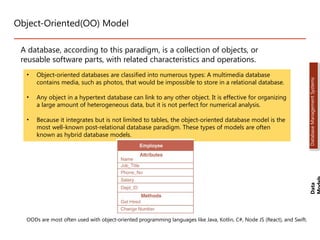
A database,according to this paradigm, is a collection of objects, or
reusable software parts, with related characteristics and operations.
• Object-oriented databases are classified into numerous types: A multimedia database
contains media, such as photos, that would be impossible to store in a relational database.
• Any object in a hypertext database can link to any other object. It is effective for organizing
a large amount of heterogeneous data, but it is not perfect for numerical analysis.
• Because it integrates but is not limited to tables, the object-oriented database model is the
most well-known post-relational database paradigm. These types of models are often
known as hybrid database models.
OODs are most often used with object-oriented programming languages like Java, Kotlin, C#, Node JS (React), and Swift.
Data
Database
Management
Systems
Dr. Jay Sarraf, School of Computer Engineering, KIIT Deemed to be University
Dr. Jay Sarraf, School of Computer Engineering, KIIT Deemed to be University
D. Jay Sarraf, School of Computer Engineering, KIIT Deemed to be University
14.
Cont…
• Complex datasets can be saved and retrieved quickly and easily.
• Object IDs are assigned automatically.
• Works well with object-oriented programming languages.
• Semantic content is added
• Support for complex objects
• Visual representation includes semantic content
Advantages of Object Oriented Data
Model
Disadvantages of Object Oriented Data
Model
• Object databases are not widely adopted.
• In some situations, the high complexity can cause performance problems.
• High system overheads slow transactions.
Data
Database
Management
Systems
Dr. Jay Sarraf, School of Computer Engineering, KIIT Deemed to be University
Dr. Jay Sarraf, School of Computer Engineering, KIIT Deemed to be University
Dr. Jay Sarraf, School of Computer Engineering, KIIT Deemed to be University
15.
Object-Relational (OR) Model
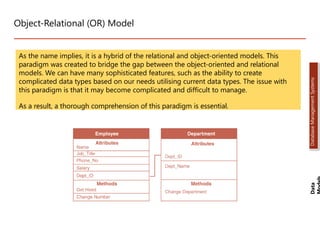
Asthe name implies, it is a hybrid of the relational and object-oriented models. This
paradigm was created to bridge the gap between the object-oriented and relational
models. We can have many sophisticated features, such as the ability to create
complicated data types based on our needs utilising current data types. The issue with
this paradigm is that it may become complicated and difficult to manage.
As a result, a thorough comprehension of this paradigm is essential.
Data
Database
Management
Systems
Dr. Jay Sarraf, School of Computer Engineering, KIIT Deemed to be University
Dr. Jay Sarraf, School of Computer Engineering, KIIT Deemed to be University
Dr. Jay Sarraf, School of Computer Engineering, KIIT Deemed to be University
16.
OO vs ORData Model
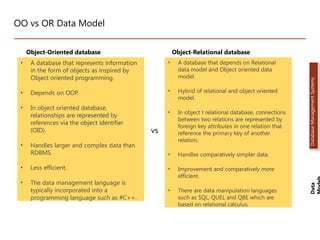
• A database that represents information
in the form of objects as inspired by
Object oriented programming.
• Depends on OOP.
• In object oriented database,
relationships are represented by
references via the object identifier
(OID).
• Handles larger and complex data than
RDBMS.
• Less efficient.
• The data management language is
typically incorporated into a
programming language such as #C++.
• A database that depends on Relational
data model and Object oriented data
model.
• Hybrid of relational and object oriented
model.
• In object t relational database, connections
between two relations are represented by
foreign key attributes in one relation that
reference the primary key of another
relation.
• Handles comparatively simpler data.
• Improvement and comparatively more
efficient.
• There are data manipulation languages
such as SQL, QUEL and QBE which are
based on relational calculus.
vs
Object-Oriented database Object-Relational database
Data
Database
Management
Systems
Dr. Jay Sarraf, School of Computer Engineering, KIIT Deemed to be University
Dr. Jay Sarraf, School of Computer Engineering, KIIT Deemed to be University
Dr. ay Sarraf, School of Computer Engineering, KIIT Deemed to be University
17.
Semi-structured Model
In thisparadigm, we can't tell the difference between data and schema. Web-
based data sources, for example, when we cannot distinguish between the
website's structure and data. Some entities in this model may be missing
characteristics, while others may have an additional attribute. This approach
allows for greater data storage flexibility. It also provides qualities with
flexibility.
The semi-structured model emerged from the relational model.
A few examples of semi-structured data sources are emails, XML and other
markup languages, binary executables, TCP/IP packets, zipped files, data
integrated from different sources, and web pages.
Data
Database
Management
Systems
Dr. Jay Sarraf, School of Computer Engineering, KIIT Deemed to be University
Dr. Jay Sarraf, School of Computer Engineering, KIIT Deemed to be University
r. Jay Sarraf, School of Computer Engineering, KIIT Deemed to be University



![[Deck] What's New in Spark-Iceberg Integration via DSV2.pptx](https://cdn.slidesharecdn.com/ss_thumbnails/deckwhatsnewinspark-icebergintegrationviadsv2-260210005337-25955b12-thumbnail.jpg?width=640&height=640&fit=bounds)


