1) Definition
2)Explanation
3) How Data Mining
Works
4) Basic Steps of
Data Minig.
5) Steps of what
Data to pick for
data Mining
6)Example.
7). Business
Intellegence (BI) &
Data Mining.
8)Types Of Data
Mining.
9) Types Of Data
Mining.
10)Result Validation
DATA MINING
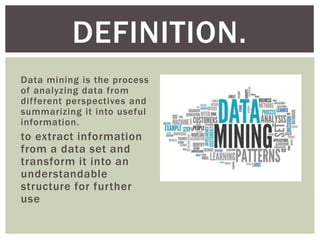
Data mining is the process
of analyzing data from
different perspectives and
summarizing it into useful
information.
to extract information
from a data set and
transform it into an
understandable
structure for further
use
DEFINITION.
 Data Mining is the Process that is used by big
companies or organizations to handle,balance and
analyzing big data.
 Data mining is primarily used today by companies
with a strong consumer focus - retail, financial,
communication, and marketing organizations. It
enables these companies to determine relationships
among internal factors such as price, product
positioning, or staff skills, and external factor.
 It is used by the companies to increase their revenue
or cut their costs or both.
EXPLANATION
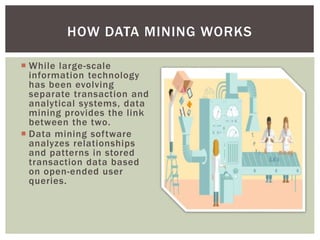
 While large-scale
information technology
has been evolving
separate transaction and
analytical systems, data
mining provides the link
between the two.
 Data mining software
analyzes relationships
and patterns in stored
transaction data based
on open-ended user
queries.
HOW DATA MINING WORKS
Following are some software's used for Data Mining:
 Microsoft SQL SERVER 2005.
 Microsoft SQL SERVER 2008.
 Oracle Data Mining etc.
SOFTWARE'S FOR DATA MINING:
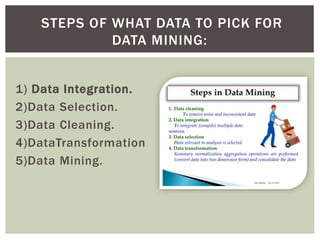
1) Data Integration.
2)Data Selection.
3)Data Cleaning.
4)DataTransformation
5)Data Mining.
STEPS OF WHAT DATA TO PICK FOR
DATA MINING:
 One Super Market in Canada used data mining capacity of
Oracle Software to analyze local buying patterns.They
discovered that when Mens bought Food for home on Saturday
and Sunday They like to tended to buy beer.On Other days of
the week mens don’t usually buy beers.
The Shopkeeper said to his workers to put sufficient
amount of beers on Saturday and Sunday.In this way income of
the shop was increased.
EXAMPLE
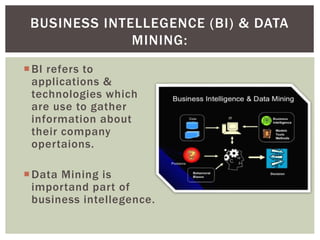
BI refers to
applications &
technologies which
are use to gather
information about
their company
opertaions.
Data Mining is
importand part of
business intellegence.
BUSINESS INTELLEGENCE (BI) & DATA
MINING:
Some Basic Examples of Use of Data Mining Are Given Below:
1) In Finance Data Mining is used for Credit Cards Analysis.
2) Astronomy:
Palomar Obstervatory discovered 22 quasars with the
help of Data Mining.
3) Telecommunication:
In Telecommunication Data Mining is used for Call
Records.
4) Offices:
In Offices it is used for to balance data and records of the
staff. etc
APPLICATIONS OF DATA MINING:
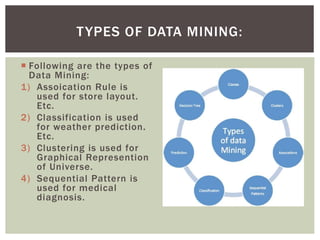
 Following are the types of
Data Mining:
1) Assoication Rule is
used for store layout.
Etc.
2) Classification is used
for weather prediction.
Etc.
3) Clustering is used for
Graphical Represention
of Universe.
4) Sequential Pattern is
used for medical
diagnosis.
TYPES OF DATA MINING:
• The final step of knowledge
discovery from data is to verify that
the patterns produced by the data
mining algorithms occur in the wider
data set.
RESULTS VALIDATION
Data mining

Data mining

  • 1.
    1) Definition 2)Explanation 3) HowData Mining Works 4) Basic Steps of Data Minig. 5) Steps of what Data to pick for data Mining 6)Example. 7). Business Intellegence (BI) & Data Mining. 8)Types Of Data Mining. 9) Types Of Data Mining. 10)Result Validation DATA MINING
  • 2.
    Data mining isthe process of analyzing data from different perspectives and summarizing it into useful information. to extract information from a data set and transform it into an understandable structure for further use DEFINITION.
  • 3.
     Data Miningis the Process that is used by big companies or organizations to handle,balance and analyzing big data.  Data mining is primarily used today by companies with a strong consumer focus - retail, financial, communication, and marketing organizations. It enables these companies to determine relationships among internal factors such as price, product positioning, or staff skills, and external factor.  It is used by the companies to increase their revenue or cut their costs or both. EXPLANATION
  • 4.
     While large-scale informationtechnology has been evolving separate transaction and analytical systems, data mining provides the link between the two.  Data mining software analyzes relationships and patterns in stored transaction data based on open-ended user queries. HOW DATA MINING WORKS
  • 5.
    Following are somesoftware's used for Data Mining:  Microsoft SQL SERVER 2005.  Microsoft SQL SERVER 2008.  Oracle Data Mining etc. SOFTWARE'S FOR DATA MINING:
  • 6.
    1) Data Integration. 2)DataSelection. 3)Data Cleaning. 4)DataTransformation 5)Data Mining. STEPS OF WHAT DATA TO PICK FOR DATA MINING:
  • 7.
     One SuperMarket in Canada used data mining capacity of Oracle Software to analyze local buying patterns.They discovered that when Mens bought Food for home on Saturday and Sunday They like to tended to buy beer.On Other days of the week mens don’t usually buy beers. The Shopkeeper said to his workers to put sufficient amount of beers on Saturday and Sunday.In this way income of the shop was increased. EXAMPLE
  • 8.
    BI refers to applications& technologies which are use to gather information about their company opertaions. Data Mining is importand part of business intellegence. BUSINESS INTELLEGENCE (BI) & DATA MINING:
  • 9.
    Some Basic Examplesof Use of Data Mining Are Given Below: 1) In Finance Data Mining is used for Credit Cards Analysis. 2) Astronomy: Palomar Obstervatory discovered 22 quasars with the help of Data Mining. 3) Telecommunication: In Telecommunication Data Mining is used for Call Records. 4) Offices: In Offices it is used for to balance data and records of the staff. etc APPLICATIONS OF DATA MINING:
  • 10.
     Following arethe types of Data Mining: 1) Assoication Rule is used for store layout. Etc. 2) Classification is used for weather prediction. Etc. 3) Clustering is used for Graphical Represention of Universe. 4) Sequential Pattern is used for medical diagnosis. TYPES OF DATA MINING:
  • 11.
    • The finalstep of knowledge discovery from data is to verify that the patterns produced by the data mining algorithms occur in the wider data set. RESULTS VALIDATION