BUSINESS INTELLIGENCE & ANALYTICS
KDS 051
UNIT-2 : BI-DATA MINING & WAREHOUSING (Part-a)
Prepared By- PROF. RUPA RANI
Contents
Introduction to Data Mining
Architecture of Data Mining
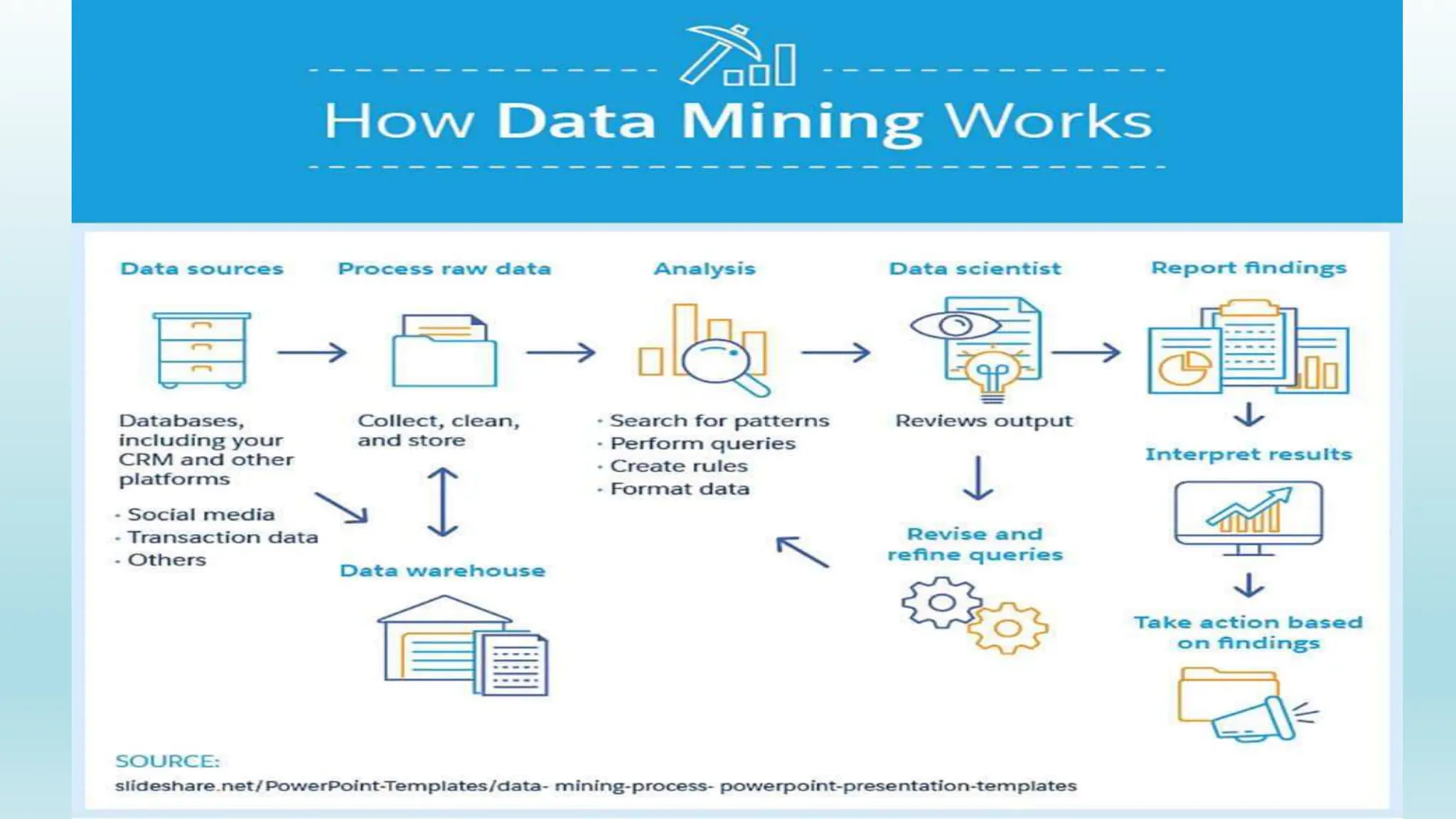
How Data mining works (Process)
Functionalities & Classifications of Data Mining
Representation of Input Data
Analysis Methodologies
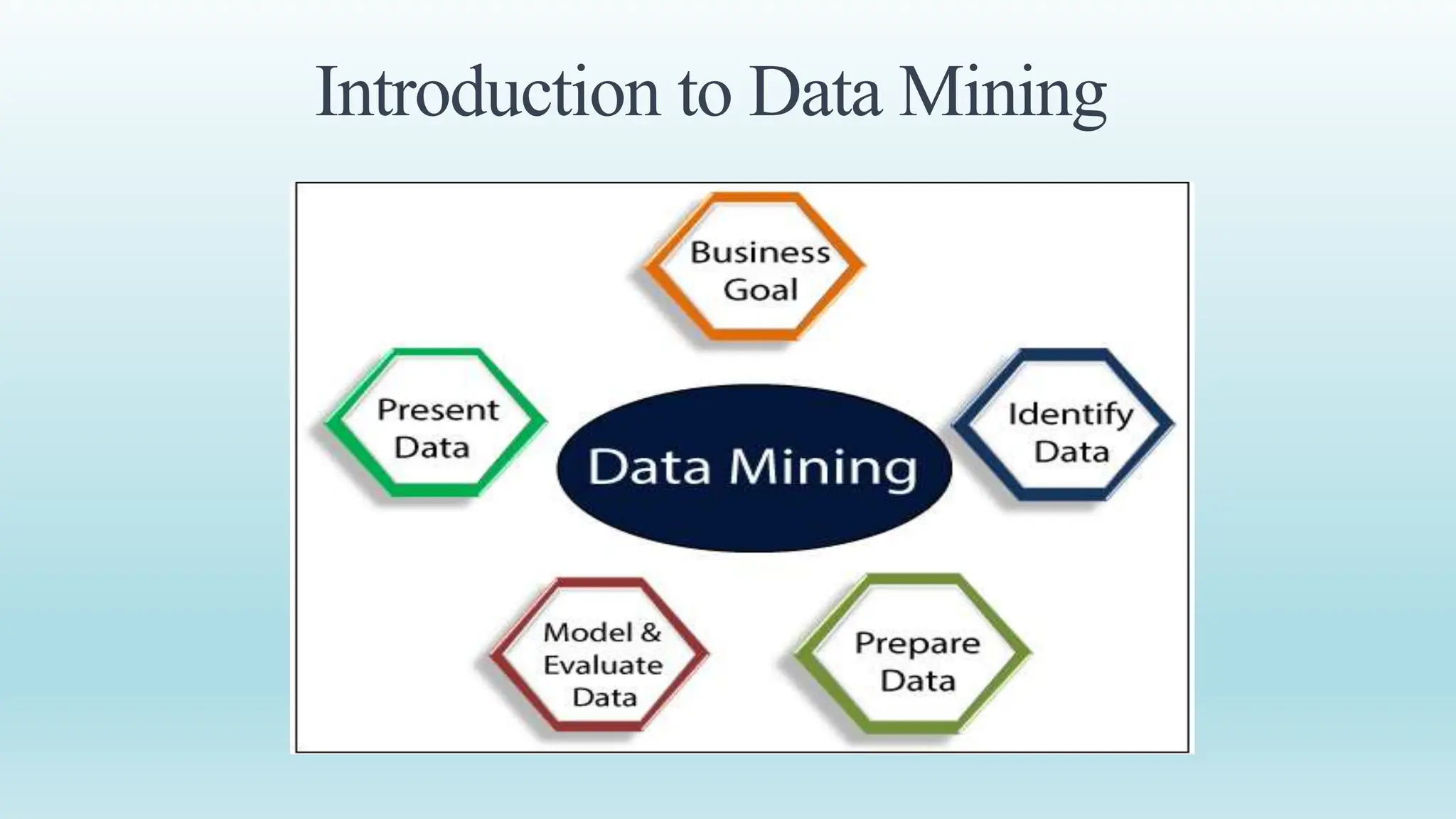
Introduction to Data Mining
Data mining is one of the most useful techniques that help entrepreneurs,
researchers, and individuals to extract valuable information from huge sets of
data. Data mining is also called Knowledge Discovery in Database (KDD). The
knowledge discovery process includes Data cleaning, Data integration, Data
selection, Data transformation, Data mining, Pattern evaluation, and Knowledge
presentation.
Definition: The process of extracting information to identify patterns, trends, and
useful data that would allow the business to take the data-driven decision from
huge sets of data is called Data Mining.
Introduction to Data Mining
Data Mining is similar to Data Science carried out by a person, in a specific
situation, on a particular data set, with an objective.
This process includes various types of services such as text mining, web mining,
audio and video mining, pictorial data mining, and social media mining.
It is done through software that is simple or highly specific.
By outsourcing data mining, all the work can be done faster with low operation
costs.
Specialized firms can also use new technologies to collect data that is impossible
to locate manually.
There are tonnes of information available on various platforms, but very little
knowledge is accessible.
The biggest challenge is to analyze the data to extract important information that
can be used to solve a problem or for company development.
There are many powerful instruments and techniques available to mine data and
find better insight from it.
Introduction to Data Mining
Types of Data Mining
Data mining can be performed on the following types of data:
Relational Database:
A relational database is a collection of multiple data sets formally organized by tables,
records, and columns from which data can be accessed in various ways without having to
recognize the database tables. Tables convey and share information, which facilitates data
searchability, reporting, and organization.
Data warehouses:
A Data Warehouse is a technology that collects data from various sources within the
organization to provide meaningful business insights. The huge amount of data comes from
multiple places such as Marketing and Finance. The extracted data is utilized for analytical
purposes and helps in decision-making for a business organization. The data warehouse is
designed for the analysis of data rather than transaction processing.
Data Repositories:
The Data Repository generally refers to a destination for data storage. However, many IT
professionals utilize the term more clearly to refer to a specific kind of setup within an IT
structure. For example, a group of databases, where an organization has kept various kinds
of information.
Types of Data Mining
Object-Relational Database:
A combination of an object-oriented database model and relational database model is
called an object-relational model. It supports Classes, Objects, Inheritance, etc.
One of the primary objectives of the Object-relational data model is to close the gap
between the Relational database and the object-oriented model practices frequently
utilized in many programming languages, for example, C++, Java, C#, and so on.
Transactional Database:
A transactional database refers to a database management system (DBMS) that has
the potential to undo a database transaction if it is not performed appropriately. Even
though this was a unique capability a very long while back, today, most of the
relational database systems support transactional database activities.
Advantages of Data Mining
•The Data Mining technique enables organizations to obtain knowledge-based data.
•Data mining enables organizations to make lucrative modifications in operation and
production.
•Compared with other statistical data applications, data mining is a cost-efficient.
•Data Mining helps the decision-making process of an organization.
•It Facilitates the automated discovery of hidden patterns as well as the prediction of
trends and behaviors.
•It can be induced in the new system as well as the existing platforms.
•It is a quick process that makes it easy for new users to analyze enormous amounts
of data in a short time.
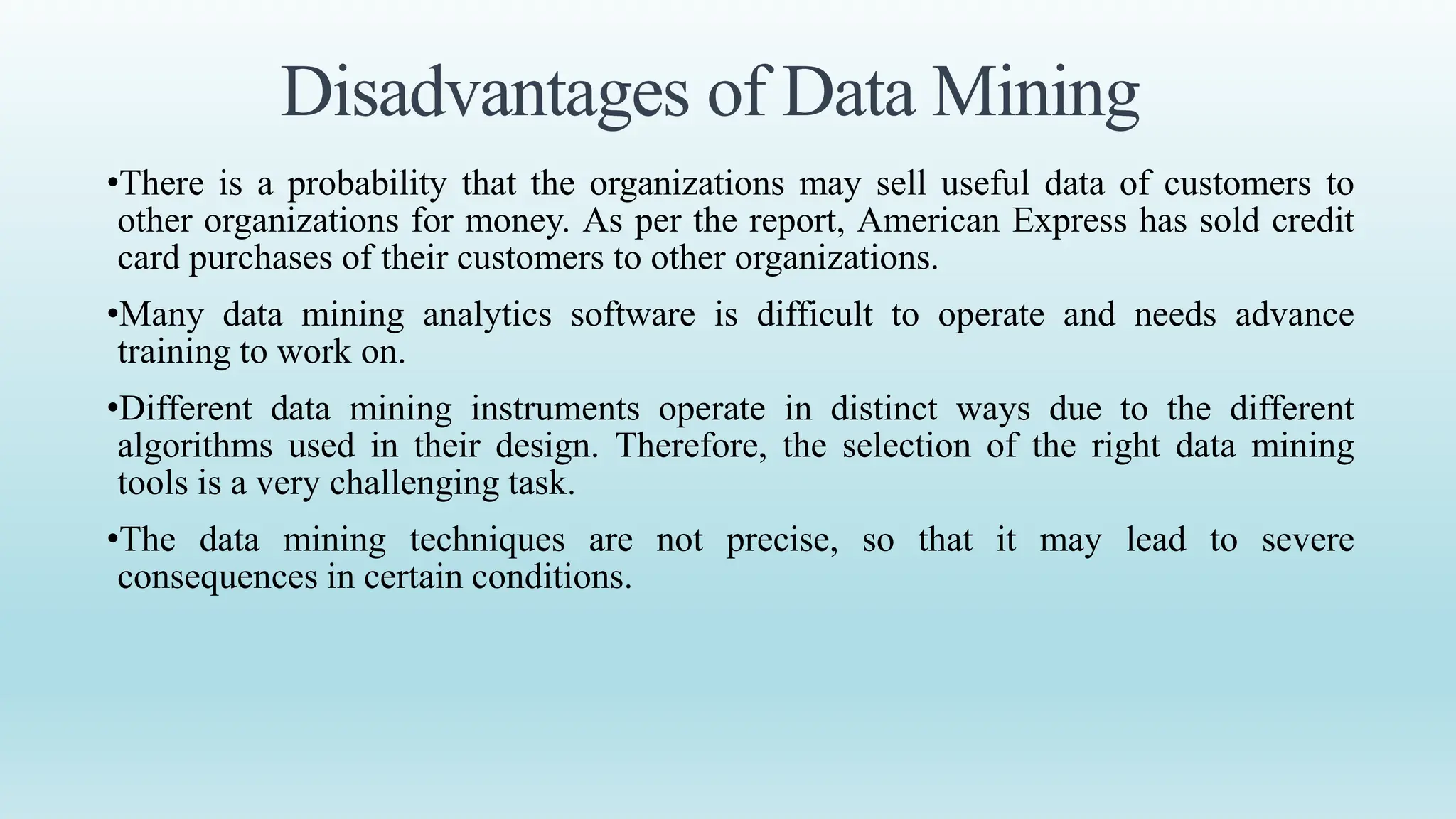
Disadvantages of Data Mining
•There is a probability that the organizations may sell useful data of customers to
other organizations for money. As per the report, American Express has sold credit
card purchases of their customers to other organizations.
•Many data mining analytics software is difficult to operate and needs advance
training to work on.
•Different data mining instruments operate in distinct ways due to the different
algorithms used in their design. Therefore, the selection of the right data mining
tools is a very challenging task.
•The data mining techniques are not precise, so that it may lead to severe
consequences in certain conditions.
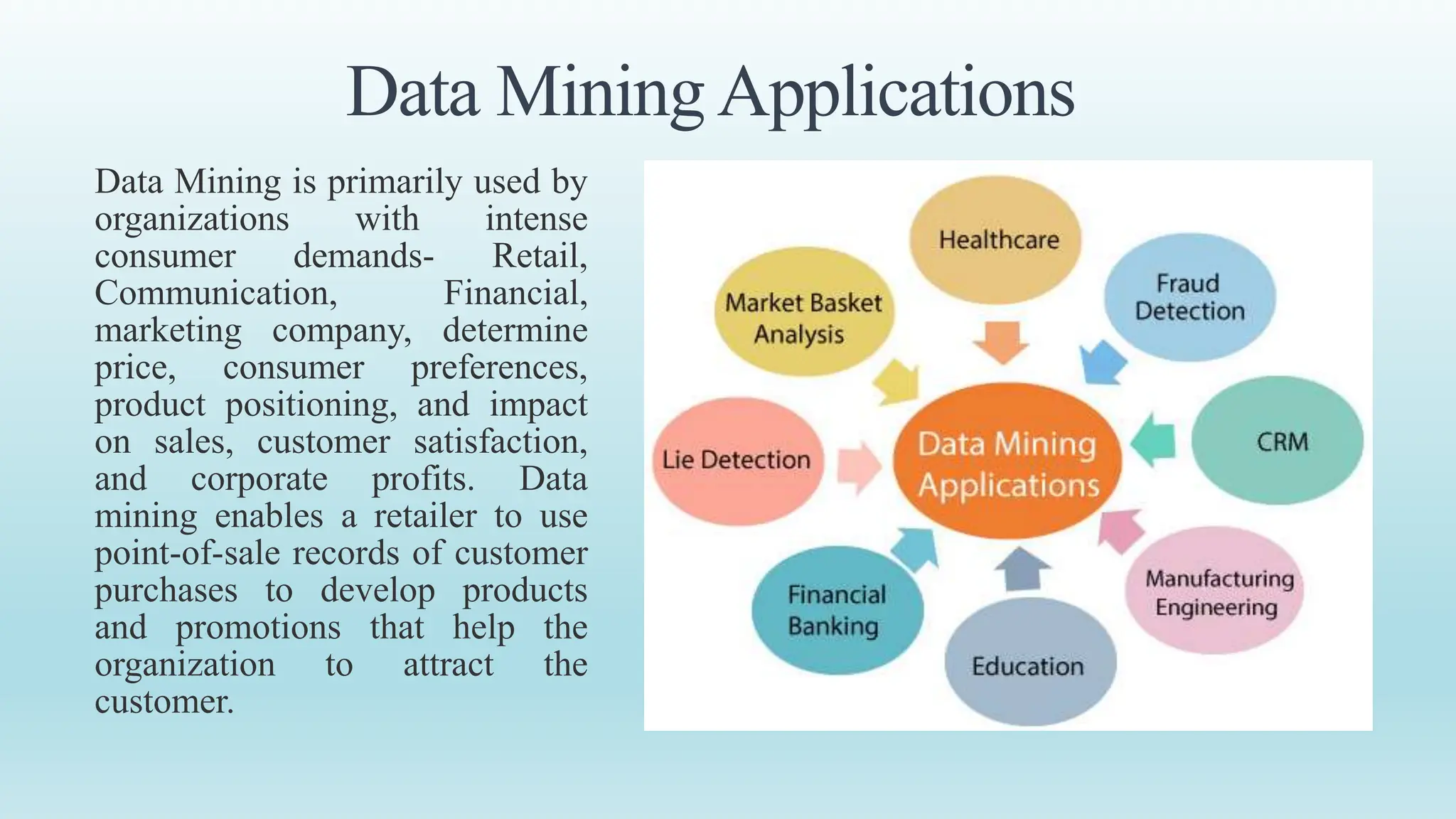
Data Mining Applications
Data Mining is primarily used by
organizations with intense
consumer demands- Retail,
Communication, Financial,
marketing company, determine
price, consumer preferences,
product positioning, and impact
on sales, customer satisfaction,
and corporate profits. Data
mining enables a retailer to use
point-of-sale records of customer
purchases to develop products
and promotions that help the
organization to attract the
customer.
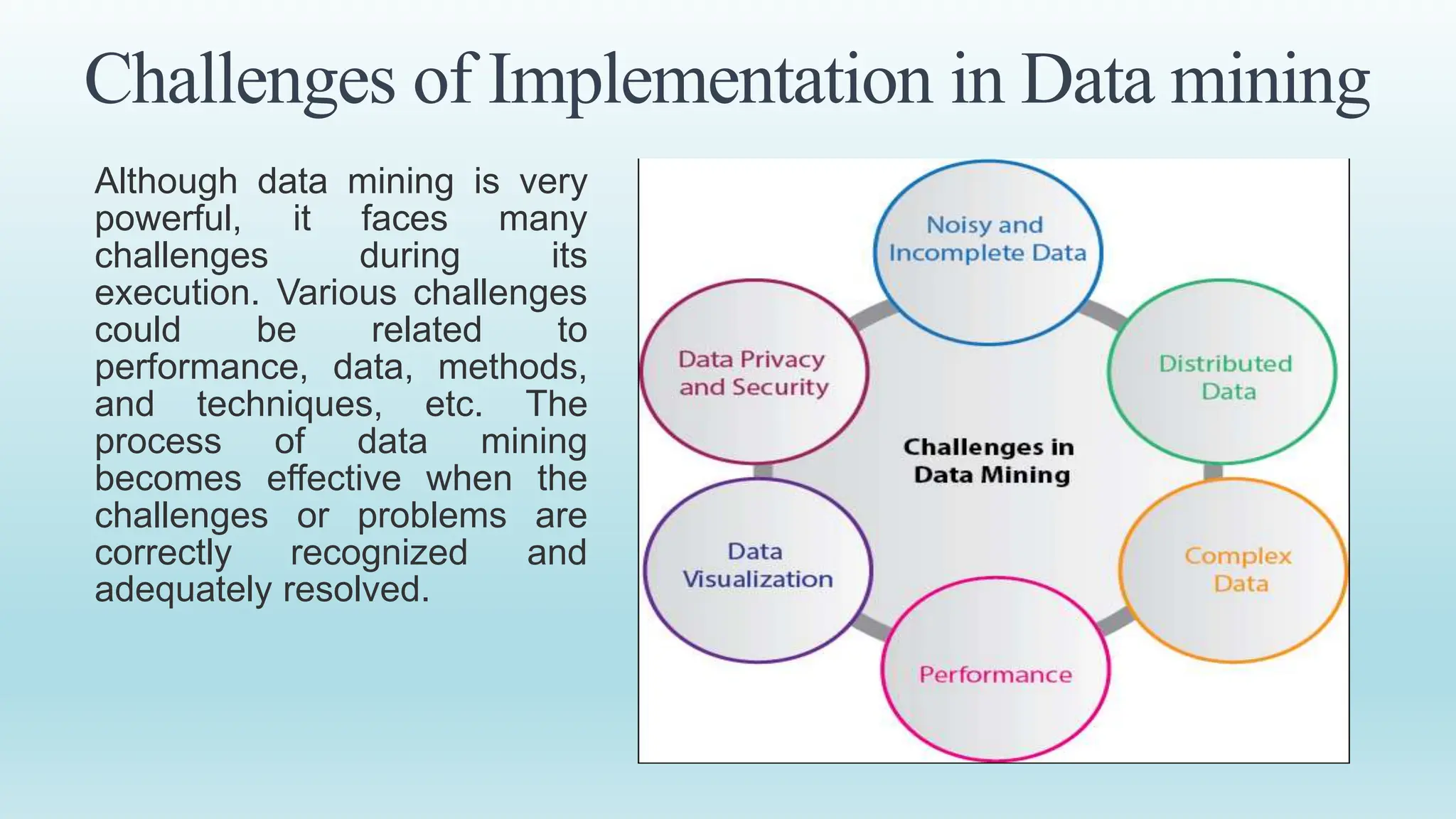
Challenges of Implementation in Data mining
Although data mining is very
powerful, it faces many
challenges during its
execution. Various challenges
could be related to
performance, data, methods,
and techniques, etc. The
process of data mining
becomes effective when the
challenges or problems are
correctly recognized and
adequately resolved.
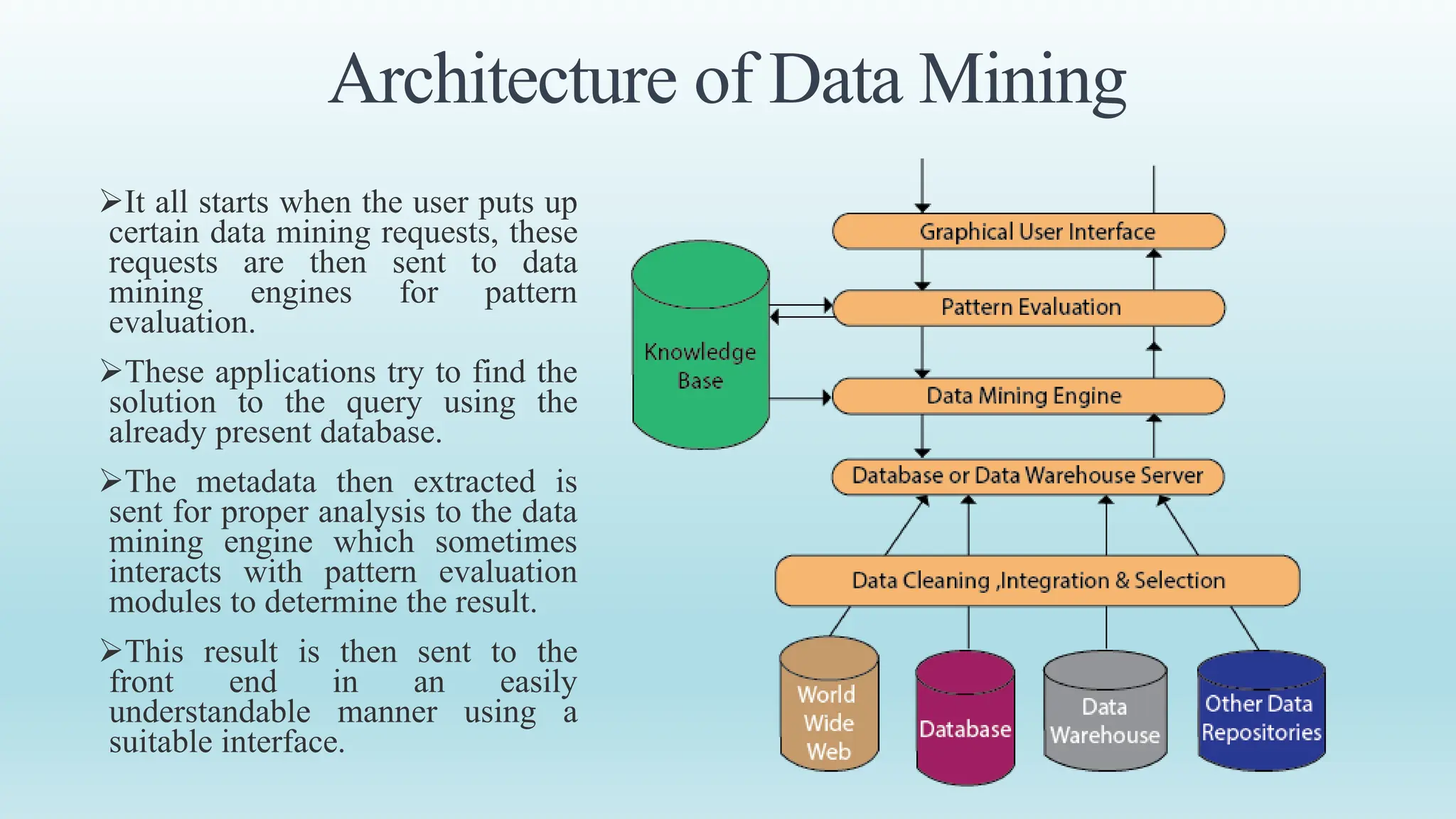
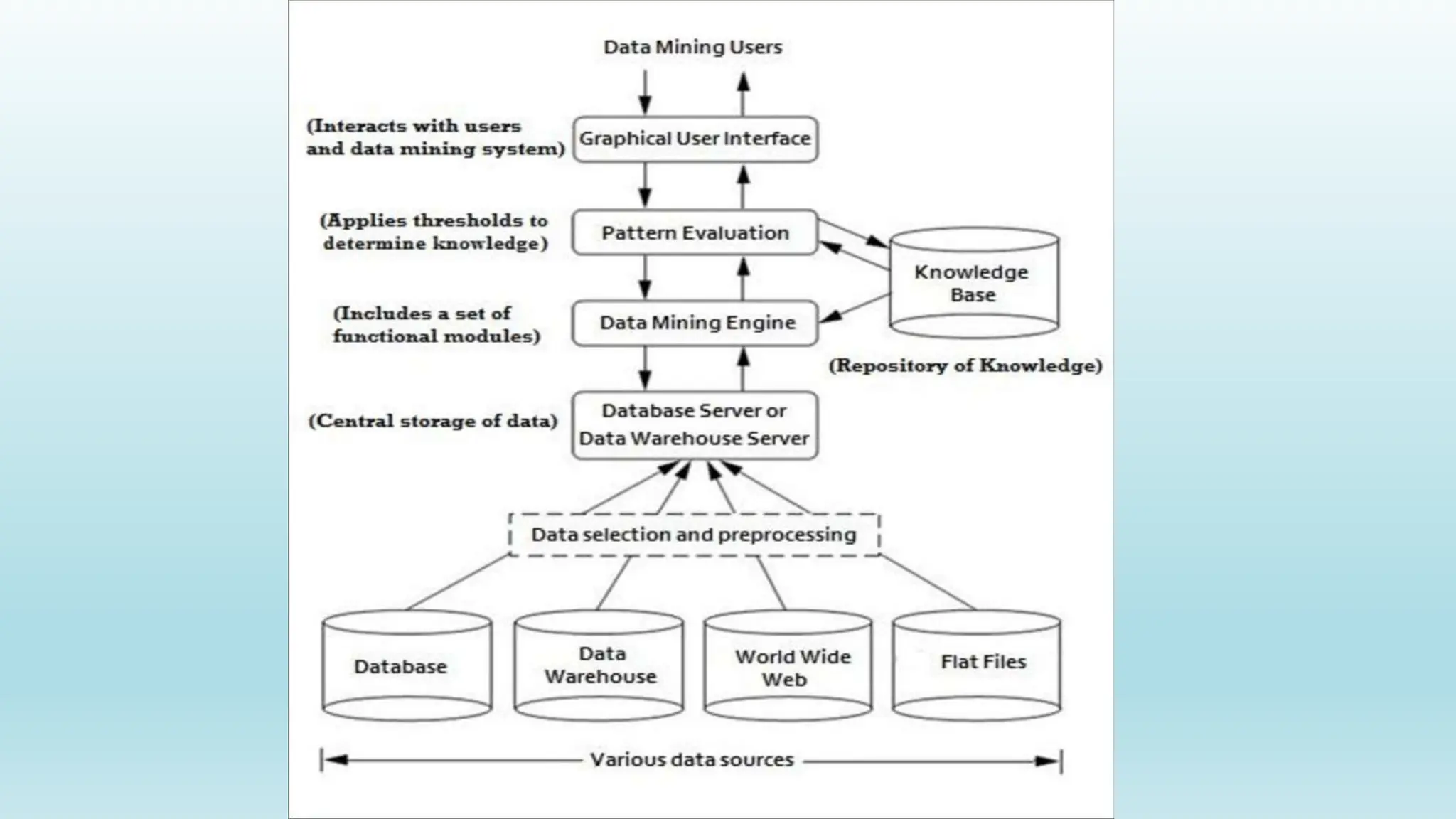
Architecture of Data Mining
It all starts when the user puts up
certain data mining requests, these
requests are then sent to data
mining engines for pattern
evaluation.
These applications try to find the
solution to the query using the
already present database.
The metadata then extracted is
sent for proper analysis to the data
mining engine which sometimes
interacts with pattern evaluation
modules to determine the result.
This result is then sent to the
front end in an easily
understandable manner using a
suitable interface.
Architecture of Data Mining
1.Data Sources: Database, World Wide Web(WWW), and data warehouse are parts of data
sources. The data in these sources may be in the form of plain text, spreadsheets, or other
forms of media like photos or videos. WWW is one of the biggest sources of data.
2.Database Server: The database server contains the actual data ready to be processed. It
performs the task of handling data retrieval as per the request of the user.
3.Data Mining Engine: It is one of the core components of the data mining architecture that
performs all kinds of data mining techniques like association, classification, characterization,
clustering, prediction, etc.
4.Pattern Evaluation Modules: They are responsible for finding interesting patterns in the
data and sometimes they also interact with the database servers for producing the result of the
user requests.
5.Graphic User Interface: Since the user cannot fully understand the complexity of the data
mining process so graphical user interface helps the user to communicate effectively with the
data mining system.
6.Knowledge Base: Knowledge Base is an important part of the data mining engine that is
quite beneficial in guiding the search for the result patterns. Data mining engines may also
sometimes get inputs from the knowledge base. This knowledge base may contain data from
user experiences. The objective of the knowledge base is to make the result more accurate and
reliable.
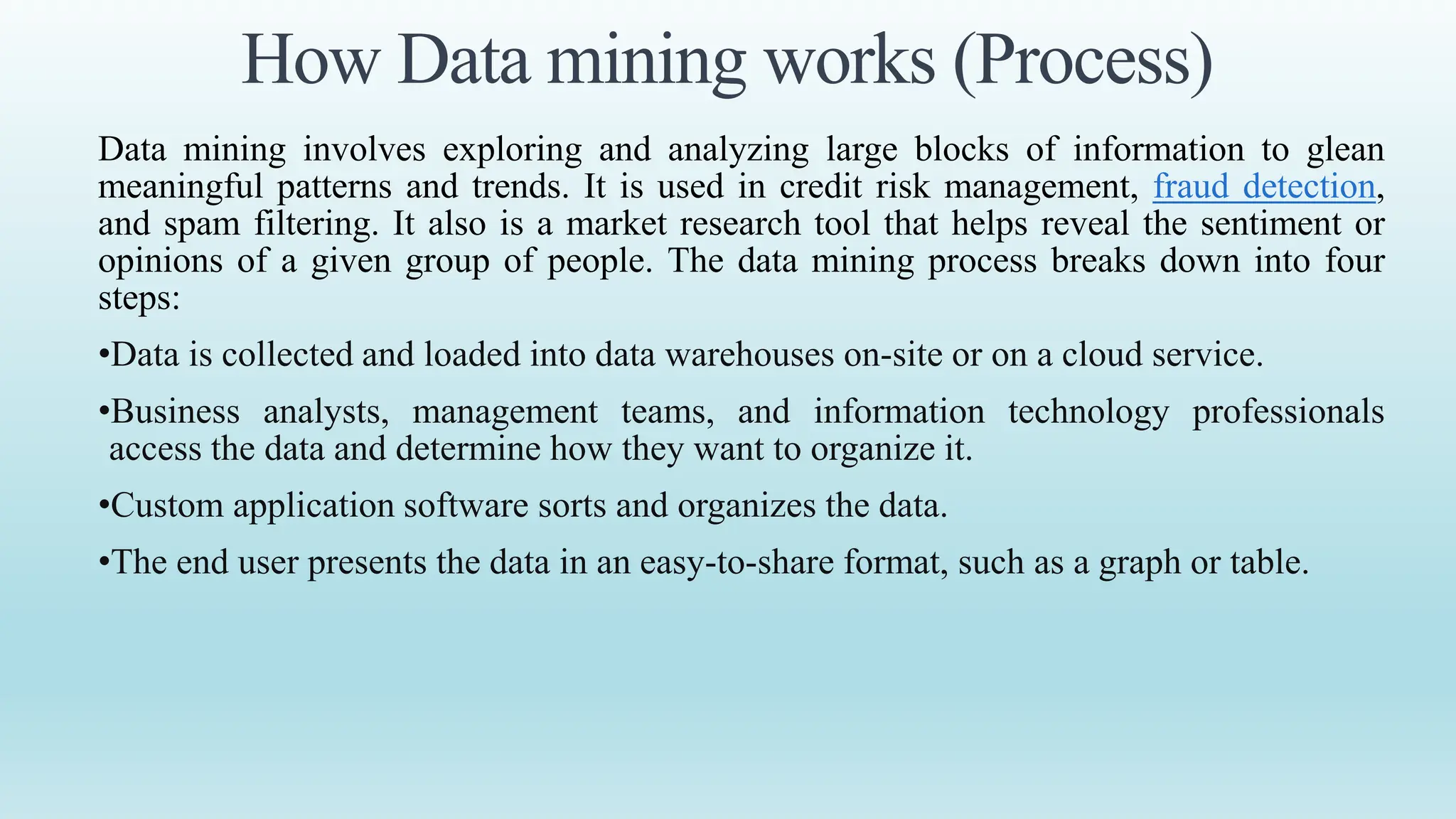
How Data mining works (Process)
Data mining involves exploring and analyzing large blocks of information to glean
meaningful patterns and trends. It is used in credit risk management, fraud detection,
and spam filtering. It also is a market research tool that helps reveal the sentiment or
opinions of a given group of people. The data mining process breaks down into four
steps:
•Data is collected and loaded into data warehouses on-site or on a cloud service.
•Business analysts, management teams, and information technology professionals
access the data and determine how they want to organize it.
•Custom application software sorts and organizes the data.
•The end user presents the data in an easy-to-share format, such as a graph or table.
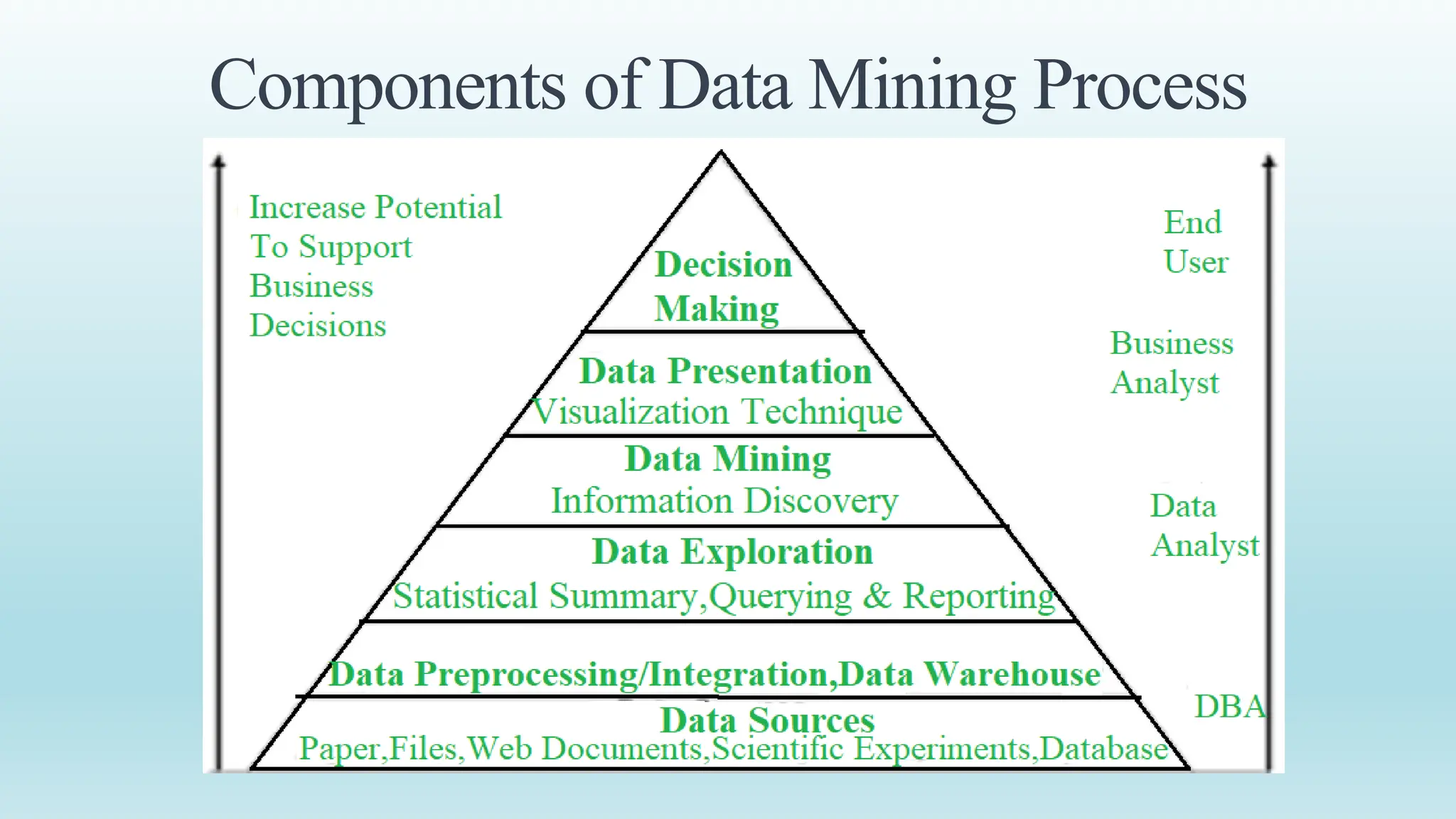
Components of Data Mining Process
Functionalities & Classifications of Data Mining
Data mining involves exploring and analyzing large blocks of information to glean
meaningful patterns and trends. It is used in credit risk management, fraud detection,
and spam filtering. It also is a market research tool that helps reveal the sentiment or
opinions of a given group of people. The data mining process breaks down into four
steps:
•Data is collected and loaded into data warehouses on-site or on a cloud service.
•Business analysts, management teams, and information technology professionals
access the data and determine how they want to organize it.
•Custom application software sorts and organizes the data.
•The end user presents the data in an easy-to-share format, such as a graph or table.
THANK YOU

Business Intelligence and Analytics Unit-2 part-A .pptx

  • 1.
    BUSINESS INTELLIGENCE &ANALYTICS KDS 051 UNIT-2 : BI-DATA MINING & WAREHOUSING (Part-a) Prepared By- PROF. RUPA RANI
  • 2.
    Contents Introduction to DataMining Architecture of Data Mining How Data mining works (Process) Functionalities & Classifications of Data Mining Representation of Input Data Analysis Methodologies
  • 3.
    Introduction to DataMining Data mining is one of the most useful techniques that help entrepreneurs, researchers, and individuals to extract valuable information from huge sets of data. Data mining is also called Knowledge Discovery in Database (KDD). The knowledge discovery process includes Data cleaning, Data integration, Data selection, Data transformation, Data mining, Pattern evaluation, and Knowledge presentation. Definition: The process of extracting information to identify patterns, trends, and useful data that would allow the business to take the data-driven decision from huge sets of data is called Data Mining.
  • 4.
    Introduction to DataMining Data Mining is similar to Data Science carried out by a person, in a specific situation, on a particular data set, with an objective. This process includes various types of services such as text mining, web mining, audio and video mining, pictorial data mining, and social media mining. It is done through software that is simple or highly specific. By outsourcing data mining, all the work can be done faster with low operation costs. Specialized firms can also use new technologies to collect data that is impossible to locate manually. There are tonnes of information available on various platforms, but very little knowledge is accessible. The biggest challenge is to analyze the data to extract important information that can be used to solve a problem or for company development. There are many powerful instruments and techniques available to mine data and find better insight from it.
  • 5.
  • 6.
    Types of DataMining Data mining can be performed on the following types of data: Relational Database: A relational database is a collection of multiple data sets formally organized by tables, records, and columns from which data can be accessed in various ways without having to recognize the database tables. Tables convey and share information, which facilitates data searchability, reporting, and organization. Data warehouses: A Data Warehouse is a technology that collects data from various sources within the organization to provide meaningful business insights. The huge amount of data comes from multiple places such as Marketing and Finance. The extracted data is utilized for analytical purposes and helps in decision-making for a business organization. The data warehouse is designed for the analysis of data rather than transaction processing. Data Repositories: The Data Repository generally refers to a destination for data storage. However, many IT professionals utilize the term more clearly to refer to a specific kind of setup within an IT structure. For example, a group of databases, where an organization has kept various kinds of information.
  • 7.
    Types of DataMining Object-Relational Database: A combination of an object-oriented database model and relational database model is called an object-relational model. It supports Classes, Objects, Inheritance, etc. One of the primary objectives of the Object-relational data model is to close the gap between the Relational database and the object-oriented model practices frequently utilized in many programming languages, for example, C++, Java, C#, and so on. Transactional Database: A transactional database refers to a database management system (DBMS) that has the potential to undo a database transaction if it is not performed appropriately. Even though this was a unique capability a very long while back, today, most of the relational database systems support transactional database activities.
  • 8.
    Advantages of DataMining •The Data Mining technique enables organizations to obtain knowledge-based data. •Data mining enables organizations to make lucrative modifications in operation and production. •Compared with other statistical data applications, data mining is a cost-efficient. •Data Mining helps the decision-making process of an organization. •It Facilitates the automated discovery of hidden patterns as well as the prediction of trends and behaviors. •It can be induced in the new system as well as the existing platforms. •It is a quick process that makes it easy for new users to analyze enormous amounts of data in a short time.
  • 9.
    Disadvantages of DataMining •There is a probability that the organizations may sell useful data of customers to other organizations for money. As per the report, American Express has sold credit card purchases of their customers to other organizations. •Many data mining analytics software is difficult to operate and needs advance training to work on. •Different data mining instruments operate in distinct ways due to the different algorithms used in their design. Therefore, the selection of the right data mining tools is a very challenging task. •The data mining techniques are not precise, so that it may lead to severe consequences in certain conditions.
  • 10.
    Data Mining Applications DataMining is primarily used by organizations with intense consumer demands- Retail, Communication, Financial, marketing company, determine price, consumer preferences, product positioning, and impact on sales, customer satisfaction, and corporate profits. Data mining enables a retailer to use point-of-sale records of customer purchases to develop products and promotions that help the organization to attract the customer.
  • 11.
    Challenges of Implementationin Data mining Although data mining is very powerful, it faces many challenges during its execution. Various challenges could be related to performance, data, methods, and techniques, etc. The process of data mining becomes effective when the challenges or problems are correctly recognized and adequately resolved.
  • 12.
    Architecture of DataMining It all starts when the user puts up certain data mining requests, these requests are then sent to data mining engines for pattern evaluation. These applications try to find the solution to the query using the already present database. The metadata then extracted is sent for proper analysis to the data mining engine which sometimes interacts with pattern evaluation modules to determine the result. This result is then sent to the front end in an easily understandable manner using a suitable interface.
  • 13.
    Architecture of DataMining 1.Data Sources: Database, World Wide Web(WWW), and data warehouse are parts of data sources. The data in these sources may be in the form of plain text, spreadsheets, or other forms of media like photos or videos. WWW is one of the biggest sources of data. 2.Database Server: The database server contains the actual data ready to be processed. It performs the task of handling data retrieval as per the request of the user. 3.Data Mining Engine: It is one of the core components of the data mining architecture that performs all kinds of data mining techniques like association, classification, characterization, clustering, prediction, etc. 4.Pattern Evaluation Modules: They are responsible for finding interesting patterns in the data and sometimes they also interact with the database servers for producing the result of the user requests. 5.Graphic User Interface: Since the user cannot fully understand the complexity of the data mining process so graphical user interface helps the user to communicate effectively with the data mining system. 6.Knowledge Base: Knowledge Base is an important part of the data mining engine that is quite beneficial in guiding the search for the result patterns. Data mining engines may also sometimes get inputs from the knowledge base. This knowledge base may contain data from user experiences. The objective of the knowledge base is to make the result more accurate and reliable.
  • 15.
    How Data miningworks (Process) Data mining involves exploring and analyzing large blocks of information to glean meaningful patterns and trends. It is used in credit risk management, fraud detection, and spam filtering. It also is a market research tool that helps reveal the sentiment or opinions of a given group of people. The data mining process breaks down into four steps: •Data is collected and loaded into data warehouses on-site or on a cloud service. •Business analysts, management teams, and information technology professionals access the data and determine how they want to organize it. •Custom application software sorts and organizes the data. •The end user presents the data in an easy-to-share format, such as a graph or table.
  • 16.
    Components of DataMining Process
  • 18.
    Functionalities & Classificationsof Data Mining Data mining involves exploring and analyzing large blocks of information to glean meaningful patterns and trends. It is used in credit risk management, fraud detection, and spam filtering. It also is a market research tool that helps reveal the sentiment or opinions of a given group of people. The data mining process breaks down into four steps: •Data is collected and loaded into data warehouses on-site or on a cloud service. •Business analysts, management teams, and information technology professionals access the data and determine how they want to organize it. •Custom application software sorts and organizes the data. •The end user presents the data in an easy-to-share format, such as a graph or table.
  • 19.