EEMS: Enhancing the Efficiency for
Mobile Commerce
Pattern Mining and Prediction
Presented by
PR.Kavidha
Department of Information Technology
Shanmuganathan Engineering College
Arasampatti-622 507
ABSTRACT
• Due to a wide range of potential applications, research on mobile
commerce has received a lot of interests from both of the industry and
academia.
• Among them, one of the active topic areas is the mining and prediction of
users’ mobile commerce behaviors such as their movements and purchase
transactions.
• In this paper, we propose a novel framework, called Mobile Commerce
Explorer (MCE), for mining and prediction of mobile users’ movements and
purchase transactions under the context of mobile commerce.
INTRODUCTION
• The rapid advance of wireless communication technology and the
increasing popularity of powerful portable devices, mobile users not only
can access worldwide information from anywhere at any time but also use
their mobile devices to make business transactions easily.
• E.g., via digital wallet.
• Meanwhile, the availability of location- acquisition technology.
• E.g., Global Positioning System (GPS), facilitates easy acquisition
of a moving trajectory, which records a user movement history.
• Thus, we envisage that, in the coming future of Mobile
Commerce age , some m-commerce services will be able to capture the
moving trajectories and purchase transactions of users.
RELATED WORK
We review and classify relevant previous studies into three categories:
• Mobile pattern mining techniques
•Mobile behavior predictions.
•Similarity measures
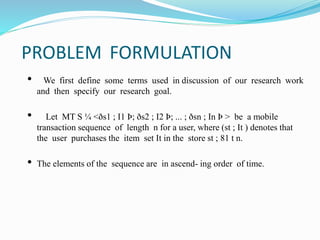
PROBLEM FORMULATION
• We first define some terms used in discussion of our research work
and then specify our research goal.
• Let MT S ¼ <ðs1 ; I1 Þ; ðs2 ; I2 Þ; ... ; ðsn ; In Þ > be a mobile
transaction sequence of length n for a user, where (st ; It ) denotes that
the user purchases the item set It in the store st ; 81 t n.
• The elements of the sequence are in ascend- ing order of time.
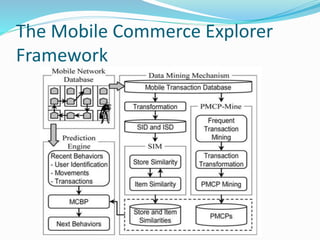
The Mobile Commerce Explorer
Framework
PROPOSED METHOD
Our design of a personal mobile commerce mining and prediction
framework, called MCE which incorporates three innovative techniques,
including
1) Similarity Inference Model for measuring the similarities among
stores and items, which are two basic mobile commerce entities
considered in this paper.
2) Personal Mobile Commerce Pattern Mine algorithm for efficient
discovery of mobile users’ Personal Mobile Commerce Patterns .
3) Mobile commerce Behaverior Predictor for prediction of possible
mobile user behaviors.
DISCOVERY OF PMCPs
• We describe the PMCP-Mine algorithm to mine the personal mobile
commerce patterns efficiently.
• The PMCP-Mine algorithm is inspired by the TJPF algorithm which is an
Apriori-like algorithm.
• However, we observe that the TJPF algorithm does not consider user
identification, which is essential for discovering personal mobile behaviors.
• In other words, the TJPF algorithm cannot be employed in our
framework.
• The PMCP-Mine algorithm is performed in a bottom-up manner.
PERFORMANCE OF THE PROPOSED
ALGORITHMS
• This experiment evaluates the performance of the proposed algorithms in
the MCE framework, including SIM, PMCP- Mine, and MCBP in terms of
execution time.
• The execution time for SIM remains constant while the execution time
for both PMCP-Mine and MCBP increases as the support threshold
decreases.
• Since the number of stores and items is constant after the mobile
transaction database is transformed into SID and ISD, the execution time of
SIM is constant.
• As the support threshold decreases, the number of discovered PMCPs
increases. Hence, the PMCP-Mine needs more time to mine the
PMCPs.
CONCLUSIONS AND FUTURE WORK
In this paper, we have proposed a novel framework, namely MCE, for
mining and prediction of mobile users movements and transactions in
mobile commerce environments. In the MCE framework, we have
proposed three major techniques:
1) SIM for measuring the similarities among stores and items.
2) PMCP-Mine algorithm for efficiently discovering mobile users
PMCPs.
3) MCBP for predicting possible mobile user behaviors.
4) To our best knowledge, this is the first work that facilitates mining and
prediction of personal mobile commerce behaviors that may recommend
stores and items previously unknown to a user.
References
• R.Agrawal,A.Swami, “Mining Association Rule between Sets of Items
in Large DataBases”.May-1993.
• J.Han and Y.Fu,”Discovery of Multiple-Level Association Rules in
Large Databases”.Sep-1995.
THANK YOU

Data mining

  • 1.
    EEMS: Enhancing theEfficiency for Mobile Commerce Pattern Mining and Prediction
  • 2.
    Presented by PR.Kavidha Department ofInformation Technology Shanmuganathan Engineering College Arasampatti-622 507
  • 3.
    ABSTRACT • Due toa wide range of potential applications, research on mobile commerce has received a lot of interests from both of the industry and academia. • Among them, one of the active topic areas is the mining and prediction of users’ mobile commerce behaviors such as their movements and purchase transactions. • In this paper, we propose a novel framework, called Mobile Commerce Explorer (MCE), for mining and prediction of mobile users’ movements and purchase transactions under the context of mobile commerce.
  • 4.
    INTRODUCTION • The rapidadvance of wireless communication technology and the increasing popularity of powerful portable devices, mobile users not only can access worldwide information from anywhere at any time but also use their mobile devices to make business transactions easily. • E.g., via digital wallet. • Meanwhile, the availability of location- acquisition technology. • E.g., Global Positioning System (GPS), facilitates easy acquisition of a moving trajectory, which records a user movement history. • Thus, we envisage that, in the coming future of Mobile Commerce age , some m-commerce services will be able to capture the moving trajectories and purchase transactions of users.
  • 5.
    RELATED WORK We reviewand classify relevant previous studies into three categories: • Mobile pattern mining techniques •Mobile behavior predictions. •Similarity measures
  • 6.
    PROBLEM FORMULATION • Wefirst define some terms used in discussion of our research work and then specify our research goal. • Let MT S ¼ <ðs1 ; I1 Þ; ðs2 ; I2 Þ; ... ; ðsn ; In Þ > be a mobile transaction sequence of length n for a user, where (st ; It ) denotes that the user purchases the item set It in the store st ; 81 t n. • The elements of the sequence are in ascend- ing order of time.
  • 7.
    The Mobile CommerceExplorer Framework
  • 8.
    PROPOSED METHOD Our designof a personal mobile commerce mining and prediction framework, called MCE which incorporates three innovative techniques, including 1) Similarity Inference Model for measuring the similarities among stores and items, which are two basic mobile commerce entities considered in this paper. 2) Personal Mobile Commerce Pattern Mine algorithm for efficient discovery of mobile users’ Personal Mobile Commerce Patterns . 3) Mobile commerce Behaverior Predictor for prediction of possible mobile user behaviors.
  • 9.
    DISCOVERY OF PMCPs •We describe the PMCP-Mine algorithm to mine the personal mobile commerce patterns efficiently. • The PMCP-Mine algorithm is inspired by the TJPF algorithm which is an Apriori-like algorithm. • However, we observe that the TJPF algorithm does not consider user identification, which is essential for discovering personal mobile behaviors. • In other words, the TJPF algorithm cannot be employed in our framework. • The PMCP-Mine algorithm is performed in a bottom-up manner.
  • 10.
    PERFORMANCE OF THEPROPOSED ALGORITHMS • This experiment evaluates the performance of the proposed algorithms in the MCE framework, including SIM, PMCP- Mine, and MCBP in terms of execution time. • The execution time for SIM remains constant while the execution time for both PMCP-Mine and MCBP increases as the support threshold decreases. • Since the number of stores and items is constant after the mobile transaction database is transformed into SID and ISD, the execution time of SIM is constant. • As the support threshold decreases, the number of discovered PMCPs increases. Hence, the PMCP-Mine needs more time to mine the PMCPs.
  • 11.
    CONCLUSIONS AND FUTUREWORK In this paper, we have proposed a novel framework, namely MCE, for mining and prediction of mobile users movements and transactions in mobile commerce environments. In the MCE framework, we have proposed three major techniques: 1) SIM for measuring the similarities among stores and items. 2) PMCP-Mine algorithm for efficiently discovering mobile users PMCPs. 3) MCBP for predicting possible mobile user behaviors. 4) To our best knowledge, this is the first work that facilitates mining and prediction of personal mobile commerce behaviors that may recommend stores and items previously unknown to a user.
  • 12.
    References • R.Agrawal,A.Swami, “MiningAssociation Rule between Sets of Items in Large DataBases”.May-1993. • J.Han and Y.Fu,”Discovery of Multiple-Level Association Rules in Large Databases”.Sep-1995.
  • 13.