DATA MANAGEMENT
FUELS BUSINESS ROI
Email marketing trends for 2019
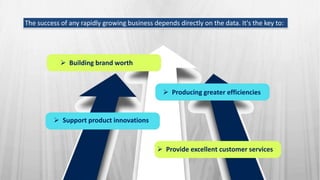
 Building brand worth
 Producing greater efficiencies
 Support product innovations
 Provide excellent customer services
The success of any rapidly growing business depends directly on the data. It's the key to:
Email marketing trends for 2019
It's no surprise that with the right data management strategy at the
top of the corporate agenda, organizations are reaping significant
ROI, and are capable of staying ahead of competitors.
What is Data Management?
Data management is the process of acquiring, authenticating,
storing, securing, and processing required data to guarantee the
reliability, timeliness, and accessibility of the data for its users.
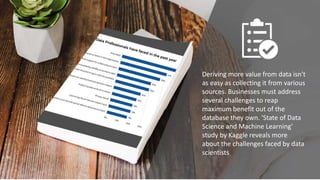
Email marketing trends for 2019Deriving more value from data isn't
as easy as collecting it from various
sources. Businesses must address
several challenges to reap
maximum benefit out of the
database they own. 'State of Data
Science and Machine Learning'
study by Kaggle reveals more
about the challenges faced by data
scientists
Poor data quality
Data inaccessibility
Talent shortages
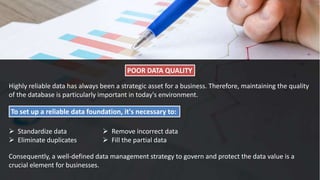
POOR DATA QUALITY
Highly reliable data has always been a strategic asset for a business. Therefore, maintaining the quality
of the database is particularly important in today's environment.
To set up a reliable data foundation, it's necessary to:
 Standardize data
 Eliminate duplicates
 Remove incorrect data
 Fill the partial data
Consequently, a well-defined data management strategy to govern and protect the data value is a
crucial element for businesses.
DATA INACCESSIBILITY
 However, inaccessibility challenges prevent them from building powerful models when
data resides in various places. Be it on-premises or cloud; a scalable data management
architecture can help the organizations to access these data.
 Data professionals continuously try to make sense of data by building the right models that
Can provide the necessary insights for organizations to grow and generate more revenue.
DATA INACCESSIBILITY
Firms can retrieve unanticipated gems of insight when they
are capable of accessing the data from diverse sources quickly.
A right hybrid data management architecture will help the
businesses to rapidly access,assimilate, and query the data
to uncover significant and impactful insights.
This agility can deliver a competitive advantage over others.
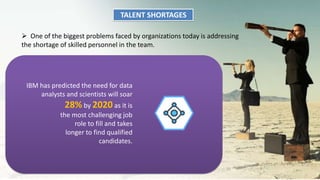
TALENT SHORTAGES
 One of the biggest problems faced by organizations today is addressing
the shortage of skilled personnel in the team.
IBM has predicted the need for data
analysts and scientists will soar
28% by 2020 as it is
the most challenging job
role to fill and takes
longer to find qualified
candidates.
TALENT SHORTAGES
 Faced with talent shortages and also a pressure to discover and act
quickly on data insights, businesses should establish a more
collaborative, data-driven culture.
 They can make use of self-service analytics tools, freeing highly-
skilled data scientists to focus on high- value projects that require
more time and expertise to solve the issue.
WHY IS DATA MANAGEMENT NECESSARY FOR BUSINESSES?
 Organizations that are investing in the proper data management
revealed that they are already benefiting from their investment
and are achieving the intents they have agreed to attain.
 According to 'The Value of Data' study by Vanson
Bourne for Veritas:
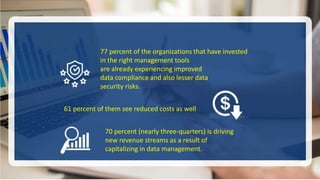
77 percent of the organizations that have invested
in the right management tools
are already experiencing improved
data compliance and also lesser data
security risks.
61 percent of them see reduced costs as well
70 percent (nearly three-quarters) is driving
new revenue streams as a result of
capitalizing in data management.
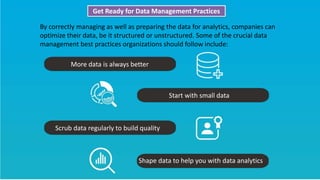
Get Ready for Data Management Practices
By correctly managing as well as preparing the data for analytics, companies can
optimize their data, be it structured or unstructured. Some of the crucial data
management best practices organizations should follow include:
More data is always better
Start with small data
Scrub data regularly to build quality
Shape data to help you with data analytics
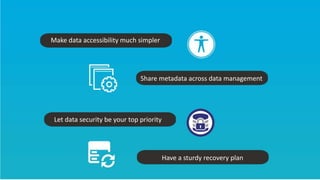
Make data accessibility much simpler
Share metadata across data management
Let data security be your top priority
Have a sturdy recovery plan
 With more data, it is easier to determine the
Outcome.
 Working with a variety of data from various
sources
 formats
 and structures
 businesses can
 Quickly gain more significant insights
 Build better models
 Provide most practical solution
MORE DATA ALWAYS BETTER
 Data management procedures usually begin with
data acquisition. It is always said that more data
are better predictors. So, data analysts and
scientists must try to gather as many data as possible.
START WITH SMALL DATA
If you own extensive data in your repository, it isn't surprising to know that you jump
straight into the data pool and begin with the experimentation. But, experts have revealed
that this approach is unlikely to see success. Instead, we recommend you to:000
 Start small with a clearly-defined goal that can tackle a given problem.
 Make some time to find something that can offer a quick result with a good return
on investment.
 Gain valuable knowledge of what is required to make your data work effectively before
rolling out big plans
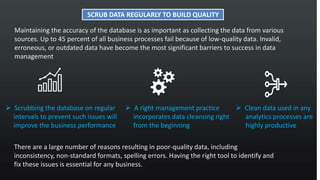
Maintaining the accuracy of the database is as important as collecting the data from various
sources. Up to 45 percent of all business processes fail because of low-quality data. Invalid,
erroneous, or outdated data have become the most significant barriers to success in data
management
SCRUB DATA REGULARLY TO BUILD QUALITY
 Scrubbing the database on regular
intervals to prevent such issues will
improve the business performance
 A right management practice
incorporates data cleansing right
from the beginning
 Clean data used in any
analytics processes are
highly productive
There are a large number of reasons resulting in poor-quality data, including
inconsistency, non-standard formats, spelling errors. Having the right tool to identify and
fix these issues is essential for any business.
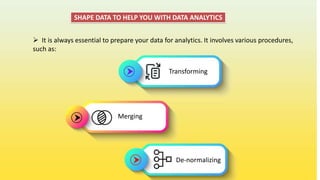
SHAPE DATA TO HELP YOU WITH DATA ANALYTICS
 It is always essential to prepare your data for analytics. It involves various procedures,
such as:
Transforming
Merging
De-normalizing
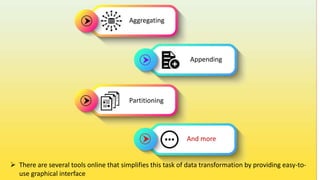
Aggregating
Appending
Partitioning
And more
 There are several tools online that simplifies this task of data transformation by providing easy-to-
use graphical interface
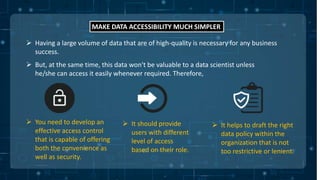
MAKE DATA ACCESSIBILITY MUCH SIMPLER
 Having a large volume of data that are of high-quality is necessary for any business
success.
 But, at the same time, this data won't be valuable to a data scientist unless
he/she can access it easily whenever required. Therefore,
 You need to develop an
effective access control
that is capable of offering
both the convenience as
well as security.
 It should provide
users with different
level of access
based on their role.
 It helps to draft the right
data policy within the
organization that is not
too restrictive or lenient.
SHARE METADATA ACROSS DATA MANAGEMENT
 Having a standard metadata
layer lets businesses repeat
the data preparation
processes consistently
whenever needed. Other
usages of sharing metadata
across data management are:
SHARE METADATA ACROSS DATA MANAGEMENT
 Better productivity
 Promotes collaboration
 More accurate models
 More flexibility
 Provides lineage information
 Faster cycle times
 Transparent data
 Easy to deploy models
 Every data management strategy must take security considerations
seriously.
 There are various laws that make sure all businesses use data legitimately.
 One of the recently introduced regulations will impact the company that
is not only based in Europe, but also that has customers in the EU.
LET DATA SECURITY BE YOUR TOP PRIORITY
 Along with this security, you must also take physical security into account
as it is capable of hampering the brand worth if not appropriately
managed.
 Organizations must never overlook these rules to succeed in their niche.
 EU's General Data Protection Regulation
HAVE A STURDY RECOVERY PLAN
Losing access to the data is one of the worst problems a business can encounter
throughout its journey Any interruption to a company's data flow because of
 some human error.
 software failure.
 hardware issues.
or power problems can cripple the functioning
of an organization altogether.
Therefore, if you do not want to face such a colossal loss, incorporate the right recovery
plan in your data management strategy.
A clear backup and recovery plan that regularly performs
back up of different types of data you own and consists of
recovery option in case of a disaster is vital for any business
Benefits of Data Management Practices
With the help of best data management practices, organizations can harness the
power of their data and gain quicker insights to make crucial decisions. It helps
organizations in various ways, such as:
 Personalizing the customer experience
 Adding value to buyer interactions
 Increasing customer engagement
 Enhancing customer loyalty
 Identifying the root causes of failures and real-time issues
 Reaping highest ROI associated with data-driven marketing
 Managing your database is essential to handle the large volume
of data that floods every day
 If you lack the data management best practices that could help
you get most out of your database
 We recommend you to implement it as early as possible
 The best data management practice gives
a glimmer of insight that aids your firm to
expand the venture into a brand new
market or receive soaring profits beyond
expectations.
Blue Mail Media provides customized B2B marketing solutions to support
your sales and marketing teams in the lead generation process.
1-888-494-0588
sales@bluemailmedia.com
www.bluemailmedia.com
300 E Royal Ln #127, Irving, Texas 75039

Data Management

  • 1.
  • 2.
    Email marketing trendsfor 2019  Building brand worth  Producing greater efficiencies  Support product innovations  Provide excellent customer services The success of any rapidly growing business depends directly on the data. It's the key to:
  • 3.
    Email marketing trendsfor 2019 It's no surprise that with the right data management strategy at the top of the corporate agenda, organizations are reaping significant ROI, and are capable of staying ahead of competitors. What is Data Management? Data management is the process of acquiring, authenticating, storing, securing, and processing required data to guarantee the reliability, timeliness, and accessibility of the data for its users.
  • 4.
    Email marketing trendsfor 2019Deriving more value from data isn't as easy as collecting it from various sources. Businesses must address several challenges to reap maximum benefit out of the database they own. 'State of Data Science and Machine Learning' study by Kaggle reveals more about the challenges faced by data scientists
  • 5.
    Poor data quality Datainaccessibility Talent shortages
  • 6.
    POOR DATA QUALITY Highlyreliable data has always been a strategic asset for a business. Therefore, maintaining the quality of the database is particularly important in today's environment. To set up a reliable data foundation, it's necessary to:  Standardize data  Eliminate duplicates  Remove incorrect data  Fill the partial data Consequently, a well-defined data management strategy to govern and protect the data value is a crucial element for businesses.
  • 7.
    DATA INACCESSIBILITY  However,inaccessibility challenges prevent them from building powerful models when data resides in various places. Be it on-premises or cloud; a scalable data management architecture can help the organizations to access these data.  Data professionals continuously try to make sense of data by building the right models that Can provide the necessary insights for organizations to grow and generate more revenue.
  • 8.
    DATA INACCESSIBILITY Firms canretrieve unanticipated gems of insight when they are capable of accessing the data from diverse sources quickly. A right hybrid data management architecture will help the businesses to rapidly access,assimilate, and query the data to uncover significant and impactful insights. This agility can deliver a competitive advantage over others.
  • 9.
    TALENT SHORTAGES  Oneof the biggest problems faced by organizations today is addressing the shortage of skilled personnel in the team. IBM has predicted the need for data analysts and scientists will soar 28% by 2020 as it is the most challenging job role to fill and takes longer to find qualified candidates.
  • 10.
    TALENT SHORTAGES  Facedwith talent shortages and also a pressure to discover and act quickly on data insights, businesses should establish a more collaborative, data-driven culture.  They can make use of self-service analytics tools, freeing highly- skilled data scientists to focus on high- value projects that require more time and expertise to solve the issue.
  • 11.
    WHY IS DATAMANAGEMENT NECESSARY FOR BUSINESSES?  Organizations that are investing in the proper data management revealed that they are already benefiting from their investment and are achieving the intents they have agreed to attain.  According to 'The Value of Data' study by Vanson Bourne for Veritas:
  • 12.
    77 percent ofthe organizations that have invested in the right management tools are already experiencing improved data compliance and also lesser data security risks. 61 percent of them see reduced costs as well 70 percent (nearly three-quarters) is driving new revenue streams as a result of capitalizing in data management.
  • 13.
    Get Ready forData Management Practices By correctly managing as well as preparing the data for analytics, companies can optimize their data, be it structured or unstructured. Some of the crucial data management best practices organizations should follow include: More data is always better Start with small data Scrub data regularly to build quality Shape data to help you with data analytics
  • 14.
    Make data accessibilitymuch simpler Share metadata across data management Let data security be your top priority Have a sturdy recovery plan
  • 15.
     With moredata, it is easier to determine the Outcome.  Working with a variety of data from various sources  formats  and structures  businesses can  Quickly gain more significant insights  Build better models  Provide most practical solution MORE DATA ALWAYS BETTER  Data management procedures usually begin with data acquisition. It is always said that more data are better predictors. So, data analysts and scientists must try to gather as many data as possible.
  • 16.
    START WITH SMALLDATA If you own extensive data in your repository, it isn't surprising to know that you jump straight into the data pool and begin with the experimentation. But, experts have revealed that this approach is unlikely to see success. Instead, we recommend you to:000  Start small with a clearly-defined goal that can tackle a given problem.  Make some time to find something that can offer a quick result with a good return on investment.  Gain valuable knowledge of what is required to make your data work effectively before rolling out big plans
  • 17.
    Maintaining the accuracyof the database is as important as collecting the data from various sources. Up to 45 percent of all business processes fail because of low-quality data. Invalid, erroneous, or outdated data have become the most significant barriers to success in data management SCRUB DATA REGULARLY TO BUILD QUALITY  Scrubbing the database on regular intervals to prevent such issues will improve the business performance  A right management practice incorporates data cleansing right from the beginning  Clean data used in any analytics processes are highly productive There are a large number of reasons resulting in poor-quality data, including inconsistency, non-standard formats, spelling errors. Having the right tool to identify and fix these issues is essential for any business.
  • 18.
    SHAPE DATA TOHELP YOU WITH DATA ANALYTICS  It is always essential to prepare your data for analytics. It involves various procedures, such as: Transforming Merging De-normalizing
  • 19.
    Aggregating Appending Partitioning And more  Thereare several tools online that simplifies this task of data transformation by providing easy-to- use graphical interface
  • 20.
    MAKE DATA ACCESSIBILITYMUCH SIMPLER  Having a large volume of data that are of high-quality is necessary for any business success.  But, at the same time, this data won't be valuable to a data scientist unless he/she can access it easily whenever required. Therefore,  You need to develop an effective access control that is capable of offering both the convenience as well as security.  It should provide users with different level of access based on their role.  It helps to draft the right data policy within the organization that is not too restrictive or lenient.
  • 21.
    SHARE METADATA ACROSSDATA MANAGEMENT  Having a standard metadata layer lets businesses repeat the data preparation processes consistently whenever needed. Other usages of sharing metadata across data management are:
  • 22.
    SHARE METADATA ACROSSDATA MANAGEMENT  Better productivity  Promotes collaboration  More accurate models  More flexibility  Provides lineage information  Faster cycle times  Transparent data  Easy to deploy models
  • 23.
     Every datamanagement strategy must take security considerations seriously.  There are various laws that make sure all businesses use data legitimately.  One of the recently introduced regulations will impact the company that is not only based in Europe, but also that has customers in the EU. LET DATA SECURITY BE YOUR TOP PRIORITY  Along with this security, you must also take physical security into account as it is capable of hampering the brand worth if not appropriately managed.  Organizations must never overlook these rules to succeed in their niche.  EU's General Data Protection Regulation
  • 24.
    HAVE A STURDYRECOVERY PLAN Losing access to the data is one of the worst problems a business can encounter throughout its journey Any interruption to a company's data flow because of  some human error.  software failure.  hardware issues. or power problems can cripple the functioning of an organization altogether. Therefore, if you do not want to face such a colossal loss, incorporate the right recovery plan in your data management strategy. A clear backup and recovery plan that regularly performs back up of different types of data you own and consists of recovery option in case of a disaster is vital for any business
  • 25.
    Benefits of DataManagement Practices With the help of best data management practices, organizations can harness the power of their data and gain quicker insights to make crucial decisions. It helps organizations in various ways, such as:  Personalizing the customer experience  Adding value to buyer interactions  Increasing customer engagement  Enhancing customer loyalty  Identifying the root causes of failures and real-time issues  Reaping highest ROI associated with data-driven marketing
  • 26.
     Managing yourdatabase is essential to handle the large volume of data that floods every day  If you lack the data management best practices that could help you get most out of your database  We recommend you to implement it as early as possible  The best data management practice gives a glimmer of insight that aids your firm to expand the venture into a brand new market or receive soaring profits beyond expectations.
  • 27.
    Blue Mail Mediaprovides customized B2B marketing solutions to support your sales and marketing teams in the lead generation process. 1-888-494-0588 sales@bluemailmedia.com www.bluemailmedia.com 300 E Royal Ln #127, Irving, Texas 75039