Data Integration and Imaging Informatics
Project (DI-cubed) Status Report
December 04, 2017
Project Objectives
• Demonstrate that standards such as BRIDG, CDISC and
DICOM will support interoperability
• Develop a prototype that supports the ability to query
across disparate data sets by leveraging the clinical data
and linking them to images.
• Could inform development of NCI Research Data Commons
• Provide mappings to CDISC SDTM for the scoped data
sets
2
Standards referenced
• BRIDG (ISO 14199)
– https://bridgmodel.nci.nih.gov/
– Stakeholders: CDISC, FDA, HL7, ISO, NCI
– Produce a shared view of the dynamic and static semantics for
the domain of basic, pre-clinical, clinical, and translational
research and its associated regulatory artifacts.
– Balloted by CDISC, HL7 and ISO
• DICOM (ISO 12052)
– International standard for medical images and related
information
• CDISC SDTM (Study Data Tabulation Model)
– Required for submission to FDA
– https://www.fda.gov/Drugs/DevelopmentApprovalProcess/Forms
SubmissionRequirements/ElectronicSubmissions/ucm248635.ht
m
3
BRIDG 5.0
• Connecting two ISO standards by including
representative portions of DICOM into BRIDG which
allows to link clinical data and images
• Contains new semantics from the harmonization of
concepts from NCI’s Surveillance, Epidemiology and
End Results (SEER)
– BRIDG can now support patient clinical care data in
addition to the clinical trial data
• BRIDG 5.0 has be balloted by HL7, CDISC and ISO in a
joint ballot cycle process.
4
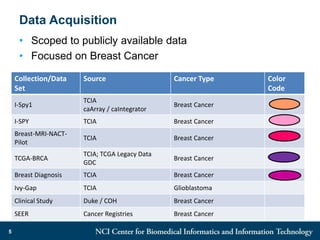
Data Acquisition
5
• Scoped to publicly available data
• Focused on Breast Cancer
Collection/Data
Set
Source Cancer Type Color
Code
I-Spy1
TCIA
caArray / caIntegrator
Breast Cancer
I-SPY TCIA Breast Cancer
Breast-MRI-NACT-
Pilot
TCIA Breast Cancer
TCGA-BRCA
TCIA; TCGA Legacy Data
GDC
Breast Cancer
Breast Diagnosis TCIA Breast Cancer
Ivy-Gap TCIA Glioblastoma
Clinical Study Duke / COH Breast Cancer
SEER Cancer Registries Breast Cancer
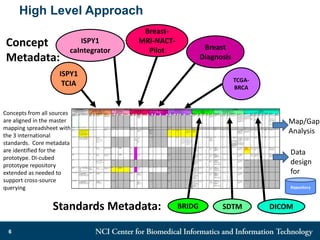
High Level Approach
6
ISPY1
TCIA
ISPY1
caIntegrator
TCGA-
BRCA
Breast-
MRI-NACT-
Pilot Breast
Diagnosis
BRIDG SDTM DICOM
Concept
Metadata:
Concepts from all sources
are aligned in the master
mapping spreadsheet with
the 3 international
standards. Core metadata
are identified for the
prototype. DI-cubed
prototype repository
extended as needed to
support cross-source
querying Repository
Standards Metadata:
Data
design
for
Map/Gap
Analysis
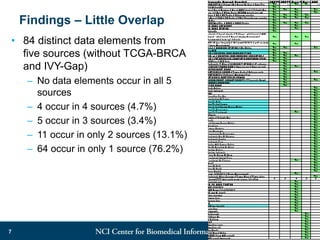
Findings – Little Overlap
• 84 distinct data elements from
five sources (without TCGA-BRCA
and IVY-Gap)
– No data elements occur in all 5
sources
– 4 occur in 4 sources (4.7%)
– 5 occur in 3 sources (3.4%)
– 11 occur in only 2 sources (13.1%)
– 64 occur in only 1 source (76.2%)
7
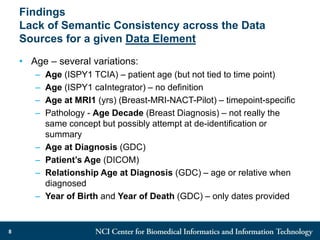
Findings
Lack of Semantic Consistency across the Data
Sources for a given Data Element
• Age – several variations:
– Age (ISPY1 TCIA) – patient age (but not tied to time point)
– Age (ISPY1 caIntegrator) – no definition
– Age at MRI1 (yrs) (Breast-MRI-NACT-Pilot) – timepoint-specific
– Pathology - Age Decade (Breast Diagnosis) – not really the
same concept but possibly attempt at de-identification or
summary
– Age at Diagnosis (GDC)
– Patient’s Age (DICOM)
– Relationship Age at Diagnosis (GDC) – age or relative when
diagnosed
– Year of Birth and Year of Death (GDC) – only dates provided
8
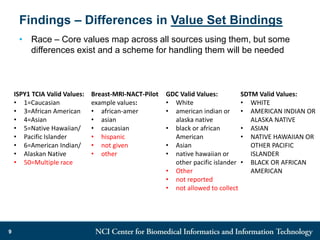
Findings – Differences in Value Set Bindings
• Race – Core values map across all sources using them, but some
differences exist and a scheme for handling them will be needed
9
ISPY1 TCIA Valid Values:
• 1=Caucasian
• 3=African American
• 4=Asian
• 5=Native Hawaiian/
• Pacific Islander
• 6=American Indian/
• Alaskan Native
• 50=Multiple race
Breast-MRI-NACT-Pilot
example values:
• african-amer
• asian
• caucasian
• hispanic
• not given
• other
GDC Valid Values:
• White
• american indian or
alaska native
• black or african
American
• Asian
• native hawaiian or
other pacific islander
• Other
• not reported
• not allowed to collect
SDTM Valid Values:
• WHITE
• AMERICAN INDIAN OR
ALASKA NATIVE
• ASIAN
• NATIVE HAWAIIAN OR
OTHER PACIFIC
ISLANDER
• BLACK OR AFRICAN
AMERICAN
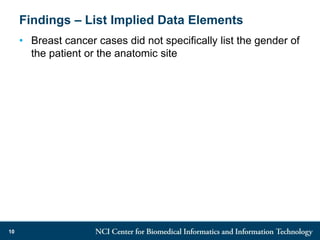
Findings – List Implied Data Elements
• Breast cancer cases did not specifically list the gender of
the patient or the anatomic site
10
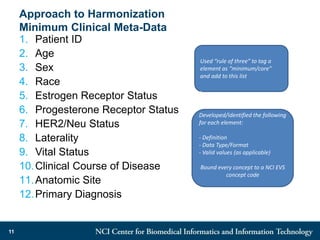
Approach to Harmonization
Minimum Clinical Meta-Data
1. Patient ID
2. Age
3. Sex
4. Race
5. Estrogen Receptor Status
6. Progesterone Receptor Status
7. HER2/Neu Status
8. Laterality
9. Vital Status
10.Clinical Course of Disease
11.Anatomic Site
12.Primary Diagnosis
11
Developed/identified the following
for each element:
- Definition
- Data Type/Format
- Valid values (as applicable)
Bound every concept to a NCI EVS
concept code
Used “rule of three” to tag a
element as “minimum/core”
and add to this list
-
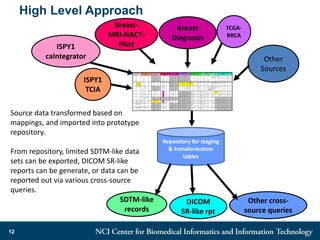
Source data transformed based on
mappings, and imported into prototype
repository.
From repository, limited SDTM-like data
sets can be exported, DICOM SR-like
reports can be generate, or data can be
reported out via various cross-source
queries.
High Level Approach
12
Other cross-
source queries
ISPY1
TCIA
ISPY1
caIntegrator
TCGA-
BRCA
Breast-
MRI-NACT-
Pilot
Breast
Diagnosis
SDTM-like
records
Repository for staging
& transformation
tables
DICOM
SR-like rpt
Other
Sources
Demo
13
Conclusions
• Looking at the state of clinical data collections presently
accessible to us shows that they are disparate
14
Recommendations
• Identification of a minimum standardized clinical data
set will enable semantic interoperability
• Prospective data collection efforts based on standards
are more efficient than retrospective transformation
• Building standards based solutions opens the door to
integrating with other large-scale projects
• Consider leveraging BRIDG as the common information
model for clinical trial and clinical care data
Documents available on NCI wiki
• Master mapping spreadsheet
• Mapping decisions
• https://wiki.nci.nih.gov/x/xIlnFQ
15
The Team (sorted alphabetically)
16
Lauren Becnel (CDISC)
David Clunie (Pixelmed)
Julie Evans (Samvit)
Smita Hastak (Samvit)
Ed Helton (NCI)
Hubert Hickman (Essex Management)
Sam Isa (Essex Management)
Wendy VerHoef (Samvit)
The Bigger Picture
• Information on FDA’s Common Data Model
Harmonization Project (CDMH)
• Led by Mitra Rocca, FDA
• Leveraging BRIDG and CDISC SDTM
17
Goal and Objectives of CDMH
Goal:
Build a data infrastructure for conducting research using Real
World Data* derived from the delivery of health care in routine
clinical settings.
Objective:
Develop the method to harmonize the Common Data Models of
various networks (Sentinel, i2b2/ACT, PCORNET, OMOP) allowing
researchers to simply ask research questions on much larger
amounts of Real World Data* than currently possible, leveraging
open standards and controlled terminologies to advance Patient-
Centered Outcomes Research.
* Examples of Real World Data are EHR data, claims data, data from registries, patient-generated data, and
data from mobile devices.

Data Integration and Imaging Informatics - Status Report

  • 1.
    Data Integration andImaging Informatics Project (DI-cubed) Status Report December 04, 2017
  • 2.
    Project Objectives • Demonstratethat standards such as BRIDG, CDISC and DICOM will support interoperability • Develop a prototype that supports the ability to query across disparate data sets by leveraging the clinical data and linking them to images. • Could inform development of NCI Research Data Commons • Provide mappings to CDISC SDTM for the scoped data sets 2
  • 3.
    Standards referenced • BRIDG(ISO 14199) – https://bridgmodel.nci.nih.gov/ – Stakeholders: CDISC, FDA, HL7, ISO, NCI – Produce a shared view of the dynamic and static semantics for the domain of basic, pre-clinical, clinical, and translational research and its associated regulatory artifacts. – Balloted by CDISC, HL7 and ISO • DICOM (ISO 12052) – International standard for medical images and related information • CDISC SDTM (Study Data Tabulation Model) – Required for submission to FDA – https://www.fda.gov/Drugs/DevelopmentApprovalProcess/Forms SubmissionRequirements/ElectronicSubmissions/ucm248635.ht m 3
  • 4.
    BRIDG 5.0 • Connectingtwo ISO standards by including representative portions of DICOM into BRIDG which allows to link clinical data and images • Contains new semantics from the harmonization of concepts from NCI’s Surveillance, Epidemiology and End Results (SEER) – BRIDG can now support patient clinical care data in addition to the clinical trial data • BRIDG 5.0 has be balloted by HL7, CDISC and ISO in a joint ballot cycle process. 4
  • 5.
    Data Acquisition 5 • Scopedto publicly available data • Focused on Breast Cancer Collection/Data Set Source Cancer Type Color Code I-Spy1 TCIA caArray / caIntegrator Breast Cancer I-SPY TCIA Breast Cancer Breast-MRI-NACT- Pilot TCIA Breast Cancer TCGA-BRCA TCIA; TCGA Legacy Data GDC Breast Cancer Breast Diagnosis TCIA Breast Cancer Ivy-Gap TCIA Glioblastoma Clinical Study Duke / COH Breast Cancer SEER Cancer Registries Breast Cancer
  • 6.
    High Level Approach 6 ISPY1 TCIA ISPY1 caIntegrator TCGA- BRCA Breast- MRI-NACT- PilotBreast Diagnosis BRIDG SDTM DICOM Concept Metadata: Concepts from all sources are aligned in the master mapping spreadsheet with the 3 international standards. Core metadata are identified for the prototype. DI-cubed prototype repository extended as needed to support cross-source querying Repository Standards Metadata: Data design for Map/Gap Analysis
  • 7.
    Findings – LittleOverlap • 84 distinct data elements from five sources (without TCGA-BRCA and IVY-Gap) – No data elements occur in all 5 sources – 4 occur in 4 sources (4.7%) – 5 occur in 3 sources (3.4%) – 11 occur in only 2 sources (13.1%) – 64 occur in only 1 source (76.2%) 7
  • 8.
    Findings Lack of SemanticConsistency across the Data Sources for a given Data Element • Age – several variations: – Age (ISPY1 TCIA) – patient age (but not tied to time point) – Age (ISPY1 caIntegrator) – no definition – Age at MRI1 (yrs) (Breast-MRI-NACT-Pilot) – timepoint-specific – Pathology - Age Decade (Breast Diagnosis) – not really the same concept but possibly attempt at de-identification or summary – Age at Diagnosis (GDC) – Patient’s Age (DICOM) – Relationship Age at Diagnosis (GDC) – age or relative when diagnosed – Year of Birth and Year of Death (GDC) – only dates provided 8
  • 9.
    Findings – Differencesin Value Set Bindings • Race – Core values map across all sources using them, but some differences exist and a scheme for handling them will be needed 9 ISPY1 TCIA Valid Values: • 1=Caucasian • 3=African American • 4=Asian • 5=Native Hawaiian/ • Pacific Islander • 6=American Indian/ • Alaskan Native • 50=Multiple race Breast-MRI-NACT-Pilot example values: • african-amer • asian • caucasian • hispanic • not given • other GDC Valid Values: • White • american indian or alaska native • black or african American • Asian • native hawaiian or other pacific islander • Other • not reported • not allowed to collect SDTM Valid Values: • WHITE • AMERICAN INDIAN OR ALASKA NATIVE • ASIAN • NATIVE HAWAIIAN OR OTHER PACIFIC ISLANDER • BLACK OR AFRICAN AMERICAN
  • 10.
    Findings – ListImplied Data Elements • Breast cancer cases did not specifically list the gender of the patient or the anatomic site 10
  • 11.
    Approach to Harmonization MinimumClinical Meta-Data 1. Patient ID 2. Age 3. Sex 4. Race 5. Estrogen Receptor Status 6. Progesterone Receptor Status 7. HER2/Neu Status 8. Laterality 9. Vital Status 10.Clinical Course of Disease 11.Anatomic Site 12.Primary Diagnosis 11 Developed/identified the following for each element: - Definition - Data Type/Format - Valid values (as applicable) Bound every concept to a NCI EVS concept code Used “rule of three” to tag a element as “minimum/core” and add to this list -
  • 12.
    Source data transformedbased on mappings, and imported into prototype repository. From repository, limited SDTM-like data sets can be exported, DICOM SR-like reports can be generate, or data can be reported out via various cross-source queries. High Level Approach 12 Other cross- source queries ISPY1 TCIA ISPY1 caIntegrator TCGA- BRCA Breast- MRI-NACT- Pilot Breast Diagnosis SDTM-like records Repository for staging & transformation tables DICOM SR-like rpt Other Sources
  • 13.
  • 14.
    Conclusions • Looking atthe state of clinical data collections presently accessible to us shows that they are disparate 14 Recommendations • Identification of a minimum standardized clinical data set will enable semantic interoperability • Prospective data collection efforts based on standards are more efficient than retrospective transformation • Building standards based solutions opens the door to integrating with other large-scale projects • Consider leveraging BRIDG as the common information model for clinical trial and clinical care data
  • 15.
    Documents available onNCI wiki • Master mapping spreadsheet • Mapping decisions • https://wiki.nci.nih.gov/x/xIlnFQ 15
  • 16.
    The Team (sortedalphabetically) 16 Lauren Becnel (CDISC) David Clunie (Pixelmed) Julie Evans (Samvit) Smita Hastak (Samvit) Ed Helton (NCI) Hubert Hickman (Essex Management) Sam Isa (Essex Management) Wendy VerHoef (Samvit)
  • 17.
    The Bigger Picture •Information on FDA’s Common Data Model Harmonization Project (CDMH) • Led by Mitra Rocca, FDA • Leveraging BRIDG and CDISC SDTM 17
  • 18.
    Goal and Objectivesof CDMH Goal: Build a data infrastructure for conducting research using Real World Data* derived from the delivery of health care in routine clinical settings. Objective: Develop the method to harmonize the Common Data Models of various networks (Sentinel, i2b2/ACT, PCORNET, OMOP) allowing researchers to simply ask research questions on much larger amounts of Real World Data* than currently possible, leveraging open standards and controlled terminologies to advance Patient- Centered Outcomes Research. * Examples of Real World Data are EHR data, claims data, data from registries, patient-generated data, and data from mobile devices.