svm@arch.ethz.ch
SEC
Data Driven Modeling Beyond Idealization
Vahid Moosavi
PhD Student at Chair for Computer Aided Architectural Design (CAAD),
Professor Ludger Hovestadt, ETH Zurich
Researcher at ETH-Singapore Centre, Future Cities Laboratory (FCL)
24 May 2014
1
Landscape of Scientific Modeling
2
First Section
Models as the way we conceive of the real phenomena are one of
the fundamental elements of any investigation…
3
5
On the other hand, what we encounter…
…A Landscape of Modeling Approaches in
Competition, Challenging Complex Systems
First Try: Formal Definitions
• No specific definition so far (Stanford Plato) but some classifications:
• Models and Representation
– Scale models. (Black 1962)
– Idealized models (Michael Weisberg)
• Aristotelian (Minimal)
• Galilean (McMullin 1985)
• Caricatures
– Analogical models (Hesse 1963)
– Approximations
– Phenomenological models: (McMullin 1968)
– …
Idealization toward perfection or simplification?!!
9
Idealization toward perfection or simplification?!!
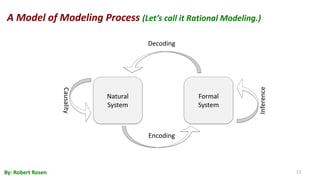
A Model of the Modeling Process
“Rational Models: Models, based on Ideals”
10
Second Section
11
Natural
System
Formal
System
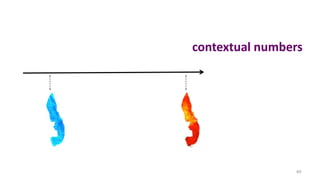
Decoding
Encoding
Inference
Causality
A Model of Modeling Process (Let’s call it Rational Modeling.)
By: Robert Rosen
12
A Normal Distribution with
outlier or a “unique case”?
Fourier Transformation: any
form is a linear combination
of some ideal forms
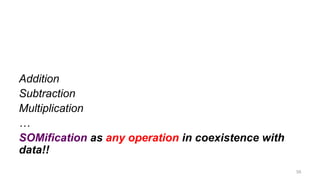
Each Code Follows On An Ideal Form
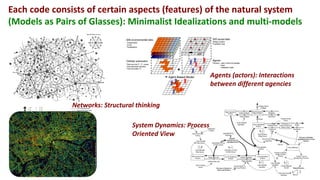
Each code consists of certain aspects (features) of the natural system
(Models as Pairs of Glasses): Minimalist Idealizations and multi-models
Networks: Structural thinking
Agents (actors): Interactions
between different agencies
System Dynamics: Process
Oriented View
13
Challenge: What to do in dealing with Complex Adaptive
Systems? Which glasses (i.e. modeling approach) is
sufficient, when in principle each view is arbitrary?
15
Hypothesis: Majority of current modeling approaches
are fundamentally limited in dealing with complex
systems and what we need is an abstraction from the
concept of “rational modeling”.
Idea: Is it conceptually possible to have all the views at
once?
Complex Numbers
Real Numbers
What do we mean by “Abstraction”? (A Metaphore)
16
Rational Numbers
Natural Numbers
Current Trend: Parametricism (multi-model Idealization) and the
Curse of Dimensionality…
17
…Complicated, but not complex models
Properties of the system for modeling
PossibleRelations
(typesandnumbers)
Complex Systems
Simple Systems
Minimal
idealization
Multi-model
idealization
18
A new realm of modeling?!
Properties of the system for modeling
PossibleRelations
(typesandnumbers)
Multi-Agent
Systems
Urban Cellular
automata
Urban Dynamics
Basic Statistics
(Hypothesis Testing)
Urban Metabolism
Urban Scaling
Social Physics
Fractal Models
Toward a new formalism for the concept of modeling
“Models without Ideals or All the Potential Ideals”
19
Third Section
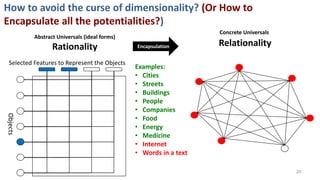
How to avoid the curse of dimensionality? (Or How to
Encapsulate all the potentialities?)
Selected Features to Represent the Objects
Objects
Encapsulation RelationalityRationality
Examples:
• Cities
• Streets
• Buildings
• People
• Companies
• Food
• Energy
• Medicine
• Internet
• Words in a text
Abstract Universals (ideal forms)
Concrete Universals
20
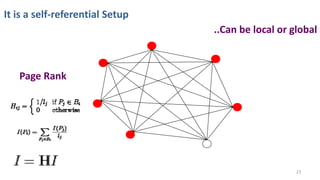
It is a self-referential Setup
21
Page Rank
..Can be local or global
Relational Modeling
22
An Example in Natural Language Modeling
Rational Modeling Relational Modeling
External Reference
We have the Ideal model of the
language
No External Reference
We have A Huge Corpus of
language
Main Assumption
Relational Representation of symbols in a language
Noam Chomsky MarkovHeroes
Based on
Approach
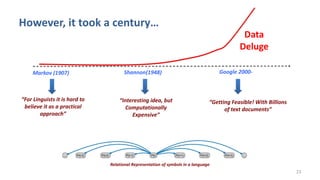
However, it took a century…
23
Markov (1907) Shannon(1948) Google 2000-
“For Linguists it is hard to
believe it as a practical
approach”
“Interesting idea, but
Computationally
Expensive”
“Getting Feasible! With Billions
of text documents”
Relational Representation of symbols in a language
Data
Deluge
…this Data Deluge has inverted the concept of empirical
research
24
Classical Simulation
SpaceSyntax, London
“The social logic of space,(1984)”
33,000+ taxicabs
GPS Trajectory of Taxicabs,
Beijing, 2012
Inversion in
Modeling
25
Link
26
27
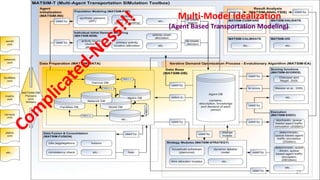
Multi-Model Idealization
(Agent Based Transportation Modeling)
28
Using GPS tracks of cars within a city:
Taking urban cells as a word in a language,
each individual driver is a unique story teller,
while driving within urban grid cells…
...A Markov Chain Model of traffic dynamics
Can be developed for :
• Simulation
• community detection
• Network Engineering
• Sensitivity Analysis
Fourth Section
Self Organizing Maps
And
Data Deluge
29
How to explain SOM or What is a good story for SOM?
30
SOM from the Context of (Nonlinear) Transformation:
Dimensionality Reduction
31
• Finding an ideal (global) transformation: e.g. PCA
• Observations are instances of an abstract representation
32
Selected Features to Represent the Objects
Objects
First General Approach: Direct Transformation
X TW
• Each observation is a dimension itself: e.g. MDS, LLE, ISOMAP,…
• There is always a mechanism to preserve neighborhood topology.
33
Second General Approach: Indirect Transformation
34
Self Organizing Map (SOM) : A generic setup, based on
symbolic indexes
• SOM as a transformation
based on topology
preserving mechanism,
but at the same time
creating an abstraction
from observations.
35
A Primal-Dual Representation
X TSOM
Pre-Specific City Modeling
Footprint of buildings in
Orchard area,
Singapore
Similar
buildings are
in the same
area of SOM
36
Data Driven Urban Pollution Modeling beyond Idealization
37Idealization in traditional simulation models
Data Driven Urban Pollution Modeling beyond Idealization
38
39
SOM: Approximating joint probability distribution
40
Frequencies of occurrence
P.E. Bieringer et al. / Atmospheric Environment 80 (2013)
41Original Distribution SOM Based Distribution
42
SOM: Computing with contextual numbers (signs!?)
43
The classic notion of (natural) number is based on a one directional
arrow.
44
This is the classical time series analysis.
45
46
47
48
contextual numbers
49
contextual numbers
50
1-Median list Price
2-Median sale price
3-Median list price -sq. ft.
4-Median sale price-sq. ft.
5-Sold for loss
6-Sold for gain
7-Increasing values
8-Decreasing values
9-Listings with price cut
10-Median price cut
11-Sold in past year
12-Homes for Rent
13-Homes foreclosed
14-Foreclosure re-sales
15-Sale-to-list price ratio
16-Price to rent ratio
Multi-Dimensional Time Series
Modeling (Real Estate Dynamics)
51
52
But it is more than visualization…
53
It improves the overall prediction accuracy
54
In general, it can be a part of larger computing machine.
SOM: A Generic Computing Machine Beyond Ideal Forms
55
Democratic Computing Social computing
(Computing with any function)
Observed Data
Resamples of Data by SOM
Addition
Subtraction
Multiplication
…
SOMification as any operation in coexistence with
data!!
56
Thanks!
57

Data Driven Modeling Beyond Idealization

  • 1.
    svm@arch.ethz.ch SEC Data Driven ModelingBeyond Idealization Vahid Moosavi PhD Student at Chair for Computer Aided Architectural Design (CAAD), Professor Ludger Hovestadt, ETH Zurich Researcher at ETH-Singapore Centre, Future Cities Laboratory (FCL) 24 May 2014 1
  • 2.
    Landscape of ScientificModeling 2 First Section
  • 3.
    Models as theway we conceive of the real phenomena are one of the fundamental elements of any investigation… 3
  • 5.
    5 On the otherhand, what we encounter… …A Landscape of Modeling Approaches in Competition, Challenging Complex Systems
  • 7.
    First Try: FormalDefinitions • No specific definition so far (Stanford Plato) but some classifications: • Models and Representation – Scale models. (Black 1962) – Idealized models (Michael Weisberg) • Aristotelian (Minimal) • Galilean (McMullin 1985) • Caricatures – Analogical models (Hesse 1963) – Approximations – Phenomenological models: (McMullin 1968) – …
  • 8.
    Idealization toward perfectionor simplification?!!
  • 9.
  • 10.
    A Model ofthe Modeling Process “Rational Models: Models, based on Ideals” 10 Second Section
  • 11.
    11 Natural System Formal System Decoding Encoding Inference Causality A Model ofModeling Process (Let’s call it Rational Modeling.) By: Robert Rosen
  • 12.
    12 A Normal Distributionwith outlier or a “unique case”? Fourier Transformation: any form is a linear combination of some ideal forms Each Code Follows On An Ideal Form
  • 13.
    Each code consistsof certain aspects (features) of the natural system (Models as Pairs of Glasses): Minimalist Idealizations and multi-models Networks: Structural thinking Agents (actors): Interactions between different agencies System Dynamics: Process Oriented View 13
  • 15.
    Challenge: What todo in dealing with Complex Adaptive Systems? Which glasses (i.e. modeling approach) is sufficient, when in principle each view is arbitrary? 15 Hypothesis: Majority of current modeling approaches are fundamentally limited in dealing with complex systems and what we need is an abstraction from the concept of “rational modeling”. Idea: Is it conceptually possible to have all the views at once?
  • 16.
    Complex Numbers Real Numbers Whatdo we mean by “Abstraction”? (A Metaphore) 16 Rational Numbers Natural Numbers
  • 17.
    Current Trend: Parametricism(multi-model Idealization) and the Curse of Dimensionality… 17 …Complicated, but not complex models Properties of the system for modeling PossibleRelations (typesandnumbers) Complex Systems Simple Systems Minimal idealization Multi-model idealization
  • 18.
    18 A new realmof modeling?! Properties of the system for modeling PossibleRelations (typesandnumbers) Multi-Agent Systems Urban Cellular automata Urban Dynamics Basic Statistics (Hypothesis Testing) Urban Metabolism Urban Scaling Social Physics Fractal Models
  • 19.
    Toward a newformalism for the concept of modeling “Models without Ideals or All the Potential Ideals” 19 Third Section
  • 20.
    How to avoidthe curse of dimensionality? (Or How to Encapsulate all the potentialities?) Selected Features to Represent the Objects Objects Encapsulation RelationalityRationality Examples: • Cities • Streets • Buildings • People • Companies • Food • Energy • Medicine • Internet • Words in a text Abstract Universals (ideal forms) Concrete Universals 20
  • 21.
    It is aself-referential Setup 21 Page Rank ..Can be local or global
  • 22.
    Relational Modeling 22 An Examplein Natural Language Modeling Rational Modeling Relational Modeling External Reference We have the Ideal model of the language No External Reference We have A Huge Corpus of language Main Assumption Relational Representation of symbols in a language Noam Chomsky MarkovHeroes Based on Approach
  • 23.
    However, it tooka century… 23 Markov (1907) Shannon(1948) Google 2000- “For Linguists it is hard to believe it as a practical approach” “Interesting idea, but Computationally Expensive” “Getting Feasible! With Billions of text documents” Relational Representation of symbols in a language Data Deluge
  • 24.
    …this Data Delugehas inverted the concept of empirical research 24
  • 25.
    Classical Simulation SpaceSyntax, London “Thesocial logic of space,(1984)” 33,000+ taxicabs GPS Trajectory of Taxicabs, Beijing, 2012 Inversion in Modeling 25
  • 26.
  • 27.
  • 28.
    28 Using GPS tracksof cars within a city: Taking urban cells as a word in a language, each individual driver is a unique story teller, while driving within urban grid cells… ...A Markov Chain Model of traffic dynamics Can be developed for : • Simulation • community detection • Network Engineering • Sensitivity Analysis
  • 29.
    Fourth Section Self OrganizingMaps And Data Deluge 29
  • 30.
    How to explainSOM or What is a good story for SOM? 30
  • 31.
    SOM from theContext of (Nonlinear) Transformation: Dimensionality Reduction 31
  • 32.
    • Finding anideal (global) transformation: e.g. PCA • Observations are instances of an abstract representation 32 Selected Features to Represent the Objects Objects First General Approach: Direct Transformation X TW
  • 33.
    • Each observationis a dimension itself: e.g. MDS, LLE, ISOMAP,… • There is always a mechanism to preserve neighborhood topology. 33 Second General Approach: Indirect Transformation
  • 34.
  • 35.
    Self Organizing Map(SOM) : A generic setup, based on symbolic indexes • SOM as a transformation based on topology preserving mechanism, but at the same time creating an abstraction from observations. 35 A Primal-Dual Representation X TSOM
  • 36.
    Pre-Specific City Modeling Footprintof buildings in Orchard area, Singapore Similar buildings are in the same area of SOM 36
  • 37.
    Data Driven UrbanPollution Modeling beyond Idealization 37Idealization in traditional simulation models
  • 38.
    Data Driven UrbanPollution Modeling beyond Idealization 38
  • 39.
    39 SOM: Approximating jointprobability distribution
  • 40.
    40 Frequencies of occurrence P.E.Bieringer et al. / Atmospheric Environment 80 (2013)
  • 41.
    41Original Distribution SOMBased Distribution
  • 42.
    42 SOM: Computing withcontextual numbers (signs!?)
  • 43.
    43 The classic notionof (natural) number is based on a one directional arrow.
  • 44.
    44 This is theclassical time series analysis.
  • 45.
  • 46.
  • 47.
  • 48.
  • 49.
  • 50.
    50 1-Median list Price 2-Mediansale price 3-Median list price -sq. ft. 4-Median sale price-sq. ft. 5-Sold for loss 6-Sold for gain 7-Increasing values 8-Decreasing values 9-Listings with price cut 10-Median price cut 11-Sold in past year 12-Homes for Rent 13-Homes foreclosed 14-Foreclosure re-sales 15-Sale-to-list price ratio 16-Price to rent ratio Multi-Dimensional Time Series Modeling (Real Estate Dynamics)
  • 51.
  • 52.
    52 But it ismore than visualization…
  • 53.
    53 It improves theoverall prediction accuracy
  • 54.
    54 In general, itcan be a part of larger computing machine.
  • 55.
    SOM: A GenericComputing Machine Beyond Ideal Forms 55 Democratic Computing Social computing (Computing with any function) Observed Data Resamples of Data by SOM
  • 56.
    Addition Subtraction Multiplication … SOMification as anyoperation in coexistence with data!! 56
  • 57.

Editor's Notes

  • #2 In terms of representation and inference we can go beyond idealization
  • #8 Focus on Idealization In the beginning ---> Simplification, but gradually it has changed to a situation that every phenomenon has an underlying nature?!! Examples: Point mass, infinite speed, circle, rational choice, rational maximizer Agents, Aristotelian: Striping away properties (elements) from the concrete case An example is a classical mechanics model of the planetary system, describing the planets as objects only having shape and mass, disregarding all other properties Galilean idealizations: Simplifying properties (mess points)
  • #12 Coding is based on an arbitrary Ideal Coordinatization
  • #13 Multiple ideals
  • #16 Numbers onion model Quantum Mechanics Similarly for the concept of modeling
  • #17 Similar to FlatLand
  • #18 Elephant and the blind men
  • #19 Don’t say about models, just the reason for the limit Walkability as an example Godel’s incompleteness theorem Hamiltonian Complexity Theory to show the limit of Model-ability!!
  • #21 Identity Assumption of objects independence
  • #22 Sheaf Theory
  • #32 Self-organizing Map : Mapping as transformation
  • #34 Sheaf Theory Localization -Globalization
  • #36 For the issue of Causality: Prediction, classification, clustering I am co-organizing a conference on SOM next Month
  • #56 From an imposed structure to operation of any potential structure Similar to Quantum Mechanics and abstraction from explicit representation to space of potential explicit representations Discontinuity