Class No.35  Data Structures http://ecomputernotes.com
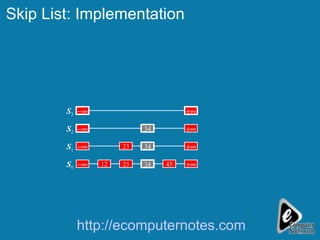
Skip List: Implementation   S 0 S 1 S 2 S 3   45 12 23 34   34   23 34 http://ecomputernotes.com
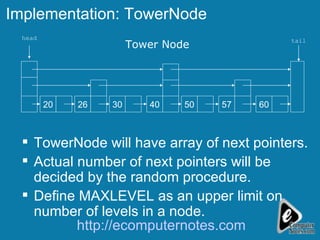
Implementation: TowerNode TowerNode will have array of next pointers. Actual number of next pointers will be decided by the random procedure. Define MAXLEVEL as an upper limit on number of levels in a node. http://ecomputernotes.com 40 50 60 head tail 20 30 26 57 Tower Node
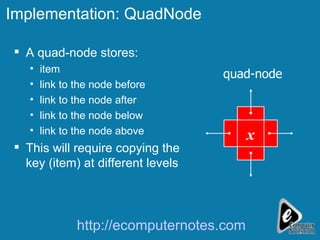
Implementation: QuadNode A quad-node stores: item link to the node before link to the node after link to the node below link to the node above This will require copying the key (item) at different levels x quad-node http://ecomputernotes.com
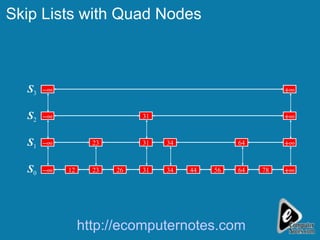
Skip Lists with Quad Nodes 56 64 78  31 34 44  12 23 26    31  64  31 34  23 S 0 S 1 S 2 S 3 http://ecomputernotes.com
Performance of Skip Lists In a skip list with  n  items  The expected space used is proportional to  n . The expected search, insertion and deletion time is proportional to  log  n . Skip lists are fast and simple to implement in practice http://ecomputernotes.com
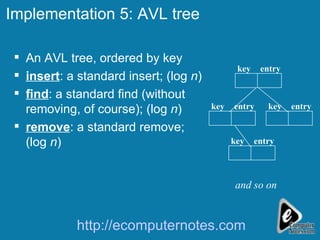
Implementation 5: AVL tree An AVL tree, ordered by key insert : a standard insert; (log  n ) find : a standard find (without removing, of course); (log  n ) remove : a standard remove; (log  n ) and so on http://ecomputernotes.com key entry key entry key entry key entry
Anything better? So far we have find, remove and insert where time varies between constant log n . It would be nice to have all three as constant time operations! http://ecomputernotes.com
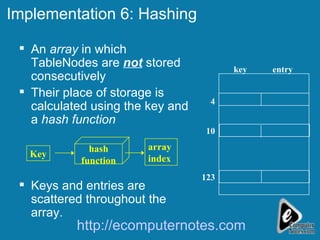
An  array  in which TableNodes are  not  stored consecutively Their place of storage is calculated using the key and a  hash function Keys and entries are scattered throughout the array. Implementation 6: Hashing key entry Key hash function array index 4 10 123 http://ecomputernotes.com
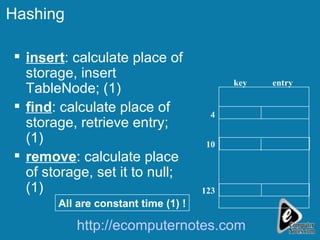
insert : calculate place of storage, insert TableNode; (1) find : calculate place of storage, retrieve entry; (1) remove : calculate place of storage, set it to null; (1) Hashing key entry 4 10 123 All are constant time (1) ! http://ecomputernotes.com
Hashing We use an array of some fixed size  T  to hold the data.  T  is typically prime. Each key is mapped into some number in the range  0  to  T-1  using a  hash function , which ideally should be efficient to compute. http://ecomputernotes.com
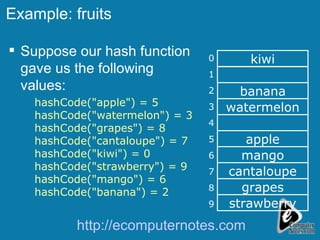
Example: fruits Suppose our hash function gave us the following values: hashCode("apple") = 5 hashCode("watermelon") = 3 hashCode("grapes") = 8 hashCode("cantaloupe") = 7 hashCode("kiwi") = 0 hashCode("strawberry") = 9 hashCode("mango") = 6 hashCode("banana") = 2 http://ecomputernotes.com kiwi banana watermelon apple mango cantaloupe grapes strawberry 0 1 2 3 4 5 6 7 8 9
Example Store data in a table array: table[5] = "apple"  table[3] = "watermelon"  table[8] = "grapes"   table[7] = "cantaloupe"  table[0] = "kiwi"  table[9] = "strawberry"   table[6] = "mango"  table[2] = "banana" http://ecomputernotes.com kiwi banana watermelon apple mango cantaloupe grapes strawberry 0 1 2 3 4 5 6 7 8 9
Example Associative array: table["apple"]  table["watermelon"]   table["grapes"]   table["cantaloupe"]   table["kiwi"]   table["strawberry"]   table["mango"]   table["banana"] http://ecomputernotes.com kiwi banana watermelon apple mango cantaloupe grapes strawberry 0 1 2 3 4 5 6 7 8 9
Example Hash Functions If the keys are strings the hash function is some function of the characters in the strings. One possibility is to simply add the ASCII values of the characters: TableSize ABC h Example TableSize i str str h length i )% 67 66 65 ( ) ( : % ] [ ) ( 1 0                http://ecomputernotes.com
Finding the hash function int hashCode( char* s ) { int i, sum; sum = 0; for(i=0; i < strlen(s); i++ )  sum = sum + s[i];  //  ascii value return sum % TABLESIZE; } http://ecomputernotes.com
Example Hash Functions Another possibility is to convert the string into some number in some arbitrary base  b  ( b  also might be a prime number): T b b b ABC h Example T b i str str h length i i )% 67 66 65 ( ) ( : % ] [ ) ( 2 1 0 1 0                 http://ecomputernotes.com
Example Hash Functions If the keys are integers then  key%T  is generally a good hash function, unless the data has some undesirable features. For example, if  T = 10  and all keys end in zeros, then  key%T = 0  for all keys.  In general, to avoid situations like this,  T  should be a prime number. http://ecomputernotes.com

Computer notes - Hashing

  • 1.
    Class No.35 Data Structures http://ecomputernotes.com
  • 2.
    Skip List: Implementation  S 0 S 1 S 2 S 3   45 12 23 34   34   23 34 http://ecomputernotes.com
  • 3.
    Implementation: TowerNode TowerNodewill have array of next pointers. Actual number of next pointers will be decided by the random procedure. Define MAXLEVEL as an upper limit on number of levels in a node. http://ecomputernotes.com 40 50 60 head tail 20 30 26 57 Tower Node
  • 4.
    Implementation: QuadNode Aquad-node stores: item link to the node before link to the node after link to the node below link to the node above This will require copying the key (item) at different levels x quad-node http://ecomputernotes.com
  • 5.
    Skip Lists withQuad Nodes 56 64 78  31 34 44  12 23 26    31  64  31 34  23 S 0 S 1 S 2 S 3 http://ecomputernotes.com
  • 6.
    Performance of SkipLists In a skip list with n items The expected space used is proportional to n . The expected search, insertion and deletion time is proportional to log n . Skip lists are fast and simple to implement in practice http://ecomputernotes.com
  • 7.
    Implementation 5: AVLtree An AVL tree, ordered by key insert : a standard insert; (log n ) find : a standard find (without removing, of course); (log n ) remove : a standard remove; (log n ) and so on http://ecomputernotes.com key entry key entry key entry key entry
  • 8.
    Anything better? Sofar we have find, remove and insert where time varies between constant log n . It would be nice to have all three as constant time operations! http://ecomputernotes.com
  • 9.
    An array in which TableNodes are not stored consecutively Their place of storage is calculated using the key and a hash function Keys and entries are scattered throughout the array. Implementation 6: Hashing key entry Key hash function array index 4 10 123 http://ecomputernotes.com
  • 10.
    insert : calculateplace of storage, insert TableNode; (1) find : calculate place of storage, retrieve entry; (1) remove : calculate place of storage, set it to null; (1) Hashing key entry 4 10 123 All are constant time (1) ! http://ecomputernotes.com
  • 11.
    Hashing We usean array of some fixed size T to hold the data. T is typically prime. Each key is mapped into some number in the range 0 to T-1 using a hash function , which ideally should be efficient to compute. http://ecomputernotes.com
  • 12.
    Example: fruits Supposeour hash function gave us the following values: hashCode(&quot;apple&quot;) = 5 hashCode(&quot;watermelon&quot;) = 3 hashCode(&quot;grapes&quot;) = 8 hashCode(&quot;cantaloupe&quot;) = 7 hashCode(&quot;kiwi&quot;) = 0 hashCode(&quot;strawberry&quot;) = 9 hashCode(&quot;mango&quot;) = 6 hashCode(&quot;banana&quot;) = 2 http://ecomputernotes.com kiwi banana watermelon apple mango cantaloupe grapes strawberry 0 1 2 3 4 5 6 7 8 9
  • 13.
    Example Store datain a table array: table[5] = &quot;apple&quot; table[3] = &quot;watermelon&quot; table[8] = &quot;grapes&quot; table[7] = &quot;cantaloupe&quot; table[0] = &quot;kiwi&quot; table[9] = &quot;strawberry&quot; table[6] = &quot;mango&quot; table[2] = &quot;banana&quot; http://ecomputernotes.com kiwi banana watermelon apple mango cantaloupe grapes strawberry 0 1 2 3 4 5 6 7 8 9
  • 14.
    Example Associative array:table[&quot;apple&quot;] table[&quot;watermelon&quot;] table[&quot;grapes&quot;] table[&quot;cantaloupe&quot;] table[&quot;kiwi&quot;] table[&quot;strawberry&quot;] table[&quot;mango&quot;] table[&quot;banana&quot;] http://ecomputernotes.com kiwi banana watermelon apple mango cantaloupe grapes strawberry 0 1 2 3 4 5 6 7 8 9
  • 15.
    Example Hash FunctionsIf the keys are strings the hash function is some function of the characters in the strings. One possibility is to simply add the ASCII values of the characters: TableSize ABC h Example TableSize i str str h length i )% 67 66 65 ( ) ( : % ] [ ) ( 1 0                http://ecomputernotes.com
  • 16.
    Finding the hashfunction int hashCode( char* s ) { int i, sum; sum = 0; for(i=0; i < strlen(s); i++ ) sum = sum + s[i]; // ascii value return sum % TABLESIZE; } http://ecomputernotes.com
  • 17.
    Example Hash FunctionsAnother possibility is to convert the string into some number in some arbitrary base b ( b also might be a prime number): T b b b ABC h Example T b i str str h length i i )% 67 66 65 ( ) ( : % ] [ ) ( 2 1 0 1 0                 http://ecomputernotes.com
  • 18.
    Example Hash FunctionsIf the keys are integers then key%T is generally a good hash function, unless the data has some undesirable features. For example, if T = 10 and all keys end in zeros, then key%T = 0 for all keys. In general, to avoid situations like this, T should be a prime number. http://ecomputernotes.com

Editor's Notes

  • #3 Start of 41.
  • #5 Start lecture 41
  • #19 End of lecture 41. Start of lecture 42.