o The climate in Nashik is quite pleasant and moderate. The
year in Nashik could be divided into four seasons.
o The cold season is from December to February, followed
by the hot season from March to May and the monsoon
from June to September followed by the post-monsoon
season from October to November.
o The winds are generally light to moderate with some
strengthening in the wind force during the latter part of
the summer season and in the monsoon season.
o In the cold season, winds blow from directions between
south-west and north-west in the morning and between
north and east in the afternoons. In the hot season, winds
are from directions south-west and north-west
REMAIGINING THE RAMKUND : GANGA GHAT
INTRODUCTION TO SITE -
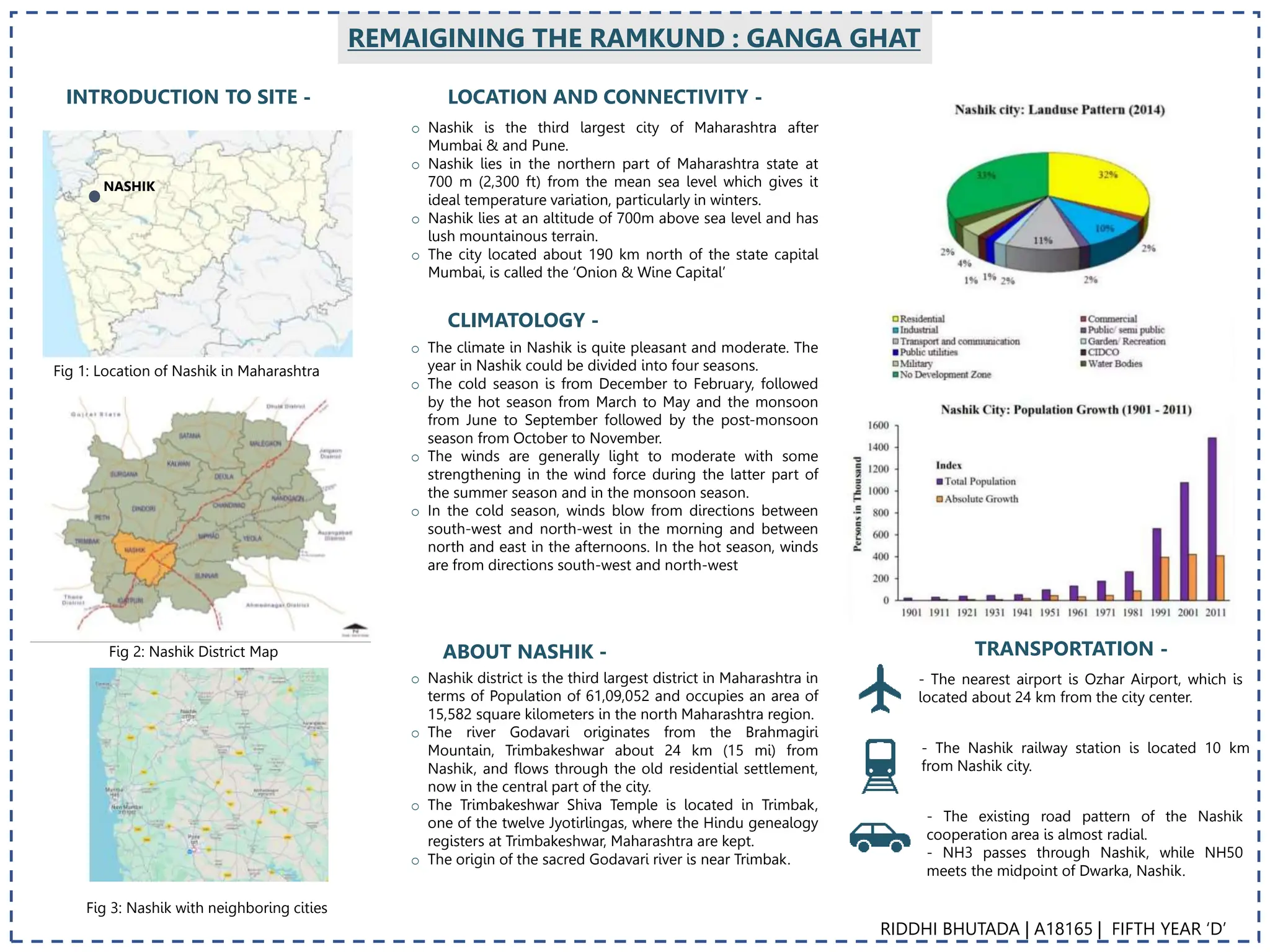
NASHIK
Fig 1: Location of Nashik in Maharashtra
Fig 2: Nashik District Map
Fig 3: Nashik with neighboring cities
LOCATION AND CONNECTIVITY -
o Nashik is the third largest city of Maharashtra after
Mumbai & and Pune.
o Nashik lies in the northern part of Maharashtra state at
700 m (2,300 ft) from the mean sea level which gives it
ideal temperature variation, particularly in winters.
o Nashik lies at an altitude of 700m above sea level and has
lush mountainous terrain.
o The city located about 190 km north of the state capital
Mumbai, is called the ‘Onion & Wine Capital’
RIDDHI BHUTADA | A18165 | FIFTH YEAR ‘D’
ABOUT NASHIK -
o Nashik district is the third largest district in Maharashtra in
terms of Population of 61,09,052 and occupies an area of
15,582 square kilometers in the north Maharashtra region.
o The river Godavari originates from the Brahmagiri
Mountain, Trimbakeshwar about 24 km (15 mi) from
Nashik, and flows through the old residential settlement,
now in the central part of the city.
o The Trimbakeshwar Shiva Temple is located in Trimbak,
one of the twelve Jyotirlingas, where the Hindu genealogy
registers at Trimbakeshwar, Maharashtra are kept.
o The origin of the sacred Godavari river is near Trimbak.
CLIMATOLOGY -
TRANSPORTATION -
- The nearest airport is Ozhar Airport, which is
located about 24 km from the city center.
- The Nashik railway station is located 10 km
from Nashik city.
- The existing road pattern of the Nashik
cooperation area is almost radial.
- NH3 passes through Nashik, while NH50
meets the midpoint of Dwarka, Nashik.
REMAIGINING THE RAMKUND : GANGA GHAT
RIDDHI BHUTADA | A18165 | FIFTH YEAR ‘D’
A HISTORICAL PERSPECTIVE -
o Nashik was known as Panchavati before the Ramayana
period.
o Nashik has mythological, historical, social, and cultural
importance.
o Nashik has a rich historical past, as the mythology has it
that Lord Rama, the King of Ayodhya, made Nashik his
abode during his 14 years in exile.
o At the same place Lord Laxman, by the wish of Lord
Rama, cut the nose of “Shurpnakha” and thus this city was
named as “Nashik”.
o The most important historical significance is that Kumbh
Mela is conducted at Nashik once every twelve years, out
of 4 places in India.
RAMKUND: GANGA GHAT -
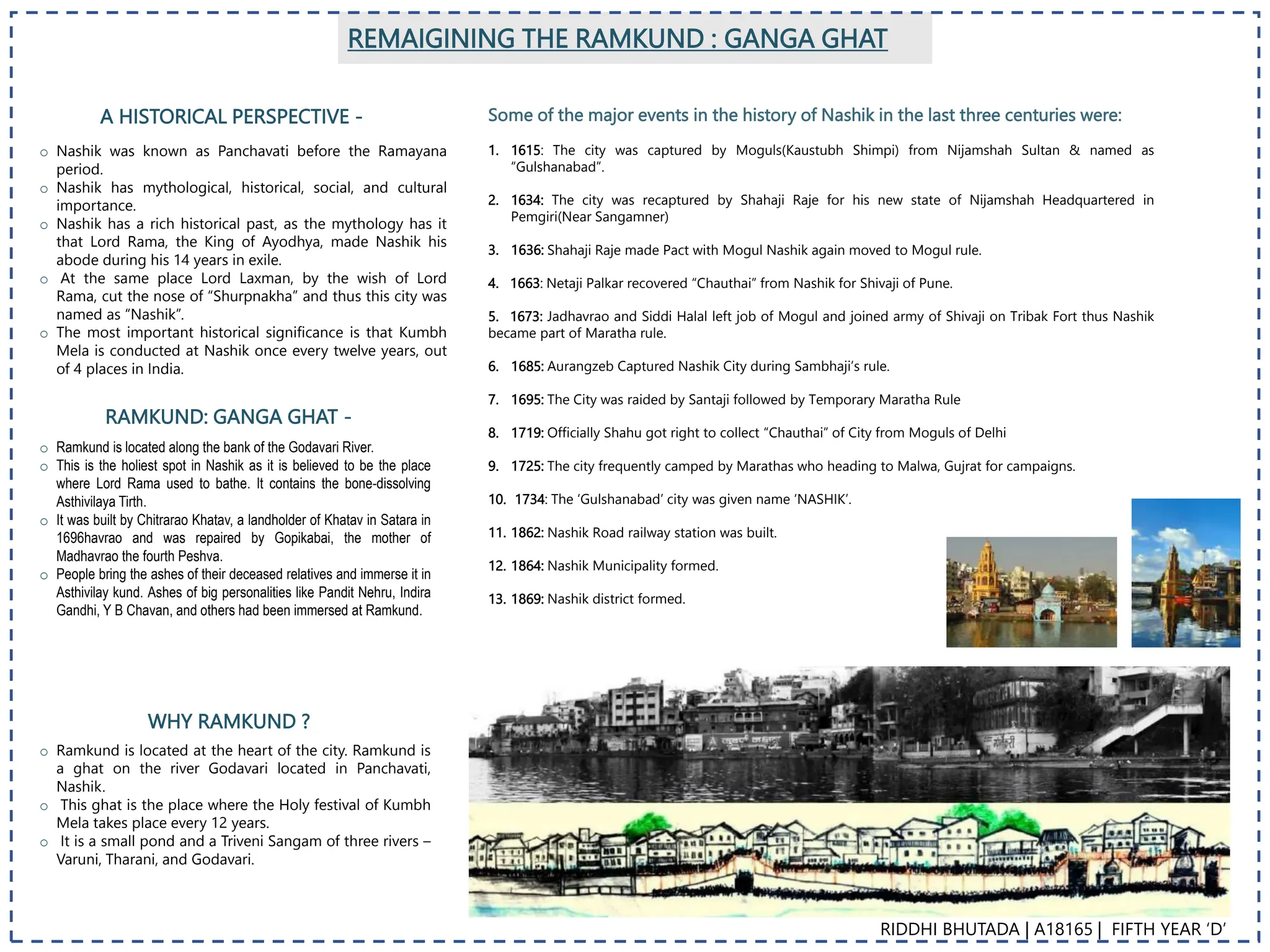
o Ramkund is located along the bank of the Godavari River.
o This is the holiest spot in Nashik as it is believed to be the place
where Lord Rama used to bathe. It contains the bone-dissolving
Asthivilaya Tirth.
o It was built by Chitrarao Khatav, a landholder of Khatav in Satara in
1696havrao and was repaired by Gopikabai, the mother of
Madhavrao the fourth Peshva.
o People bring the ashes of their deceased relatives and immerse it in
Asthivilay kund. Ashes of big personalities like Pandit Nehru, Indira
Gandhi, Y B Chavan, and others had been immersed at Ramkund.
WHY RAMKUND ?
o Ramkund is located at the heart of the city. Ramkund is
a ghat on the river Godavari located in Panchavati,
Nashik.
o This ghat is the place where the Holy festival of Kumbh
Mela takes place every 12 years.
o It is a small pond and a Triveni Sangam of three rivers –
Varuni, Tharani, and Godavari.
Some of the major events in the history of Nashik in the last three centuries were:
1. 1615: The city was captured by Moguls(Kaustubh Shimpi) from Nijamshah Sultan & named as
“Gulshanabad”.
2. 1634: The city was recaptured by Shahaji Raje for his new state of Nijamshah Headquartered in
Pemgiri(Near Sangamner)
3. 1636: Shahaji Raje made Pact with Mogul Nashik again moved to Mogul rule.
4. 1663: Netaji Palkar recovered “Chauthai” from Nashik for Shivaji of Pune.
5. 1673: Jadhavrao and Siddi Halal left job of Mogul and joined army of Shivaji on Tribak Fort thus Nashik
became part of Maratha rule.
6. 1685: Aurangzeb Captured Nashik City during Sambhaji’s rule.
7. 1695: The City was raided by Santaji followed by Temporary Maratha Rule
8. 1719: Officially Shahu got right to collect “Chauthai” of City from Moguls of Delhi
9. 1725: The city frequently camped by Marathas who heading to Malwa, Gujrat for campaigns.
10. 1734: The ‘Gulshanabad’ city was given name ‘NASHIK’.
11. 1862: Nashik Road railway station was built.
12. 1864: Nashik Municipality formed.
13. 1869: Nashik district formed.
REMAIGINING THE RAMKUND : GANGA GHAT
RIDDHI BHUTADA | A18165 | FIFTH YEAR ‘D’
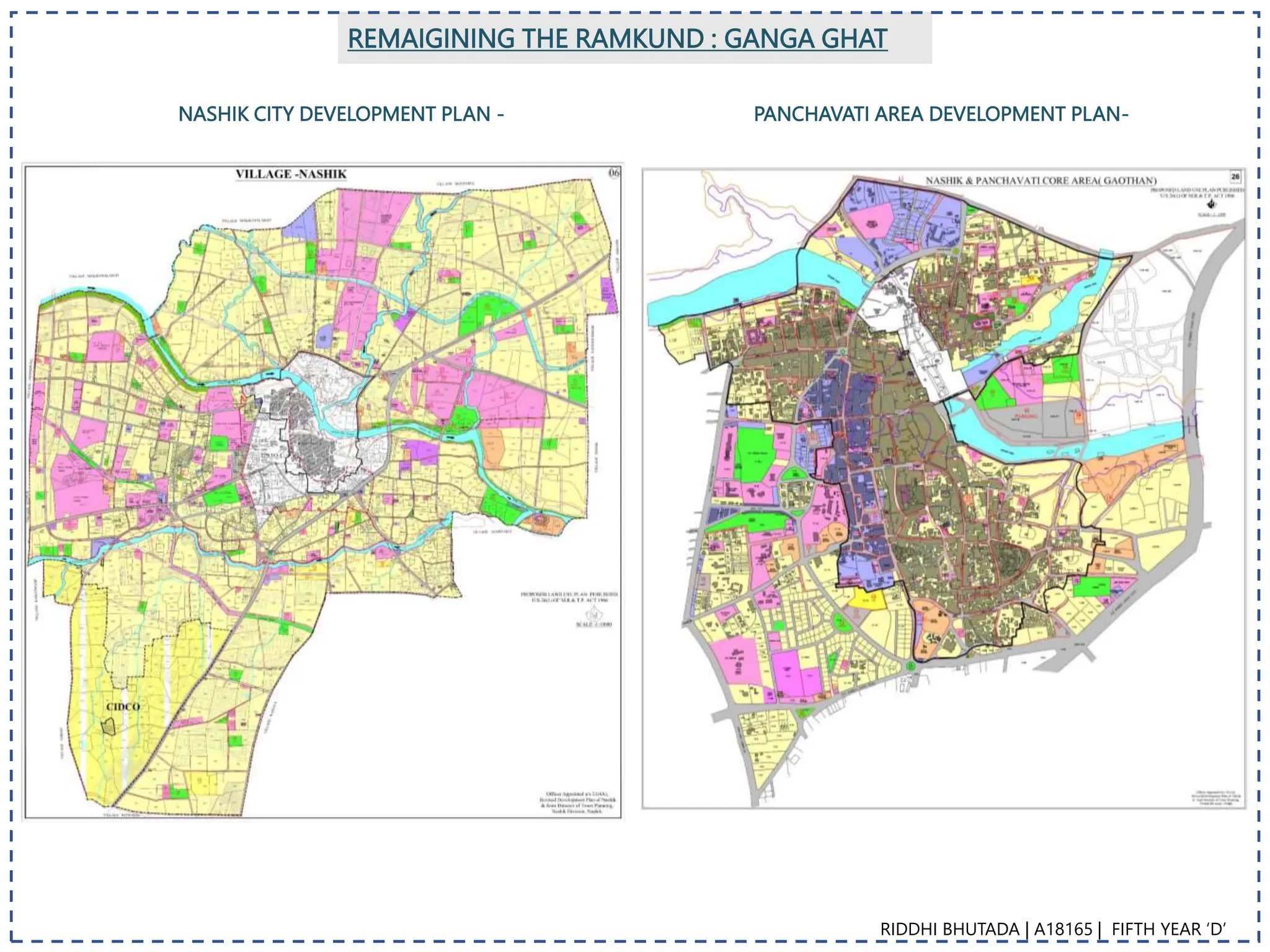
NASHIK CITY DEVELOPMENT PLAN - PANCHAVATI AREA DEVELOPMENT PLAN-
REMAIGINING THE RAMKUND : GANGA GHAT
RIDDHI BHUTADA | A18165 | FIFTH YEAR ‘D’
SITE ANALYSIS - CURRENT SCENARIO -
o The scenario of Ramkund is dirty
and unhygienic.
o Being one of the most historical
places, measures need to be taken
to preserve the site.
o There are no proper parking
facilities, cars are parked on the foot
of Ramkund.
o As so many people come to take a
bath in scared Ramkund, proper
changing rooms, and toilets are
major missing things.
o A vegetable market is established in
the surrounding area and it is losing
the importance of the place.
VEGETABLE MARKET
IMPROPER PARKING
CHANGING ROOMS & WASHROOMS
o The topography of the site is
rectangular in shape.
o Essential units are in close
proximity.
o Landmarks – temples.
o Easy approach and connectivity.
S T R E N G H T S
o Informal vehicle zone.
o Hawkers and vendor movements.
o Many Abandoned structures nearby.
W E A K N E S S
o There is step landscaping on site, which
can be developed with vegetation/
planters.
o High economic growth, as a bazaar is
set up nearby to site within 100 mts.
O P P O U R T U N I T Y
o Possibility of more expansion.
o Unwanted facilities nearby.
o Re-settling of hawkers and vendors.
T H R E A T S
SWOT ANALYSIS
BASIC LANDSCAPING
2 KMS
o The climate in Nashik is quite pleasant and moderate. The
year in Nashik could be divided into four seasons.
o The cold season is from December to February, followed
by the hot season from March to May and the monsoon
from June to September followed by the post-monsoon
season from October to November.
o The winds are generally light to moderate with some
strengthening in the wind force during the latter part of
the summer season and in the monsoon season.
o In the cold season, winds blow from directions between
south-west and north-west in the morning and between
north and east in the afternoons. In the hot season, winds
are from directions south-west and north-west
CASE STUDY: SABARMATI RIVERFRONT
INTRODUCTION TO SITE - LOCATION AND CONNECTIVITY -
o Nashik is the third largest city of Maharashtra after
Mumbai & and Pune.
o Nashik lies in the northern part of Maharashtra state at
700 m (2,300 ft) from the mean sea level which gives it
ideal temperature variation, particularly in winters.
o Nashik lies at an altitude of 700m above sea level and has
lush mountainous terrain.
o The city located about 190 km north of the state capital
Mumbai, is called the ‘Onion & Wine Capital’
RIDDHI BHUTADA | A18165 | FIFTH YEAR ‘D’
ABOUT NASHIK -
o Nashik district is the third largest district in Maharashtra in
terms of Population of 61,09,052 and occupies an area of
15,582 square kilometers in the north Maharashtra region.
o The river Godavari originates from the Brahmagiri
Mountain, Trimbakeshwar about 24 km (15 mi) from
Nashik, and flows through the old residential settlement,
now in the central part of the city.
o The Trimbakeshwar Shiva Temple is located in Trimbak,
one of the twelve Jyotirlingas, where the Hindu genealogy
registers at Trimbakeshwar, Maharashtra are kept.
o The origin of the sacred Godavari river is near Trimbak.
CLIMATOLOGY -
TRANSPORTATION -
- The nearest airport is Ozhar Airport, which is
located about 24 km from the city center.
- The Nashik railway station is located 10 km
from Nashik city.
- The existing road pattern of the Nashik
cooperation area is almost radial.
- NH3 passes through Nashik, while NH50
meets the midpoint of Dwarka, Nashik.

DATA COLLECTION RAMKUND, nashik .pptx

  • 1.
    o The climatein Nashik is quite pleasant and moderate. The year in Nashik could be divided into four seasons. o The cold season is from December to February, followed by the hot season from March to May and the monsoon from June to September followed by the post-monsoon season from October to November. o The winds are generally light to moderate with some strengthening in the wind force during the latter part of the summer season and in the monsoon season. o In the cold season, winds blow from directions between south-west and north-west in the morning and between north and east in the afternoons. In the hot season, winds are from directions south-west and north-west REMAIGINING THE RAMKUND : GANGA GHAT INTRODUCTION TO SITE - NASHIK Fig 1: Location of Nashik in Maharashtra Fig 2: Nashik District Map Fig 3: Nashik with neighboring cities LOCATION AND CONNECTIVITY - o Nashik is the third largest city of Maharashtra after Mumbai & and Pune. o Nashik lies in the northern part of Maharashtra state at 700 m (2,300 ft) from the mean sea level which gives it ideal temperature variation, particularly in winters. o Nashik lies at an altitude of 700m above sea level and has lush mountainous terrain. o The city located about 190 km north of the state capital Mumbai, is called the ‘Onion & Wine Capital’ RIDDHI BHUTADA | A18165 | FIFTH YEAR ‘D’ ABOUT NASHIK - o Nashik district is the third largest district in Maharashtra in terms of Population of 61,09,052 and occupies an area of 15,582 square kilometers in the north Maharashtra region. o The river Godavari originates from the Brahmagiri Mountain, Trimbakeshwar about 24 km (15 mi) from Nashik, and flows through the old residential settlement, now in the central part of the city. o The Trimbakeshwar Shiva Temple is located in Trimbak, one of the twelve Jyotirlingas, where the Hindu genealogy registers at Trimbakeshwar, Maharashtra are kept. o The origin of the sacred Godavari river is near Trimbak. CLIMATOLOGY - TRANSPORTATION - - The nearest airport is Ozhar Airport, which is located about 24 km from the city center. - The Nashik railway station is located 10 km from Nashik city. - The existing road pattern of the Nashik cooperation area is almost radial. - NH3 passes through Nashik, while NH50 meets the midpoint of Dwarka, Nashik.
  • 2.
    REMAIGINING THE RAMKUND: GANGA GHAT RIDDHI BHUTADA | A18165 | FIFTH YEAR ‘D’ A HISTORICAL PERSPECTIVE - o Nashik was known as Panchavati before the Ramayana period. o Nashik has mythological, historical, social, and cultural importance. o Nashik has a rich historical past, as the mythology has it that Lord Rama, the King of Ayodhya, made Nashik his abode during his 14 years in exile. o At the same place Lord Laxman, by the wish of Lord Rama, cut the nose of “Shurpnakha” and thus this city was named as “Nashik”. o The most important historical significance is that Kumbh Mela is conducted at Nashik once every twelve years, out of 4 places in India. RAMKUND: GANGA GHAT - o Ramkund is located along the bank of the Godavari River. o This is the holiest spot in Nashik as it is believed to be the place where Lord Rama used to bathe. It contains the bone-dissolving Asthivilaya Tirth. o It was built by Chitrarao Khatav, a landholder of Khatav in Satara in 1696havrao and was repaired by Gopikabai, the mother of Madhavrao the fourth Peshva. o People bring the ashes of their deceased relatives and immerse it in Asthivilay kund. Ashes of big personalities like Pandit Nehru, Indira Gandhi, Y B Chavan, and others had been immersed at Ramkund. WHY RAMKUND ? o Ramkund is located at the heart of the city. Ramkund is a ghat on the river Godavari located in Panchavati, Nashik. o This ghat is the place where the Holy festival of Kumbh Mela takes place every 12 years. o It is a small pond and a Triveni Sangam of three rivers – Varuni, Tharani, and Godavari. Some of the major events in the history of Nashik in the last three centuries were: 1. 1615: The city was captured by Moguls(Kaustubh Shimpi) from Nijamshah Sultan & named as “Gulshanabad”. 2. 1634: The city was recaptured by Shahaji Raje for his new state of Nijamshah Headquartered in Pemgiri(Near Sangamner) 3. 1636: Shahaji Raje made Pact with Mogul Nashik again moved to Mogul rule. 4. 1663: Netaji Palkar recovered “Chauthai” from Nashik for Shivaji of Pune. 5. 1673: Jadhavrao and Siddi Halal left job of Mogul and joined army of Shivaji on Tribak Fort thus Nashik became part of Maratha rule. 6. 1685: Aurangzeb Captured Nashik City during Sambhaji’s rule. 7. 1695: The City was raided by Santaji followed by Temporary Maratha Rule 8. 1719: Officially Shahu got right to collect “Chauthai” of City from Moguls of Delhi 9. 1725: The city frequently camped by Marathas who heading to Malwa, Gujrat for campaigns. 10. 1734: The ‘Gulshanabad’ city was given name ‘NASHIK’. 11. 1862: Nashik Road railway station was built. 12. 1864: Nashik Municipality formed. 13. 1869: Nashik district formed.
  • 3.
    REMAIGINING THE RAMKUND: GANGA GHAT RIDDHI BHUTADA | A18165 | FIFTH YEAR ‘D’ NASHIK CITY DEVELOPMENT PLAN - PANCHAVATI AREA DEVELOPMENT PLAN-
  • 4.
    REMAIGINING THE RAMKUND: GANGA GHAT RIDDHI BHUTADA | A18165 | FIFTH YEAR ‘D’ SITE ANALYSIS - CURRENT SCENARIO - o The scenario of Ramkund is dirty and unhygienic. o Being one of the most historical places, measures need to be taken to preserve the site. o There are no proper parking facilities, cars are parked on the foot of Ramkund. o As so many people come to take a bath in scared Ramkund, proper changing rooms, and toilets are major missing things. o A vegetable market is established in the surrounding area and it is losing the importance of the place. VEGETABLE MARKET IMPROPER PARKING CHANGING ROOMS & WASHROOMS o The topography of the site is rectangular in shape. o Essential units are in close proximity. o Landmarks – temples. o Easy approach and connectivity. S T R E N G H T S o Informal vehicle zone. o Hawkers and vendor movements. o Many Abandoned structures nearby. W E A K N E S S o There is step landscaping on site, which can be developed with vegetation/ planters. o High economic growth, as a bazaar is set up nearby to site within 100 mts. O P P O U R T U N I T Y o Possibility of more expansion. o Unwanted facilities nearby. o Re-settling of hawkers and vendors. T H R E A T S SWOT ANALYSIS BASIC LANDSCAPING 2 KMS
  • 5.
    o The climatein Nashik is quite pleasant and moderate. The year in Nashik could be divided into four seasons. o The cold season is from December to February, followed by the hot season from March to May and the monsoon from June to September followed by the post-monsoon season from October to November. o The winds are generally light to moderate with some strengthening in the wind force during the latter part of the summer season and in the monsoon season. o In the cold season, winds blow from directions between south-west and north-west in the morning and between north and east in the afternoons. In the hot season, winds are from directions south-west and north-west CASE STUDY: SABARMATI RIVERFRONT INTRODUCTION TO SITE - LOCATION AND CONNECTIVITY - o Nashik is the third largest city of Maharashtra after Mumbai & and Pune. o Nashik lies in the northern part of Maharashtra state at 700 m (2,300 ft) from the mean sea level which gives it ideal temperature variation, particularly in winters. o Nashik lies at an altitude of 700m above sea level and has lush mountainous terrain. o The city located about 190 km north of the state capital Mumbai, is called the ‘Onion & Wine Capital’ RIDDHI BHUTADA | A18165 | FIFTH YEAR ‘D’ ABOUT NASHIK - o Nashik district is the third largest district in Maharashtra in terms of Population of 61,09,052 and occupies an area of 15,582 square kilometers in the north Maharashtra region. o The river Godavari originates from the Brahmagiri Mountain, Trimbakeshwar about 24 km (15 mi) from Nashik, and flows through the old residential settlement, now in the central part of the city. o The Trimbakeshwar Shiva Temple is located in Trimbak, one of the twelve Jyotirlingas, where the Hindu genealogy registers at Trimbakeshwar, Maharashtra are kept. o The origin of the sacred Godavari river is near Trimbak. CLIMATOLOGY - TRANSPORTATION - - The nearest airport is Ozhar Airport, which is located about 24 km from the city center. - The Nashik railway station is located 10 km from Nashik city. - The existing road pattern of the Nashik cooperation area is almost radial. - NH3 passes through Nashik, while NH50 meets the midpoint of Dwarka, Nashik.