ASWIN SARATH
PHARM D
JKKN COLLEGE OF PHARMACY
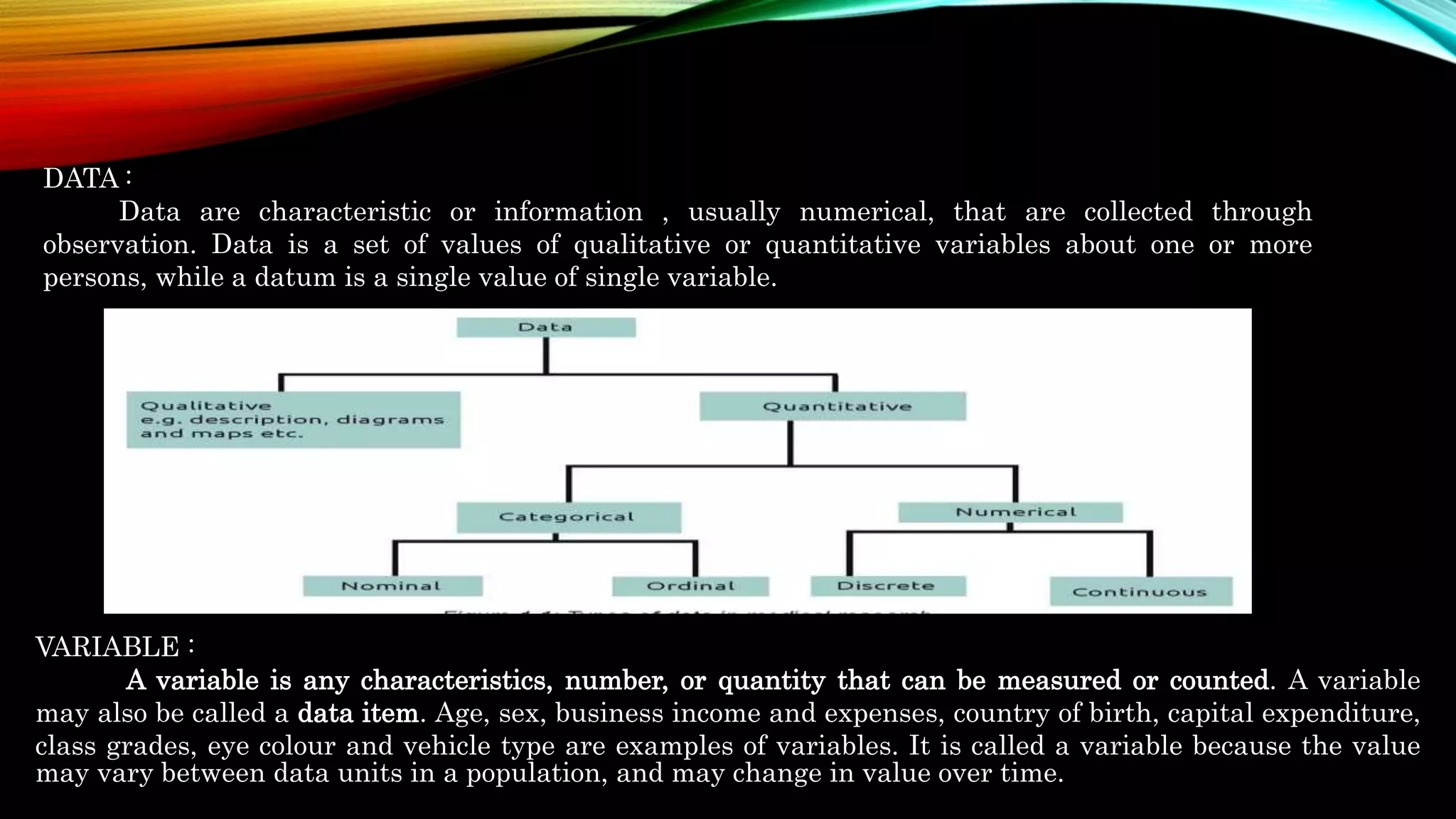
DATA :
Data are characteristic or information , usually numerical, that are collected through
observation. Data is a set of values of qualitative or quantitative variables about one or more
persons, while a datum is a single value of single variable.
VARIABLE :
A variable is any characteristics, number, or quantity that can be measured or counted. A variable
may also be called a data item. Age, sex, business income and expenses, country of birth, capital expenditure,
class grades, eye colour and vehicle type are examples of variables. It is called a variable because the value
may vary between data units in a population, and may change in value over time.
QUANTITATIVE DATA
Quantitative data is the type of data whose value is measured in the form of numbers or counts, with a unique numerical value associated with
each data set. Also known as numerical data, quantitative data further describes numeric variables.
Types of Quantitative Data
Quantitative Data can be divided into two types, namely;
• Numerical
• Categorical
 Numerical
Data that is measurable, such as time, height, weight, amount, and so on. You can help yourself identify numerical data by seeing if you can
average or order the data in either ascending or descending order.
Types of Numerical Data: 1)Discrete 2)Continous
Continuous Data
• Continuous data is a data type that takes on numeric values that can be meaningfully broken down into smaller units. As opposed to discrete
data which can't be measured, continuous data can be placed on a measurement scale (e.g. weight, length, time, etc.).
• For example, let us consider the Cumulative Grade Point (CGPA) of students in a class, measured on a 5 point scale. A student can score any
grade between 0 points and 5 points, including figures like 1.573, 4.5, 2.6981, etc. We classify this an uncountably finite continuous data
because it has an upper (5) and lower bound (0).
• An example of an uncountably infinite data is the set of real numbers, R = {..., -1, 0, 1, ...}. In this case, the data has neither an upper nor a
lower bound.
• Continuous data can also be divided into two types, namely;
Interval data
Ratio data
Discrete Data
• Data that can only take certain values.
• Discrete data can take on only integer values whereas continuous data can take on any value. For
instance the number of cancer patients treated by a hospital each year is discrete but your weight is
continuous. Some data are continuous but measured in a discrete way e.g. your age.
Interval data is a type of data which is measured along a scale, in which each point is placed at an equal distance (interval) from
one another. Interval data is one of the two types of discrete data. An example of interval data is the data collected on a
thermometer- its markings are on equidistant.
Characteristics of Interval Data
• Quantitativeness
• Measurement Scale
• Negative Reading
• Arithmetic Operation
Examples of Interval Data
Temperature
When measuring temperature in Celsius or Fahrenheit, it is considered interval data because 0 is arbitrary. That is, 0°C and 0°F
cannot be read on the thermometer.
Time
Time passes as a good example of interval data if measured during the day or using a 12-hour clock. The numbers on a wall clock
are on an interval scale since they are equidistant and measurable. For example, the difference between 1 o’clock and 2 o’clock is
the same as that between 2 o’clock and 3 o’clock.
Interval data
RATIO DATA:
Ratio Data is defined as a quantitative data, having the same properties as interval data, with an equal and definitive ratio
between each data and absolute “zero” being a treated as a point of origin.
In other words, there can be no negative numerical value in ratio data.
RATIO DATA HAS ALL PROPERTIES OF INTERVAL DATA SUCH AS
• Data should have numeric values, a distance between the two points are equal etc. but, unlike interval data where zero is
arbitrary, in ratio data, zero is absolute.
• A very good example of ratio data is the measurement of heights. Height could be measured in centimeters, meters, inches or
feet. It is not possible to have a negative height. When comparing to interval data for example temperature can be – 10-
degree Celsius but height cannot be in negative as stated above.
What is your weight in kgs?
Less than 50 kgs
51-60 kgs 61-70 kgs 71-80 kgs 81-90 kgs Above 90 Kgs
The difference between interval and ratio scales comes from their ability to dip below zero. Interval scales hold
no true zero and can represent values below zero. For example, you can measure temperature below 0 degrees
Celsius, such as -10 degrees. Ratio variables, on the other hand, never fall below zero.
Categorical
Data represent characteristics such as a person's gender, marital status, hometown, or the types of movies they like. Categorical
data can take on numerical values (such as “1” indicating male and “2” indicating female), but those numbers don't have
mathematical meaning.
Types of Categorical Data: 1)Nominal 2)Ordinal
• Nominal
In statistics, nominal data (also known as nominal scale) is a type of data that is used to label variables without providing any
quantitative value. It is the simplest form of a scale of measure. Unlike ordinal data nominal data cannot be ordered and cannot
be measured.
Characteristics of nominal data
o Nominal data can never be quantified
o Absence of order
o Can’t calculate Mean
Ordinal
Ordinal data is a statistical type of quantitative data in which variables exist in naturally occurring ordered categories.
The main difference between ordinal and nominal data is that ordinal has an order of categories while nominal doesn’t.
There are multiple terms that represent order such as high, higher, highest or satisfied, dissatisfied, extremely dissatisfied etc.
The difference between variables is non-uniform.
Eg:
 Which of the following categories best describe your purchasing experience with the product?
• Very Pleasant
• Somewhat pleasant
• Neutral
• Unpleasant
• Very unpleasant
Qualitative data is a type of data that describes information. It is investigative and also often open-ended, allowing
respondents to fully express themselves.
 Also known as categorical data, this data type isn’t necessarily measured using numbers but rather categorized based
on properties, attributes, labels, and other identifiers.
EXAMPLES OF QUALITATIVE DATA :
Include sex (male or female), name, state of origin, citizenship, etc. A more practical example is a case whereby
a teacher gives the whole class an essay that was assessed by giving comments on spelling, grammar, and punctuation
rather than score.
QUALITATIVE DATA
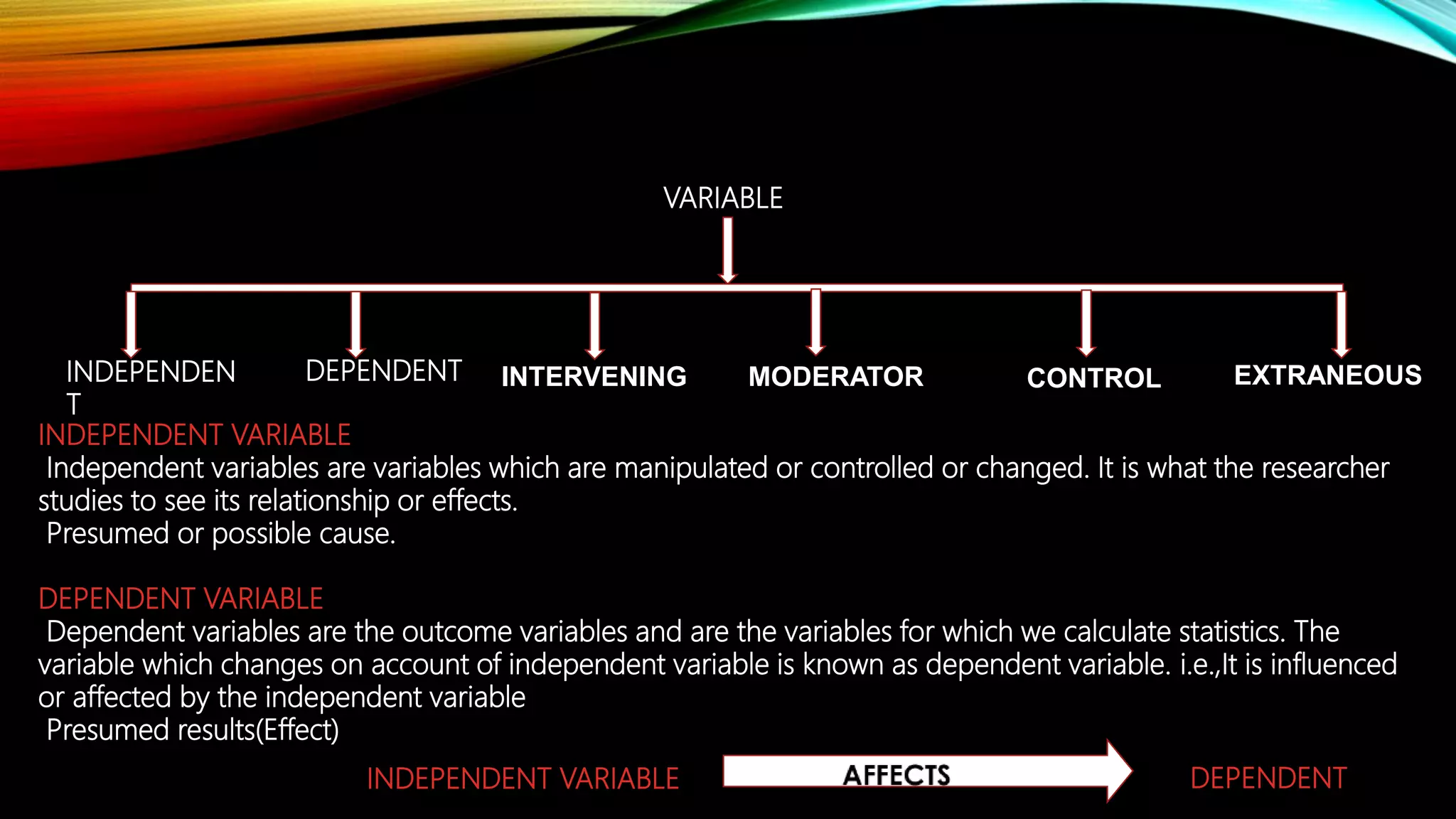
VARIABLE
DEPENDENTINDEPENDEN
T
INTERVENING MODERATOR CONTROL EXTRANEOUS
INDEPENDENT VARIABLE
Independent variables are variables which are manipulated or controlled or changed. It is what the researcher
studies to see its relationship or effects.
Presumed or possible cause.
DEPENDENT VARIABLE
Dependent variables are the outcome variables and are the variables for which we calculate statistics. The
variable which changes on account of independent variable is known as dependent variable. i.e.,It is influenced
or affected by the independent variable
Presumed results(Effect)
INDEPENDENT VARIABLE DEPENDENT
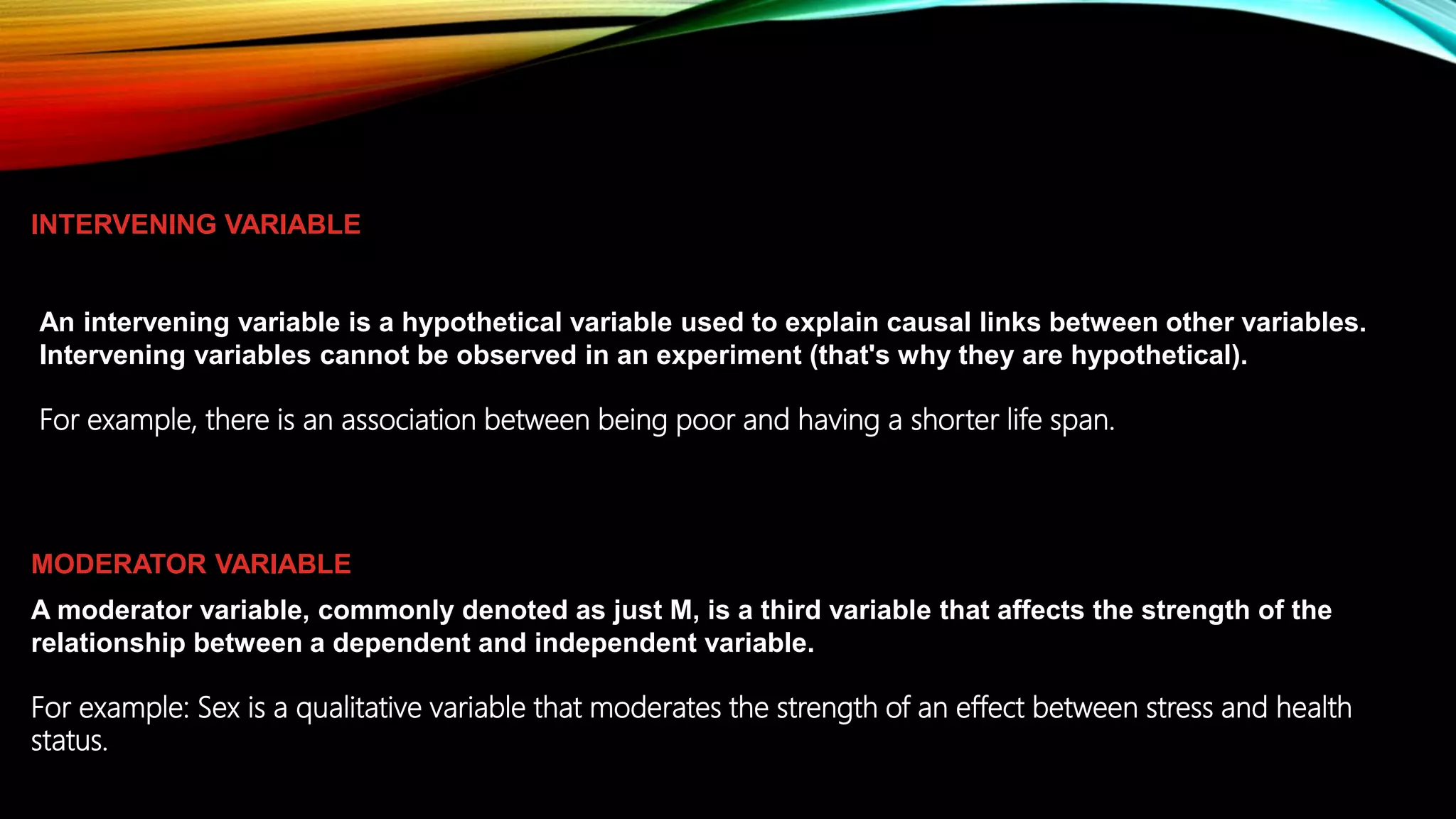
INTERVENING VARIABLE
An intervening variable is a hypothetical variable used to explain causal links between other variables.
Intervening variables cannot be observed in an experiment (that's why they are hypothetical).
For example, there is an association between being poor and having a shorter life span.
A moderator variable, commonly denoted as just M, is a third variable that affects the strength of the
relationship between a dependent and independent variable.
For example: Sex is a qualitative variable that moderates the strength of an effect between stress and health
status.
MODERATOR VARIABLE
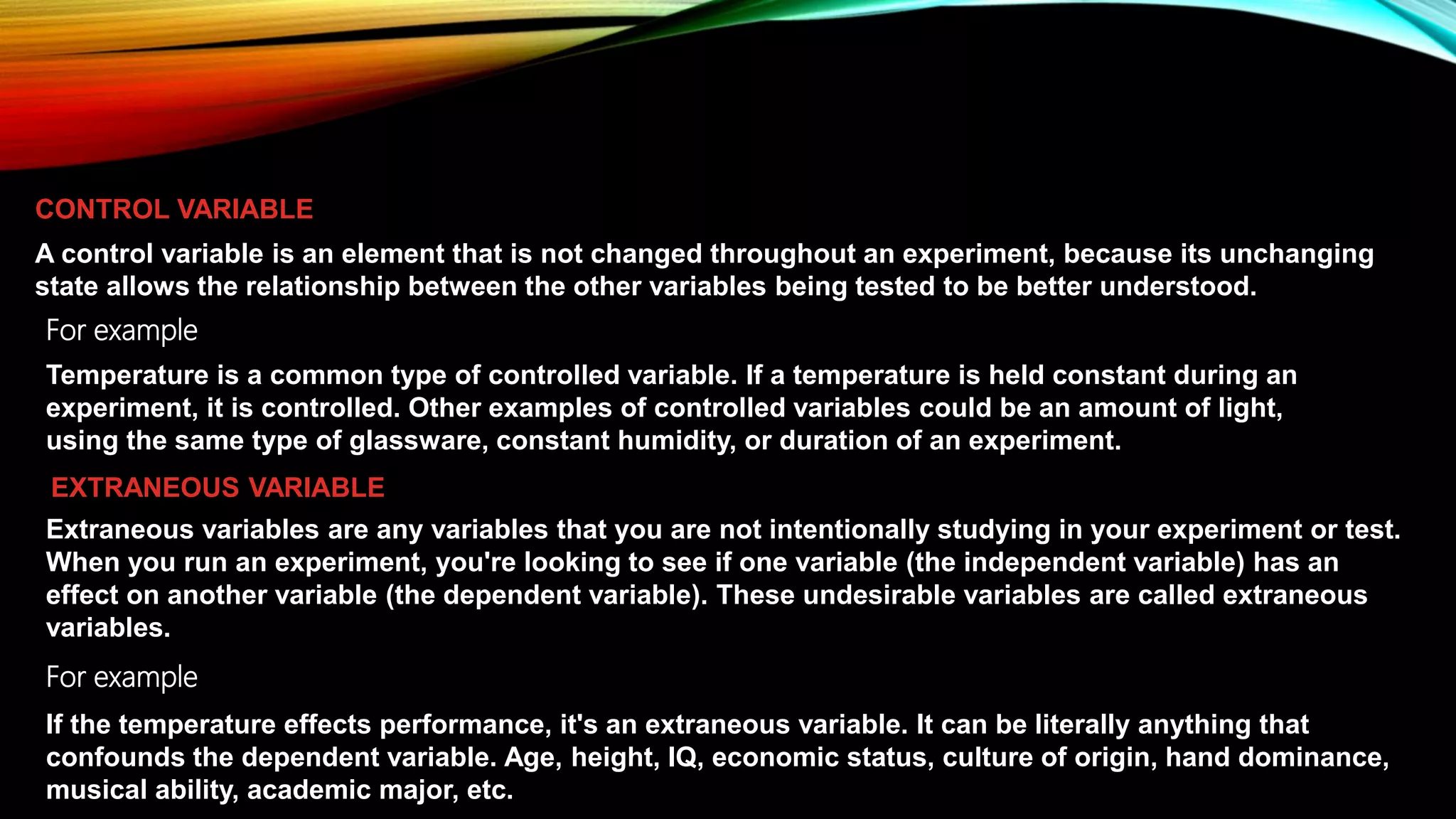
A control variable is an element that is not changed throughout an experiment, because its unchanging
state allows the relationship between the other variables being tested to be better understood.
CONTROL VARIABLE
Temperature is a common type of controlled variable. If a temperature is held constant during an
experiment, it is controlled. Other examples of controlled variables could be an amount of light,
using the same type of glassware, constant humidity, or duration of an experiment.
For example
Extraneous variables are any variables that you are not intentionally studying in your experiment or test.
When you run an experiment, you're looking to see if one variable (the independent variable) has an
effect on another variable (the dependent variable). These undesirable variables are called extraneous
variables.
If the temperature effects performance, it's an extraneous variable. It can be literally anything that
confounds the dependent variable. Age, height, IQ, economic status, culture of origin, hand dominance,
musical ability, academic major, etc.
For example
EXTRANEOUS VARIABLE
*Predictor variable is the name given to an independent variable

Data And Variable In Scientific Research

  • 1.
    ASWIN SARATH PHARM D JKKNCOLLEGE OF PHARMACY
  • 2.
    DATA : Data arecharacteristic or information , usually numerical, that are collected through observation. Data is a set of values of qualitative or quantitative variables about one or more persons, while a datum is a single value of single variable. VARIABLE : A variable is any characteristics, number, or quantity that can be measured or counted. A variable may also be called a data item. Age, sex, business income and expenses, country of birth, capital expenditure, class grades, eye colour and vehicle type are examples of variables. It is called a variable because the value may vary between data units in a population, and may change in value over time.
  • 3.
    QUANTITATIVE DATA Quantitative datais the type of data whose value is measured in the form of numbers or counts, with a unique numerical value associated with each data set. Also known as numerical data, quantitative data further describes numeric variables. Types of Quantitative Data Quantitative Data can be divided into two types, namely; • Numerical • Categorical  Numerical Data that is measurable, such as time, height, weight, amount, and so on. You can help yourself identify numerical data by seeing if you can average or order the data in either ascending or descending order. Types of Numerical Data: 1)Discrete 2)Continous
  • 4.
    Continuous Data • Continuousdata is a data type that takes on numeric values that can be meaningfully broken down into smaller units. As opposed to discrete data which can't be measured, continuous data can be placed on a measurement scale (e.g. weight, length, time, etc.). • For example, let us consider the Cumulative Grade Point (CGPA) of students in a class, measured on a 5 point scale. A student can score any grade between 0 points and 5 points, including figures like 1.573, 4.5, 2.6981, etc. We classify this an uncountably finite continuous data because it has an upper (5) and lower bound (0). • An example of an uncountably infinite data is the set of real numbers, R = {..., -1, 0, 1, ...}. In this case, the data has neither an upper nor a lower bound. • Continuous data can also be divided into two types, namely; Interval data Ratio data Discrete Data • Data that can only take certain values. • Discrete data can take on only integer values whereas continuous data can take on any value. For instance the number of cancer patients treated by a hospital each year is discrete but your weight is continuous. Some data are continuous but measured in a discrete way e.g. your age.
  • 5.
    Interval data isa type of data which is measured along a scale, in which each point is placed at an equal distance (interval) from one another. Interval data is one of the two types of discrete data. An example of interval data is the data collected on a thermometer- its markings are on equidistant. Characteristics of Interval Data • Quantitativeness • Measurement Scale • Negative Reading • Arithmetic Operation Examples of Interval Data Temperature When measuring temperature in Celsius or Fahrenheit, it is considered interval data because 0 is arbitrary. That is, 0°C and 0°F cannot be read on the thermometer. Time Time passes as a good example of interval data if measured during the day or using a 12-hour clock. The numbers on a wall clock are on an interval scale since they are equidistant and measurable. For example, the difference between 1 o’clock and 2 o’clock is the same as that between 2 o’clock and 3 o’clock. Interval data
  • 6.
    RATIO DATA: Ratio Datais defined as a quantitative data, having the same properties as interval data, with an equal and definitive ratio between each data and absolute “zero” being a treated as a point of origin. In other words, there can be no negative numerical value in ratio data. RATIO DATA HAS ALL PROPERTIES OF INTERVAL DATA SUCH AS • Data should have numeric values, a distance between the two points are equal etc. but, unlike interval data where zero is arbitrary, in ratio data, zero is absolute. • A very good example of ratio data is the measurement of heights. Height could be measured in centimeters, meters, inches or feet. It is not possible to have a negative height. When comparing to interval data for example temperature can be – 10- degree Celsius but height cannot be in negative as stated above. What is your weight in kgs? Less than 50 kgs 51-60 kgs 61-70 kgs 71-80 kgs 81-90 kgs Above 90 Kgs The difference between interval and ratio scales comes from their ability to dip below zero. Interval scales hold no true zero and can represent values below zero. For example, you can measure temperature below 0 degrees Celsius, such as -10 degrees. Ratio variables, on the other hand, never fall below zero.
  • 7.
    Categorical Data represent characteristicssuch as a person's gender, marital status, hometown, or the types of movies they like. Categorical data can take on numerical values (such as “1” indicating male and “2” indicating female), but those numbers don't have mathematical meaning. Types of Categorical Data: 1)Nominal 2)Ordinal • Nominal In statistics, nominal data (also known as nominal scale) is a type of data that is used to label variables without providing any quantitative value. It is the simplest form of a scale of measure. Unlike ordinal data nominal data cannot be ordered and cannot be measured. Characteristics of nominal data o Nominal data can never be quantified o Absence of order o Can’t calculate Mean
  • 8.
    Ordinal Ordinal data isa statistical type of quantitative data in which variables exist in naturally occurring ordered categories. The main difference between ordinal and nominal data is that ordinal has an order of categories while nominal doesn’t. There are multiple terms that represent order such as high, higher, highest or satisfied, dissatisfied, extremely dissatisfied etc. The difference between variables is non-uniform. Eg:  Which of the following categories best describe your purchasing experience with the product? • Very Pleasant • Somewhat pleasant • Neutral • Unpleasant • Very unpleasant
  • 9.
    Qualitative data isa type of data that describes information. It is investigative and also often open-ended, allowing respondents to fully express themselves.  Also known as categorical data, this data type isn’t necessarily measured using numbers but rather categorized based on properties, attributes, labels, and other identifiers. EXAMPLES OF QUALITATIVE DATA : Include sex (male or female), name, state of origin, citizenship, etc. A more practical example is a case whereby a teacher gives the whole class an essay that was assessed by giving comments on spelling, grammar, and punctuation rather than score. QUALITATIVE DATA
  • 11.
    VARIABLE DEPENDENTINDEPENDEN T INTERVENING MODERATOR CONTROLEXTRANEOUS INDEPENDENT VARIABLE Independent variables are variables which are manipulated or controlled or changed. It is what the researcher studies to see its relationship or effects. Presumed or possible cause. DEPENDENT VARIABLE Dependent variables are the outcome variables and are the variables for which we calculate statistics. The variable which changes on account of independent variable is known as dependent variable. i.e.,It is influenced or affected by the independent variable Presumed results(Effect) INDEPENDENT VARIABLE DEPENDENT
  • 12.
    INTERVENING VARIABLE An interveningvariable is a hypothetical variable used to explain causal links between other variables. Intervening variables cannot be observed in an experiment (that's why they are hypothetical). For example, there is an association between being poor and having a shorter life span. A moderator variable, commonly denoted as just M, is a third variable that affects the strength of the relationship between a dependent and independent variable. For example: Sex is a qualitative variable that moderates the strength of an effect between stress and health status. MODERATOR VARIABLE
  • 13.
    A control variableis an element that is not changed throughout an experiment, because its unchanging state allows the relationship between the other variables being tested to be better understood. CONTROL VARIABLE Temperature is a common type of controlled variable. If a temperature is held constant during an experiment, it is controlled. Other examples of controlled variables could be an amount of light, using the same type of glassware, constant humidity, or duration of an experiment. For example Extraneous variables are any variables that you are not intentionally studying in your experiment or test. When you run an experiment, you're looking to see if one variable (the independent variable) has an effect on another variable (the dependent variable). These undesirable variables are called extraneous variables. If the temperature effects performance, it's an extraneous variable. It can be literally anything that confounds the dependent variable. Age, height, IQ, economic status, culture of origin, hand dominance, musical ability, academic major, etc. For example EXTRANEOUS VARIABLE
  • 14.
    *Predictor variable isthe name given to an independent variable