What is Data
Data is a stream of raw facts representing things
or events that have happened.
In ICT, we usually say that data is made up from
four basic types:
• Numbers
• Text
• Images
• Sound
Storing Data
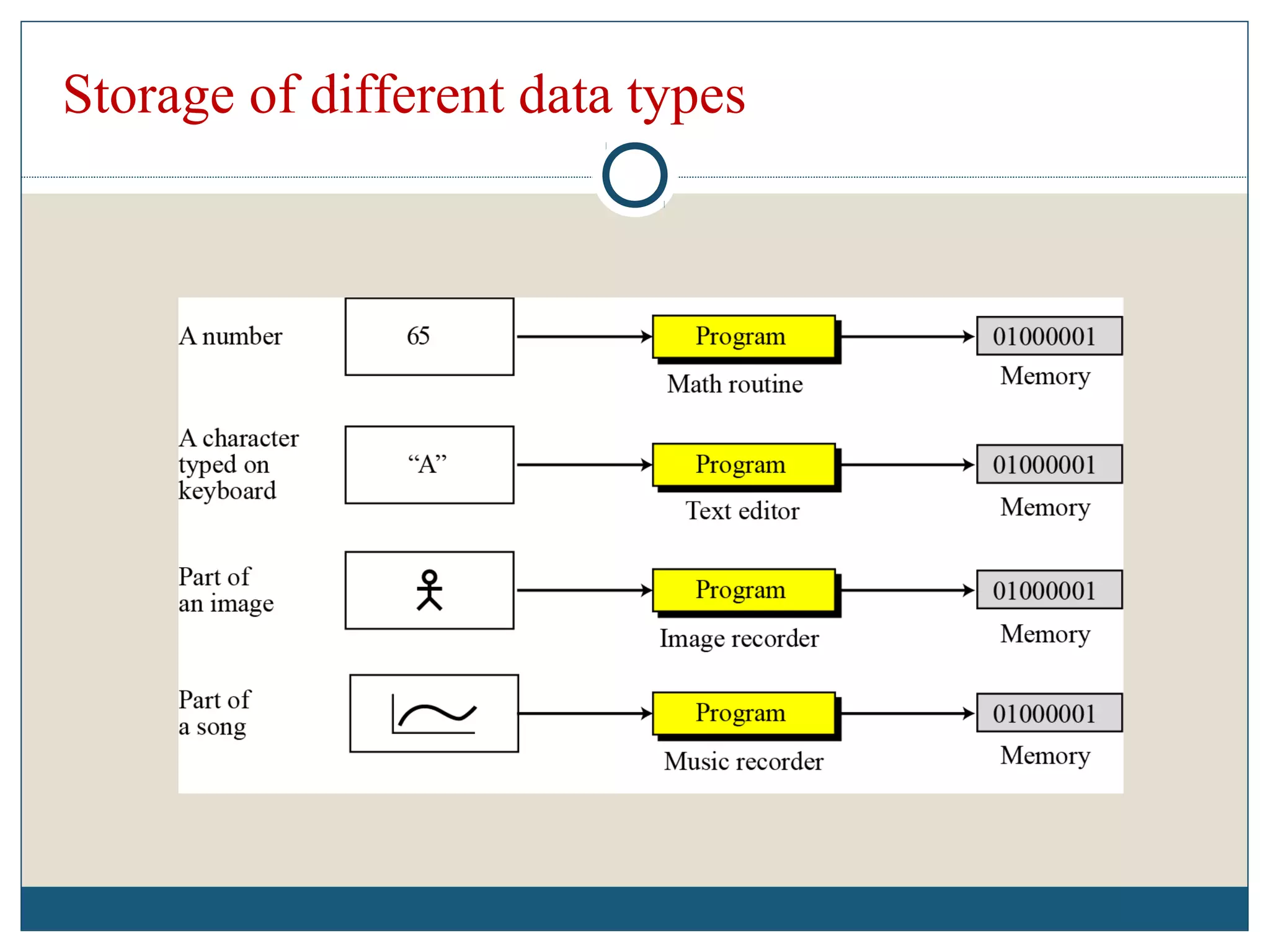
Inside the computer, however, all data is stored as
numbers:
• Numbers – are stored as numbers, obviously!
• Text characters are stored as a code that represents each –
e.g. ASCII
• Images are stored as numbers representing the amounts of
red, green and blue for each pixel
• Sounds are stored as numbers representing the loudness at
given intervals
How are the numbers represented
All data types are transformed into a uniform
representation when they are stored in a computer
and transformed back to their original form when
retrieved. This universal representation is called a
bit pattern.
Bits and Bytes
• Each of the 0s and 1s is called a bit – binary
digit
• Eight bits together form a byte
• The longest number a computer can handle in
one go is called a word – e.g. a 32-bit computer
has a 32-bit word length
• 1024 bytes is a kilobyte, 1024 kilobytes is a
megabyte, 1024 megabytes is a gigabyte, etc.
Storage of different data types
Storing Numbers
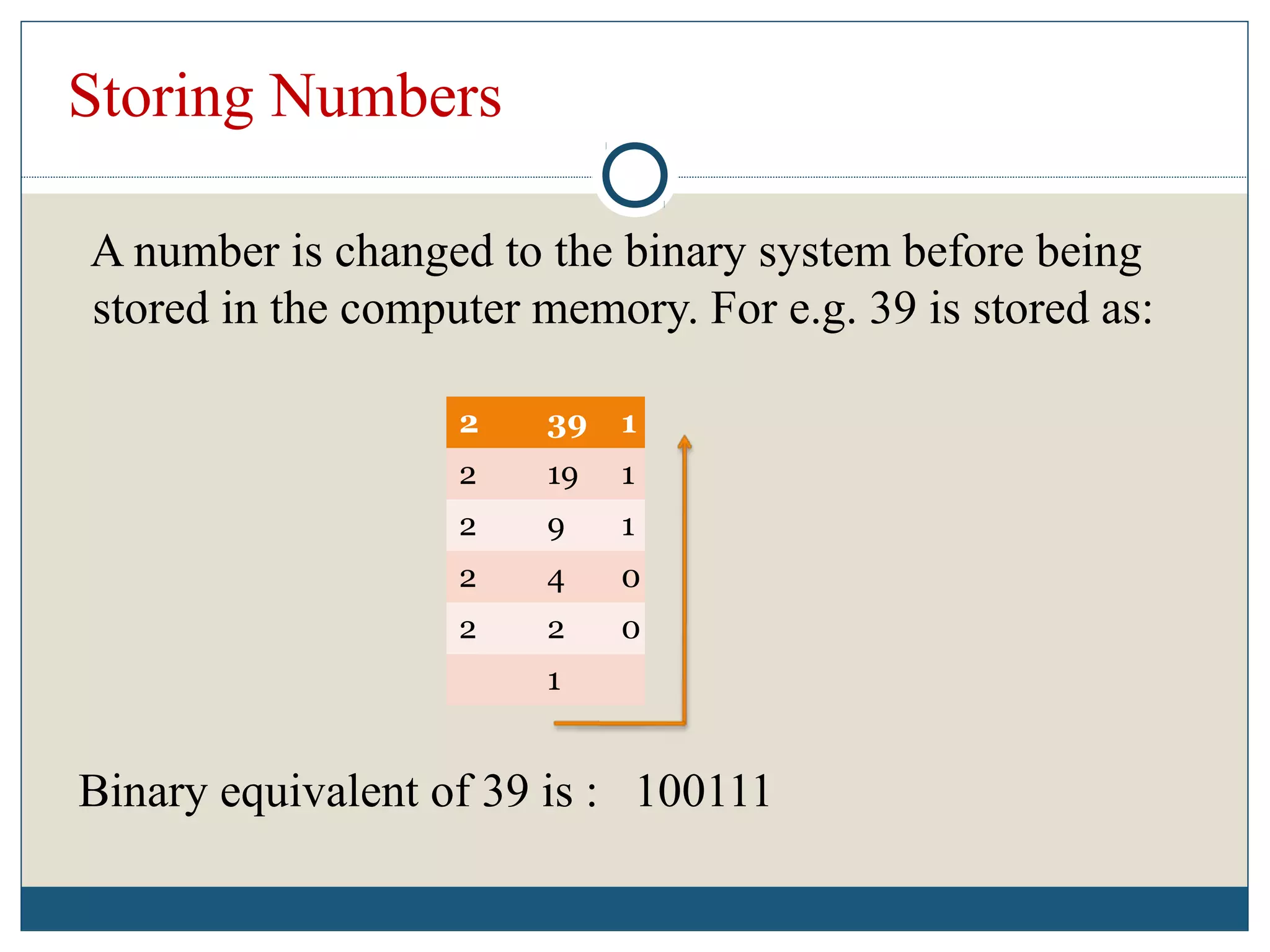
A number is changed to the binary system before being
stored in the computer memory. For e.g. 39 is stored as:
Binary equivalent of 39 is : 100111
2 39 1
2 19 1
2 9 1
2 4 0
2 2 0
1
Storing Text
A section of text in any language is a sequence of symbolsA section of text in any language is a sequence of symbols
used to represent an idea in that language.used to represent an idea in that language.
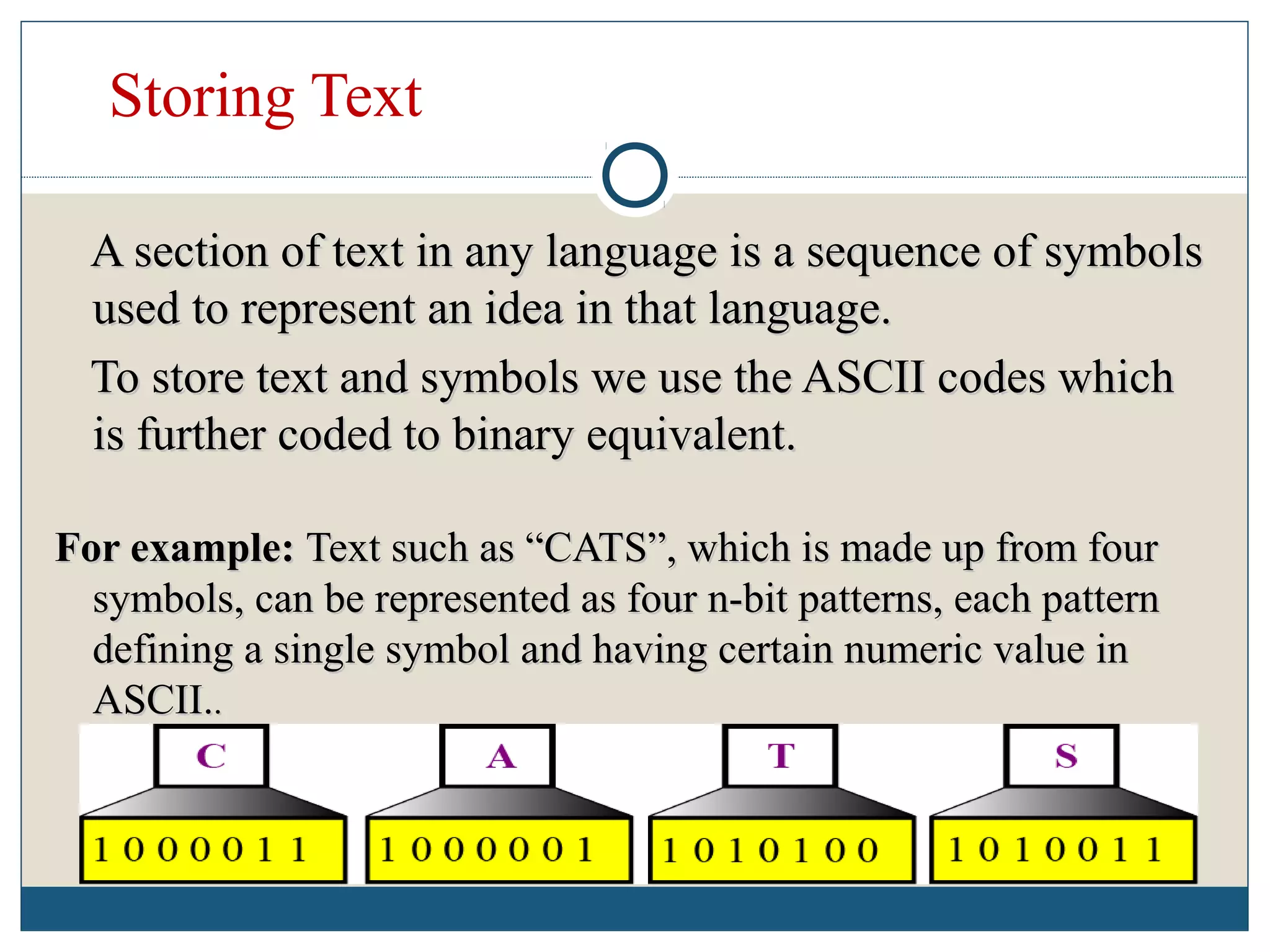
To store text and symbols we use the ASCII codes whichTo store text and symbols we use the ASCII codes which
is further coded to binary equivalent.is further coded to binary equivalent.
For example:For example: Text such as “CATS”, which is made up from fourText such as “CATS”, which is made up from four
symbols, can be represented as four n-bit patterns, each patternsymbols, can be represented as four n-bit patterns, each pattern
defining a single symbol and having certain numeric value indefining a single symbol and having certain numeric value in
ASCII.ASCII...
Storing Audio
Audio is not countable and Continuous data, Audio is anAudio is not countable and Continuous data, Audio is an
example ofexample of analog dataanalog data..
For audioFor audio we select only a finite number of points on the
analog signal, measure their values, and record them, this
records are known as sample.
The quantized sample values need to be encoded as bit
patterns, to store in computer memory.
Storing Images
Images are stored in computers using twoImages are stored in computers using two
different techniques:different techniques: Raster graphics andand Vector
graphics.
These graphics are stored in form ofThese graphics are stored in form of PixelPixel, Pixel, Pixel
is picture element.is picture element.
To store Pixel there be a certain bit pattern.To store Pixel there be a certain bit pattern.
Information
• Information is data that has been processed to make it
meaningful and useful
• Data + Meaning = Information
• For storing Information in digital organization we
require a tool called database.
Database
A centralized and structured set of data stored on a
computer system.
The database provides facilities for retrieving, adding,
modifying and deleting the data when required.
A database is usually managed by a Database
Administrator (DBA).
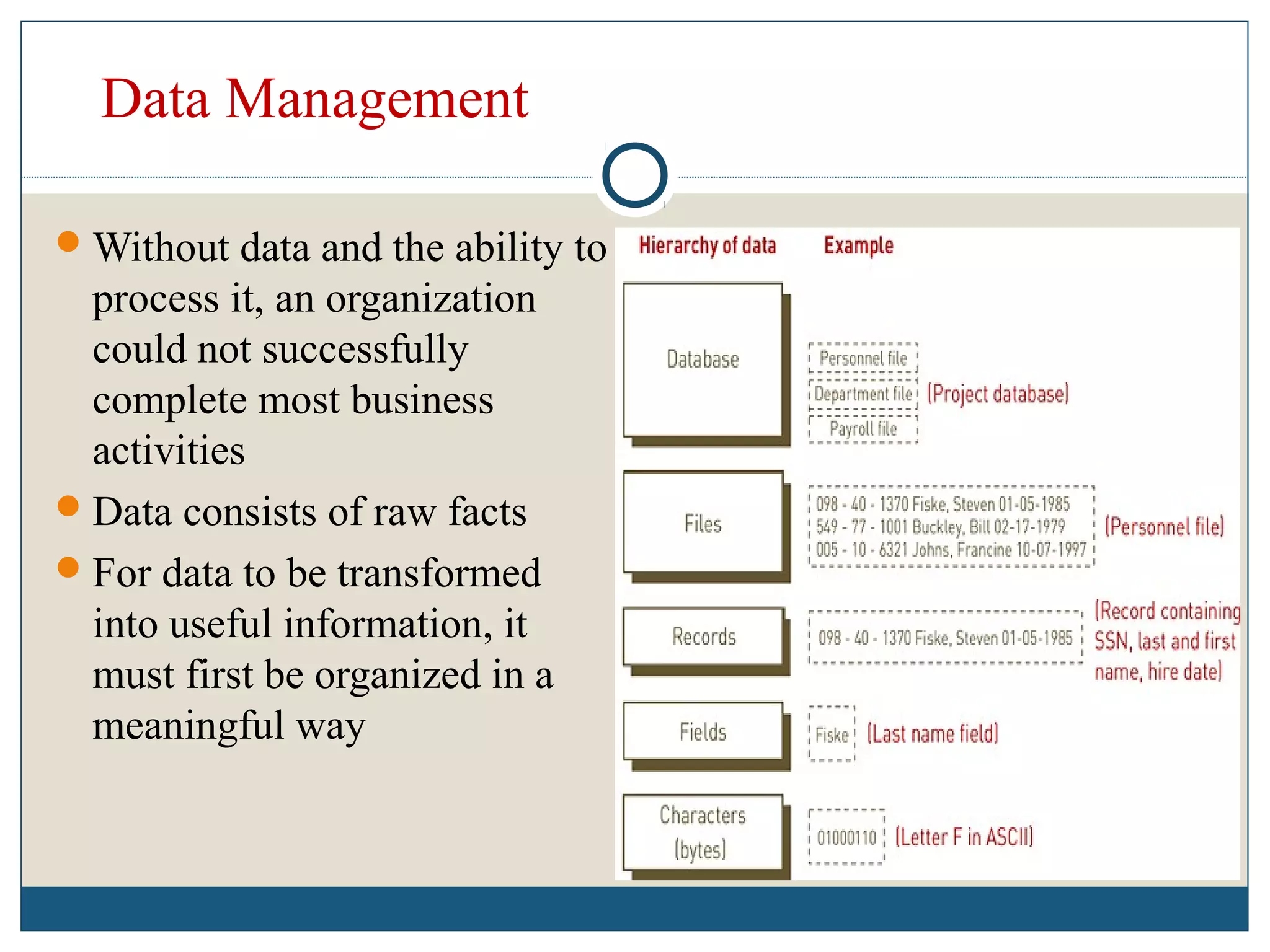
Traditional Database are organized by fields, records
and files.
Data Management
Without data and the ability to
process it, an organization
could not successfully
complete most business
activities
Data consists of raw facts
For data to be transformed
into useful information, it
must first be organized in a
meaningful way
Digital Information Systems
 Digital information system (DIS): single set of hardware, software,
databases, telecommunications, people, and procedures configured to collect,
manipulate, store, and process data into information
DIS components
– Hardware: computer equipment used to perform input, processing, and
output activities
– Software: computer programs that govern the operation of the computer
– Database: organized collection of facts and information
– Telecommunications: electronic transmission of signals for
communications
– Networks: connect computers and equipment in a building, around the
country, and around the world
Business Information Systems
Most common types of information systems used in
business organizations
E-commerce: any business transaction executed electronically
between parties
Transaction processing system (TPS): organized collection of
people, software, databases, and devices used to record
completed business transactions
Management Information Systems (MIS): provide routine
information to managers and decision makers
Decision support system (DSS) : used to support problem-
specific decision making
Thank You

Data and information in digital organisation

  • 2.
    What is Data Datais a stream of raw facts representing things or events that have happened. In ICT, we usually say that data is made up from four basic types: • Numbers • Text • Images • Sound
  • 3.
    Storing Data Inside thecomputer, however, all data is stored as numbers: • Numbers – are stored as numbers, obviously! • Text characters are stored as a code that represents each – e.g. ASCII • Images are stored as numbers representing the amounts of red, green and blue for each pixel • Sounds are stored as numbers representing the loudness at given intervals
  • 4.
    How are thenumbers represented All data types are transformed into a uniform representation when they are stored in a computer and transformed back to their original form when retrieved. This universal representation is called a bit pattern.
  • 5.
    Bits and Bytes •Each of the 0s and 1s is called a bit – binary digit • Eight bits together form a byte • The longest number a computer can handle in one go is called a word – e.g. a 32-bit computer has a 32-bit word length • 1024 bytes is a kilobyte, 1024 kilobytes is a megabyte, 1024 megabytes is a gigabyte, etc.
  • 6.
  • 7.
    Storing Numbers A numberis changed to the binary system before being stored in the computer memory. For e.g. 39 is stored as: Binary equivalent of 39 is : 100111 2 39 1 2 19 1 2 9 1 2 4 0 2 2 0 1
  • 8.
    Storing Text A sectionof text in any language is a sequence of symbolsA section of text in any language is a sequence of symbols used to represent an idea in that language.used to represent an idea in that language. To store text and symbols we use the ASCII codes whichTo store text and symbols we use the ASCII codes which is further coded to binary equivalent.is further coded to binary equivalent. For example:For example: Text such as “CATS”, which is made up from fourText such as “CATS”, which is made up from four symbols, can be represented as four n-bit patterns, each patternsymbols, can be represented as four n-bit patterns, each pattern defining a single symbol and having certain numeric value indefining a single symbol and having certain numeric value in ASCII.ASCII...
  • 9.
    Storing Audio Audio isnot countable and Continuous data, Audio is anAudio is not countable and Continuous data, Audio is an example ofexample of analog dataanalog data.. For audioFor audio we select only a finite number of points on the analog signal, measure their values, and record them, this records are known as sample. The quantized sample values need to be encoded as bit patterns, to store in computer memory.
  • 10.
    Storing Images Images arestored in computers using twoImages are stored in computers using two different techniques:different techniques: Raster graphics andand Vector graphics. These graphics are stored in form ofThese graphics are stored in form of PixelPixel, Pixel, Pixel is picture element.is picture element. To store Pixel there be a certain bit pattern.To store Pixel there be a certain bit pattern.
  • 11.
    Information • Information isdata that has been processed to make it meaningful and useful • Data + Meaning = Information • For storing Information in digital organization we require a tool called database.
  • 12.
    Database A centralized andstructured set of data stored on a computer system. The database provides facilities for retrieving, adding, modifying and deleting the data when required. A database is usually managed by a Database Administrator (DBA). Traditional Database are organized by fields, records and files.
  • 13.
    Data Management Without dataand the ability to process it, an organization could not successfully complete most business activities Data consists of raw facts For data to be transformed into useful information, it must first be organized in a meaningful way
  • 14.
    Digital Information Systems Digital information system (DIS): single set of hardware, software, databases, telecommunications, people, and procedures configured to collect, manipulate, store, and process data into information DIS components – Hardware: computer equipment used to perform input, processing, and output activities – Software: computer programs that govern the operation of the computer – Database: organized collection of facts and information – Telecommunications: electronic transmission of signals for communications – Networks: connect computers and equipment in a building, around the country, and around the world
  • 15.
    Business Information Systems Mostcommon types of information systems used in business organizations E-commerce: any business transaction executed electronically between parties Transaction processing system (TPS): organized collection of people, software, databases, and devices used to record completed business transactions Management Information Systems (MIS): provide routine information to managers and decision makers Decision support system (DSS) : used to support problem- specific decision making
  • 16.