DATA ANALYSIS
WHAT IS DATA ANALYSIS?
a process to sort out the
information from the
data collected in a
research or a study.
It converts data into information and
knowledge, and
It explores the relationship between
variables (a variable refers to some
specific characteristic of a subject
that assumes one or more different
values. Amount of insurance sold is an
example of a variable—some subjects
sold a lot of insurance and others
sold less)
WHY ANALYSING DATA IS
IMPORTANT?
HOW TO MANAGE THE DATA?
You need to code the
data – as soon as the
data is collected- the
date of the
questionnaires, who
completed them, the
number of returns.
Categorise the data into categories
– e.g. Gender and origin
For more open—ended
questionnaire, read through
carefully and put the data into
events, or groups.
PIE CHART
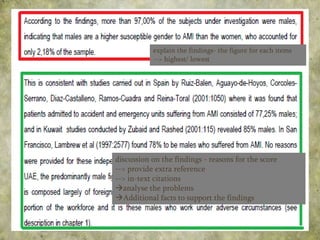
explain the findings- the figure for each items
--> highest/ lowest
discussion on the findings - reasons for the score
--> provide extra reference
--> in-text citations
analyse the problems
Additional facts to support the findings
BAR GRAPH
TABLE
PREPARING THE DATA ANALYSIS
1. Use texts and visuals properly- write not
draw
Reporting data Interpreting data
Only 26% reported
knowing how to
perform
emergency
procedures like
mouth-to-mouth
resuscitation.
This finding shows how
unprepared
Singaporeans are in
emergencies and
illustrates that perhaps
efforts to provide
emergency training for
Singaporeans need to
be stepped up.
2. REPORT AND INTERPRET
3. USE HEADINGS AND SUBHEADINGS
LANGUAGE
OF
REPORTING
Taken from
Reporting
Research
Findings by
Peggy Chan
Inappropriate Appropriate
From the survey, 40% of the
respondents feel… (It is not
from the survey that the
respondents feel or think a
certain way.)
The survey shows that 40%
of the respondents feel...
From the study, not many
people...
The study tells us that not
many people...From the
study, we can see that not
many people… From
interviews with students,
Inappropriate Appropriate
From interviews with students,
they do not benefit from...
From interviews with students,
it can be see that/it was found
that they do not benefit from...
Through my dealings with
employees, they are concerned
mostly with... (The subject
following through my dealings
with employees should be I not
they.)
Through my dealings with
employees, I find that they are
concerned mostly with...
My dealings with employees
show that
they are concerned mostly
with...
Dissertation Findings & Discussion
Chapter: Sample. (2003). Retrieved
2013, March 22 from
http://www.newessays.co.uk/wp-
content/uploads/2011/12/10Findings
chapter.sample.pdf
Chan, P. (2013). Reporting research
findings. Retrieved 2013, March 22
from http://www.nus.edu.sg/
Green, S. (2003). Research and
evaluation division. Retrieved 2013,
March 22 from
http://www.cambridgeassessment.o
rg.uk/ca/digitalAssets/113786_Comp
arability_Study_of_Pupils_Writing_fro
m_Different_Key_Sta.pdf
REFERENCES

data analysis ii.ppt

  • 1.
  • 2.
    WHAT IS DATAANALYSIS? a process to sort out the information from the data collected in a research or a study.
  • 3.
    It converts datainto information and knowledge, and It explores the relationship between variables (a variable refers to some specific characteristic of a subject that assumes one or more different values. Amount of insurance sold is an example of a variable—some subjects sold a lot of insurance and others sold less) WHY ANALYSING DATA IS IMPORTANT?
  • 4.
    HOW TO MANAGETHE DATA? You need to code the data – as soon as the data is collected- the date of the questionnaires, who completed them, the number of returns.
  • 5.
    Categorise the datainto categories – e.g. Gender and origin For more open—ended questionnaire, read through carefully and put the data into events, or groups.
  • 6.
  • 7.
    explain the findings-the figure for each items --> highest/ lowest discussion on the findings - reasons for the score --> provide extra reference --> in-text citations analyse the problems Additional facts to support the findings
  • 8.
  • 9.
  • 10.
  • 11.
    1. Use textsand visuals properly- write not draw
  • 12.
    Reporting data Interpretingdata Only 26% reported knowing how to perform emergency procedures like mouth-to-mouth resuscitation. This finding shows how unprepared Singaporeans are in emergencies and illustrates that perhaps efforts to provide emergency training for Singaporeans need to be stepped up. 2. REPORT AND INTERPRET
  • 13.
    3. USE HEADINGSAND SUBHEADINGS
  • 14.
  • 15.
    Inappropriate Appropriate From thesurvey, 40% of the respondents feel… (It is not from the survey that the respondents feel or think a certain way.) The survey shows that 40% of the respondents feel... From the study, not many people... The study tells us that not many people...From the study, we can see that not many people… From interviews with students,
  • 16.
    Inappropriate Appropriate From interviewswith students, they do not benefit from... From interviews with students, it can be see that/it was found that they do not benefit from... Through my dealings with employees, they are concerned mostly with... (The subject following through my dealings with employees should be I not they.) Through my dealings with employees, I find that they are concerned mostly with... My dealings with employees show that they are concerned mostly with...
  • 18.
    Dissertation Findings &Discussion Chapter: Sample. (2003). Retrieved 2013, March 22 from http://www.newessays.co.uk/wp- content/uploads/2011/12/10Findings chapter.sample.pdf Chan, P. (2013). Reporting research findings. Retrieved 2013, March 22 from http://www.nus.edu.sg/ Green, S. (2003). Research and evaluation division. Retrieved 2013, March 22 from http://www.cambridgeassessment.o rg.uk/ca/digitalAssets/113786_Comp arability_Study_of_Pupils_Writing_fro m_Different_Key_Sta.pdf REFERENCES