Damped Vibrations
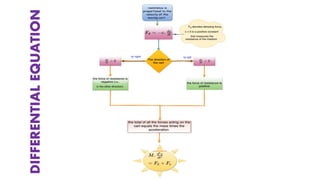
Observations from Undamped Model:
the physical model in the
last section was not
realistic.
Typically, a cart that is
attached to a spring and
released, will enter a harmonic
motion that dies out over time.
i.e.,resistance and friction will
cause the system to be
damped.
Let us add that
information to the
system.
DIFFERENTIALEQUATION
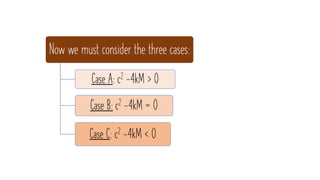
Now we must consider the three cases:
Case A: c2 -4kM > 0
Case B: c2 -4kM = 0
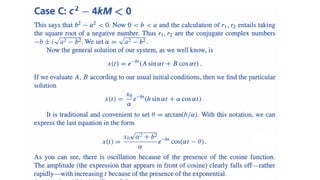
Case C: c2 -4kM < 0
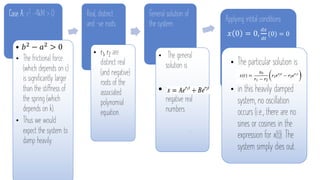
Case A: c2 -4kM > 0
• 𝑏! − 𝑎! > 0
• The frictional force
(which depends on c)
is significantly larger
than the stiffness of
the spring (which
depends on k).
• Thus we would
expect the system to
damp heavily.
Real, distinct
and –ve roots
• r1, r2 are
distinct real
(and negative)
roots of the
associated
polynomial
equation.
General solution of
the system:
• The general
solution is
• 𝑟!, 𝑟" are
negative real
numbers
.
Applying intital conditions
𝑥 0 = 0,
!"
!#
(0) = 0
• The particular solution is
• in this heavily damped
system, no oscillation
occurs (i.e., there are no
sines or cosines in the
expression for x(t)). The
system simply dies out.
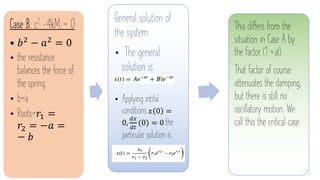
Case B: c2 -4kM = 0
• 𝑏!
− 𝑎!
= 0
• the resistance
balances the force of
the spring.
• b=a
• Roots= 𝑟" =
𝑟! = −𝑎 =
− 𝑏
General solution of
the system:
• The general
solution is
• Applying intital
conditions 𝑥 0 =
0,
"#
"$
(0) = 0 the
particular solution is
•
This differs from the
situation in Case A by
the factor (1 +at).
That factor of course
attenuates the damping,
but there is still no
oscillatory motion. We
call this the critical case.
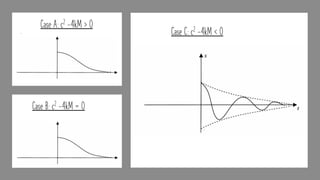
Case A: c2 -4kM > 0
Case B: c2 -4kM = 0
Case C: c2 -4kM < 0

Damped vibrations

  • 1.
  • 2.
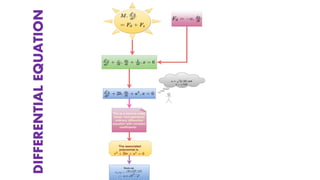
    Observations from UndampedModel: the physical model in the last section was not realistic. Typically, a cart that is attached to a spring and released, will enter a harmonic motion that dies out over time. i.e.,resistance and friction will cause the system to be damped. Let us add that information to the system.
  • 3.
  • 4.
  • 5.
    Now we mustconsider the three cases: Case A: c2 -4kM > 0 Case B: c2 -4kM = 0 Case C: c2 -4kM < 0
  • 6.
    Case A: c2-4kM > 0 • 𝑏! − 𝑎! > 0 • The frictional force (which depends on c) is significantly larger than the stiffness of the spring (which depends on k). • Thus we would expect the system to damp heavily. Real, distinct and –ve roots • r1, r2 are distinct real (and negative) roots of the associated polynomial equation. General solution of the system: • The general solution is • 𝑟!, 𝑟" are negative real numbers . Applying intital conditions 𝑥 0 = 0, !" !# (0) = 0 • The particular solution is • in this heavily damped system, no oscillation occurs (i.e., there are no sines or cosines in the expression for x(t)). The system simply dies out.
  • 7.
    Case B: c2-4kM = 0 • 𝑏! − 𝑎! = 0 • the resistance balances the force of the spring. • b=a • Roots= 𝑟" = 𝑟! = −𝑎 = − 𝑏 General solution of the system: • The general solution is • Applying intital conditions 𝑥 0 = 0, "# "$ (0) = 0 the particular solution is • This differs from the situation in Case A by the factor (1 +at). That factor of course attenuates the damping, but there is still no oscillatory motion. We call this the critical case.
  • 9.
    Case A: c2-4kM > 0 Case B: c2 -4kM = 0 Case C: c2 -4kM < 0