DAILY STANDUPS
Purbarun Chakrabarti
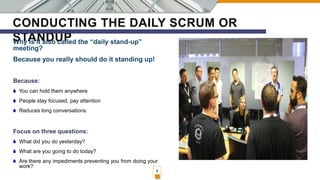
CONDUCTING THE DAILY SCRUM OR
STANDUPWhy is it also called the “daily stand-up”
meeting?
Because you really should do it standing up!
Because:
You can hold them anywhere
People stay focused, pay attention
Reduces long conversations
Focus on three questions:
What did you do yesterday?
What are you going to do today?
Are there any impediments preventing you from doing your
work?
1
GROUND RULES FOR THE DAILY SCRUM
Everyone has to participate in person
≈ Except workers who are not physically located with the rest of the team or who are offsite and call in
and call in
≈ Offshore may be an exception, but they still should have their own daily stand up that is coordinated
coordinated with onshore
No discussion of problems or solutions
≈ Set up a follow up meeting
Start and end on time – always!
Stay focused on the questions
Everyone must stand for the meeting
No laptops, iPads, blackberries or any other distraction during the meeting.
If something really cant wait 15 minutes, take care of it outside the meeting!
2
PATTERNS FOR THE DAILY SCRUM
Who else attends besides the Team
≈ All Hands from the Team
≈ People and representatives from various other areas may join as ‘Chickens’(listening only) unless they
unless they have been asked to join
≈ Therefore, place some or all meetings and reports with daily stand up
Work Items attend too!
≈ Instead of thinking of it as a ritual for People, think of it as a ritual for the Work(e.g., User Stories, PBIs,
Stories, PBIs, etc)
What do we talk about?
≈ Only the three questions, but it is recommended to reverse the common order to emphasize the
the importance:
~ Are there any impediments preventing you from doing your work?
~ What are you going to do today?
~ What did you do yesterday?
What order do we talk in?
≈ Last arrivals speaks first OR
≈ Round Robin
3
PATTERNS FOR THE DAILY SCRUM (CONT.)
Walk the Board or Wall?
≈ Each person should speak to a User story or Product Backlog Items (PBI) that is made visible via
physical or digital Kanban boards.
≈ Even when discussing the specific task accomplished, should also relate the Work being discussed
back to the PBI (User Story) and sometimes the Feature too.
≈ Therefore, replace some or all meetings and reports with daily stand up.
Meet wherever the work is happening
≈ Do the meeting in the actual place or in a discussion room but not in a conference room
Same Place, Same Time
≈ Consistency is paramount
Time the Meetings
≈ 15 minutes maximum
Rotate the Facilitator
4
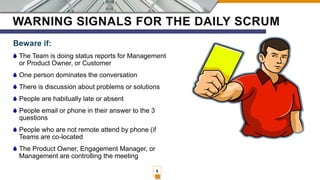
WARNING SIGNALS FOR THE DAILY SCRUM
Beware if:
The Team is doing status reports for Management
or Product Owner, or Customer
One person dominates the conversation
There is discussion about problems or solutions
People are habitually late or absent
People email or phone in their answer to the 3
questions
People who are not remote attend by phone (if
Teams are co-located
The Product Owner, Engagement Manager, or
Management are controlling the meeting
5
REASONS FOR HAVING THE STAND-UP
EVERYDAYThe Scope of a Sprint is agreed to and committed to at the beginning of each Sprint
≈ Contract between Product Owner, Engagement Manager and product team
≈ Neither can alter it without consent of the other
≈ Product Owner can’t walk in one day and say “I changed my mind”
≈ Product Team can’t decide they want to work on something else
All changes must be negotiated
≈ Product Owner agrees to let team swap stories for good reason
≈ Team agrees to swap stories at Product Owner request due to sudden change in priorities
≈ Team needs more work to do as they underestimated the current work
≈ Both parties must agree
≈ Should be rare but could happen
6
REASONS FOR HAVING THE STAND-UP
EVERYDAY (CONT.)
What if something drastic happens?
≈ Major shift in priorities
≈ Technical impediment that cannot be overcome
≈ Significant loss of time or resources make it impossible to deliver
≈ With Product Owner concurrence you may cancel the Sprint, re-plan and start a new Sprint
≈ Very rare!
7
QUESTIONS ??

Daily standups

  • 1.
  • 2.
    CONDUCTING THE DAILYSCRUM OR STANDUPWhy is it also called the “daily stand-up” meeting? Because you really should do it standing up! Because: You can hold them anywhere People stay focused, pay attention Reduces long conversations Focus on three questions: What did you do yesterday? What are you going to do today? Are there any impediments preventing you from doing your work? 1
  • 3.
    GROUND RULES FORTHE DAILY SCRUM Everyone has to participate in person ≈ Except workers who are not physically located with the rest of the team or who are offsite and call in and call in ≈ Offshore may be an exception, but they still should have their own daily stand up that is coordinated coordinated with onshore No discussion of problems or solutions ≈ Set up a follow up meeting Start and end on time – always! Stay focused on the questions Everyone must stand for the meeting No laptops, iPads, blackberries or any other distraction during the meeting. If something really cant wait 15 minutes, take care of it outside the meeting! 2
  • 4.
    PATTERNS FOR THEDAILY SCRUM Who else attends besides the Team ≈ All Hands from the Team ≈ People and representatives from various other areas may join as ‘Chickens’(listening only) unless they unless they have been asked to join ≈ Therefore, place some or all meetings and reports with daily stand up Work Items attend too! ≈ Instead of thinking of it as a ritual for People, think of it as a ritual for the Work(e.g., User Stories, PBIs, Stories, PBIs, etc) What do we talk about? ≈ Only the three questions, but it is recommended to reverse the common order to emphasize the the importance: ~ Are there any impediments preventing you from doing your work? ~ What are you going to do today? ~ What did you do yesterday? What order do we talk in? ≈ Last arrivals speaks first OR ≈ Round Robin 3
  • 5.
    PATTERNS FOR THEDAILY SCRUM (CONT.) Walk the Board or Wall? ≈ Each person should speak to a User story or Product Backlog Items (PBI) that is made visible via physical or digital Kanban boards. ≈ Even when discussing the specific task accomplished, should also relate the Work being discussed back to the PBI (User Story) and sometimes the Feature too. ≈ Therefore, replace some or all meetings and reports with daily stand up. Meet wherever the work is happening ≈ Do the meeting in the actual place or in a discussion room but not in a conference room Same Place, Same Time ≈ Consistency is paramount Time the Meetings ≈ 15 minutes maximum Rotate the Facilitator 4
  • 6.
    WARNING SIGNALS FORTHE DAILY SCRUM Beware if: The Team is doing status reports for Management or Product Owner, or Customer One person dominates the conversation There is discussion about problems or solutions People are habitually late or absent People email or phone in their answer to the 3 questions People who are not remote attend by phone (if Teams are co-located The Product Owner, Engagement Manager, or Management are controlling the meeting 5
  • 7.
    REASONS FOR HAVINGTHE STAND-UP EVERYDAYThe Scope of a Sprint is agreed to and committed to at the beginning of each Sprint ≈ Contract between Product Owner, Engagement Manager and product team ≈ Neither can alter it without consent of the other ≈ Product Owner can’t walk in one day and say “I changed my mind” ≈ Product Team can’t decide they want to work on something else All changes must be negotiated ≈ Product Owner agrees to let team swap stories for good reason ≈ Team agrees to swap stories at Product Owner request due to sudden change in priorities ≈ Team needs more work to do as they underestimated the current work ≈ Both parties must agree ≈ Should be rare but could happen 6
  • 8.
    REASONS FOR HAVINGTHE STAND-UP EVERYDAY (CONT.) What if something drastic happens? ≈ Major shift in priorities ≈ Technical impediment that cannot be overcome ≈ Significant loss of time or resources make it impossible to deliver ≈ With Product Owner concurrence you may cancel the Sprint, re-plan and start a new Sprint ≈ Very rare! 7
  • 9.