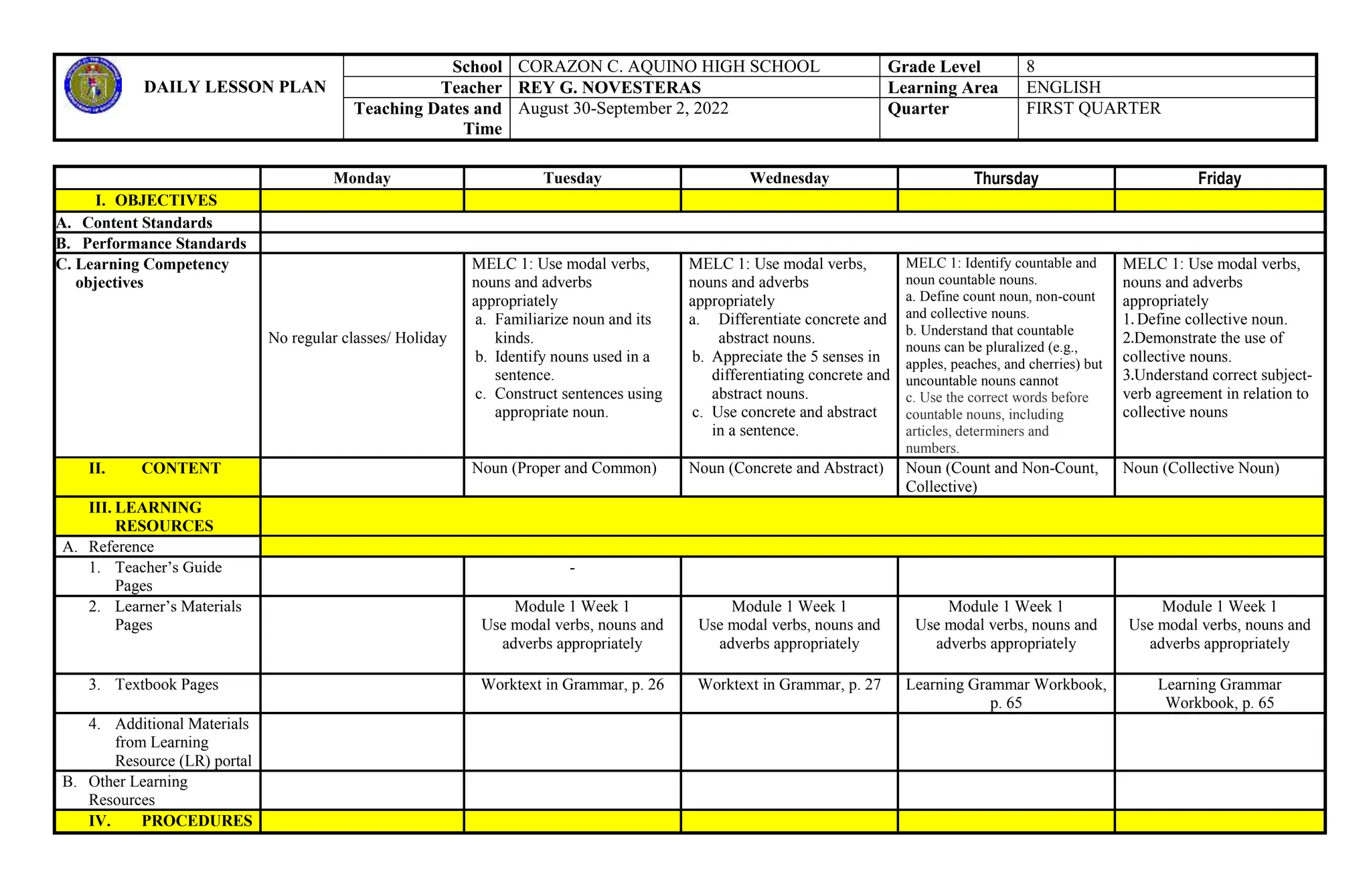
DAILY LESSON PLAN
School CORAZON C. AQUINO HIGH SCHOOL Grade Level 8
Teacher REY G. NOVESTERAS Learning Area ENGLISH
Teaching Dates and
Time
August 30-September 2, 2022 Quarter FIRST QUARTER
Monday Tuesday Wednesday Thursday Friday
I. OBJECTIVES
A. Content Standards
B. Performance Standards
C. Learning Competency
objectives
No regular classes/ Holiday
MELC 1: Use modal verbs,
nouns and adverbs
appropriately
a. Familiarize noun and its
kinds.
b. Identify nouns used in a
sentence.
c. Construct sentences using
appropriate noun.
MELC 1: Use modal verbs,
nouns and adverbs
appropriately
a. Differentiate concrete and
abstract nouns.
b. Appreciate the 5 senses in
differentiating concrete and
abstract nouns.
c. Use concrete and abstract
in a sentence.
MELC 1: Identify countable and
noun countable nouns.
a. Define count noun, non-count
and collective nouns.
b. Understand that countable
nouns can be pluralized (e.g.,
apples, peaches, and cherries) but
uncountable nouns cannot
c. Use the correct words before
countable nouns, including
articles, determiners and
numbers.
MELC 1: Use modal verbs,
nouns and adverbs
appropriately
1. Define collective noun.
2.Demonstrate the use of
collective nouns.
3.Understand correct subject-
verb agreement in relation to
collective nouns
II. CONTENT Noun (Proper and Common) Noun (Concrete and Abstract) Noun (Count and Non-Count,
Collective)
Noun (Collective Noun)
III. LEARNING
RESOURCES
A. Reference
1. Teacher’s Guide
Pages
-
2. Learner’s Materials
Pages
Module 1 Week 1
Use modal verbs, nouns and
adverbs appropriately
Module 1 Week 1
Use modal verbs, nouns and
adverbs appropriately
Module 1 Week 1
Use modal verbs, nouns and
adverbs appropriately
Module 1 Week 1
Use modal verbs, nouns and
adverbs appropriately
3. Textbook Pages Worktext in Grammar, p. 26 Worktext in Grammar, p. 27 Learning Grammar Workbook,
p. 65
Learning Grammar
Workbook, p. 65
4. Additional Materials
from Learning
Resource (LR) portal
B. Other Learning
Resources
IV. PROCEDURES
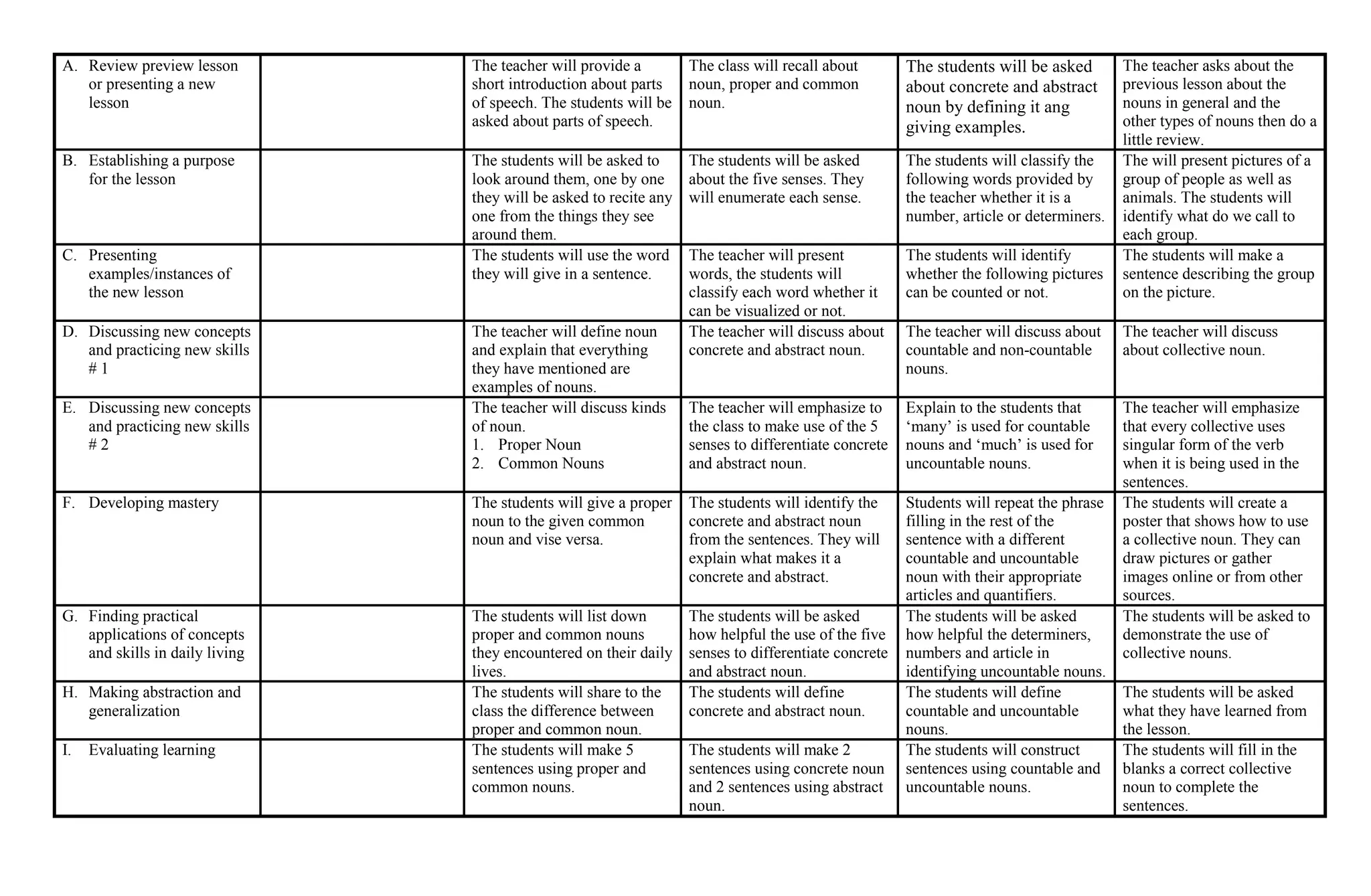
A. Review preview lesson
or presenting a new
lesson
The teacher will provide a
short introduction about parts
of speech. The students will be
asked about parts of speech.
The class will recall about
noun, proper and common
noun.
The students will be asked
about concrete and abstract
noun by defining it ang
giving examples.
The teacher asks about the
previous lesson about the
nouns in general and the
other types of nouns then do a
little review.
B. Establishing a purpose
for the lesson
The students will be asked to
look around them, one by one
they will be asked to recite any
one from the things they see
around them.
The students will be asked
about the five senses. They
will enumerate each sense.
The students will classify the
following words provided by
the teacher whether it is a
number, article or determiners.
The will present pictures of a
group of people as well as
animals. The students will
identify what do we call to
each group.
C. Presenting
examples/instances of
the new lesson
The students will use the word
they will give in a sentence.
The teacher will present
words, the students will
classify each word whether it
can be visualized or not.
The students will identify
whether the following pictures
can be counted or not.
The students will make a
sentence describing the group
on the picture.
D. Discussing new concepts
and practicing new skills
# 1
The teacher will define noun
and explain that everything
they have mentioned are
examples of nouns.
The teacher will discuss about
concrete and abstract noun.
The teacher will discuss about
countable and non-countable
nouns.
The teacher will discuss
about collective noun.
E. Discussing new concepts
and practicing new skills
# 2
The teacher will discuss kinds
of noun.
1. Proper Noun
2. Common Nouns
The teacher will emphasize to
the class to make use of the 5
senses to differentiate concrete
and abstract noun.
Explain to the students that
‘many’ is used for countable
nouns and ‘much’ is used for
uncountable nouns.
The teacher will emphasize
that every collective uses
singular form of the verb
when it is being used in the
sentences.
F. Developing mastery The students will give a proper
noun to the given common
noun and vise versa.
The students will identify the
concrete and abstract noun
from the sentences. They will
explain what makes it a
concrete and abstract.
Students will repeat the phrase
filling in the rest of the
sentence with a different
countable and uncountable
noun with their appropriate
articles and quantifiers.
The students will create a
poster that shows how to use
a collective noun. They can
draw pictures or gather
images online or from other
sources.
G. Finding practical
applications of concepts
and skills in daily living
The students will list down
proper and common nouns
they encountered on their daily
lives.
The students will be asked
how helpful the use of the five
senses to differentiate concrete
and abstract noun.
The students will be asked
how helpful the determiners,
numbers and article in
identifying uncountable nouns.
The students will be asked to
demonstrate the use of
collective nouns.
H. Making abstraction and
generalization
The students will share to the
class the difference between
proper and common noun.
The students will define
concrete and abstract noun.
The students will define
countable and uncountable
nouns.
The students will be asked
what they have learned from
the lesson.
I. Evaluating learning The students will make 5
sentences using proper and
common nouns.
The students will make 2
sentences using concrete noun
and 2 sentences using abstract
noun.
The students will construct
sentences using countable and
uncountable nouns.
The students will fill in the
blanks a correct collective
noun to complete the
sentences.
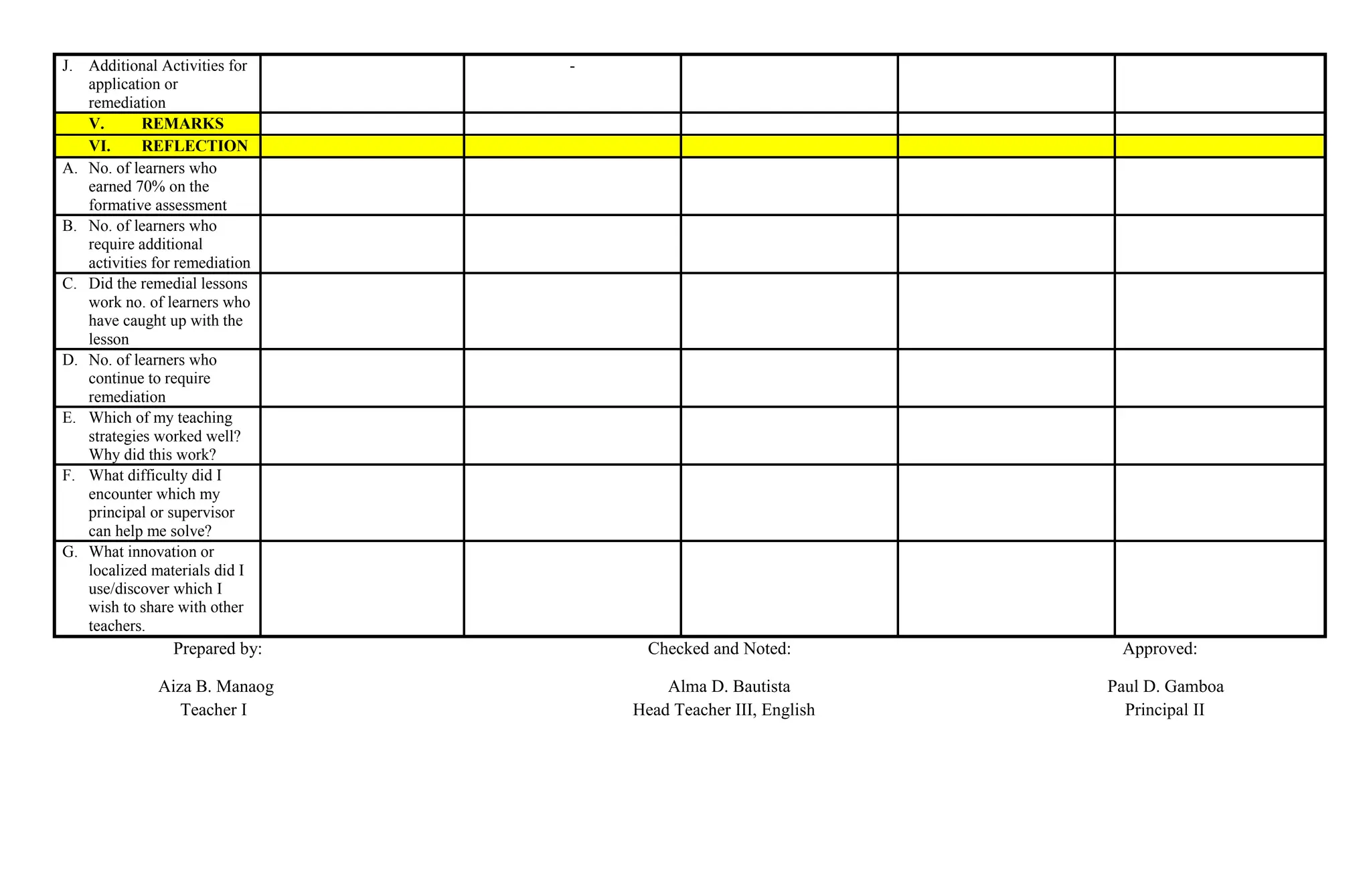
J. Additional Activities for
application or
remediation
-
V. REMARKS
VI. REFLECTION
A. No. of learners who
earned 70% on the
formative assessment
B. No. of learners who
require additional
activities for remediation
C. Did the remedial lessons
work no. of learners who
have caught up with the
lesson
D. No. of learners who
continue to require
remediation
E. Which of my teaching
strategies worked well?
Why did this work?
F. What difficulty did I
encounter which my
principal or supervisor
can help me solve?
G. What innovation or
localized materials did I
use/discover which I
wish to share with other
teachers.
Prepared by: Checked and Noted: Approved:
Aiza B. Manaog Alma D. Bautista Paul D. Gamboa
Teacher I Head Teacher III, English Principal II

Daily Lesson Log Daily Lesson Log Daily Lesson

  • 1.
    DAILY LESSON PLAN SchoolCORAZON C. AQUINO HIGH SCHOOL Grade Level 8 Teacher REY G. NOVESTERAS Learning Area ENGLISH Teaching Dates and Time August 30-September 2, 2022 Quarter FIRST QUARTER Monday Tuesday Wednesday Thursday Friday I. OBJECTIVES A. Content Standards B. Performance Standards C. Learning Competency objectives No regular classes/ Holiday MELC 1: Use modal verbs, nouns and adverbs appropriately a. Familiarize noun and its kinds. b. Identify nouns used in a sentence. c. Construct sentences using appropriate noun. MELC 1: Use modal verbs, nouns and adverbs appropriately a. Differentiate concrete and abstract nouns. b. Appreciate the 5 senses in differentiating concrete and abstract nouns. c. Use concrete and abstract in a sentence. MELC 1: Identify countable and noun countable nouns. a. Define count noun, non-count and collective nouns. b. Understand that countable nouns can be pluralized (e.g., apples, peaches, and cherries) but uncountable nouns cannot c. Use the correct words before countable nouns, including articles, determiners and numbers. MELC 1: Use modal verbs, nouns and adverbs appropriately 1. Define collective noun. 2.Demonstrate the use of collective nouns. 3.Understand correct subject- verb agreement in relation to collective nouns II. CONTENT Noun (Proper and Common) Noun (Concrete and Abstract) Noun (Count and Non-Count, Collective) Noun (Collective Noun) III. LEARNING RESOURCES A. Reference 1. Teacher’s Guide Pages - 2. Learner’s Materials Pages Module 1 Week 1 Use modal verbs, nouns and adverbs appropriately Module 1 Week 1 Use modal verbs, nouns and adverbs appropriately Module 1 Week 1 Use modal verbs, nouns and adverbs appropriately Module 1 Week 1 Use modal verbs, nouns and adverbs appropriately 3. Textbook Pages Worktext in Grammar, p. 26 Worktext in Grammar, p. 27 Learning Grammar Workbook, p. 65 Learning Grammar Workbook, p. 65 4. Additional Materials from Learning Resource (LR) portal B. Other Learning Resources IV. PROCEDURES
  • 2.
    A. Review previewlesson or presenting a new lesson The teacher will provide a short introduction about parts of speech. The students will be asked about parts of speech. The class will recall about noun, proper and common noun. The students will be asked about concrete and abstract noun by defining it ang giving examples. The teacher asks about the previous lesson about the nouns in general and the other types of nouns then do a little review. B. Establishing a purpose for the lesson The students will be asked to look around them, one by one they will be asked to recite any one from the things they see around them. The students will be asked about the five senses. They will enumerate each sense. The students will classify the following words provided by the teacher whether it is a number, article or determiners. The will present pictures of a group of people as well as animals. The students will identify what do we call to each group. C. Presenting examples/instances of the new lesson The students will use the word they will give in a sentence. The teacher will present words, the students will classify each word whether it can be visualized or not. The students will identify whether the following pictures can be counted or not. The students will make a sentence describing the group on the picture. D. Discussing new concepts and practicing new skills # 1 The teacher will define noun and explain that everything they have mentioned are examples of nouns. The teacher will discuss about concrete and abstract noun. The teacher will discuss about countable and non-countable nouns. The teacher will discuss about collective noun. E. Discussing new concepts and practicing new skills # 2 The teacher will discuss kinds of noun. 1. Proper Noun 2. Common Nouns The teacher will emphasize to the class to make use of the 5 senses to differentiate concrete and abstract noun. Explain to the students that ‘many’ is used for countable nouns and ‘much’ is used for uncountable nouns. The teacher will emphasize that every collective uses singular form of the verb when it is being used in the sentences. F. Developing mastery The students will give a proper noun to the given common noun and vise versa. The students will identify the concrete and abstract noun from the sentences. They will explain what makes it a concrete and abstract. Students will repeat the phrase filling in the rest of the sentence with a different countable and uncountable noun with their appropriate articles and quantifiers. The students will create a poster that shows how to use a collective noun. They can draw pictures or gather images online or from other sources. G. Finding practical applications of concepts and skills in daily living The students will list down proper and common nouns they encountered on their daily lives. The students will be asked how helpful the use of the five senses to differentiate concrete and abstract noun. The students will be asked how helpful the determiners, numbers and article in identifying uncountable nouns. The students will be asked to demonstrate the use of collective nouns. H. Making abstraction and generalization The students will share to the class the difference between proper and common noun. The students will define concrete and abstract noun. The students will define countable and uncountable nouns. The students will be asked what they have learned from the lesson. I. Evaluating learning The students will make 5 sentences using proper and common nouns. The students will make 2 sentences using concrete noun and 2 sentences using abstract noun. The students will construct sentences using countable and uncountable nouns. The students will fill in the blanks a correct collective noun to complete the sentences.
  • 3.
    J. Additional Activitiesfor application or remediation - V. REMARKS VI. REFLECTION A. No. of learners who earned 70% on the formative assessment B. No. of learners who require additional activities for remediation C. Did the remedial lessons work no. of learners who have caught up with the lesson D. No. of learners who continue to require remediation E. Which of my teaching strategies worked well? Why did this work? F. What difficulty did I encounter which my principal or supervisor can help me solve? G. What innovation or localized materials did I use/discover which I wish to share with other teachers. Prepared by: Checked and Noted: Approved: Aiza B. Manaog Alma D. Bautista Paul D. Gamboa Teacher I Head Teacher III, English Principal II