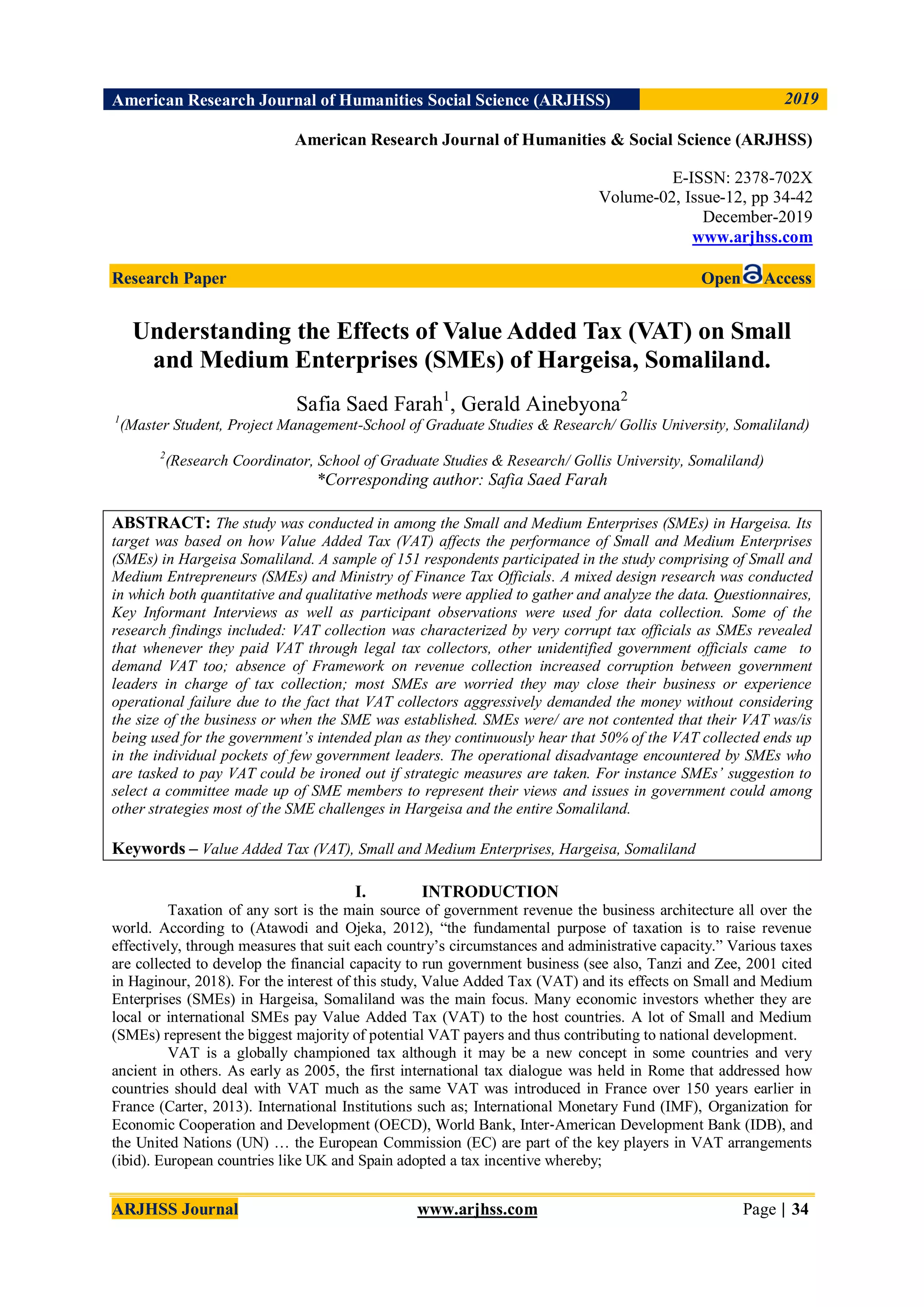
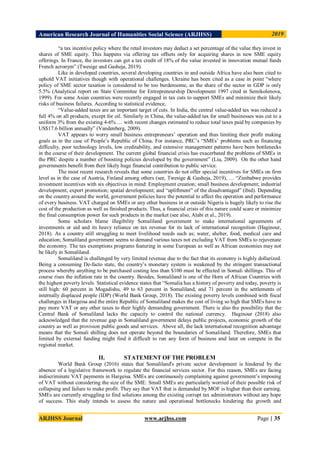
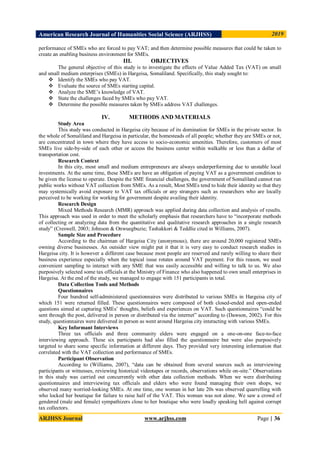
American Research Journal of Humanities Social Science (ARJHSS)R) 2019
ARJHSS Journal www.arjhss.com Page | 34
American Research Journal of Humanities & Social Science (ARJHSS)
E-ISSN: 2378-702X
Volume-02, Issue-12, pp 34-42
December-2019
www.arjhss.com
Research Paper Open Access
Understanding the Effects of Value Added Tax (VAT) on Small
and Medium Enterprises (SMEs) of Hargeisa, Somaliland.
Safia Saed Farah1
, Gerald Ainebyona2
1
(Master Student, Project Management-School of Graduate Studies & Research/ Gollis University, Somaliland)
2
(Research Coordinator, School of Graduate Studies & Research/ Gollis University, Somaliland)
*Corresponding author: Safia Saed Farah
ABSTRACT: The study was conducted in among the Small and Medium Enterprises (SMEs) in Hargeisa. Its
target was based on how Value Added Tax (VAT) affects the performance of Small and Medium Enterprises
(SMEs) in Hargeisa Somaliland. A sample of 151 respondents participated in the study comprising of Small and
Medium Entrepreneurs (SMEs) and Ministry of Finance Tax Officials. A mixed design research was conducted
in which both quantitative and qualitative methods were applied to gather and analyze the data. Questionnaires,
Key Informant Interviews as well as participant observations were used for data collection. Some of the
research findings included: VAT collection was characterized by very corrupt tax officials as SMEs revealed
that whenever they paid VAT through legal tax collectors, other unidentified government officials came to
demand VAT too; absence of Framework on revenue collection increased corruption between government
leaders in charge of tax collection; most SMEs are worried they may close their business or experience
operational failure due to the fact that VAT collectors aggressively demanded the money without considering
the size of the business or when the SME was established. SMEs were/ are not contented that their VAT was/is
being used for the government’s intended plan as they continuously hear that 50% of the VAT collected ends up
in the individual pockets of few government leaders. The operational disadvantage encountered by SMEs who
are tasked to pay VAT could be ironed out if strategic measures are taken. For instance SMEs’ suggestion to
select a committee made up of SME members to represent their views and issues in government could among
other strategies most of the SME challenges in Hargeisa and the entire Somaliland.
Keywords – Value Added Tax (VAT), Small and Medium Enterprises, Hargeisa, Somaliland
I. INTRODUCTION
Taxation of any sort is the main source of government revenue the business architecture all over the
world. According to (Atawodi and Ojeka, 2012), “the fundamental purpose of taxation is to raise revenue
effectively, through measures that suit each country’s circumstances and administrative capacity.” Various taxes
are collected to develop the financial capacity to run government business (see also, Tanzi and Zee, 2001 cited
in Haginour, 2018). For the interest of this study, Value Added Tax (VAT) and its effects on Small and Medium
Enterprises (SMEs) in Hargeisa, Somaliland was the main focus. Many economic investors whether they are
local or international SMEs pay Value Added Tax (VAT) to the host countries. A lot of Small and Medium
(SMEs) represent the biggest majority of potential VAT payers and thus contributing to national development.
VAT is a globally championed tax although it may be a new concept in some countries and very
ancient in others. As early as 2005, the first international tax dialogue was held in Rome that addressed how
countries should deal with VAT much as the same VAT was introduced in France over 150 years earlier in
France (Carter, 2013). International Institutions such as; International Monetary Fund (IMF), Organization for
Economic Cooperation and Development (OECD), World Bank, Inter‐American Development Bank (IDB), and
the United Nations (UN) … the European Commission (EC) are part of the key players in VAT arrangements
(ibid). European countries like UK and Spain adopted a tax incentive whereby;
American Research Journal of Humanities Social Science (ARJHSS)R) 2019
ARJHSS Journal www.arjhss.com Page | 35
“a tax incentive policy where the retail investors may deduct a set percentage of the value they invest in
shares of SME equity. This happens via offering tax offsets only for acquiring shares in new SME equity
offerings. In France, the investors can get a tax credit of 18% of the value invested in innovation mutual funds
French acronym” (Twesige and Gasheja, 2019).
Like in developed countries, several developing countries in and outside Africa have also been cited to
uphold VAT initiatives though with operational challenges. Ukraine has been cited as a case in point “where
policy of SME sector taxation is considered to be too burdensome, as the share of the sector in GDP is only
5.5% (Analytical report on State Committee for Entrepreneurship Development 1997 cited in Semikolenova,
1999). For some Asian countries were recently engaged in tax cuts to support SMEs and minimize their likely
risks of business failures. According to statistical evidence,
“Value-added taxes are an important target of cuts. In India, the central value-added tax was reduced a
full 4% on all products, except for oil. Similarly in China, the value-added tax for small businesses was cut to a
uniform 3% from the existing 4-6% … with recent changes estimated to reduce total taxes paid by companies by
US$17.6 billion annually” (Vandenberg, 2009).
VAT appears to worry small business entrepreneurs’ operation and thus limiting their profit making
goals as in the case of People’s Republic of China. For instance, PRC’s “SMEs’ problems such as financing
difficulty, poor technology levels, low creditability, and extensive management patterns have been bottlenecks
in the course of their development. The current global financial crisis has exacerbated the problems of SMEs in
the PRC despite a number of boosting policies developed by the government” (Liu, 2009). On the other hand
governments benefit from their likely huge financial contribution to public service.
The most recent research reveals that some countries do not offer special incentives for SMEs on firm
level as in the case of Austria, Finland among others (see, Twesige & Gasheja, 2019), … “Zimbabwe provides
investment incentives with six objectives in mind: Employment creation; small business development; industrial
development; export promotion; spatial development; and “upliftment” of the disadvantaged” (ibid). Depending
on the country around the world, government policies have the potential to affect the operation and performance
of every business. VAT charged on SMEs or any other business in or outside Nigeria is hugely likely to rise the
cost of the production as well as finished products. Thus, a financial crisis of this nature could scare or minimize
the final consumption power for such products in the market (see also, Alabi et al., 2019).
Some scholars blame illegibility Somaliland government to make international agreements of
investments or aid and its heavy reliance on tax revenue for its lack of international recognition (Haginour,
2018). As a country still struggling to meet livelihood needs such as; water, shelter, food, medical care and
education; Somaliland government seems to demand various taxes not excluding VAT from SMEs to rejuvenate
the economy. The tax exemptions programs featuring in some European as well as African economies may not
be likely in Somaliland.
Somaliland is challenged by very limited revenue due to the fact that its economy is highly dollarized.
Being a consuming De-facto state, the country’s monetary system is weakened by the stringent transactional
process whereby anything to be purchased costing less than $100 must be effected in Somali shillings. This of
course rises the inflation rate in the country. Besides, Somaliland is one of the Horn of African Countries with
the highest poverty levels. Statistical evidence states that “Somalia has a history of poverty and today, poverty is
still high: 60 percent in Mogadishu, 49 to 63 percent in Somaliland, and 71 percent in the settlements of
internally displaced people (IDP) (World Bank Group, 2018). The existing poverty levels combined with fiscal
challenges in Hargeisa and the entire Republic of Somaliland makes the cost of living so high that SMEs have to
pay more VAT or any other taxes to their highly demanding government. There is also the possibility that the
Central Bank of Somaliland lacks the capacity to control the national currency. Haginour (2018) also
acknowledged that the revenue gap in Somaliland government delays public projects, economic growth of the
country as well as provision public goods and services. Above all, the lack international recognition advantage
means that the Somali shilling does not operate beyond the boundaries of Somaliland. Therefore, SMEs that
limited by external funding might find it difficult to run any form of business and later on compete in the
regional market.
II. STATEMENT OF THE PROBLEM
World Bank Group (2016) states that Somaliland's private sector development is hindered by the
absence of a legislative framework to regulate the financial services sector. For this reason, SMEs are facing
indiscriminate VAT payments in Hargeisa. SMEs are continuously complaining against government’s imposing
of VAT without considering the size of the SME. Small SMEs are particularly worried of their possible risk of
collapsing and failure to make profit. They say that VAT that is demanded by MOF is higher than their earning.
SMEs are currently struggling to find solutions among the existing corrupt tax administrators without any hope
of success. This study intends to assess the nature and operational bottlenecks hindering the growth and
American Research Journal of Humanities Social Science (ARJHSS)R) 2019
ARJHSS Journal www.arjhss.com Page | 36
performance of SMEs who are forced to pay VAT; and then determine possible measures that could be taken to
create an enabling business environment for SMEs.
III. OBJECTIVES
The general objective of this study is to investigate the effects of Value Added Tax (VAT) on small
and small medium enterprises (SMEs) in Hargeisa, Somaliland. Specifically, this study sought to:
 Identify the SMEs who pay VAT.
 Evaluate the source of SMEs starting capital.
 Analyze the SME’s knowledge of VAT.
 State the challenges faced by SMEs who pay VAT.
 Determine the possible measures taken by SMEs address VAT challenges.
IV. METHODS AND MATERIALS
Study Area
This study was conducted in Hargeisa city because of its domination for SMEs in the private sector. In
the whole of Somaliland and Hargeisa in particular, the homesteads of all people; whether they are SMEs or not,
are concentrated in town where they have access to socio-economic amenities. Therefore, customers of most
SMEs live side-by-side of each other or access the business center within walkable or less than a dollar of
transportation cost.
Research Context
In this city, most small and medium entrepreneurs are always underperforming due to unstable local
investments. At the same time, these SMEs are have an obligation of paying VAT as a government condition to
be given the license to operate. Despite the SME financial challenges, the government of Somaliland cannot run
public works without VAT collection from SMEs. As a result, Most SMEs tend to hide their identity so that they
may systemically avoid exposure to VAT tax officials or any strangers such as researchers who are locally
perceived to be working for working for government despite availing their identity.
Research Design
Mixed Methods Research (MMR) approach was applied during data collection and analysis of results.
This approach was used in order to meet the scholarly emphasis that researchers have to “incorporate methods
of collecting or analyzing data from the quantitative and qualitative research approaches in a single research
study” (Creswell, 2003; Johnson & Onwuegbuzie; Tashakkori & Teddlie cited in Williams, 2007).
Sample Size and Procedure
According to the chairman of Hargeisa City (anonymous), there are around 20,000 registered SMEs
owning diverse businesses. An outsider view might put it that it is very easy to conduct research studies in
Hargeisa city. It is however a different case because most people are reserved and rarely willing to share their
business experience especially when the topical issue rotates around VAT payment. For this reason, we used
convenient sampling to interact with any SME that was easily accessible and willing to talk to us. We also
purposively selected some tax officials at the Ministry of Finance who also happened to own small enterprises in
Hargeisa. At the end of the study, we managed to engage with 151 participants in total.
Data Collection Tools and Methods
Questionnaires
Four hundred self-administered questionnaires were distributed to various SMEs in Hargeisa city of
which 151 were returned filled. These questionnaires were composed of both closed-ended and open-ended
questions aimed at capturing SMEs’ thoughts, beliefs and experiences on VAT. Such questionnaires “could be
sent through the post, delivered in person or distributed via the internet” according to (Dawson, 2002). For this
study, questionnaires were delivered in person as went around Hargeisa city interacting with various SMEs.
Key Informant Interviews
Three tax officials and three community elders were engaged on a one-on-one face-to-face
interviewing approach. These six participants had also filled the questionnaire but were also purposively
targeted to share some specific information at different days. They provided very interesting information that
correlated with the VAT collection and performance of SMEs.
Participant Observation
According to (Williams, 2007), “data can be obtained from several sources such as interviewing
participants or witnesses, reviewing historical videotapes or records, observations while on-site.” Observations
in this study was carried out concurrently with other data collection methods. When we were distributing
questionnaires and interviewing tax officials and elders who were found managing their own shops, we
observed many worried-looking SMEs. At one time, one woman in her late 20s was observed quarrelling with
who locked her boutique for failure to raise half of the VAT. This woman was not alone. We saw a crowd of
gendered (male and female) sympathizers close to her boutique who were loudly speaking hell against corrupt
tax collectors.
American Research Journal of Humanities Social Science (ARJHSS)R) 2019
ARJHSS Journal www.arjhss.com Page | 37
V. DISCUSSION OF RESULTS
4.1 Demographic Information
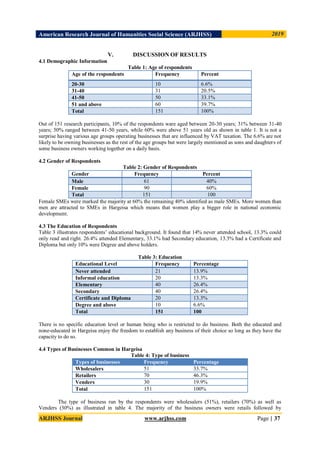
Table 1: Age of respondents
Age of the respondents Frequency Percent
20-30 10 6.6%
31-40 31 20.5%
41-50 50 33.1%
51 and above 60 39.7%
Total 151 100%
Out of 151 research participants, 10% of the respondents ware aged between 20-30 years; 31% between 31-40
years; 50% ranged between 41-50 years, while 60% were above 51 years old as shown in table 1. It is not a
surprise having various age groups operating businesses that are influenced by VAT taxation. The 6.6% are not
likely to be owning businesses as the rest of the age groups but were largely mentioned as sons and daughters of
some business owners working together on a daily basis.
4.2 Gender of Respondents
Table 2: Gender of Respondents
Gender Frequency Percent
Male 61 40%
Female 90 60%
Total 151 100
Female SMEs were marked the majority at 60% the remaining 40% identified as male SMEs. More women than
men are attracted to SMEs in Hargeisa which means that women play a bigger role in national economic
development.
4.3 The Education of Respondents
Table 3 illustrates respondents’ educational background. It found that 14% never attended school, 13.3% could
only read and right. 26.4% attended Elementary, 33.1% had Secondary education, 13.3% had a Certificate and
Diploma but only 10% were Degree and above holders.
Table 3: Education
Educational Level Frequency Percentage
Never attended 21 13.9%
Informal education 20 13.3%
Elementary 40 26.4%
Secondary 40 26.4%
Certificate and Diploma 20 13.3%
Degree and above 10 6.6%
Total 151 100
There is no specific education level or human being who is restricted to do business. Both the educated and
none-educated in Hargeisa enjoy the freedom to establish any business of their choice so long as they have the
capacity to do so.
4.4 Types of Businesses Common in Hargeisa
Table 4: Type of business
Types of businesses Frequency Percentage
Wholesalers 51 33.7%
Retailers 70 46.3%
Venders 30 19.9%
Total 151 100%
The type of business run by the respondents were wholesalers (51%), retailers (70%) as well as
Venders (30%) as illustrated in table 4. The majority of the business owners were retails followed by
American Research Journal of Humanities Social Science (ARJHSS)R) 2019
ARJHSS Journal www.arjhss.com Page | 38
wholesalers at 46.3% and 33.7% respectively. Venders were the least equivalent to 19.9%. The qualitative data
that was gathered from all the participants unveiled that both SMEs and bigger businesses were supposed to pay
VAT tax although some most of them were struggling to pay and stay in business.
4.5 Sources of Starting Capital
Research participants were asked where they obtained initial capital they started their businesses with.
Some of them said they obtained a bank loan, others received remittances from relatives and friends, while
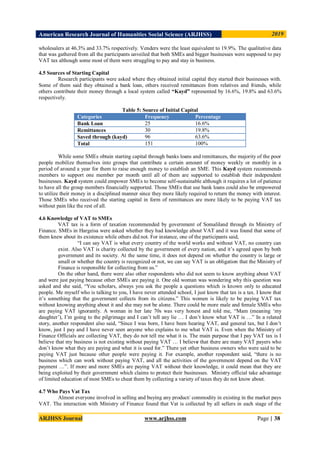
others contribute their money through a local system called “Kayd” represented by 16.6%, 19.8% and 63.6%
respectively.
Table 5: Source of Initial Capital
Categories Frequency Percentage
Bank Loan 25 16.6%
Remittances 30 19.8%
Saved through (kayd) 96 63.6%
Total 151 100%
While some SMEs obtain starting capital through banks loans and remittances, the majority of the poor
people mobilize themselves into groups that contribute a certain amount of money weekly or monthly in a
period of around a year for them to raise enough money to establish an SME. This Kayd system recommends
members to support one member per month until all of them are supported to establish their independent
businesses. Kayd system could empower SMEs to become self-sustainable although it requires a lot of patience
to have all the group members financially supported. Those SMEs that use bank loans could also be empowered
to utilize their money in a disciplined manner since they more likely required to return the money with interest.
Those SMEs who received the starting capital in form of remittances are more likely to be paying VAT tax
without pain like the rest of all.
4.6 Knowledge of VAT to SMEs
VAT tax is a form of taxation recommended by government of Somaliland through its Ministry of
Finance. SMEs in Hargeisa were asked whether they had knowledge about VAT and it was found that some of
them knew about its existence while others did not. For instance, one of the participants said,
“I can say VAT is what every country of the world works and without VAT, no country can
exist. Also VAT is charity collected by the government of every nation, and it’s agreed upon by both
government and its society. At the same time, it does not depend on whether the country is large or
small or whether the country is recognized or not, we can say VAT is an obligation that the Ministry of
Finance is responsible for collecting from us.”
On the other hand, there were also other respondents who did not seem to know anything about VAT
and were just paying because other SMEs are paying it. One old woman was wondering why this question was
asked and she said, “You scholars, always you ask the people a questions which is known only to educated
people. Me myself who is talking to you, I have never attended school, I just know that tax is a tax. I know that
it’s something that the government collects from its citizens.” This women is likely to be paying VAT tax
without knowing anything about it and she may not be alone. There could be more male and female SMEs who
are paying VAT ignorantly. A woman in her late 70s was very honest and told me, “Mam (meaning ‘my
daughter’), I’m going to the pilgrimage and I can’t tell any lie … I don’t know what VAT is …” In a related
story, another respondent also said, “Since I was born, I have been hearing VAT, and general tax, but I don’t
know, just I pay and I have never seen anyone who explains to me what VAT is. Even when the Ministry of
Finance Officials are collecting VAT, they do not tell me what it is. The main purpose that I pay VAT tax is I
believe that my business is not existing without paying VAT … I believe that there are many VAT payers who
don’t know what they are paying and what it is used for.” There yet other business owners who were said to be
paying VAT just because other people were paying it. For example, another respondent said, “there is no
business which can work without paying VAT, and all the activities of the government depend on the VAT
payment …”. If more and more SMEs are paying VAT without their knowledge, it could mean that they are
being exploited by their government which claims to protect their businesses. Ministry official take advantage
of limited education of most SMEs to cheat them by collecting a variety of taxes they do not know about.
4.7 Who Pays Vat Tax
Almost everyone involved in selling and buying any product/ commodity in existing in the market pays
VAT. The interaction with Ministry of Finance found that Vat is collected by all sellers in each stage of the
American Research Journal of Humanities Social Science (ARJHSS)R) 2019
ARJHSS Journal www.arjhss.com Page | 39
supply chain. People like suppliers, manufacturers, distributors and retailers all collect the value added tax on
taxable sales as well as end consumers all pay the VAT on their purchases. Businesses must track and document
the VAT they pay on purchases that will be resold in order to receive a credit for the VAT paid on their tax
return. Tax jurisdictions receive the tax revenue throughout the entire supply chain as opposed to at the sale to
the final consumer chain.
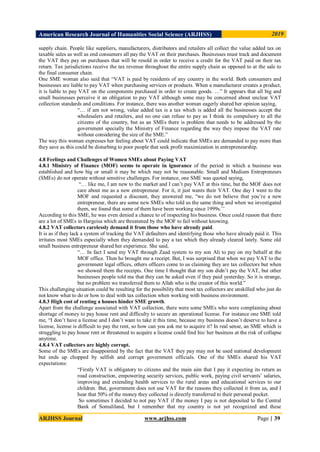
One SME woman also said that “VAT is paid by residents of any country in the world. Both consumers and
businesses are liable to pay VAT when purchasing services or products. When a manufacturer creates a product,
it is liable to pay VAT on the components purchased in order to create goods. …” It appears that all big and
small businesses perceive it an obligation to pay VAT although some may be concerned about unclear VAT
collection standards and conditions. For instance, there was another woman eagerly shared her opinion saying,
“… if am not wrong, value added tax is a tax which is added all the businesses accept the
wholesalers and retailers, and no one can refuse to pay as I think its compulsory to all the
citizens of the country, but as an SMEs there is problem that needs to be addressed by the
government specially the Ministry of Finance regarding the way they impose the VAT rate
without considering the size of the SME.”
The way this woman expresses her feeling about VAT could indicate that SMEs are demanded to pay more than
they save as this could be disturbing to poor people that seek profit maximization in entrepreneurship.
4.8 Feelings and Challenges of Women SMEs about Paying VAT
4.8.1 Ministry of Finance (MOF) seems to operate in ignorance of the period in which a business was
established and how big or small it may be which may not be reasonable. Small and Medium Entrepreneurs
(SMEs) do not operate without sensitive challenges. For instance, one SME was quoted saying,
“… like me, I am new to the market and I can’t pay VAT at this time, but the MOF does not
care about me as a new entrepreneur. For it, it just wants their VAT. One day I went to the
MOF and requested a discount, they answered me, “we do not believe that you’re a new
entrepreneur, there are some new SMEs who told us the same thing and when we investigated
them, we found that some of them have been working since 1999s.’’
According to this SME, he was even denied a chance to of inspecting his business. Once could reason that there
are a lot of SMEs in Hargeisa which are threatened by the MOF to fail without knowing.
4.8.2 VAT collectors carelessly demand it from those who have already paid.
It is as if they lack a system of tracking the VAT defaulters and identifying those who have already paid it. This
irritates most SMEs especially when they demanded to pay a tax which they already cleared lately. Some old
small business entrepreneur shared her experience. She said,
“… In fact I send my VAT through Zaad system to my son Ali to pay on my behalf at the
MOF office. Then he brought me a receipt. But, I was surprised that when we pay VAT to the
government legal offices, others officers come to us claiming they are tax collectors but when
we showed them the receipts. One time I thought that my son didn’t pay the VAT, but other
businesses people told me that they can be asked even if they paid yesterday. So it is strange,
but no problem we transferred them to Allah who is the creator of this world.”
This challenging situation could be resulting for the possibility that most tax collectors are unskilled who just do
not know what to do or how to deal with tax collection when working with business environment.
4.8.3 High cost of renting a houses hinder SME growth.
Apart from the challenge associated with VAT collection, there were some SMEs who were complaining about
shortage of money to pay house rent and difficulty to secure an operational license. For instance one SME told
me, “I don’t have a license and I don’t want to take it this time, because my business doesn’t deserve to have a
license, license is difficult to pay the rent, so how can you ask me to acquire it? In real sense, an SME which is
struggling to pay house rent or threatened to acquire a license could find his/ her business at the risk of collapse
anytime.
4.8.4 VAT collectors are highly corrupt.
Some of the SMEs are disappointed by the fact that the VAT they pay may not be used national development
but ends up chopped by selfish and corrupt government officials. One of the SMEs shared his VAT
expectations:
“Firstly VAT is obligatory to citizens and the main aim that I pay it expecting its return as
road construction, empowering security services, public work, paying civil servants’ salaries,
improving and extending health services to the rural areas and educational services to our
children. But, government does not use VAT for the reasons they collected it from us, and I
hear that 50% of the money they collected is directly transferred to their personal pocket.
So sometimes I decided to not pay VAT if the money I pay is not deposited to the Central
Bank of Somaliland, but I remember that my country is not yet recognized and these
American Research Journal of Humanities Social Science (ARJHSS)R) 2019
ARJHSS Journal www.arjhss.com Page | 40
challenges are due to lack of accountability and transparency and that we are clan-based
country. So, I hope that the country will get International recognition, and then our problems
will be solved for the better because there is proverb which says “every dog has its day.”
International recognition that is badly needed by Somaliland citizens may not solve the problem of corruption.
Rather, the punishing of corrupt government officials and pressurizing them to return what they have already
stolen cold strengthen chances of good governance. Thus, creating a responsible business environment that
serves the public interests of all SMEs and general citizens in Somaliland.
4.8.5 Corrupt VAT officials take advantage of lack of education among the SMEs to cheat them. Some of
the SMEs do have any knowledge on the payment of VAT. For this very reason, there is a high likelihood that
they might be financially exploited by tax officials. Seven SMEs whose shops were close to each other shared
the same experience saying,
“We face a lot of challenges specifically regarding the way of paying VAT. This is because
when you are a new entrepreneur and you don’t have a knowledge about how to pay VAT, the
MOF officials come to us and they asked us to pay VAT at that moment. We told them we
are not ready and that let us come to your office tomorrow which they accepted. On reaching
at their offices, we were asked what they called “tea” (some money that will not be deposited
to the official accounts of the ministry). They told us that no one would ask us VAT since they
were/ are officials who have the authority of collecting tax. They also told us that other
businesses like ours were paying the money “for tea” and they run their businesses without
any problem and encouraged us not to be afraid of anyone of anyone of them”.
Tax collectors of this nature are doubly cheating their country twofold. First, they demand monies separate from
VAT from SMEs for their selfish gains. Second, they use their authority and status to cheat the Central Bank of
Somaliland by systemically avoiding to deposit required taxes to the government bank account. International
recognition that is sought by the wider Somaliland is likely to be delayed by the huge presence of corrupt public
servants who use systemic means of raping the principles of good governance.
4.8.6 Charging more than Required Amount of VAT is another problem SMEs Face.
The system of VAT payment appears to be confusing in the view of many SMEs. “My son Abdirahman meets a
lot of challenges for example the amount tax collectors wrote on the receipt and the amount we paid is not equal.
We are confused,” one business woman said. Other SMEs testified they often experience bitter exchanges with
tax collectors on the insufficiencies related to VAT clearance.
4.8.7 Forcing SMEs to pay two Licenses is one of the biggest problems faced in Hargeisa’s entrepreneurship.
Most SMEs were concerned to share their double business challenge. Whenever we are applying for licenses,
both the local government and central government are forcing us to take the two licenses. “Firstly, we took a
license from local government; then, Ministry of Trade forced us to take their license too. They think we have
money to waste,” SMEs said. A case like this is highly surrounded by disorganization of public system as well
as lack of SME awareness of the right institutions responsible for tax collection. It is very likely that SMEs pay
taxes to any strangers who claim to be tax collectors from government. In addition, these SMEs could also be
paying their money to possible thugs disguising themselves as government tax collectors.
4.9 Number of Years Businesses spent in Business.
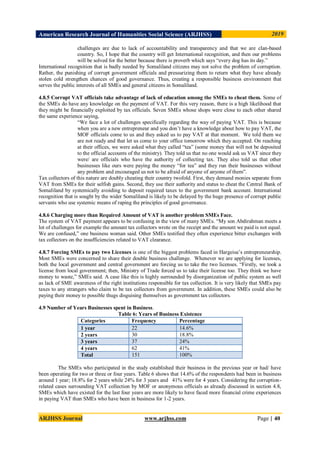
Table 6: Years of Business Existence
Categories Frequency Percentage
1 year 22 14.6%
2 years 30 18.8%
3 years 37 24%
4 years 62 41%
Total 151 100%
The SMEs who participated in the study established their business in the previous year or had/ have
been operating for two or three or four years. Table 6 shows that 14.6% of the respondents had been in business
around 1 year; 18.8% for 2 years while 24% for 3 years and 41% were for 4 years. Considering the corruption-
related cases surrounding VAT collection by MOF or anonymous officials as already discussed in section 4.8,
SMEs which have existed for the last four years are more likely to have faced more financial crime experiences
in paying VAT than SMEs who have been in business for 1-2 years.
American Research Journal of Humanities Social Science (ARJHSS)R) 2019
ARJHSS Journal www.arjhss.com Page | 41
4.10 Mixed Reactions on how VAT affects SMEs
Table 7: Effects of Vat on SMEs
Categories Frequency Percentage
VAT reduces my profit 94 62.2%
VAT improves my Profit 2 1.3%
VAT reduces my stock has too much 55 36.4%
Total = 151 100%
This study found that some SMEs were comfortable with VAT payment while others are greatly
troubled. In table 7, 62.2% of the participants talked with negative emotions against VAT. One of the women
SME was cited saying, “VAT has damaged our businesses, because government aggressively demand it before
the business reaches at least one year and we are wondering why they impose it to us without considering the
size of the business”. There were those 26.4% who were saying that VAT has reduced their stock. Their SME
experience did not reveal anything good about VAT. On the other hand, it was only the smallest number of
participants 1.3% who were pro-VAT collection. They praised VAT as a strong vehicle to their business
success. Quoting direct words from one of them, she said,
“I have been running my business since 2015 up to now. Since then, I have been paying VAT
except the first year. I know many more SMEs pay VAT like me and still am ready to pay it
because my business is growing year after year. It is a must for me to pay all the taxes that my
government asks from me. Lastly, in my advice and suggestion to all SMEs like should pay
VAT like I do. You know if you are a full tax payer, you can discuss with government, but if
SMEs do not pay VAT, they cannot advocate for positive change.”
The way this last research participant is as if she was a government official. Whether she was pro-government or
not, pay VAT could make more sense if MOF could lay out and sensitize SMEs on which business size is
responsible for paying VAT. Demanding VAT from SMEs which have been established for one or less than a
year could risk blocking their entrepreneurship goals and objectives.
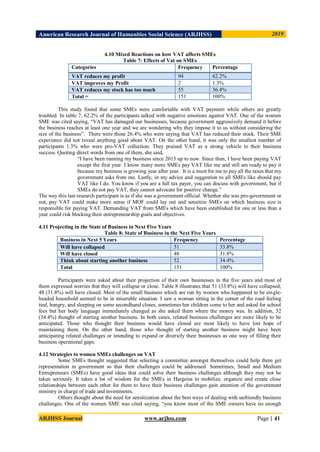
4.11 Projecting in the State of Business in Next Five Years
Table 8: State of Business in the Next Five Years
Business in Next 5 Years Frequency Percentage
Will have collapsed 51 33.8%
Will have closed 48 31.8%
Think about starting another business 52 34.4%
Total 151 100%
Participants were asked about their projection of their own businesses in the five years and most of
them expressed worries that they will collapse or close. Table 8 illustrates that 51 (33.8%) will have collapsed;
48 (31.8%) will have closed. Most of the small business which are run by women who happened to be single-
headed household seemed to be in miserable situation. I saw a woman sitting in the corner of the road feeling
tied, hungry, and sleeping on some secondhand closes, sometimes her children come to her and asked for school
fees but her body language immediately changed as she asked them where the money was. In addition, 52
(34.4%) thought of starting another business. In both cases, related business challenges are more likely to be
anticipated. Those who thought their business would have closed are most likely to have lost hope of
maintaining them. On the other hand, those who thought of starting another business might have been
anticipating related challenges or intending to expand or diversify their businesses as one way of filling their
business operational gaps.
4.12 Strategies to women SMEs challenges on VAT
Some SMEs thought suggested that selecting a committee amongst themselves could help them get
representation in government so that their challenges could be addressed. Sometimes, Small and Medium
Entrepreneurs (SMEs) have good ideas that could solve their business challenges although they may not be
taken seriously. It takes a lot of wisdom for the SMEs in Hargeisa to mobilize, organize and create close
relationships between each other for them to have their business challenges gain attention of the government
ministry in charge of trade and investments.
Others thought about the need for sensitization about the best ways of dealing with unfriendly business
challenges. One of the women SME was cited saying, “you know most of the SME owners have no enough
American Research Journal of Humanities Social Science (ARJHSS)R) 2019
ARJHSS Journal www.arjhss.com Page | 42
educational background … even me my self-talking to you, I do not have even secondary education, so how can
I do successful business? As a matter of fact, entrepreneurial innovation correlates with education and therefore,
it makes more sense to train SMEs on how best they can operate successful business.
VI. CONCLUSION
Paying VAT in Somaliland is associated with advantages to the host country and very few business but
proved to be disadvantageous to mostly the Small and Medium Entrepreneurs (SMEs). The existing research
and the research findings have provided that VAT is the direct source of government revenue from which the
government leaders fund the provision of public social and economic services. On the other hand, VAT has been
cited to be harmful to SMEs as the latter feel that they are being exploited by country which claims to rebuild its
statehood. Very few SMEs well found to get along with VAT claiming it builds their capacity to negotiate with
government in favour of their business growth. However, the majority of the SMEs felt that they were/ are not
capable of pay VAT and that the method of VAT collection were/ are currently very inconsiderate of the size of
the business. To the SMEs, it appeared that the size business the number years a business has been operating
should be the Ministry of Finance’s highest consideration for identifying and determining who should or not pay
VAT tax, how and when. The SMEs have a good point in this aspect of SME operations. The indiscriminate
VAT demand could hugely discourage effective SME growth as well as new SMEs to invest in the host country.
REFERENCES
[1]. Ainebyona, Gerald (2011) The Reintegration of the Female Ex-Abductees of the Lord’s Resistance
Army (LRA) of Northern Uganda: A Case of Gulu District. Published by the University of Tromso.
[2]. Alabi, F.A, David, J.O; David, J.O and Aderinto, O.C (2019) The Impact of Government on Business
Growth of SMEs in South Western Nigeria. International Journal of Management Studies and Social
Sciences Research; Volume 1, Issue 2, March-April.
[3]. Ali-Nayea, A. (2008) Taxation in Ghana: Principles, Practice and Planning. Published by Black Mask
Limited.
[4]. Atawodi, Ojochogwu, Winnie and Ojeka, Stephen, Aanu (2012) Factors that affect Tax Compliance
among Small and Medium Enterprises (SMEs) in North Central Africa. International Journal of
Business and Management; Vol. 7, No. 12 June, 2012.
[5]. Atawodi, Ojochogwu, Winnie and Ojeka, Stephen, Aanu (2012) Factors that affect Tax Compliance
among Small and Medium Enterprises (SMEs) in North Central Nigeria. International Journal of
Business and Management; Vol. 7. No. 12; June, 2012.
[6]. Baker, Anita (2012) Evaluation Services. (Available at: www.evaluationservices.com).
[7]. Carter, Allan (2013)(ed.) International Tax Dialogue: Key Issues and Debates in VAT, SME taxation
and the Tax Treatment of the Financial Sector. Published by European Commission).
[8]. Dawson, Catherine (2002) Practical Research Methods: A User-Friendly Guide to Mastering Research.
Oxford: How To Books Ltd.
[9]. Haginour, Faisal (2018) The Challenges of Tax Administration in Administration in Somaliland
Ministry of Finance: A Critical Analysis of Institutional Perspective. A Mini-Thesis submitted in
Partial Fulfilment of the Requirements for the Degree of Master’s in Public Administration in the
School of Government, Faculty of Economics and Management Science, University of Western Cape.
[10]. Liu, Xiangfeng (2009) Impacts of the Global Financial Crisis on Small and Medium Enterprises in the
People’s Republic of China. ADBI Working Paper Series. Published by ADBInstitute.
[11]. Semikolenova, Yadviga (1999) Taxation of Small and Medium Enterprises. A thesis submitted in
partial fulfilment of the requirements for the degree of Master in Economics, EERC MA Program in
National University of Kiev-Mohyla Academy.
[12]. Twesige, Daniel and Gasheja, Faustin (2019) Effect of Tax Incentives on the Growth of Small and
Medium-sized Enterprises (SMEs) in Rwanda: A Case Study of SMEs in Nyarujenge District. Journal
of Accounting and Taxation, Vol. 11(5), pp. 89-98.
[13]. Vandenberg, Paul (2009) Micro, Small and Medium-sized and the Global Economic Crisis: Impacts
and Policy Responses. Published by International Labour Organisation.
[14]. Williams, Carrie (2007) Research Methods. Journal of Business and Economic Research; Volume 5,
Number 3.
[15]. World Bank Group (2016) Somaliland’s Private Sector at Crossroads: Political Economy and Policy
Choices for Prosperity and Job Creation. Washington: International Bank for Reconstruction and
Development.
[16]. World Bank Group (2018) Federal Republic of Somalia Systematic Country Diagnostic. Report No.
123807-SO.

D2123442

  • 1.
    American Research Journalof Humanities Social Science (ARJHSS)R) 2019 ARJHSS Journal www.arjhss.com Page | 34 American Research Journal of Humanities & Social Science (ARJHSS) E-ISSN: 2378-702X Volume-02, Issue-12, pp 34-42 December-2019 www.arjhss.com Research Paper Open Access Understanding the Effects of Value Added Tax (VAT) on Small and Medium Enterprises (SMEs) of Hargeisa, Somaliland. Safia Saed Farah1 , Gerald Ainebyona2 1 (Master Student, Project Management-School of Graduate Studies & Research/ Gollis University, Somaliland) 2 (Research Coordinator, School of Graduate Studies & Research/ Gollis University, Somaliland) *Corresponding author: Safia Saed Farah ABSTRACT: The study was conducted in among the Small and Medium Enterprises (SMEs) in Hargeisa. Its target was based on how Value Added Tax (VAT) affects the performance of Small and Medium Enterprises (SMEs) in Hargeisa Somaliland. A sample of 151 respondents participated in the study comprising of Small and Medium Entrepreneurs (SMEs) and Ministry of Finance Tax Officials. A mixed design research was conducted in which both quantitative and qualitative methods were applied to gather and analyze the data. Questionnaires, Key Informant Interviews as well as participant observations were used for data collection. Some of the research findings included: VAT collection was characterized by very corrupt tax officials as SMEs revealed that whenever they paid VAT through legal tax collectors, other unidentified government officials came to demand VAT too; absence of Framework on revenue collection increased corruption between government leaders in charge of tax collection; most SMEs are worried they may close their business or experience operational failure due to the fact that VAT collectors aggressively demanded the money without considering the size of the business or when the SME was established. SMEs were/ are not contented that their VAT was/is being used for the government’s intended plan as they continuously hear that 50% of the VAT collected ends up in the individual pockets of few government leaders. The operational disadvantage encountered by SMEs who are tasked to pay VAT could be ironed out if strategic measures are taken. For instance SMEs’ suggestion to select a committee made up of SME members to represent their views and issues in government could among other strategies most of the SME challenges in Hargeisa and the entire Somaliland. Keywords – Value Added Tax (VAT), Small and Medium Enterprises, Hargeisa, Somaliland I. INTRODUCTION Taxation of any sort is the main source of government revenue the business architecture all over the world. According to (Atawodi and Ojeka, 2012), “the fundamental purpose of taxation is to raise revenue effectively, through measures that suit each country’s circumstances and administrative capacity.” Various taxes are collected to develop the financial capacity to run government business (see also, Tanzi and Zee, 2001 cited in Haginour, 2018). For the interest of this study, Value Added Tax (VAT) and its effects on Small and Medium Enterprises (SMEs) in Hargeisa, Somaliland was the main focus. Many economic investors whether they are local or international SMEs pay Value Added Tax (VAT) to the host countries. A lot of Small and Medium (SMEs) represent the biggest majority of potential VAT payers and thus contributing to national development. VAT is a globally championed tax although it may be a new concept in some countries and very ancient in others. As early as 2005, the first international tax dialogue was held in Rome that addressed how countries should deal with VAT much as the same VAT was introduced in France over 150 years earlier in France (Carter, 2013). International Institutions such as; International Monetary Fund (IMF), Organization for Economic Cooperation and Development (OECD), World Bank, Inter‐American Development Bank (IDB), and the United Nations (UN) … the European Commission (EC) are part of the key players in VAT arrangements (ibid). European countries like UK and Spain adopted a tax incentive whereby;
  • 2.
    American Research Journalof Humanities Social Science (ARJHSS)R) 2019 ARJHSS Journal www.arjhss.com Page | 35 “a tax incentive policy where the retail investors may deduct a set percentage of the value they invest in shares of SME equity. This happens via offering tax offsets only for acquiring shares in new SME equity offerings. In France, the investors can get a tax credit of 18% of the value invested in innovation mutual funds French acronym” (Twesige and Gasheja, 2019). Like in developed countries, several developing countries in and outside Africa have also been cited to uphold VAT initiatives though with operational challenges. Ukraine has been cited as a case in point “where policy of SME sector taxation is considered to be too burdensome, as the share of the sector in GDP is only 5.5% (Analytical report on State Committee for Entrepreneurship Development 1997 cited in Semikolenova, 1999). For some Asian countries were recently engaged in tax cuts to support SMEs and minimize their likely risks of business failures. According to statistical evidence, “Value-added taxes are an important target of cuts. In India, the central value-added tax was reduced a full 4% on all products, except for oil. Similarly in China, the value-added tax for small businesses was cut to a uniform 3% from the existing 4-6% … with recent changes estimated to reduce total taxes paid by companies by US$17.6 billion annually” (Vandenberg, 2009). VAT appears to worry small business entrepreneurs’ operation and thus limiting their profit making goals as in the case of People’s Republic of China. For instance, PRC’s “SMEs’ problems such as financing difficulty, poor technology levels, low creditability, and extensive management patterns have been bottlenecks in the course of their development. The current global financial crisis has exacerbated the problems of SMEs in the PRC despite a number of boosting policies developed by the government” (Liu, 2009). On the other hand governments benefit from their likely huge financial contribution to public service. The most recent research reveals that some countries do not offer special incentives for SMEs on firm level as in the case of Austria, Finland among others (see, Twesige & Gasheja, 2019), … “Zimbabwe provides investment incentives with six objectives in mind: Employment creation; small business development; industrial development; export promotion; spatial development; and “upliftment” of the disadvantaged” (ibid). Depending on the country around the world, government policies have the potential to affect the operation and performance of every business. VAT charged on SMEs or any other business in or outside Nigeria is hugely likely to rise the cost of the production as well as finished products. Thus, a financial crisis of this nature could scare or minimize the final consumption power for such products in the market (see also, Alabi et al., 2019). Some scholars blame illegibility Somaliland government to make international agreements of investments or aid and its heavy reliance on tax revenue for its lack of international recognition (Haginour, 2018). As a country still struggling to meet livelihood needs such as; water, shelter, food, medical care and education; Somaliland government seems to demand various taxes not excluding VAT from SMEs to rejuvenate the economy. The tax exemptions programs featuring in some European as well as African economies may not be likely in Somaliland. Somaliland is challenged by very limited revenue due to the fact that its economy is highly dollarized. Being a consuming De-facto state, the country’s monetary system is weakened by the stringent transactional process whereby anything to be purchased costing less than $100 must be effected in Somali shillings. This of course rises the inflation rate in the country. Besides, Somaliland is one of the Horn of African Countries with the highest poverty levels. Statistical evidence states that “Somalia has a history of poverty and today, poverty is still high: 60 percent in Mogadishu, 49 to 63 percent in Somaliland, and 71 percent in the settlements of internally displaced people (IDP) (World Bank Group, 2018). The existing poverty levels combined with fiscal challenges in Hargeisa and the entire Republic of Somaliland makes the cost of living so high that SMEs have to pay more VAT or any other taxes to their highly demanding government. There is also the possibility that the Central Bank of Somaliland lacks the capacity to control the national currency. Haginour (2018) also acknowledged that the revenue gap in Somaliland government delays public projects, economic growth of the country as well as provision public goods and services. Above all, the lack international recognition advantage means that the Somali shilling does not operate beyond the boundaries of Somaliland. Therefore, SMEs that limited by external funding might find it difficult to run any form of business and later on compete in the regional market. II. STATEMENT OF THE PROBLEM World Bank Group (2016) states that Somaliland's private sector development is hindered by the absence of a legislative framework to regulate the financial services sector. For this reason, SMEs are facing indiscriminate VAT payments in Hargeisa. SMEs are continuously complaining against government’s imposing of VAT without considering the size of the SME. Small SMEs are particularly worried of their possible risk of collapsing and failure to make profit. They say that VAT that is demanded by MOF is higher than their earning. SMEs are currently struggling to find solutions among the existing corrupt tax administrators without any hope of success. This study intends to assess the nature and operational bottlenecks hindering the growth and
  • 3.
    American Research Journalof Humanities Social Science (ARJHSS)R) 2019 ARJHSS Journal www.arjhss.com Page | 36 performance of SMEs who are forced to pay VAT; and then determine possible measures that could be taken to create an enabling business environment for SMEs. III. OBJECTIVES The general objective of this study is to investigate the effects of Value Added Tax (VAT) on small and small medium enterprises (SMEs) in Hargeisa, Somaliland. Specifically, this study sought to:  Identify the SMEs who pay VAT.  Evaluate the source of SMEs starting capital.  Analyze the SME’s knowledge of VAT.  State the challenges faced by SMEs who pay VAT.  Determine the possible measures taken by SMEs address VAT challenges. IV. METHODS AND MATERIALS Study Area This study was conducted in Hargeisa city because of its domination for SMEs in the private sector. In the whole of Somaliland and Hargeisa in particular, the homesteads of all people; whether they are SMEs or not, are concentrated in town where they have access to socio-economic amenities. Therefore, customers of most SMEs live side-by-side of each other or access the business center within walkable or less than a dollar of transportation cost. Research Context In this city, most small and medium entrepreneurs are always underperforming due to unstable local investments. At the same time, these SMEs are have an obligation of paying VAT as a government condition to be given the license to operate. Despite the SME financial challenges, the government of Somaliland cannot run public works without VAT collection from SMEs. As a result, Most SMEs tend to hide their identity so that they may systemically avoid exposure to VAT tax officials or any strangers such as researchers who are locally perceived to be working for working for government despite availing their identity. Research Design Mixed Methods Research (MMR) approach was applied during data collection and analysis of results. This approach was used in order to meet the scholarly emphasis that researchers have to “incorporate methods of collecting or analyzing data from the quantitative and qualitative research approaches in a single research study” (Creswell, 2003; Johnson & Onwuegbuzie; Tashakkori & Teddlie cited in Williams, 2007). Sample Size and Procedure According to the chairman of Hargeisa City (anonymous), there are around 20,000 registered SMEs owning diverse businesses. An outsider view might put it that it is very easy to conduct research studies in Hargeisa city. It is however a different case because most people are reserved and rarely willing to share their business experience especially when the topical issue rotates around VAT payment. For this reason, we used convenient sampling to interact with any SME that was easily accessible and willing to talk to us. We also purposively selected some tax officials at the Ministry of Finance who also happened to own small enterprises in Hargeisa. At the end of the study, we managed to engage with 151 participants in total. Data Collection Tools and Methods Questionnaires Four hundred self-administered questionnaires were distributed to various SMEs in Hargeisa city of which 151 were returned filled. These questionnaires were composed of both closed-ended and open-ended questions aimed at capturing SMEs’ thoughts, beliefs and experiences on VAT. Such questionnaires “could be sent through the post, delivered in person or distributed via the internet” according to (Dawson, 2002). For this study, questionnaires were delivered in person as went around Hargeisa city interacting with various SMEs. Key Informant Interviews Three tax officials and three community elders were engaged on a one-on-one face-to-face interviewing approach. These six participants had also filled the questionnaire but were also purposively targeted to share some specific information at different days. They provided very interesting information that correlated with the VAT collection and performance of SMEs. Participant Observation According to (Williams, 2007), “data can be obtained from several sources such as interviewing participants or witnesses, reviewing historical videotapes or records, observations while on-site.” Observations in this study was carried out concurrently with other data collection methods. When we were distributing questionnaires and interviewing tax officials and elders who were found managing their own shops, we observed many worried-looking SMEs. At one time, one woman in her late 20s was observed quarrelling with who locked her boutique for failure to raise half of the VAT. This woman was not alone. We saw a crowd of gendered (male and female) sympathizers close to her boutique who were loudly speaking hell against corrupt tax collectors.
  • 4.
    American Research Journalof Humanities Social Science (ARJHSS)R) 2019 ARJHSS Journal www.arjhss.com Page | 37 V. DISCUSSION OF RESULTS 4.1 Demographic Information Table 1: Age of respondents Age of the respondents Frequency Percent 20-30 10 6.6% 31-40 31 20.5% 41-50 50 33.1% 51 and above 60 39.7% Total 151 100% Out of 151 research participants, 10% of the respondents ware aged between 20-30 years; 31% between 31-40 years; 50% ranged between 41-50 years, while 60% were above 51 years old as shown in table 1. It is not a surprise having various age groups operating businesses that are influenced by VAT taxation. The 6.6% are not likely to be owning businesses as the rest of the age groups but were largely mentioned as sons and daughters of some business owners working together on a daily basis. 4.2 Gender of Respondents Table 2: Gender of Respondents Gender Frequency Percent Male 61 40% Female 90 60% Total 151 100 Female SMEs were marked the majority at 60% the remaining 40% identified as male SMEs. More women than men are attracted to SMEs in Hargeisa which means that women play a bigger role in national economic development. 4.3 The Education of Respondents Table 3 illustrates respondents’ educational background. It found that 14% never attended school, 13.3% could only read and right. 26.4% attended Elementary, 33.1% had Secondary education, 13.3% had a Certificate and Diploma but only 10% were Degree and above holders. Table 3: Education Educational Level Frequency Percentage Never attended 21 13.9% Informal education 20 13.3% Elementary 40 26.4% Secondary 40 26.4% Certificate and Diploma 20 13.3% Degree and above 10 6.6% Total 151 100 There is no specific education level or human being who is restricted to do business. Both the educated and none-educated in Hargeisa enjoy the freedom to establish any business of their choice so long as they have the capacity to do so. 4.4 Types of Businesses Common in Hargeisa Table 4: Type of business Types of businesses Frequency Percentage Wholesalers 51 33.7% Retailers 70 46.3% Venders 30 19.9% Total 151 100% The type of business run by the respondents were wholesalers (51%), retailers (70%) as well as Venders (30%) as illustrated in table 4. The majority of the business owners were retails followed by
  • 5.
    American Research Journalof Humanities Social Science (ARJHSS)R) 2019 ARJHSS Journal www.arjhss.com Page | 38 wholesalers at 46.3% and 33.7% respectively. Venders were the least equivalent to 19.9%. The qualitative data that was gathered from all the participants unveiled that both SMEs and bigger businesses were supposed to pay VAT tax although some most of them were struggling to pay and stay in business. 4.5 Sources of Starting Capital Research participants were asked where they obtained initial capital they started their businesses with. Some of them said they obtained a bank loan, others received remittances from relatives and friends, while others contribute their money through a local system called “Kayd” represented by 16.6%, 19.8% and 63.6% respectively. Table 5: Source of Initial Capital Categories Frequency Percentage Bank Loan 25 16.6% Remittances 30 19.8% Saved through (kayd) 96 63.6% Total 151 100% While some SMEs obtain starting capital through banks loans and remittances, the majority of the poor people mobilize themselves into groups that contribute a certain amount of money weekly or monthly in a period of around a year for them to raise enough money to establish an SME. This Kayd system recommends members to support one member per month until all of them are supported to establish their independent businesses. Kayd system could empower SMEs to become self-sustainable although it requires a lot of patience to have all the group members financially supported. Those SMEs that use bank loans could also be empowered to utilize their money in a disciplined manner since they more likely required to return the money with interest. Those SMEs who received the starting capital in form of remittances are more likely to be paying VAT tax without pain like the rest of all. 4.6 Knowledge of VAT to SMEs VAT tax is a form of taxation recommended by government of Somaliland through its Ministry of Finance. SMEs in Hargeisa were asked whether they had knowledge about VAT and it was found that some of them knew about its existence while others did not. For instance, one of the participants said, “I can say VAT is what every country of the world works and without VAT, no country can exist. Also VAT is charity collected by the government of every nation, and it’s agreed upon by both government and its society. At the same time, it does not depend on whether the country is large or small or whether the country is recognized or not, we can say VAT is an obligation that the Ministry of Finance is responsible for collecting from us.” On the other hand, there were also other respondents who did not seem to know anything about VAT and were just paying because other SMEs are paying it. One old woman was wondering why this question was asked and she said, “You scholars, always you ask the people a questions which is known only to educated people. Me myself who is talking to you, I have never attended school, I just know that tax is a tax. I know that it’s something that the government collects from its citizens.” This women is likely to be paying VAT tax without knowing anything about it and she may not be alone. There could be more male and female SMEs who are paying VAT ignorantly. A woman in her late 70s was very honest and told me, “Mam (meaning ‘my daughter’), I’m going to the pilgrimage and I can’t tell any lie … I don’t know what VAT is …” In a related story, another respondent also said, “Since I was born, I have been hearing VAT, and general tax, but I don’t know, just I pay and I have never seen anyone who explains to me what VAT is. Even when the Ministry of Finance Officials are collecting VAT, they do not tell me what it is. The main purpose that I pay VAT tax is I believe that my business is not existing without paying VAT … I believe that there are many VAT payers who don’t know what they are paying and what it is used for.” There yet other business owners who were said to be paying VAT just because other people were paying it. For example, another respondent said, “there is no business which can work without paying VAT, and all the activities of the government depend on the VAT payment …”. If more and more SMEs are paying VAT without their knowledge, it could mean that they are being exploited by their government which claims to protect their businesses. Ministry official take advantage of limited education of most SMEs to cheat them by collecting a variety of taxes they do not know about. 4.7 Who Pays Vat Tax Almost everyone involved in selling and buying any product/ commodity in existing in the market pays VAT. The interaction with Ministry of Finance found that Vat is collected by all sellers in each stage of the
  • 6.
    American Research Journalof Humanities Social Science (ARJHSS)R) 2019 ARJHSS Journal www.arjhss.com Page | 39 supply chain. People like suppliers, manufacturers, distributors and retailers all collect the value added tax on taxable sales as well as end consumers all pay the VAT on their purchases. Businesses must track and document the VAT they pay on purchases that will be resold in order to receive a credit for the VAT paid on their tax return. Tax jurisdictions receive the tax revenue throughout the entire supply chain as opposed to at the sale to the final consumer chain. One SME woman also said that “VAT is paid by residents of any country in the world. Both consumers and businesses are liable to pay VAT when purchasing services or products. When a manufacturer creates a product, it is liable to pay VAT on the components purchased in order to create goods. …” It appears that all big and small businesses perceive it an obligation to pay VAT although some may be concerned about unclear VAT collection standards and conditions. For instance, there was another woman eagerly shared her opinion saying, “… if am not wrong, value added tax is a tax which is added all the businesses accept the wholesalers and retailers, and no one can refuse to pay as I think its compulsory to all the citizens of the country, but as an SMEs there is problem that needs to be addressed by the government specially the Ministry of Finance regarding the way they impose the VAT rate without considering the size of the SME.” The way this woman expresses her feeling about VAT could indicate that SMEs are demanded to pay more than they save as this could be disturbing to poor people that seek profit maximization in entrepreneurship. 4.8 Feelings and Challenges of Women SMEs about Paying VAT 4.8.1 Ministry of Finance (MOF) seems to operate in ignorance of the period in which a business was established and how big or small it may be which may not be reasonable. Small and Medium Entrepreneurs (SMEs) do not operate without sensitive challenges. For instance, one SME was quoted saying, “… like me, I am new to the market and I can’t pay VAT at this time, but the MOF does not care about me as a new entrepreneur. For it, it just wants their VAT. One day I went to the MOF and requested a discount, they answered me, “we do not believe that you’re a new entrepreneur, there are some new SMEs who told us the same thing and when we investigated them, we found that some of them have been working since 1999s.’’ According to this SME, he was even denied a chance to of inspecting his business. Once could reason that there are a lot of SMEs in Hargeisa which are threatened by the MOF to fail without knowing. 4.8.2 VAT collectors carelessly demand it from those who have already paid. It is as if they lack a system of tracking the VAT defaulters and identifying those who have already paid it. This irritates most SMEs especially when they demanded to pay a tax which they already cleared lately. Some old small business entrepreneur shared her experience. She said, “… In fact I send my VAT through Zaad system to my son Ali to pay on my behalf at the MOF office. Then he brought me a receipt. But, I was surprised that when we pay VAT to the government legal offices, others officers come to us claiming they are tax collectors but when we showed them the receipts. One time I thought that my son didn’t pay the VAT, but other businesses people told me that they can be asked even if they paid yesterday. So it is strange, but no problem we transferred them to Allah who is the creator of this world.” This challenging situation could be resulting for the possibility that most tax collectors are unskilled who just do not know what to do or how to deal with tax collection when working with business environment. 4.8.3 High cost of renting a houses hinder SME growth. Apart from the challenge associated with VAT collection, there were some SMEs who were complaining about shortage of money to pay house rent and difficulty to secure an operational license. For instance one SME told me, “I don’t have a license and I don’t want to take it this time, because my business doesn’t deserve to have a license, license is difficult to pay the rent, so how can you ask me to acquire it? In real sense, an SME which is struggling to pay house rent or threatened to acquire a license could find his/ her business at the risk of collapse anytime. 4.8.4 VAT collectors are highly corrupt. Some of the SMEs are disappointed by the fact that the VAT they pay may not be used national development but ends up chopped by selfish and corrupt government officials. One of the SMEs shared his VAT expectations: “Firstly VAT is obligatory to citizens and the main aim that I pay it expecting its return as road construction, empowering security services, public work, paying civil servants’ salaries, improving and extending health services to the rural areas and educational services to our children. But, government does not use VAT for the reasons they collected it from us, and I hear that 50% of the money they collected is directly transferred to their personal pocket. So sometimes I decided to not pay VAT if the money I pay is not deposited to the Central Bank of Somaliland, but I remember that my country is not yet recognized and these
  • 7.
    American Research Journalof Humanities Social Science (ARJHSS)R) 2019 ARJHSS Journal www.arjhss.com Page | 40 challenges are due to lack of accountability and transparency and that we are clan-based country. So, I hope that the country will get International recognition, and then our problems will be solved for the better because there is proverb which says “every dog has its day.” International recognition that is badly needed by Somaliland citizens may not solve the problem of corruption. Rather, the punishing of corrupt government officials and pressurizing them to return what they have already stolen cold strengthen chances of good governance. Thus, creating a responsible business environment that serves the public interests of all SMEs and general citizens in Somaliland. 4.8.5 Corrupt VAT officials take advantage of lack of education among the SMEs to cheat them. Some of the SMEs do have any knowledge on the payment of VAT. For this very reason, there is a high likelihood that they might be financially exploited by tax officials. Seven SMEs whose shops were close to each other shared the same experience saying, “We face a lot of challenges specifically regarding the way of paying VAT. This is because when you are a new entrepreneur and you don’t have a knowledge about how to pay VAT, the MOF officials come to us and they asked us to pay VAT at that moment. We told them we are not ready and that let us come to your office tomorrow which they accepted. On reaching at their offices, we were asked what they called “tea” (some money that will not be deposited to the official accounts of the ministry). They told us that no one would ask us VAT since they were/ are officials who have the authority of collecting tax. They also told us that other businesses like ours were paying the money “for tea” and they run their businesses without any problem and encouraged us not to be afraid of anyone of anyone of them”. Tax collectors of this nature are doubly cheating their country twofold. First, they demand monies separate from VAT from SMEs for their selfish gains. Second, they use their authority and status to cheat the Central Bank of Somaliland by systemically avoiding to deposit required taxes to the government bank account. International recognition that is sought by the wider Somaliland is likely to be delayed by the huge presence of corrupt public servants who use systemic means of raping the principles of good governance. 4.8.6 Charging more than Required Amount of VAT is another problem SMEs Face. The system of VAT payment appears to be confusing in the view of many SMEs. “My son Abdirahman meets a lot of challenges for example the amount tax collectors wrote on the receipt and the amount we paid is not equal. We are confused,” one business woman said. Other SMEs testified they often experience bitter exchanges with tax collectors on the insufficiencies related to VAT clearance. 4.8.7 Forcing SMEs to pay two Licenses is one of the biggest problems faced in Hargeisa’s entrepreneurship. Most SMEs were concerned to share their double business challenge. Whenever we are applying for licenses, both the local government and central government are forcing us to take the two licenses. “Firstly, we took a license from local government; then, Ministry of Trade forced us to take their license too. They think we have money to waste,” SMEs said. A case like this is highly surrounded by disorganization of public system as well as lack of SME awareness of the right institutions responsible for tax collection. It is very likely that SMEs pay taxes to any strangers who claim to be tax collectors from government. In addition, these SMEs could also be paying their money to possible thugs disguising themselves as government tax collectors. 4.9 Number of Years Businesses spent in Business. Table 6: Years of Business Existence Categories Frequency Percentage 1 year 22 14.6% 2 years 30 18.8% 3 years 37 24% 4 years 62 41% Total 151 100% The SMEs who participated in the study established their business in the previous year or had/ have been operating for two or three or four years. Table 6 shows that 14.6% of the respondents had been in business around 1 year; 18.8% for 2 years while 24% for 3 years and 41% were for 4 years. Considering the corruption- related cases surrounding VAT collection by MOF or anonymous officials as already discussed in section 4.8, SMEs which have existed for the last four years are more likely to have faced more financial crime experiences in paying VAT than SMEs who have been in business for 1-2 years.
  • 8.
    American Research Journalof Humanities Social Science (ARJHSS)R) 2019 ARJHSS Journal www.arjhss.com Page | 41 4.10 Mixed Reactions on how VAT affects SMEs Table 7: Effects of Vat on SMEs Categories Frequency Percentage VAT reduces my profit 94 62.2% VAT improves my Profit 2 1.3% VAT reduces my stock has too much 55 36.4% Total = 151 100% This study found that some SMEs were comfortable with VAT payment while others are greatly troubled. In table 7, 62.2% of the participants talked with negative emotions against VAT. One of the women SME was cited saying, “VAT has damaged our businesses, because government aggressively demand it before the business reaches at least one year and we are wondering why they impose it to us without considering the size of the business”. There were those 26.4% who were saying that VAT has reduced their stock. Their SME experience did not reveal anything good about VAT. On the other hand, it was only the smallest number of participants 1.3% who were pro-VAT collection. They praised VAT as a strong vehicle to their business success. Quoting direct words from one of them, she said, “I have been running my business since 2015 up to now. Since then, I have been paying VAT except the first year. I know many more SMEs pay VAT like me and still am ready to pay it because my business is growing year after year. It is a must for me to pay all the taxes that my government asks from me. Lastly, in my advice and suggestion to all SMEs like should pay VAT like I do. You know if you are a full tax payer, you can discuss with government, but if SMEs do not pay VAT, they cannot advocate for positive change.” The way this last research participant is as if she was a government official. Whether she was pro-government or not, pay VAT could make more sense if MOF could lay out and sensitize SMEs on which business size is responsible for paying VAT. Demanding VAT from SMEs which have been established for one or less than a year could risk blocking their entrepreneurship goals and objectives. 4.11 Projecting in the State of Business in Next Five Years Table 8: State of Business in the Next Five Years Business in Next 5 Years Frequency Percentage Will have collapsed 51 33.8% Will have closed 48 31.8% Think about starting another business 52 34.4% Total 151 100% Participants were asked about their projection of their own businesses in the five years and most of them expressed worries that they will collapse or close. Table 8 illustrates that 51 (33.8%) will have collapsed; 48 (31.8%) will have closed. Most of the small business which are run by women who happened to be single- headed household seemed to be in miserable situation. I saw a woman sitting in the corner of the road feeling tied, hungry, and sleeping on some secondhand closes, sometimes her children come to her and asked for school fees but her body language immediately changed as she asked them where the money was. In addition, 52 (34.4%) thought of starting another business. In both cases, related business challenges are more likely to be anticipated. Those who thought their business would have closed are most likely to have lost hope of maintaining them. On the other hand, those who thought of starting another business might have been anticipating related challenges or intending to expand or diversify their businesses as one way of filling their business operational gaps. 4.12 Strategies to women SMEs challenges on VAT Some SMEs thought suggested that selecting a committee amongst themselves could help them get representation in government so that their challenges could be addressed. Sometimes, Small and Medium Entrepreneurs (SMEs) have good ideas that could solve their business challenges although they may not be taken seriously. It takes a lot of wisdom for the SMEs in Hargeisa to mobilize, organize and create close relationships between each other for them to have their business challenges gain attention of the government ministry in charge of trade and investments. Others thought about the need for sensitization about the best ways of dealing with unfriendly business challenges. One of the women SME was cited saying, “you know most of the SME owners have no enough
  • 9.
    American Research Journalof Humanities Social Science (ARJHSS)R) 2019 ARJHSS Journal www.arjhss.com Page | 42 educational background … even me my self-talking to you, I do not have even secondary education, so how can I do successful business? As a matter of fact, entrepreneurial innovation correlates with education and therefore, it makes more sense to train SMEs on how best they can operate successful business. VI. CONCLUSION Paying VAT in Somaliland is associated with advantages to the host country and very few business but proved to be disadvantageous to mostly the Small and Medium Entrepreneurs (SMEs). The existing research and the research findings have provided that VAT is the direct source of government revenue from which the government leaders fund the provision of public social and economic services. On the other hand, VAT has been cited to be harmful to SMEs as the latter feel that they are being exploited by country which claims to rebuild its statehood. Very few SMEs well found to get along with VAT claiming it builds their capacity to negotiate with government in favour of their business growth. However, the majority of the SMEs felt that they were/ are not capable of pay VAT and that the method of VAT collection were/ are currently very inconsiderate of the size of the business. To the SMEs, it appeared that the size business the number years a business has been operating should be the Ministry of Finance’s highest consideration for identifying and determining who should or not pay VAT tax, how and when. The SMEs have a good point in this aspect of SME operations. The indiscriminate VAT demand could hugely discourage effective SME growth as well as new SMEs to invest in the host country. REFERENCES [1]. Ainebyona, Gerald (2011) The Reintegration of the Female Ex-Abductees of the Lord’s Resistance Army (LRA) of Northern Uganda: A Case of Gulu District. Published by the University of Tromso. [2]. Alabi, F.A, David, J.O; David, J.O and Aderinto, O.C (2019) The Impact of Government on Business Growth of SMEs in South Western Nigeria. International Journal of Management Studies and Social Sciences Research; Volume 1, Issue 2, March-April. [3]. Ali-Nayea, A. (2008) Taxation in Ghana: Principles, Practice and Planning. Published by Black Mask Limited. [4]. Atawodi, Ojochogwu, Winnie and Ojeka, Stephen, Aanu (2012) Factors that affect Tax Compliance among Small and Medium Enterprises (SMEs) in North Central Africa. International Journal of Business and Management; Vol. 7, No. 12 June, 2012. [5]. Atawodi, Ojochogwu, Winnie and Ojeka, Stephen, Aanu (2012) Factors that affect Tax Compliance among Small and Medium Enterprises (SMEs) in North Central Nigeria. International Journal of Business and Management; Vol. 7. No. 12; June, 2012. [6]. Baker, Anita (2012) Evaluation Services. (Available at: www.evaluationservices.com). [7]. Carter, Allan (2013)(ed.) International Tax Dialogue: Key Issues and Debates in VAT, SME taxation and the Tax Treatment of the Financial Sector. Published by European Commission). [8]. Dawson, Catherine (2002) Practical Research Methods: A User-Friendly Guide to Mastering Research. Oxford: How To Books Ltd. [9]. Haginour, Faisal (2018) The Challenges of Tax Administration in Administration in Somaliland Ministry of Finance: A Critical Analysis of Institutional Perspective. A Mini-Thesis submitted in Partial Fulfilment of the Requirements for the Degree of Master’s in Public Administration in the School of Government, Faculty of Economics and Management Science, University of Western Cape. [10]. Liu, Xiangfeng (2009) Impacts of the Global Financial Crisis on Small and Medium Enterprises in the People’s Republic of China. ADBI Working Paper Series. Published by ADBInstitute. [11]. Semikolenova, Yadviga (1999) Taxation of Small and Medium Enterprises. A thesis submitted in partial fulfilment of the requirements for the degree of Master in Economics, EERC MA Program in National University of Kiev-Mohyla Academy. [12]. Twesige, Daniel and Gasheja, Faustin (2019) Effect of Tax Incentives on the Growth of Small and Medium-sized Enterprises (SMEs) in Rwanda: A Case Study of SMEs in Nyarujenge District. Journal of Accounting and Taxation, Vol. 11(5), pp. 89-98. [13]. Vandenberg, Paul (2009) Micro, Small and Medium-sized and the Global Economic Crisis: Impacts and Policy Responses. Published by International Labour Organisation. [14]. Williams, Carrie (2007) Research Methods. Journal of Business and Economic Research; Volume 5, Number 3. [15]. World Bank Group (2016) Somaliland’s Private Sector at Crossroads: Political Economy and Policy Choices for Prosperity and Job Creation. Washington: International Bank for Reconstruction and Development. [16]. World Bank Group (2018) Federal Republic of Somalia Systematic Country Diagnostic. Report No. 123807-SO.