American Research Journal of Humanities Social Science (ARJHSS)R) 2021
ARJHSS Journal www.arjhss.com Page | 38
American Research Journal of Humanities Social Science (ARJHSS)
E-ISSN: 2378-702X
Volume-04, Issue-09, pp-38-52
www.arjhss.com
Research Paper Open Access
Error Analysis in Integral Calculus: A Modified Newman’s
Approach
Robert Jay N. Angco
Department of Mathematics and Statistics, Cebu Technological University, Philippines
I. INTRODUCTION
Mathematics has been recognized as a major factor in development which also contributes to many
fields and is therefore emphasize in the national agenda. An alarming observation of Filipino students reveals
that they excel in knowledge acquisition but fare considerably low in lessons requiring higher-order thinking
skills [19]. Hence, mathematics is essential in the school curriculum since it is a crucial mode of thinking that
helps students acquire some skills in many fields. Therefore, mathematics plays an important role in helping
students develop the necessary skills in all their endeavors.
Math is a very important subject. This subject is taken by all students especially in the sciences at
various levels of study. Learning mathematics is not just about calculations, memorization of formulas, or
theories; even mathematical learning involves research, testing, and problem-solving [32].
Teaching and learning mathematics aim to encourage and stimulate logical thinking, enhance good
decision-making, and connect school to everyday life. Several students find mathematics interesting to study,
while others find it difficult to understand. Hence, some students begin to struggle and will need appropriate
help to pursue further mathematics [24].
Among all the major areas in mathematics, Calculus is known to be one of the stimulating and exciting
educational experiences. For this to happen, a student must enter into the Calculus course with a knowledge of
certain precalculus courses such Algebra, Trigonometry, and Analytic Geometry. Calculus is considered an
important subject of study for both high school and college students because it is used in a broad range of
disciplines for various purposes [31]. According to Berggren [8], Calculus is a branch of mathematics that deals
with calculating instantaneous rates of change, differential calculus, and the summation of infinitely many small
factors to determine some whole, known as Integral Calculus.
However, an increasing number of investigations have shown that students have difficulties
understanding the concept of Integral Calculus [9]. Therefore, it is essential to investigate the errors,
misconceptions, and mistakes of the students in learning integral calculus for some possible diagnosis and
remediation. Taking advantage of such errors as learning opportunities to understand the subject matter and
choose the most helpful learning strategies.
ABSTRACT:This study aimed to investigate the types of errors faced by undergraduate students when solving
Integral Calculus problems. Participants in this study were given nine (9) problems categorized as follows:
Integration by Substitution, Integration by Parts, and Integral Using Partial Fractions. Quantitative data
disclosed that the students had experienced the same level of difficulties in dealing with the three topics in
Integral Calculus. The qualitative data revealed that most of the errors committed were under the
Transformation and Motivation Error. The findings of the study may help the learners, teachers, and the
administration recognize and understand the nature of the difficulties in Integral Calculus and know the reasons
underlying their struggle. Students should remember the algebraic operations and trigonometric identities. While
teachers should emphasize on the proper use of integration formulas and do some review on basic algebraic
concepts.
Keywords-Integral calculus, Integration by substitution, Integration by parts, Integration using partial fractions,
Types of error
American Research Journal of Humanities Social Science (ARJHSS)R) 2021
ARJHSS Journal www.arjhss.com Page | 39
II. RELATED LITERATURE
Misconceptions, errors, and mistakes play an essential role in the learning process of the students.
Mistakes serve as a strong point of the students and can learn from it, allowing them to grow even more.
However, if not addressed properly, these misconceptions, errors, and mistakes can bring a negative impact,
especially in the development and in the students' learning process.
Type Classification Guide from Newman Error Hierarchy Model
Most misconceptions in mathematics are like challenges to students [12], which will lead them to
commit errors and poor performance [17]. Weakness in understanding the basic concepts may lead them to use
the wrong strategy when solving mathematical questions [14]. Methods were developed by Newman [35] and
Clements [36] for analyzing errors. Emphasis is given to Newman's hierarchy of error causes. The researcher
modified the Newman’s Error Hierarchy Model and did not include the reading and comprehension errors which
are not essential and not applicable in this study. The researcher focused on the following types of errors.
Motivation error means that students did not have the confidence to answer the given questions. The
immediate respondents did not try to solve the given questions. Respondents could not answer because they did
not understand the question [1].
Understanding error means that the students still did not understand how to solve the given problems.
The students have read or seen the given problems; however, they did not understand the terminology, specific
terms, or the whole process and concept [1].
Transformation error means that students do not understand well the formulas that are used to solve
the problem; students are unable to determine which formula to use for solving a problem; students cannot
appropriately determine a mathematical operation or set of operations to solve problems in a question; or
students can't recognize the operation or a set of operations [13]. It also means that students cannot plan a
solution to solve the problem and students do not have many exercises. This shows that students do not
understand formulas well. It is because students still memorize the formulas without understanding them.
According to Wijaya [17], as cited by Nurul Shida [1], errors in transforming a word problem into a
proper mathematical problem will indicate that students have problems in computations and apply the formula
or forget a formula that utilized or technique on what to do. Therefore, students cannot select appropriate
mathematical operations or procedures. The transformation error happens because the student cannot choose the
formula or plan an answer to solve it [3].
Transformation errors can be avoided if respondents understand the concepts and mathematical
sentences [6]. According to Nurul Shida[1], transformation error occurs in a solution involving a mathematical
problem. The respondents face problems translating the mathematical problems from the word form and
description into the mathematical form. If the students cannot interpret the question to the appropriate forum,
they may choose the wrong strategy and operation to resolve the problem. Most respondents found difficulty
concluding the mathematical sentences because they might not be exposed to the connection between their
existing experiences with the concept to be taught and could not think and learn the common way or strategy in
problem-solving.
Process skills occur when students are not aware of making mistakes in a summation operation and
cannot operate to simplify fractions, thus causing errors in performing mathematical procedures [27]. In the
meantime, students also encounter challenges in replacing the positive and negative signs, resulting in errors
when the formula is used [25]. Process error can also be seen in the unfinished answer, when students use a
correct formula or procedure, but they do not finish it.
Coding error is to represent the mathematical solution into an acceptable written form. Still, the
students cannot effectively interpret and validate the mathematical solution in terms of the real-world problem
[23]. This error is reflected by an impossible or not reasonable answer [17]. Encoding error means that students
cannot give an appropriate conclusion because there is an error in the calculation result since they cannot answer
according to the question [16].
The coding error involved the interpretation of mathematical solutions in connection to the original
problem situation, validating the interpreted mathematical solution by checking whether this is appropriate and
reasonable for its purpose [17]. This implies that teachers are proposed to use scaffolding to overcome errors so
that errors don't occur once more [3].
Carelessness happens in transcribing information from the question [12]. Negligence/carelessness
means that students are not careful when they calculate but can correct it immediately without guidance from the
researcher [13]. Students are not careful in doing the calculations and do not check before the exam answers are
collected. Students do not read carefully to what is given [13]. Errors are caused by students' carelessness [16].
For negligence errors, students were needed to discover the cause of their errors. Therefore,
understanding of calculation operation procedures is needed again and do more exercises. Next, students should
not disregard basic mathematical skills that include addition, subtraction, multiplication, and division [24].
American Research Journal of Humanities Social Science (ARJHSS)R) 2021
ARJHSS Journal www.arjhss.com Page | 40
Mastery of these skills is deficient if the students could not show the mathematical steps neatly and efficiently
[12].
Error types in mathematics [34] differentiates errors from slips and misconceptions. He defines an error
as wrong answers due to planning that are systematic in that they are applied regularly in the same
circumstances. Slips, on the other hand, are described as wrong answers due to processing. Unlike errors, they
are not systematic but are sporadically and carelessly made by both experts and novices. They are easily
detected and corrected. Misconceptions are referred to as underlying conceptual structures that give rise to
errors. Thus, it could be argued that errors are indicators of the existence of misconceptions.
Errors have been classified differently by various researchers and mathematics educators. According to
Legutko[27], a mathematical error is made by a person (student, teacher) who, in a given moment, considers an
untrue sentence as mathematically true.
Mathematical errors include giving an incorrect definition of a mathematical concept and a wrong
application of the definition, making a generalization after observing a few particular cases, and incorrect use of
mathematical terms.
According to Li [29], student errors are a symptom of misunderstanding. Among many different types
of errors, systematic errors occur to many students over a long-time period. It is relatively easy and thus possible
to research with current knowledge and tools. The cause of systematic errors may relate to students' procedure
knowledge, conceptual knowledge, or links between these two types of knowledge [29]. Generally,
misconceptions manifest through errors. An error can be a mistake, blunder, miscalculation, or misjudge, and
such a category falls under unsystematic errors [21]. Some people do not like to be proven wrong and will
continue clinging to a misconception in the face of evidence to the contrary.
Misconceptions cause errors, and the latter is attributed to a lack of conceptualization and
understanding. According to Ncube [10], misconceptions are habitual and cannot be solved easily. In the study
of Ncube [10] with Grade 11 learners after they had written an algebra test, he discovered that learners' errors
occur frequently and repeatedly. In concluding his study, Ncube [10] then recommended that teachers and
learners need to talk about misconceptions during the teaching and learning process to identify ways of doing
away with them.
Another factor that affects the students' performance is mathematical anxiety, and negative attitudes
towards mathematics. Students who did not pass Calculus show a higher level of mathematical anxiety (more
specifically, a math test and math course anxiety) and a lower level of enjoyment, motivation, and self-
confidence in mathematics than those who passed it [20]. The negative effect of mathematical anxiety is defined
as a feeling of panic, helplessness, paralysis, and mental disorganization that arises among some people when
they are required to solve a mathematical problem.
Taken from the CHED Memorandum Order Number 48, Series of 2017 [7], Calculus 1 is the first
course in Calculus. It covers limits, continuity, derivatives of algebraic and transcendental functions,
applications of derivatives, differentials and applications of definite integrals. Meanwhile, Calculus 2 covers
techniques of integration, parametric equations and polar coordinates, cylindrical surfaces, surfaces of
revolution, partial derivates and total differential.
According to the study of Ahmad [5] students' behavior and students' preference were considered as the
main factors that may be related to students' performance in Calculus. The study shows that the only factor
related to the students' performance in Calculus is students' behavior (self-effort). On the other hand, students'
preference in terms of lecturers' attitude and class size are the same regardless of their scores in Calculus. Lastly,
self-effort is the factor that is related to the students' performance in Calculus.
According to Ferrer [9], students' learning difficulties in Integral Calculus are evidently based on
Trigonometry's weak knowledge. Similarly, findings by Iheanachor (2007), as cited by Isack[15] indicate that
there is a significant positive relationship between students' academic achievement in mathematics and teachers'
backgrounds. Teachers who have good qualifications in mathematics (highest educational attainment, subject
handled, and years of experience especially from six years of experience) have their students performing better
in mathematics.
According to Tata (2013) as cited by Isack [15], made his study in Nigeria and found that students'
negative attitudes toward mathematics, fear of mathematics, inadequate qualified teachers, and inadequate
teaching materials were some of the causes student’s poor mathematics performance. Developing a positive
attitude, motivation, and proper guidance toward mathematics and providing relevant teaching materials could
make students perform better in mathematics.
According to Mwavitam[30], struggles with mathematics courses at the junior and high school level
often lead to an overall weak background in Calculus and may contribute to performance difficulties among
freshman engineering students. Another causative factor that will lead to an incorrect answer is inaccuracy.
Inaccuracy due to haste is a common cause of errors by students in answering questions, not only in working on
American Research Journal of Humanities Social Science (ARJHSS)R) 2021
ARJHSS Journal www.arjhss.com Page | 41
word problems but also in other forms of questions, even in other subjects. In this study, the inaccuracy factor
was caused by students hurrying in working on the problem [2].
III. OBJECTIVE OF THE STUDY
This study investigated the types of errors faced by undergraduate students in the different degree
programs when solving Integral Calculus problems, particularly the following integration techniques:
integration by substitution, integration by parts, and integration by partial fractions. This also identified the level
and index of difficulty on the different topics in Integral Calculus.
IV. METHODOLOGY
Related to the data, purpose, and usefulness of this research, this research was mixed quantitative and
qualitative since the researcher administered a written examination on some topics of Integral Calculus and
interviewed the respondents. This study's quantitative results were calculated to identify their performance, then
qualitatively analyzed to identify their difficulties.
Research Respondents
Students from the different degree programs were the respondents of this study. These different degree
programs were from different colleges, namely: College of Arts and Sciences and from the College of
Engineering. The respondents of this study were those who have taken the Integral Calculus subject. Table 1
shows the distribution of the number of respondents in this study.
Table 1. Distribution of the Number of Respondents
Scoring Procedure
Table 2. Index Level of Difficulty
Adopted from the study of Ferrer, F.P. (2016) on Investigating Students’ Learning Difficulties in Integral
Calculus.
V. RESULTS AND DISCUSSIONS
This section presents the results and analysis of the data.
Profile of the Respondents
Table 3 presents the respondents' profile in terms of their Calculus 1 and 2 grades and their Academic Strand
during their Senior High School.
College Degree
Program
No. of
Respondents
College of Arts
and Sciences
Bachelor of
Science in Mathematics
(BSMath)
23
Bachelor of
Science in Statistics
(BSStat)
24
College of
Engineering
Bachelor of
Science in Civil
Engineering (BSCE)
23
Level of Difficulties Index of Difficulties
Very Difficult 0.81-1.00
Difficult 0.61-0.80
Average 0.41-0.60
Easy 0.21-0.40
Very Easy 0.01-0.20
American Research Journal of Humanities Social Science (ARJHSS)R) 2021
ARJHSS Journal www.arjhss.com Page | 42
Table 3. Calculus 1 and 2 Grades of the Respondents (n=70)
Calculus 1 Calculus 2
Grade
Range
Frequency
Percentage
(%)
Frequency
Percentage
(%)
1.2-1.5 2 2.86 2 2.86
1.6-1.9 4 5.71 8 11.43
2.0-2.3 16 22.86 14 20.00
2.4-.27 22 31.43 13 18.57
2.8-3.0 26 37.14 33 47.14
Total 70 100.00 70 100.00
Table 3 reflects the respondents' profile in terms of their grades for both Calculus 1 and 2. As depicted,
out of 70 respondents, 37.14 percent or 26 respondents have a grade in Calculus 1 between 2.8-3.0, while only
2.86 percent or two (2) respondents have a grade in Calculus 1 between 1.2-1.5.
Based on the University's Student Manual 2015 Edition, most of the students belong to a category of Fair,
whose grade range is 2.8-3.0. It can be implied that the students had a hard time coping with the Calculus 1
course.
In addition, according to Mwavitam [29] struggles with mathematics courses at the junior and high school
level often lead to an overall weak background in calculus and may contribute to performance difficulties
among freshman engineering students. The data is also supported by the study of Ahmad [5] Students' behavior
or self -effort and students' preference were considered the main factors related to students' performance in
Calculus.
Moreover, another factor that might affect the students' grades is the delivery of the lesson or the teacher
factor. The students' low grades, as reflected, also confirms the study of Isack [15] that there is a significant
positive relationship between students' academic achievement in mathematics and teachers' background.
Teachers who have good qualifications in mathematics have their students performing better in mathematics.
As reflected in table 4, it shows that fifty-nine percent are Science, Technology, Engineering, and
Mathematics (STEM) students enrolled in different degree programs. The figures show that the rest of forty-one
percent were distributed into the different academic strands, where Mathematics was not the focus.
Table 4. Academic Strands of the Respondents (n=70)
As depicted, it can be implied that most of the students who are enrolled in the program were
mathematically inclined. Meanwhile, for non-STEM graduates, their academic strand/track was not the basis for
enrolling in Math courses. Hence, when students were asked why they enrolled in a program with Calculus
courses, they just want to enroll in engineering and other related programs. Those who belong to sciences
especially the BS Statistics program said they do not have a choice because it is a required course.
In the engineering program of the university, the college is strict in accepting enrollees and requires
that their academic strands must be aligned with STEM. However, the college had no choice but to follow the
memorandum from CHED to accept students regardless of their strand/track where they have graduated from.
The STEM students are most likely to enroll in degree programs with Calculus courses and are
presumed to be more literate in mathematics. Thus, capable of undertaking advanced mathematics courses like
Calculus 1 [18].
Academic Strand
Frequency
Percentage
(%)
ABM 7 10.00
GAS 5 7.14
HUMSS 4 5.71
STEM 41 58.57
TVL 4 5.71
NO STRAND 9 12.86
Total 70 100.00
American Research Journal of Humanities Social Science (ARJHSS)R) 2021
ARJHSS Journal www.arjhss.com Page | 43
Difficulty Level and Index in each topic in Integral Calculus
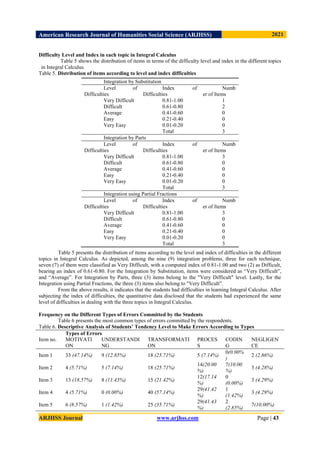
Table 5 shows the distribution of items in terms of the difficulty level and index in the different topics
in Integral Calculus.
Table 5. Distribution of items according to level and index difficulties
Table 5 presents the distribution of items according to the level and index of difficulties in the different
topics in Integral Calculus. As depicted, among the nine (9) integration problems, three for each technique,
seven (7) of them were classified as Very Difficult, with a computed index of 0.81-1.00 and two (2) as Difficult,
bearing an index of 0.61-0.80. For the Integration by Substitution, items were considered as “Very Difficult”,
and “Average”. For Integration by Parts, three (3) items belong to the "Very Difficult" level. Lastly, for the
Integration using Partial Fractions, the three (3) items also belong to "Very Difficult”.
From the above results, it indicates that the students had difficulties in learning Integral Calculus. After
subjecting the index of difficulties, the quantitative data disclosed that the students had experienced the same
level of difficulties in dealing with the three topics in Integral Calculus.
Frequency on the Different Types of Errors Committed by the Students
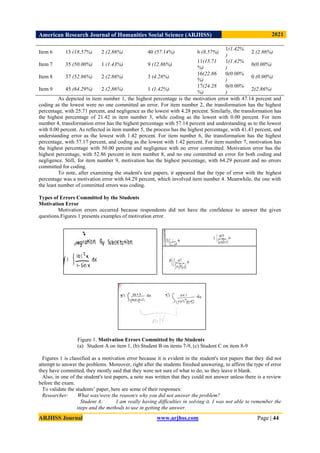
Table 6 presents the most common types of errors committed by the respondents.
Table 6. Descriptive Analysis of Students’ Tendency Level to Make Errors According to Types
Item no.
Types of Errors
MOTIVATI
ON
UNDERSTANDI
NG
TRANSFORMATI
ON
PROCES
S
CODIN
G
NEGLIGEN
CE
Item 1 33 (47.14%) 9 (12.85%) 18 (25.71%) 5 (7.14%)
0(0.00%
)
2 (2.86%)
Item 2 4 (5.71%) 5 (7.14%) 18 (25.71%)
14(20.00
%)
7(10.00
%)
3 (4.28%)
Item 3 13 (18.57%) 8 (11.43%) 15 (21.42%)
12(17.14
%)
0
(0.00%)
3 (4.29%)
Item 4 4 (5.71%) 0 (0.00%) 40 (57.14%)
29(41.42
%)
1
(1.42%)
3 (4.29%)
Item 5 6 (8.57%) 1 (1.42%) 25 (35.71%)
29(41.43
%)
2
(2.85%)
7(10.00%)
Integration by Substitution
Level of
Difficulties
Index of
Difficulties
Numb
er of Items
Very Difficult 0.81-1.00 1
Difficult 0.61-0.80 2
Average 0.41-0.60 0
Easy 0.21-0.40 0
Very Easy 0.01-0.20 0
Total 3
Integration by Parts
Level of
Difficulties
Index of
Difficulties
Numb
er of Items
Very Difficult 0.81-1.00 3
Difficult 0.61-0.80 0
Average 0.41-0.60 0
Easy 0.21-0.40 0
Very Easy 0.01-0.20 0
Total 3
Integration using Partial Fractions
Level of
Difficulties
Index of
Difficulties
Numb
er of Items
Very Difficult 0.81-1.00 3
Difficult 0.61-0.80 0
Average 0.41-0.60 0
Easy 0.21-0.40 0
Very Easy 0.01-0.20 0
Total 3
American Research Journal of Humanities Social Science (ARJHSS)R) 2021
ARJHSS Journal www.arjhss.com Page | 44
Item 6 13 (18.57%) 2 (2.86%) 40 (57.14%) 6 (8.57%)
1(1.42%
)
2 (2.86%)
Item 7 35 (50.00%) 1 (1.43%) 9 (12.86%)
11(15.71
%)
1(1.42%
)
0(0.00%)
Item 8 37 (52.86%) 2 (2.86%) 3 (4.28%)
16(22.86
%)
0(0.00%
)
0 (0.00%)
Item 9 45 (64.29%) 2 (2.86%) 1 (1.42%)
17(24.28
%)
0(0.00%
)
2(2.86%)
As depicted in item number 1, the highest percentage is the motivation error with 47.14 percent and
coding as the lowest were no one committed an error. For item number 2, the transformation has the highest
percentage, with 25.71 percent, and negligence as the lowest with 4.28 percent. Similarly, the transformation has
the highest percentage of 21.42 in item number 3, while coding as the lowest with 0.00 percent. For item
number 4, transformation error has the highest percentage with 57.14 percent and understanding as to the lowest
with 0.00 percent. As reflected in item number 5, the process has the highest percentage, with 41.43 percent, and
understanding error as the lowest with 1.42 percent. For item number 6, the transformation has the highest
percentage, with 57.17 percent, and coding as the lowest with 1.42 percent. For item number 7, motivation has
the highest percentage with 50.00 percent and negligence with no error committed. Motivation error has the
highest percentage, with 52.86 percent in item number 8, and no one committed an error for both coding and
negligence. Still, for item number 9, motivation has the highest percentage, with 64.29 percent and no errors
committed for coding.
To note, after examining the student's test papers, it appeared that the type of error with the highest
percentage was a motivation error with 64.29 percent, which involved item number 4. Meanwhile, the one with
the least number of committed errors was coding.
Types of Errors Committed by the Students
Motivation Error
Motivation errors occurred because respondents did not have the confidence to answer the given
questions.Figures 1 presents examples of motivation error.
Figure 1. Motivation Errors Committed by the Students
(a) Student A on item 1, (b) Student B on items 7-9, (c) Student C on item 8-9
Figures 1 is classified as a motivation error because it is evident in the student's test papers that they did not
attempt to answer the problems. Moreover, right after the students finished answering, to affirm the type of error
they have committed, they mostly said that they were not sure of what to do, so they leave it blank.
Also, in one of the student's test papers, a note was written that they could not answer unless there is a review
before the exam.
To validate the students’ paper, here are some of their responses:
Researcher: What was/were the reason/s why you did not answer the problem?
Student A: I am really having difficulties in solving it. I was not able to remember the
steps and the methods to use in getting the answer.
American Research Journal of Humanities Social Science (ARJHSS)R) 2021
ARJHSS Journal www.arjhss.com Page | 45
Student B: I had some blank entries because it was hard for me to recall all the rules
and the proper processes in executing the different ways of integration.
Student C: When I first look at it, it was hard; then I forgot also the process in solving.
To affirm a study conducted by Nurul Shida [1], motivation errors occurred because respondents did
not have the confidence to answer the given questions. The immediate respondents did not try to solve the given
questions.
The figures above support Ghazali and Rosli [6] study that on the student error analysis, the results
revealed that of all the questions given, most of the respondents make motivational mistakes. A question that
many respondents make motivational mistakes is a direct question or indirect question. According to their study,
nearly half the question integral to the respondent commits a motivation mistake.
Understanding Error
The understanding error may occur in all questions. This matter happened because students still did not
understand how to solve the problems.
This understanding error occurred because the students have read or seen the given questions, but they
did not understand the terminology, specific terms, or the whole given as shown in Figure 2.
Figure 2. Student D on item 6
In Figure 2, although the given problem was very clear and relatively easy to understand, it is
obvious to say that the student (1) did not understand the concept of the integration by parts which leads the
succeeding steps to be incorrect, (2) the student failed to integrate 𝑣 which is 𝑣𝑑𝑥 = cos 2𝑥𝑑𝑥 =
1
2
sin 2𝑥
which is crucial in obtaining the correct answer, (3) the student is not familiar with the rules of integration.
Integral of a product is not product of the integral of each factor, (4) student interprets cos 2𝑥 as (cos 2) (𝑥) , (5)
even if the solution is wrong, it is evident that the student does not know how to apply the power rule for
integration which is evident when the student handled 𝑥. 𝑥𝑑𝑥, and (6) since the problem is an indefinite
integration, the student failed to add a constant of integration 𝐶in the final answer. From the figure, the answer
is wrong and shows weak knowledge and technique in indefinite integration.
Here are some of the statements of the respondents to the problem that involves integration by
parts.
“Integration by parts is a long method, even though I know the formula to be used,
sometimes it’s confusing, specifically when to stop in doing the integration.”
Another student said,
“Integration by parts has a confusing process. I was confused on the formula, the one
with 𝑢𝑑𝑣 = 𝑢𝑣 − 𝑣𝑑𝑢, sometimes I interchanged them, the 𝑢 becomes 𝑢 and vice versa. From there, I
was wrong already until in the succeeding steps”.
The perceived lack of importance of concepts is the actual difficulty in studying and learning
the lesson. On the other hand, from a constructivists point of view, teachers must give clear concepts to the
students because the errors may derive from the experiences in the classroom particularly in the teaching
process. Hence, students learn by connecting new knowledge with knowledge and concepts they already know,
thereby constructing new meanings [32]. Research suggests that students connect knowledge most effectively in
active social classrooms, where they negotiate understanding through interaction and varied approaches.
Instructors should be aware that students, as novice learners, often possess less developed or incomplete
conceptual frameworks [11]. As a result, it may take time to learn how to "chunk" knowledge into similar,
American Research Journal of Humanities Social Science (ARJHSS)R) 2021
ARJHSS Journal www.arjhss.com Page | 46
retrievable categories, grow larger conceptual ideas, and interconnect ideas. They may also harbor
misconceptions or erroneous thinking, limiting, or weakening connections with new knowledge [22].
Figure 3. Student E on item 1
In Figure 3, the following are the errors committed by the student: (1) student fails to
recognize that the presence of the sin x in the denominator suggest recalling the basic identity 𝑠𝑖𝑛2
𝑥 + 𝑐𝑜𝑠2
𝑥 =
1 and that the substitution 𝑐𝑜𝑠2
𝑥 = 1 − 𝑠𝑖𝑛2
𝑥 must be done, (2) wrong application of the chain rule for
differentiation 𝑑 𝑐𝑜𝑠2
𝑥 = −2 cos 𝑥 sin 𝑥, (3) with all the wrong substitutions, the student’s final answer was
an expression containing 𝑑𝑥 . This indicates the lack of understanding of integration as an inverse operation of
differentiation.
During the examination, some students raised their concerns if they could have a copy of the
cheat sheet for trigonometry because they felt uncomfortable without the copy of trigonometric
identities/functions.
Here are some of the responses from the students.
“I forgot the trigonometric function and identities. Another student said, I am having
hard time remembering all of the identities. I was having a hard time to remember on how to solve it
because it’s a really hard lesson for me.”
Figure 4. Student F on item 3
In Figure 4, it is clearly an understanding error as shown by the following: (1) the student wrote down
−1 − 𝑥 2
instead of 𝑐𝑜𝑠 2
𝜃 = 1 − 𝑥 2
, (2) the expression
sin 𝜃 cos 𝜃
cos 𝜃
= sin 𝜃 and the student wrote
sin 𝜃
cos 𝜃
which
is carelessness, (3) Another error in this solution is, although the answer is wrong, the student failed to integrate
tan 𝜃𝑑𝜃 correctly, and simply ignored it and wrote the final answer as −2, and (4) the lack of knowledge that
answer to an indefinite integration problem always has a + 𝐶 , the constant of integration.
To validate the students’ paper, here are some of their responses:
Researcher: Some of the problems required the use of trigonometric function/identities, what
was/were the reasons of failing to do it?
“I forgot the corresponding trigonometric identities that should be used, there are
lots of trigonometric identities and I failed to memorize all those. Another student also said, I had a
weak knowledge in the identities; I forgot the basics of trigonometric functions”.
Transformation Error
American Research Journal of Humanities Social Science (ARJHSS)R) 2021
ARJHSS Journal www.arjhss.com Page | 47
Transformation errors happen at every problem that is being solved. Figure 5 shows that the students
do not understand the formulas well or do not know the formulas.
Figure 5. Student G on item 2
Figure 5 is a transformation error because the student fails to remember the formula for the integral
which is 𝑒 𝑢
𝑑𝑢 = 𝑒 𝑢
+ 𝐶 . In an informal interview, the student saw a series of examples like this, but he
forgot how to apply the formula. The solution in figure 5 is an affirmation of a transformation error because the
student still memorizes the formulas without even understanding them.
This affirms the study of Nurul [1] that transformation errors happened at every number. This showed
that students did not understand the formulas well. It was because the students were still memorizing formulas
without even understanding them.
The transformation error in Figure 5 is also supported by Rokhimah [13] when students cannot plan a
solution to solve the problem, cannot determine which formula is applicable, do not have many exercises, and
cannot determine the mathematical operations be used.
Figure 6. Student H on item 1
In Figure 6, the student fails to recognize that the presence of the sin 𝑥 in the denominator suggest recalling
the basic identity 𝑠𝑖𝑛 2
𝑥 + 𝑐𝑜𝑠 2
𝑥 = 1 and that the substitution𝑐𝑜𝑠 2
𝑥 = 1 − 𝑠𝑖𝑛 2
𝑥 must be done. In
addition, the student failed to recognize that 1 − 𝑠𝑖𝑛 2
𝑥 can be factored as 1 + 𝑠𝑖𝑛𝑥 (1 − sin 𝑥 ), thus a
simpler integrand could have been obtained which is 1 + 𝑠𝑖𝑛𝑥 .
Figure 7. Student I on item 6
American Research Journal of Humanities Social Science (ARJHSS)R) 2021
ARJHSS Journal www.arjhss.com Page | 48
In Figure 7, the student understands the problem; however, the student failed to recognize the correct
formula for integration by parts which is 𝑢𝑑𝑣 . In the solution, the student failed to show the value of 𝑣
which is 𝑣 =
1
2
sin 2𝑥 which leads the student to the incorrect application to the formula.
Process Error
Process error occurs when students can identify the appropriate operation or series of operations but did
not know the necessary measures to carry out these operations perfectly. Students can find the formula to be
used, but students are less conscientious in carrying out the operation as shown in Figure 8.
Figure 8. Student J on item 8
In Figure 8, the student understands the concept, knows how to use the formula; however, (1) the
student was careless in doing the basic algebra and wrote down the value of 𝐴 =
2
5
instead of 𝐴 =
3
5
which leads
the answer to be incorrect. The student knows the process of resolving a fraction into its partial fractions. (2) It
also evident in the solution that another error was setting the sum of the two integrals to zero, (3) Lastly, due to
carelessness, the student failed to include 𝑑𝑥 in both integrals whose sum was equated to zero. It revealed that
deficiencies in algebra and precalculus skills continue affect the performance of the students when taking
Calculus courses [25]. Accordingly, students' knowledge of Algebra and understanding of Trigonometry has a
significant impact on Calculus's performance [9]
A student said, “I was confused, careless and do not know the process and most and foremost, weak
knowledge”.
Figure 9. Student K on item 4
The student who answered the problem in Figure 9 clearly understands the problem's
procedure/integration technique and how to feasibly arrive on a correct answer. However, the only error here is
wrong simplification. The student replaced
1
3
𝑤𝑖𝑡 ℎ 3 𝑎𝑛 𝑑
1
9
𝑤𝑖𝑡 ℎ 9.
Figure 10. Student L on item 6
American Research Journal of Humanities Social Science (ARJHSS)R) 2021
ARJHSS Journal www.arjhss.com Page | 49
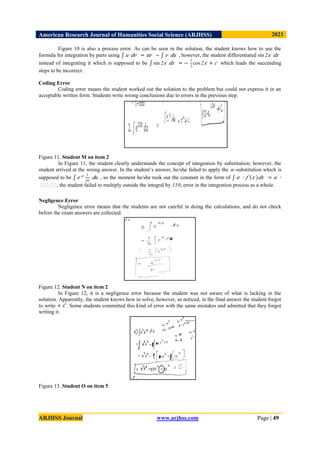
Figure 10 is also a process error. As can be seen in the solution, the student knows how to use the
formula for integration by parts using 𝑢 𝑑𝑣 = 𝑢𝑣 − 𝑣 𝑑𝑢 , however, the student differentiated sin 2𝑥 𝑑𝑥
instead of integrating it which is supposed to be sin 2𝑥 𝑑𝑥 = −
1
2
cos 2𝑥 + 𝑐 which leads the succeeding
steps to be incorrect.
Coding Error
Coding error means the student worked out the solution to the problem but could not express it in an
acceptable written form. Students write wrong conclusions due to errors in the previous step.
Figure 11. Student M on item 2
In Figure 11, the student clearly understands the concept of integration by substitution; however, the
student arrived at the wrong answer. In the student’s answer, he/she failed to apply the 𝑢 -substitution which is
supposed to be 𝑒 𝑢 1
10
𝑑𝑢 , so the moment he/she took out the constant in the form of 𝑎 ∙ 𝑓 𝑥 𝑑𝑥 = 𝑎 ∙
�
�
�
�
, the student failed to multiply outside the integral by 110; error in the integration process as a whole.
Negligence Error
Negligence error means that the students are not careful in doing the calculations, and do not check
before the exam answers are collected.
Figure 12. Student N on item 2
In Figure 12, it is a negligence error because the student was not aware of what is lacking in the
solution. Apparently, the student knows how to solve, however, as noticed, in the final answer the student forgot
to write + 𝐶 . Some students committed this kind of error with the same mistakes and admitted that they forgot
writing it.
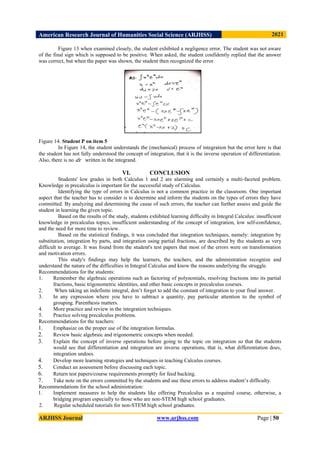
Figure 13. Student O on item 5
American Research Journal of Humanities Social Science (ARJHSS)R) 2021
ARJHSS Journal www.arjhss.com Page | 50
Figure 13 when examined closely, the student exhibited a negligence error. The student was not aware
of the final sign which is supposed to be positive. When asked, the student confidently replied that the answer
was correct, but when the paper was shown, the student then recognized the error.
Figure 14. Student P on item 5
In Figure 14, the student understands the (mechanical) process of integration but the error here is that
the student has not fully understood the concept of integration, that it is the inverse operation of differentiation.
Also, there is no 𝑑𝑥 written in the integrand.
VI. CONCLUSION
Students' low grades in both Calculus 1 and 2 are alarming and certainly a multi-faceted problem.
Knowledge in precalculus is important for the successful study of Calculus.
Identifying the type of errors in Calculus is not a common practice in the classroom. One important
aspect that the teacher has to consider is to determine and inform the students on the types of errors they have
committed. By analyzing and determining the cause of such errors, the teacher can further assess and guide the
student in learning the given topic.
Based on the results of the study, students exhibited learning difficulty in Integral Calculus: insufficient
knowledge in precalculus topics, insufficient understanding of the concept of integration, low self-confidence,
and the need for more time to review.
Based on the statistical findings, it was concluded that integration techniques, namely: integration by
substitution, integration by parts, and integration using partial fractions, are described by the students as very
difficult to average. It was found from the student's test papers that most of the errors were on transformation
and motivation errors.
This study's findings may help the learners, the teachers, and the administration recognize and
understand the nature of the difficulties in Integral Calculus and know the reasons underlying the struggle.
Recommendations for the students:
1. Remember the algebraic operations such as factoring of polynomials, resolving fractions into its partial
fractions, basic trigonometric identities, and other basic concepts in precalculus courses.
2. When taking an indefinite integral, don’t forget to add the constant of integration to your final answer.
3. In any expression where you have to subtract a quantity, pay particular attention to the symbol of
grouping. Parenthesis matters.
4. More practice and review in the integration techniques.
5. Practice solving precalculus problems.
Recommendations for the teachers:
1. Emphasize on the proper use of the integration formulas.
2. Review basic algebraic and trigonometric concepts when needed.
3. Explain the concept of inverse operations before going to the topic on integration so that the students
would see that differentiation and integration are inverse operations, that is, what differentiation does,
integration undoes.
4. Develop more learning strategies and techniques in teaching Calculus courses.
5. Conduct an assessment before discussing each topic.
6. Return test papers/course requirements promptly for feed backing.
7. Take note on the errors committed by the students and use these errors to address student’s difficulty.
Recommendations for the school administration:
1. Implement measures to help the students like offering Precalculus as a required course, otherwise, a
bridging program especially to those who are non-STEM high school graduates.
2. Regular scheduled tutorials for non-STEM high school graduates.
American Research Journal of Humanities Social Science (ARJHSS)R) 2021
ARJHSS Journal www.arjhss.com Page | 51
3. Provision of online platforms (Khan Academy, ebooks, and etc.)
4. Provide internet connection to the students for educational purposes (e.g. online resources).
5. Computers in the library with internet connection and discussion rooms.
6. Come up a learning resource center for students where they can have the tutorials, review sessions, and
other educational activities.
VII. ACKNOWLEDGMENT
This humble piece of work is tenderly dedicated to the researcher's parents, who serve as his
inspiration, to the love of his life, and all the people who always make things positive throughout this writing.
To ALMIGHTY GOD, who serves as guidance and the source of strength and knowledge, without his
guidance, everything is futile.
REFERENCES
[1]
N. N. A. S. A. H. Nurul Shida, "Investigating Newman’s Error In Integral Calculus," International Journal of
Innovative Technology and Exploring Engineering (IJITEE), Vols. ISSN: 2278-3075, Volume-8, no.
Issue-6, April 2019 , 2019.
[2]
U. I. Kusuma, "Analysis of Sixth Graders’ Difficulties in Solving Mathematics," Journal of Physics:
Conference Series 1320 012008, p. 9, 2019.
[3] U. A. S. M. &. F. Y. Sumule, "Error Analysis of esian Junior High School Student in Solving Space and
Shape Content PISA Problem Using Newman Procedure," 2018.
[4] Z. R. G. Z. A. &. R. R. Azrin, "ANALISIS KESILAPAN PELAJAR MENGAPLIKASIKAN
PENGIRAAN DALAM TOPIK PENGAMIRAN," p. 247–255, 2017.
[5] S. N. e. Ahmad, "Factors Related to Students' Performance in Calculus," Journal of Applied
Environmental and Biological Sciences, p. 7, 2017.
[6] R. R. Zul Azrin Ghazali, "ANALISIS KESILAPAN PELAJAR MENGAPLIKASIKAN PENGIRAAN
DALAM TOPIK PENGAMIRAN," 2017.
[7] C. CMO, "CHED Memorandu Order Number 48, Series of 2017," 2017.
[8] J. L. (. Berggren, "Calculus: Mathematics. Encyclopedia Britannica. Retrieved from Floredeliza P. Ferrer.
INVESTIGATING STUDENTS’ LEARNING DIFFICULTIES IN INTEGRAL CALCULUS," 2016.
[9] F. P. Ferrer, "INVESTIGATING STUDENTS’ LEARNING DIFFICULTIES IN INTEGRAL
CALCULUS," PEOPLE: International Journal of Social Sciences, Vols. Volume 2 Issue 1, pp. 310-
324 , ISSN 2454-5899 , p. 15, 2016.
[10] M. Ncube, "Analysis of errors made by learners in simplifying algebraic expressions at grade 9 level,"
2016.
[11] N. Kober, "Reaching Students: What Research Says About Effective Instruction in Undergraduate Science
and Engineering.," Board on Science Education, Division of Behavioral and Social Sciences and
Education. Washington, DC: National Academies Press. , 2015.
[12] A. K. H. N. &. W. A. W. S. Veloo, "Types of Student Errors in Mathematical Symbols, Graphs and
Problem-Solving," Asian Social Science, pp. 11(15), 324–334., 2015.
[13]
S. S. A. &. S. Y. L. Rokhimah, "Students Error Analysis in Solving Math Word Problems of Social Arithmetic
Material for 7th Grade Based on Newman Procedure," Proceeding in International Conference on
Conservation for Better Life, pp. 349–356. Retrieved from Nurul Shida, Norulhuda, Nurul Aini, Sharifah,
Abdul Halim, 2019. Investigating Newman’s Error. International Journal of Innovative Technology and
Exploring Engineering (IJITEE), 2015.
[14] S. B. M. N. U. &. A. F. A. Maisurah Shamsuddin, "MATHEMATICAL ERRORS IN ADVANCED
CALCULUS: A SURVEY AMONG ENGINEERING STUDENTS," 2015.
[15] M. Isack, "FACTORS LEADING TO POOR PERFORMANCE IN MATHEMATICS," p. 88, 2015.
[16]
I. S. A. S. E. &. E. C. K. Junaedi, "Disclosure Causes of Students Error in Resolving Discrete Mathematics
Problems Based on NEA as A Means of Enhancing Creativity," International Journal, pp. 7(4), 31, 2015.
[17] A. H.-p. M. V. D. D. M. &. R. A. Wijaya, "Difficulties in solving context-based PISA mathematics tasks :
An analysis of students ’ errors.," The Mathematics Enthusiast, pp. 11(3),, 2014.
[18]
I. Cruz, 2014. [Online]. Available: https://www.pressreader.com/philippines/the-philippine-
star/20140703/281741267516628.
American Research Journal of Humanities Social Science (ARJHSS)R) 2021
ARJHSS Journal www.arjhss.com Page | 52
[19] M. A. D. Patena and D. B. L. H. Dinglasan, "STUDENTS’ PERFORMANCE ON MATHEMATICS
DEPARTMENTAL EXAMINATION: BASIS FOR MATH INTERVENTION PROGRAM," Asian
Academic Research Journal of Social Sciences & Humanities, Vols. Volume 1, ISSN : 2278 – 859X ,
no. Issue 14, p. 18, 2013.
[20] M. I. e. Núñez-Peña, "Math Anxiety Efrfects on Student Success on Higher Education," International
Journal of Educational Research, p. 28, 2013.
[21] P. C. Jonatan Muzangwa, "ANALYSIS OF ERRORS AND MISCONCEPTIONS IN THE LEARNING
OF CALCULUS BY UNDERGRADUATE STUDENTS," vol. Volume 5 Number 2, 2012.
[22] S. B. M. L. M. D. M. &. N. M. Ambrose, "How Learning Works: 7 Research – Based Principles for Smart
Teaching. San Francisco: Jossey-Bass.," 2010.
[23] K. &. M. P. J. Luneta, "Learner Errors and Misconceptions in Elementary Analysis : A Case Study of a
Grade 12 Class in South Africa, Acta Didactica Napocensia," 2010.
[24] R. A. Tarmizi, "Visualizing Student's Difficulties in Learning Calculus," International Conference on
Mathematics Education Research 2010 (ICMER 2010) , 2010.
[25]
I. &. S. M. Effandi, "Analysis of Students’ Error in Learning of Quadratic Equations," International Education
Studies, pp. 3(3),105–110, 2010.
[26] M. N. &. A. M. A. Agustin, "Algebra and Precalculus Skills and Performance in First-Semester Calculus,"
International Journal of Case Method Research & Application,XXI(3), 232-236., no. ISSN 2457-
0648, p. 21, 2009.
[27] N. &. N. S. Prakitipong, "Analysis of mathematics performance of grade five students in Thailand using
Newman procedure," Journal of International Cooperation, pp. Retrieved from Nurul Shida,
Norulhuda, Nurul Aini, Sharifah, Abdul Halim. Investigating Newman’s Error. International Journal
of Innovative Technology and Exploring Engineering (IJITEE). ISSN: 2278-3075, Volume-8 Issue-6,
April 2019, 2006.
[28] M. Legutko, "An analysis of students’ mathematical errors in the teachingresearch process. In B.
Czarnocha (Ed.), Handbook for mathematics teaching: Teacher experiment. A tool for research (pp.
141–152). Rzeszόw: University of Rzeszόw.," 2008.
[29] X. Li, " Cognitive Analysis of students’ errors and misconceptions in variables, equations," Journal for
Research in Mathematics Education., 2006.
[30] M. Mwavitam, "Factors Influencing Calculus Course Success Among Freshmen Engineering Students,"
Retrieved, http://citeseerx.ist.psu.edu/viewdoc/download?doi=10.1.1.634.2513&rep=rep1&type=pdf,
p. 172, 2005.
[31] B. M. Moskal, "Calculus: Mathematics.," 2002.
[32] N. Idris, "Pedagogi dalam pendidikan Matematik," 2001.
[33] NRC, "National Research Council. How People Learn: Brain, Mind, Experience, and School: Expanded
Edition. Washington, DC: The National Academies Press.," 2000.
[34] A. Olivier, "Handling pupils’ misconceptions," 1989.
[35] M. A. Newman, "An analysis of sixth-grade pupils' errors on written mathematical," Victorian Institute for
Educational Research Bulletin, pp. 39, 31-43, 1977.
[36] M. Clements, "Analysing children's errors on written mathematical tasks.," Educational Studies in
Mathematics, pp. 11 (1), 1-21., 1980.
*Corresponding author:Robert Jay N. Angco
(Department of Mathematics and Statistics, Cebu Technological University, Philippines)

F493852.pdf

  • 1.
    American Research Journalof Humanities Social Science (ARJHSS)R) 2021 ARJHSS Journal www.arjhss.com Page | 38 American Research Journal of Humanities Social Science (ARJHSS) E-ISSN: 2378-702X Volume-04, Issue-09, pp-38-52 www.arjhss.com Research Paper Open Access Error Analysis in Integral Calculus: A Modified Newman’s Approach Robert Jay N. Angco Department of Mathematics and Statistics, Cebu Technological University, Philippines I. INTRODUCTION Mathematics has been recognized as a major factor in development which also contributes to many fields and is therefore emphasize in the national agenda. An alarming observation of Filipino students reveals that they excel in knowledge acquisition but fare considerably low in lessons requiring higher-order thinking skills [19]. Hence, mathematics is essential in the school curriculum since it is a crucial mode of thinking that helps students acquire some skills in many fields. Therefore, mathematics plays an important role in helping students develop the necessary skills in all their endeavors. Math is a very important subject. This subject is taken by all students especially in the sciences at various levels of study. Learning mathematics is not just about calculations, memorization of formulas, or theories; even mathematical learning involves research, testing, and problem-solving [32]. Teaching and learning mathematics aim to encourage and stimulate logical thinking, enhance good decision-making, and connect school to everyday life. Several students find mathematics interesting to study, while others find it difficult to understand. Hence, some students begin to struggle and will need appropriate help to pursue further mathematics [24]. Among all the major areas in mathematics, Calculus is known to be one of the stimulating and exciting educational experiences. For this to happen, a student must enter into the Calculus course with a knowledge of certain precalculus courses such Algebra, Trigonometry, and Analytic Geometry. Calculus is considered an important subject of study for both high school and college students because it is used in a broad range of disciplines for various purposes [31]. According to Berggren [8], Calculus is a branch of mathematics that deals with calculating instantaneous rates of change, differential calculus, and the summation of infinitely many small factors to determine some whole, known as Integral Calculus. However, an increasing number of investigations have shown that students have difficulties understanding the concept of Integral Calculus [9]. Therefore, it is essential to investigate the errors, misconceptions, and mistakes of the students in learning integral calculus for some possible diagnosis and remediation. Taking advantage of such errors as learning opportunities to understand the subject matter and choose the most helpful learning strategies. ABSTRACT:This study aimed to investigate the types of errors faced by undergraduate students when solving Integral Calculus problems. Participants in this study were given nine (9) problems categorized as follows: Integration by Substitution, Integration by Parts, and Integral Using Partial Fractions. Quantitative data disclosed that the students had experienced the same level of difficulties in dealing with the three topics in Integral Calculus. The qualitative data revealed that most of the errors committed were under the Transformation and Motivation Error. The findings of the study may help the learners, teachers, and the administration recognize and understand the nature of the difficulties in Integral Calculus and know the reasons underlying their struggle. Students should remember the algebraic operations and trigonometric identities. While teachers should emphasize on the proper use of integration formulas and do some review on basic algebraic concepts. Keywords-Integral calculus, Integration by substitution, Integration by parts, Integration using partial fractions, Types of error
  • 2.
    American Research Journalof Humanities Social Science (ARJHSS)R) 2021 ARJHSS Journal www.arjhss.com Page | 39 II. RELATED LITERATURE Misconceptions, errors, and mistakes play an essential role in the learning process of the students. Mistakes serve as a strong point of the students and can learn from it, allowing them to grow even more. However, if not addressed properly, these misconceptions, errors, and mistakes can bring a negative impact, especially in the development and in the students' learning process. Type Classification Guide from Newman Error Hierarchy Model Most misconceptions in mathematics are like challenges to students [12], which will lead them to commit errors and poor performance [17]. Weakness in understanding the basic concepts may lead them to use the wrong strategy when solving mathematical questions [14]. Methods were developed by Newman [35] and Clements [36] for analyzing errors. Emphasis is given to Newman's hierarchy of error causes. The researcher modified the Newman’s Error Hierarchy Model and did not include the reading and comprehension errors which are not essential and not applicable in this study. The researcher focused on the following types of errors. Motivation error means that students did not have the confidence to answer the given questions. The immediate respondents did not try to solve the given questions. Respondents could not answer because they did not understand the question [1]. Understanding error means that the students still did not understand how to solve the given problems. The students have read or seen the given problems; however, they did not understand the terminology, specific terms, or the whole process and concept [1]. Transformation error means that students do not understand well the formulas that are used to solve the problem; students are unable to determine which formula to use for solving a problem; students cannot appropriately determine a mathematical operation or set of operations to solve problems in a question; or students can't recognize the operation or a set of operations [13]. It also means that students cannot plan a solution to solve the problem and students do not have many exercises. This shows that students do not understand formulas well. It is because students still memorize the formulas without understanding them. According to Wijaya [17], as cited by Nurul Shida [1], errors in transforming a word problem into a proper mathematical problem will indicate that students have problems in computations and apply the formula or forget a formula that utilized or technique on what to do. Therefore, students cannot select appropriate mathematical operations or procedures. The transformation error happens because the student cannot choose the formula or plan an answer to solve it [3]. Transformation errors can be avoided if respondents understand the concepts and mathematical sentences [6]. According to Nurul Shida[1], transformation error occurs in a solution involving a mathematical problem. The respondents face problems translating the mathematical problems from the word form and description into the mathematical form. If the students cannot interpret the question to the appropriate forum, they may choose the wrong strategy and operation to resolve the problem. Most respondents found difficulty concluding the mathematical sentences because they might not be exposed to the connection between their existing experiences with the concept to be taught and could not think and learn the common way or strategy in problem-solving. Process skills occur when students are not aware of making mistakes in a summation operation and cannot operate to simplify fractions, thus causing errors in performing mathematical procedures [27]. In the meantime, students also encounter challenges in replacing the positive and negative signs, resulting in errors when the formula is used [25]. Process error can also be seen in the unfinished answer, when students use a correct formula or procedure, but they do not finish it. Coding error is to represent the mathematical solution into an acceptable written form. Still, the students cannot effectively interpret and validate the mathematical solution in terms of the real-world problem [23]. This error is reflected by an impossible or not reasonable answer [17]. Encoding error means that students cannot give an appropriate conclusion because there is an error in the calculation result since they cannot answer according to the question [16]. The coding error involved the interpretation of mathematical solutions in connection to the original problem situation, validating the interpreted mathematical solution by checking whether this is appropriate and reasonable for its purpose [17]. This implies that teachers are proposed to use scaffolding to overcome errors so that errors don't occur once more [3]. Carelessness happens in transcribing information from the question [12]. Negligence/carelessness means that students are not careful when they calculate but can correct it immediately without guidance from the researcher [13]. Students are not careful in doing the calculations and do not check before the exam answers are collected. Students do not read carefully to what is given [13]. Errors are caused by students' carelessness [16]. For negligence errors, students were needed to discover the cause of their errors. Therefore, understanding of calculation operation procedures is needed again and do more exercises. Next, students should not disregard basic mathematical skills that include addition, subtraction, multiplication, and division [24].
  • 3.
    American Research Journalof Humanities Social Science (ARJHSS)R) 2021 ARJHSS Journal www.arjhss.com Page | 40 Mastery of these skills is deficient if the students could not show the mathematical steps neatly and efficiently [12]. Error types in mathematics [34] differentiates errors from slips and misconceptions. He defines an error as wrong answers due to planning that are systematic in that they are applied regularly in the same circumstances. Slips, on the other hand, are described as wrong answers due to processing. Unlike errors, they are not systematic but are sporadically and carelessly made by both experts and novices. They are easily detected and corrected. Misconceptions are referred to as underlying conceptual structures that give rise to errors. Thus, it could be argued that errors are indicators of the existence of misconceptions. Errors have been classified differently by various researchers and mathematics educators. According to Legutko[27], a mathematical error is made by a person (student, teacher) who, in a given moment, considers an untrue sentence as mathematically true. Mathematical errors include giving an incorrect definition of a mathematical concept and a wrong application of the definition, making a generalization after observing a few particular cases, and incorrect use of mathematical terms. According to Li [29], student errors are a symptom of misunderstanding. Among many different types of errors, systematic errors occur to many students over a long-time period. It is relatively easy and thus possible to research with current knowledge and tools. The cause of systematic errors may relate to students' procedure knowledge, conceptual knowledge, or links between these two types of knowledge [29]. Generally, misconceptions manifest through errors. An error can be a mistake, blunder, miscalculation, or misjudge, and such a category falls under unsystematic errors [21]. Some people do not like to be proven wrong and will continue clinging to a misconception in the face of evidence to the contrary. Misconceptions cause errors, and the latter is attributed to a lack of conceptualization and understanding. According to Ncube [10], misconceptions are habitual and cannot be solved easily. In the study of Ncube [10] with Grade 11 learners after they had written an algebra test, he discovered that learners' errors occur frequently and repeatedly. In concluding his study, Ncube [10] then recommended that teachers and learners need to talk about misconceptions during the teaching and learning process to identify ways of doing away with them. Another factor that affects the students' performance is mathematical anxiety, and negative attitudes towards mathematics. Students who did not pass Calculus show a higher level of mathematical anxiety (more specifically, a math test and math course anxiety) and a lower level of enjoyment, motivation, and self- confidence in mathematics than those who passed it [20]. The negative effect of mathematical anxiety is defined as a feeling of panic, helplessness, paralysis, and mental disorganization that arises among some people when they are required to solve a mathematical problem. Taken from the CHED Memorandum Order Number 48, Series of 2017 [7], Calculus 1 is the first course in Calculus. It covers limits, continuity, derivatives of algebraic and transcendental functions, applications of derivatives, differentials and applications of definite integrals. Meanwhile, Calculus 2 covers techniques of integration, parametric equations and polar coordinates, cylindrical surfaces, surfaces of revolution, partial derivates and total differential. According to the study of Ahmad [5] students' behavior and students' preference were considered as the main factors that may be related to students' performance in Calculus. The study shows that the only factor related to the students' performance in Calculus is students' behavior (self-effort). On the other hand, students' preference in terms of lecturers' attitude and class size are the same regardless of their scores in Calculus. Lastly, self-effort is the factor that is related to the students' performance in Calculus. According to Ferrer [9], students' learning difficulties in Integral Calculus are evidently based on Trigonometry's weak knowledge. Similarly, findings by Iheanachor (2007), as cited by Isack[15] indicate that there is a significant positive relationship between students' academic achievement in mathematics and teachers' backgrounds. Teachers who have good qualifications in mathematics (highest educational attainment, subject handled, and years of experience especially from six years of experience) have their students performing better in mathematics. According to Tata (2013) as cited by Isack [15], made his study in Nigeria and found that students' negative attitudes toward mathematics, fear of mathematics, inadequate qualified teachers, and inadequate teaching materials were some of the causes student’s poor mathematics performance. Developing a positive attitude, motivation, and proper guidance toward mathematics and providing relevant teaching materials could make students perform better in mathematics. According to Mwavitam[30], struggles with mathematics courses at the junior and high school level often lead to an overall weak background in Calculus and may contribute to performance difficulties among freshman engineering students. Another causative factor that will lead to an incorrect answer is inaccuracy. Inaccuracy due to haste is a common cause of errors by students in answering questions, not only in working on
  • 4.
    American Research Journalof Humanities Social Science (ARJHSS)R) 2021 ARJHSS Journal www.arjhss.com Page | 41 word problems but also in other forms of questions, even in other subjects. In this study, the inaccuracy factor was caused by students hurrying in working on the problem [2]. III. OBJECTIVE OF THE STUDY This study investigated the types of errors faced by undergraduate students in the different degree programs when solving Integral Calculus problems, particularly the following integration techniques: integration by substitution, integration by parts, and integration by partial fractions. This also identified the level and index of difficulty on the different topics in Integral Calculus. IV. METHODOLOGY Related to the data, purpose, and usefulness of this research, this research was mixed quantitative and qualitative since the researcher administered a written examination on some topics of Integral Calculus and interviewed the respondents. This study's quantitative results were calculated to identify their performance, then qualitatively analyzed to identify their difficulties. Research Respondents Students from the different degree programs were the respondents of this study. These different degree programs were from different colleges, namely: College of Arts and Sciences and from the College of Engineering. The respondents of this study were those who have taken the Integral Calculus subject. Table 1 shows the distribution of the number of respondents in this study. Table 1. Distribution of the Number of Respondents Scoring Procedure Table 2. Index Level of Difficulty Adopted from the study of Ferrer, F.P. (2016) on Investigating Students’ Learning Difficulties in Integral Calculus. V. RESULTS AND DISCUSSIONS This section presents the results and analysis of the data. Profile of the Respondents Table 3 presents the respondents' profile in terms of their Calculus 1 and 2 grades and their Academic Strand during their Senior High School. College Degree Program No. of Respondents College of Arts and Sciences Bachelor of Science in Mathematics (BSMath) 23 Bachelor of Science in Statistics (BSStat) 24 College of Engineering Bachelor of Science in Civil Engineering (BSCE) 23 Level of Difficulties Index of Difficulties Very Difficult 0.81-1.00 Difficult 0.61-0.80 Average 0.41-0.60 Easy 0.21-0.40 Very Easy 0.01-0.20
  • 5.
    American Research Journalof Humanities Social Science (ARJHSS)R) 2021 ARJHSS Journal www.arjhss.com Page | 42 Table 3. Calculus 1 and 2 Grades of the Respondents (n=70) Calculus 1 Calculus 2 Grade Range Frequency Percentage (%) Frequency Percentage (%) 1.2-1.5 2 2.86 2 2.86 1.6-1.9 4 5.71 8 11.43 2.0-2.3 16 22.86 14 20.00 2.4-.27 22 31.43 13 18.57 2.8-3.0 26 37.14 33 47.14 Total 70 100.00 70 100.00 Table 3 reflects the respondents' profile in terms of their grades for both Calculus 1 and 2. As depicted, out of 70 respondents, 37.14 percent or 26 respondents have a grade in Calculus 1 between 2.8-3.0, while only 2.86 percent or two (2) respondents have a grade in Calculus 1 between 1.2-1.5. Based on the University's Student Manual 2015 Edition, most of the students belong to a category of Fair, whose grade range is 2.8-3.0. It can be implied that the students had a hard time coping with the Calculus 1 course. In addition, according to Mwavitam [29] struggles with mathematics courses at the junior and high school level often lead to an overall weak background in calculus and may contribute to performance difficulties among freshman engineering students. The data is also supported by the study of Ahmad [5] Students' behavior or self -effort and students' preference were considered the main factors related to students' performance in Calculus. Moreover, another factor that might affect the students' grades is the delivery of the lesson or the teacher factor. The students' low grades, as reflected, also confirms the study of Isack [15] that there is a significant positive relationship between students' academic achievement in mathematics and teachers' background. Teachers who have good qualifications in mathematics have their students performing better in mathematics. As reflected in table 4, it shows that fifty-nine percent are Science, Technology, Engineering, and Mathematics (STEM) students enrolled in different degree programs. The figures show that the rest of forty-one percent were distributed into the different academic strands, where Mathematics was not the focus. Table 4. Academic Strands of the Respondents (n=70) As depicted, it can be implied that most of the students who are enrolled in the program were mathematically inclined. Meanwhile, for non-STEM graduates, their academic strand/track was not the basis for enrolling in Math courses. Hence, when students were asked why they enrolled in a program with Calculus courses, they just want to enroll in engineering and other related programs. Those who belong to sciences especially the BS Statistics program said they do not have a choice because it is a required course. In the engineering program of the university, the college is strict in accepting enrollees and requires that their academic strands must be aligned with STEM. However, the college had no choice but to follow the memorandum from CHED to accept students regardless of their strand/track where they have graduated from. The STEM students are most likely to enroll in degree programs with Calculus courses and are presumed to be more literate in mathematics. Thus, capable of undertaking advanced mathematics courses like Calculus 1 [18]. Academic Strand Frequency Percentage (%) ABM 7 10.00 GAS 5 7.14 HUMSS 4 5.71 STEM 41 58.57 TVL 4 5.71 NO STRAND 9 12.86 Total 70 100.00
  • 6.
    American Research Journalof Humanities Social Science (ARJHSS)R) 2021 ARJHSS Journal www.arjhss.com Page | 43 Difficulty Level and Index in each topic in Integral Calculus Table 5 shows the distribution of items in terms of the difficulty level and index in the different topics in Integral Calculus. Table 5. Distribution of items according to level and index difficulties Table 5 presents the distribution of items according to the level and index of difficulties in the different topics in Integral Calculus. As depicted, among the nine (9) integration problems, three for each technique, seven (7) of them were classified as Very Difficult, with a computed index of 0.81-1.00 and two (2) as Difficult, bearing an index of 0.61-0.80. For the Integration by Substitution, items were considered as “Very Difficult”, and “Average”. For Integration by Parts, three (3) items belong to the "Very Difficult" level. Lastly, for the Integration using Partial Fractions, the three (3) items also belong to "Very Difficult”. From the above results, it indicates that the students had difficulties in learning Integral Calculus. After subjecting the index of difficulties, the quantitative data disclosed that the students had experienced the same level of difficulties in dealing with the three topics in Integral Calculus. Frequency on the Different Types of Errors Committed by the Students Table 6 presents the most common types of errors committed by the respondents. Table 6. Descriptive Analysis of Students’ Tendency Level to Make Errors According to Types Item no. Types of Errors MOTIVATI ON UNDERSTANDI NG TRANSFORMATI ON PROCES S CODIN G NEGLIGEN CE Item 1 33 (47.14%) 9 (12.85%) 18 (25.71%) 5 (7.14%) 0(0.00% ) 2 (2.86%) Item 2 4 (5.71%) 5 (7.14%) 18 (25.71%) 14(20.00 %) 7(10.00 %) 3 (4.28%) Item 3 13 (18.57%) 8 (11.43%) 15 (21.42%) 12(17.14 %) 0 (0.00%) 3 (4.29%) Item 4 4 (5.71%) 0 (0.00%) 40 (57.14%) 29(41.42 %) 1 (1.42%) 3 (4.29%) Item 5 6 (8.57%) 1 (1.42%) 25 (35.71%) 29(41.43 %) 2 (2.85%) 7(10.00%) Integration by Substitution Level of Difficulties Index of Difficulties Numb er of Items Very Difficult 0.81-1.00 1 Difficult 0.61-0.80 2 Average 0.41-0.60 0 Easy 0.21-0.40 0 Very Easy 0.01-0.20 0 Total 3 Integration by Parts Level of Difficulties Index of Difficulties Numb er of Items Very Difficult 0.81-1.00 3 Difficult 0.61-0.80 0 Average 0.41-0.60 0 Easy 0.21-0.40 0 Very Easy 0.01-0.20 0 Total 3 Integration using Partial Fractions Level of Difficulties Index of Difficulties Numb er of Items Very Difficult 0.81-1.00 3 Difficult 0.61-0.80 0 Average 0.41-0.60 0 Easy 0.21-0.40 0 Very Easy 0.01-0.20 0 Total 3
  • 7.
    American Research Journalof Humanities Social Science (ARJHSS)R) 2021 ARJHSS Journal www.arjhss.com Page | 44 Item 6 13 (18.57%) 2 (2.86%) 40 (57.14%) 6 (8.57%) 1(1.42% ) 2 (2.86%) Item 7 35 (50.00%) 1 (1.43%) 9 (12.86%) 11(15.71 %) 1(1.42% ) 0(0.00%) Item 8 37 (52.86%) 2 (2.86%) 3 (4.28%) 16(22.86 %) 0(0.00% ) 0 (0.00%) Item 9 45 (64.29%) 2 (2.86%) 1 (1.42%) 17(24.28 %) 0(0.00% ) 2(2.86%) As depicted in item number 1, the highest percentage is the motivation error with 47.14 percent and coding as the lowest were no one committed an error. For item number 2, the transformation has the highest percentage, with 25.71 percent, and negligence as the lowest with 4.28 percent. Similarly, the transformation has the highest percentage of 21.42 in item number 3, while coding as the lowest with 0.00 percent. For item number 4, transformation error has the highest percentage with 57.14 percent and understanding as to the lowest with 0.00 percent. As reflected in item number 5, the process has the highest percentage, with 41.43 percent, and understanding error as the lowest with 1.42 percent. For item number 6, the transformation has the highest percentage, with 57.17 percent, and coding as the lowest with 1.42 percent. For item number 7, motivation has the highest percentage with 50.00 percent and negligence with no error committed. Motivation error has the highest percentage, with 52.86 percent in item number 8, and no one committed an error for both coding and negligence. Still, for item number 9, motivation has the highest percentage, with 64.29 percent and no errors committed for coding. To note, after examining the student's test papers, it appeared that the type of error with the highest percentage was a motivation error with 64.29 percent, which involved item number 4. Meanwhile, the one with the least number of committed errors was coding. Types of Errors Committed by the Students Motivation Error Motivation errors occurred because respondents did not have the confidence to answer the given questions.Figures 1 presents examples of motivation error. Figure 1. Motivation Errors Committed by the Students (a) Student A on item 1, (b) Student B on items 7-9, (c) Student C on item 8-9 Figures 1 is classified as a motivation error because it is evident in the student's test papers that they did not attempt to answer the problems. Moreover, right after the students finished answering, to affirm the type of error they have committed, they mostly said that they were not sure of what to do, so they leave it blank. Also, in one of the student's test papers, a note was written that they could not answer unless there is a review before the exam. To validate the students’ paper, here are some of their responses: Researcher: What was/were the reason/s why you did not answer the problem? Student A: I am really having difficulties in solving it. I was not able to remember the steps and the methods to use in getting the answer.
  • 8.
    American Research Journalof Humanities Social Science (ARJHSS)R) 2021 ARJHSS Journal www.arjhss.com Page | 45 Student B: I had some blank entries because it was hard for me to recall all the rules and the proper processes in executing the different ways of integration. Student C: When I first look at it, it was hard; then I forgot also the process in solving. To affirm a study conducted by Nurul Shida [1], motivation errors occurred because respondents did not have the confidence to answer the given questions. The immediate respondents did not try to solve the given questions. The figures above support Ghazali and Rosli [6] study that on the student error analysis, the results revealed that of all the questions given, most of the respondents make motivational mistakes. A question that many respondents make motivational mistakes is a direct question or indirect question. According to their study, nearly half the question integral to the respondent commits a motivation mistake. Understanding Error The understanding error may occur in all questions. This matter happened because students still did not understand how to solve the problems. This understanding error occurred because the students have read or seen the given questions, but they did not understand the terminology, specific terms, or the whole given as shown in Figure 2. Figure 2. Student D on item 6 In Figure 2, although the given problem was very clear and relatively easy to understand, it is obvious to say that the student (1) did not understand the concept of the integration by parts which leads the succeeding steps to be incorrect, (2) the student failed to integrate 𝑣 which is 𝑣𝑑𝑥 = cos 2𝑥𝑑𝑥 = 1 2 sin 2𝑥 which is crucial in obtaining the correct answer, (3) the student is not familiar with the rules of integration. Integral of a product is not product of the integral of each factor, (4) student interprets cos 2𝑥 as (cos 2) (𝑥) , (5) even if the solution is wrong, it is evident that the student does not know how to apply the power rule for integration which is evident when the student handled 𝑥. 𝑥𝑑𝑥, and (6) since the problem is an indefinite integration, the student failed to add a constant of integration 𝐶in the final answer. From the figure, the answer is wrong and shows weak knowledge and technique in indefinite integration. Here are some of the statements of the respondents to the problem that involves integration by parts. “Integration by parts is a long method, even though I know the formula to be used, sometimes it’s confusing, specifically when to stop in doing the integration.” Another student said, “Integration by parts has a confusing process. I was confused on the formula, the one with 𝑢𝑑𝑣 = 𝑢𝑣 − 𝑣𝑑𝑢, sometimes I interchanged them, the 𝑢 becomes 𝑢 and vice versa. From there, I was wrong already until in the succeeding steps”. The perceived lack of importance of concepts is the actual difficulty in studying and learning the lesson. On the other hand, from a constructivists point of view, teachers must give clear concepts to the students because the errors may derive from the experiences in the classroom particularly in the teaching process. Hence, students learn by connecting new knowledge with knowledge and concepts they already know, thereby constructing new meanings [32]. Research suggests that students connect knowledge most effectively in active social classrooms, where they negotiate understanding through interaction and varied approaches. Instructors should be aware that students, as novice learners, often possess less developed or incomplete conceptual frameworks [11]. As a result, it may take time to learn how to "chunk" knowledge into similar,
  • 9.
    American Research Journalof Humanities Social Science (ARJHSS)R) 2021 ARJHSS Journal www.arjhss.com Page | 46 retrievable categories, grow larger conceptual ideas, and interconnect ideas. They may also harbor misconceptions or erroneous thinking, limiting, or weakening connections with new knowledge [22]. Figure 3. Student E on item 1 In Figure 3, the following are the errors committed by the student: (1) student fails to recognize that the presence of the sin x in the denominator suggest recalling the basic identity 𝑠𝑖𝑛2 𝑥 + 𝑐𝑜𝑠2 𝑥 = 1 and that the substitution 𝑐𝑜𝑠2 𝑥 = 1 − 𝑠𝑖𝑛2 𝑥 must be done, (2) wrong application of the chain rule for differentiation 𝑑 𝑐𝑜𝑠2 𝑥 = −2 cos 𝑥 sin 𝑥, (3) with all the wrong substitutions, the student’s final answer was an expression containing 𝑑𝑥 . This indicates the lack of understanding of integration as an inverse operation of differentiation. During the examination, some students raised their concerns if they could have a copy of the cheat sheet for trigonometry because they felt uncomfortable without the copy of trigonometric identities/functions. Here are some of the responses from the students. “I forgot the trigonometric function and identities. Another student said, I am having hard time remembering all of the identities. I was having a hard time to remember on how to solve it because it’s a really hard lesson for me.” Figure 4. Student F on item 3 In Figure 4, it is clearly an understanding error as shown by the following: (1) the student wrote down −1 − 𝑥 2 instead of 𝑐𝑜𝑠 2 𝜃 = 1 − 𝑥 2 , (2) the expression sin 𝜃 cos 𝜃 cos 𝜃 = sin 𝜃 and the student wrote sin 𝜃 cos 𝜃 which is carelessness, (3) Another error in this solution is, although the answer is wrong, the student failed to integrate tan 𝜃𝑑𝜃 correctly, and simply ignored it and wrote the final answer as −2, and (4) the lack of knowledge that answer to an indefinite integration problem always has a + 𝐶 , the constant of integration. To validate the students’ paper, here are some of their responses: Researcher: Some of the problems required the use of trigonometric function/identities, what was/were the reasons of failing to do it? “I forgot the corresponding trigonometric identities that should be used, there are lots of trigonometric identities and I failed to memorize all those. Another student also said, I had a weak knowledge in the identities; I forgot the basics of trigonometric functions”. Transformation Error
  • 10.
    American Research Journalof Humanities Social Science (ARJHSS)R) 2021 ARJHSS Journal www.arjhss.com Page | 47 Transformation errors happen at every problem that is being solved. Figure 5 shows that the students do not understand the formulas well or do not know the formulas. Figure 5. Student G on item 2 Figure 5 is a transformation error because the student fails to remember the formula for the integral which is 𝑒 𝑢 𝑑𝑢 = 𝑒 𝑢 + 𝐶 . In an informal interview, the student saw a series of examples like this, but he forgot how to apply the formula. The solution in figure 5 is an affirmation of a transformation error because the student still memorizes the formulas without even understanding them. This affirms the study of Nurul [1] that transformation errors happened at every number. This showed that students did not understand the formulas well. It was because the students were still memorizing formulas without even understanding them. The transformation error in Figure 5 is also supported by Rokhimah [13] when students cannot plan a solution to solve the problem, cannot determine which formula is applicable, do not have many exercises, and cannot determine the mathematical operations be used. Figure 6. Student H on item 1 In Figure 6, the student fails to recognize that the presence of the sin 𝑥 in the denominator suggest recalling the basic identity 𝑠𝑖𝑛 2 𝑥 + 𝑐𝑜𝑠 2 𝑥 = 1 and that the substitution𝑐𝑜𝑠 2 𝑥 = 1 − 𝑠𝑖𝑛 2 𝑥 must be done. In addition, the student failed to recognize that 1 − 𝑠𝑖𝑛 2 𝑥 can be factored as 1 + 𝑠𝑖𝑛𝑥 (1 − sin 𝑥 ), thus a simpler integrand could have been obtained which is 1 + 𝑠𝑖𝑛𝑥 . Figure 7. Student I on item 6
  • 11.
    American Research Journalof Humanities Social Science (ARJHSS)R) 2021 ARJHSS Journal www.arjhss.com Page | 48 In Figure 7, the student understands the problem; however, the student failed to recognize the correct formula for integration by parts which is 𝑢𝑑𝑣 . In the solution, the student failed to show the value of 𝑣 which is 𝑣 = 1 2 sin 2𝑥 which leads the student to the incorrect application to the formula. Process Error Process error occurs when students can identify the appropriate operation or series of operations but did not know the necessary measures to carry out these operations perfectly. Students can find the formula to be used, but students are less conscientious in carrying out the operation as shown in Figure 8. Figure 8. Student J on item 8 In Figure 8, the student understands the concept, knows how to use the formula; however, (1) the student was careless in doing the basic algebra and wrote down the value of 𝐴 = 2 5 instead of 𝐴 = 3 5 which leads the answer to be incorrect. The student knows the process of resolving a fraction into its partial fractions. (2) It also evident in the solution that another error was setting the sum of the two integrals to zero, (3) Lastly, due to carelessness, the student failed to include 𝑑𝑥 in both integrals whose sum was equated to zero. It revealed that deficiencies in algebra and precalculus skills continue affect the performance of the students when taking Calculus courses [25]. Accordingly, students' knowledge of Algebra and understanding of Trigonometry has a significant impact on Calculus's performance [9] A student said, “I was confused, careless and do not know the process and most and foremost, weak knowledge”. Figure 9. Student K on item 4 The student who answered the problem in Figure 9 clearly understands the problem's procedure/integration technique and how to feasibly arrive on a correct answer. However, the only error here is wrong simplification. The student replaced 1 3 𝑤𝑖𝑡 ℎ 3 𝑎𝑛 𝑑 1 9 𝑤𝑖𝑡 ℎ 9. Figure 10. Student L on item 6
  • 12.
    American Research Journalof Humanities Social Science (ARJHSS)R) 2021 ARJHSS Journal www.arjhss.com Page | 49 Figure 10 is also a process error. As can be seen in the solution, the student knows how to use the formula for integration by parts using 𝑢 𝑑𝑣 = 𝑢𝑣 − 𝑣 𝑑𝑢 , however, the student differentiated sin 2𝑥 𝑑𝑥 instead of integrating it which is supposed to be sin 2𝑥 𝑑𝑥 = − 1 2 cos 2𝑥 + 𝑐 which leads the succeeding steps to be incorrect. Coding Error Coding error means the student worked out the solution to the problem but could not express it in an acceptable written form. Students write wrong conclusions due to errors in the previous step. Figure 11. Student M on item 2 In Figure 11, the student clearly understands the concept of integration by substitution; however, the student arrived at the wrong answer. In the student’s answer, he/she failed to apply the 𝑢 -substitution which is supposed to be 𝑒 𝑢 1 10 𝑑𝑢 , so the moment he/she took out the constant in the form of 𝑎 ∙ 𝑓 𝑥 𝑑𝑥 = 𝑎 ∙ � � � � , the student failed to multiply outside the integral by 110; error in the integration process as a whole. Negligence Error Negligence error means that the students are not careful in doing the calculations, and do not check before the exam answers are collected. Figure 12. Student N on item 2 In Figure 12, it is a negligence error because the student was not aware of what is lacking in the solution. Apparently, the student knows how to solve, however, as noticed, in the final answer the student forgot to write + 𝐶 . Some students committed this kind of error with the same mistakes and admitted that they forgot writing it. Figure 13. Student O on item 5
  • 13.
    American Research Journalof Humanities Social Science (ARJHSS)R) 2021 ARJHSS Journal www.arjhss.com Page | 50 Figure 13 when examined closely, the student exhibited a negligence error. The student was not aware of the final sign which is supposed to be positive. When asked, the student confidently replied that the answer was correct, but when the paper was shown, the student then recognized the error. Figure 14. Student P on item 5 In Figure 14, the student understands the (mechanical) process of integration but the error here is that the student has not fully understood the concept of integration, that it is the inverse operation of differentiation. Also, there is no 𝑑𝑥 written in the integrand. VI. CONCLUSION Students' low grades in both Calculus 1 and 2 are alarming and certainly a multi-faceted problem. Knowledge in precalculus is important for the successful study of Calculus. Identifying the type of errors in Calculus is not a common practice in the classroom. One important aspect that the teacher has to consider is to determine and inform the students on the types of errors they have committed. By analyzing and determining the cause of such errors, the teacher can further assess and guide the student in learning the given topic. Based on the results of the study, students exhibited learning difficulty in Integral Calculus: insufficient knowledge in precalculus topics, insufficient understanding of the concept of integration, low self-confidence, and the need for more time to review. Based on the statistical findings, it was concluded that integration techniques, namely: integration by substitution, integration by parts, and integration using partial fractions, are described by the students as very difficult to average. It was found from the student's test papers that most of the errors were on transformation and motivation errors. This study's findings may help the learners, the teachers, and the administration recognize and understand the nature of the difficulties in Integral Calculus and know the reasons underlying the struggle. Recommendations for the students: 1. Remember the algebraic operations such as factoring of polynomials, resolving fractions into its partial fractions, basic trigonometric identities, and other basic concepts in precalculus courses. 2. When taking an indefinite integral, don’t forget to add the constant of integration to your final answer. 3. In any expression where you have to subtract a quantity, pay particular attention to the symbol of grouping. Parenthesis matters. 4. More practice and review in the integration techniques. 5. Practice solving precalculus problems. Recommendations for the teachers: 1. Emphasize on the proper use of the integration formulas. 2. Review basic algebraic and trigonometric concepts when needed. 3. Explain the concept of inverse operations before going to the topic on integration so that the students would see that differentiation and integration are inverse operations, that is, what differentiation does, integration undoes. 4. Develop more learning strategies and techniques in teaching Calculus courses. 5. Conduct an assessment before discussing each topic. 6. Return test papers/course requirements promptly for feed backing. 7. Take note on the errors committed by the students and use these errors to address student’s difficulty. Recommendations for the school administration: 1. Implement measures to help the students like offering Precalculus as a required course, otherwise, a bridging program especially to those who are non-STEM high school graduates. 2. Regular scheduled tutorials for non-STEM high school graduates.
  • 14.
    American Research Journalof Humanities Social Science (ARJHSS)R) 2021 ARJHSS Journal www.arjhss.com Page | 51 3. Provision of online platforms (Khan Academy, ebooks, and etc.) 4. Provide internet connection to the students for educational purposes (e.g. online resources). 5. Computers in the library with internet connection and discussion rooms. 6. Come up a learning resource center for students where they can have the tutorials, review sessions, and other educational activities. VII. ACKNOWLEDGMENT This humble piece of work is tenderly dedicated to the researcher's parents, who serve as his inspiration, to the love of his life, and all the people who always make things positive throughout this writing. To ALMIGHTY GOD, who serves as guidance and the source of strength and knowledge, without his guidance, everything is futile. REFERENCES [1] N. N. A. S. A. H. Nurul Shida, "Investigating Newman’s Error In Integral Calculus," International Journal of Innovative Technology and Exploring Engineering (IJITEE), Vols. ISSN: 2278-3075, Volume-8, no. Issue-6, April 2019 , 2019. [2] U. I. Kusuma, "Analysis of Sixth Graders’ Difficulties in Solving Mathematics," Journal of Physics: Conference Series 1320 012008, p. 9, 2019. [3] U. A. S. M. &. F. Y. Sumule, "Error Analysis of esian Junior High School Student in Solving Space and Shape Content PISA Problem Using Newman Procedure," 2018. [4] Z. R. G. Z. A. &. R. R. Azrin, "ANALISIS KESILAPAN PELAJAR MENGAPLIKASIKAN PENGIRAAN DALAM TOPIK PENGAMIRAN," p. 247–255, 2017. [5] S. N. e. Ahmad, "Factors Related to Students' Performance in Calculus," Journal of Applied Environmental and Biological Sciences, p. 7, 2017. [6] R. R. Zul Azrin Ghazali, "ANALISIS KESILAPAN PELAJAR MENGAPLIKASIKAN PENGIRAAN DALAM TOPIK PENGAMIRAN," 2017. [7] C. CMO, "CHED Memorandu Order Number 48, Series of 2017," 2017. [8] J. L. (. Berggren, "Calculus: Mathematics. Encyclopedia Britannica. Retrieved from Floredeliza P. Ferrer. INVESTIGATING STUDENTS’ LEARNING DIFFICULTIES IN INTEGRAL CALCULUS," 2016. [9] F. P. Ferrer, "INVESTIGATING STUDENTS’ LEARNING DIFFICULTIES IN INTEGRAL CALCULUS," PEOPLE: International Journal of Social Sciences, Vols. Volume 2 Issue 1, pp. 310- 324 , ISSN 2454-5899 , p. 15, 2016. [10] M. Ncube, "Analysis of errors made by learners in simplifying algebraic expressions at grade 9 level," 2016. [11] N. Kober, "Reaching Students: What Research Says About Effective Instruction in Undergraduate Science and Engineering.," Board on Science Education, Division of Behavioral and Social Sciences and Education. Washington, DC: National Academies Press. , 2015. [12] A. K. H. N. &. W. A. W. S. Veloo, "Types of Student Errors in Mathematical Symbols, Graphs and Problem-Solving," Asian Social Science, pp. 11(15), 324–334., 2015. [13] S. S. A. &. S. Y. L. Rokhimah, "Students Error Analysis in Solving Math Word Problems of Social Arithmetic Material for 7th Grade Based on Newman Procedure," Proceeding in International Conference on Conservation for Better Life, pp. 349–356. Retrieved from Nurul Shida, Norulhuda, Nurul Aini, Sharifah, Abdul Halim, 2019. Investigating Newman’s Error. International Journal of Innovative Technology and Exploring Engineering (IJITEE), 2015. [14] S. B. M. N. U. &. A. F. A. Maisurah Shamsuddin, "MATHEMATICAL ERRORS IN ADVANCED CALCULUS: A SURVEY AMONG ENGINEERING STUDENTS," 2015. [15] M. Isack, "FACTORS LEADING TO POOR PERFORMANCE IN MATHEMATICS," p. 88, 2015. [16] I. S. A. S. E. &. E. C. K. Junaedi, "Disclosure Causes of Students Error in Resolving Discrete Mathematics Problems Based on NEA as A Means of Enhancing Creativity," International Journal, pp. 7(4), 31, 2015. [17] A. H.-p. M. V. D. D. M. &. R. A. Wijaya, "Difficulties in solving context-based PISA mathematics tasks : An analysis of students ’ errors.," The Mathematics Enthusiast, pp. 11(3),, 2014. [18] I. Cruz, 2014. [Online]. Available: https://www.pressreader.com/philippines/the-philippine- star/20140703/281741267516628.
  • 15.
    American Research Journalof Humanities Social Science (ARJHSS)R) 2021 ARJHSS Journal www.arjhss.com Page | 52 [19] M. A. D. Patena and D. B. L. H. Dinglasan, "STUDENTS’ PERFORMANCE ON MATHEMATICS DEPARTMENTAL EXAMINATION: BASIS FOR MATH INTERVENTION PROGRAM," Asian Academic Research Journal of Social Sciences & Humanities, Vols. Volume 1, ISSN : 2278 – 859X , no. Issue 14, p. 18, 2013. [20] M. I. e. Núñez-Peña, "Math Anxiety Efrfects on Student Success on Higher Education," International Journal of Educational Research, p. 28, 2013. [21] P. C. Jonatan Muzangwa, "ANALYSIS OF ERRORS AND MISCONCEPTIONS IN THE LEARNING OF CALCULUS BY UNDERGRADUATE STUDENTS," vol. Volume 5 Number 2, 2012. [22] S. B. M. L. M. D. M. &. N. M. Ambrose, "How Learning Works: 7 Research – Based Principles for Smart Teaching. San Francisco: Jossey-Bass.," 2010. [23] K. &. M. P. J. Luneta, "Learner Errors and Misconceptions in Elementary Analysis : A Case Study of a Grade 12 Class in South Africa, Acta Didactica Napocensia," 2010. [24] R. A. Tarmizi, "Visualizing Student's Difficulties in Learning Calculus," International Conference on Mathematics Education Research 2010 (ICMER 2010) , 2010. [25] I. &. S. M. Effandi, "Analysis of Students’ Error in Learning of Quadratic Equations," International Education Studies, pp. 3(3),105–110, 2010. [26] M. N. &. A. M. A. Agustin, "Algebra and Precalculus Skills and Performance in First-Semester Calculus," International Journal of Case Method Research & Application,XXI(3), 232-236., no. ISSN 2457- 0648, p. 21, 2009. [27] N. &. N. S. Prakitipong, "Analysis of mathematics performance of grade five students in Thailand using Newman procedure," Journal of International Cooperation, pp. Retrieved from Nurul Shida, Norulhuda, Nurul Aini, Sharifah, Abdul Halim. Investigating Newman’s Error. International Journal of Innovative Technology and Exploring Engineering (IJITEE). ISSN: 2278-3075, Volume-8 Issue-6, April 2019, 2006. [28] M. Legutko, "An analysis of students’ mathematical errors in the teachingresearch process. In B. Czarnocha (Ed.), Handbook for mathematics teaching: Teacher experiment. A tool for research (pp. 141–152). Rzeszόw: University of Rzeszόw.," 2008. [29] X. Li, " Cognitive Analysis of students’ errors and misconceptions in variables, equations," Journal for Research in Mathematics Education., 2006. [30] M. Mwavitam, "Factors Influencing Calculus Course Success Among Freshmen Engineering Students," Retrieved, http://citeseerx.ist.psu.edu/viewdoc/download?doi=10.1.1.634.2513&rep=rep1&type=pdf, p. 172, 2005. [31] B. M. Moskal, "Calculus: Mathematics.," 2002. [32] N. Idris, "Pedagogi dalam pendidikan Matematik," 2001. [33] NRC, "National Research Council. How People Learn: Brain, Mind, Experience, and School: Expanded Edition. Washington, DC: The National Academies Press.," 2000. [34] A. Olivier, "Handling pupils’ misconceptions," 1989. [35] M. A. Newman, "An analysis of sixth-grade pupils' errors on written mathematical," Victorian Institute for Educational Research Bulletin, pp. 39, 31-43, 1977. [36] M. Clements, "Analysing children's errors on written mathematical tasks.," Educational Studies in Mathematics, pp. 11 (1), 1-21., 1980. *Corresponding author:Robert Jay N. Angco (Department of Mathematics and Statistics, Cebu Technological University, Philippines)