WHAT IS THE ‘FISCAL
SUSTAINABILITY’ OF
HEALTH?
3rd Annual Meeting of the Joint Network on Fiscal
Sustainability of Health Systems
24 April 2014
Ankit Kumar
OECD Secretariat
1. Health spending is likely to continue to grow as
a share of the economy
2. This will demand a public budget response:
– Accommodating for greater health spending as a share of
government budgets may not be a bad thing
– Considerable scope to increase productivity in health
3. In the long term, we may need to de-link the
correlation between health as a share of
budgets and health as a share of the economy
2
Key points
• The general and not the specific case
• Bias towards high income OECD countries
• Economic sustainability not accounting
balance
3
Caveats and clarifications
HEALTH AND THE
ECONOMY
4
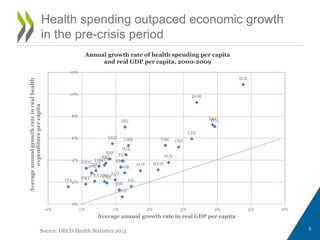
Health spending outpaced economic growth
in the pre-crisis period
Source: OECD Health Statistics 2013 5
Annual growth rate of health spending per capita
and real GDP per capita, 2000-2009
AUS
AUT
BELCAN
CHI
CZE
DEN
EST
FIN
FRA DEU
GRC
HUN
ISL
IRL
ISR
ITA
JPN
KOR
LUX
MEX
NLD
NZL
NOR
POL
PRT
SVK
SVN
ESP
SWE
CHE
GBR
USA
0%
2%
4%
6%
8%
10%
12%
-1% 0% 1% 2% 3% 4% 5% 6%
Averageannualgrowthrateinrealhealth
expenditurepercapita
Average annual growth rate in real GDP per capita
6
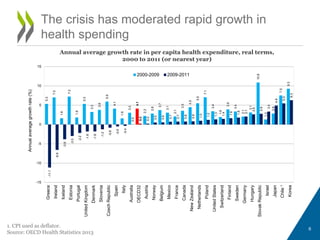
The crisis has moderated rapid growth in
health spending
5.3
7.0
1.6
7.2
1.8
5.3
3.3
3.8
5.9
4.1
1.6
3.0
4.1
2.2
2.8
3.7
3.1
2.1
3.5
4.5
5.5
7.1
3.4
1.9
3.9
3.4
2.1
3.1
10.9
1.3
2.8
7.5
9.3
-11.1
-6.6
-3.8
-3.0
-2.2
-1.8
-1.8
-1.2
-0.8
-0.5
-0.4
0.0
0.2
0.2
0.5
0.6
0.7
0.7
0.8
0.8
1.0
1.2
1.3
1.4
1.6
1.8
2.1
2.6
2.8
3.4
4.9
5.5
6.3
-15
-10
-5
0
5
10
15
Greece
Ireland
Iceland
Estonia
Portugal
UnitedKingdom
Denmark
Slovenia
CzechRepublic
Spain
Italy
Australia
OECD32
Austria
Norway
Belgium
Mexico
France
Canada
NewZealand
Netherlands
Poland
UnitedStates
Switzerland
Finland
Sweden
Germany
Hungary
SlovakRepublic
Israel
Japan
Chile¹
Korea
2000-2009 2009-2011
1. CPI used as deflator.
Source: OECD Health Statistics 2013
Annualaveragegrowthrate(%)
Annual average growth rate in per capita health expenditure, real terms,
2000 to 2011 (or nearest year)
7
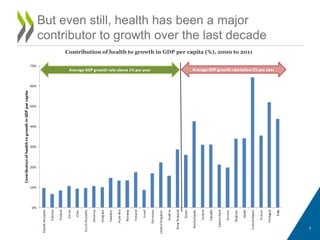
But even still, health has been a major
contributor to growth over the last decade
Contribution of health to growth in GDP per capita (%), 2000 to 2011
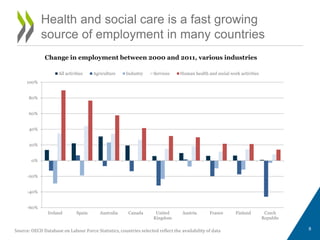
Health and social care is a fast growing
source of employment in many countries
Source: OECD Database on Labour Force Statistics, countries selected reflect the availability of data 8
Change in employment between 2000 and 2011, various industries
-60%
-40%
-20%
0%
20%
40%
60%
80%
100%
Ireland Spain Australia Canada United
Kingdom
Austria France Finland Czech
Republic
All activities Agriculture Industry Services Human health and social work activities
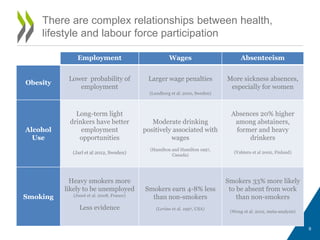
There are complex relationships between health,
lifestyle and labour force participation
Employment Wages Absenteeism
Obesity
Lower probability of
employment
Larger wage penalties
(Lundborg et al. 2010, Sweden)
More sickness absences,
especially for women
Alcohol
Use
Long-term light
drinkers have better
employment
opportunities
(Jarl et al 2012, Sweden)
Moderate drinking
positively associated with
wages
(Hamilton and Hamilton 1997,
Canada)
Absences 20% higher
among abstainers,
former and heavy
drinkers
(Vahtera et al 2002, Finland)
Smoking
Heavy smokers more
likely to be unemployed
(Jusot et al. 2008, France)
Less evidence
Smokers earn 4-8% less
than non-smokers
(Levine et al. 1997, USA)
Smokers 33% more likely
to be absent from work
than non-smokers
(Weng et al. 2012, meta-analysis)
9
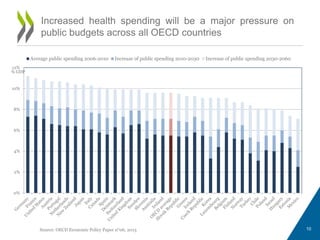
Increased health spending will be a major pressure on
public budgets across all OECD countries
Source: OECD Economic Policy Paper n°06, 2013 10
0%
2%
4%
6%
8%
10%
12%
Average public spending 2006-2010 Increase of public spending 2010-2030 Increase of public spending 2030-2060
% GDP
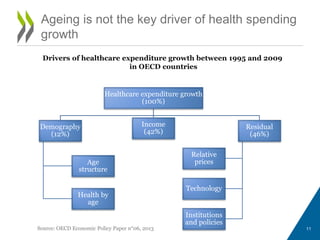
Drivers of healthcare expenditure growth between 1995 and 2009
in OECD countries
Ageing is not the key driver of health spending
growth
Healthcare expenditure growth
(100%)
Demography
(12%)
Age
structure
Health by
age
Income
(42%)
Residual
(46%)
Relative
prices
Technology
Institutions
and policies
Source: OECD Economic Policy Paper n°06, 2013 11
• Implications:
– Intergenerational transfer
– As ageing is not the driver, so we cannot ‘ride out’
health spending by letting budgets run into deficit
– The policy challenges are relative budget priority, the
boundaries of financing, and productivity
What do we mean by fiscal
sustainability?
12
IMF: The capacity of a
government, at least in the
future, to finance its desired
expenditure programs, to
service any debt obligations
[…] and to ensure its solvency.
EU: This considers the ability of the
government to meet the costs of its current
and future debt through future revenues
(Indicator S1). The finite version of the budget
constraint is assessed with reference to a
target date of 2030 and a target level of debt
of 60 % of GDP (Indicator S2)
13
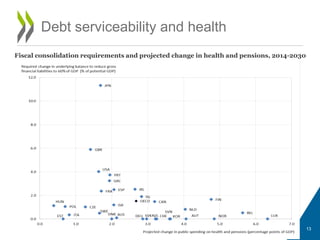
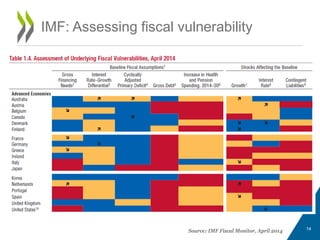
Debt serviceability and health
Fiscal consolidation requirements and projected change in health and pensions, 2014-2030
14
IMF: Assessing fiscal vulnerability
Source: IMF Fiscal Monitor, April 2014
HEALTH IN GOVERNMENT
BUDGETS
15
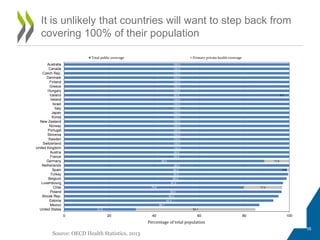
It is unlikely that countries will want to step back from
covering 100% of their population
100.0
100.0
100.0
100.0
100.0
100.0
100.0
99.8
100.0
100.0
100.0
100.0
100.0
100.0
100.0
100.0
100.0
100.0
100.0
100.0
99.9
99.9
88.9
99.9
99.0
99.5
98.8
97.2
79.8
96.6
95.2
92.9
86.7
31.8
0.2
11.0
0.9
17.0
53.1
0 20 40 60 80 100
Australia
Canada
Czech Rep.
Denmark
Finland
Greece
Hungary
Iceland
Ireland
Israel
Italy
Japan
Korea
New Zealand
Norway
Portugal
Slovenia
Sweden
Switzerland
United Kingdom
Austria
France
Germany
Netherlands
Spain
Turkey
Belgium
Luxembourg
Chile
Poland
Slovak Rep.
Estonia
Mexico
United States
Total public coverage Primary private health coverage
Percentage of total population
16
Source: OECD Health Statistics, 2013
17
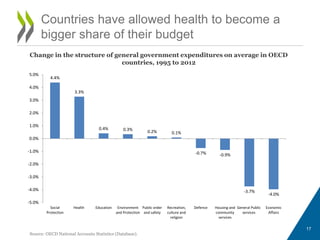
Countries have allowed health to become a
bigger share of their budget
Source: OECD National Accounts Statistics (Database).
Change in the structure of general government expenditures on average in OECD
countries, 1995 to 2012
4.4%
3.3%
0.4% 0.3% 0.2% 0.1%
-0.7% -0.9%
-3.7%
-4.0%
-5.0%
-4.0%
-3.0%
-2.0%
-1.0%
0.0%
1.0%
2.0%
3.0%
4.0%
5.0%
Social
Protection
Health Education Environment
and Protection
Public order
and safety
Recreation,
culture and
religion
Defence Housing and
community
services
General Public
services
Economic
Affairs
0%
10%
20%
30%
40%
50%
60%
70%
80%
90%
100%
Australia
NewZealand
Norway
UnitedKingdom
Sweden
Chile
Hungary
France
Austria
Slovenia
Korea
Poland
Germany
Netherlands
Estonia
Czechrepublic
Slovakrepublic
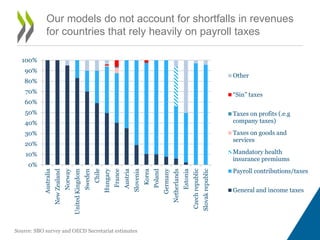
Other
“Sin” taxes
Taxes on profits (.e.g
company taxes)
Taxes on goods and
services
Mandatory health
insurance premiums
Payroll contributions/taxes
General and income taxes
Source: SBO survey and OECD Secretariat estimates
Our models do not account for shortfalls in revenues
for countries that rely heavily on payroll taxes
• ‘Sin taxes’ are increasingly being used by OECD countries
– These taxes target lifestyle choices that can affect
productivity and employment outcomes.
– The arguments for using taxes to attain public health
objectives are strong for tobacco products and alcohol.
– The poor are likely to pay more but have greater health
benefits.
Some new taxes could be effective in improving
health, but will not be major sources of revenue
19
20
Source: Paris et al.,
Measuring coverage
(Forthcoming) from
Busse, Schreyögg et
Gericke, 2007
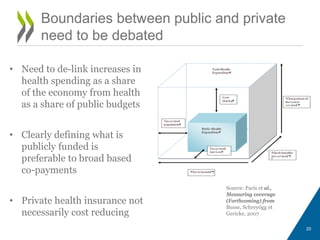
• Need to de-link increases in
health spending as a share
of the economy from health
as a share of public budgets
• Clearly defining what is
publicly funded is
preferable to broad based
co-payments
• Private health insurance not
necessarily cost reducing
Boundaries between public and private
need to be debated
• Be more specific and selective in defining the
range of services covered
• Health systems have become better at assessing
new activities, but this misses most spending:
– Cost effectiveness analysis studies are used to assess
whether a new service or drug should be funded
– A more systematic assessment of therapeutic strategies by
disease should be conducted
• Most countries already have institutions in
charge of the incremental approach
21
A better way to cost share
REDUCING INEFFICIENCY,
IMPROVING PRODUCTIVITY
AND SHIFTING FOCUS
22
23
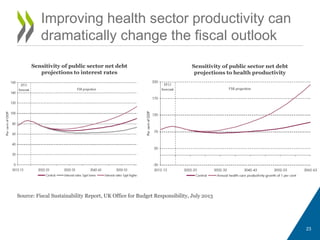
Improving health sector productivity can
dramatically change the fiscal outlook
Sensitivity of public sector net debt
projections to interest rates
Sensitivity of public sector net debt
projections to health productivity
Source: Fiscal Sustainability Report, UK Office for Budget Responsibility, July 2013
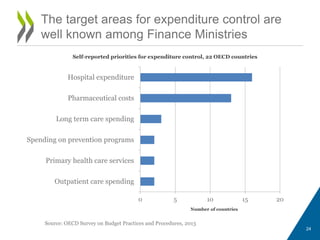
The target areas for expenditure control are
well known among Finance Ministries
24
0 5 10 15 20
Outpatient care spending
Primary health care services
Spending on prevention programs
Long term care spending
Pharmaceutical costs
Hospital expenditure
Source: OECD Survey on Budget Practices and Procedures, 2013
Number of countries
Self-reported priorities for expenditure control, 22 OECD countries
25
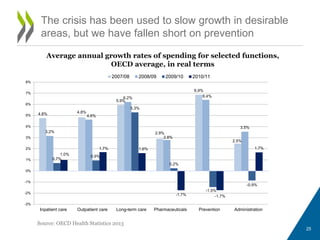
The crisis has been used to slow growth in desirable
areas, but we have fallen short on prevention
4.8% 4.8%
5.9%
2.9%
6.9%
2.5%
3.2%
4.6%
6.2%
2.8%
6.4%
3.5%
0.7%
0.9%
5.3%
0.2%
-1.5%
-0.9%
1.0%
1.7% 1.6%
-1.7% -1.7%
1.7%
-3%
-2%
-1%
0%
1%
2%
3%
4%
5%
6%
7%
8%
Inpatient care Outpatient care Long-term care Pharmaceuticals Prevention Administration
2007/08 2008/09 2009/10 2010/11
Source: OECD Health Statistics 2013
Average annual growth rates of spending for selected functions,
OECD average, in real terms
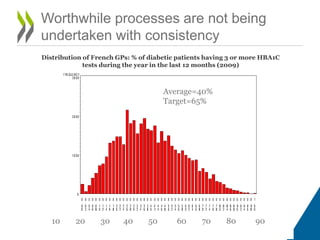
Worthwhile processes are not being
undertaken with consistency
Distribution of French GPs: % of diabetic patients having 3 or more HBA1C
tests during the year in the last 12 months (2009)
Average=40%
Target=65%
10 20 30 40 50 60 70 80 90
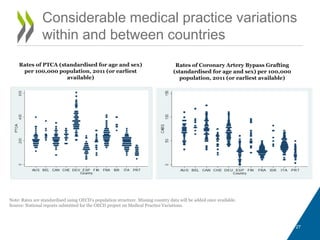
Considerable medical practice variations
within and between countries
27
Note: Rates are standardised using OECD’s population structure. Missing country data will be added once available.
Source: National reports submitted for the OECD project on Medical Practice Variations.
Rates of PTCA (standardised for age and sex)
per 100,000 population, 2011 (or earliest
available)
Rates of Coronary Artery Bypass Grafting
(standardised for age and sex) per 100,000
population, 2011 (or earliest available)
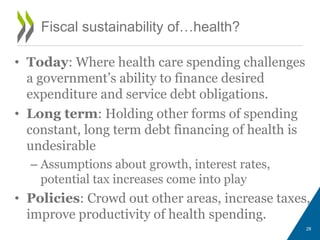
• Today: Where health care spending challenges
a government’s ability to finance desired
expenditure and service debt obligations.
• Long term: Holding other forms of spending
constant, long term debt financing of health is
undesirable
– Assumptions about growth, interest rates,
potential tax increases come into play
• Policies: Crowd out other areas, increase taxes,
improve productivity of health spending.
28
Fiscal sustainability of…health?
WHAT IS THE ‘FISCAL
SUSTAINABILITY’ OF
HEALTH?
3rd Annual Meeting of the Joint Network on Fiscal
Sustainability of Health Systems
24 April 2014
Ankit Kumar
OECD Secretariat

DELSA/GOV Health - Session 1 - Ankit Kumar - oecd

  • 1.
    WHAT IS THE‘FISCAL SUSTAINABILITY’ OF HEALTH? 3rd Annual Meeting of the Joint Network on Fiscal Sustainability of Health Systems 24 April 2014 Ankit Kumar OECD Secretariat
  • 2.
    1. Health spendingis likely to continue to grow as a share of the economy 2. This will demand a public budget response: – Accommodating for greater health spending as a share of government budgets may not be a bad thing – Considerable scope to increase productivity in health 3. In the long term, we may need to de-link the correlation between health as a share of budgets and health as a share of the economy 2 Key points
  • 3.
    • The generaland not the specific case • Bias towards high income OECD countries • Economic sustainability not accounting balance 3 Caveats and clarifications
  • 4.
  • 5.
    Health spending outpacedeconomic growth in the pre-crisis period Source: OECD Health Statistics 2013 5 Annual growth rate of health spending per capita and real GDP per capita, 2000-2009 AUS AUT BELCAN CHI CZE DEN EST FIN FRA DEU GRC HUN ISL IRL ISR ITA JPN KOR LUX MEX NLD NZL NOR POL PRT SVK SVN ESP SWE CHE GBR USA 0% 2% 4% 6% 8% 10% 12% -1% 0% 1% 2% 3% 4% 5% 6% Averageannualgrowthrateinrealhealth expenditurepercapita Average annual growth rate in real GDP per capita
  • 6.
    6 The crisis hasmoderated rapid growth in health spending 5.3 7.0 1.6 7.2 1.8 5.3 3.3 3.8 5.9 4.1 1.6 3.0 4.1 2.2 2.8 3.7 3.1 2.1 3.5 4.5 5.5 7.1 3.4 1.9 3.9 3.4 2.1 3.1 10.9 1.3 2.8 7.5 9.3 -11.1 -6.6 -3.8 -3.0 -2.2 -1.8 -1.8 -1.2 -0.8 -0.5 -0.4 0.0 0.2 0.2 0.5 0.6 0.7 0.7 0.8 0.8 1.0 1.2 1.3 1.4 1.6 1.8 2.1 2.6 2.8 3.4 4.9 5.5 6.3 -15 -10 -5 0 5 10 15 Greece Ireland Iceland Estonia Portugal UnitedKingdom Denmark Slovenia CzechRepublic Spain Italy Australia OECD32 Austria Norway Belgium Mexico France Canada NewZealand Netherlands Poland UnitedStates Switzerland Finland Sweden Germany Hungary SlovakRepublic Israel Japan Chile¹ Korea 2000-2009 2009-2011 1. CPI used as deflator. Source: OECD Health Statistics 2013 Annualaveragegrowthrate(%) Annual average growth rate in per capita health expenditure, real terms, 2000 to 2011 (or nearest year)
  • 7.
    7 But even still,health has been a major contributor to growth over the last decade Contribution of health to growth in GDP per capita (%), 2000 to 2011
  • 8.
    Health and socialcare is a fast growing source of employment in many countries Source: OECD Database on Labour Force Statistics, countries selected reflect the availability of data 8 Change in employment between 2000 and 2011, various industries -60% -40% -20% 0% 20% 40% 60% 80% 100% Ireland Spain Australia Canada United Kingdom Austria France Finland Czech Republic All activities Agriculture Industry Services Human health and social work activities
  • 9.
    There are complexrelationships between health, lifestyle and labour force participation Employment Wages Absenteeism Obesity Lower probability of employment Larger wage penalties (Lundborg et al. 2010, Sweden) More sickness absences, especially for women Alcohol Use Long-term light drinkers have better employment opportunities (Jarl et al 2012, Sweden) Moderate drinking positively associated with wages (Hamilton and Hamilton 1997, Canada) Absences 20% higher among abstainers, former and heavy drinkers (Vahtera et al 2002, Finland) Smoking Heavy smokers more likely to be unemployed (Jusot et al. 2008, France) Less evidence Smokers earn 4-8% less than non-smokers (Levine et al. 1997, USA) Smokers 33% more likely to be absent from work than non-smokers (Weng et al. 2012, meta-analysis) 9
  • 10.
    Increased health spendingwill be a major pressure on public budgets across all OECD countries Source: OECD Economic Policy Paper n°06, 2013 10 0% 2% 4% 6% 8% 10% 12% Average public spending 2006-2010 Increase of public spending 2010-2030 Increase of public spending 2030-2060 % GDP
  • 11.
    Drivers of healthcareexpenditure growth between 1995 and 2009 in OECD countries Ageing is not the key driver of health spending growth Healthcare expenditure growth (100%) Demography (12%) Age structure Health by age Income (42%) Residual (46%) Relative prices Technology Institutions and policies Source: OECD Economic Policy Paper n°06, 2013 11
  • 12.
    • Implications: – Intergenerationaltransfer – As ageing is not the driver, so we cannot ‘ride out’ health spending by letting budgets run into deficit – The policy challenges are relative budget priority, the boundaries of financing, and productivity What do we mean by fiscal sustainability? 12 IMF: The capacity of a government, at least in the future, to finance its desired expenditure programs, to service any debt obligations […] and to ensure its solvency. EU: This considers the ability of the government to meet the costs of its current and future debt through future revenues (Indicator S1). The finite version of the budget constraint is assessed with reference to a target date of 2030 and a target level of debt of 60 % of GDP (Indicator S2)
  • 13.
    13 Debt serviceability andhealth Fiscal consolidation requirements and projected change in health and pensions, 2014-2030
  • 14.
    14 IMF: Assessing fiscalvulnerability Source: IMF Fiscal Monitor, April 2014
  • 15.
  • 16.
    It is unlikelythat countries will want to step back from covering 100% of their population 100.0 100.0 100.0 100.0 100.0 100.0 100.0 99.8 100.0 100.0 100.0 100.0 100.0 100.0 100.0 100.0 100.0 100.0 100.0 100.0 99.9 99.9 88.9 99.9 99.0 99.5 98.8 97.2 79.8 96.6 95.2 92.9 86.7 31.8 0.2 11.0 0.9 17.0 53.1 0 20 40 60 80 100 Australia Canada Czech Rep. Denmark Finland Greece Hungary Iceland Ireland Israel Italy Japan Korea New Zealand Norway Portugal Slovenia Sweden Switzerland United Kingdom Austria France Germany Netherlands Spain Turkey Belgium Luxembourg Chile Poland Slovak Rep. Estonia Mexico United States Total public coverage Primary private health coverage Percentage of total population 16 Source: OECD Health Statistics, 2013
  • 17.
    17 Countries have allowedhealth to become a bigger share of their budget Source: OECD National Accounts Statistics (Database). Change in the structure of general government expenditures on average in OECD countries, 1995 to 2012 4.4% 3.3% 0.4% 0.3% 0.2% 0.1% -0.7% -0.9% -3.7% -4.0% -5.0% -4.0% -3.0% -2.0% -1.0% 0.0% 1.0% 2.0% 3.0% 4.0% 5.0% Social Protection Health Education Environment and Protection Public order and safety Recreation, culture and religion Defence Housing and community services General Public services Economic Affairs
  • 18.
    0% 10% 20% 30% 40% 50% 60% 70% 80% 90% 100% Australia NewZealand Norway UnitedKingdom Sweden Chile Hungary France Austria Slovenia Korea Poland Germany Netherlands Estonia Czechrepublic Slovakrepublic Other “Sin” taxes Taxes onprofits (.e.g company taxes) Taxes on goods and services Mandatory health insurance premiums Payroll contributions/taxes General and income taxes Source: SBO survey and OECD Secretariat estimates Our models do not account for shortfalls in revenues for countries that rely heavily on payroll taxes
  • 19.
    • ‘Sin taxes’are increasingly being used by OECD countries – These taxes target lifestyle choices that can affect productivity and employment outcomes. – The arguments for using taxes to attain public health objectives are strong for tobacco products and alcohol. – The poor are likely to pay more but have greater health benefits. Some new taxes could be effective in improving health, but will not be major sources of revenue 19
  • 20.
    20 Source: Paris etal., Measuring coverage (Forthcoming) from Busse, Schreyögg et Gericke, 2007 • Need to de-link increases in health spending as a share of the economy from health as a share of public budgets • Clearly defining what is publicly funded is preferable to broad based co-payments • Private health insurance not necessarily cost reducing Boundaries between public and private need to be debated
  • 21.
    • Be morespecific and selective in defining the range of services covered • Health systems have become better at assessing new activities, but this misses most spending: – Cost effectiveness analysis studies are used to assess whether a new service or drug should be funded – A more systematic assessment of therapeutic strategies by disease should be conducted • Most countries already have institutions in charge of the incremental approach 21 A better way to cost share
  • 22.
  • 23.
    23 Improving health sectorproductivity can dramatically change the fiscal outlook Sensitivity of public sector net debt projections to interest rates Sensitivity of public sector net debt projections to health productivity Source: Fiscal Sustainability Report, UK Office for Budget Responsibility, July 2013
  • 24.
    The target areasfor expenditure control are well known among Finance Ministries 24 0 5 10 15 20 Outpatient care spending Primary health care services Spending on prevention programs Long term care spending Pharmaceutical costs Hospital expenditure Source: OECD Survey on Budget Practices and Procedures, 2013 Number of countries Self-reported priorities for expenditure control, 22 OECD countries
  • 25.
    25 The crisis hasbeen used to slow growth in desirable areas, but we have fallen short on prevention 4.8% 4.8% 5.9% 2.9% 6.9% 2.5% 3.2% 4.6% 6.2% 2.8% 6.4% 3.5% 0.7% 0.9% 5.3% 0.2% -1.5% -0.9% 1.0% 1.7% 1.6% -1.7% -1.7% 1.7% -3% -2% -1% 0% 1% 2% 3% 4% 5% 6% 7% 8% Inpatient care Outpatient care Long-term care Pharmaceuticals Prevention Administration 2007/08 2008/09 2009/10 2010/11 Source: OECD Health Statistics 2013 Average annual growth rates of spending for selected functions, OECD average, in real terms
  • 26.
    Worthwhile processes arenot being undertaken with consistency Distribution of French GPs: % of diabetic patients having 3 or more HBA1C tests during the year in the last 12 months (2009) Average=40% Target=65% 10 20 30 40 50 60 70 80 90
  • 27.
    Considerable medical practicevariations within and between countries 27 Note: Rates are standardised using OECD’s population structure. Missing country data will be added once available. Source: National reports submitted for the OECD project on Medical Practice Variations. Rates of PTCA (standardised for age and sex) per 100,000 population, 2011 (or earliest available) Rates of Coronary Artery Bypass Grafting (standardised for age and sex) per 100,000 population, 2011 (or earliest available)
  • 28.
    • Today: Wherehealth care spending challenges a government’s ability to finance desired expenditure and service debt obligations. • Long term: Holding other forms of spending constant, long term debt financing of health is undesirable – Assumptions about growth, interest rates, potential tax increases come into play • Policies: Crowd out other areas, increase taxes, improve productivity of health spending. 28 Fiscal sustainability of…health?
  • 29.
    WHAT IS THE‘FISCAL SUSTAINABILITY’ OF HEALTH? 3rd Annual Meeting of the Joint Network on Fiscal Sustainability of Health Systems 24 April 2014 Ankit Kumar OECD Secretariat