Program Five P (Big Brothers Big Sisters)
What is Five P? Social preventive leisure time program It is focus on: Friendship  ( P řátelství) Support  ( P odpora) Prevention  ( P revence) Care  ( P éče) Help  ( P omoc) to children, who may profit from relationship  with adult friend
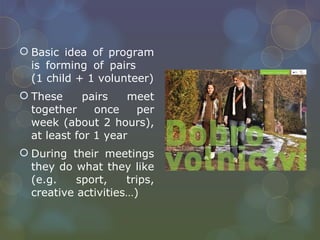
Basic idea of program is forming of pairs  (1 child + 1 volunteer) These pairs meet together once per week (about 2 hours), at least for 1 year During their meetings they do what they like (e.g. sport, trips, creative activities…)
Target group Children in age 7 – 15 let Disadvantaged E.g.:  Social disadvantaged family Disabled Troubles in school (with studying, bullying) Different etnic group After traumatic experience (divorce, death) Non-independent, distrustful
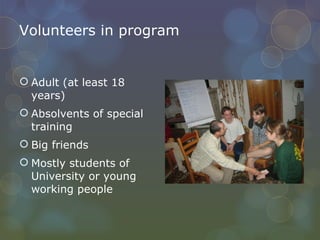
Volunteers in program Adult (at least 18 years) Absolvents of special training Big friends Mostly students of University or young working people
Activities of program Searching of participants – children, volunteers (including interviews) Training of volunteers with experts  (and their screening) Making pairs First meeting family with volunteer and me (introducing, contract, individual plan) Regularly meetings of pairs
Supervision for volunteers (1 x 6 months) Regularly contact with participants Common actions for all our children and their volunteers (trips, excursions…) Supervision for children (1 per a year) Education training for volunteers Evaluation (at least one per 6 months)
Results Program 5P helps children in these spheres: Self-confidence Interest in new things (hobbies) Ability to express feelings Better in decision making Independence School results New friends
Program Compass
What is Compass? Social preventive leisure time program It is focus on: Comunication  ( Kom unikace) Partnership  ( Pa rtnerství) Cooperation  ( S polupráce) COMPASS ® obtained from the Industrial   Property Office ® trademark and it is the intellectual property of the Volunteer Center.
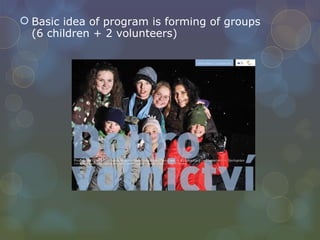
Basic idea of program is forming of groups  (6 children + 2 volunteers)
These groups meet together once per week (about 2 hours), for 4 - 5 months.  During their meetings they do what they like (e.g. sport, trips, creative activities…) It is for children who can benefit from friendship, relationships in a small goup of six children and two adults.
Target group Children in age 7 – 15 let Disadvantaged E.g.:  Social disadvantaged family Disabled Troubles in school (with studying, bullying) Different etnic group After traumatic experience (divorce, death) Non-independent, distrustful
Volunteers in program Adult (at least 18 years or 17 years) Absolvents of special training Big friends – leaders of groups Mostly students of high school Every group has support team of volunteers
Activities of program Searching of participants – children, volunteers (including interviews, plans) Training of volunteers with experts (and their screening) Making groups (usually 3 in spring and 3 in autumn) Starting meeting of each group (introducing, contract, harmonogram)
Regularly meetings of each group (every week in the same day and time) Supervision for volunteers (1 x 6 months) Regularly contact with participants Common actions for all our children and their volunteers Education training for volunteers Evaluation (in half of program, in the end)
Results Development of values like respect, friendship Children are better in cooperation, conflicts solution, in communication with each other and so on Children are more assertive They teach following the rules and accepting other views
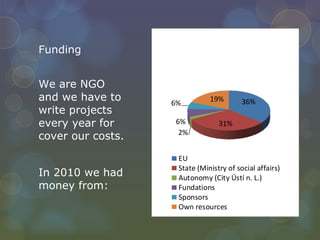
Funding We are NGO and we have to write projects every year for cover our costs. In 2010 we had money from:
Thank you for your attention 

Czech rep.good practices 5 p and kompas

  • 1.
    Program Five P(Big Brothers Big Sisters)
  • 2.
    What is FiveP? Social preventive leisure time program It is focus on: Friendship ( P řátelství) Support ( P odpora) Prevention ( P revence) Care ( P éče) Help ( P omoc) to children, who may profit from relationship with adult friend
  • 3.
    Basic idea ofprogram is forming of pairs (1 child + 1 volunteer) These pairs meet together once per week (about 2 hours), at least for 1 year During their meetings they do what they like (e.g. sport, trips, creative activities…)
  • 4.
    Target group Childrenin age 7 – 15 let Disadvantaged E.g.: Social disadvantaged family Disabled Troubles in school (with studying, bullying) Different etnic group After traumatic experience (divorce, death) Non-independent, distrustful
  • 5.
    Volunteers in programAdult (at least 18 years) Absolvents of special training Big friends Mostly students of University or young working people
  • 6.
    Activities of programSearching of participants – children, volunteers (including interviews) Training of volunteers with experts (and their screening) Making pairs First meeting family with volunteer and me (introducing, contract, individual plan) Regularly meetings of pairs
  • 7.
    Supervision for volunteers(1 x 6 months) Regularly contact with participants Common actions for all our children and their volunteers (trips, excursions…) Supervision for children (1 per a year) Education training for volunteers Evaluation (at least one per 6 months)
  • 8.
    Results Program 5Phelps children in these spheres: Self-confidence Interest in new things (hobbies) Ability to express feelings Better in decision making Independence School results New friends
  • 9.
  • 10.
    What is Compass?Social preventive leisure time program It is focus on: Comunication ( Kom unikace) Partnership ( Pa rtnerství) Cooperation ( S polupráce) COMPASS ® obtained from the Industrial Property Office ® trademark and it is the intellectual property of the Volunteer Center.
  • 11.
    Basic idea ofprogram is forming of groups (6 children + 2 volunteers)
  • 12.
    These groups meettogether once per week (about 2 hours), for 4 - 5 months. During their meetings they do what they like (e.g. sport, trips, creative activities…) It is for children who can benefit from friendship, relationships in a small goup of six children and two adults.
  • 13.
    Target group Childrenin age 7 – 15 let Disadvantaged E.g.: Social disadvantaged family Disabled Troubles in school (with studying, bullying) Different etnic group After traumatic experience (divorce, death) Non-independent, distrustful
  • 14.
    Volunteers in programAdult (at least 18 years or 17 years) Absolvents of special training Big friends – leaders of groups Mostly students of high school Every group has support team of volunteers
  • 15.
    Activities of programSearching of participants – children, volunteers (including interviews, plans) Training of volunteers with experts (and their screening) Making groups (usually 3 in spring and 3 in autumn) Starting meeting of each group (introducing, contract, harmonogram)
  • 16.
    Regularly meetings ofeach group (every week in the same day and time) Supervision for volunteers (1 x 6 months) Regularly contact with participants Common actions for all our children and their volunteers Education training for volunteers Evaluation (in half of program, in the end)
  • 17.
    Results Development ofvalues like respect, friendship Children are better in cooperation, conflicts solution, in communication with each other and so on Children are more assertive They teach following the rules and accepting other views
  • 18.
    Funding We areNGO and we have to write projects every year for cover our costs. In 2010 we had money from:
  • 19.
    Thank you foryour attention 