Cyrano de Bergerac

 By Edmond Rostand
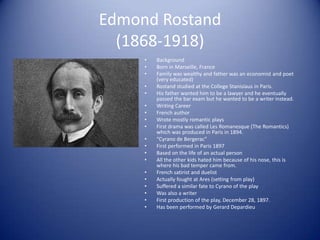
Edmond Rostand
  (1868-1918)
     •   Background
     •   Born in Marseille, France
     •   Family was wealthy and father was an economist and poet
         (very educated)
     •   Rostand studied at the College Stanislaus in Paris.
     •   His father wanted him to be a lawyer and he eventually
         passed the bar exam but he wanted to be a writer instead.
     •   Writing Career
     •   French author
     •   Wrote mostly romantic plays
     •   First drama was called Les Romanesque (The Romantics)
         which was produced in Paris in 1894.
     •   “Cyrano de Bergerac”
     •   First performed in Paris 1897
     •   Based on the life of an actual person
     •   All the other kids hated him because of his nose, this is
         where his bad temper came from.
     •   French satirist and duelist
     •   Actually fought at Ares (setting from play)
     •   Suffered a similar fate to Cyrano of the play
     •   Was also a writer
     •   First production of the play, December 28, 1897.
     •   Has been performed by Gerard Depardieu
Tragedy vs. Comedy
Tragedy: literature in which the   Comedy: literature which deals
hero is destroyed by some tragic   with life in a light, humorous
flaw within his/her character      way, often poking fun at people’s
                                   mistakes
Literary Elements

         • Literary elements
           are most
           frequently used to
           aid discussion on a
           work or better
           understand a work
           of literature.
SUSPENSE
• DESCREPENCY BETWEEN
IRONY                                      WHAT IS SAID AND WHAT
Verbal Irony:                              IS MEANT


Situational Irony:


Dramatic Irony: Audience knows from 1st act that Roxane was attracted to Christian.
Cyrano, however, does not know this and makes assumptions about why Roxane wants
to meet with him.
•   Ex: 2 persons in play wore a mask
Imagery                                   •   Roxane when visiting Cyrano at Ragueneau’s
                                              pastry shop (Act II) and DeGuiche when he
                                              comes to pick up Roxane for the convent (Act
Use of details to create a mental image
                                              III). . . Each are wearing them so they will not
Not only visual but sensational
                                              be seen, however they too are blinded by the
                                              mask at seeing how the person feels right in
                                              front of them.
                                          •   Ex: dueling imagery – physical, yes but also
                                              mixed with language of a duel with images of
                                              pursuit, retreat, victory and defeat
                                          •   Ex: pg 30
                                          •   Ex: pg 36 – “Ah, do you love the little birds?”
• Food & Drink – Poetic Puff-Pastry
IMAGERY CONTINUED   • Mask (Act II) – Roxanne cannot see
                      that Cyrano loves her (she shows up
                      at Rageneau’s wearing a mask)
Characterization
MAJOR CHARACTERS
• PROTAGONIST: The main             • Major characters are almost
       character in the story.        always round or three-
                                      dimensional characters who have
• ANTAGONIST: The character           good and bad qualities. Their
  or force that opposes the           goals, ambitions, and values
       protagonist.                   change. A round character
• FOIL: A character who               changes as a result of what
       provides a contrast (often     happens to him/her. A character
       through highlighting           who changes inside as a result of
       comparisons) to                what happens to him referred to
                                      in literature as a DYNAMIC
       the protagonist in order       character. A dynamic character
       highlight protaganist’s        grows or progresses to a higher
       characteristics. (AKA          level of understanding in the
       Sidekick)                      course of the story.
Metaphor
• By definition a           • Cyrano personifies his
  metaphor is an image        sword (Act I when he
  or thing used to            “takes his sword by the
  represent an intangible     nape and draw out it’s
  or idea                     form”@ the Hotel
                              Burgoine
• Hyperbole is type of
  metaphor, ex. Pg 37,
  “When you light your
  pipe . . . “
HYPERBOLE
Page 37
•
  When you light your pipe . .
  Neighbors think it is a
  chimney.
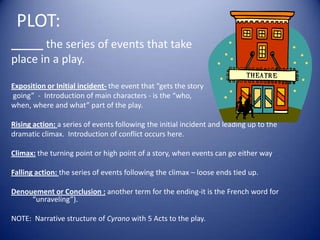
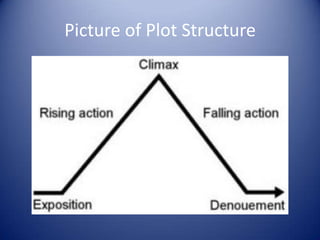
PLOT:
       the series of events that take
place in a play.

Exposition or Initial incident- the event that “gets the story
going” - Introduction of main characters - is the “who,
when, where and what” part of the play.

Rising action: a series of events following the initial incident and leading up to the
dramatic climax. Introduction of conflict occurs here.

Climax: the turning point or high point of a story, when events can go either way

Falling action: the series of events following the climax – loose ends tied up.

Denouement or Conclusion : another term for the ending-it is the French word for
     “unraveling”).

NOTE: Narrative structure of Cyrano with 5 Acts to the play.
Picture of Plot Structure
Conflict
           (5 Universal categories)
•   1) Man against Man
•   2) Man against Society
•   3) Man against Himself
•   4) Man against Nature
•   5) Person against Fate (God)
Man against Society
• A character has a conflict or problem with
  society – the school, the law, the tradition
Man against Himself
• A character struggles inside and has trouble
  deciding what to do
Man against nature
• A character has a problem with some element
  of nature: a snowstorm avalanche, etc.
Person against Fate (God)
• A character has to battle what seems to be an
  uncontrollable problem.

• http://video.aol.com/aolvideo/moviefone/clas
  h-of-the-titans-trailer-no-2/60458686001
Symbolism
In writing, symbolism is the use of a
  word, phrase or description, which
  represents a deeper meaning than
  the words themselves.
• Cyrano’s nose
   – His nose is the barrier between him and
     love.
   – This is the barrier that keeps him from
     telling Roxane he loves her
• The Moon
   –Ex: Act III – moon is the happy fantasy
    of Cyrano as he pretends to be a
    drunken madman that believes he has
    fallen from the sky.
   –Ex: Act V – it is his desired destination
    after death . . . He can chill with other
    awesome dead guys like Socrates and
    Galileo
• The White Plume
   – Ex: Act IV: The plume is a mark of military
     rank and a target for enemy guns. The fact
     that de Guiche threw his away in the heat
     of battle means he is a coward. The fact
     that Cyrano picks it up is symbolic of his
     courage, loyalty, commitment to the
     Gascoyne Guards and honor. He speaks of
     this plume shortly before he dies in the
     final act.
• Tears and Blood – Act V Roxanne reads Christian’s
  dying letter and it is stained with blood from
  Christian and Cyrano’s tears. Cyrano represents
  the emotional half of the man that Roxane has
  fallen in love with, while Christian represents the
  physical. At the end of the play, Roxane declares
  that the tears were Cyrano’s and he counters with
  a reminder that the blood was Christian’s. i.e.
  both men were pivotal in winning the love of
  Roxane
• Letters – symbol of deception and love –
  Cyrano is able to hide his identity while at the
  same time expressing his true feelings.
Allusion
• a brief reference, explicit or indirect, to a
  person, place or event, or to another literary
  work or passage

     • Example: Act I - Cuigy wittingly claims that Cyrano’s
       name is d’Artagnan (a hero of Alexandre Dumas’s novel
       written 200 years after the time in which Cyrano de
       Bergerac is set) . . . Later LeBret admonishes Cyrano to
       stop trying to be three musketeers in one.
• 1. Samson/jawbone

   – But when he is brought to them
     the spirit of the Lord come upon
     him; he bursts his bonds and slays
     a thousand Philistines with the
     jawbone of an ass.A, he is revived
     by a spring of water which the Lord
     causes to flow from the jawbone.
     Later while Samson come upon
     him; he bursts his bonds and slays
     a thousand Philistines with the
     jawbone of an ass. Being thirsty
     after this exploit, he is revived by a
     spring of water which the Lord
     causes to flow from the jawbone.
     Later while Samson
2954063
Punctuatio
2954051
A few
2954062
Distracting
2954050
2954061
2954049
2954060
Writing
2954048
2954059
Logical pr
2954047
Organizati
2954058
No errors
2954046
Action/poi
2954057
Well is
2954045
There are
2954056
Detailsare
2954044
Extremely
2954055
2954043
Introductio
2954054
Backgroun
2954042
Excellent
2954053
Good erro
2954041
Fairdiscern
2954052
Poor deve
2954040
Discuss this rubric
               Tragedy vs.. Comedy (Genre)
    • At times, it’s easy to see that Cyrano is a comedy;
      it’s outlandish, hilarious, features clever verbal
      sparring and over–the-top wit. At other times, it
      seems dark; there is death, thwarted love,
      revenge, etc. The thing to remember is that this
      dark stuff isn’t so much tragic. Just look at
      Roxane’s depiction of getting through the enemy
      Spanish lines, or Cyrano’s absurdly grandiose
      speeches on his deathbed. These moments
      aren’t supposed to be tragic, but rather comic in
      their exaggerations.
Theme
– The fundamental and often universal ideas
  explored in a literary work. The underlying
  meaning of the story, a.k.a moral.
•   Values & Virtue
•   Inner & Outer Beauty
•   The Danger in Deception
•   Love

Cyrano de bergerac

  • 1.
    Cyrano de Bergerac By Edmond Rostand
  • 2.
    Edmond Rostand (1868-1918) • Background • Born in Marseille, France • Family was wealthy and father was an economist and poet (very educated) • Rostand studied at the College Stanislaus in Paris. • His father wanted him to be a lawyer and he eventually passed the bar exam but he wanted to be a writer instead. • Writing Career • French author • Wrote mostly romantic plays • First drama was called Les Romanesque (The Romantics) which was produced in Paris in 1894. • “Cyrano de Bergerac” • First performed in Paris 1897 • Based on the life of an actual person • All the other kids hated him because of his nose, this is where his bad temper came from. • French satirist and duelist • Actually fought at Ares (setting from play) • Suffered a similar fate to Cyrano of the play • Was also a writer • First production of the play, December 28, 1897. • Has been performed by Gerard Depardieu
  • 3.
    Tragedy vs. Comedy Tragedy:literature in which the Comedy: literature which deals hero is destroyed by some tragic with life in a light, humorous flaw within his/her character way, often poking fun at people’s mistakes
  • 4.
    Literary Elements • Literary elements are most frequently used to aid discussion on a work or better understand a work of literature.
  • 5.
  • 6.
    • DESCREPENCY BETWEEN IRONY WHAT IS SAID AND WHAT Verbal Irony: IS MEANT Situational Irony: Dramatic Irony: Audience knows from 1st act that Roxane was attracted to Christian. Cyrano, however, does not know this and makes assumptions about why Roxane wants to meet with him.
  • 7.
    Ex: 2 persons in play wore a mask Imagery • Roxane when visiting Cyrano at Ragueneau’s pastry shop (Act II) and DeGuiche when he comes to pick up Roxane for the convent (Act Use of details to create a mental image III). . . Each are wearing them so they will not Not only visual but sensational be seen, however they too are blinded by the mask at seeing how the person feels right in front of them. • Ex: dueling imagery – physical, yes but also mixed with language of a duel with images of pursuit, retreat, victory and defeat • Ex: pg 30 • Ex: pg 36 – “Ah, do you love the little birds?”
  • 8.
    • Food &Drink – Poetic Puff-Pastry IMAGERY CONTINUED • Mask (Act II) – Roxanne cannot see that Cyrano loves her (she shows up at Rageneau’s wearing a mask)
  • 9.
    Characterization MAJOR CHARACTERS • PROTAGONIST:The main • Major characters are almost character in the story. always round or three- dimensional characters who have • ANTAGONIST: The character good and bad qualities. Their or force that opposes the goals, ambitions, and values protagonist. change. A round character • FOIL: A character who changes as a result of what provides a contrast (often happens to him/her. A character through highlighting who changes inside as a result of comparisons) to what happens to him referred to in literature as a DYNAMIC the protagonist in order character. A dynamic character highlight protaganist’s grows or progresses to a higher characteristics. (AKA level of understanding in the Sidekick) course of the story.
  • 10.
    Metaphor • By definitiona • Cyrano personifies his metaphor is an image sword (Act I when he or thing used to “takes his sword by the represent an intangible nape and draw out it’s or idea form”@ the Hotel Burgoine • Hyperbole is type of metaphor, ex. Pg 37, “When you light your pipe . . . “
  • 11.
    HYPERBOLE Page 37 • When you light your pipe . . Neighbors think it is a chimney.
  • 12.
    PLOT: the series of events that take place in a play. Exposition or Initial incident- the event that “gets the story going” - Introduction of main characters - is the “who, when, where and what” part of the play. Rising action: a series of events following the initial incident and leading up to the dramatic climax. Introduction of conflict occurs here. Climax: the turning point or high point of a story, when events can go either way Falling action: the series of events following the climax – loose ends tied up. Denouement or Conclusion : another term for the ending-it is the French word for “unraveling”). NOTE: Narrative structure of Cyrano with 5 Acts to the play.
  • 13.
    Picture of PlotStructure
  • 14.
    Conflict (5 Universal categories) • 1) Man against Man • 2) Man against Society • 3) Man against Himself • 4) Man against Nature • 5) Person against Fate (God)
  • 15.
    Man against Society •A character has a conflict or problem with society – the school, the law, the tradition
  • 16.
    Man against Himself •A character struggles inside and has trouble deciding what to do
  • 17.
    Man against nature •A character has a problem with some element of nature: a snowstorm avalanche, etc.
  • 18.
    Person against Fate(God) • A character has to battle what seems to be an uncontrollable problem. • http://video.aol.com/aolvideo/moviefone/clas h-of-the-titans-trailer-no-2/60458686001
  • 19.
    Symbolism In writing, symbolismis the use of a word, phrase or description, which represents a deeper meaning than the words themselves. • Cyrano’s nose – His nose is the barrier between him and love. – This is the barrier that keeps him from telling Roxane he loves her
  • 20.
    • The Moon –Ex: Act III – moon is the happy fantasy of Cyrano as he pretends to be a drunken madman that believes he has fallen from the sky. –Ex: Act V – it is his desired destination after death . . . He can chill with other awesome dead guys like Socrates and Galileo
  • 21.
    • The WhitePlume – Ex: Act IV: The plume is a mark of military rank and a target for enemy guns. The fact that de Guiche threw his away in the heat of battle means he is a coward. The fact that Cyrano picks it up is symbolic of his courage, loyalty, commitment to the Gascoyne Guards and honor. He speaks of this plume shortly before he dies in the final act.
  • 22.
    • Tears andBlood – Act V Roxanne reads Christian’s dying letter and it is stained with blood from Christian and Cyrano’s tears. Cyrano represents the emotional half of the man that Roxane has fallen in love with, while Christian represents the physical. At the end of the play, Roxane declares that the tears were Cyrano’s and he counters with a reminder that the blood was Christian’s. i.e. both men were pivotal in winning the love of Roxane
  • 23.
    • Letters –symbol of deception and love – Cyrano is able to hide his identity while at the same time expressing his true feelings.
  • 24.
    Allusion • a briefreference, explicit or indirect, to a person, place or event, or to another literary work or passage • Example: Act I - Cuigy wittingly claims that Cyrano’s name is d’Artagnan (a hero of Alexandre Dumas’s novel written 200 years after the time in which Cyrano de Bergerac is set) . . . Later LeBret admonishes Cyrano to stop trying to be three musketeers in one.
  • 25.
    • 1. Samson/jawbone – But when he is brought to them the spirit of the Lord come upon him; he bursts his bonds and slays a thousand Philistines with the jawbone of an ass.A, he is revived by a spring of water which the Lord causes to flow from the jawbone. Later while Samson come upon him; he bursts his bonds and slays a thousand Philistines with the jawbone of an ass. Being thirsty after this exploit, he is revived by a spring of water which the Lord causes to flow from the jawbone. Later while Samson
  • 26.
    2954063 Punctuatio 2954051 A few 2954062 Distracting 2954050 2954061 2954049 2954060 Writing 2954048 2954059 Logical pr 2954047 Organizati 2954058 Noerrors 2954046 Action/poi 2954057 Well is 2954045 There are 2954056 Detailsare 2954044 Extremely 2954055 2954043 Introductio 2954054 Backgroun 2954042 Excellent 2954053 Good erro 2954041 Fairdiscern 2954052 Poor deve 2954040 Discuss this rubric Tragedy vs.. Comedy (Genre) • At times, it’s easy to see that Cyrano is a comedy; it’s outlandish, hilarious, features clever verbal sparring and over–the-top wit. At other times, it seems dark; there is death, thwarted love, revenge, etc. The thing to remember is that this dark stuff isn’t so much tragic. Just look at Roxane’s depiction of getting through the enemy Spanish lines, or Cyrano’s absurdly grandiose speeches on his deathbed. These moments aren’t supposed to be tragic, but rather comic in their exaggerations.
  • 27.
    Theme – The fundamentaland often universal ideas explored in a literary work. The underlying meaning of the story, a.k.a moral.
  • 28.
    Values & Virtue • Inner & Outer Beauty • The Danger in Deception • Love